Recognition: 1 theorem link
Dynamic Mechanical Response of Spinodal Architectures Across Length and Time Scales
Pith reviewed 2026-05-08 19:18 UTC · model grok-4.3
The pith
Macroscale spinodal architected materials exhibit nearly tenfold strength increase at high strain rates due to inertia, unlike microscale specimens.
A machine-rendered reading of the paper's core claim, the machinery that carries it, and where it could break.
Core claim
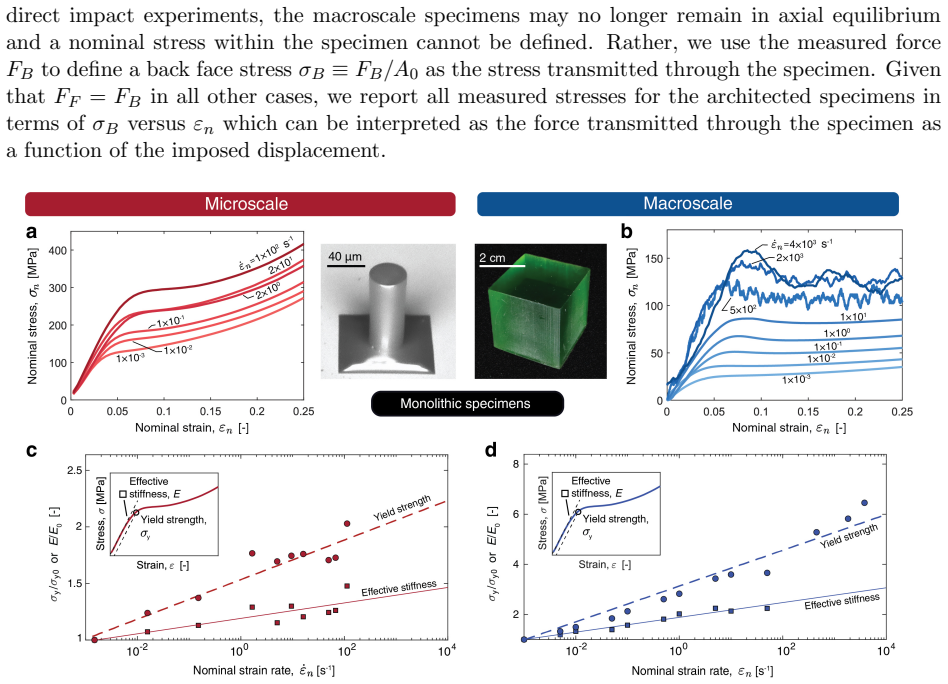
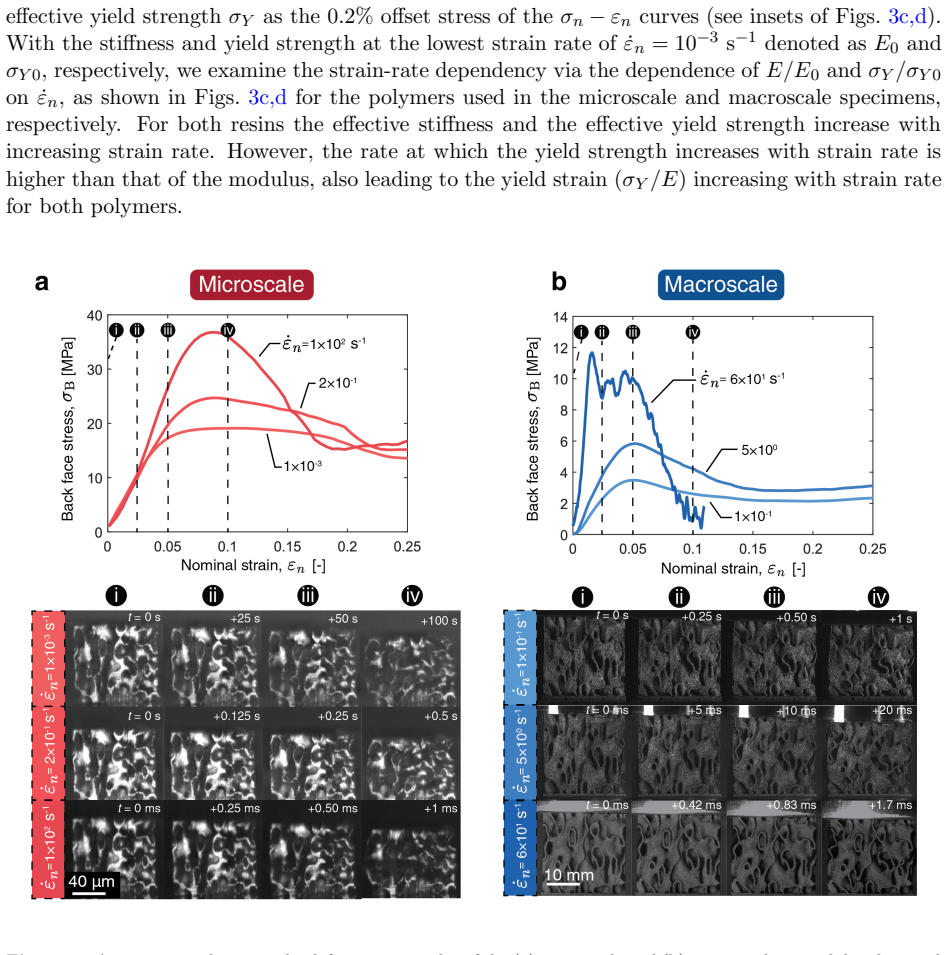
Experiments on spinodal architected specimens with 100 μm and 30 mm length scales across strain rates from 10^{-3} s^{-1} to 10^4 s^{-1} demonstrate that macroscale specimens exhibit a nearly tenfold increase in strength at high rates. Finite element calculations link the increase to a transition from a response governed by constituent material strain-rate sensitivity to inertia-dominated behavior, a transition absent in microscale specimens at the rates tested. Extensive calculations map the governing parameters and establish that the transition depends on structural length scale in a manner analogous to fluids.
What carries the argument
Spinodal architected morphology that permits controlled scaling between micro and macro lengths, together with finite element models that separate material rate sensitivity from inertial contributions and produce regime maps.
If this is right
- Laboratory screening of architected materials at micro scales may miss inertia-driven strengthening that appears at engineering scales.
- Regime maps allow selection of spinodal topologies and sizes for target strain rates.
- Dynamic properties extracted from small specimens require length-scale corrections before use in macroscale applications.
- The fluid analogy implies that dimensionless groups combining length, density, and rate can delineate behavioral regimes for other architectures.
Where Pith is reading between the lines
- Similar length-scale thresholds may govern dynamic response in other open-cell or stochastic architectures, allowing unified scaling rules.
- Impact-resistant structures could exploit the macroscale inertia regime for higher energy absorption without changing base material.
- High-rate testing protocols might incorporate specimen size as a variable to isolate the inertia transition directly.
Load-bearing premise
The difference in strength scaling between micro and macro specimens arises purely from the shift to inertia dominance rather than from manufacturing defects, boundary conditions, or unaccounted rate effects in the base material.
What would settle it
A controlled macroscale experiment in which inertial contributions are deliberately minimized yet the tenfold strength increase still appears, or an experiment in which inertial effects are present yet the increase fails to appear.
Figures




read the original abstract
High-throughput characterization of architected materials across a wide range of length scales enables rapid screening of topologies for engineering applications. Scaled-down specimens manufactured and evaluated in laboratory environments enable this iteration, but application scenarios may involve differing length scales and loading conditions that complicate direct comparisons. Here, we use a spinodal architected morphology to determine the interplay among the constituent material's strain-rate sensitivity, the topological length scale, and the imposed deformation rates. We report characterization spanning strain rates from $10^{-3}$ s$^{-1}$ to $10^{4}$ s$^{-1}$ on spinodal architected specimens with length scales of 100 $\mu$m (microscale) and 30 mm (macroscale). The experiments show that while microscale specimens exhibit moderate increase in strength at high strain rates, macroscale specimens exhibit a nearly tenfold increase in strength at equivalent strain rates. Finite element calculations reveal that this increase is linked to a transition from a response governed by constituent material strain-rate sensitivity to inertia-dominated behavior in macroscale specimens, a transition not observed in microscale specimens at the strain rates investigated here. Using extensive finite element calculations, we develop maps to establish the parameters governing the regimes of behavior, illustrating that the transition from behavior governed by constituent material rate sensitivity to inertia-dominated behavior has analogies to fluids in that it depends on a structural length scale. Our findings provide insights into the physical parameters that govern responses across length and time scales, towards the development and design of new laboratory experiments that extract relevant dynamic properties for structural applications.
Editorial analysis
A structured set of objections, weighed in public.
Referee Report
Summary. The manuscript examines the dynamic mechanical response of spinodal architected materials at microscale (100 μm) and macroscale (30 mm) length scales across strain rates from 10^{-3} s^{-1} to 10^4 s^{-1}. Experiments show moderate strength increases in microscale specimens at high rates but a nearly tenfold increase in macroscale specimens. Finite element simulations attribute the macroscale jump to a transition from material strain-rate sensitivity to inertia-dominated behavior (absent in microscale at the tested rates) and develop regime maps governed by structural length scale, drawing analogies to fluid inertia.
Significance. If the central claim holds, the work is significant for revealing length-scale-dependent transitions in dynamic response of architected materials, with practical value for high-rate applications. The combination of multi-scale experiments and extensive FE calculations to produce regime maps is a strength, offering concrete guidance on when inertia overtakes material rate sensitivity. The analogy to fluids and the falsifiable nature of the maps add to the contribution.
major comments (2)
- [Abstract] Abstract: the reported 'nearly tenfold increase' in macroscale strength at high strain rates is presented without error bars, standard deviations, number of replicates, or raw data, which makes it difficult to assess the robustness and statistical significance of this load-bearing quantitative result.
- [Finite element calculations] Finite element calculations and experimental sections: the attribution of the macroscale strength increase solely to inertia-dominated behavior requires that the constituent material's strain-rate sensitivity is identical across scales. Different manufacturing routes for 100 μm vs. 30 mm specimens may introduce variations in porosity, residual stresses, or effective properties that alter rate dependence independently of inertia; the manuscript does not report direct validation (e.g., bulk constituent tests at both scales or sensitivity analysis in the FE models) to rule out this confound.
minor comments (2)
- The abstract and methods would benefit from explicit statements on the number of experimental replicates and any statistical analysis performed on the strength data.
- Clarify in the regime-map discussion how the structural length scale is quantitatively defined and whether the maps include any uncertainty bounds from the FE parameter sweeps.
Simulated Author's Rebuttal
We thank the referee for their thoughtful and constructive comments, which help clarify key aspects of our work on the dynamic response of spinodal architectures. We address each major comment below and indicate the revisions planned for the next manuscript version.
read point-by-point responses
-
Referee: [Abstract] Abstract: the reported 'nearly tenfold increase' in macroscale strength at high strain rates is presented without error bars, standard deviations, number of replicates, or raw data, which makes it difficult to assess the robustness and statistical significance of this load-bearing quantitative result.
Authors: We agree that statistical details are necessary to support the quantitative claim in the abstract. In the revised manuscript, we will add error bars, standard deviations, and the number of replicates to the relevant experimental figures and main-text discussion of the macroscale results. To accommodate abstract length limits, we will revise the phrasing to 'a nearly tenfold increase in strength (with statistical details provided in the main text)' while preserving the original meaning. This change improves transparency and allows readers to evaluate robustness without requiring raw data in the abstract itself. revision: yes
-
Referee: [Finite element calculations] Finite element calculations and experimental sections: the attribution of the macroscale strength increase solely to inertia-dominated behavior requires that the constituent material's strain-rate sensitivity is identical across scales. Different manufacturing routes for 100 μm vs. 30 mm specimens may introduce variations in porosity, residual stresses, or effective properties that alter rate dependence independently of inertia; the manuscript does not report direct validation (e.g., bulk constituent tests at both scales or sensitivity analysis in the FE models) to rule out this confound.
Authors: We acknowledge the validity of this concern about potential manufacturing-induced variations in material response. The original models apply a single constitutive description calibrated to the base material for both length scales. To address the referee's point directly, the revised manuscript will include a new sensitivity analysis within the finite element section. This analysis will systematically vary the strain-rate sensitivity parameters over a range consistent with possible manufacturing differences and show that such variations produce only modest strength changes, insufficient to explain the observed tenfold macroscale increase. The inertia-dominated regime remains the dominant mechanism at the macroscale. We will also add a brief discussion of the two fabrication routes and any available measurements of porosity or other effective properties to further support the assumption of comparable base-material behavior. revision: yes
Circularity Check
No significant circularity; claims rest on independent experiments and FE simulations
full rationale
The paper's derivation chain consists of direct experimental measurements of strength at micro (100 μm) and macro (30 mm) scales across strain rates, followed by finite element calculations that interpret the macroscale ~10x strength jump as a shift to inertia-dominated response (absent at microscale). No step reduces by construction to a fitted input renamed as prediction, self-definition, or load-bearing self-citation. The material constitutive response is characterized separately and applied uniformly; the regime maps are generated from extensive FE runs rather than ansatz smuggling or renaming known patterns. The skeptic concern about scale-dependent material variations is a potential correctness issue, not a circularity reduction. This matches the reader's assessment of score 2.0.
Axiom & Free-Parameter Ledger
Reference graph
Works this paper leans on
-
[1]
X. Xia, C. M. Spadaccini, J. R. Greer, Responsive materials architected in space and time, Nature Reviews Materials 7 (9) (2022) 683–701.doi:https://doi.org/10.1038/s41578-022-00450-z
-
[2]
C. M. Portela, A. Vidyasagar, S. Kr¨ odel, T. Weissenbach, D. W. Yee, J. R. Greer, D. M. Kochmann, Extreme mechanical resilience of self-assembled nanolabyrinthine materials, Proceedings of the National Academy of Sciences 117 (11) (2020) 5686–5693.doi:10.1073/pnas.1916817117
-
[3]
P. Jiao, J. Mueller, J. R. Raney, X. Zheng, A. H. Alavi, Mechanical metamaterials and beyond, Nature commu- nications 14 (1) (2023) 6004.doi:https://doi.org/10.1038/s41467-023-41679-8
-
[4]
T. A. Schaedler, A. J. Jacobsen, A. Torrents, A. E. Sorensen, J. Lian, J. R. Greer, L. Valdevit, W. B. Carter, Ultralight metallic microlattices, Science 334 (6058) (2011) 962–965.doi:10.1126/science.1211649
-
[5]
L. R. Meza, A. J. Zelhofer, N. Clarke, A. J. Mateos, D. M. Kochmann, J. R. Greer, Resilient 3d hierarchical architected metamaterials, Proceedings of the National Academy of Sciences 112 (37) (2015) 11502–11507. doi:10.1073/pnas.1509120112
-
[6]
A. Evans, M. He, V. Deshpande, J. Hutchinson, A. Jacobsen, W. Carter, Concepts for enhanced energy absorption using hollow micro-lattices, International Journal of Impact Engineering 37 (9) (2010) 947–959. doi:https://doi.org/10.1016/j.ijimpeng.2010.03.007
-
[7]
L. E. Murr, S. M. Gaytan, F. Medina, H. Lopez, E. Martinez, B. I. Machado, D. H. Hernandez, L. Martinez, M. I. Lopez, R. B. Wicker, J. Bracke, Next-generation biomedical implants using additive manufacturing of complex, cellular and functional mesh arrays, Philosophical Transactions of the Royal Society A: Mathematical, Physical and Engineering Sciences 3...
-
[8]
J. C. Najmon, D. J. Jacob, Z. M. Wood, A. Tovar, Cellular helmet liner design through bio-inspired structures and topology optimization of compliant mechanism lattices, SAE International journal of transportation safety 6 (3) (2018) 217–236.doi:https://doi.org/10.4271/2018-01-1057
-
[9]
A. Fuganti, L. Lorenzi, A. Grønsund, M. Langseth, Aluminum foam for automotive applications, Advanced Engi- neering Materials 2 (4) (2000) 200–204.doi:https://doi.org/10.1002/(SICI)1527-2648(200004)2:4<200:: AID-ADEM200>3.0.CO;2-2
-
[10]
Selivanov, M
V. Selivanov, M. Silnikov, V. Markov, Y. Popov, V. Pusev, Using highly porous aluminum alloys and honeycomb structures in spacecraft landing gear, Acta Astronautica 180 (2021) 105–109.doi:https://doi.org/10.1016/ j.actaastro.2020.12.014. 20
2021
-
[11]
N. A. Fleck, V. S. Deshpande, The resistance of clamped sandwich beams to shock loading, Journal of Applied Mechanics 71 (3) (2004) 386–401.doi:10.1115/1.1629109
-
[12]
Y. Liang, A. V. Spuskanyuk, S. E. Flores, D. R. Hayhurst, J. W. Hutchinson, R. M. McMeeking, A. G. Evans, The response of metallic sandwich panels to water blast, Journal of Applied Mechanics 74 (1) (2005) 81–99. doi:10.1115/1.2178837
-
[13]
G. J. McShane, V. S. Deshpande, N. A. Fleck, The underwater blast resistance of metallic sandwich beams with prismatic lattice cores, Journal of Applied Mechanics 74 (2) (2006) 352–364.doi:10.1115/1.2198549
-
[14]
Z. Wei, V. Deshpande, A. Evans, K. Dharmasena, D. Queheillalt, H. Wadley, Y. Murty, R. Elzey, P. Dudt, Y. Chen, D. Knight, K. Kiddy, The resistance of metallic plates to localized impulse, Journal of the Mechanics and Physics of Solids 56 (5) (2008) 2074–2091.doi:https://doi.org/10.1016/j.jmps.2007.10.010
-
[15]
H. Rathbun, D. Radford, Z. Xue, M. He, J. Yang, V. Deshpande, N. Fleck, J. Hutchinson, F. Zok, A. Evans, Performance of metallic honeycomb-core sandwich beams under shock loading, International Journal of Solids and Structures 43 (6) (2006) 1746–1763.doi:https://doi.org/10.1016/j.ijsolstr.2005.06.079
-
[16]
J. U. Surjadi, C. M. Portela, Enabling three-dimensional architected materials across length scales and timescales, Nature Materials (Mar. 2025).doi:10.1038/s41563-025-02119-8
-
[17]
Zenkert, An Introduction to Sandwich Construction, Engineering Materials Advisory Services, 1995
D. Zenkert, An Introduction to Sandwich Construction, Engineering Materials Advisory Services, 1995. URLhttps://books.google.com/books?id=zc-GQgAACAAJ
1995
-
[18]
D. Radford, N. Fleck, V. Deshpande, The response of clamped sandwich beams subjected to shock loading, In- ternational Journal of Impact Engineering 32 (6) (2006) 968–987.doi:https://doi.org/10.1016/j.ijimpeng. 2004.08.007
-
[19]
Tilbrook, D
M. Tilbrook, D. Radford, V. Deshpande, N. Fleck, Dynamic crushing of sandwich panels with prismatic lattice cores, International Journal of Solids and Structures 44 (18) (2007) 6101–6123.doi:https://doi.org/10.1016/ j.ijsolstr.2007.02.015
2007
-
[20]
K. Dharmasena, D. Queheillalt, H. Wadley, P. Dudt, Y. Chen, D. Knight, A. Evans, V. Deshpande, Dynamic compression of metallic sandwich structures during planar impulsive loading in water, European Journal of Mechanics - A/Solids 29 (1) (2010) 56–67.doi:https://doi.org/10.1016/j.euromechsol.2009.05.003
-
[21]
R. Holloman, K. Kandan, V. Deshpande, H. Wadley, Dynamic compression of square tube cellular structures, Journal of Mechanics of Materials and Structures 9 (2) (2014) 149–182.doi:10.2140/jomms.2014.9.149
-
[22]
D. D. Radford, G. J. McShane, V. S. Deshpande, N. A. Fleck, Dynamic compressive response of stainless-steel square honeycombs, Journal of Applied Mechanics 74 (4) (2006) 658–667.doi:10.1115/1.2424717
-
[23]
V. Deshpande, M. Ashby, N. Fleck, Foam topology: bending versus stretching dominated architectures, Acta Materialia 49 (6) (2001) 1035–1040.doi:https://doi.org/10.1016/S1359-6454(00)00379-7
-
[24]
Calladine, R
C. Calladine, R. English, Strain-rate and inertia effects in the collapse of two types of energy-absorbing struc- ture, International Journal of Mechanical Sciences 26 (11) (1984) 689–701.doi:https://doi.org/10.1016/ 0020-7403(84)90021-3
1984
-
[25]
V. Deshpande, N. Fleck, High strain rate compressive behaviour of aluminium alloy foams, International Journal of Impact Engineering 24 (3) (2000) 277–298.doi:https://doi.org/10.1016/S0734-743X(99)00153-0
-
[26]
G. McShane, D. Radford, V. Deshpande, N. Fleck, The response of clamped sandwich plates with lattice cores subjected to shock loading, European Journal of Mechanics - A/Solids 25 (2) (2006) 215–229.doi:https: //doi.org/10.1016/j.euromechsol.2005.08.001
-
[27]
E. Ferri, V. S. Deshpande, A. G. Evans, The dynamic strength of a representative double layer prismatic core: A combined experimental, numerical, and analytical assessment, Journal of Applied Mechanics 77 (6) (2010) 061011.doi:10.1115/1.4000905
-
[28]
K. P. Dharmasena, H. N. Wadley, T. Liu, V. S. Deshpande, The dynamic response of edge clamped plates loaded by spherically expanding sand shells, International Journal of Impact Engineering 62 (2013) 182–195. doi:https://doi.org/10.1016/j.ijimpeng.2013.06.012
-
[30]
R. Mines, S. Tsopanos, Y. Shen, R. Hasan, S. McKown, Drop weight impact behaviour of sandwich panels with metallic micro lattice cores, International Journal of Impact Engineering 60 (2013) 120–132.doi:10.1016/j. ijimpeng.2013.04.007. 21
work page doi:10.1016/j 2013
-
[31]
J. S. Weeks, G. Ravichandran, Effect of topology on transient dynamic and shock response of polymeric lattice structures, Journal of Dynamic Behavior of Materials 9 (1) (2022) 44–64.doi:10.1007/s40870-022-00359-2
-
[32]
T. Tancogne-Dejean, A. B. Spierings, D. Mohr, Additively-manufactured metallic micro-lattice materials for high specific energy absorption under static and dynamic loading, Acta Materialia 116 (2016) 14–28.doi: 10.1016/j.actamat.2016.05.054
-
[33]
J. A. Hawreliak, J. Lind, B. Maddox, M. Barham, M. Messner, N. Barton, B. J. Jensen, M. Kumar, Dynamic Behavior of Engineered Lattice Materials, Scientific Reports 6 (1) (2016) 28094.doi:10.1038/srep28094
-
[34]
D. M. Dattelbaum, A. Ionita, B. M. Patterson, B. A. Branch, L. Kuettner, Shockwave dissipation by interface- dominated porous structures, AIP Advances 10 (7) (2020) 075016.doi:10.1063/5.0015179
-
[35]
J. Lind, B. J. Jensen, M. Barham, M. Kumar, In situ dynamic compression wave behavior in additively manu- factured lattice materials, Journal of Materials Research 34 (1) (2019) 2–19.doi:10.1557/jmr.2018.351
-
[36]
T. Butruille, J. C. Crone, C. M. Portela, Decoupling particle-impact dissipation mechanisms in 3d architected materials, Proceedings of the National Academy of Sciences 121 (6) (Feb. 2024).doi:10.1073/pnas.2313962121
-
[37]
P. Serles, A. Maguire, T. Butruille, J. Lem, S. Yang, P. G. Demingos, S. Choukir, M. Hach´ e, B. Kumral, K. Jia, C. Jia, Y. Zou, C. V. Singh, C. M. Portela, J. Lou, P. M. Ajayan, T. Filleter, Quasi-static to supersonic energy absorption of nanoarchitected tubulanes and schwarzites, Advanced Functional Materials (Feb. 2026). doi:10.1002/adfm.202526595
-
[38]
O. Reynolds, Xxix. an experimental investigation of the circumstances which determine whether the motion of water shall be direct or sinuous, and of the law of resistance in parallel channels, Philosophical Transactions of the Royal society of London (174) (1883) 935–982.doi:https://doi.org/10.1098/rstl.1883.0029
-
[39]
Zheng, W
X. Zheng, W. Smith, J. Jackson, B. Moran, H. Cui, D. Chen, J. Ye, N. Fang, N. Rodriguez, T. Weisgraber, C. M. Spadaccini, Multiscale metallic metamaterials, Nature Materials 15 (10) (2016) 1100–1106.doi:10.1038/ nmat4694
2016
-
[40]
A. J. D. Shaikeea, H. Cui, M. O’Masta, X. R. Zheng, V. S. Deshpande, The toughness of mechanical metama- terials, Nature Materials 21 (3) (2022) 297–304.doi:10.1038/s41563-021-01182-1
-
[41]
S. Gu, C. Mao, A. Guell Izard, S. Sadana, D. Terrel-Perez, M. Mettry-Yassa, W. Choi, W. Zhou, H. Yan, Z. Zhou, T. Massey, A. Abelson, Y. Zhou, S. Huang, C. Daraio, T. U. Tumkur, J. A. Fan, X. Xia, 3D nanolithography with metalens arrays and spatially adaptive illumination, Nature 648 (8094) (2025) 591–599.doi:10.1038/ s41586-025-09842-x
2025
-
[42]
L. Liu, P. Kamm, F. Garc´ ıa-Moreno, J. Banhart, D. Pasini, Elastic and failure response of imperfect three- dimensional metallic lattices: the role of geometric defects induced by selective laser melting, Journal of the Mechanics and Physics of Solids 107 (2017) 160–184.doi:https://doi.org/10.1016/j.jmps.2017.07.003
-
[43]
L. R. Meza, G. P. Phlipot, C. M. Portela, A. Maggi, L. C. Montemayor, A. Comella, D. M. Kochmann, J. R. Greer, Reexamining the mechanical property space of three-dimensional lattice architectures, Acta Materialia 140 (2017) 424–432.doi:https://doi.org/10.1016/j.actamat.2017.08.052
-
[44]
R. Glaesener, S. Kumar, C. Lestringant, T. Butruille, C. Portela, D. Kochmann, Predicting the influence of geometric imperfections on the mechanical response of 2D and 3D periodic trusses, Acta Materialia 254 (2023) 118918.doi:10.1016/j.actamat.2023.118918
-
[45]
S. Dhulipala, C. M. Portela, Curvature-guided mechanics and design of spinodal and shell-based architected materials, Journal of the Mechanics and Physics of Solids 204 (2025) 106273.doi:https://doi.org/10.1016/ j.jmps.2025.106273
-
[46]
A. G. Izard, J. Bauer, C. Crook, V. Turlo, L. Valdevit, Ultrahigh energy absorption multifunctional spinodal nanoarchitectures, Small 15 (45) (Sept 2019).doi:10.1002/smll.201903834
-
[47]
Stuart, and Kaushik Bhattacharya
M.-T. Hsieh, B. Endo, Y. Zhang, J. Bauer, L. Valdevit, The mechanical response of cellular materials with spinodal topologies, Journal of the Mechanics and Physics of Solids 125 (2019) 401–419.doi:10.1016/j.jmps. 2019.01.002
-
[48]
F. V. Senhora, E. D. Sanders, G. H. Paulino, Optimally-tailored spinodal architected materials for multiscale design and manufacturing, Advanced Materials 34 (26) (2022) 2109304.doi:https://doi.org/10.1002/adma. 202109304
-
[49]
Inverse-designed spinodoid meta- materials
S. Kumar, S. Tan, L. Zheng, D. M. Kochmann, Inverse-designed spinodoid metamaterials, npj Computational Materials 6 (1) (2020) 73.doi:https://doi.org/10.1038/s41524-020-0341-6. 22
-
[50]
L. Zheng, S. Kumar, D. M. Kochmann, Data-driven topology optimization of spinodoid metamaterials with seamlessly tunable anisotropy, Computer Methods in Applied Mechanics and Engineering 383 (2021) 113894. doi:https://doi.org/10.1016/j.cma.2021.113894
-
[51]
A. Lazarus, H. C. B. Florijn, P. M. Reis, Geometry-induced rigidity in nonspherical pressurized elastic shells, Physical Review Letters 109 (14) (Oct. 2012).doi:10.1103/physrevlett.109.144301
-
[52]
A. Vidyasagar, S. Kr¨ odel, D. M. Kochmann, Microstructural patterns with tunable mechanical anisotropy ob- tained by simulating anisotropic spinodal decomposition, Proceedings of the Royal Society A: Mathematical, Physical and Engineering Sciences 474 (2218) (2018) 20180535.doi:10.1098/rspa.2018.0535
-
[53]
Hibbitt, Karlsson, Sorenson, ABAQUS/Explicit: User’s Manual, Version 6.2, Hibbitt, Karlsson and Sorenson Inc., United States, 2001
2001
-
[54]
A. Needleman, Material rate dependence and mesh sensitivity in localization problems, Computer Methods in Applied Mechanics and Engineering 67 (1) (1988) 69–85.doi:https://doi.org/10.1016/0045-7825(88) 90069-2. 23
discussion (0)
Sign in with ORCID, Apple, or X to comment. Anyone can read and Pith papers without signing in.