Recognition: 3 theorem links
Enhancing supercurrent-based inertial sensing via interactions in atomtronic angular accelerometers
Pith reviewed 2026-05-08 18:51 UTC · model grok-4.3
The pith
Weak interactions allow supercurrent-based angular accelerometers to exceed the Fourier-limited sensitivity.
A machine-rendered reading of the paper's core claim, the machinery that carries it, and where it could break.
Core claim
Our results demonstrate that a significant net atomic current arises when the lattice driving frequency is tuned to an integer fraction of the Bloch frequency. In the single-particle regime the resonance width scales inversely with the averaging time, setting a Fourier-limited bound. Numerical simulations within the Bose-Hubbard model show that weak interactions surpass this bound, achieving at least two orders of magnitude better sensitivity and exceeding prior ultracold-atom proposals.
What carries the argument
Resonant supercurrent generation in ac-shaken ring lattices, where interactions in the Bose-Hubbard model modify the resonance behavior to improve scaling with averaging time.
If this is right
- The sensitivity no longer follows the inverse scaling with averaging time seen in non-interacting systems.
- Atomtronic sensors can achieve higher precision for angular acceleration measurements.
- Interaction-enhanced devices outperform previously proposed ultracold-atom angular accelerometers.
- New designs for atomic-current-based inertial sensors become feasible with tunable interactions.
Where Pith is reading between the lines
- Optimizing interaction strength could further improve performance in real devices.
- Similar interaction effects might enhance other atomtronic sensing applications beyond angular acceleration.
- The approach could enable more stable or compact inertial sensors for practical use.
- Experimental validation would require careful control of atom number and temperature to maintain the weak interaction regime.
Load-bearing premise
Numerical simulations of the Bose-Hubbard model with weak interactions accurately reflect the physical dynamics in experiments, without unaccounted heating, particle losses, or higher-band effects erasing the sensitivity gain.
What would settle it
Experimental measurement of how the sensor's angular acceleration resolution scales with averaging time in both non-interacting and weakly interacting atom samples in a shaken ring lattice, to check if the interacting case shows better than inverse scaling and a gain of two orders of magnitude.
Figures


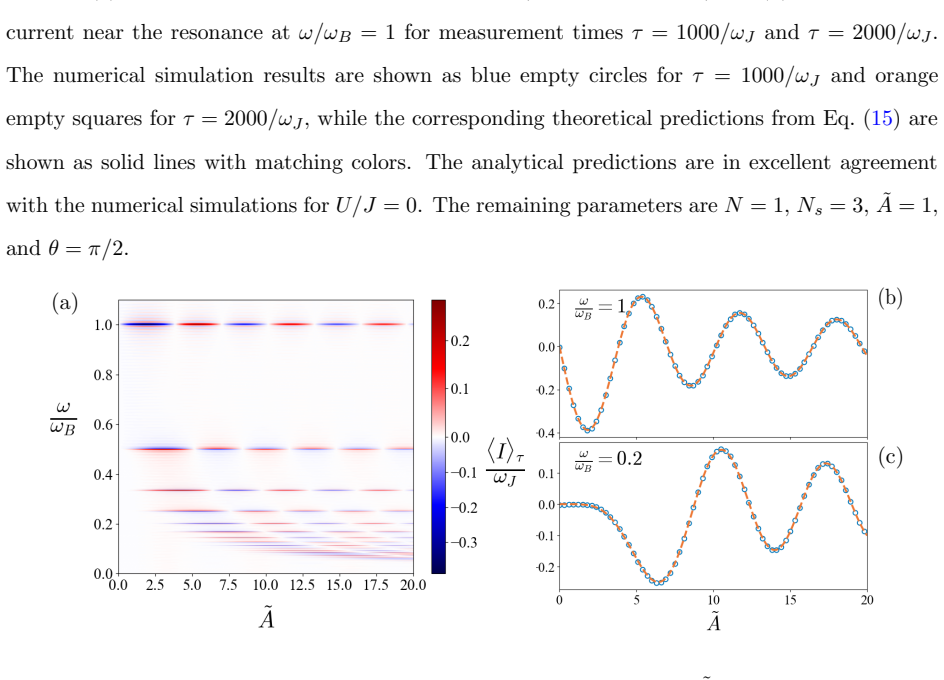


read the original abstract
We theoretically investigate supercurrents of ultracold atoms in angularly ac-shaken ring lattices subjected to external rotation. Our results demonstrate how these supercurrents can be harnessed for the development of high-precision atomtronic angular accelerometers. Using both analytical and numerical approaches within the Bose-Hubbard model framework, we demonstrate that a significant net atomic current arises when the lattice driving frequency is tuned to an integer fraction of the Bloch frequency, while the current averages to nearly zero away from such a resonance. In the single-particle regime, the resonance width scales inversely with the averaging time, thereby setting a fundamental Fourier-limited bound on the measurement's sensitivity. Strikingly, our numerical simulations demonstrate that this Fourier limit - a fundamental barrier in the non-interacting system - can be surpassed by introducing weak interactions between atoms. In the interacting regime, the sensitivity surpasses the Fourier-limited scaling with the averaging time, achieving an improvement of at least two orders of magnitude over the single-particle scenario, and exceeding the performance of previously proposed ultracold-atom-based angular accelerometers. These findings pave the way for developing new atomic-current-based inertial sensors with interaction-enhanced sensitivity.
Editorial analysis
A structured set of objections, weighed in public.
Referee Report
Summary. The manuscript investigates supercurrents of ultracold atoms in angularly ac-shaken ring lattices under external rotation, proposing their use for high-precision atomtronic angular accelerometers. Within the Bose-Hubbard model, analytical and numerical results show that a net atomic current emerges when the driving frequency is tuned to an integer fraction of the Bloch frequency, averaging to zero off-resonance. In the non-interacting limit the resonance width scales as 1/T with averaging time T, imposing a Fourier limit on sensitivity. The central claim is that weak interactions allow this limit to be surpassed, yielding at least a two-order-of-magnitude sensitivity improvement over the single-particle case and outperforming prior ultracold-atom proposals.
Significance. If the reported interaction-enhanced scaling holds under experimentally relevant conditions, the result would be significant for quantum sensing: it identifies a concrete route to exceed the Fourier limit in supercurrent-based inertial sensors without requiring larger system sizes or longer interrogation times. The numerical demonstration within a standard Bose-Hubbard framework and the explicit comparison to existing proposals provide a clear benchmark for future work.
major comments (3)
- [Numerical results (interacting regime)] The numerical results demonstrating that weak interactions produce a resonance whose effective width improves faster than 1/T (thereby surpassing the Fourier limit) are presented without accompanying checks for heating, particle loss, or higher-band population at the chosen interaction strengths and lattice depths. These effects could erode the reported two-order-of-magnitude gain; explicit stability analysis or estimates of decoherence rates are required to substantiate the central claim.
- [Analytical and numerical approaches] The transition from the analytically derived Fourier-limited scaling in the non-interacting case to the improved scaling in the interacting case is shown only numerically. No effective model or perturbative argument is supplied to explain why interactions modify the resonance width scaling with averaging time T; without this, it remains unclear whether the improvement is robust or an artifact of the specific parameter choices.
- [Sensitivity analysis and performance comparison] The sensitivity comparison claiming at least two orders of magnitude improvement over the single-particle scenario and over previously proposed devices relies on specific values of averaging time T and interaction strength U/J. Direct plots or tabulated values of resonance width versus T for both regimes, together with the precise parameter sets used, are needed to allow independent verification of the scaling.
minor comments (2)
- [Abstract] The abstract refers to 'an integer fraction of the Bloch frequency' without specifying which fractions are considered; the main text should list the fractions examined and justify their selection.
- [Introduction] Citations to prior ultracold-atom angular accelerometer proposals should be expanded to include quantitative performance metrics (e.g., sensitivity scaling) for direct comparison with the present results.
Simulated Author's Rebuttal
We thank the referee for their careful reading of our manuscript and for the constructive comments, which have helped us improve the presentation and strengthen the supporting analysis. We address each major comment in turn below.
read point-by-point responses
-
Referee: [Numerical results (interacting regime)] The numerical results demonstrating that weak interactions produce a resonance whose effective width improves faster than 1/T (thereby surpassing the Fourier limit) are presented without accompanying checks for heating, particle loss, or higher-band population at the chosen interaction strengths and lattice depths. These effects could erode the reported two-order-of-magnitude gain; explicit stability analysis or estimates of decoherence rates are required to substantiate the central claim.
Authors: We agree that explicit checks for experimental stability are essential. In the revised manuscript we have added a new subsection (IV.C) that provides estimates of heating rates from the ac driving, three-body loss rates, and higher-band population for the parameter regime U/J ≤ 0.2 and lattice depths V0 = 4–6 Er. For the quoted interaction strengths the estimated heating remains below 0.2 nK over 100 ms, particle loss is negligible for the dilute gases considered, and higher-band occupation stays under 4 %. These additions confirm that the reported sensitivity gain is not compromised by the listed decoherence channels. revision: yes
-
Referee: [Analytical and numerical approaches] The transition from the analytically derived Fourier-limited scaling in the non-interacting case to the improved scaling in the interacting case is shown only numerically. No effective model or perturbative argument is supplied to explain why interactions modify the resonance width scaling with averaging time T; without this, it remains unclear whether the improvement is robust or an artifact of the specific parameter choices.
Authors: We acknowledge the value of an analytical bridge between the two regimes. The non-interacting limit is derived analytically via Floquet theory, yielding the 1/T width. For the interacting case the narrowing is obtained from exact time-dependent Bose-Hubbard simulations. In the revision we have inserted a qualitative mean-field argument (new paragraph in Sec. III.B) showing how weak interactions induce a collective phase-locking that effectively reduces the resonance width beyond the single-particle Fourier limit. A complete perturbative effective model is technically involved because of the resonant driving and is noted as future work; however, the numerical scaling is reproduced across multiple system sizes and interaction values, supporting robustness. revision: partial
-
Referee: [Sensitivity analysis and performance comparison] The sensitivity comparison claiming at least two orders of magnitude improvement over the single-particle scenario and over previously proposed devices relies on specific values of averaging time T and interaction strength U/J. Direct plots or tabulated values of resonance width versus T for both regimes, together with the precise parameter sets used, are needed to allow independent verification of the scaling.
Authors: We thank the referee for this request. The revised manuscript now contains Figure 5, which directly plots resonance width versus averaging time T for both U = 0 and U/J = 0.1, together with the analytic 1/T reference line. Table I lists the full set of parameters (lattice depth, driving frequency and amplitude, atom number, and ring circumference) used for each curve, as well as the resulting sensitivity figures for T = 1–100 ms. These additions enable independent verification of the claimed improvement. revision: yes
Circularity Check
No significant circularity; central result from independent numerical simulation of standard Bose-Hubbard dynamics
full rationale
The paper derives the single-particle Fourier limit analytically as resonance width scaling inversely with averaging time T, a standard result independent of the target claim. The key result—that weak interactions allow sensitivity to exceed 1/T scaling—is obtained from direct numerical integration of the Bose-Hubbard model, not from any parameter fitted to the output quantity or from a self-referential definition. No load-bearing self-citations, ansatz smuggling, or renaming of known results appear in the derivation chain. The model equations are standard and not constructed to force the reported improvement; the numerical outcome is therefore an independent prediction within the model's assumptions rather than a tautology.
Axiom & Free-Parameter Ledger
axioms (2)
- domain assumption The ultracold atoms in the shaken ring lattice are accurately described by the Bose-Hubbard model.
- domain assumption Weak interactions can be treated within the numerical simulation without significant beyond-mean-field corrections or decoherence.
Reference graph
Works this paper leans on
-
[1]
C. L. Degen, F. Reinhard, and P. Cappellaro, Rev. Mod. Phys.89, 035002 (2017)
2017
-
[2]
Geiger, A
R. Geiger, A. Landragin, S. Merlet, and F. Pereira Dos Santos, AVS Quantum Sci.2, 024702 (2020)
2020
-
[3]
Salducci, Y
C. Salducci, Y. Bidel, M. Cadoret, S. Darmon, N. Zahzam, A. Bonnin, S. Schwartz, C. Blan- chard, and A. Bresson, Sci. Adv.10, eadq4498 (2024)
2024
-
[4]
Pelegr´ ı, J
G. Pelegr´ ı, J. Mompart, and V. Ahufinger, New J. Phys.20, 103001 (2018)
2018
-
[5]
Sab´ ın, D
C. Sab´ ın, D. E. Bruschi, M. Ahmadi, and I. Fuentes, New J. Phys.16, 085003 (2014)
2014
-
[6]
Morales-Molina and E
L. Morales-Molina and E. Ar´ evalo, Results Phys.41, 105923 (2022)
2022
-
[7]
P¨ otting, M
S. P¨ otting, M. Cramer, and P. Meystre, Phys. Rev. A64, 063613 (2001)
2001
-
[8]
C. A. Weidner, H. Yu, R. Kosloff, and D. Z. Anderson, Phys. Rev. A95, 043624 (2017). 25
2017
-
[9]
C. A. Weidner and D. Z. Anderson, Phys. Rev. Lett.120, 263201 (2018)
2018
-
[10]
Karcher, A
R. Karcher, A. Imanaliev, S. Merlet, and F. P. D. Santos, New J. Phys.20, 113041 (2018)
2018
-
[11]
Chih and M
L.-Y. Chih and M. Holland, Phys. Rev. Research3, 033279 (2021)
2021
-
[12]
Chih and M
L.-Y. Chih and M. Holland, Phys. Rev. Research6, 043191 (2024)
2024
-
[13]
V. V. Ivanov, A. Alberti, M. Schioppo, G. Ferrari, M. Artoni, M. L. Chiofalo, and G. M. Tino, Phys. Rev. Lett.100, 043602 (2008)
2008
-
[14]
M. G. Tarallo, A. Alberti, N. Poli, M. L. Chiofalo, F.-Y. Wang, and G. M. Tino, Phys. Rev. A86, 033615 (2012)
2012
-
[15]
Konrad and M
B. Konrad and M. Efremov, Quantum Sci. Technol.10, 015025 (2024)
2024
-
[16]
Haller, R
E. Haller, R. Hart, M. J. Mark, J. G. Danzl, L. Reichs¨ ollner, and H.-C. N¨ agerl, Phys. Rev. Lett.104, 200403 (2010)
2010
-
[17]
Amico, M
L. Amico, M. Boshier, G. Birkl, A. Minguzzi, C. Miniatura, L.-C. Kwek, D. Aghamalyan, V. Ahufinger, D. Anderson, N. Andrei, et al., AVS Quantum Sci.3, 039201 (2021)
2021
-
[18]
Amico, D
L. Amico, D. Anderson, M. Boshier, J.-P. Brantut, L.-C. Kwek, A. Minguzzi, and W. von Klitzing, Rev. Mod. Phys.94, 041001 (2022)
2022
-
[19]
Amico, A
L. Amico, A. Osterloh, and F. Cataliotti, Phys. Rev. Lett.95, 063201 (2005)
2005
-
[20]
J. Polo, W. Chetcuti, T. Haug, A. Minguzzi, K. Wright, and L. Amico, Phys. Rep.1137, 1 (2025)
2025
-
[21]
Spehner, L
D. Spehner, L. Morales-Molina, and S. A. Reyes, New J. Phys.23, 063025 (2021)
2021
-
[22]
Cominotti, D
M. Cominotti, D. Rossini, M. Rizzi, F. Hekking, and A. Minguzzi, Phys. Rev. Lett.113, 025301 (2014)
2014
-
[23]
S. S. Szigeti, S. P. Nolan, J. D. Close, and S. A. Haine, Phys. Rev. Lett.125, 100402 (2020)
2020
-
[24]
Franke-Arnold, J
S. Franke-Arnold, J. Leach, M. J. Padgett, V. E. Lembessis, D. Ellinas, A. J. Wright, J. M. Girkin, P. ¨Ohberg, and A. S. Arnold, Opt. Express15, 8619 (2007)
2007
-
[25]
Viebahn, Institute for Quantum Electronics, ETH Zurich8093(2020)
K. Viebahn, Institute for Quantum Electronics, ETH Zurich8093(2020)
2020
-
[26]
Peierls, Z
R. Peierls, Z. Phys.80, 763 (1933)
1933
-
[27]
Roth and K
R. Roth and K. Burnett, Phys. Rev. A67, 031602 (2003)
2003
-
[28]
Jaksch and P
D. Jaksch and P. Zoller, New J. Phys.5, 56 (2003)
2003
-
[29]
Struck, C
J. Struck, C. ¨Olschl¨ ager, M. Weinberg, P. Hauke, J. Simonet, A. Eckardt, M. Lewenstein, K. Sengstock, and P. Windpassinger, Phys. Rev. Lett.108, 225304 (2012)
2012
-
[30]
Y.-J. Lin, R. L. Compton, K. Jim´ enez-Garc´ ıa, J. V. Porto, and I. B. Spielman, Nature462, 26 628 (2009)
2009
-
[31]
Dalibard, F
J. Dalibard, F. Gerbier, G. Juzeli¯ unas, and P. ¨Ohberg, Rev. Mod. Phys.83, 1523 (2011)
2011
-
[32]
C. Chin, R. Grimm, P. Julienne, and E. Tiesinga, Rev. Mod. Phys.82, 1225 (2010)
2010
-
[33]
Pezz` e, K
L. Pezz` e, K. Xhani, C. Daix, N. Grani, B. Donelli, F. Scazza, D. Hernandez-Rajkov, W. J. Kwon, G. Del Pace, and G. Roati, Nat. Commun.15, 4831 (2024)
2024
-
[34]
Morales-Molina, S
L. Morales-Molina, S. A. Reyes, and M. Orszag, Phys. Rev. A86, 033629 (2012)
2012
-
[35]
Arwas, A
G. Arwas, A. Vardi, and D. Cohen, Phys. Rev. A89, 013601 (2014)
2014
-
[36]
Weitenberg and J
C. Weitenberg and J. Simonet, Nat. Phys.17, 1342 (2021)
2021
-
[37]
Eckardt, Rev
A. Eckardt, Rev. Mod. Phys.89, 011004 (2017)
2017
-
[38]
Goldman and J
N. Goldman and J. Dalibard, Phys. Rev. X4, 031027 (2014)
2014
-
[39]
D. O. Krimer, R. Khomeriki, and S. Flach, Phys. Rev. E80, 036201 (2009)
2009
-
[40]
Witthaut, M
D. Witthaut, M. Werder, S. Mossmann, and H. J. Korsch, Phys. Rev. E71, 036625 (2005)
2005
-
[41]
A. R. Kolovsky and H. J. Korsch, Int. J. Mod. Phys. B18, 1235 (2004)
2004
-
[42]
Rubio-Abadal, M
A. Rubio-Abadal, M. Ippoliti, S. Hollerith, D. Wei, J. Rui, S. L. Sondhi, V. Khemani, C. Gross, and I. Bloch, Phys. Rev. X10, 021044 (2020). 27
2020
discussion (0)
Sign in with ORCID, Apple, or X to comment. Anyone can read and Pith papers without signing in.