Recognition: 3 theorem links
· Lean TheoremNucleon strange electromagnetic form factors using N_f=2+1+1 twisted-mass fermions at the physical point
Pith reviewed 2026-05-08 18:35 UTC · model grok-4.3
The pith
Lattice simulations at physical quark masses extract the strange electric and magnetic radii and magnetic moment of the nucleon after continuum extrapolation.
A machine-rendered reading of the paper's core claim, the machinery that carries it, and where it could break.
Core claim
Using Nf=2+1+1 clover-improved twisted-mass fermions at the physical point, the disconnected strange electromagnetic form factors are evaluated on four ensembles with lattice spacings a=0.080, 0.068, 0.057 and 0.049 fm. Stochastic estimation of the strange-quark loops employs spin-color dilution and hierarchical probing, combined with high-statistics two-point functions. Momentum dependence of the resulting form factors is fitted to obtain the strange electric and magnetic radii together with the strange magnetic moment, all reported in the continuum limit.
What carries the argument
Continuum extrapolation of strange electromagnetic form factors obtained from stochastic estimates of disconnected strange-quark loops on physical-mass twisted-mass ensembles with spin-color dilution and hierarchical probing.
If this is right
- The strange magnetic moment is obtained directly in the continuum at the physical point.
- Strange electric and magnetic radii follow from the low-momentum slope of the form factors.
- No additional chiral extrapolation is required because all ensembles sit at the physical pion mass.
- The results provide benchmark values for comparison with other lattice groups and with extractions from parity-violating electron scattering.
Where Pith is reading between the lines
- These continuum values could be used to tighten constraints on effective models that incorporate strangeness in the nucleon.
- The hierarchical probing technique shown here could be adapted to other flavor-singlet observables such as the strange scalar charge.
- Future parity-violating experiments with reduced uncertainty could provide an external cross-check on the lattice methodology.
Load-bearing premise
The stochastic estimation of disconnected strange-quark loops via spin-color dilution and hierarchical probing introduces no significant bias that survives the continuum extrapolation.
What would settle it
An independent lattice calculation with substantially higher statistics or a different fermion action that produces a strange magnetic moment outside the reported error band after continuum extrapolation would falsify the central result.
Figures


read the original abstract
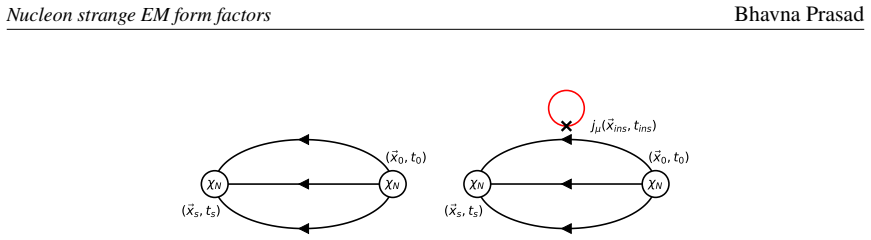
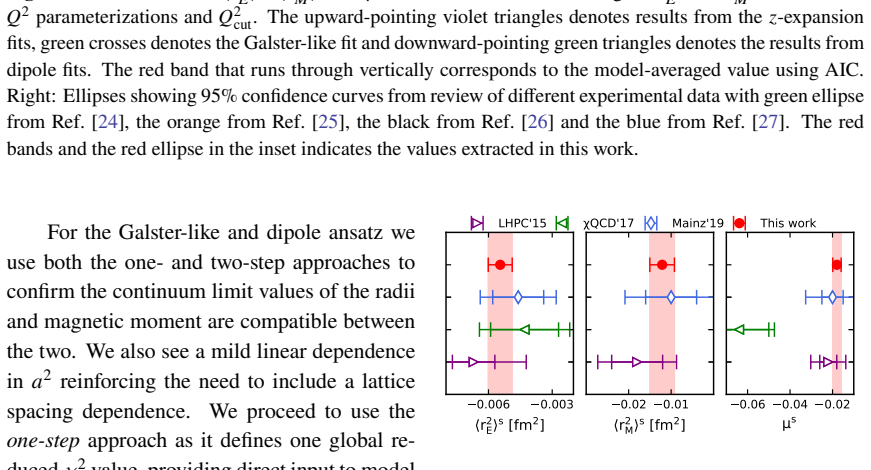
We present the strange electromagnetic form factors of the nucleon using lattice QCD with $N_f=2+1+1$ twisted mass clover-improved fermions and quark masses tuned to their physical values. Using four ensembles with lattice spacings of $a=0.080$ fm, $0.068$ fm, $0.057$ fm and $0.049$ fm, and similar physical volume, we obtain the continuum limit directly at the physical pion mass. The disconnected strange contributions are computed using high statistics two-point functions combined with stochastic noise mitigation techniques, such as spin-color dilution and hierarchical probing in the estimation of the quark loop. From the momentum dependence of the form factors, we provide the strange electric and magnetic radii, as well as the strange magnetic moment in the continuum limit.
Editorial analysis
A structured set of objections, weighed in public.
Referee Report
Summary. The manuscript computes the strange electromagnetic form factors of the nucleon using N_f=2+1+1 twisted-mass clover-improved fermions at the physical point. Four ensembles with lattice spacings a=0.080, 0.068, 0.057, and 0.049 fm (similar physical volumes) are used to perform a direct continuum extrapolation at physical pion mass. Disconnected strange-quark loops are estimated stochastically with spin-color dilution and hierarchical probing; the Q^2 dependence of the resulting form factors is fitted to extract the strange electric and magnetic radii together with the strange magnetic moment in the continuum limit.
Significance. If the results hold, the work supplies first-principles lattice determinations of nucleon strange form factors directly at the physical point and in the continuum limit. The combination of physical quark masses, multiple lattice spacings, and standard variance-reduction techniques for the disconnected contributions constitutes a clear strength; these results provide useful benchmarks for other lattice calculations and for phenomenological extractions of nucleon structure.
minor comments (3)
- [Results and analysis section] The functional form adopted for the Q^2 extrapolation of the form factors (used to obtain the radii and magnetic moment) should be stated explicitly, together with any systematic uncertainty assigned to the choice of parametrization.
- [Lattice setup] The precise physical volumes (or L values) for each ensemble are described only as 'similar'; tabulating the exact L/a and m_π L for each ensemble would improve reproducibility and allow readers to assess finite-volume effects directly.
- [Continuum extrapolation] In the continuum-extrapolation plots, the linear fit in a² should be accompanied by the χ²/dof and the range of a values used; this would make the quality of the extrapolation transparent.
Simulated Author's Rebuttal
We thank the referee for their positive assessment of our manuscript and for recommending a minor revision. The referee's summary correctly describes our calculation of the strange electromagnetic form factors using N_f=2+1+1 twisted-mass fermions at the physical point with continuum extrapolation. Since no major comments were provided, we have no specific rebuttals to offer and will proceed with any minor revisions as needed.
Circularity Check
No significant circularity identified
full rationale
The derivation proceeds from direct lattice computation of two- and three-point correlation functions on four physical-point ensembles, through stochastic estimation of disconnected strange loops (with spin-color dilution and hierarchical probing), to extraction of the electromagnetic form factors G_E^s(Q^2) and G_M^s(Q^2) at discrete nonzero Q^2 values. The strange radii and magnetic moment are obtained from the Q^2 dependence of these computed form factors via standard parametrizations. No equation or step reduces by construction to its own inputs; the functional form for the Q^2 extrapolation is an analysis choice, not a self-definition or a fitted input relabeled as a prediction. No load-bearing self-citation, uniqueness theorem, or ansatz smuggling is present in the provided text. The central results remain independent lattice outputs, self-contained against external benchmarks.
Axiom & Free-Parameter Ledger
free parameters (1)
- form-factor parametrization parameters
axioms (2)
- domain assumption Twisted-mass clover-improved fermions at physical quark masses correctly discretize QCD and permit reliable continuum extrapolation.
- domain assumption Spin-color dilution and hierarchical probing yield unbiased estimates of the strange-quark disconnected loops.
Lean theorems connected to this paper
-
Cost.FunctionalEquation (J-cost ansätze absent — paper uses standard phenomenological forms with free parameters)washburn_uniqueness_aczel unclear?
unclearRelation between the paper passage and the cited Recognition theorem.
dipole ansatz, Galster-like parameterization, z-expansion ... with gaussian prior of width w, varied together with k_max
What do these tags mean?
- matches
- The paper's claim is directly supported by a theorem in the formal canon.
- supports
- The theorem supports part of the paper's argument, but the paper may add assumptions or extra steps.
- extends
- The paper goes beyond the formal theorem; the theorem is a base layer rather than the whole result.
- uses
- The paper appears to rely on the theorem as machinery.
- contradicts
- The paper's claim conflicts with a theorem or certificate in the canon.
- unclear
- Pith found a possible connection, but the passage is too broad, indirect, or ambiguous to say the theorem truly supports the claim.
Reference graph
Works this paper leans on
-
[1]
D. B. Kaplan and A. Manohar,Strange Matrix Elements in the Proton from Neutral Current Experiments,Nucl. Phys. B310(1988) 527
1988
- [2]
-
[3]
E. J. Beise, M. L. Pitt and D. T. Spayde,The SAMPLE experiment and weak nucleon structure,Prog. Part. Nucl. Phys.54(2005) 289 [nucl-ex/0412054]. [5]A4collaboration, F. E. Maas et al.,Measurement of strange quark contributions to the nucleon’s form-factors at Q**2 = 0.230-(GeV/c)**2,Phys. Rev. Lett.93(2004) 022002 [nucl-ex/0401019]
- [4]
-
[5]
S. Baunack et al.,Measurement of Strange Quark Contributions to the Vector Form Factors of the Proton at Q**2=0.22 (GeV/c)**2,Phys. Rev. Lett.102(2009) 151803 [0903.2733]. [8]HAPPEXcollaboration, K. A. Aniol et al.,Parity-violating electron scattering from He-4 and the strange electric form-factor of the nucleon,Phys. Rev. Lett.96(2006) 022003 [nucl-ex/05...
-
[6]
D. Djukanovic, K. Ottnad, J. Wilhelm and H. Wittig,Strange electromagnetic form factors of the nucleon with𝑁𝑓 =2+1O (𝑎)-improved Wilson fermions,Phys. Rev. Lett.123(2019) 212001 [1903.12566]. 9 Nucleon strange EM form factorsBhavna Prasad
-
[7]
C. Alexandrou, S. Bacchio, M. Constantinou, J. Finkenrath, K. Hadjiyiannakou et al., Nucleon strange electromagnetic form factors,Phys. Rev. D101(2020) 031501 [1909.10744]
- [8]
- [9]
-
[10]
C. Alexandrou, S. Bacchio, M. Bode, J. Finkenrath, A. Herten et al.,Nucleon strange electromagnetic form factors from𝑁𝑓 =2+1+1lattice QCD,2603.26591
-
[11]
C. Alexandrou, S. Bacchio, M. Bode, J. Finkenrath, A. Herten et al.,Strangeness of nucleons from𝑁 𝑓 =2+1+1lattice QCD,2603.26600. [21]Extended Twisted Masscollaboration, C. Alexandrou et al.,Lattice calculation of the short and intermediate time-distance hadronic vacuum polarization contributions to the muon magnetic moment using twisted-mass fermions,Phy...
-
[12]
C. Alexandrou, S. Bacchio, G. Koutsou, B. Prasad and G. Spanoudes,Proton and neutron electromagnetic form factors from lattice QCD in the continuum limit,2507.20910
- [13]
- [14]
- [15]
-
[16]
R. Gonzalez-Jimenez, J. A. Caballero and T. W. Donnelly,Parity Violation in Elastic Electron-Nucleon Scattering: Strangeness Content in the Nucleon,Phys. Rept.524(2013) 1 [1111.6918]
- [17]
- [18]
discussion (0)
Sign in with ORCID, Apple, or X to comment. Anyone can read and Pith papers without signing in.