Recognition: 3 theorem links
· Lean TheoremNon-variational scalar field cosmology: Exact Bianchi I solutions for near-minimal scalar fields
Pith reviewed 2026-05-08 18:58 UTC · model grok-4.3
The pith
Non-variational near-minimal scalar fields with quadratic potentials admit four new exact Bianchi I solutions exhibiting Big Bang, Big Crunch, Big Rip, and oscillatory cosmologies.
A machine-rendered reading of the paper's core claim, the machinery that carries it, and where it could break.
Core claim
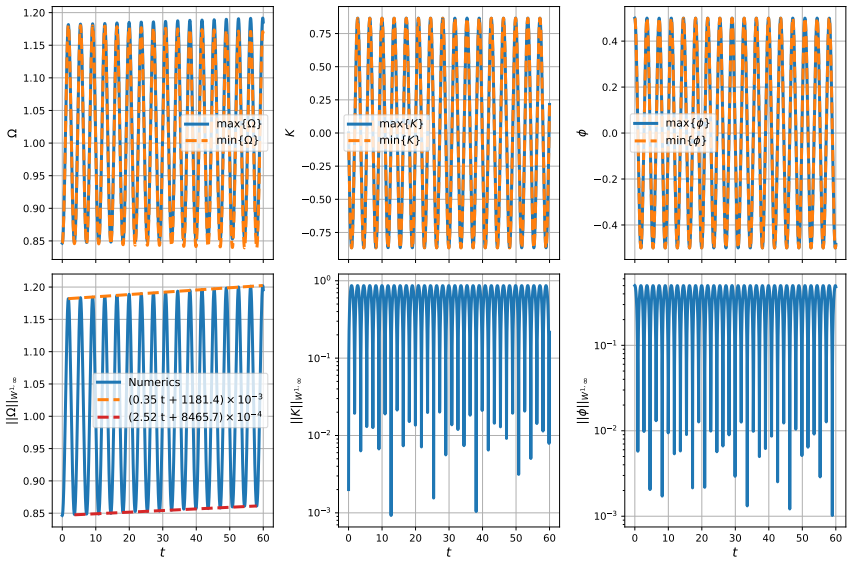
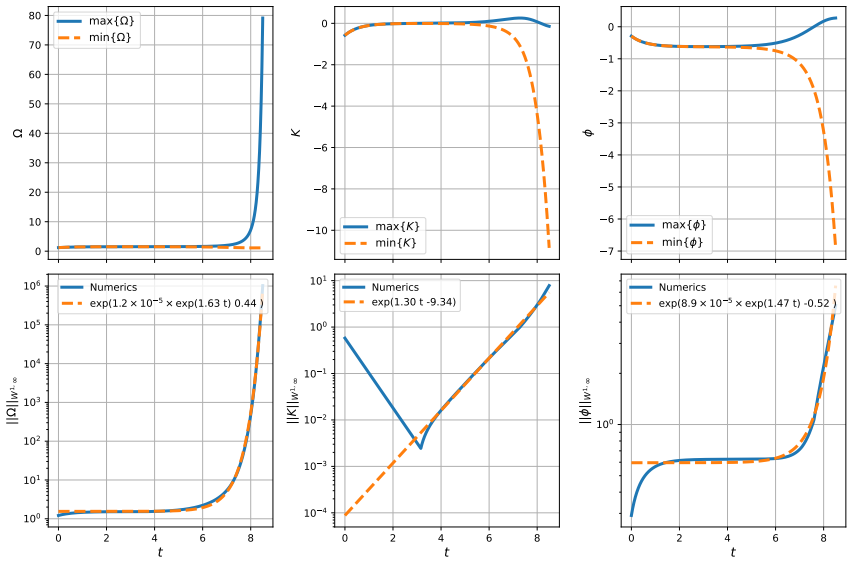
By decoupling the scalar field's self-interaction term from the derivative of its potential and setting that term proportional to a quadratic potential, four exact Bianchi I solutions are obtained for the non-variational near-minimal scalar field. These solutions realize Big Bang, Big Crunch, Big Rip, and oscillatory (cyclic) behavior, with all singularities occurring at infinite proper time. Numerical stability analysis against spatially inhomogeneous perturbations of the mean curvature establishes that the oscillatory solution and solutions possessing crushing singularities are unstable, whereas solutions with a Big Rip singularity at infinity are stable.
What carries the argument
The non-variational coupling that decouples the scalar-field self-interaction from the potential derivative, combined with the proportionality of that term to a quadratic potential, which permits exact integration of the Bianchi I field equations.
If this is right
- The four solutions cover Big Bang, Big Crunch, Big Rip, and cyclic cosmological evolutions.
- All singularities occur at infinite proper time and are unreachable by observers.
- Oscillatory solutions and those with crushing singularities are unstable to spatially inhomogeneous mean-curvature perturbations.
- Big Rip solutions are stable against the same class of perturbations.
Where Pith is reading between the lines
- If the near-minimal model applies at late times, Big Rip cosmologies would be robust against mean-curvature inhomogeneities.
- The infinite proper time to every singularity reframes the physical meaning of cosmic doomsdays as limits never actually encountered.
- These exact solutions supply analytic test cases for numerical codes that evolve modified scalar-field cosmologies.
Load-bearing premise
The scalar field's self-interaction term can be chosen independently of the derivative of its potential and set proportional to a quadratic potential while still describing physically relevant cosmology.
What would settle it
A direct numerical evolution of the derived oscillatory Bianchi I metric under spatially inhomogeneous mean-curvature perturbations that either confirms instability or shows stabilization at late times.
Figures





read the original abstract
The purpose of this work is to investigate spatially homogeneous and flat cosmological solutions of the Einstein equations coupled to a non-variational ``near-minimal'' scalar field. This coupling model represents a minimal departure from standard theory by decoupling the scalar field's self-interaction term from the derivative of its potential. By assuming a quadratic potential and a self-interaction term that is proportional to the potential, we derive four new exact Bianchi I solutions. We demonstrate that these solutions produce a diverse range of cosmological phenomena, including Big Bang, Big Crunch, and Big Rip singularities, as well as oscillatory (``cyclic'') behaviour. For our exact solutions, these singularities occur in infinite proper time and hence are never truly reachable by an observer. To assess the stability of these cosmologies, we perform a numerical stability analysis against spatially inhomogeneous perturbations of the mean curvature. We find that the oscillatory solution is unstable to perturbations of this type, as are solutions in possession of a crushing singularity. Conversely, solutions with a Big Rip singularity (at infinity) are stable to spatially inhomogeneous perturbations of the mean curvature.
Editorial analysis
A structured set of objections, weighed in public.
Referee Report
Summary. The paper investigates exact Bianchi I solutions for a non-variational 'near-minimal' scalar field model coupled to Einstein gravity. By decoupling the scalar self-interaction term from the derivative of the potential and assuming it is proportional to a quadratic potential V = (1/2)m²φ², four exact solutions are derived that exhibit Big Bang, Big Crunch, Big Rip, and oscillatory (cyclic) behaviors, with all singularities occurring at infinite proper time. A numerical stability analysis is performed against spatially inhomogeneous perturbations of the mean curvature, concluding that oscillatory solutions and those with crushing singularities are unstable while Big Rip solutions are stable.
Significance. If the claimed solutions are consistent with the Einstein equations, the work provides new exact Bianchi I cosmologies in a modified scalar-field setting, demonstrating a range of singularity structures and stability properties that could be relevant for understanding non-standard scalar dynamics in homogeneous spacetimes. The explicit construction of diverse cosmological evolutions and the distinction in stability results represent a concrete contribution to exact-solution methods in GR.
major comments (2)
- [Model definition and derivation of the field equations] The central construction decouples the scalar self-interaction from dV/dφ and imposes proportionality to the quadratic potential to obtain closed-form solutions. For these to satisfy the Einstein equations, the effective stress-energy tensor must obey ∇_μ T^μν = 0 identically (via the contracted Bianchi identities). Direct substitution of the decoupled interaction into the divergence must be performed and shown to vanish; without this verification the four exact solutions cannot be solutions of the full system.
- [Stability analysis] The numerical stability analysis against mean-curvature perturbations is described in the abstract and results section but lacks explicit details on the perturbation ansatz, the discretization scheme, or quantitative error estimates. This makes it difficult to assess the robustness of the reported stability distinctions (unstable for oscillatory/crushing cases, stable for Big Rip).
minor comments (1)
- The abstract states that singularities occur in infinite proper time but does not specify the coordinate or proper-time parametrization used to reach this conclusion; a brief clarification would improve readability.
Simulated Author's Rebuttal
We thank the referee for their careful reading of the manuscript and for the constructive comments, which will help improve the clarity and rigor of our presentation. We address each major comment below and indicate the revisions that will be incorporated.
read point-by-point responses
-
Referee: [Model definition and derivation of the field equations] The central construction decouples the scalar self-interaction from dV/dφ and imposes proportionality to the quadratic potential to obtain closed-form solutions. For these to satisfy the Einstein equations, the effective stress-energy tensor must obey ∇_μ T^μν = 0 identically (via the contracted Bianchi identities). Direct substitution of the decoupled interaction into the divergence must be performed and shown to vanish; without this verification the four exact solutions cannot be solutions of the full system.
Authors: We agree that an explicit verification of stress-energy conservation is required for consistency in this non-variational setting. Although the solutions were obtained by direct substitution into the Einstein equations with the specified form of the effective stress-energy tensor, we will add a dedicated subsection in the revised manuscript that computes ∇_μ T^μν for each of the four exact solutions. We will show that the divergence vanishes identically because of the imposed proportionality between the decoupled self-interaction term and the quadratic potential V = (1/2)m²φ². This calculation confirms that the solutions satisfy the contracted Bianchi identities and are therefore valid solutions of the full system. revision: yes
-
Referee: [Stability analysis] The numerical stability analysis against mean-curvature perturbations is described in the abstract and results section but lacks explicit details on the perturbation ansatz, the discretization scheme, or quantitative error estimates. This makes it difficult to assess the robustness of the reported stability distinctions (unstable for oscillatory/crushing cases, stable for Big Rip).
Authors: We acknowledge that the current description of the numerical stability analysis is insufficiently detailed. In the revised manuscript we will expand the relevant section to include: (i) the precise perturbation ansatz applied to the mean curvature and the Bianchi I metric components, (ii) the finite-difference discretization scheme, including grid resolution, time-stepping method, and boundary conditions, and (iii) quantitative error estimates such as convergence tests under grid refinement and residual norms. These additions will allow readers to evaluate the robustness of the reported stability results, namely that the oscillatory and crushing-singularity solutions are unstable while the Big Rip solutions remain stable under the considered class of inhomogeneous perturbations. revision: yes
Circularity Check
No circularity: solutions obtained by direct integration from explicit model assumptions.
full rationale
The paper states its non-variational model by decoupling the self-interaction term from V' and setting it proportional to V = (1/2)m²φ², then integrates the resulting Einstein-scalar equations to produce four exact Bianchi-I solutions. This is a standard ansatz-plus-integration procedure with no reduction of outputs to fitted parameters, no load-bearing self-citations, and no renaming of known results. The stability analysis is a separate numerical check against perturbations. The derivation chain is self-contained against the stated assumptions; any concern about conservation-law consistency is a question of model validity, not circularity in the derivation.
Axiom & Free-Parameter Ledger
free parameters (1)
- proportionality constant between self-interaction and potential
axioms (3)
- standard math Einstein field equations govern the gravitational sector
- domain assumption Bianchi I metric describes the spacetime geometry
- domain assumption Quadratic potential for the scalar field
invented entities (1)
-
near-minimal non-variational scalar field
no independent evidence
Lean theorems connected to this paper
-
Cost.FunctionalEquation / Foundation.AlphaCoordinateFixationwashburn_uniqueness_aczel (J(x)=½(x+x⁻¹)−1) unclearf(φ) = 3ωV(φ), for some constant ω∈ℝ⁺ ... we instead choose a quadratic-type potential V(φ) = m₀ + m₁φ + m₂φ²
-
Foundation (parameter-free chain) — RS forbids adjustable parameters in its derivation but does not constrain phenomenological cosmology modelsreality_from_one_distinction unclearm₀, m₁, m₂, ω are freely specifiable constants
Reference graph
Works this paper leans on
-
[1]
Cambridge University Press, 2003
Stephani, H., Kramer, D., MacCallum, M., Hoenselaers, C., and Herlt, E.Exact Solutions of Einstein’s Field Equations, volume 2nd Edition. Cambridge University Press, 2003. ISBN: 978-0521467025
2003
-
[2]
Empty space-times admitting a three parameter group of mo- tions,
Taub, A.H. Empty space-times admitting a three parameter group of motions.Annals of Mathematics, 53(3):472–490, 1951. DOI: 10.2307/1969567
-
[4]
Beyer, F. and Hennig, J. An exact smooth Gowdy-symmetric generalized Taub-NUT solution.Classical and Quantum Gravity, 31(9):095010, 2014. DOI: 10.1088/0264- 9381/31/9/095010
-
[5]
¨Uber das gravitationsfeld eines massenpunktes nach der ein- steinschen theorie.Sitzungsberichte der k¨ oniglich preussischen Akademie der Wis- senschaften, pages 189–196, 1916
Schwarzschild, K. ¨Uber das gravitationsfeld eines massenpunktes nach der ein- steinschen theorie.Sitzungsberichte der k¨ oniglich preussischen Akademie der Wis- senschaften, pages 189–196, 1916
1916
-
[6]
Misner, C.W., Thorne K.S., and Wheeler, J.A.Gravitation. W. H. Freeman and Company, San Francisco, 1973. ISBN: 978-0716703440
1973
-
[7]
and Podolsk´ y, J.Exact Space-Times in Einstein’s General Relativity
Griffiths, J.B. and Podolsk´ y, J.Exact Space-Times in Einstein’s General Relativity. Cambridge Monographs on Mathematical Physics. Cambridge University Press, 2009. ISBN: 978-0521889278
2009
-
[8]
¨Uber die Kr¨ ummung des Raumes.Zeitschrift f¨ ur Physik, 10(1):377–386,
Friedmann, A. ¨Uber die Kr¨ ummung des Raumes.Zeitschrift f¨ ur Physik, 10(1):377–386,
-
[9]
DOI: 10.1007/BF01332580
-
[10]
Lemaˆ ıtre, A.G. Un Univers homog` ene de masse constante et de rayon croissant rendant compte de la vitesse radiale des n´ ebuleuses extra-galactiques.Annales de la Soci´ et´ e Scientifique de Bruxelles, 47:49–59, 1927. English Reprint: mnras/91.5.483
1927
-
[11]
, year = 1935, month = nov, volume =
Robertson, H.P. Kinematics and World-Structure.The Astrophysical Journal, 82:284– 301, 1935. DOI: 10.1086/143681
-
[12]
Proceedings of the London Mathematical Society , year = 1937, month = jan, volume =
Walker, A.G. On Milne’s Theory of World-Structure.Proceedings of the London Mathematical Society, s2-42(1):90–127, 1937. DOI: 10.1112/plms/s2-42.1.90
-
[13]
Akrami, Y., Ashdown, M., Aumont, J., et al. Planck 2018 results. VII. Isotropy and statistics of the CMB.Astronomy & Astrophysics, 641:A7, 2020. DOI: 10.1051/0004- 6361/201935201
-
[14]
Aluri, P.K. et. al. Is the observable Universe consistent with the cosmological principle? Classical and Quantum Gravity, 40(9):094001, 2023. DOI: 10.1088/1361-6382/acbefc. 34
-
[15]
On the Three-Dimensional Spaces Which Admit a Continuous Group of Motions,
Bianchi, L. On the Three-Dimensional Spaces Which Admit a Continuous Group of Motions.General Relativity and Gravitation, 33, 2001. English Reprint: 10.1023/A:1015357132699
-
[16]
and Ellis, G.F.R.Dynamical Systems in Cosmology
Wainwright, J. and Ellis, G.F.R.Dynamical Systems in Cosmology. Cambridge Uni- versity Press, 1997. ISBN: 978-0521673525
1997
-
[17]
A Class of Homogeneous Cosmological Models,
Ellis, G.F.R and MacCallum, M.A.H. A class of homogeneous cosmologi- cal models.Communications in Mathematical Physics, 12(2):108–141, 1969. DOI: 10.1007/BF01645908
-
[18]
Kasner, E. Geometrical Theorems on Einstein’s Cosmological Equations.American Journal of Mathematics, 43(4):217–221, 1921. DOI: 10.2307/2370192
-
[19]
Rodnianski, I. and Speck, J. A regime of linear stability for the Einstein-scalar field system with applications to nonlinear Big Bang formation.Annals of Mathematics, 187(1):65–156, 2018. DOI: 10.4007/annals.2018.187.1.2
-
[20]
Rodnianski, I. and Speck, J. Stable Big Bang formation in near-FLRW solutions to the Einstein-scalar field and Einstein-stiff fluid systems.Sel. Math. New Ser. 24, 204(5):4293–4459, 2018. DOI: 10.1007/s00029-018-0437-8
-
[21]
Beyer, F. and Oliynyk, T.A. Localized big bang stability for the Einstein-scalar field equations.Archive for Rational Mechanics and Analysis, 248(3):3, 2023. DOI: 10.1007/s00205-023-01939-9
-
[22]
Beyer, F. and Oliynyk, T.A. Past stability of FLRW solutions to the Einstein- Euler-scalar field equations and their big bang singularities.ArXiv Preprint, 2023. ArXiv: 2308.07475
-
[23]
The inflationary universe: A possible solu- tion to the horizon and flatness problems,
Guth, A.H. Inflationary universe: A possible solution to the horizon and flatness problems.Physical Review D, 23(2):347–356, 1981. DOI: 10.1103/PhysRevD.23.347
-
[24]
An Introduction to Cosmological Inflation.High Energy Physics and Cosmology, 1998
Liddle, A.R. An Introduction to Cosmological Inflation.High Energy Physics and Cosmology, 1998. ArXiv: astro-ph/9901124v1
work page internal anchor Pith review arXiv 1998
-
[25]
PhD thesis, Massachusetts Institute of Technology, Cambridge, MA, 2007
Sloan, D.Inflationary Cosmology and the Horizon and Flatness Problems: The Mutual Constitution of Explanation and Questions. PhD thesis, Massachusetts Institute of Technology, Cambridge, MA, 2007. Handle: 1721.1/38370
2007
-
[26]
PhD thesis, M¨ unchen University, 2007
Vikman, A.k-essence: cosmology, causality and emergent geometry. PhD thesis, M¨ unchen University, 2007. URL: e20632c0fd86b33f891771b45f3c8e21
2007
-
[27]
Armendariz-Picon, C., Mukhanov, V., and Steinhardt, P.J. Essentials of k-essence. Physical Review D, 63(10):103510, 2001. DOI: 10.1103/PhysRevD.63.103510. 35
-
[28]
Linde, A.D. A new inflationary universe scenario: A possible solution of the horizon, flatness, homogeneity, isotropy and primordial monopole problems.Physics Letters B, 108(6), 1982. DOI: 10.1016/0370-2693(82)91219-9
-
[29]
Beyer, F. and Escobar, L. Graceful exit from inflation for minimally coupled Bianchi A scalar field models.Classical and Quantum Gravity, 30(19):195020, 2013. DOI: 10.1088/0264-9381/30/19/195020
-
[30]
Condeescu, C. and Dudas, E. Kasner solutions, climbing scalars and big-bang sin- gularity.Journal of Cosmology and Astroparticle Physics, 2013(10):102–504, 2013. DOI: 10.1088/1475-7516/2013/08/013
-
[31]
The strong coupling constant: state of the art and the decade ahead,
Ritchie, J. Bianchi I ‘asymptotically Kasner’ solutions of the Einstein scalar field equations.Classical and Quantum Gravity, 39(13):135007, 2022. DOI: 10.1088/1361- 6382/ac7279
-
[32]
Koutvitsky, V.A. and Maslov, E.M. Parametric instability of the real scalar pulsons. Physics Letters A, 336(1):31–36, 2005. DOI: 10.1016/j.physleta.2004.12.083
-
[33]
Koutvitsky, V.A. and Maslov, E.M. Instability of coherent states of a real scalar field. Journal of mathematical physics, 47(2), 2006. DOI: 10.1063/1.2167918
-
[34]
Drees, M. and Wang, C. Inflaton self resonance, oscillons, and gravitational waves in small field polynomial inflation.Journal of Cosmology and Astroparticle Physics, 2025(04):078, 2025. DOI: 10.1088/1475-7516/2025/04/078
-
[35]
Kujat, J., Scherrer, R.J., and Sen, A.A. Phantom dark energy models with nega- tive kinetic term.Physical Review D—Particles, Fields, Gravitation, and Cosmology, 74(8):083501, 2006. DOI: 10.1103/PhysRevD.74.083501
-
[36]
On big rip singularities.Modern Physics Letters A, 19(33):2479–2484, 2004
Chimento, L.P and Lazkoz, R. On big rip singularities.Modern Physics Letters A, 19(33):2479–2484, 2004. DOI: 10.1142/S0217732304015646
-
[37]
Briscese, F., Elizalde, E., Nojiri, S., and Odintsov, S.D. Phantom scalar dark energy as modified gravity: Understanding the origin of the Big Rip singularity.Physics Letters B, 646(2-3):105–111, 2007. DOI: 10.1016/j.physletb.2007.01.0138
-
[38]
Unified dark energy and dark matter from a scalar field different from quintessence.Physical Review D, 81(4):043520,
Gao, C., Kunz, M., Liddle, A.R., and Parkinson, D. Unified dark energy and dark matter from a scalar field different from quintessence.Physical Review D, 81(4):043520,
-
[39]
DOI: 10.1103/PhysRevD.81.043520
-
[40]
Ritchie, J. A general formalism for coupling scalar fields to the Einstein equations without a variational principle.ArXiv Preprint, 2026. ArXiv: 2604.24944
work page internal anchor Pith review Pith/arXiv arXiv 2026
-
[41]
General-covariant evolution formalism for numerical relativity
Bona, C., Ledvinka, T., Palenzuela, C., and ˇZ´ aˇ cek, M. General-covariant evolu- tion formalism for numerical relativity.Physical Review D, 67(10):104005, 2003. DOI: 10.1103/PhysRevD.67.104005. 36
-
[42]
Symmetry-breaking mechanism for the Z4 general-covariant evolution system
Bona, C., Ledvinka, T., Palenzuela, C., and ˇZ´ aˇ cek, M. Symmetry-breaking mechanism for the Z4 general-covariant evolution system.Physical Review D, 69(6):064036, 2004. DOI: 10.1103/PhysRevD.69.064036
-
[43]
and Palenzuela-Luque, C.Elements of numerical relativity: from Einsteins equations to black hole simulations, volume 673
Bona, C. and Palenzuela-Luque, C.Elements of numerical relativity: from Einsteins equations to black hole simulations, volume 673. Springer Science & Business Media,
-
[44]
ISBN: 978-3540257790
-
[45]
Oxford Science Publications,
Alcubierre, M.Introduction to 3+1 Numerical Relativity. Oxford Science Publications,
-
[46]
ISBN: 978-0199205677
-
[47]
Weyhausen, A., Bernuzzi, S., and Hilditch, D. Constraint damping for the Z4c for- mulation of general relativity.Physical Review D—Particles, Fields, Gravitation, and Cosmology, 85(2):024038, 2012. DOI: 10.1103/PhysRevD.85.024038
-
[48]
and Cole, J.D.Multiple scale and singular perturbation methods, vol- ume 114
Kevorkian, J.K. and Cole, J.D.Multiple scale and singular perturbation methods, vol- ume 114. Springer Science & Business Media, 2012. ISBN: 978-0387942025
2012
-
[49]
small” and hence are “almost a solution
Schlichting, H. and Gersten, K.Boundary-layer theory. springer, 2016. ISBN: 978- 3662529171. 37 A Numerical infrastructure The purpose of this appendix is to expand on the discussion presented in Section 2.3.2. Our code must do three key things. First, it must construct initial data. For this we use the conformal method of Lichnerowicz and York; the detai...
2016
discussion (0)
Sign in with ORCID, Apple, or X to comment. Anyone can read and Pith papers without signing in.