Recognition: unknown
Equilibrium of a simplified coil quasi-axisymmetric stellarator: Free boundary approach
Pith reviewed 2026-05-08 03:03 UTC · model grok-4.3
The pith
Four-coil stellarator configurations reach quasi-axisymmetric equilibria with low neoclassical transport.
A machine-rendered reading of the paper's core claim, the machinery that carries it, and where it could break.
Core claim
Quasi-axisymmetric equilibria are obtained with this minimal coil set through single-stage DESC optimization that minimizes the triple product metric, producing configurations with reasonably good neoclassical transport in the Boozer sense for both vacuum and finite-pressure cases, and with inverted rotational transform in the best outcomes.
What carries the argument
The triple product metric used as a local error indicator for quasi-symmetry, evaluated without Boozer coordinates to minimize the effective ripple modulation amplitude epsilon_eff to the 3/2 power.
If this is right
- Quasi-axisymmetric configurations are achieved for both vacuum magnetic fields and cases with finite plasma pressure.
- The optimized equilibria exhibit reasonably good neoclassical transport when evaluated in Boozer coordinates.
- In the best optimization runs the rotational transform profile is inverted relative to the initial assumption.
Where Pith is reading between the lines
- The single-stage workflow couples equilibrium solution directly to quasi-symmetry improvement without separate stages.
- The coil set is drawn from earlier CNT-inspired proposals and may allow simpler fabrication than traditional stellarators with many coils.
- The approach assumes the initial equilibrium guess with given major and minor radii remains close enough for the optimizer to converge.
Load-bearing premise
The triple product metric evaluated without Boozer coordinates reliably indicates low effective ripple and thus reduced neoclassical transport in the 1/nu regime for the optimized coil configurations.
What would settle it
Direct calculation of the effective ripple epsilon_eff using full Boozer-coordinate transformation on the final optimized equilibria would show whether the triple product values correctly predict low neoclassical transport.
Figures



read the original abstract
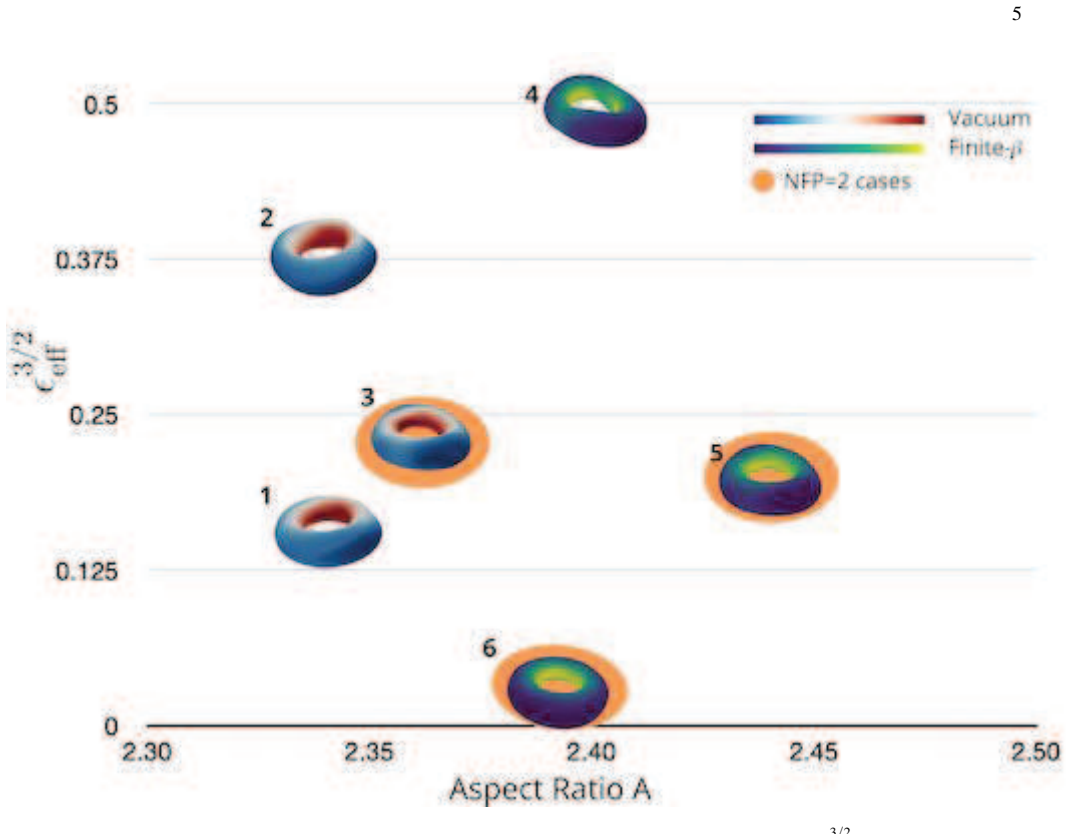
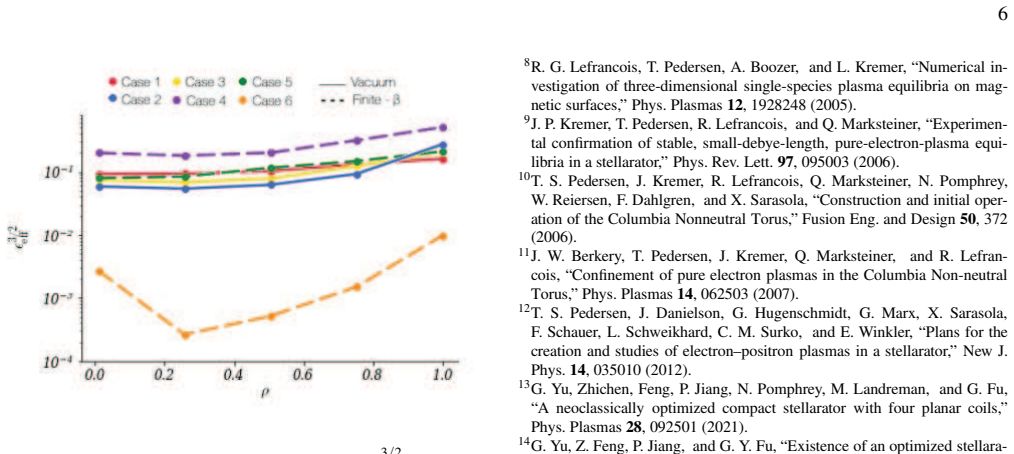
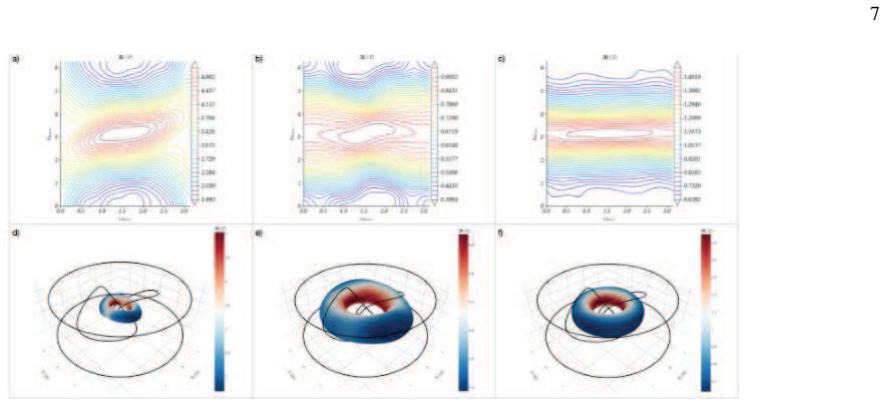
Inspired by the design for the simple Columbia Non-neutral Torus (CNT) proposed by Pedersen and Boozer (Phys. Rev. Lett. 88 205002(2002)), and later revisited by Yu et al. (J. Plasma Phys. 88 905880306 (2022)), this work explores axi-symmetric equilibria using two planar vertical field coils and two non-planar intertwined coils. Neoclassical optimization studies are performed in a single stage approach using the DESC stellarator equilibrium solver (Dudt and Koleman, Phys. Plasmas 27 (2020) 102513). The physical parameters used as input were the toroidal magnetic flux function $\psi$, the rotational transform $\iota(\rho)$ as a function of the normalized flux function $\rho$ as the radial coordinate, the number of field periods $N_{FP}$, and an initial equilibrium assumption, given the major radius $R_0$ and the minor radius $a$. Once the equilibrium given by the coil configuration is defined, an optimization is made for quasi-symmetry. In this study, a triple product metric as defined by Dudt et al., (J. Plasma Phys. 89 (2023) 95589020) is used as a local error indicator, which is evaluated without resorting to Boozer coordinates. The goal is to optimize the effective ripple modulation amplitude ${\epsilon}_{eff}^{3/2}$, thus decreasing the neoclassical transport in the low collisionality $1/\nu$ regime. We show a sample of quasi-axisymmetric configurations obtained, both for the vacuum field and with finite pressure, which have reasonably good neoclassical transport in the sense of Boozer coordinates. In the best case scenarios the final rotational transfrom is inverted after optimization.
Editorial analysis
A structured set of objections, weighed in public.
Referee Report
Summary. The manuscript describes a single-stage optimization using the DESC code to obtain quasi-axisymmetric stellarator equilibria with a simplified four-coil set (two planar vertical-field coils and two non-planar coils) inspired by the CNT design. Inputs are toroidal flux ψ, rotational transform ι(ρ), field periods N_FP, and initial R0/a; optimization minimizes the triple-product metric of Dudt et al. (JPP 2023) evaluated without Boozer coordinates to reduce ε_eff^{3/2} and 1/ν neoclassical transport. Sample vacuum and finite-β equilibria are presented that are claimed to exhibit reasonably good neoclassical transport when assessed in Boozer coordinates, with some cases showing inverted rotational transform after optimization.
Significance. If the central transport claim holds, the work offers a practical route to QA stellarators with reduced coil complexity via single-stage free-boundary DESC optimization. The approach builds directly on prior CNT studies and supplies concrete configurations for both vacuum and finite-pressure cases, which could aid reproducibility. The use of a local, Boozer-free metric during optimization is a technical strength, but the overall impact is limited by the absence of quantitative validation linking the metric to actual Boozer-coordinate transport for these geometries.
major comments (2)
- [Abstract and optimization/results] Abstract and optimization/results sections: The central claim that the optimized configurations 'have reasonably good neoclassical transport in the sense of Boozer coordinates' is not supported by direct evidence. Optimization is performed exclusively with the triple-product metric evaluated without Boozer coordinates (targeting ε_eff^{3/2}), yet no comparison, correlation study, or post-optimization evaluation of the actual effective ripple in Boozer coordinates is reported for the four-coil free-boundary equilibria. This assumption is load-bearing for the transport conclusion.
- [Numerical results] Numerical results section: No quantitative error bars, resolution convergence studies, or comparisons against independent equilibrium solvers are provided for the reported equilibria or their transport metrics. This absence leaves the reliability of the 'best case' inverted-ι configurations and the overall optimization outcomes only moderately supported.
minor comments (2)
- [Abstract] Abstract: Typo 'transfrom' should read 'transform'.
- [Introduction/methods] The description of coil geometry and the precise definition of the input parameters (ψ, ι(ρ), R0, a) would benefit from an explicit table or figure for reproducibility.
Simulated Author's Rebuttal
We thank the referee for the constructive and detailed review of our manuscript. The comments correctly identify areas where additional validation would strengthen the presentation of our results. We respond point by point to the major comments below and outline the revisions we will implement.
read point-by-point responses
-
Referee: [Abstract and optimization/results] Abstract and optimization/results sections: The central claim that the optimized configurations 'have reasonably good neoclassical transport in the sense of Boozer coordinates' is not supported by direct evidence. Optimization is performed exclusively with the triple-product metric evaluated without Boozer coordinates (targeting ε_eff^{3/2}), yet no comparison, correlation study, or post-optimization evaluation of the actual effective ripple in Boozer coordinates is reported for the four-coil free-boundary equilibria. This assumption is load-bearing for the transport conclusion.
Authors: We agree that the manuscript as submitted does not report an explicit post-optimization computation of the effective ripple ε_eff in Boozer coordinates for the four-coil equilibria. The triple-product metric was selected because it provides a local, Boozer-free proxy for neoclassical transport that targets the 1/ν regime, with supporting analysis in the referenced Dudt et al. (JPP 2023) work. To directly substantiate the claim of reasonably good neoclassical transport, we will add in the revised manuscript a dedicated comparison: for each presented vacuum and finite-β equilibrium we will compute and report the actual ε_eff^{3/2} in Boozer coordinates (using the standard transformation) alongside the optimized triple-product values. This will supply the missing quantitative link between the optimization metric and the Boozer-frame transport indicator. revision: yes
-
Referee: [Numerical results] Numerical results section: No quantitative error bars, resolution convergence studies, or comparisons against independent equilibrium solvers are provided for the reported equilibria or their transport metrics. This absence leaves the reliability of the 'best case' inverted-ι configurations and the overall optimization outcomes only moderately supported.
Authors: We concur that quantitative error estimates and convergence information would improve confidence in the results. In the revised manuscript we will include resolution studies in which the Fourier mode numbers and radial collocation points in DESC are systematically varied; we will report the resulting changes in the triple-product metric, rotational transform profiles, and coil currents for the optimized cases, including the inverted-ι configurations. This will provide the requested convergence data and error bars. Direct comparisons of the free-boundary equilibria against independent solvers such as VMEC are not available in the present study. revision: partial
- Direct comparisons of the reported equilibria and transport metrics against independent equilibrium solvers
Circularity Check
No significant circularity: external solver and metric drive independent optimization outputs
full rationale
The derivation begins with explicit input parameters (ψ, ι(ρ), N_FP, R0, a) fed into the DESC solver. Quasi-symmetry optimization is performed by minimizing the triple-product metric taken from an external citation (Dudt et al. 2023), which is evaluated without Boozer coordinates. The resulting coil equilibria are then assessed for neoclassical transport properties directly in Boozer coordinates. This produces concrete configuration outputs whose transport metrics are not algebraically identical to the optimization inputs or the metric definition itself. No self-definitional loop, fitted-input-as-prediction, or load-bearing self-citation chain exists; the central claims rest on the solver's numerical solution and the external metric's application rather than tautological restatement.
Axiom & Free-Parameter Ledger
free parameters (4)
- toroidal flux psi
- rotational transform iota(rho)
- number of field periods N_FP
- major radius R0 and minor radius a
axioms (2)
- domain assumption The DESC solver produces accurate free-boundary equilibria for the given coil currents and plasma profiles.
- domain assumption The triple-product metric without Boozer coordinates is a faithful local proxy for effective ripple amplitude epsilon_eff^{3/2}.
Reference graph
Works this paper leans on
-
[1]
T. S. Pedersen and A. H. Boozer. Confinement of N onneutral P lasmas on M agnetic S urfaces. Phys. Rev. Lett. 2002
2002
-
[2]
T. S. Pedersen and A.H. Boozer and W. Dorland and J.P. Kremer and R. Schmitt. Prospects for the creation of positron–electron plasmas in a non-neutral stellarator. J. Phys. B: At. Mol. Opt. Phys. 2003
2003
-
[3]
T. S. Pedersen and A.H. Boozer and J.P. Kremer and R. Lefrancois. Confinement of plasmas of arbitrary neutrality in a stellarator. Phys. Plasmas. 2004
2004
-
[4]
R. G. Lefrancois and T.S. Pedersen and A.H. Boozer and L.P. Kremer. Numerical investigation of three-dimensional single-species plasma equilibria on magnetic surfaces. Phys. Plasmas. 2005
2005
-
[5]
J. P. Kremer and T.S. Pedersen and R.G. Lefrancois and Q. Marksteiner. Experimental Confirmation of Stable, Small-Debye-Length, Pure-Electron-Plasma Equilibria in a Stellarator. Phys. Rev. Lett. 2006
2006
-
[6]
T. S. Pedersen and J.P. Kremer and R.G. Lefrancois and Q. Marksteiner and N. Pomphrey and W. Reiersen and F. Dahlgren and Xabier Sarasola. Construction and initial operation of the C olumbia N onneutral T orus. Fusion Eng. and Design. 2006
2006
-
[7]
J. W. Berkery and T.S. Pedersen and J.P. Kremer and Q.R. Marksteiner and R.G. Lefrancois. Confinement of pure electron plasmas in the C olumbia N on-neutral T orus. Phys. Plasmas. 2007
2007
-
[8]
T. S. Pedersen and J.R. Danielson and G.H. Hugenschmidt and G. Marx and X. Sarasola and F. Schauer and L Schweikhard and C M Surko and E Winkler. Plans for the creation and studies of electron–positron plasmas in a stellarator. New J. Phys. 2012
2012
-
[9]
A neoclassically optimized compact stellarator with four planar coils
Guodong Yu and Zhichen and Feng and Peiyou Jiang and Neil Pomphrey and Matt Landreman and GuoYong Fu. A neoclassically optimized compact stellarator with four planar coils. Phys. Plasmas. 2021
2021
-
[10]
Yu and Z
G. Yu and Z. Feng and P. Jiang and G. Y. Fu. Existence of an optimized stellarator with simple coils. J. Plasma Phys. 2022
2022
-
[11]
Baillod and E.J
A. Baillod and E.J. Paul and G. Rawlinson and M. Haque and S.W. Freiberger and S. Thapa. Integrating novel stellarator single-stage optimization algorithms to design the Columbia stellarator experiment. Nucl. Fusion. 2025
2025
-
[12]
Paul and Mohammed Haque and Pedro F
Paul Huslage and Elizabeth J. Paul and Mohammed Haque and Pedro F. Gil and Nicolo Foppiani and Jason Smoniewski and Eve V. Stenson. Strain optimisation for R e BCO high-temperature superconducting stellarator coils in SIMSOPT. J. Plasma Phys. 2025
2025
-
[13]
Jorge and A
R. Jorge and A. Goodman and M. Landreman and J. Rodrigues and F. Wechsung. Existence of an optimized stellarator with simple coils. Plasma Phys. Control. Fusion. 2023
2023
-
[14]
Shmeling and M
D. Shmeling and M. Russo and B.T. Gebreamlak and T. J. Kiker and A. R. Skrypek and A. R. Hightower and J. Xue and S. Chen and S. Sohaib and C. Martinez and others. Experimental Results from Early Non-Planar NI-HTS Magnet Prototypes for the C olumbia S tellarator e X periment ( CSX ). 2025
2025
-
[15]
D. W. Dudt and E. Kolemen. DESC : A stellarator equilibrium solver. Phys. Plasmas. 2020
2020
-
[16]
Panici and R
D. Panici and R. Conlin and D.W. Dudt and K. Unalmis and Kolemen. The DESC stellarator code suite. P art 1. Q uick and accurate equilibria computations. J. Plasma Phys. 2023
2023
-
[17]
Conlin and D.W
R. Conlin and D.W. Dudt and D. Panici and E. Kolemen. The DESC stellarator code suite. P art 2. P erturbation and continuation methods. J. Plasma Phys. 2023
2023
-
[18]
D. W. Dudt and R. Conlin and D. Panici and E. Kolemen. The DESC stellarator code suite P art 3: Q uasi-symmetry optimization. J. Plasma Phys. 2023
2023
-
[19]
Numerical Methods for Stellarator Equilibrium and Optimization: Continuation Methods, Free Boundary Equilibrium, and Constrained Optimization
William Conlin. Numerical Methods for Stellarator Equilibrium and Optimization: Continuation Methods, Free Boundary Equilibrium, and Constrained Optimization. 2024
2024
-
[20]
Colin and P
R. Colin and P. Kim and D.W. Dudt and D. Panici and E. Kolemen. Stellarator optimization with constraints. J. Plasma Phys. 2024
2024
-
[21]
D. W. Dudt and A.G. Goodman and R. Colin and D. Panici and E. Kolemen. Magnetic fields with general omnigenity. J. Plasma Phys. 2024
2024
-
[22]
S. R. Hudson and D. Panici and C. Zhu and G. S. Woodbury Saudeau and A. Baillod and M. Cianciosa and A. S. Ware. Verification of the Shafranov shift in free-boundary VMEC , DESC , and SPEC calculations with elliptical geometry. Phys. Plasmas. 2025
2025
-
[23]
D. G. Panici and E. Rodtiguez and R. Colin and D.W. Dudt and E. Kolemen. Extending near-axis equilibria in DESC. J. Plasma Phys. 2025
2025
-
[24]
Graur and D.G
R. Graur and D.G. Panici and T.M. Elder and M. Landreman and K. Unalmis and Y.G. Elmacioglu and D.W. Dudt and R. Conlin and E. Kolemen. Omnigenous umbilic stellarators. J. Plasma Phys. 2025
2025
-
[25]
Jorge and A
R. Jorge and A. Goodman and M. Landreman and J. Rodrigues and F. Weschsung. Single-stage stellarator optimization: combining coils with fixed boundary equilibria. Plasma Phys. Control. Fusion. 2023
2023
-
[26]
Thun and R
T. Thun and R. Colin and D. G. Panici and D. Br o kenhoff. Narrow operator models of stellarator equilibria in Fourier Zernike basis. J. Plasma Phys. 2026
2026
-
[27]
Hellander and C
P. Hellander and C. Beidler and P.M. Bird and M. Drevlak and Y. Feng and R. Hatzky and F. Jenko and R. Kleiber and J. H. E. Proll and Yu. Turkin. Stellarator and tokamak plasmas: a comparison. Plasma Phys. Control. Fusion. 2012
2012
-
[28]
Landreman
M. Landreman. Mapping the space of quasisymmetric stellarators using optimized near-axis expansion. J. Plasma Phys. 2022
2022
-
[29]
Rodr \' guez and G
E. Rodr \' guez and G. G. Plunk. Near-axis quasi-isodynamic database. 2026
2026
-
[30]
Rodr \' guez and P
E. Rodr \' guez and P. Hellander and A. Bhattacharjee. Necessary and sufficient conditions for quasisymmetry. Phys. Plasmas. 2020
2020
-
[31]
Theory of plasma confinement in non-axisymmetric magnetic fields
Per Hellander. Theory of plasma confinement in non-axisymmetric magnetic fields. Rep. Prog. Phys. 2014
2014
-
[32]
Zeernike and F.J.M
F. Zeernike and F.J.M. Stratton. Diffraction theory of knife-edge test and its improved form, the phase-contrast method. Mon. Not. R. Astron. Soc. 1934
1934
-
[33]
Sakai and L.G
T. Sakai and L.G. Redekopp. An application of one-sided Jacobi polynomials for spectral modeling of vector fields in polar coordinates. J. Comput. Phys. 2009
2009
-
[34]
Nemov and S.V.K
V.V. Nemov and S.V.K. Kasilov and S.V.K. Kernbichler and M.F. Heyn. Evaluation of 1/ neoclassical transport in stellarators. Phys. Plasmas. 1999
1999
-
[35]
Paul and T
E.J. Paul and T. Antonsen and M. Landreman and W. Cooper. Adjoint approach to calculating shape gradients for three-dimensional magnetic confinement equilibria. Part 2. J. Plasma Phys. 2020
2020
-
[36]
Stringer
T.E. Stringer. Effect of the magnetic field ripple on diffusion in Tokamaks. Nucl. Fusion. 1972
1972
-
[37]
Beidler and K
C.D. Beidler and K. Allmaier and M.Yu. Isaev and S.V. Kasilov and W. Kernbichler and G.O. Leitold and H. Maaßberg and D.R. Mikkelsen and S. Murakami and M. Schmidt and others. Benchmarking of the mono-energetic transport coefficients—results from the International Collaboration on Neoclassical Transport in Stellarators (ICNTS). Nucl. Fusion. 2011
2011
discussion (0)
Sign in with ORCID, Apple, or X to comment. Anyone can read and Pith papers without signing in.