Recognition: 3 theorem links
· Lean TheoremMobility Anisotropy Reshapes Self-Propelled Motion
Pith reviewed 2026-05-08 19:04 UTC · model grok-4.3
The pith
Anisotropic mobility produces a strictly sub-Gaussian position distribution in trapped self-propelled particles.
A machine-rendered reading of the paper's core claim, the machinery that carries it, and where it could break.
Core claim
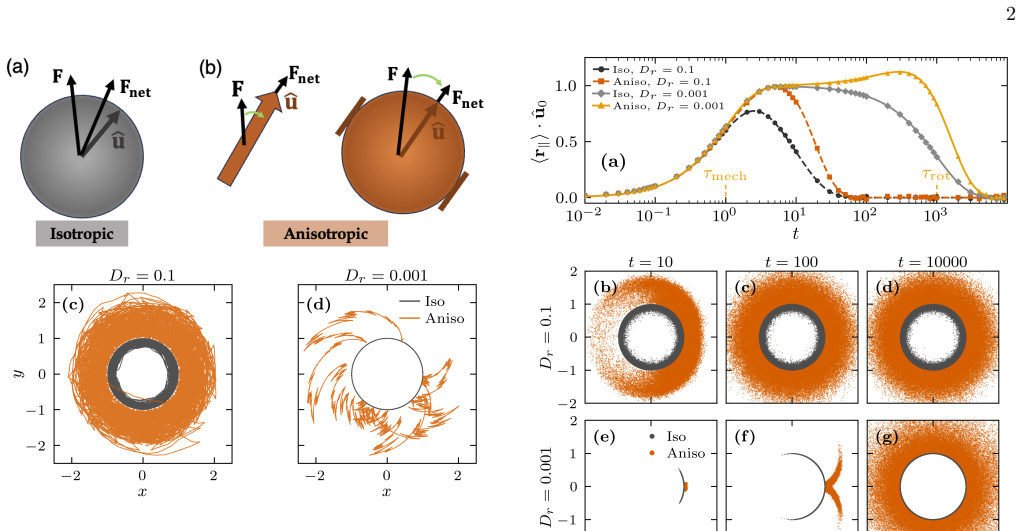
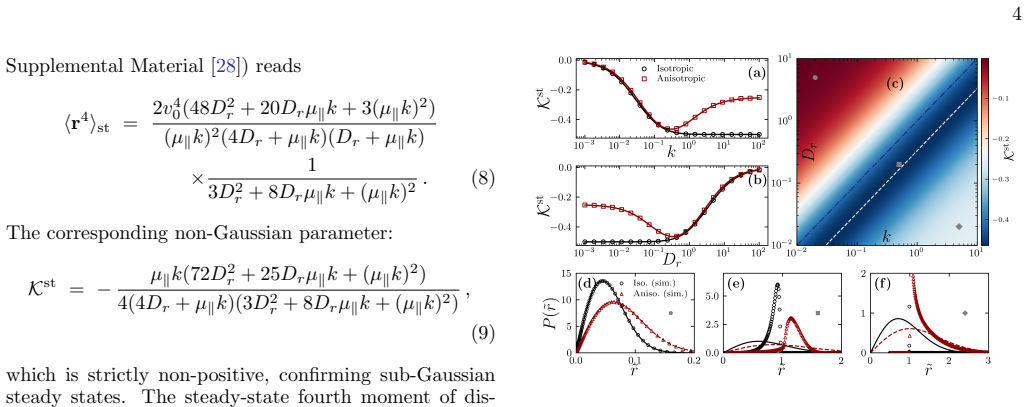
Exact solution of the coupled translational and rotational equations reveals a quasi-steady plateau in displacement statistics with vanishing fluctuations at high persistence. The steady-state fourth moment yields negative excess kurtosis that changes non-monotonically with the mechanical-to-rotational timescale ratio, producing a strictly sub-Gaussian position distribution. In the high-persistence limit the particle is therefore displaced into the high-potential region outside the stationary contour defined by activity and confinement, a conclusion corroborated by the relaxation of the mean-squared displacement from the plateau to the final steady state.
What carries the argument
The anisotropic mobility tensor that couples the particle's propulsion direction to its translational friction in the overdamped Langevin equation with rotational diffusion, solved in closed form for the first four position moments.
If this is right
- The steady-state position distribution is strictly sub-Gaussian rather than Gaussian.
- Excess kurtosis varies non-monotonically with the ratio of mechanical to rotational relaxation timescales.
- In the high-persistence regime the particle displaces beyond the activity-defined contour into higher-potential regions.
- The mean-squared displacement relaxes from a quasi-steady plateau to the long-time steady state.
Where Pith is reading between the lines
- Mobility anisotropy may allow active particles to reach higher-energy states than isotropic models predict under identical confinement.
- The non-monotonic dependence on timescale ratio could be exploited to tune the degree of sub-Gaussian behavior by adjusting persistence.
- Analogous effects may appear in three-dimensional or crowded active systems where directed propulsion encounters orientation-dependent friction.
Load-bearing premise
The derivation assumes a fixed anisotropic mobility tensor, overdamped Langevin dynamics in a purely harmonic potential, and the high-persistence limit for the quasi-steady plateau.
What would settle it
Measuring the position histogram of a rod-like microswimmer in a harmonic optical trap and finding positive excess kurtosis or a Gaussian distribution would contradict the predicted sub-Gaussian character.
Figures

read the original abstract
We exactly solve the nonequilibrium dynamics of a harmonically trapped self-propelled particle with anisotropic translational mobility in two dimensions, relevant to rodlike microswimmers and wheeled robots. The mean displacement and MSD reveal a quasi-steady plateau with vanishing fluctuations in the high-persistence regime. An exact calculation of steady-state fourth moment yields a negative excess kurtosis that varies non-monotonically with the ratio of mechanical to rotational relaxation timescales. This gives rise to a strictly sub-Gaussian steady-state position distribution, in which the particle with anisotropic mobility, in high persistence regime, is displaced into the high-potential region lying outside the stationary contour set by the activity and harmonic confinement. This is further corroborated by the relaxation of the MSD from the quasi-steady plateau to the steady-state regime.
Editorial analysis
A structured set of objections, weighed in public.
Referee Report
Summary. The manuscript exactly solves the overdamped Langevin dynamics of a harmonically trapped self-propelled particle with anisotropic translational mobility in 2D. It reports a quasi-steady plateau in mean displacement and MSD in the high-persistence regime, followed by an exact steady-state fourth-moment calculation that yields negative excess kurtosis varying non-monotonically with the ratio of mechanical to rotational relaxation times. This is claimed to produce a strictly sub-Gaussian position distribution in which the particle is displaced into the high-potential region outside the activity-and-confinement contour, with the claim further supported by the relaxation of the MSD from the quasi-steady plateau.
Significance. If the fourth-moment result is exact and the sub-Gaussian interpretation can be rigorously justified, the work supplies an analytically tractable benchmark for how mobility anisotropy modifies the statistics of confined active particles, with potential relevance to rod-like microswimmers and wheeled robots. The non-monotonic kurtosis dependence on the timescale ratio constitutes a falsifiable prediction.
major comments (2)
- [Abstract] Abstract (and the section presenting the fourth-moment result): the assertion that negative excess kurtosis 'gives rise to a strictly sub-Gaussian steady-state position distribution' is not justified. Sub-Gaussianity requires a bound on the moment-generating function or uniform control of all higher even moments; a negative fourth cumulant alone supplies no such bound. In the high-persistence anisotropic regime the translational-rotational coupling prevents closure of the moment hierarchy after fourth order, so nothing in the reported calculation rules out higher moments that would violate sub-Gaussian tails.
- [Abstract] Abstract (and the paragraph linking fourth moment to spatial displacement): the claim that the particle is 'displaced into the high-potential region lying outside the stationary contour' cannot be inferred from fourth-moment data. A distribution with negative excess kurtosis can still place appreciable mass at large radii if the second moment is sufficiently inflated; radial or higher-order information is required to support this statement.
minor comments (2)
- [Abstract] The abstract and main text should explicitly state the precise definition of the 'stationary contour set by the activity and harmonic confinement' and how it is computed.
- Clarify whether the exact fourth-moment expressions are obtained by direct integration of the Fokker-Planck equation or by solving the closed moment equations; include the key intermediate steps or an appendix reference.
Simulated Author's Rebuttal
We thank the referee for the careful and constructive report. The comments highlight important distinctions between moment-based characterizations and stronger distributional properties. We address each point below and will revise the manuscript to ensure claims are precisely supported by the calculations.
read point-by-point responses
-
Referee: [Abstract] Abstract (and the section presenting the fourth-moment result): the assertion that negative excess kurtosis 'gives rise to a strictly sub-Gaussian steady-state position distribution' is not justified. Sub-Gaussianity requires a bound on the moment-generating function or uniform control of all higher even moments; a negative fourth cumulant alone supplies no such bound. In the high-persistence anisotropic regime the translational-rotational coupling prevents closure of the moment hierarchy after fourth order, so nothing in the reported calculation rules out higher moments that would violate sub-Gaussian tails.
Authors: We agree with the referee that a negative excess kurtosis does not, by itself, establish sub-Gaussianity, as the moment hierarchy does not close and higher even moments remain uncontrolled. Our exact solution yields the fourth moment but provides no uniform bound on the moment-generating function. We will therefore revise the abstract and the fourth-moment section to remove the claim of a 'strictly sub-Gaussian' distribution. The revised text will state only that the steady-state distribution exhibits negative excess kurtosis (platykurtic relative to Gaussian at fourth order) and will explicitly note the limitation on higher moments. revision: yes
-
Referee: [Abstract] Abstract (and the paragraph linking fourth moment to spatial displacement): the claim that the particle is 'displaced into the high-potential region lying outside the stationary contour' cannot be inferred from fourth-moment data. A distribution with negative excess kurtosis can still place appreciable mass at large radii if the second moment is sufficiently inflated; radial or higher-order information is required to support this statement.
Authors: The referee correctly observes that fourth-moment information alone cannot establish displacement beyond the activity-confinement contour. While the manuscript already reports the exact steady-state MSD and its relaxation from the quasi-steady plateau, this second-moment dynamics provides only indirect support. We will revise the abstract and the relevant paragraph to ground the displacement statement in the MSD relaxation behavior and the overall exact solution rather than in the kurtosis result. We will also qualify the language to indicate that a direct radial distribution or higher radial moments would be needed for a fully rigorous demonstration; if the exact framework permits, we will add a brief discussion of radial moments. revision: partial
Circularity Check
No circularity: exact moment calculations are self-contained
full rationale
The paper states it exactly solves the overdamped Langevin dynamics for the harmonically confined anisotropic particle and computes the steady-state fourth moment directly from the resulting Fokker-Planck or moment equations. No parameters are fitted to a data subset and then renamed as a prediction, no self-citations are invoked to establish uniqueness theorems or ansatzes, and the negative excess kurtosis is obtained as an output of the explicit calculation rather than presupposed by definition. The derivation therefore remains independent of its own inputs and does not reduce by construction to any of the enumerated circular patterns.
Axiom & Free-Parameter Ledger
axioms (3)
- domain assumption Overdamped Langevin dynamics govern the particle motion.
- domain assumption Translational mobility is anisotropic in two dimensions.
- domain assumption Harmonic confinement potential is applied.
Lean theorems connected to this paper
-
Cost.FunctionalEquation / Foundation.AlphaCoordinateFixationwashburn_uniqueness_aczel; J_uniquely_calibrated_via_higher_derivative unclear?
unclearRelation between the paper passage and the cited Recognition theorem.
An exact calculation of steady-state fourth moment yields a negative excess kurtosis that varies non-monotonically with the ratio of mechanical to rotational relaxation timescales.
-
Foundation.AlphaCoordinateFixation; Constants (phi)n/a — extremum is rational in D_r,μ∥k, not a φ-identity unclear?
unclearRelation between the paper passage and the cited Recognition theorem.
K_st = −μ∥k(72D_r² + 25 D_r μ∥k + (μ∥k)²) / [4(4D_r+μ∥k)(3D_r²+8D_r μ∥k+(μ∥k)²)]; numerically the most negative K_st,* ≈ −0.46 at χ* ≈ 0.33.
-
Foundation.ArrowOfTime; Foundation.Atomicityn/a unclear?
unclearRelation between the paper passage and the cited Recognition theorem.
Self-propelled particle obeying overdamped Langevin dynamics ṙ = v₀ û + μ∥ ûûᵀ F with rotational diffusion ˙û = √(2D_r) η û⊥.
What do these tags mean?
- matches
- The paper's claim is directly supported by a theorem in the formal canon.
- supports
- The theorem supports part of the paper's argument, but the paper may add assumptions or extra steps.
- extends
- The paper goes beyond the formal theorem; the theorem is a base layer rather than the whole result.
- uses
- The paper appears to rely on the theorem as machinery.
- contradicts
- The paper's claim conflicts with a theorem or certificate in the canon.
- unclear
- Pith found a possible connection, but the passage is too broad, indirect, or ambiguous to say the theorem truly supports the claim.
Reference graph
Works this paper leans on
-
[1]
Ramaswamy, The mechanics and statistics of active matter, Annual Review of Condensed Matter Physics1, 323 (2010)
S. Ramaswamy, The mechanics and statistics of active matter, Annual Review of Condensed Matter Physics1, 323 (2010)
2010
-
[2]
H. C. Berg,E. coli in Motion(Springer, 2004)
2004
-
[3]
W. F. Paxton, K. C. Kistler, C. C. Olmeda, A. Sen, S. K. St. Angelo, Y. Cao, T. E. Mallouk, P. E. Lammert, and V. H. Crespi, Catalytic nanomotors: Autonomous movement of striped nanorods, Journal of the American Chemical Society126, 13424 (2004)
2004
-
[4]
Tailleur and M
J. Tailleur and M. E. Cates, Statistical mechanics of in- teracting run-and-tumble bacteria, Phys. Rev. Lett.100, 218103 (2008)
2008
-
[5]
Jiang, N
H.-R. Jiang, N. Yoshinaga, and M. Sano, Active motion of a janus particle by self-thermophoresis in a defocused laser beam, Phys. Rev. Lett.105, 268302 (2010)
2010
-
[6]
Palacci, S
J. Palacci, S. Sacanna, A. P. Steinberg, D. J. Pine, and P. M. Chaikin, Living crystals of light-activated colloidal surfers, Science339, 936 (2013)
2013
-
[7]
R. E. Goldstein, Green algae as model organisms for bio- logical fluid dynamics, Annual Review of Fluid Mechanics 47, 343 (2015)
2015
-
[8]
Dauchot and V
O. Dauchot and V. D´ emery, Dynamics of a self-propelled particle in a harmonic trap, Phys. Rev. Lett.122, 068002 (2019)
2019
-
[9]
M. C. Marchetti, J. F. Joanny, S. Ramaswamy, T. B. Liverpool, J. Prost, M. Rao, and R. A. Simha, Hydrody- namics of soft active matter, Rev. Mod. Phys.85, 1143 (2013)
2013
-
[10]
Romanczuk, M
P. Romanczuk, M. B¨ ar, W. Ebeling, B. Lindner, and L. Schimansky-Geier, Active brownian particles: From individual to collective stochastic dynamics, The Euro- pean Physical Journal Special Topics202, 1 (2012)
2012
-
[11]
Bechinger, R
C. Bechinger, R. Di Leonardo, H. L¨ owen, C. Reichhardt, G. Volpe, and G. Volpe, Active particles in complex and crowded environments, Rev. Mod. Phys.88, 045006 (2016)
2016
-
[12]
U. Basu, S. N. Majumdar, A. Rosso, and G. Schehr, Ac- tive brownian motion in two dimensions, Phys. Rev. E 98, 062121 (2018)
2018
-
[13]
U. Basu, S. N. Majumdar, A. Rosso, and G. Schehr, Long-time position distribution of an active brownian particle in two dimensions, Phys. Rev. E100, 062116 (2019)
2019
-
[14]
A. Shee, A. Dhar, and D. Chaudhuri, Active Brownian particles: mapping to equilibrium polymers and exact computation of moments, Soft Matter16, 4776 (2020)
2020
-
[15]
G. S. Redner, M. F. Hagan, and A. Baskaran, Structure and dynamics of a phase-separating active colloidal fluid, Phys. Rev. Lett.110, 055701 (2013)
2013
-
[16]
A. P. Solon, J. Stenhammar, R. Wittkowski, M. Kardar, Y. Kafri, M. E. Cates, and J. Tailleur, Pressure and phase equilibria in interacting active brownian spheres, Phys. Rev. Lett.114, 198301 (2015)
2015
-
[17]
Henkes, K
S. Henkes, K. Kostanjevec, J. M. Collinson, R. Sknep- nek, and E. Bertin, Dense active matter model of motion patterns in confluent cell monolayers, Nature Communi- cations11, 1405 (2020)
2020
-
[18]
Peruani, A
F. Peruani, A. Deutsch, and M. B¨ ar, Nonequilibrium clustering of self-propelled rods, Phys. Rev. E74, 030904 (2006)
2006
-
[19]
Baskaran and M
A. Baskaran and M. C. Marchetti, Hydrodynamics of self- propelled hard rods, Phys. Rev. E77, 011920 (2008)
2008
-
[20]
Elgeti and G
J. Elgeti and G. Gompper, Self-propelled rods near sur- faces, Europhysics Letters85, 38002 (2009)
2009
-
[21]
Elgeti, R
J. Elgeti, R. G. Winkler, and G. Gompper, Physics of mi- croswimmers—single particle motion and collective be- havior, Reports on Progress in Physics78, 056601 (2015)
2015
-
[22]
Peruani, Active brownian rods, The European Physi- cal Journal Special Topics225, 2301 (2016)
F. Peruani, Active brownian rods, The European Physi- cal Journal Special Topics225, 2301 (2016)
2016
-
[23]
B¨ ar, R
M. B¨ ar, R. Großmann, S. Heidenreich, and F. Peruani, Self-propelled rods: Insights and perspectives for active matter, Annual Review of Condensed Matter Physics11, 441 (2020)
2020
-
[24]
Zheng, C
Y. Zheng, C. Huepe, and Z. Han, Experimental capabili- ties and limitations of a position-based control algorithm for swarm robotics, Adaptive Behavior30, 19 (2022)
2022
-
[25]
H. Xu, Y. Huang, R. Zhang, and Y. Wu, Autonomous waves and global motion modes in living active solids, Nature Physics19, 46 (2023)
2023
-
[26]
Malakar, A
K. Malakar, A. Das, A. Kundu, K. V. Kumar, and A. Dhar, Steady state of an active brownian particle in a two-dimensional harmonic trap, Phys. Rev. E101, 022610 (2020)
2020
-
[27]
Chaudhuri and A
D. Chaudhuri and A. Dhar, Active brownian particle in harmonic trap: exact computation of moments, and re- entrant transition, Journal of Statistical Mechanics: The- ory and Experiment , 013207 (2021)
2021
-
[28]
[14, 27]
See supplemental material at [publisher will insert url] for 6 detailed derivations of all analytic moments for isotropic and anisotropic mobility, including exact laplace-space calculations, time-dependent results, and the steady- state fourth moment and non-Gaussian parameter, which includes refs. [14, 27]. END MA TTER Exact analytic results for isotrop...
discussion (0)
Sign in with ORCID, Apple, or X to comment. Anyone can read and Pith papers without signing in.