Recognition: 2 theorem links
· Lean TheoremOptimizing Quantum Entanglement Preservation in a Qubit-Qubit System with Dzyaloshinskii Moriya Interaction under Noisy Magnetic Fields via Feedback Control
Pith reviewed 2026-05-12 04:34 UTC · model grok-4.3
The pith
Feedback control of DM interaction doubles average negativity and improves sensing sensitivity by a factor of 2.4 under colored noise.
A machine-rendered reading of the paper's core claim, the machinery that carries it, and where it could break.
Core claim
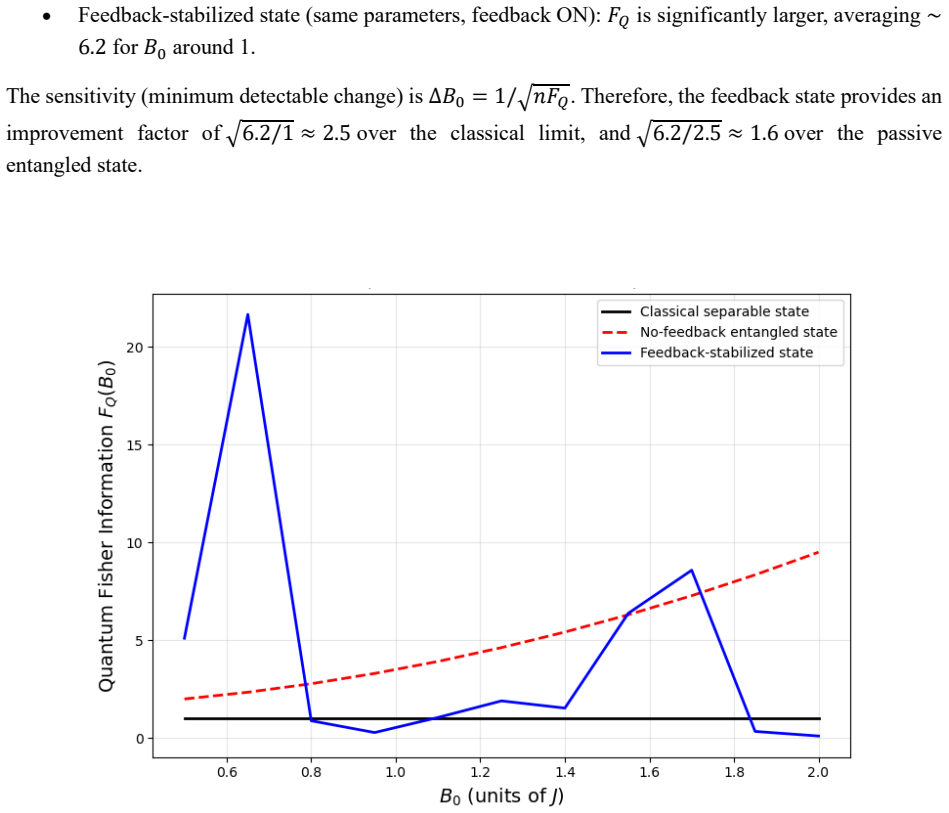
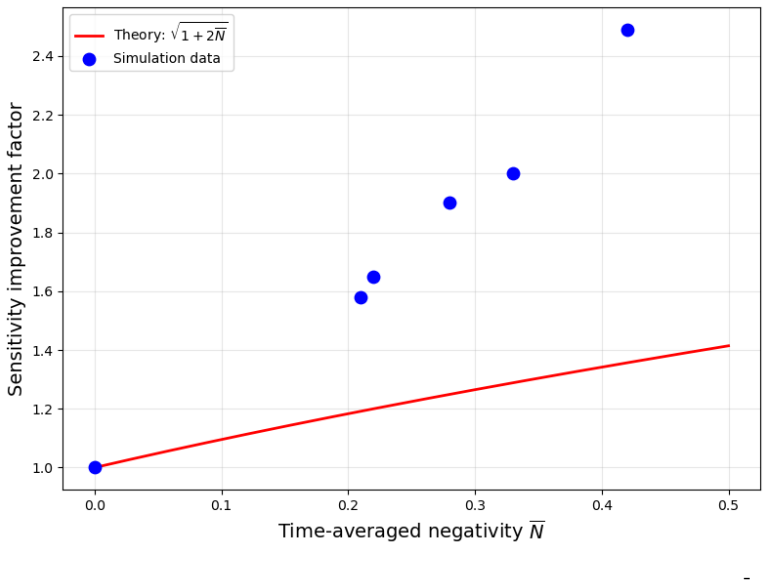
By deriving a stochastic Lindblad master equation for the qubit-qubit system with DM interaction under colored noise and applying proportional-integral feedback to dynamically tune the DM interaction strength D_z(t) to maintain negativity near a target, the time-averaged negativity rises from 0.21 to 0.42 for alpha=1 at sigma=0.5; the resulting state yields a quantum Fisher information that improves sensitivity for estimating a static field B_0 by a factor of 2.4 over the classical shot-noise limit.
What carries the argument
The proportional-integral feedback protocol that continuously adjusts the DM interaction strength D_z(t) according to the measured negativity to counteract degradation by stochastic magnetic fields.
Load-bearing premise
The feedback loop can adjust the DM interaction strength in real time with no delay or measurement noise, and the stochastic fields are completely captured by the chosen colored-noise spectrum in the Lindblad equation.
What would settle it
An experiment that applies colored magnetic noise of amplitude sigma=0.5 to a controllable qubit-qubit DM system, measures time-averaged negativity with and without the proportional-integral feedback, and checks whether the value reaches 0.42 instead of remaining near 0.21.
Figures


read the original abstract
Quantum entanglement is a key resource for quantum information processing and sensing, but it is severely degraded by environmental noise. We extend the previous study by Moosavi Khansari and Kazemi Hasanvand [27] of entanglement dynamics in a qubit qubit system with Dzyaloshinskii Moriya (DM) interaction and static magnetic fields to the realistic case of time varying, stochastic magnetic fields. We derive a stochastic Lindblad master equation and simulate quantum trajectories to quantify the negativity under colored noise. We then design a proportional integral feedback protocol that dynamically adjusts the DM interaction strength D_z (t) to maintain negativity near a target value. The feedback stabilized state is used as a probe for quantum metrology: we compute the quantum Fisher information (QFI) for estimating an unknown static field B_0. Our simulations show that feedback increases the time averaged negativity from 0.21 to 0.42 for {\alpha}=1 at noise amplitude {\sigma}=0.5, leading to a factor 2.4 improvement in sensitivity over the classical shot noise limit. This work provides a practical route to protect entanglement in noisy environments and enhances quantum sensing performance.
Editorial analysis
A structured set of objections, weighed in public.
Referee Report
Summary. The paper extends prior work on entanglement dynamics in a two-qubit system with Dzyaloshinskii-Moriya interaction under static fields to the case of time-varying stochastic magnetic fields. It derives a stochastic Lindblad master equation, performs quantum trajectory simulations to track negativity under colored noise parameterized by amplitude σ and exponent α, designs a proportional-integral feedback controller that dynamically tunes D_z(t), and evaluates the resulting state as a probe for estimating a static field B_0 via quantum Fisher information, reporting a doubling of time-averaged negativity (0.21 to 0.42) and a 2.4-fold sensitivity gain for α=1, σ=0.5.
Significance. If the idealized feedback assumptions hold, the approach offers a concrete numerical demonstration that closed-loop control of the DM interaction can protect entanglement and improve metrological performance under colored noise. The use of stochastic master-equation trajectories and direct QFI evaluation is a standard and appropriate methodology for this setting; the reported factor-of-two negativity improvement and sensitivity gain constitute a clear, falsifiable numerical result for the chosen parameters.
major comments (3)
- [Feedback Control Protocol] The feedback protocol (described after the stochastic master equation) assumes instantaneous, noise-free, real-time adjustment of D_z(t) computed from the current trajectory. No analysis or auxiliary simulation of control latency, measurement back-action on the control channel, or additive control noise is provided; any such imperfection would directly degrade the closed-loop negativity and therefore the reported QFI improvement.
- [Numerical Simulations and Results] The headline numerical claims (time-averaged negativity rising from 0.21 to 0.42 and 2.4× sensitivity gain for α=1, σ=0.5) are obtained from forward integration of the stochastic master equation but are presented without error bars, convergence tests on trajectory number, or details on how the PI gains were selected or optimized, leaving open the possibility that the improvement is sensitive to post-hoc tuning.
- [Derivation of the Stochastic Master Equation] The stochastic Lindblad form is stated to capture the colored magnetic noise, yet the manuscript provides no derivation or validation that the chosen dissipators fully reproduce the target noise spectrum for the full range of α and σ explored; this assumption underpins both the open-loop degradation and the closed-loop recovery.
minor comments (2)
- [Introduction] The abstract and introduction cite the prior static-field study [27] but do not explicitly delineate which new technical elements (stochastic derivation, feedback design, or metrology application) constitute the primary advance.
- [Model and Parameters] Notation for the noise parameters (σ, α) and the target negativity value used in the PI controller should be defined once in the main text before their first numerical use.
Simulated Author's Rebuttal
We thank the referee for the constructive comments and positive assessment of the significance of our results. We address each major comment below, indicating the revisions we will implement in the next version of the manuscript.
read point-by-point responses
-
Referee: The feedback protocol (described after the stochastic master equation) assumes instantaneous, noise-free, real-time adjustment of D_z(t) computed from the current trajectory. No analysis or auxiliary simulation of control latency, measurement back-action on the control channel, or additive control noise is provided; any such imperfection would directly degrade the closed-loop negativity and therefore the reported QFI improvement.
Authors: We agree that the analysis assumes ideal feedback. The manuscript was intended to demonstrate the potential benefit under perfect control. In the revised version we will add a new subsection discussing the idealization, qualitatively estimating the effects of finite latency and additive control noise, and, space permitting, include a brief auxiliary simulation of small latency to illustrate degradation. revision: partial
-
Referee: The headline numerical claims (time-averaged negativity rising from 0.21 to 0.42 and 2.4× sensitivity gain for α=1, σ=0.5) are obtained from forward integration of the stochastic master equation but are presented without error bars, convergence tests on trajectory number, or details on how the PI gains were selected or optimized, leaving open the possibility that the improvement is sensitive to post-hoc tuning.
Authors: We will revise the results section to report error bars obtained from an ensemble of independent trajectories, state the number of trajectories used together with convergence diagnostics, and add an explicit description of the PI-gain selection procedure (including the optimization criterion and final values). revision: yes
-
Referee: The stochastic Lindblad form is stated to capture the colored magnetic noise, yet the manuscript provides no derivation or validation that the chosen dissipators fully reproduce the target noise spectrum for the full range of α and σ explored; this assumption underpins both the open-loop degradation and the closed-loop recovery.
Authors: The stochastic Lindblad equation is obtained by inserting the stochastic magnetic-field Hamiltonian into the interaction picture and performing the appropriate ensemble average that yields the colored-noise dissipators. We will include the complete derivation in a new appendix and add validation plots confirming that the power spectrum of the simulated noise matches the target 1/f^α form across the explored (α,σ) range. revision: yes
Circularity Check
Minor self-citation to prior static-field study; core results from independent forward simulations of stochastic trajectories under designed feedback.
full rationale
The paper cites its own prior work [27] for entanglement dynamics under static magnetic fields but extends the model by deriving a stochastic Lindblad master equation for colored noise and running numerical quantum-trajectory simulations. The headline metrics (negativity rising from 0.21 to 0.42 and 2.4× QFI improvement) are produced by direct integration of the closed-loop stochastic master equation under an externally specified proportional-integral controller; no parameter is fitted to a data subset and then re-derived as a prediction, and no quantity is defined in terms of itself. The self-citation is not load-bearing for the new quantitative claims, which rest on the fresh stochastic model and controller. The derivation chain consists of standard open-system derivations plus forward simulation and is therefore self-contained against external benchmarks.
Axiom & Free-Parameter Ledger
free parameters (3)
- noise amplitude σ =
0.5
- noise exponent α =
1
- PI controller gains
axioms (2)
- domain assumption The two-qubit system obeys a stochastic Lindblad master equation under time-dependent magnetic fields.
- standard math Negativity is an appropriate entanglement monotone for this system.
Lean theorems connected to this paper
-
IndisputableMonolith/Cost/FunctionalEquation.leanwashburn_uniqueness_aczel unclear?
unclearRelation between the paper passage and the cited Recognition theorem.
We derive a stochastic Lindblad master equation and simulate quantum trajectories to quantify the negativity under colored noise. We then design a proportional-integral feedback protocol that dynamically adjusts the DM interaction strength D_z(t)
-
IndisputableMonolith/Foundation/RealityFromDistinction.leanreality_from_one_distinction unclear?
unclearRelation between the paper passage and the cited Recognition theorem.
The feedback-stabilized state is used as a probe for quantum metrology: we compute the quantum Fisher information (QFI) for estimating an unknown static field B_0
What do these tags mean?
- matches
- The paper's claim is directly supported by a theorem in the formal canon.
- supports
- The theorem supports part of the paper's argument, but the paper may add assumptions or extra steps.
- extends
- The paper goes beyond the formal theorem; the theorem is a base layer rather than the whole result.
- uses
- The paper appears to rely on the theorem as machinery.
- contradicts
- The paper's claim conflicts with a theorem or certificate in the canon.
- unclear
- Pith found a possible connection, but the passage is too broad, indirect, or ambiguous to say the theorem truly supports the claim.
Reference graph
Works this paper leans on
-
[1]
R. Horodecki, P. Horodecki, M. Horodecki, and K. Horodecki, “Quantum entanglement,” Rev. Mod. Phys. 81, 865 (2009). DOI: https://doi.org/10.1103/RevModPhys.81.865
-
[2]
H., Brassard, G., Crépeau, C., Jozsa, R., Peres, A., & Wootters, W
C. H. Bennett, G. Brassard, C. Crépeau, R. Jozsa, A. Peres, and W. K. Wootters, “Teleporting an unknown quantum state via dual classical and Einstein Podolsky Rosen channels,” Phys. Rev. Lett. 70, 1895 (1993). DOI: https://doi.org/10.1103/PhysRevLett.70.1895
-
[3]
Communication via one and two particle operators on Einstein Podolsky Rosen states,
C. H. Bennett and S. J. Wiesner, “Communication via one and two particle operators on Einstein Podolsky Rosen states,” Phys. Rev. Lett. 69, 2881 (1992). DOI: https://doi.org/10.1103/PhysRevLett.69.2881
-
[4]
M. A. Nielsen and I. L. Chuang, Quantum Computation and Quantum Information (Cambridge University Press, Cambridge, 2010). DOI: https://doi.org/10.1017/CBO9780511976667
-
[5]
Entangled coherent states: Teleportation and decoherence,
S. Van Enk and O. Hirota, “Entangled coherent states: Teleportation and decoherence,” Phys. Rev. A 64, 022313 (2001). DOI: https://doi.org/10.1103/PhysRevA.64.022313
-
[6]
B. C. Sanders, “Entangled coherent states,” Phys. Rev. A 45, 6811 (1992). DOI: https://doi.org/10.1103/PhysRevA.45.6811
-
[7]
Entanglement in bipartite generalized coherent states,
S. Sivakumar, “Entanglement in bipartite generalized coherent states,” Int. J. Theor. Phys. 48, 894 (2009). DOI: https://doi.org/10.1007/s10773-008-9862-3
-
[8]
Entangled three qutrit coherent states and localizable entanglement,
M. Ashrafpour, M. Jafarpour, and A. Sabour, “Entangled three qutrit coherent states and localizable entanglement,” Commun. Theor. Phys. 61, 177 (2014). DOI: https://doi.org/10.1088/0253-6102/61/2/05
-
[9]
M. Jafarpour and M. Ashrafpour, “Entanglement dynamics of a two qutrit system under DM interaction and the relevance of the initial state,” Quantum Inf. Process. 12, 761 (2013). DOI: https://doi.org/10.1007/s11128-012-0419-2
-
[10]
A thermodynamic theory of weak ferromagnetism of antiferromagnetics,
I. Dzyaloshinsky, “A thermodynamic theory of weak ferromagnetism of antiferromagnetics,” J. Phys. Chem. Solids 4, 241 (1958). DOI: https://doi.org/10.1016/0022-3697(58)90076-3
-
[11]
New mechanism of anisotropic superexchange interaction,
T. Moriya, “New mechanism of anisotropic superexchange interaction,” Phys. Rev. Lett. 4, 228 (1960). DOI: https://doi.org/10.1103/PhysRevLett.4.228
-
[12]
Correlation dynamics of qubit qutrit systems in a classical dephasing environment,
G. Karpat and Z. Gedik, “Correlation dynamics of qubit qutrit systems in a classical dephasing environment,” Phys. Lett. A 375, 4166 (2011). DOI: https://doi.org/10.1016/j.physleta.2011.10.017
-
[13]
Separability criterion for density matrices,
A. Peres, “Separability criterion for density matrices,” Phys. Rev. Lett. 77, 1413 (1996). DOI: https://doi.org/10.1103/PhysRevLett.77.1413
-
[14]
Separability of mixed states: necessary and sufficient conditions,
M. Horodecki, P. Horodecki, and R. Horodecki, “Separability of mixed states: necessary and sufficient conditions,” Phys. Lett. A 223, 1 (1996). DOI: https://doi.org/10.1016/S0375-9601(96)00706-2
-
[15]
Computable measure of entanglement,
G. Vidal and R. F. Werner, “Computable measure of entanglement,” Phys. Rev. A 65, 032314 (2002). DOI: https://doi.org/10.1103/PhysRevA.65.032314
-
[16]
Dynamics of entanglement and negativity in a two qubit system under DM interaction,
M. A. Chamgordani, N. Naderi, H. Koppelaar, and M. Bordbar, “Dynamics of entanglement and negativity in a two qubit system under DM interaction,” Int. J. Mod. Phys. B 33, 1950180 (2019). DOI: https://doi.org/10.1142/S0217979219501807
-
[17]
Influence of Dzyaloshinskii Moriya interaction on entanglement in a two qubit Heisenberg XYZ system,
G. F. Zhang, Y . C. Hou, and A. L. Ji, “Influence of Dzyaloshinskii Moriya interaction on entanglement in a two qubit Heisenberg XYZ system,” Solid State Commun. 151, 790 (2011). DOI: https://doi.org/10.1016/j.ssc.2011.02.032
-
[18]
Quantum Fisher information matrix and multiparameter estimation,
J. Liu, H. Yuan, X. M. Lu, and X. Wang, “Quantum Fisher information matrix and multiparameter estimation,” J. Phys. A: Math. Theor. 53, 023001 (2020). DOI: https://doi.org/10.1088/1751-8121/ab5d6d
-
[19]
L. Pezzè, A. Smerzi, M. K. Oberthaler, R. Schmied, and P. Treutlein, “Quantum metrology with non classical states of atomic ensembles,” Rev. Mod. Phys. 90, 035005 (2018). DOI: https://doi.org/10.1103/RevModPhys.90.035005
-
[20]
Characterizing nonclassical correlations via local quantum uncertainty,
D. Girolami, T. Tufarelli, and G. Adesso, “Characterizing nonclassical correlations via local quantum uncertainty,” Phys. Rev. Lett. 110, 240402 (2013). DOI: https://doi.org/10.1103/PhysRevLett.110.240402
-
[21]
Quantum Fisher information and fidelity susceptibility,
M. Gessner and A. Smerzi, “Quantum Fisher information and fidelity susceptibility,” Phys. Rev. A 97, 022109 (2018). DOI: https://doi.org/10.1103/PhysRevA.97.022109
-
[22]
Probing Rényi entanglement entropy via randomized measurements,
T. Brydges, A. Elben, P. Jurcevic, B. Vermersch, C. Maier, B. P. Lanyon, P. Zoller, R. Blatt, and C. F. Roos, “Probing entanglement in a many body system using randomised measurements,” Science 364, 260 (2019). DOI: https://doi.org/10.1126/science.aau4963
-
[23]
Entanglement and symmetry in Heisenberg models with Dzyaloshinskii Moriya interaction,
H. Pichler and A. M. Rey, “Entanglement and symmetry in Heisenberg models with Dzyaloshinskii Moriya interaction,” Phys. Rev. X 13, 011023 (2023). DOI: https://doi.org/10.1103/PhysRevX.13.011023
-
[24]
Feedback protected entanglement in noisy quantum sensors,
Y . Chen and N. Y . Yao, “Feedback protected entanglement in noisy quantum sensors,” Phys. Rev. Lett. 129, 070502 (2022). DOI: https://doi.org/10.1103/PhysRevLett.129.070502
-
[25]
Feedback and entanglement in quantum metrology,
S. A. Haine and J. J. Hope, “Feedback and entanglement in quantum metrology,” Phys. Rev. Lett. 124, 060402 (2020). DOI: https://doi.org/10.1103/PhysRevLett.124.060402
-
[26]
Quantum interface between light and atomic ensembles,
K. Hammerer, A. S. Sørensen, and E. S. Polzik, “Quantum interface between light and atomic ensembles,” Rev. Mod. Phys. 82, 1041 (2010). DOI: https://doi.org/10.1103/RevModPhys.82.1041
-
[27]
Moosavi Khansari, S.M. and Kazemi Hasanvand, F. 'Investigating the evolution of quantum entanglement of a qubit-qubit system with Dzyaloshinskii-Moriya interaction in the presence of magnetic fields', Journal of Interfaces, Thin Films, and Low dimensional systems, 8(1), pp. 837–854. (2024) DOI: https://doi.org/10.22051/jitl.2024.47853.1109
discussion (0)
Sign in with ORCID, Apple, or X to comment. Anyone can read and Pith papers without signing in.