Recognition: 2 theorem links
· Lean TheoremVoltage-Tunable Nonequilibrium Dispersion Interactions
Pith reviewed 2026-05-08 19:10 UTC · model grok-4.3
The pith
Applied bias voltage can enhance dispersion interactions by nearly an order of magnitude and make them repulsive.
A machine-rendered reading of the paper's core claim, the machinery that carries it, and where it could break.
Core claim
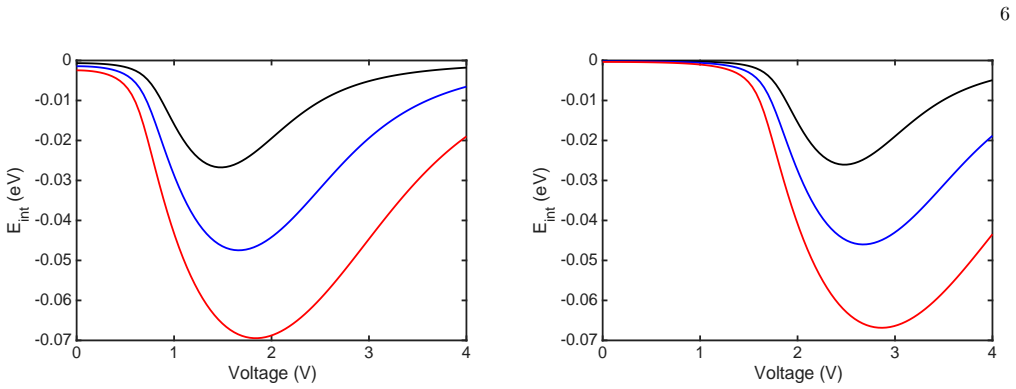
Starting from the two-particle nonequilibrium Green's function, the authors derive a general expression for the interaction energy between two biased nanostructures in terms of their individual polarisation propagators. This energy decomposes into charge noise and charge dissipation contributions. Model calculations for coupled molecular junctions show that the applied voltage can enhance the attractive dispersion interaction by nearly an order of magnitude relative to equilibrium. Nonequilibrium conditions allow a repulsive dispersion interaction, in contrast to the universal attraction in thermal equilibrium, and a generalised Kubo-Martin-Schwinger ratio parametrizes the departure from the
What carries the argument
Expression for the dispersion interaction energy in terms of the individual polarisation propagators of each open quantum system, obtained from the two-particle nonequilibrium Green's function.
If this is right
- Applied voltage enhances the attractive dispersion interaction by nearly an order of magnitude in model molecular junctions.
- Nonequilibrium conditions allow the dispersion interaction to become repulsive.
- A generalised Kubo-Martin-Schwinger ratio parametrizes departure from detailed balance.
- Population inversion in the electronic leads can drive a sign reversal of the dispersion interaction.
Where Pith is reading between the lines
- Voltage control over dispersion forces could be used to adjust mechanical stability or adhesion inside nanoelectronic devices.
- The same framework might describe dispersion forces under other nonequilibrium drives such as optical pumping.
- Force measurements in scanning tunneling or atomic-force setups with biased junctions could directly test the predicted enhancement or sign change.
Load-bearing premise
The interaction energy between the two open quantum systems can be expressed solely in terms of the individual polarization propagators under nonequilibrium steady-state conditions driven by bias voltage.
What would settle it
A measurement of the force between two coupled molecular junctions as a function of applied bias voltage, checking whether the attraction increases by nearly an order of magnitude or changes sign to repulsion.
Figures


read the original abstract
We develop a nonequilibrium Green's function theory for dispersion interactions between two nanostructures, each an open quantum system driven into a nonequilibrium steady state by an applied bias voltage. Starting from the two-particle nonequilibrium Green's function, we derive a general expression for the interaction energy in terms of the polarisation propagators of the individual systems. The interaction energy admits a physically transparent decomposition into charge noise and charge dissipation contributions, providing a fluctuation-dissipation interpretation that generalises the equilibrium London picture. Model calculations for coupled molecular junctions demonstrate that the applied voltage can enhance the attractive dispersion interaction by nearly an order of magnitude relative to equilibrium. In thermal equilibrium, the dispersion interaction is universally attractive, irrespective of the specific form of the nanostructure Hamiltonians or their coupling to reservoirs. Out of equilibrium, we introduce a generalised Kubo-Martin-Schwinger ratio that parametrises the departure from detailed balance. We show that, in contrast to equilibrium, nonequilibrium conditions can lead to a repulsive dispersion interaction. Finally, we discuss the conditions under which population inversion in the electronic leads can drive a sign reversal of the dispersion interaction.
Editorial analysis
A structured set of objections, weighed in public.
Referee Report
Summary. The manuscript develops a nonequilibrium Green's function theory for dispersion interactions between two open quantum systems, each driven into a nonequilibrium steady state by an applied bias voltage. Starting from the two-particle NEGF of the combined system, it derives an expression for the interaction energy solely in terms of the individual nonequilibrium polarization propagators, decomposes the result into charge-noise and charge-dissipation channels, introduces a generalized KMS ratio that parametrizes departure from detailed balance, and reports model calculations on coupled molecular junctions showing that bias can enhance the attractive interaction by nearly an order of magnitude or produce a repulsive interaction under population inversion in the leads.
Significance. If the central reduction holds, the work is significant for extending the equilibrium London dispersion picture to voltage-tunable nonequilibrium settings with a transparent fluctuation-dissipation interpretation. The explicit derivation from the two-particle NEGF and the demonstration of both quantitative enhancement and sign reversal in a concrete model of molecular junctions constitute clear strengths that could guide experiments in mesoscopic and molecular electronics.
major comments (2)
- [§2 (derivation)] The reduction of the two-particle NEGF to an interaction energy expressed only in terms of the separate polarization propagators (the step that enables the noise/dissipation decomposition and the generalized KMS ratio) is load-bearing for all subsequent claims; the manuscript should state the precise factorization assumptions and any neglected cross-correlations explicitly, with a short proof sketch showing they vanish under the NESS bias conditions used.
- [§4 (model results)] In the model calculations, the reported order-of-magnitude enhancement and sign reversal are presented without tabulated parameter values, bias ranges, or sensitivity checks; this makes it impossible to judge whether the effects survive modest changes in lead coupling or level alignment and therefore weakens the support for the nonequilibrium repulsion claim.
minor comments (3)
- Notation for the generalized KMS ratio should be introduced with an equation number the first time it appears, and its relation to the equilibrium KMS condition should be written explicitly.
- Figure captions for the molecular-junction schematics should indicate the direction of the applied bias and the population-inversion condition used for the repulsive case.
- [Introduction] A brief comparison paragraph with prior NEGF treatments of van der Waals forces in equilibrium or with other nonequilibrium force formalisms would help readers place the new decomposition.
Simulated Author's Rebuttal
We thank the referee for the careful reading, positive assessment of the work's significance, and constructive suggestions. We address each major comment below and will revise the manuscript accordingly to improve clarity and reproducibility.
read point-by-point responses
-
Referee: [§2 (derivation)] The reduction of the two-particle NEGF to an interaction energy expressed only in terms of the separate polarization propagators (the step that enables the noise/dissipation decomposition and the generalized KMS ratio) is load-bearing for all subsequent claims; the manuscript should state the precise factorization assumptions and any neglected cross-correlations explicitly, with a short proof sketch showing they vanish under the NESS bias conditions used.
Authors: We agree that explicitly stating the factorization assumptions will strengthen the presentation. In the revised manuscript we will insert a short paragraph (or appendix subsection) immediately following the central reduction in §2. This will list the assumptions: (i) weak inter-system coupling allowing a perturbative expansion of the two-particle NEGF, (ii) statistical independence of the two nanostructures under separate lead biasing, and (iii) vanishing of cross-correlation terms in the nonequilibrium steady state because each nanostructure couples to its own pair of leads with distinct chemical potentials. We will include a concise proof sketch demonstrating that the cross terms average to zero when the lead distributions are taken as independent Fermi functions at different biases, consistent with the NESS conditions used throughout the paper. These additions clarify the derivation without changing any results. revision: yes
-
Referee: [§4 (model results)] In the model calculations, the reported order-of-magnitude enhancement and sign reversal are presented without tabulated parameter values, bias ranges, or sensitivity checks; this makes it impossible to judge whether the effects survive modest changes in lead coupling or level alignment and therefore weakens the support for the nonequilibrium repulsion claim.
Authors: We accept that the model section would benefit from greater transparency. In the revised manuscript we will add a table in §4 (or a supplementary table) that lists all numerical parameters: lead coupling strengths Γ, molecular level positions ε, bias voltage ranges V, temperature, and interaction strengths. We will also include a short sensitivity subsection showing that both the order-of-magnitude enhancement and the sign reversal remain robust under ±10–20% variations in lead couplings and level alignments, provided the system stays within the regime of well-defined nonequilibrium steady states (i.e., no strong hybridization or breakdown of the wide-band approximation). These additions will directly address the concern about reproducibility and strengthen the evidence for nonequilibrium repulsion. revision: yes
Circularity Check
No significant circularity in derivation chain
full rationale
The paper derives the interaction energy starting from the two-particle nonequilibrium Green's function of the combined system and reduces it explicitly to an expression involving only the individual nonequilibrium polarization propagators of each open system. This reduction is presented as a derivation yielding a decomposition into charge-noise and charge-dissipation channels plus a generalized KMS ratio. Model calculations then apply the derived formula to coupled molecular junctions using applied bias voltage as an external input parameter rather than fitting the interaction energy itself. No load-bearing self-citations, fitted inputs renamed as predictions, or self-definitional steps are present; the central claim retains independent content from standard NEGF techniques and is self-contained against external benchmarks.
Axiom & Free-Parameter Ledger
axioms (2)
- domain assumption The two nanostructures are open quantum systems maintained in a nonequilibrium steady state by applied bias voltage.
- domain assumption The interaction energy admits a decomposition into charge noise and charge dissipation contributions from the individual polarization propagators.
Lean theorems connected to this paper
-
IndisputableMonolith.Cost (J(x)=½(x+x⁻¹)−1)Jcost / washburn_uniqueness_aczel unclear?
unclearRelation between the paper passage and the cited Recognition theorem.
S(ω) = (S+ + S−)/2, χ(ω) = (S+ − S−)/2; in equilibrium S(ω) = χ(ω) coth(βω/2); generalised KMS ratio Z(ω,V) = S+/S− with Z·Z(−ω)=1.
-
IndisputableMonolith.Foundation (parameter-free forcing chain)reality_from_one_distinction unclear?
unclearRelation between the paper passage and the cited Recognition theorem.
Model parameters ε_a=ε_b=−0.5 eV, Γ=0.05 eV, U∈{0.5,0.75,1.0} eV, T=300 K, with numerical self-consistent second Born iteration on a uniform energy grid.
What do these tags mean?
- matches
- The paper's claim is directly supported by a theorem in the formal canon.
- supports
- The theorem supports part of the paper's argument, but the paper may add assumptions or extra steps.
- extends
- The paper goes beyond the formal theorem; the theorem is a base layer rather than the whole result.
- uses
- The paper appears to rely on the theorem as machinery.
- contradicts
- The paper's claim conflicts with a theorem or certificate in the canon.
- unclear
- Pith found a possible connection, but the passage is too broad, indirect, or ambiguous to say the theorem truly supports the claim.
Reference graph
Works this paper leans on
-
[1]
Time-dependent transport in interacting and noninteracting resonant-tunneling systems , author =. Phys. Rev. B , volume =. 1994 , month =. doi:10.1103/PhysRevB.50.5528 , url =
-
[2]
Coulomb drag , author =. Rev. Mod. Phys. , volume =. 2016 , month =. doi:10.1103/RevModPhys.88.025003 , url =
-
[3]
Ultrafast Surface Plasmon Probing of Interband and Intraband Hot Electron Excitations , journal =
Sándor, P. Ultrafast Surface Plasmon Probing of Interband and Intraband Hot Electron Excitations , journal =. 2024 , doi =
2024
-
[4]
Journal of Physics: Condensed Matter , abstract =
Arutyunov, K Yu and Chernyaev, S A and Karabassov, T and Lvov, D S and Stolyarov, V S and Vasenko, A S , title =. Journal of Physics: Condensed Matter , abstract =. 2018 , month =. doi:10.1088/1361-648X/aad3ea , url =
-
[5]
K. S. Novoselov and A. Mishchenko and A. Carvalho and A. H. Science , volume =. 2016 , url=
2016
-
[6]
Kim and I
S. Kim and I. Jo and J. Nah and Z. Yao and S. K. Banerjee and E. Tutuc , title =. Phys. Rev. B , volume =
-
[7]
R. V. Gorbachev and A. K. Geim and M. I. Katsnelson and K. S. Novoselov and T. Tudorovskiy and I. V. Grigorieva and A. H. MacDonald and S. V. Morozov and K. Watanabe and T. Taniguchi and L. A. Ponomarenko , title =. Nature Phys. , volume =. 2012 , url=
2012
-
[8]
Journal of Physics: Condensed Matter , abstract =
Schl\"unzen, N and Hermanns, S and Scharnke, M and Bonitz, M , title =. Journal of Physics: Condensed Matter , abstract =. 2019 , month =. doi:10.1088/1361-648X/ab2d32 , url =
-
[9]
The Casimir force between real materials: Experiment and theory , author =. Rev. Mod. Phys. , volume =. 2009 , month =. doi:10.1103/RevModPhys.81.1827 , url =
-
[10]
A. J. Stone , edition =. The Theory of Intermolecular Forces , year =
-
[11]
Autumn and M
K. Autumn and M. Sitti and Y. A. Liang and A. M. Peattie and W. R. Hansen and S. Sponberg and T. W. Kenny and R. Fearing and J. N. Israelachvili and R. J. Full , journal =. Evidence for van der. 2002 , url=
2002
-
[12]
J. N. Israelachvili , edition =. Intermolecular and Surface Forces , year =
-
[13]
H. B. G. Casimir , journal =. On the attraction between two perfectly conducting plates , volume =
-
[14]
Bordag and G
M. Bordag and G. L. Klimchitskaya and U. Mohideen and V. M. Mostepanenko , publisher =. Advances in the
-
[15]
J. C. Cuevas and E. Scheer , edition =. Molecular Electronics: An Introduction to Theory and Experiment , year =
-
[16]
Stefanucci and R
G. Stefanucci and R. Nonequilibrium Many-Body Theory of Quantum Systems , year =
-
[17]
Haug and A.-P
H. Haug and A.-P. Jauho , edition =. Quantum Kinetics in Transport and Optics of Semiconductors , year =
discussion (0)
Sign in with ORCID, Apple, or X to comment. Anyone can read and Pith papers without signing in.