Recognition: 3 theorem links
· Lean TheoremQuantum State Engineering Under Multiple Expectation-Value Constraints
Pith reviewed 2026-05-08 18:29 UTC · model grok-4.3
The pith
The QUEST framework builds quantum states to match multiple expectation-value targets by adding one Pauli rotation at a time to reduce squared residuals.
A machine-rendered reading of the paper's core claim, the machinery that carries it, and where it could break.
Core claim
We introduce QUEST, a framework purpose-built for expectation-value targeting, in which the engineered state is constructed as a depth-adaptive sequence of Pauli rotations, with each rotation chosen to descend a sum-of-squared-residuals cost. QUEST provides a constructive route to expectation-value targeting, building the engineered state one Pauli rotation at a time, and establishes adaptive synthesis as a primitive for state preparation under multiple, potentially inconsistent target constraints.
What carries the argument
The QUEST procedure, which iteratively appends a Pauli rotation chosen to minimize the sum of squared residuals across all target expectation values.
If this is right
- Ground-state preparation becomes a special case of the same procedure when the only target is the lowest eigenvalue of a Hamiltonian.
- The method can still produce a useful state even when the supplied targets are mutually inconsistent by driving the state toward the closest achievable point in expectation space.
- Adaptive operator selection replaces the need for a hand-designed fixed-depth circuit, removing one source of barren plateaus in multi-constraint problems.
- The same iterative construction supplies a general primitive that can be applied to any set of observables rather than being limited to energy minimization.
Where Pith is reading between the lines
- The same adaptive selection rule could be applied to noisy hardware by replacing the exact cost with a shot-based estimator, potentially allowing on-device state preparation without full classical simulation.
- When exact targets cannot be met, the final residual value itself becomes a diagnostic of how close a given set of observables can be simultaneously satisfied.
- The approach suggests testing whether similar depth-adaptive growth works for other quantum tasks such as preparing approximate steady states of open systems rather than pure states.
Load-bearing premise
An adaptive sequence of Pauli rotations chosen from a fixed pool can reliably lower the sum-of-squared-residuals cost without becoming trapped by barren plateaus or local minima created by competing constraints.
What would settle it
On a small system such as two or three qubits, running QUEST with three or more non-commuting target observables and finding that the residual cost stops decreasing well above zero or exhibits flat gradients would show the adaptive construction does not always succeed.
Figures



read the original abstract
This work introduces a formulation of quantum state engineering termed expectation-value targeting: the task of preparing a pure state whose expectation values with respect to a prescribed set of observables attain specified targets. This formulation subsumes standard ground-state preparation problems in quantum chemistry and many-body physics, while extending beyond variational energy minimization to multi-constraint state synthesis. The problem amounts to solving a system of nonlinear constraints on an exponentially large state space, for which no general efficient classical approaches are known. Variational quantum algorithms tackle this problem by restricting the search to a low-dimensional parameter space, and relying on classical optimization techniques for solutions. However, these approaches can become extremely ineffective for the present problem, where competing constraints can induce rugged landscapes and vanishing gradients (barren plateaus). Adaptive variational methods, in which the ansatz is constructed iteratively from a pool of candidate operators rather than fixed in advance, have been developed primarily for ground-state preparation. However, we show that the present problem also admits a similar construction. We introduce QUEST (Quantum Unitary Engineering of States to Target), a framework purpose-built for expectation-value targeting, in which the engineered state is constructed as a depth-adaptive sequence of Pauli rotations, with each rotation chosen to descend a sum-of-squared-residuals cost. QUEST provides a constructive route to expectation-value targeting, building the engineered state one Pauli rotation at a time, and establishes adaptive synthesis as a primitive for state preparation under multiple, potentially inconsistent target constraints.
Editorial analysis
A structured set of objections, weighed in public.
Referee Report
Summary. The manuscript introduces QUEST (Quantum Unitary Engineering of States to Target), a framework for quantum state engineering under multiple expectation-value constraints. It formulates the task of preparing a pure state whose expectation values match prescribed targets for a set of observables, subsuming ground-state problems while extending to multi-constraint synthesis. The approach constructs the state as a depth-adaptive sequence of Pauli rotations, with each rotation selected to reduce a sum-of-squared-residuals cost function, providing a constructive alternative to fixed-ansatz variational methods that may suffer from rugged landscapes.
Significance. If the adaptive construction and numerical demonstrations hold, the work would establish adaptive synthesis as a viable primitive for multi-constraint state preparation, potentially useful in quantum chemistry and many-body physics where competing targets arise. The emphasis on a constructive, iterative route addresses a gap in handling inconsistent constraints, though the absence of machine-checked proofs or open reproducible code limits the strength of the contribution.
major comments (2)
- [QUEST framework and algorithm description] The central claim that the adaptive Pauli-rotation construction reliably descends the sum-of-squared-residuals cost and avoids local minima from competing constraints is load-bearing but supported only by numerical demonstrations on small systems; no convergence analysis or explicit handling of barren-plateaus risk is provided to confirm reliability beyond the tested cases.
- [Introduction] The motivation section states that variational methods become ineffective due to rugged landscapes induced by multiple constraints, yet no specific example, gradient-variance calculation, or comparison to standard adaptive VQE is given to quantify this failure mode for the expectation-value targeting problem.
minor comments (3)
- [Abstract] The expansion of the QUEST acronym appears after its first use in the abstract; define it at the initial occurrence for clarity.
- [Methods] Notation for the cost function and residual vector could be introduced with an explicit equation in the methods section to aid readability.
- [Numerical results] Figure captions for the numerical results on small systems should include the system sizes, number of constraints, and target values to make the demonstrations self-contained.
Simulated Author's Rebuttal
We thank the referee for the careful review and constructive feedback. We address each major comment below and describe the revisions we will incorporate to strengthen the manuscript.
read point-by-point responses
-
Referee: The central claim that the adaptive Pauli-rotation construction reliably descends the sum-of-squared-residuals cost and avoids local minima from competing constraints is load-bearing but supported only by numerical demonstrations on small systems; no convergence analysis or explicit handling of barren-plateaus risk is provided to confirm reliability beyond the tested cases.
Authors: We agree that the central claim rests on numerical demonstrations for small systems and that a general convergence analysis is absent. The underlying problem of satisfying multiple nonlinear constraints is non-convex and, in general, computationally hard, so a universal proof of reliable descent is not available. The adaptive construction proceeds by greedily selecting the Pauli rotation that most reduces the sum-of-squared-residuals cost at each step; our experiments indicate that this procedure consistently reaches the target residuals without becoming trapped for the systems considered. Regarding barren plateaus, the incremental, depth-adaptive nature of QUEST differs from fixed-ansatz optimization and may reduce the incidence of vanishing gradients, but we do not supply an explicit variance analysis. In the revised manuscript we will expand the QUEST framework section with additional discussion of the cost-function descent properties, a clearer statement of the numerical scope, and an explicit acknowledgment of the lack of convergence guarantees and barren-plateau analysis for larger systems. revision: partial
-
Referee: The motivation section states that variational methods become ineffective due to rugged landscapes induced by multiple constraints, yet no specific example, gradient-variance calculation, or comparison to standard adaptive VQE is given to quantify this failure mode for the expectation-value targeting problem.
Authors: We accept that the introduction would be strengthened by a concrete illustration of the difficulties encountered by standard variational approaches under multiple expectation-value constraints. While the general phenomena of rugged landscapes and barren plateaus are documented in the VQA literature, a targeted example for the multi-constraint setting is not provided. In the revised manuscript we will add a short paragraph (or subsection) in the introduction that presents a simple two- or three-qubit example with competing targets, shows the resulting cost landscape or gradient statistics for a fixed-ansatz VQE, and contrasts this with the adaptive construction used by QUEST. A brief comparison to existing adaptive VQE variants will also be included. revision: yes
Circularity Check
No significant circularity detected
full rationale
The manuscript introduces QUEST as an adaptive algorithm that iteratively appends Pauli rotations to minimize a sum-of-squared-residuals cost over multiple expectation-value targets. The derivation consists of defining the cost function, specifying the operator pool, and demonstrating convergence on small systems via numerical examples. No step reduces by construction to a fitted parameter renamed as a prediction, no uniqueness theorem is imported from self-citation, and no ansatz is smuggled via prior work. The central claims remain algorithmic and empirical, fully self-contained against external benchmarks.
Axiom & Free-Parameter Ledger
Lean theorems connected to this paper
-
Cost.FunctionalEquation (J(x)=½(x+x⁻¹)−1)washburn_uniqueness_aczel unclear?
unclearRelation between the paper passage and the cited Recognition theorem.
the multi-constraint cost is an exact five-parameter trigonometric polynomial in any single rotation angle, fully characterized by five oracle queries and minimized in closed form
-
Foundation/AlphaCoordinateFixation (cosh-based α-family)costAlphaLog_fourth_deriv_at_zero unclear?
unclearRelation between the paper passage and the cited Recognition theorem.
C(θ) = α + β cos(2θ) + γ sin(2θ) + δ cos(4θ) + ε sin(4θ)
What do these tags mean?
- matches
- The paper's claim is directly supported by a theorem in the formal canon.
- supports
- The theorem supports part of the paper's argument, but the paper may add assumptions or extra steps.
- extends
- The paper goes beyond the formal theorem; the theorem is a base layer rather than the whole result.
- uses
- The paper appears to rely on the theorem as machinery.
- contradicts
- The paper's claim conflicts with a theorem or certificate in the canon.
- unclear
- Pith found a possible connection, but the passage is too broad, indirect, or ambiguous to say the theorem truly supports the claim.
Reference graph
Works this paper leans on
-
[1]
(10), in case where rest of the parameters are fixed, therefore becomes: C(θ) = NX i=1 wi (Oi(θ)−τ i)2 .(12) Here,C(θ) isC( ⃗θ, ⃗P;l;θ, P), seen only as a function of θ
QUEST tE and bE implementations The key property that makes analytic parameter de- termination possible is that following: The cost functions of Eq. (10), in case where rest of the parameters are fixed, therefore becomes: C(θ) = NX i=1 wi (Oi(θ)−τ i)2 .(12) Here,C(θ) isC( ⃗θ, ⃗P;l;θ, P), seen only as a function of θ. This cost functionC(θ) depends onθas: ...
-
[2]
QUEST tG and bG Implementations We select the best PauliP ⋆ and the best locationl ⋆ as those which yield the largest gradient of cost in the Pauli Path ⃗θ, ⃗P. For this, we define a quantity calledg(l;P) as the gradient of the costC( ⃗θ, ⃗P;l;θ, P) evaluated at θ= 0: g(l;P) = d dθ C(⃗θ, ⃗P;l;θ, P)| θ=0 (17) Hereg(l;P) also depends on the current state ⃗θ...
-
[3]
Classical Optimization In the Optimization Phase, all the accumulated ro- tation angles in the current Pauli Path, ⃗θ, are jointly optimized. In this phase the goal is to minimize the full multi-constraint cost functionC( ⃗θ, ⃗P) with respect to the complete angle vector ⃗θ, while keeping the Pauli string sequence ⃗Pfixed. This classical refinement of an-...
-
[4]
The terminal state at this stage is the desired state that satisfies the constraints of Eq
Stopping Condition of QUEST Implementations QUEST terminates at the iteration where the cost function becomes close to 0. The terminal state at this stage is the desired state that satisfies the constraints of Eq. (1). It is, however, possible that the cost remains finite (non-zero), but QUEST finds that insertion of any Pauli stringP∈ P pool at any locat...
-
[5]
QUEST-bE and QUEST-tE Implementations Consider first the QUEST-bE implementation. In the insertion phase, for identifyingP ⋆ andl ⋆ the cost C(⃗θ, ⃗P;l;θ, P) is evaluated at five anglesθ∈Θ, for ev- ery Pauli stringP∈ P n, and at every insertion position l∈ {0,1,· · ·, t−1}. However, the costC( ⃗θ, ⃗P;l;θ, P) atθ= 0 is independent ofPandPand is equal to th...
-
[6]
Consider first the QUEST-bG implementation
QUEST-bG and QUEST-tG Implementations We now consider the number of Oracle calls in the tth iteration in the gradient based QUEST implemen- tations. Consider first the QUEST-bG implementation. Here, in the insertion phase,P ⋆ andl ⋆ are identified throughl ⋆, P ⋆ =argmax(|g(l;P)|). Computingg(l;P) requires evaluatingO i(l;θ, P) at two anglesθ= π 4 and θ=−...
-
[7]
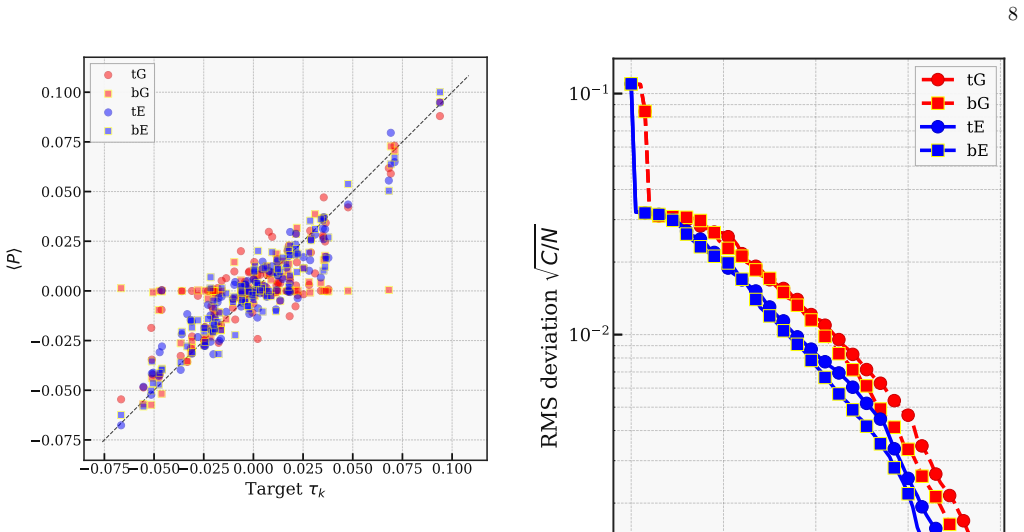
Noise-less case The RMS cost per constraint at every iteration in the four versions of QUEST are shown in Fig. (1). The QUEST-bG implementation reaches the desired RMS cost per constraintϵ= 10 −3 in aboutt= 60 iter- ations, the quickest of the four. While the QUEST-tG implementation takes about 10 iterations more to reach the sameϵ, being the slowest of t...
-
[8]
However, these targets are now assumed to be noisy
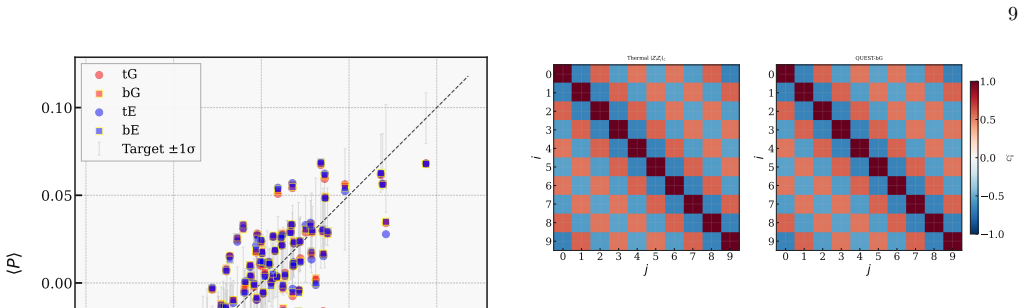
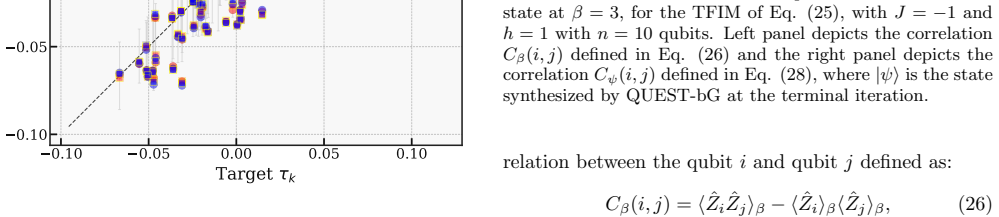
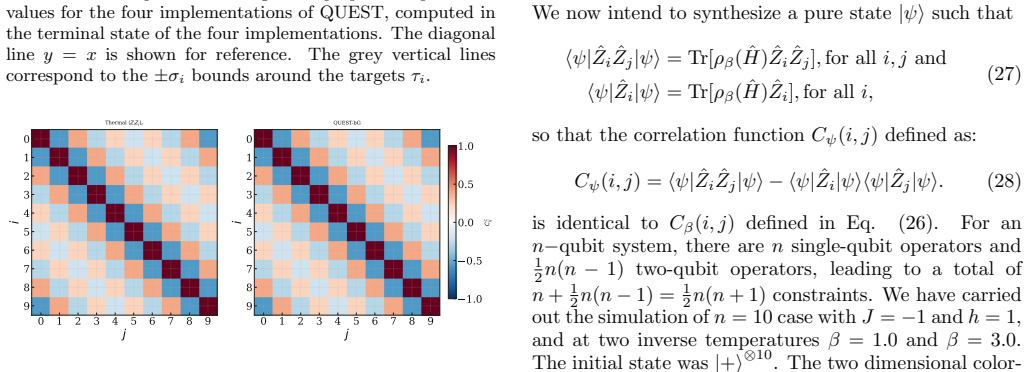
Noisy case In this illustration, we take the same reference state as in the noise-less case, the same set ofN= 100 Pauli strings, and consequently the same targetsτ i. However, these targets are now assumed to be noisy. To simu- late the noisy targetsτ i, we drawM i, i= 1,· · ·, Nran- domly between 1000 and 5000. The corresponding stan- dard deviationσ i ...
-
[9]
In second quantization, its Hamiltonian is [56–58] ˆH=−t M−2X p=0 X σ∈{↑,↓} ˆa† p,σˆap+1,σ + H.c
System and Jordan–Wigner mapping We consider a one-dimensional Hubbard chain onM sites with open boundary conditions, at half filling (Ne = Melectrons). In second quantization, its Hamiltonian is [56–58] ˆH=−t M−2X p=0 X σ∈{↑,↓} ˆa† p,σˆap+1,σ + H.c. +U M−1X p=0 ˆnp,↑ ˆnp,↓, (30) where ˆa† p,σ creates an electron of spinσon sitep, ˆn p,σ = ˆa† p,σˆap,σ is...
-
[10]
Parameters, operators and the initial states We shall work withM= 4 spatial orbitals, with t= 1 andU= 4, corresponding to the strong inter- action regime. In this illustration, we employ QUEST and ADAPT-VQE for the following two sets of targets: ⟨ψ| ˆH|ψ⟩= 3,⟨ψ| ˆN↑|ψ⟩= 4,andψ| ˆN↓|ψ⟩= 2 ⟨ψ| ˆH|ψ⟩= 9,⟨ψ| ˆN↑|ψ⟩= 2,andψ| ˆN↓|ψ⟩= 2 (35) As for the initial s...
-
[11]
(7 and 8), show the results corresponding to the first set of targets of Eq
Results Figs. (7 and 8), show the results corresponding to the first set of targets of Eq. (35), starting from the five initial conditions listed in Table . Fig. (7) shows the RMS cost per constraint at the termination for the four runs starting from the five initial conditions. Evidently, the gradient based methods (denoted by red bars in this figure) it...
-
[12]
Doubly-occupied (M/2)U M/2M/2
-
[13]
Fully polarized 0M0 D. A construction of QUEST-tG stalling configurations As an illustration of a failure mode unqiue to gradient- based QUEST implementations, we now construct a expectation value targeting problem where the two gradient-based QUEST implementations fail at the ini- tial state itself. That is, the gradients of the cost vanish for all the P...
-
[14]
Zhang, T
X.-M. Zhang, T. Li, and X. Yuan, Physical Review Let- ters129, 230504 (2022)
2022
-
[15]
Rosenkranz, E
M. Rosenkranz, E. Brunner, G. Marin-Sanchez, N. Fitzpatrick, S. Dilkes, Y. Tang, Y. Kikuchi, and M. Benedetti, Quantum9, 1703 (2025)
2025
-
[16]
Y. Cao, J. Romero, J. P. Olson, M. Degroote, P. D. John- son, M. Kieferov´ a, I. D. Kivlichan, T. Menke, B. Per- opadre, N. P. Sawaya,et al., Chemical reviews119, 10856 (2019)
2019
-
[17]
Y. Yang, B. Yadin, and Z.-P. Xu, Physical Review Letters 132, 210801 (2024)
2024
-
[18]
J. C. Zu˜ niga Castro, J. Larson, S. H. K. Narayanan, V. E. Colussi, M. A. Perlin, and R. J. Lewis-Swan, Physical Review A110, 052615 (2024)
2024
-
[19]
Giovannetti, S
V. Giovannetti, S. Lloyd, and L. Maccone, Science306, 1330 (2004)
2004
-
[20]
C. Brif, R. Chakrabarti, and H. Rabitz, New Journal of Physics12, 075008 (2010)
2010
-
[21]
J. R. McClean, J. Romero, R. Babbush, and A. Aspuru- Guzik, New Journal of Physics18, 023023 (2016)
2016
-
[22]
Khaneja, T
N. Khaneja, T. Reiss, C. Kehlet, T. Schulte-Herbr¨ uggen, and S. J. Glaser, Journal of magnetic resonance172, 296 (2005)
2005
-
[23]
M. G. Paris, International Journal of Quantum Informa- tion7, 125 (2009)
2009
-
[24]
S. B. Bravyi and A. Y. Kitaev, Annals of Physics298, 210 (2002)
2002
-
[25]
Cramer, M
M. Cramer, M. B. Plenio, S. T. Flammia, R. Somma, D. Gross, S. D. Bartlett, O. Landon-Cardinal, D. Poulin, and Y.-K. Liu, Nature communications1, 149 (2010)
2010
-
[26]
T apering off qubits to simulate fermionic hamil- tonians,
S. Bravyi, J. M. Gambetta, A. Mezzacapo, and K. Temme, arXiv preprint arXiv:1701.08213 (2017)
-
[27]
Calabrese and J
P. Calabrese and J. Cardy, Physical review letters96, 136801 (2006)
2006
-
[28]
H. M. Wiseman and G. J. Milburn, Physical Review Let- ters70, 548 (1993)
1993
-
[29]
A. J. Coleman, Reviews of modern Physics35, 668 (1963)
1963
-
[30]
Quantum marginal problem and representations of the symmetric group
A. Klyachko, arXiv preprint quant-ph/0409113 (2004)
work page Pith review arXiv 2004
-
[31]
Schillinget al., Mathematical results in quantum me- chanics , 165 (2014)
C. Schillinget al., Mathematical results in quantum me- chanics , 165 (2014)
2014
-
[32]
D. W. Smith, The Journal of Chemical Physics43, S258 (1965)
1965
-
[33]
A. A. Klyachko, inJournal of Physics: Conference Se- ries, Vol. 36 (2006) pp. 72–86
2006
-
[34]
Cerezo, A
M. Cerezo, A. Arrasmith, R. Babbush, S. C. Benjamin, S. Endo, K. Fujii, J. R. McClean, K. Mitarai, X. Yuan, L. Cincio,et al., Nature Reviews Physics3, 625 (2021)
2021
-
[35]
Peruzzo, J
A. Peruzzo, J. McClean, P. Shadbolt, M.-H. Yung, X.-Q. Zhou, P. J. Love, A. Aspuru-Guzik, and J. L. O’brien, Nature communications5, 4213 (2014)
2014
-
[36]
Tilly, H
J. Tilly, H. Chen, S. Cao, D. Picozzi, K. Setia, Y. Li, E. Grant, L. Wossnig, I. Rungger, G. H. Booth,et al., Physics Reports986, 1 (2022)
2022
-
[37]
Kandala, A
A. Kandala, A. Mezzacapo, K. Temme, M. Takita, M. Brink, J. M. Chow, and J. M. Gambetta, nature549, 242 (2017)
2017
-
[38]
S. Sim, P. D. Johnson, and A. Aspuru-Guzik, Advanced Quantum Technologies2, 1900070 (2019)
2019
-
[39]
R. J. Bartlett and M. Musia l, Reviews of Modern Physics 79, 291 (2007)
2007
-
[40]
M.-H. Yung, J. Casanova, A. Mezzacapo, J. Mcclean, L. Lamata, A. Aspuru-Guzik, and E. Solano, Scientific reports4, 3589 (2014)
2014
-
[41]
A. G. Taube and R. J. Bartlett, International journal of quantum chemistry106, 3393 (2006)
2006
-
[42]
Harsha, T
G. Harsha, T. Shiozaki, and G. E. Scuseria, The Journal of chemical physics148(2018)
2018
-
[43]
Kutzelnigg, Theoretica chimica acta80, 349 (1991)
W. Kutzelnigg, Theoretica chimica acta80, 349 (1991)
1991
-
[44]
Ekstrom, H
L. Ekstrom, H. Wang, and S. Schmitt, Physical Review Research7, 023141 (2025)
2025
-
[45]
D. C. Liu and J. Nocedal, Mathematical programming 45, 503 (1989)
1989
-
[46]
J. C. Spall, Johns Hopkins apl technical digest19, 482 (1998)
1998
-
[47]
J. C. Spall, inProceedings of the 36th IEEE Conference on Decision and Control, Vol. 2 (IEEE, 1997) pp. 1417– 1424
1997
-
[48]
Wierichs, J
D. Wierichs, J. Izaac, C. Wang, and C. Y.-Y. Lin, Quan- tum6, 677 (2022)
2022
-
[49]
Larocca, S
M. Larocca, S. Thanasilp, S. Wang, K. Sharma, J. Bia- monte, P. J. Coles, L. Cincio, J. R. McClean, Z. Holmes, and M. Cerezo, Nature Reviews Physics7, 174 (2025)
2025
-
[50]
S. Wang, E. Fontana, M. Cerezo, K. Sharma, A. Sone, L. Cincio, and P. J. Coles, Nature communications12, 6961 (2021)
2021
-
[51]
J. R. McClean, S. Boixo, V. N. Smelyanskiy, R. Babbush, and H. Neven, Nature communications9, 4812 (2018)
2018
-
[52]
Cunningham and J
J. Cunningham and J. Zhuang, Quantum Information Processing24, 48 (2025)
2025
-
[53]
G.-L. R. Anselmetti, D. Wierichs, C. Gogolin, and R. M. Parrish, New Journal of Physics23, 113010 (2021). 15
2021
-
[54]
H. G. Burton, Physical Review Research6, 023300 (2024)
2024
-
[55]
Gocho, H
S. Gocho, H. Nakamura, S. Kanno, Q. Gao, T. Kobayashi, T. Inagaki, and M. Hatanaka, npj Com- putational Materials9, 13 (2023)
2023
-
[56]
H. R. Grimsley, S. E. Economou, E. Barnes, and N. J. Mayhall, Nature communications10, 3007 (2019)
2019
-
[57]
H. L. Tang, V. Shkolnikov, G. S. Barron, H. R. Grimsley, N. J. Mayhall, E. Barnes, and S. E. Economou, PRX Quantum2, 020310 (2021)
2021
-
[58]
Feniou, M
C. Feniou, M. Hassan, D. Traor´ e, E. Giner, Y. Ma- day, and J.-P. Piquemal, Communications Physics6, 192 (2023)
2023
-
[59]
P. G. Anastasiou, Y. Chen, N. J. Mayhall, E. Barnes, and S. E. Economou, Physical Review Research6, 013254 (2024)
2024
-
[60]
Y. S. Yordanov, V. Armaos, C. H. Barnes, and D. R. Arvidsson-Shukur, Communications Physics4, 228 (2021)
2021
-
[61]
Ramˆ oa, P
M. Ramˆ oa, P. G. Anastasiou, L. P. Santos, N. J. Mayhall, E. Barnes, and S. E. Economou, npj Quantum Informa- tion11, 86 (2025)
2025
-
[62]
K. M. Nakanishi, K. Fujii, and S. Todo, Physical Review Research2, 043158 (2020)
2020
-
[63]
Ostaszewski, E
M. Ostaszewski, E. Grant, and M. Benedetti, Quantum 5, 391 (2021)
2021
-
[64]
E. T. Jaynes, Physical review106, 620 (1957)
1957
-
[65]
Rigol, V
M. Rigol, V. Dunjko, V. Yurovsky, and M. Olshanii, Physical review letters98, 050405 (2007)
2007
-
[66]
Vidmar and M
L. Vidmar and M. Rigol, Journal of Statistical Mechan- ics: Theory and Experiment2016, 064007 (2016)
2016
-
[67]
McArdle, S
S. McArdle, S. Endo, A. Aspuru-Guzik, S. C. Benjamin, and X. Yuan, Reviews of Modern Physics92, 015003 (2020)
2020
-
[68]
Bauer, S
B. Bauer, S. Bravyi, M. Motta, and G. K.-L. Chan, Chemical reviews120, 12685 (2020)
2020
-
[69]
D. P. Arovas, E. Berg, S. A. Kivelson, and S. Raghu, An- nual review of condensed matter physics13, 239 (2022)
2022
-
[70]
C. Cade, L. Mineh, A. Montanaro, and S. Stanisic, Phys- ical Review B102, 235122 (2020)
2020
-
[71]
T. A. Bespalova, K. Deli´ c, G. Pupillo, F. Tacchino, and I. Tavernelli, Physical Review A111, 052619 (2025)
2025
-
[72]
M. A. Nielsenet al., School of Physical Sciences The Uni- versity of Queensland59, 75 (2005)
2005
-
[73]
Tranter, P
A. Tranter, P. J. Love, F. Mintert, and P. V. Coveney, Journal of chemical theory and computation14, 5617 (2018)
2018
discussion (0)
Sign in with ORCID, Apple, or X to comment. Anyone can read and Pith papers without signing in.