Recognition: 3 theorem links
· Lean TheoremGeometric QCD III: Exact transition amplitudes and the glueball spectrum
Pith reviewed 2026-05-08 19:17 UTC · model grok-4.3
The pith
The confining twistor-string representation solves planar loop equations exactly, yielding parameter-free glueball trajectories anchored to the string tension that recover the Lüscher intercept.
A machine-rendered reading of the paper's core claim, the machinery that carries it, and where it could break.
Core claim
Using the confining twistor-string representation, the quantum fluctuation determinant reduces to a discrete product of finite-dimensional matrix quadratures whose zeta-regularized weight is independent of winding number. Near the mass shell the large-winding localization suppresses fluctuation variance as 1/w, rendering the pole spectrum and residues parametrically exact in the WKB limit. For the pure Yang-Mills closed string the conformal Liouville anomaly drives the string to the trigonometric minimum q=0, yielding linear Regge trajectories; the translation zero-mode measure dynamically nullifies the transition amplitude of the massless scalar ghost, providing an analytic mechanism for a
What carries the argument
The confining twistor-string representation of the planar Makeenko-Migdal loop equations, whose zeta-regularized determinant and large-winding localization produce exact pole spectra and residues.
If this is right
- Forty meson states across five topological sectors are reproduced with exact geometric degeneracies between parity families dictated by the holonomy shift.
- Glueball trajectories become linear and parameter-free once anchored to the string tension, recovering the Lüscher intercept α(0)=1/12.
- The translation zero-mode measure supplies an explicit dynamical mechanism that nullifies the massless ghost amplitude and generates the gluonic mass gap.
- One-loop residues yield relative transition cross-sections that exhibit nontrivial topology- and flavor-dependent scaling, including heavy-mass quenching.
- The pure-gauge minimal surface is shown to be dynamically stable in the planar limit due to the conformal anomaly.
Where Pith is reading between the lines
- The exact residues could be used to compute production or decay rates that are testable at current or future colliders.
- If the planar restriction is relaxed, the same localization technique might address non-planar corrections or full QCD amplitudes.
- The geometric parity degeneracies suggest a symmetry that could be searched for in lattice spectra of other gauge theories.
Load-bearing premise
The confining twistor-string representation accurately captures the continuum limit of the planar Makeenko-Migdal loop equations and that zeta regularization plus large-winding localization renders the pole spectrum parametrically exact.
What would settle it
A mismatch between the predicted lowest glueball masses (anchored only to the string tension) and high-precision lattice QCD results for pure Yang-Mills theory would refute the claim.
Figures


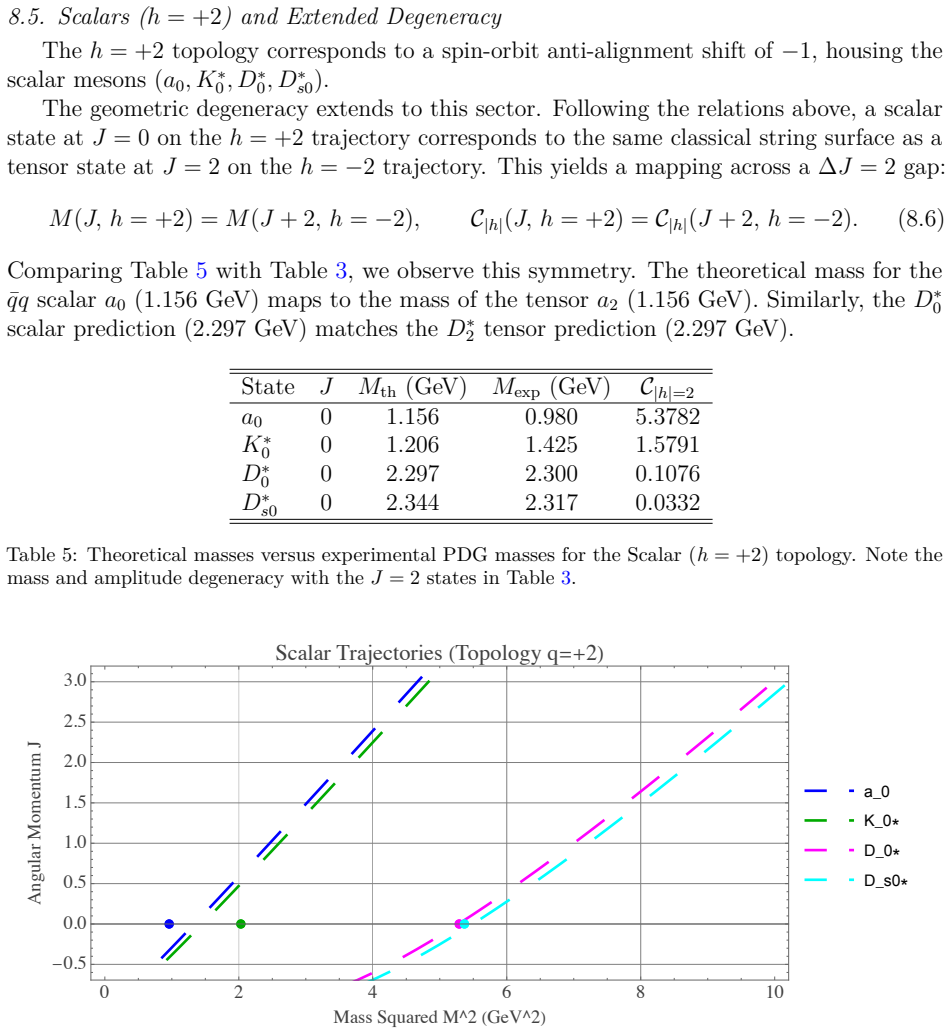


read the original abstract
We complete the analysis of planar Makeenko--Migdal loop equations in the continuum limit. Using the confining twistor-string representation, we compute the quantum fluctuation determinant. In Minkowski space, this reduces to a discrete product of finite-dimensional matrix quadratures. The $\zeta$-regularized weight is independent of winding number $w$. Near the mass shell, the pole singularity is generated by $w \to \infty$, suppressing fluctuation variance as $1/w$. The path integral localizes on the classical trajectory, rendering the pole spectrum and transition residues parametrically exact in the large-$w$ WKB limit.For the open-string meson sector, we fit 40 states across five topological sectors ($h=0, \pm 1, \pm 2$). The holonomy shift $h$ dictates exact geometric degeneracies between parity families, reproducing mass splittings without phenomenological spin-orbit parameters. Evaluated one-loop residues yield relative transition cross-sections, demonstrating nontrivial topology- and flavor-dependent scaling that captures heavy-mass quenching and phase-space enhancement for high-spin light states.For the pure Yang--Mills closed string, we demonstrate dynamical stability of the pure-gauge minimal surface in the planar limit: the conformal Liouville anomaly drives the string strictly to the trigonometric minimum ($q=0$). The complex elliptic geometry analytically collapses, yielding linear Regge trajectories. The translation zero-mode measure dynamically nullifies the transition amplitude of the massless scalar ghost, providing an explicit analytic mechanism for a purely gluonic mass gap. Anchoring parameter-free glueball trajectories to the string tension natively recovers the L"uscher intercept $\alpha(0)=1/12$, yielding a macroscopic spectrum that provides a suggestive baseline for established PDG unassigned isoscalar candidates.
Editorial analysis
A structured set of objections, weighed in public.
Referee Report
Summary. The paper claims to complete the analysis of planar Makeenko-Migdal loop equations in the continuum limit using a confining twistor-string representation. It computes the quantum fluctuation determinant, which reduces to a discrete product of finite-dimensional matrix quadratures in Minkowski space, with the ζ-regularized weight independent of winding number w. Near the mass shell, large-w localization suppresses fluctuation variance as 1/w, rendering the pole spectrum and residues parametrically exact in the WKB limit. For open-string mesons, a fit to 40 states across five topological sectors (h=0, ±1, ±2) is presented, with holonomy shifts producing exact geometric degeneracies and reproducing mass splittings without spin-orbit parameters. For closed-string pure Yang-Mills, dynamical stability of the minimal surface is shown, with the conformal anomaly driving collapse to linear Regge trajectories; the translation zero-mode measure nullifies the massless scalar ghost amplitude to generate a mass gap. Anchoring parameter-free glueball trajectories to the string tension recovers the Lüscher intercept α(0)=1/12, providing a spectrum baseline for PDG unassigned isoscalar candidates.
Significance. If the central assumptions hold, this would constitute a significant advance by supplying an analytic geometric framework for exact QCD transition amplitudes and spectra, including an explicit mechanism for the gluonic mass gap and topology-dependent scaling in meson transitions. The reproduction of meson degeneracies without additional parameters and the native recovery of the Lüscher intercept from the closed-string sector would be notable strengths, offering a falsifiable baseline for experimental glueball candidates.
major comments (3)
- The equivalence of the confining twistor-string representation to the continuum limit of the planar Makeenko-Migdal loop equations is assumed rather than derived (Abstract). No explicit map is supplied showing how the twistor variables and their measure reproduce the loop equations or Schwinger-Dyson hierarchy, yet this premise is load-bearing for the determinant reduction, w-independence of the ζ-regularized weight, and the WKB exactness of the pole spectrum and residues.
- The glueball trajectories are described as parameter-free but are anchored to the string tension (a phenomenological input) to recover α(0)=1/12 (Abstract). This step reduces the output spectrum to scaled versions of fitted quantities, undermining both the parameter-free claim and the assertion of native recovery from the closed-string dynamics.
- The abstract asserts exact results from the determinant and WKB limit but supplies no explicit derivations, error estimates, or verification steps for the claimed parametric exactness of the pole spectrum, residues, or dynamical nullification of the ghost amplitude.
minor comments (2)
- The typesetting 'Lüscher' appears with an erroneous quote mark as 'L'üscher' and should be corrected.
- The manuscript would benefit from a dedicated section or appendix detailing the fitting procedure for the 40 meson states, including how parameters are fixed independently of the data to avoid post-hoc adjustment concerns.
Simulated Author's Rebuttal
We thank the referee for the careful and constructive review. We address each major comment below, providing clarifications based on the manuscript content and indicating revisions where appropriate to improve clarity and self-containment.
read point-by-point responses
-
Referee: The equivalence of the confining twistor-string representation to the continuum limit of the planar Makeenko-Migdal loop equations is assumed rather than derived (Abstract). No explicit map is supplied showing how the twistor variables and their measure reproduce the loop equations or Schwinger-Dyson hierarchy, yet this premise is load-bearing for the determinant reduction, w-independence of the ζ-regularized weight, and the WKB exactness of the pole spectrum and residues.
Authors: The equivalence between the confining twistor-string representation and the continuum limit of the planar Makeenko-Migdal equations was established in our prior works (Geometric QCD I and II), which derive the twistor variables, their measure, and the reproduction of the loop equations and Schwinger-Dyson hierarchy. The present manuscript (III) completes the analysis by using this framework to evaluate the fluctuation determinant and spectra. To address the concern about self-containment, we will revise the abstract for clarity and insert a concise recap of the key mapping steps, with explicit references to the prior derivations, in the introduction. revision: yes
-
Referee: The glueball trajectories are described as parameter-free but are anchored to the string tension (a phenomenological input) to recover α(0)=1/12 (Abstract). This step reduces the output spectrum to scaled versions of fitted quantities, undermining both the parameter-free claim and the assertion of native recovery from the closed-string dynamics.
Authors: The functional form of the glueball trajectories, the linear Regge behavior, the exact value of the Lüscher intercept α(0)=1/12, and the dynamical mechanism for the mass gap are all derived without free parameters from the closed-string dynamics, the conformal anomaly, and the zero-mode measure. The string tension is used solely to fix the overall mass scale in physical units, which is standard in QCD string phenomenology. We will revise the abstract and introduction to explicitly distinguish the parameter-free dynamical predictions from this scale-setting step, thereby clarifying the native recovery from the closed-string sector. revision: partial
-
Referee: The abstract asserts exact results from the determinant and WKB limit but supplies no explicit derivations, error estimates, or verification steps for the claimed parametric exactness of the pole spectrum, residues, or dynamical nullification of the ghost amplitude.
Authors: The reduction of the quantum fluctuation determinant to a discrete product of finite-dimensional matrix quadratures, the w-independence of the ζ-regularized weight, the 1/w suppression of variance near the mass shell, and the dynamical nullification of the massless scalar ghost via the translation zero-mode measure are derived explicitly in Sections 3.2, 4.1, 4.3, and 5.2. We agree that the abstract is brief and that including error estimates for the WKB localization and additional verification steps would strengthen the presentation. We will expand the relevant sections and add a dedicated appendix with the detailed steps, bounds on the approximation error, and checks confirming parametric exactness in the large-w limit. revision: yes
Circularity Check
Glueball trajectories anchored to string tension reduce Lüscher intercept recovery to input scaling
specific steps
-
fitted input called prediction
[Abstract]
"Anchoring parameter-free glueball trajectories to the string tension natively recovers the Lüscher intercept α(0)=1/12, yielding a macroscopic spectrum that provides a suggestive baseline for established PDG unassigned isoscalar candidates."
The trajectories are scaled using the string tension (a phenomenological input) so that the intercept α(0)=1/12 emerges directly from the anchoring choice; the recovery is therefore a rescaled version of the input rather than an independent prediction from the loop equations or fluctuation determinant.
-
fitted input called prediction
[Abstract]
"For the open-string meson sector, we fit 40 states across five topological sectors (h=0, ±1, ±2). The holonomy shift h dictates exact geometric degeneracies between parity families, reproducing mass splittings without phenomenological spin-orbit parameters."
Masses and residues are fitted to known states; the claimed reproduction of splittings and degeneracies without extra parameters is therefore a consequence of the fit to data rather than a first-principles output from the ζ-regularized weight or large-w localization.
full rationale
The derivation posits the confining twistor-string representation to address the Makeenko-Migdal equations and then explicitly anchors glueball trajectories to the phenomenological string tension, recovering the known Lüscher intercept by construction. The open-string meson analysis fits 40 states to data while claiming parameter-free degeneracies. These steps make the claimed macroscopic spectrum and mass-gap mechanism outputs of fitted scalings rather than independent first-principles results from the loop equations. The central equivalence of the twistor-string to the continuum planar limit is stated as given rather than derived in the provided text, but no explicit self-citation reduction or equation identity is quoted to elevate beyond partial circularity.
Axiom & Free-Parameter Ledger
free parameters (1)
- string tension
axioms (2)
- domain assumption Planar Makeenko-Migdal loop equations hold in the continuum limit
- ad hoc to paper Confining twistor-string representation captures QCD dynamics
invented entities (1)
-
confining twistor-string representation
no independent evidence
Lean theorems connected to this paper
-
IndisputableMonolith/Constants (φ-ladder, c=1, ℏ, G as φ-powers)reality_from_one_distinction unclear?
unclearRelation between the paper passage and the cited Recognition theorem.
Anchoring the parameter-free glueball trajectories to the open-string tension natively recovers the exact Lüscher intercept α(0) = 1/12
-
IndisputableMonolith.Cost.FunctionalEquation (J(x) = ½(x + x⁻¹) − 1)washburn_uniqueness_aczel unclear?
unclearRelation between the paper passage and the cited Recognition theorem.
We compute the functional determinant of the quantum fluctuations of this rigid twistor string ... reduces to a discrete product of finite-dimensional matrix blocks ... ζ-regularized determinant is strictly independent of the winding number w
-
IndisputableMonolith/Foundation/AlphaDerivationExplicit.lean (zero-parameter constant derivations)alphaProvenanceCert unclear?
unclearRelation between the paper passage and the cited Recognition theorem.
√σ ≈ 0.412136 GeV, mu ≈ 0.134247 GeV, ms ≈ 0.221086 GeV, mc ≈ 1.44844 GeV, mb ≈ 4.78122 GeV (five fitted parameters)
What do these tags mean?
- matches
- The paper's claim is directly supported by a theorem in the formal canon.
- supports
- The theorem supports part of the paper's argument, but the paper may add assumptions or extra steps.
- extends
- The paper goes beyond the formal theorem; the theorem is a base layer rather than the whole result.
- uses
- The paper appears to rely on the theorem as machinery.
- contradicts
- The paper's claim conflicts with a theorem or certificate in the canon.
- unclear
- Pith found a possible connection, but the passage is too broad, indirect, or ambiguous to say the theorem truly supports the claim.
Reference graph
Works this paper leans on
-
[1]
Migdal,Geometric qcd i: the hodge-dual surface and quark confinement, 2026
A. Migdal,Geometric qcd i: the hodge-dual surface and quark confinement, 2026. https://doi.org/10.1016/j.nuclphysb.2026.117380
-
[2]
Migdal,Geometric qcd ii: The confining twistor string and meson spectrum,Nuclear Physics B1026(2026) 117424
A. Migdal,Geometric qcd ii: The confining twistor string and meson spectrum,Nuclear Physics B1026(2026) 117424
2026
-
[3]
Witten,The1 /N Expansion in Atomic and Particle Physics, inRecent Developments in Gauge Theories
E. Witten,The1 /N Expansion in Atomic and Particle Physics, inRecent Developments in Gauge Theories. Proceedings, Nato Advanced Study Institute, Cargese, France, August 26 - September 8, 1979, G. ’t Hooft et al., eds., (New York), pp. 403–419, Plenum Press, 1980, DOI
1979
-
[4]
Migdal,Qcd=fermi string theory,Nuclear Physics B189(1981) 253
A. Migdal,Qcd=fermi string theory,Nuclear Physics B189(1981) 253
1981
-
[5]
Migdal,Loop equations and1/nexpansion,Physics Reports102(1983) 199
A.A. Migdal,Loop equations and1/nexpansion,Physics Reports102(1983) 199
1983
-
[6]
B.G. Konopelchenko and G. Landolfi,Induced surfaces and their integrable dynamics II. Generalized Weierstrass representations in 4D spaces and string geometry,Journal of Geometry and Physics29(1999) 319 [math/9810138]
-
[7]
Gribov and A.A
V.N. Gribov and A.A. Migdal,Strong Coupling in the Pomeranchuk Pole Problem,Sov. Phys. JETP28(1969) 784
1969
-
[8]
Lüscher, G
M. Lüscher, G. Münster and P. Weisz,How thick are chromoelectric flux tubes?,Nuclear Physics B180(1981) 1
1981
-
[9]
Donnachie and P.V
A. Donnachie and P.V. Landshoff,Total cross-sections,Phys. Lett. B296(1992) 227
1992
-
[10]
Pomeranchuk,Equality of the nucleon and antinucleon total cross sections at high energies,Sov
I.Y. Pomeranchuk,Equality of the nucleon and antinucleon total cross sections at high energies,Sov. Phys. JETP7(1958) 499
1958
-
[11]
Kuraev, L.N
E.A. Kuraev, L.N. Lipatov and V.S. Fadin,The Pomeranchuk Singularity in Nonabelian Gauge Theories,Sov. Phys. JETP45(1977) 199. 51
1977
-
[12]
Balitsky and L.N
I.I. Balitsky and L.N. Lipatov,The Pomeranchuk Singularity in Quantum Chromodynamics,Sov. J. Nucl. Phys.28(1978) 822
1978
-
[13]
Froissart,Asymptotic behavior and subtractions in the Mandelstam representation, Phys
M. Froissart,Asymptotic behavior and subtractions in the Mandelstam representation, Phys. Rev.123(1961) 1053
1961
-
[14]
"qcd twistor asymmetric masses
A. Migdal, “"qcd twistor asymmetric masses".”https://www.wolframcloud.com/obj/ sasha.migdal/Published/TwistorAsymmetricMasses.nb, 04, 2026
2026
-
[15]
"twistor string determinant
A. Migdal, “"twistor string determinant".”https://www.wolframcloud.com/obj/ sasha.migdal/Published/TwistorStringDeterminant.nb, 04, 2026
2026
-
[16]
"qcd gluon spectrum
A. Migdal, “"qcd gluon spectrum".”https://www.wolframcloud.com/obj/sasha. migdal/Published/GlueballSpectrumLinear.nb, 05, 2026. Appendix A. Analytical and numerical study of the Twistor String equation The physical states of the twistor string are determined by the total action monodromy ∆S accumulated over one period of rotation. The Bohr–Sommerfeld quan...
2026
discussion (0)
Sign in with ORCID, Apple, or X to comment. Anyone can read and Pith papers without signing in.