Perturbative Analysis of Dark State Dynamics in Weakly Anharmonic Photon-Emitter Pairs
Pith reviewed 2026-05-08 18:06 UTC · model grok-4.3
The pith
Weak anharmonicity perturbs dark state wavefunctions in photon-emitter pairs, inducing dissipation tracked by the master equation.
A machine-rendered reading of the paper's core claim, the machinery that carries it, and where it could break.
Core claim
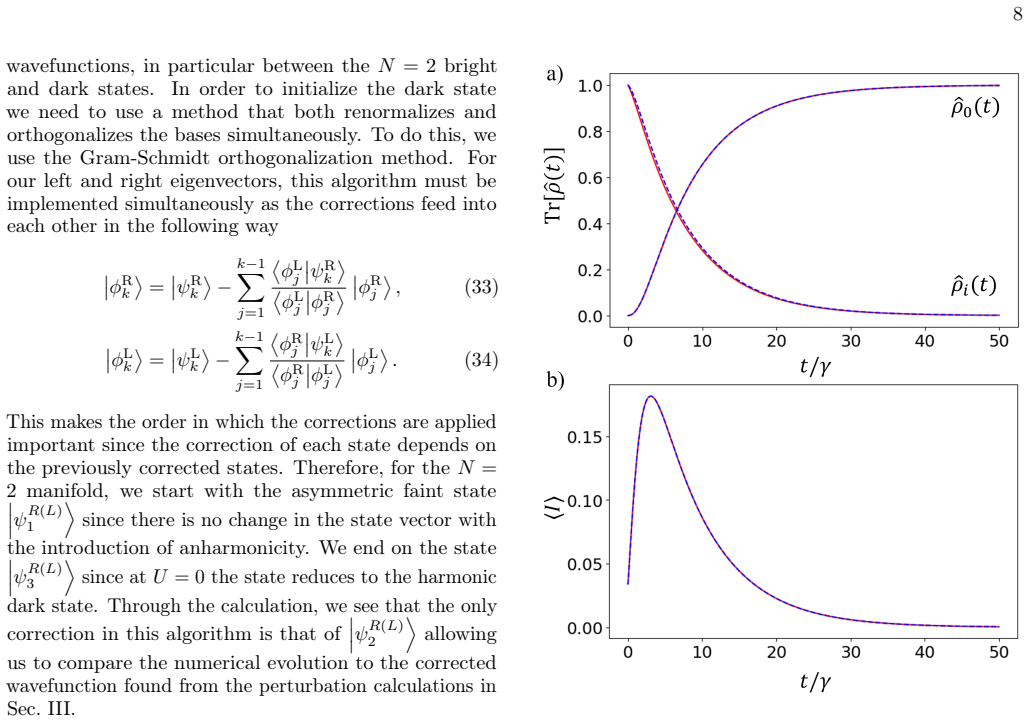
In the absence of on-site interactions, a pair of dissipatively coupled harmonic oscillators supports genuine dark states that do not couple to the environment. Introducing weak anharmonicity breaks this decoupling. The wavefunction is expanded perturbatively, yielding first- and second-order corrections that generate effective dissipative terms. When these corrected states are inserted into the master equation, the dynamics exhibit a finite decay rate for the dark state population.
What carries the argument
Second-order perturbative corrections to the dark state wavefunction arising from the on-site interaction term, which are used to evaluate the action of the dissipators in the master equation and thereby obtain the induced dynamics.
If this is right
- The dark states acquire a decay rate that vanishes in the harmonic limit.
- The master equation with corrected states predicts the time scale of the induced dissipation.
- First-order corrections alone may be insufficient, requiring the second-order terms for accurate dynamics.
Where Pith is reading between the lines
- If the on-site interaction grows stronger, the perturbative truncation will eventually fail and non-perturbative techniques will be required.
- The approach can be generalized to chains or lattices of emitters to investigate collective dark states in extended systems.
Load-bearing premise
The on-site interaction is sufficiently weak for the second-order perturbative expansion to capture the leading dissipative effects without significant contributions from higher orders.
What would settle it
An experiment that prepares the approximate dark state in a tunable anharmonic system and measures its population decay as a function of interaction strength would falsify the claim if the observed rate deviates from the perturbative prediction.
Figures
read the original abstract
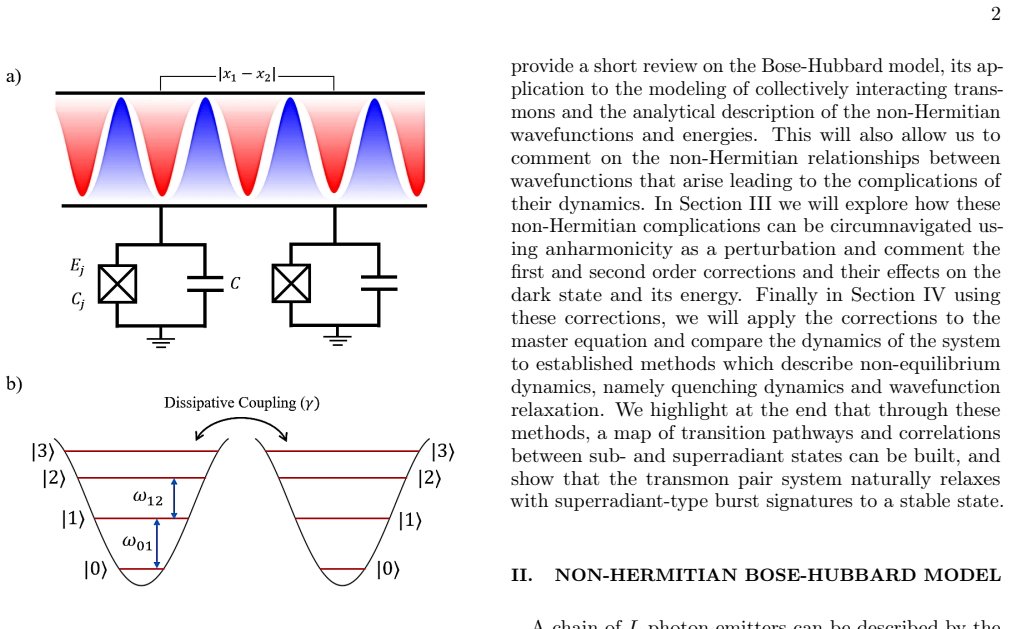
Dark states are excited quantum states that decouple from their environment in such a way that they do not emit or absorb external photons. These states are found in a variety of different open quantum systems and can be derived from the collective interactions of individual quantum emitters interacting with one another. One of the simplest model where these states exist is in a pair of dissipatively coupled harmonic oscillators described under the Bose-Hubbard model. When on-site interactions are included, these states can no longer be classified as genuine dark states since dissipation is induced in them. In this paper we study the origin of this dissipation in dark states by using weak anharmonicity as a perturbing factor. In our analysis, we find the first and second order corrections to the wavefunction and apply these corrections to the master equation in order to track the dynamics.
Editorial analysis
A structured set of objections, weighed in public.
Referee Report
Summary. The paper analyzes dark states in a pair of weakly anharmonic photon emitters under the Bose-Hubbard model with Markovian dissipation. It treats the on-site interaction as a small perturbation, computes first- and second-order corrections to the closed-system eigenstates, and substitutes the corrected states into the Lindblad master equation to extract the induced dynamics and decay of the nominally dark state.
Significance. If the perturbative substitution correctly yields the leading dissipative corrections, the result would provide an analytic window into how weak anharmonicity lifts perfect dark-state decoupling. This could inform the design of interaction-robust states in circuit-QED or atomic arrays, with the explicit wavefunction corrections serving as a reusable technical tool.
major comments (1)
- [Abstract (perturbative procedure)] The central procedure perturbs only the closed-system wavefunctions before insertion into the master equation (as described in the abstract). This approach risks omitting O(U²) cross terms that arise when the anharmonicity perturbation acts on the jump operators inside the full Liouvillian; an explicit second-order expansion of the Liouvillian itself is required to confirm that the reported decay rate includes all leading contributions.
minor comments (1)
- The abstract would benefit from an explicit statement of the final expression for the induced decay rate at second order.
Simulated Author's Rebuttal
We thank the referee for their careful reading of the manuscript and for identifying a potential subtlety in the perturbative treatment. We address the major comment below.
read point-by-point responses
-
Referee: The central procedure perturbs only the closed-system wavefunctions before insertion into the master equation (as described in the abstract). This approach risks omitting O(U²) cross terms that arise when the anharmonicity perturbation acts on the jump operators inside the full Liouvillian; an explicit second-order expansion of the Liouvillian itself is required to confirm that the reported decay rate includes all leading contributions.
Authors: We appreciate the referee's concern. However, the anharmonicity U enters the problem exclusively through the Hamiltonian; the Markovian jump operators (and therefore the dissipators) are independent of U. As a result, no cross terms arise from the perturbation acting on the jump operators. The leading O(U²) decay rate of the nominally dark state is generated solely by its O(U) admixture with bright, decaying states, which is captured by the first-order wavefunction correction. The second-order correction to the wavefunction contributes only at O(U⁴) to the decay rate and is retained for completeness in the state dynamics. We will add a short appendix or subsection in the revised manuscript that explicitly compares our procedure with a direct second-order expansion of the Liouvillian projected onto the dark-state manifold, confirming that the two approaches agree on the leading decay rate. revision: partial
Circularity Check
No circularity: standard perturbative expansion from Hamiltonian to master equation
full rationale
The derivation applies time-independent perturbation theory to the Bose-Hubbard Hamiltonian (with weak on-site anharmonicity U as the perturbation) to generate explicit first- and second-order corrections to the dark-state wavefunction. These corrected states are then inserted into the Lindblad master equation to obtain the induced decay dynamics. This is a direct, forward calculation from the model Hamiltonian and dissipators; the output decay rate is not defined in terms of itself, nor obtained by fitting any parameter to the target quantity. No self-citations, uniqueness theorems, or ansatzes imported from prior work are used to close the chain. The approach is self-contained against the stated microscopic model and does not reduce to its inputs by construction.
Axiom & Free-Parameter Ledger
axioms (2)
- domain assumption The system is accurately described by the Bose-Hubbard Hamiltonian plus standard Lindblad dissipation terms.
- ad hoc to paper Anharmonicity is weak enough for truncation at second-order perturbation theory.
Lean theorems connected to this paper
-
Constants/φ-ladder; AlexanderDuality (D=3 forcing)phi_golden_ratio / alexander_duality_circle_linking unclear?
unclearRelation between the paper passage and the cited Recognition theorem.
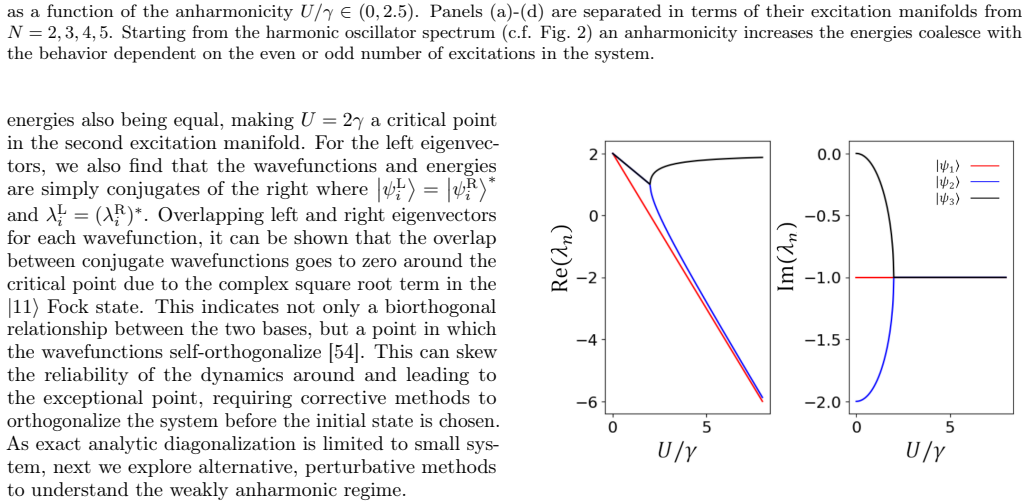
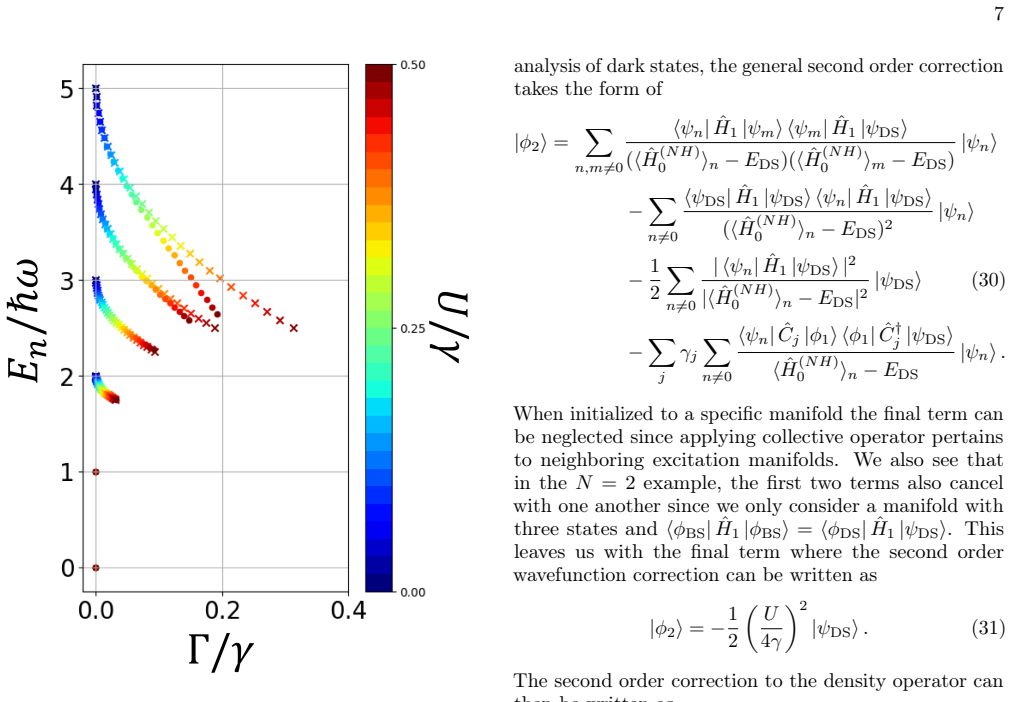
λR_2/ℏ = 2ω − U/2 − iγ − ½√(U²−4γ²) ... at U = 2γ the wavefunctions are indistinguishable
-
Cost.Jcost (½(x+x⁻¹)−1) — not invokedwashburn_uniqueness_aczel unclear?
unclearRelation between the paper passage and the cited Recognition theorem.
λc(N) = N(N−1)ℏU/4 − iN(N−1)ℏU²/(16γ)
What do these tags mean?
- matches
- The paper's claim is directly supported by a theorem in the formal canon.
- supports
- The theorem supports part of the paper's argument, but the paper may add assumptions or extra steps.
- extends
- The paper goes beyond the formal theorem; the theorem is a base layer rather than the whole result.
- uses
- The paper appears to rely on the theorem as machinery.
- contradicts
- The paper's claim conflicts with a theorem or certificate in the canon.
- unclear
- Pith found a possible connection, but the passage is too broad, indirect, or ambiguous to say the theorem truly supports the claim.
Reference graph
Works this paper leans on
-
[1]
D. Finkelstein-Shapiro, S. Felicetti, T. Hansen, T. o. Pul- lerits, and A. Keller, Classification of dark states in multi- level dissipative systems, Phys. Rev. A99, 053829 (2019)
work page 2019
- [2]
-
[3]
C. J. Villas-Boas, C. E. Máximo, P. J. Paulino, R. P. Bachelard, and G. Rempe, Bright and dark states of light: The quantum origin of classical interference, Phys. Rev. Lett.134, 133603 (2025)
work page 2025
- [4]
-
[5]
D. Petrosyan, F. Motzoi, M. Saffman, and K. Mølmer, High-fidelity Rydberg quantum gate via a two-atom dark state, Phys. Rev. A96, 042306 (2017)
work page 2017
-
[6]
K. Shen, X. Hu, and F. Wang, Dark-state entanglement of two atomic ensembles via cavity superradiance, Phys. Rev. A112, 043708 (2025)
work page 2025
-
[7]
J. Zou, S. Zhang, and Y. Tserkovnyak, Bell-state genera- tion for spin qubits via dissipative coupling, Phys. Rev. B106, L180406 (2022)
work page 2022
-
[8]
D. A. Lidar, I. L. Chuang, and K. B. Whaley, Decoherence- free subspaces for quantum computation, Phys. Rev. Lett. 81, 2594 (1998)
work page 1998
-
[9]
O. Rubies-Bigorda, V. Walther, T. L. Patti, and S. F. Yelin, Photon control and coherent interactions via lattice dark states in atomic arrays, Phys. Rev. Res.4, 013110 (2022)
work page 2022
-
[10]
Z.-Y. Zhou, M. Chen, L.-A. Wu, T. Yu, and J. Q. You, Dark state with counter-rotating dissipative channels, Sci. Rep.7, 6254 (2017)
work page 2017
- [11]
-
[12]
X. Zhao, L.-M. Kuang, and J.-Q. Liao, General dark-state theory for arbitrary multilevel quantum systems, Phys. Rev. A113, 013723 (2026)
work page 2026
-
[13]
E. Arimondo and G. Orriols, Nonabsorbing atomic coher- ences by coherent two-photon transitions in a three-level optical pumping, Nuovo Cimento Lett.17, 333 (1976)
work page 1976
-
[14]
A. Hemmerich, M. Weidemüller, T. Esslinger, C. Zimmer- mann, and T. Hänsch, Trapping atoms in a dark optical lattice, Phys. Rev. Lett.75, 37 (1995)
work page 1995
-
[15]
S. Sevinçli, C. Ates, T. Pohl, H. Schempp, C. S. Hofmann, G. Günter, T. Amthor, M. Weidemüller, J. D. Pritchard, D. Maxwell, A. Gauguet, K. J. Weatherill, M. P. A. Jones, and C. S. Adams, Quantum interference in interacting three-level Rydberg gases: Coherent population trapping and electromagnetically induced transparency, J. Phys. B: At. Mol. Opt. Phys4...
work page 2011
-
[16]
J. Hu, S. Liu, and Y. Ji, Influence of decoherence on elec- tromannetically induced transparency in superconducting quantum circuit, Optik135, 366 (2017)
work page 2017
-
[17]
M. Fleischhauer, A. Imamoglu, and J. P. Marangos, Elec- tromagnetically induced transparency: Optics in coherent media, Rev. Mod. Phys.77, 633 (2005)
work page 2005
-
[18]
K. J. Weatherill, J. D. Pritchard, R. P. Abel, M. G. Bason, A. K. Mohapatra, and C. S. Adams, Electromagnetically induced transparency of an interacting cold Rydberg en- semble, J. Phys. B: At. Mol. Opt. Phys41, 201002 (2008)
work page 2008
-
[19]
R. Holzinger, R. Gutiérrez-Jáuregui, T. Hönigl-Decrinis, G. Kirchmair, A. Asenjo-Garcia, and H. Ritsch, Control of localized single- and many-body dark states in waveguide QED, Phys. Rev. Lett.129, 253601 (2022)
work page 2022
- [20]
-
[21]
S. Kwon, A. Tomonaga, G. Lakshmi Bhai, S. J. Devitt, and J.-S. Tsai, Gate-based superconducting quantum com- puting, J. Appl. Phys.129, 041102 (2021)
work page 2021
- [22]
- [23]
-
[24]
E. Wiegand, B. Rousseaux, and G. Johansson, Semiclassi- cal analysis of dark-state transient dynamics in waveguide circuit QED, Phys. Rev. A101, 033801 (2020)
work page 2020
- [25]
-
[26]
O. Mansikkamäki, S. Laine, A. Piltonen, and M. Silveri, Beyond hard-core bosons in transmon arrays, PRX Quan- tum3, 040314 (2022)
work page 2022
-
[27]
A. Vaaranta, M. Cattaneo, and R. E. Lake, Dynamics of a dispersively coupled transmon qubit in the presence of a noise source embedded in the control line, Phys. Rev. A106, 042605 (2022)
work page 2022
-
[28]
A. Sergi and K. G. Zloshcastiev, Non-Hermitian quantum dynamics of a two-level system and models of dissipative environments, Int. J. Mod. Phys. B27, 1350163 (2013)
work page 2013
-
[29]
Y. Wang, K. Snizhko, A. Romito, Y. Gefen, and K. Murch, Dissipative preparation and stabilization of many-body quantum states in a superconducting qutrit array, Phys. Rev. A108, 013712 (2023)
work page 2023
-
[30]
X.-L. Dong, P.-B. Li, Z. Gong, and F. Nori, Waveguide QED with dissipative light-matter couplings, Phys. Rev. Res.7, L012036 (2025)
work page 2025
-
[31]
X. Feng, S. Liu, S.-X. Zhang, and S. Chen, Numerical instability of non-Hermitian Hamiltonian evolution, Phys. Rev. B111, 224310 (2025)
work page 2025
-
[32]
T. Curtright and L. Mezincescu, Biorthogonal quantum systems, J. Math. Phys.48, 092106 (2007)
work page 2007
-
[33]
D. C. Brody, Biorthogonal quantum mechanics, J. Phys. A: Math. Theor.47, 035305 (2013)
work page 2013
-
[34]
Z. Tóth, P. R. Nagy, P. Jeszenszki, and Á. Szabados, Novel orthogonalization and biorthogonalization algo- rithms, Theor. Chem. Acc.134, 100 (2015). 11
work page 2015
-
[35]
B. N. Parlett, D. R. Taylor, and Z. A. Liu, A look-ahead Lanczos algorithm for unsymmetric matrices, Math. Com- put.44, 105 (1985)
work page 1985
-
[36]
E. Edvardsson, J. L. K. König, and M. Stålhammar, Biorthogonal renormalization, arXiv:2212.06004 (2024)
- [37]
-
[38]
D. Huybrechts and T. Roscilde, Quantum correlations in the steady state of light-emitter ensembles from pertur- bation theory, Quantum10, 2058 (2026)
work page 2058
-
[39]
M. M. Sternheim and J. F. Walker, Non-Hermitian Hamil- tonians, decaying states, and perturbation theory, Phys. Rev. C6, 114 (1972)
work page 1972
- [40]
- [41]
-
[42]
H. Wang, Y.-J. Zhao, and X.-W. Xu, Controllable non- Hermitian qubit–qubit coupling in superconducting quan- tum circuit, APL Quantum1, 046125 (2024)
work page 2024
-
[43]
N. Goss, A. Morvan, B. Marinelli, B. K. Mitchell, L. B. Nguyen, R. K. Naik, L. Chen, C. Jünger, J. M. Kreike- baum, D. I. Santiago, J. J. Wallman, and I. Siddiqi, High- fidelity qutrit entangling gates for superconducting cir- cuits, Nat. Commun.13, 7481 (2022)
work page 2022
-
[44]
M. Delanty, S. Rebić, and J. Twamley, Superradiance and phase multistability in circuit quantum electrodynamics, New J. Phys.13, 053032 (2011)
work page 2011
-
[45]
Y. S. Greenberg and O. A. Chuikin, Superradiant emis- sion spectra of a two-qubit system in circuit quantum electrodynamics, Eur. Phys. J. B.95, 151 (2022)
work page 2022
-
[46]
H. Pichler, T. Ramos, A. J. Daley, and P. Zoller, Quantum optics of chiral spin networks, Phys. Rev. A91, 042116 (2015)
work page 2015
-
[47]
N. Shammah, S. Ahmed, N. Lambert, S. De Liberato, and F. Nori, Open quantum systems with local and collec- tive incoherent processes: Efficient numerical simulations using permutational invariance, Phys. Rev. A98, 063815 (2018)
work page 2018
-
[48]
X. Niu, J. Li, S. L. Wu, and X. X. Yi, Effect of quantum jumps on non-Hermitian systems, Phys. Rev. A108, 032214 (2023)
work page 2023
-
[49]
N. Hatano and D. R. Nelson, Localization transitions in non-Hermitian quantum mechanics, Phys. Rev. Lett.77, 570 (1996)
work page 1996
-
[50]
P. Martinez-Azcona, A. Kundu, A. Saxena, A. del Campo, and A. Chenu, Quantum dynamics with stochastic non- Hermitian Hamiltonians, Phys. Rev. Lett.135, 010402 (2025)
work page 2025
-
[51]
G. Ordonez and S. Kim, Complex collective states in a one-dimensional two-atom system, Phys. Rev. A70, 032702 (2004)
work page 2004
-
[52]
A. J. Daley, Quantum trajectories and open many-body quantum systems, Adv. Phys.63, 77 (2014)
work page 2014
-
[53]
M. Delanty, S. Rebicand, and J. Twamley, Superradiance of harmonic oscillators, arXiv:1107.5080 (2018)
-
[54]
A. Fritzsche, R. Sorbello, R. Thomale, and A. Szameit, Unveiling the self-orthogonality at exceptional points in driven PT -symmetric systems, Phys. Rev. A113, L021701 (2026)
work page 2026
-
[55]
K. S. Kumar, A. Vepsäläinen, S. Danilin, and G. S. Paraoanu, Stimulated Raman adiabatic passage in a three- level superconducting circuit, Nat. Commun.7, 10628 (2016)
work page 2016
-
[56]
S. Erdamar, M. Abbasi, W. Chen, N. Hörnedal, A. Chenu, and K. W. Murch, Exploring the Riemann-surface topol- ogy of a non-Hermitian superconducting qubit using short- cuts to adiabaticity, PRX Quantum7, 010337 (2026)
work page 2026
-
[57]
U. Singhal, H. V. Upadhyay, I. Ahmad, and V. Singh, Robust gates inspired by stimulated Raman adiabatic passage for a superconducting dual-rail qubit, Phys. Rev. Appl.23, 014044 (2025)
work page 2025
- [58]
discussion (0)
Sign in with ORCID, Apple, or X to comment. Anyone can read and Pith papers without signing in.