Recognition: unknown
Revisiting the surface density of states of midgap Andreev edge states
Pith reviewed 2026-05-08 02:51 UTC · model grok-4.3
The pith
Surface roughness broadens the midgap peak into a V-shape in d-wave superconductors because their flat band holds two distinct Andreev edge modes that scatter into each other, while p-wave peaks stay sharp with only one mode.
A machine-rendered reading of the paper's core claim, the machinery that carries it, and where it could break.
Core claim
The flat band in the d-wave state consists of two distinct types of MAES modes. Inter-mode diffuse scattering leads to substantial broadening of the midgap peak and to the formation of the V-shaped structure. By contrast, the robustness of MAES in the p-wave state arises from the presence of a single MAES mode in the flat band.
What carries the argument
The distinction between one versus two distinct midgap Andreev edge state modes inside the zero-energy flat band, which controls whether inter-mode diffuse scattering occurs at rough surfaces.
If this is right
- Diffuse scattering broadens the d-wave midgap peak substantially.
- A V-shaped structure centered at the Fermi energy appears in the d-wave surface density of states.
- The p-wave midgap peak stays narrow and robust under the same diffuse scattering.
- The contrasting behaviors trace directly to the gap structure and boundary conditions that set the number of modes in each flat band.
Where Pith is reading between the lines
- The single-mode versus two-mode counting may generalize to other nodal superconductors when their surface flat bands are examined under roughness.
- Varying the surface preparation in experiments could isolate whether the V-shape emerges only when two modes are present.
- Alternative scattering models could be checked to see if the two-mode feature and resulting V-shape survive changes in the roughness description.
Load-bearing premise
The d-wave flat band contains exactly two distinct MAES modes that can scatter into each other under the adopted model of diffuse surface scattering.
What would settle it
A numerical calculation or tunneling measurement on a d-wave sample with controlled surface roughness that shows the midgap peak remaining sharp instead of developing a V-shape.
Figures




read the original abstract
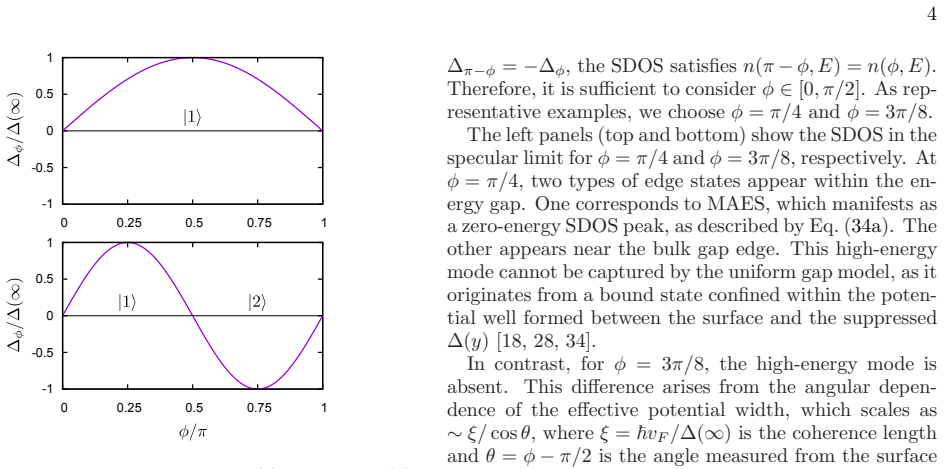
We revisit the effect of surface roughness on midgap Andreev edge states (MAES) in p- and d- wave superconductors. For a perfectly specular surface, MAES form a flat band at the Fermi energy, which manifests as a sharp midgap peak in the surface density of states (SDOS). Previous theoretical studies have shown that MAES in p- and d-wave superconductors respond markedly differently to surface roughness. In the d-wave state, diffuse surface scattering significantly broadens the midgap peak in the SDOS, accompanied by the emergence of a V-shaped structure centered at the Fermi energy. In contrast, the midgap peak in the p-wave state remains robust against diffuse scattering. In this work, we clarify the physical origin of this contrasting behavior. A key aspect of our analysis is that the flat band in the d-wave state consists of two distinct types of MAES modes. We show that inter-mode diffuse scattering leads to substantial broadening of the midgap peak and to the formation of the V-shaped structure. By contrast, the robustness of MAES in the p-wave state arises from the presence of a single MAES mode in the flat band. These results provide new insight into the response of MAES to surface roughness.
Editorial analysis
A structured set of objections, weighed in public.
Referee Report
Summary. The manuscript revisits the effect of surface roughness on midgap Andreev edge states (MAES) in p- and d-wave superconductors. For specular surfaces, MAES form a flat band at the Fermi energy manifesting as a sharp midgap peak in the surface density of states (SDOS). It claims that the d-wave flat band consists of two distinct MAES modes, such that inter-mode diffuse scattering broadens the midgap peak and produces a V-shaped structure, while the p-wave flat band contains only a single MAES mode, rendering the peak robust against the same scattering.
Significance. If the two-mode versus single-mode distinction is robust, the work supplies a concrete physical mechanism for the contrasting roughness responses previously reported in the literature. This mode-based explanation strengthens the conceptual toolkit for interpreting tunneling spectra of unconventional superconductors and could inform models of surface states in related systems.
major comments (2)
- [Section describing the flat-band mode structure and scattering mechanism] The central claim that inter-mode diffuse scattering between two distinct MAES types produces the d-wave broadening and V-shape (while a single mode protects the p-wave peak) is load-bearing. The manuscript should demonstrate that the mode classification survives changes in the diffuse-scattering kernel or boundary conditions, as the distinction is stated to depend on gap symmetry and boundary details; without such a check the explanatory power remains tied to the specific model chosen.
- [Comparison of p-wave and d-wave flat bands] The robustness argument for the p-wave case rests on the assertion of a single MAES mode. An explicit enumeration or symmetry classification of modes under the same boundary conditions used for the d-wave case would strengthen this contrast and rule out the possibility that additional modes are simply not resolved in the chosen calculation.
minor comments (2)
- [Methods or model section] Clarify in the text whether the SDOS is obtained from a quasiclassical Green's-function approach, numerical diagonalization, or another method, and state the precise form of the diffuse-scattering model employed.
- [Figure captions] Ensure that all figures showing SDOS curves are labeled with the precise scattering strength or roughness parameter values used.
Simulated Author's Rebuttal
We thank the referee for the careful reading of our manuscript and the constructive comments. We address the major comments point by point below, indicating the revisions we will implement to strengthen the presentation and robustness of our claims.
read point-by-point responses
-
Referee: [Section describing the flat-band mode structure and scattering mechanism] The central claim that inter-mode diffuse scattering between two distinct MAES types produces the d-wave broadening and V-shape (while a single mode protects the p-wave peak) is load-bearing. The manuscript should demonstrate that the mode classification survives changes in the diffuse-scattering kernel or boundary conditions, as the distinction is stated to depend on gap symmetry and boundary details; without such a check the explanatory power remains tied to the specific model chosen.
Authors: We agree that demonstrating robustness of the mode distinction is valuable. The classification of MAES modes follows directly from the gap symmetry (sign-changing for d-wave versus nodeless or chiral for p-wave) and the resulting number of zero-energy solutions to the Bogoliubov-de Gennes equation at specular boundaries. Inter-mode scattering is allowed only when multiple modes exist, which is symmetry-protected and independent of the precise form of the diffuse kernel. Our numerical results already show the V-shape and broadening persisting over a range of roughness parameters. In the revised manuscript we will add a dedicated paragraph with symmetry arguments and a brief check using an alternative kernel (e.g., a different angular distribution) to confirm the qualitative distinction remains unchanged. This revision will be partial, as a exhaustive scan of all possible kernels lies outside the scope of the present work. revision: partial
-
Referee: [Comparison of p-wave and d-wave flat bands] The robustness argument for the p-wave case rests on the assertion of a single MAES mode. An explicit enumeration or symmetry classification of modes under the same boundary conditions used for the d-wave case would strengthen this contrast and rule out the possibility that additional modes are simply not resolved in the chosen calculation.
Authors: We thank the referee for this suggestion. The p-wave flat band indeed supports only a single mode per edge due to its topological character and the absence of a sign-changing gap, while the d-wave case yields two counter-propagating modes. In the revised manuscript we will add an explicit enumeration of zero-energy modes together with a symmetry classification (based on particle-hole symmetry and boundary scattering) performed under identical boundary conditions for both pairing symmetries. This will be presented in a new subsection or appendix to make the contrast unambiguous and to exclude any numerical-resolution artifact. revision: yes
Circularity Check
No circularity: mode classification and scattering effects derived from gap symmetry and boundary conditions
full rationale
The paper performs a theoretical analysis of MAES in p- and d-wave superconductors by solving the Bogoliubov-de Gennes equations under specular and diffuse boundary conditions. The distinction between two MAES modes in the d-wave flat band versus one in p-wave follows directly from the nodal structure of the gap and the chosen surface scattering kernel; the resulting SDOS broadening and V-shape are computed consequences, not inputs. No parameter is fitted and then relabeled as a prediction, no result is defined in terms of itself, and self-citations (if present for prior work on the known difference) are not load-bearing for the new explanatory step. The derivation chain is self-contained against the stated model assumptions.
Axiom & Free-Parameter Ledger
axioms (1)
- domain assumption Standard BCS theory framework for p- and d-wave pairing symmetries and the existence of midgap Andreev edge states at specular surfaces.
Reference graph
Works this paper leans on
-
[1]
We apply the quasiclassical theory of superconduc- tivity to this model system
satisfies the symmetry relation ∆ +(y, φ ) = − ∆ − (y, φ ), MAES are formed for all angles φ [1, 2]. We apply the quasiclassical theory of superconduc- tivity to this model system. A central quantity in this framework is the quasiclassical Green’s function ˆ gα , which satisfies the Eilenberger equation [29, 30] αi ℏvy∂y ˆgα (y) = [ˆgα (y), ˆhα (y, φ, ε )],...
-
[2]
and ( 3) can be expressed in terms of D(y) and F (y) as ˆg+(y) = 2i ˆρ3 1 + D(y)F (y) ( 1 D(y) ) (1 − F (y)) − i, (19) ˆg− (y) = ˆgT +(y). (20) Thus, the boundary-value problem for ˆ gα (y) reduces to solving for D(y) and F (y) with the boundary conditions D(∞ ) = ∆ φ ε + iΩ , (21) ( 1 F (0) ) ∝ ˆρ3 1 − iˆγ 1 + iˆγ ˆρ3 ( 1 D(0) ) . (22) Equations (17)–(22...
-
[3]
The results are calculated at T = 0
1. The results are calculated at T = 0. 2Tc, where Tc is the transition temperature. The distance y from the surface is scaled by the coherence length ξ = ℏvF / ∆( ∞ ). expressions for G1, 2, we obtain G1 = − 1 + sφ 2 2|∆ φ | − εS2 ε + 2|∆ φ |S2 + 1 − sφ 2 ε + 2|∆ φ |S2 2|∆ φ | − εS2 , (38) G2 = − 1 − sφ 2 2|∆ φ | − εS1 ε + 2|∆ φ |S1 + 1 + sφ 2 ε + 2|∆ φ ...
-
[4]
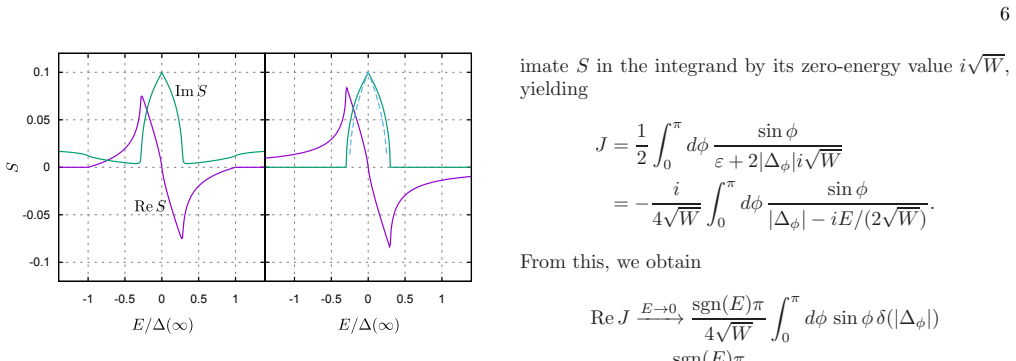
01. The left panel presents the exact result obtained within the uniform gap model, while the right panel demonstrates that the low-energy behavior is well repro- duced by the approximation in Eq. ( 44). At E = 0, S is purely imaginary, with S = i √ W . Near E = 0, Im S 6 -0.1 -0.05 0 0.05 0.1 -1 -0.5 0 0.5 1 -1 -0.5 0 0.5 1 FIG. 5. Energy dependence of S...
-
[5]
Figure 6 shows the corresponding SDOS obtained from Eq
simplifies to n(φ, E ) ≃ 1/ (2 Im S). Figure 6 shows the corresponding SDOS obtained from Eq. ( 42) using the S values from the right panel of Fig. 5. The resulting low-energy struc- ture closely reproduces the self-consistent SDOS shown in Fig. 3. To clarify the origin of the cusp in Im S, we rewrite Eq. ( 44) as GW 1 + GW 2 = − 1 S ( 1 − ε ε + 2|∆ φ |S )...
-
[6]
( 47) indicates that the cusp in Im S orig- inates from inter-mode scattering near the gap node at φ = π/ 2 within the broadened MAES flat band
The first line of Eq. ( 47) indicates that the cusp in Im S orig- inates from inter-mode scattering near the gap node at φ = π/ 2 within the broadened MAES flat band. B. SDOS in the p-wave SC state The low-energy expressions in Eqs. (
-
[7]
The key difference from the d-wave case arises from the behavior of sφ
and ( 39) for G1, 2 can also be applied to the p-wave SC state. The key difference from the d-wave case arises from the behavior of sφ . In the p-wave case, sφ = +1 over the entire range of φ. Consequently, G1, 2 reduce to G1 = − 2|∆ φ | − εS2 ε + 2|∆ φ |S2 , G2 = ε + 2|∆ φ |S1 2|∆ φ | − εS1 . (49) The Green’s functions GW 1, 2 correspond to G1, 2 without ...
-
[8]
(51) 7 0 0.2 0.4 0.6 0.8 1 1.2 1.4 0 0.1 0.2 0.3 0.4 0.5 0.6 0.7 0.8 0.9 1 FIG
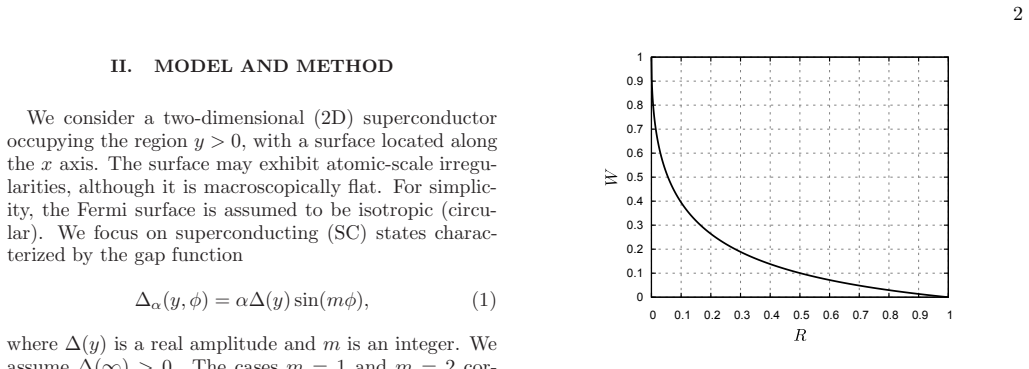
exhibits the following energy dependence: S1 = − 2∆( ∞ ) ε σ1, S 2 = ε 2∆( ∞ ) σ2. (51) 7 0 0.2 0.4 0.6 0.8 1 1.2 1.4 0 0.1 0.2 0.3 0.4 0.5 0.6 0.7 0.8 0.9 1 FIG. 7. Dependence of σ 1, 2 on W in the p-wave SC state, obtained from Eq. (52). Here, σ1, 2 are energy-independent parameters that sat- isfy σ1 = 2W ⟨ sin φ 1 + σ2 sin φ ⟩ φ , (52a) σ2 = 2W ⟨ 1 sin...
-
[9]
shows that both σ1 and σ2 increase monotonically with W (Fig. 7). Sub- stituting Eq. ( 51) into Eq. ( 49) yields G1 = 1 1 + σ2 sin φ ( − 2|∆ φ | ε + εσ2 2∆( ∞ ) ) , (53) G2 = 1 sin φ + σ1 ( ε 2∆( ∞ ) − 2|∆ φ |σ1 ε ) . (54) These expressions lead to the SDOS n(φ, E ) = Z(φ) π |∆ φ |δ(E), (55) where Z(φ) = 1 1 + σ2 sin φ + σ1 sin φ + σ1 . (56) Equation ( 55...
-
[10]
(57b) Thus, S1 and S2 describe MAES–MAES and MAES–CS scattering processes, respectively
simplifies to S1 = 2W ⟨ − 2|∆ φ | ε ⟩ φ = 2W ⟨ GES⟩ φ , (57a) S2 = 2W ⟨ ε 2|∆ φ | ⟩ φ = 2W ⟨ GCS⟩ φ . (57b) Thus, S1 and S2 describe MAES–MAES and MAES–CS scattering processes, respectively. In the p-wave SC state, where the |2⟩ MAES mode is absent, MAES–MAES scat- tering corresponds to intra-mode scattering within the flat band of the |1⟩ MAES mode. In con...
-
[11]
Hu, Midgap surface states as a novel signature for dx2 a− x2 b -wave superconductivity, Phys
C.-R. Hu, Midgap surface states as a novel signature for dx2 a− x2 b -wave superconductivity, Phys. Rev. Lett. 72, 1526 (1994)
1994
-
[12]
Ohashi and S
Y. Ohashi and S. Takada, Unified description of the mid gap states in inhomogeneous superconductors, J. Phys. Soc. Jpn. 65, 246 (1996)
1996
-
[13]
Tanaka, M
Y. Tanaka, M. Sato, and N. Nagaosa, Symmetry and topology in superconductors –odd-frequency pairing and edge states–, J. Phys. Soc. Jpn. 81, 011013 (2012)
2012
-
[14]
Mizushima, Y
T. Mizushima, Y. Tsutsumi, T. Kawakami, M. Sato, M. Ichioka, and K. Machida, Symmetry-protected topo- logical superfluids and superconductors —from the basics to 3He—, J. Phys. Soc. Jpn. 85, 022001 (2016)
2016
-
[15]
Tanaka and S
Y. Tanaka and S. Kashiwaya, Theory of tun- neling spectroscopy of d -wave superconductors, Phys. Rev. Lett. 74, 3451 (1995)
1995
-
[16]
Kashiwaya and Y
S. Kashiwaya and Y. Tanaka, Tunnelling effects on sur- face bound states in unconventional superconductors, Rep. Prog. Phys. 63, 1641 (2000)
2000
-
[17]
Y. S. Barash, H. Burkhardt, and D. Rainer, Low- temperature anomaly in the Josephson critical current of junctions in d -wave superconductors, Phys. Rev. Lett. 77, 4070 (1996)
1996
-
[18]
Matsumoto and H
M. Matsumoto and H. Shiba, Coexistence of different symmetry order parameters near a surface in d-wave superconductors I, J. Phys. Soc. Jpn. 64, 3384 (1995) ; Coexistence of different symmetry order param- 9 eters near a surface in d-wave superconductors II, J. Phys. Soc. Jpn. 64, 4867 (1995) ; Coexis- tence of different symmetry order parameters near a surf...
1995
-
[19]
Higashitani, Mechanism of paramagnetic Meiss- ner effect in high-temperature superconductors, J
S. Higashitani, Mechanism of paramagnetic Meiss- ner effect in high-temperature superconductors, J. Phys. Soc. Jpn. 66, 2556 (1997)
1997
-
[20]
Fogelstr¨ om, D
M. Fogelstr¨ om, D. Rainer, and J. A. Sauls, Tunneling into current-carrying surface states of high- Tc supercon- ductors, Phys. Rev. Lett. 79, 281 (1997)
1997
-
[21]
Sigrist, Time-reversal symmetry breaking states in high-temperature superconductors, Prog
M. Sigrist, Time-reversal symmetry breaking states in high-temperature superconductors, Prog. Theor. Phys. 99, 899 (1998)
1998
-
[22]
L¨ ofwander, V
T. L¨ ofwander, V. S. Shumeiko, and G. Wendin, Time-reversal symmetry breaking at Josephson tun- nel junctions of purely d-wave superconductors, Phys. Rev. B 62, R14653 (2000)
2000
-
[23]
A. B. Vorontsov, Broken translational and time-reversal symmetry in unconventional superconducting films, Phys. Rev. Lett. 102, 177001 (2009)
2009
-
[24]
H ˚ akansson, T
M. H ˚ akansson, T. L¨ ofwander, and M. Fogel- str¨ om, Spontaneously broken time-reversal sym- metry in high-temperature superconductors, Nat. Phys. 11, 755 (2015)
2015
-
[25]
Holmvall, A
P. Holmvall, A. B. Vorontsov, M. Fogelstr¨ om, and T. L¨ ofwander, Broken translational symme- try at edges of high-temperature superconductors, Nat. Commun. 9, 2190 (2018)
2018
-
[26]
Miyawaki and S
N. Miyawaki and S. Higashitani, Influence of diffuse sur- face scattering on the stability of superconducting phases with spontaneous surface current generated by Andreev bound states, Phys. Rev. B 98, 134516 (2018)
2018
-
[27]
Matsumoto and H
M. Matsumoto and H. Shiba, On bound- ary effect in d-wave superconductors, J. Phys. Soc. Jpn. 64, 1703 (1995)
1995
-
[28]
Yamada, Y
K. Yamada, Y. Nagato, S. Higashitani, and K. Na- gai, Rough surface effects on d-wave superconductors, J. Phys. Soc. Jpn. 65, 1540 (1996)
1996
-
[29]
L¨ uck, U
T. L¨ uck, U. Eckern, and A. Shelankov, d-wave su- perconductors near surfaces and interfaces: A scatter- ing matrix approach within the quasiclassical technique, Phys. Rev. B 63, 064510 (2001)
2001
-
[30]
S. V. Bakurskiy, A. A. Golubov, M. Y. Kupriyanov, K. Yada, and Y. Tanaka, Anomalous surface states at interfaces in p-wave superconductors, Phys. Rev. B 90, 064513 (2014)
2014
-
[31]
Nagato, M
Y. Nagato, M. Yamamoto, and K. Nagai, Rough surface effects on the p-wave Fermi superfluids, J. Low Temp. Phys. 110, 1135 (1998)
1998
-
[32]
A. B. Vorontsov and J. A. Sauls, Thermody- namic properties of thin films of superfluid 3He-A, Phys. Rev. B 68, 064508 (2003)
2003
-
[33]
Nagai, Y
K. Nagai, Y. Nagato, M. Yamamoto, and S. Hi- gashitani, Surface bound states in superfluid 3He, J. Phys. Soc. Jpn. 77, 111003 (2008)
2008
-
[34]
Nagato, S
Y. Nagato, S. Higashitani, and K. Nagai, Sub- gap in the edge states of two-dimensional chiral superconductor with rough surface, J. Phys. Soc. Jpn. 80, 113706 (2011)
2011
-
[35]
A. V. Chaplik and M. V. ´Entin, Energy spectrum and electron mobility in a thin film with non-ideal boundary, Sov. Phys.-JETP 28, 514 (1969)
1969
-
[36]
L. A. Fal’kovski˘i, Density attenuation of surface magnetic states, Sov. Phys.-JETP 31, 981 (1970)
1970
-
[37]
Higashitani, S
S. Higashitani, S. Matsuo, Y. Nagato, K. Nagai, S. Mu- rakawa, R. Nomura, and Y. Okuda, Odd-frequency Cooper pairs and zero-energy surface bound states in su- perfluid 3He, Phys. Rev. B 85, 024524 (2012)
2012
-
[38]
Higashitani, G
S. Higashitani, G. Sato, and Y. Nagato, Lifetime of edge modes at rough surfaces of chiral superconductors, Phys. Rev. B 110, 224506 (2024)
2024
-
[39]
Eilenberger, Transformation of Gorkov’s equation for type II superconductors into transport-like equations, Z
G. Eilenberger, Transformation of Gorkov’s equation for type II superconductors into transport-like equations, Z. Phys. 214, 195 (1968)
1968
-
[40]
Serene and D
J. Serene and D. Rainer, The quasiclassical approach to superfluid 3He, Physics Reports 101, 221 (1983)
1983
-
[41]
Zhang, J
W. Zhang, J. Kurkij¨ arvi, and E. V. Thuneberg, Variation of the order parameter of 3He-B near a diffusely scatter- ing boundary, Phys. Lett. A 109, 238 (1985)
1985
-
[42]
Kieselmann, Self-consistent calculations of the pair potential and the tunneling density of states in proximity contacts, Phys
G. Kieselmann, Self-consistent calculations of the pair potential and the tunneling density of states in proximity contacts, Phys. Rev. B 35, 6762 (1987)
1987
-
[43]
Nagato, S
Y. Nagato, S. Higashitani, K. Yamada, and K. Nagai, Theory of rough surface effects on the anisotropic BCS states, J. Low Temp. Phys. 103, 1 (1996)
1996
-
[44]
Sugiyama and S
E. Sugiyama and S. Higashitani, Surface bound states and spontaneous edge currents in chiral supercon- ductors: Effect of spatially varying order parameter, J. Phys. Soc. Jpn. 89, 034706 (2020)
2020
-
[45]
Huang, E
W. Huang, E. Taylor, and C. Kallin, Vanishing edge cur- rents in non- p-wave topological chiral superconductors, Phys. Rev. B 90, 224519 (2014)
2014
-
[46]
Y. Tada, W. Nie, and M. Oshikawa, Orbital angular mo- mentum and spectral flow in two-dimensional chiral su- perfluids, Phys. Rev. Lett. 114, 195301 (2015)
2015
-
[47]
X. Wang, Z. Wang, and C. Kallin, Spontaneous edge current in higher chirality superconductors, Phys. Rev. B 98, 094501 (2018)
2018
discussion (0)
Sign in with ORCID, Apple, or X to comment. Anyone can read and Pith papers without signing in.