Recognition: 3 theorem links
· Lean TheoremConstraint Preserving XY-Mixers under Trotterized Adiabatic Evolution
Pith reviewed 2026-05-08 18:28 UTC · model grok-4.3
The pith
XY-mixers outperform X-mixers under Trotterized adiabatic evolution only when constraints decompose into multiple disjoint local blocks.
A machine-rendered reading of the paper's core claim, the machinery that carries it, and where it could break.
Core claim
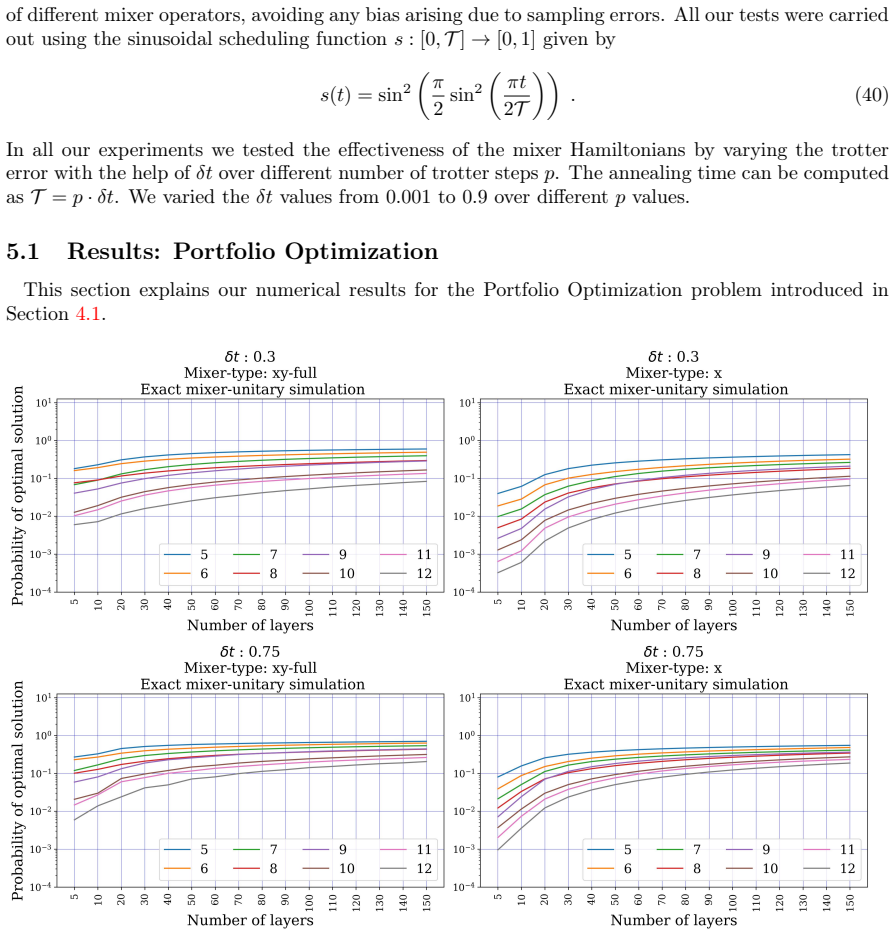
The paper establishes that the leading Trotter error terms in the XY-mixer evolution arise from commutators local to each constraint block. When constraints are small and disjoint, these errors remain bounded independently of total variables, preserving the feasible subspace effectively and yielding superior optimization trajectories compared to X-mixers. When a single constraint involves all variables, the error terms grow with system size and degrade the XY-mixer advantage, rendering X-mixers more reliable under realistic gate-based implementations.
What carries the argument
The XY-mixer Hamiltonian, a sum of pairwise XY interaction terms that swap values while conserving the feasible subspace defined by each constraint block, together with the per-block decomposition of the Trotter error.
If this is right
- Problems whose constraints split into small independent groups will maintain feasibility with high accuracy when using XY-mixers in Trotterized adiabatic evolution.
- Problems featuring one large equality constraint across all variables will see better results from X-mixers when Trotterization is used.
- A new mixer Hamiltonian tailored to TSP-style two-way one-hot encoding can handle those specific constraints while preserving feasibility.
- Structure-aware mixer selection in Trotterized adiabatic evolution offers a reliable route for quantum combinatorial optimization without heavy penalty terms.
Where Pith is reading between the lines
- Reformulating problems to localize large constraints could extend the XY-mixer advantage to more applications.
- The per-block error scaling may guide mixer choice between adiabatic and variational methods based on the constraint graph.
- Hardware runs with growing qubit count but fixed block size would directly test whether errors stay independent of total size.
Load-bearing premise
Trotter errors are dominated by terms whose size is set by each constraint's individual extent rather than by interactions or the total number of variables.
What would settle it
A simulation increasing total variables while holding each constraint block size fixed, yet showing the XY-mixer performance advantage disappearing for the local-constraint problems.
Figures


read the original abstract
Constraint handling is a central challenge for quantum algorithms applied to combinatorial optimization. Standard penalty-based approaches increase problem size, distort energy landscapes, and often degrade performance. Constraint-preserving mixers, such as XY-mixers, restrict quantum evolution to feasible subspaces, but their implementation on gate-based hardware requires Trotterization, which introduces approximation errors. In this work, we systematically investigate the interplay between constraint-preserving XY-mixers and Trotterized Adiabatic Evolution (TAE). We present a theoretical analyses of the origin and scaling of Trotter errors in XY-mixers and show that the dominant contribution depends on the size and structure of individual constraints rather than on the total problem size. Our findings are validated through extensive numerical simulations on three representative problems: Portfolio Optimization, the Multi-Car Paint Shop problem, and a Multi-Commodity Flow problem. For problems with a single global equality constraint spanning all variables, Trotter errors significantly impair XY-mixer performance, making standard Pauli-X mixers more robust under realistic implementations. In contrast, for problems whose constraints decompose into multiple disjoint local blocks, XY-mixers outperform X-mixers by several orders of magnitude even under Trotterized evolution. These results identify constraint locality as the key criterion for the effective use of XY-mixers and demonstrate that TAE combined with structure-aware mixer design provides a robust and theoretically grounded alternative to variational quantum optimization methods. We further present a dedicated mixer Hamiltonian for TSP-like 2-way-1-hot constraints.
Editorial analysis
A structured set of objections, weighed in public.
Referee Report
Summary. The paper examines constraint-preserving XY-mixers within Trotterized Adiabatic Evolution for combinatorial optimization. It presents a theoretical analysis asserting that the dominant Trotter errors scale with the size and structure of individual constraints rather than total problem size N. Numerical simulations on Portfolio Optimization (global equality constraint), Multi-Car Paint Shop, and Multi-Commodity Flow (disjoint local blocks) are used to show that XY-mixers outperform X-mixers by orders of magnitude for local constraints but suffer significant impairment for global ones. A dedicated mixer Hamiltonian for TSP-like 2-way-1-hot constraints is also introduced.
Significance. If the scaling result holds, the work supplies practical guidance for mixer selection in quantum adiabatic algorithms, potentially enabling orders-of-magnitude gains on locally constrained problems while identifying when standard X-mixers remain preferable. The combination of theoretical error-origin analysis with numerical validation on representative problems strengthens the case for structure-aware mixer design as an alternative to purely variational approaches.
major comments (2)
- [Numerical Simulations and Theoretical Analysis] The central scaling claim (that dominant Trotter error depends on per-constraint size/structure rather than total N) is load-bearing for the performance conclusions. The three simulated problems differ simultaneously in constraint locality and in N; without controlled scaling experiments that vary N while holding block size fixed (or vice versa), the observed gaps could be driven by N-dependent commutator norms or Trotter step counts rather than the claimed locality property.
- [Theoretical Analysis] The theoretical analysis of Trotter error origins is described in the abstract but supplies no explicit commutator bounds, derivation steps, or scaling formulas. This absence makes it difficult to verify that the dominant contribution is independent of total problem size.
minor comments (2)
- Simulation parameters (Trotter step size, number of steps, annealing schedule, and any noise models) are not reported, hindering reproducibility of the numerical results.
- A summary table comparing success probabilities or approximation ratios for XY-mixers versus X-mixers across the three problems would improve clarity.
Simulated Author's Rebuttal
We thank the referee for the careful reading and constructive feedback on our manuscript. The major comments raise valid points about strengthening the empirical and theoretical support for our scaling claims. We address each below and will revise the manuscript accordingly.
read point-by-point responses
-
Referee: [Numerical Simulations and Theoretical Analysis] The central scaling claim (that dominant Trotter error depends on per-constraint size/structure rather than total N) is load-bearing for the performance conclusions. The three simulated problems differ simultaneously in constraint locality and in N; without controlled scaling experiments that vary N while holding block size fixed (or vice versa), the observed gaps could be driven by N-dependent commutator norms or Trotter step counts rather than the claimed locality property.
Authors: We agree that the current numerical examples vary both total problem size N and constraint locality at the same time, which prevents a fully controlled isolation of the locality effect. Our theoretical analysis predicts that the leading Trotter error term is governed by the size and internal structure of individual constraints (independent of N), but the referee is correct that additional numerical evidence is needed to corroborate this. In the revised manuscript we will add controlled scaling experiments: for the Multi-Commodity Flow instance we will systematically increase the number of commodities (hence N) while keeping the per-block constraint size fixed, and we will report the observed Trotter error growth versus N. We will also include a complementary study that fixes N and varies block size. These additions will directly address the concern that the performance gaps might arise from N-dependent factors rather than locality. revision: yes
-
Referee: [Theoretical Analysis] The theoretical analysis of Trotter error origins is described in the abstract but supplies no explicit commutator bounds, derivation steps, or scaling formulas. This absence makes it difficult to verify that the dominant contribution is independent of total problem size.
Authors: We acknowledge that the present manuscript presents the Trotter-error scaling argument at a summary level without the full set of commutator bounds or derivation steps. In the revised version we will expand the theoretical section to include: (i) explicit upper bounds on the relevant nested commutators for both XY- and X-mixers, (ii) the step-by-step derivation showing how the leading error term factors into per-constraint contributions, and (iii) the resulting scaling formulas that demonstrate independence from total problem size N when constraints are local and disjoint. These additions will allow readers to verify the claimed locality property directly from the text. revision: yes
Circularity Check
No circularity in derivation chain
full rationale
The paper's central analysis derives Trotter error scaling for XY-mixers from standard quantum evolution operators and the Trotter product formula applied to the mixer Hamiltonian, without reducing any claimed prediction or scaling law to a fitted parameter or self-referential definition. Numerical validation on three distinct combinatorial problems (Portfolio Optimization, Multi-Car Paint Shop, Multi-Commodity Flow) serves as external checks rather than inputs that define the result. No self-citation chains, ansatz smuggling, or uniqueness theorems imported from prior author work are load-bearing for the error-origin claim; the derivation remains self-contained against the external benchmarks of Trotter theory and direct simulation.
Axiom & Free-Parameter Ledger
axioms (2)
- standard math Adiabatic theorem applies to the continuous evolution before Trotterization
- domain assumption Trotter-Suzuki decomposition error scales with commutator norms of mixer and problem Hamiltonians
Reference graph
Works this paper leans on
-
[1]
A Quantum Approximate Optimization Algorithm
Edward Farhi, Jeffrey Goldstone, and Sam Gutmann. A quantum approximate optimization algorithm.arXiv preprint arXiv:1411.4028, 2014
work page internal anchor Pith review arXiv 2014
-
[2]
Rieffel, Davide Venturelli, and Rupak Biswas
Stuart Hadfield, Zhihui Wang, Bryan O’Gorman, Eleanor G. Rieffel, Davide Venturelli, and Rupak Biswas. Fromthequantumapproximateoptimizationalgorithmtoaquantumalternatingoperator ansatz.Algorithms, 12(2):34, February 2019
2019
-
[3]
Constraint preserving mixers for the quantum approximate optimization algorithm
Franz Georg Fuchs, Kjetil Olsen Lye, Halvor Møll Nilsen, Alexander Johannes Stasik, and Gior- gio Sartor. Constraint preserving mixers for the quantum approximate optimization algorithm. Algorithms, 15(6), 2022
2022
-
[4]
Alignment between initial state and mixer improves qaoa performance for constrained optimization.npj Quantum Information, 9(1), November 2023
Zichang He, Ruslan Shaydulin, Shouvanik Chakrabarti, Dylan Herman, Changhao Li, Yue Sun, and Marco Pistoia. Alignment between initial state and mixer improves qaoa performance for constrained optimization.npj Quantum Information, 9(1), November 2023
2023
-
[5]
Computer solutions of the traveling salesman problem.The Bell System Technical Journal, 44(10):2245–2269, 1965
Shen Lin. Computer solutions of the traveling salesman problem.The Bell System Technical Journal, 44(10):2245–2269, 1965
1965
-
[6]
Multi-car paint shop optimization with quantum annealing
Sheir Yarkoni, Alex Alekseyenko, Michael Streif, David Von Dollen, Florian Neukart, and Thomas Back. Multi-car paint shop optimization with quantum annealing . In2021 IEEE International Conference on Quantum Computing and Engineering (QCE), pages 35–41, October 2021
2021
-
[7]
Ising formulations of many np problems.Frontiers in Physics, 2, 2014
Andrew Lucas. Ising formulations of many np problems.Frontiers in Physics, 2, 2014
2014
-
[8]
Gershgorin
S. Gershgorin. Über die abgrenzung der eigenwerte einer matrix.Bulletin de l’Académie des Sciences de l’URSS. Classe des sciences matheématiques et na, 6:749–754, 1931
1931
-
[9]
Constructing driver hamiltonians for optimization prob- lems with linear constraints.Quantum Science and Technology, 7:015013, 11 2021
Hannes Leipold and Federico Spedalieri. Constructing driver hamiltonians for optimization prob- lems with linear constraints.Quantum Science and Technology, 7:015013, 11 2021
2021
-
[10]
Rubin, Jason M
Zhihui Wang, Nicholas C. Rubin, Jason M. Dominy, and Eleanor G. Rieffel.xymixers: Analytical and numerical results for the quantum alternating operator ansatz.Phys. Rev. A, 101:012320, Jan 2020
2020
-
[11]
Springer International Publishing, 2019
Andreas Bärtschi and Stephan Eidenbenz.Deterministic Preparation of Dicke States, page 126–139. Springer International Publishing, 2019
2019
-
[12]
Short-depthcircuitsfordickestatepreparation
AndreasBartschiandStephanEidenbenz. Short-depthcircuitsfordickestatepreparation. In2022 IEEE International Conference on Quantum Computing and Engineering (QCE), page 87–96. IEEE, September 2022
2022
-
[13]
Quantum supremacy through the quantum approximate optimization algorithm, 2019
Edward Farhi and Aram W Harrow. Quantum supremacy through the quantum approximate optimization algorithm, 2019
2019
-
[14]
Quantum advantage with shallow circuits
Sergey Bravyi, David Gosset, and Robert König. Quantum advantage with shallow circuits. Science, 362(6412):308–311, October 2018. 18
2018
-
[15]
Evaluating the limits of qaoa parameter transfer at high-rounds on sparse ising models with geometrically local cubic terms, 2026
Elijah Pelofske, Marek Rams, Andreas Bärtschi, Piotr Czarnik, Paolo Braccia, Lukasz Cincio, and Stephan Eidenbenz. Evaluating the limits of qaoa parameter transfer at high-rounds on sparse ising models with geometrically local cubic terms, 2026
2026
-
[16]
Wilhelm, and Tim Bode
Thorge Müller, Ajainderpal Singh, Frank K. Wilhelm, and Tim Bode. Limitations of quantum approximate optimization in solving generic higher-order constraint-satisfaction problems.Phys. Rev. Res., 7:023165, May 2025
2025
-
[17]
Effective embed- ding of integer linear inequalities for variational quantum algorithms
Maximilian Hess, Lilly Palackal, Abhishek Awasthi, and Karen Wintersperger. Effective embed- ding of integer linear inequalities for variational quantum algorithms. In2024 IEEE International Conference on Quantum Computing and Engineering (QCE), volume 01, pages 221–231, 2024
2024
-
[18]
Quantum approximate optimization algorithm: Performance, mechanism, and implementation on near-term devices.Physical Review X, 10(2):021067, 2020
Leo Zhou, Sheng-Tao Wang, Soonwon Choi, Hannes Pichler, and Mikhail D Lukin. Quantum approximate optimization algorithm: Performance, mechanism, and implementation on near-term devices.Physical Review X, 10(2):021067, 2020
2020
-
[19]
Kovalsky, Fernando A
Lucas K. Kovalsky, Fernando A. Calderon-Vargas, Matthew D. Grace, Alicia B. Magann, James B. Larsen, Andrew D. Baczewski, and Mohan Sarovar. Self-healing of trotter error in digital adiabatic state preparation.Physical Review Letters, 131(6), August 2023
2023
-
[20]
Lecture notes on quantum computing.arXiv preprint arXiv:2311.08445, 2024
Anton Frisk Kockum, Ariadna Soro, Laura García-Álvarez, Pontus Vikstål, Tom Douce, Göran Johansson, and Giulia Ferrini. Lecture notes on quantum computing.arXiv preprint arXiv:2311.08445, 2024
-
[21]
Hegade, Xi Chen, and Enrique Solano
Narendra N. Hegade, Xi Chen, and Enrique Solano. Digitized counterdiabatic quantum optimiza- tion.Physical Review Research, 4(4), 2022
2022
-
[22]
Rubin, Jason M
Zhihui Wang, Nicholas C. Rubin, Jason M. Dominy, and Eleanor G. Rieffel. Xy-mixers: Analytical and numerical results for the quantum alternating operator ansatz.Physical Review A, 101(1), January 2020
2020
-
[23]
Portfolio selection.The Journal of Finance, 7(1):77–91, 1952
Harry Markowitz. Portfolio selection.The Journal of Finance, 7(1):77–91, 1952
1952
-
[24]
QisKit SDK, 2022
IBM. QisKit SDK, 2022
2022
-
[25]
Adaptive trotterization for time-dependent hamiltonian quantum dynamics using piecewise conservation laws.Phys
Hongzheng Zhao, Marin Bukov, Markus Heyl, and Roderich Moessner. Adaptive trotterization for time-dependent hamiltonian quantum dynamics using piecewise conservation laws.Phys. Rev. Lett., 133:010603, Jul 2024. 19 A Portfolio Optimization: Results against differentδtvalues A.1 Exact Simulation of Mixer Unitaries: Portfolio Optimization Figure 5:Results fo...
2024
discussion (0)
Sign in with ORCID, Apple, or X to comment. Anyone can read and Pith papers without signing in.