Recognition: unknown
Background of the BULLKID detector array operated with moderate shield on surface
Pith reviewed 2026-05-08 17:12 UTC · model grok-4.3
The pith
BULLKID silicon detector array operated on surface with moderate shielding shows low-energy background compatible with simulations down to 600 eV.
A machine-rendered reading of the paper's core claim, the machinery that carries it, and where it could break.
Core claim
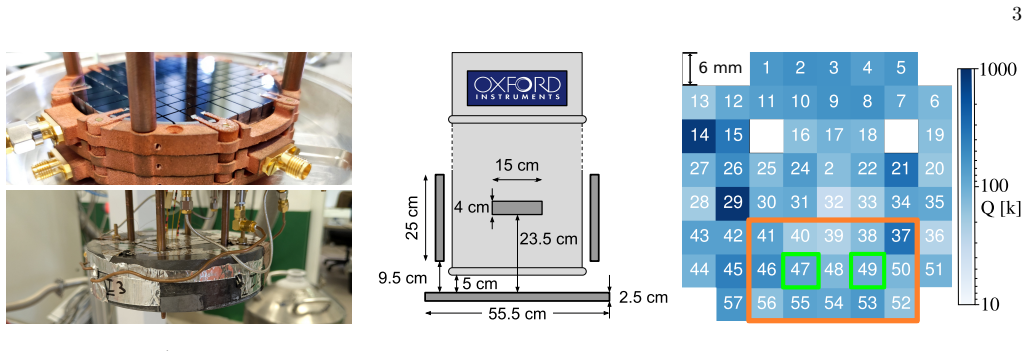
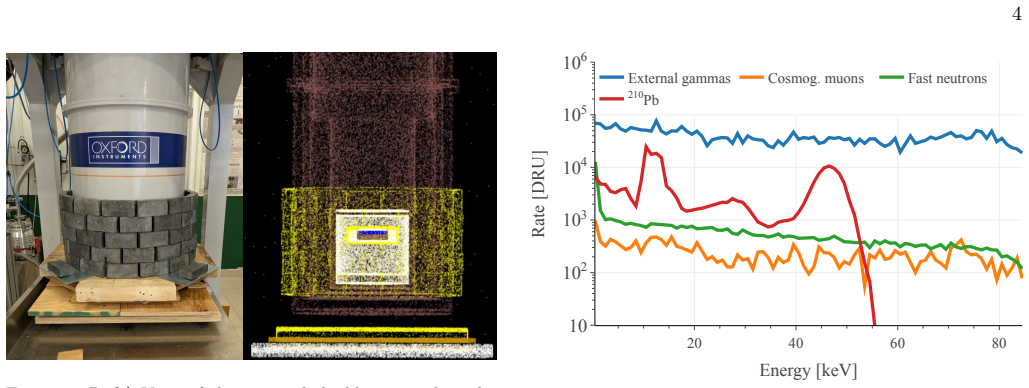
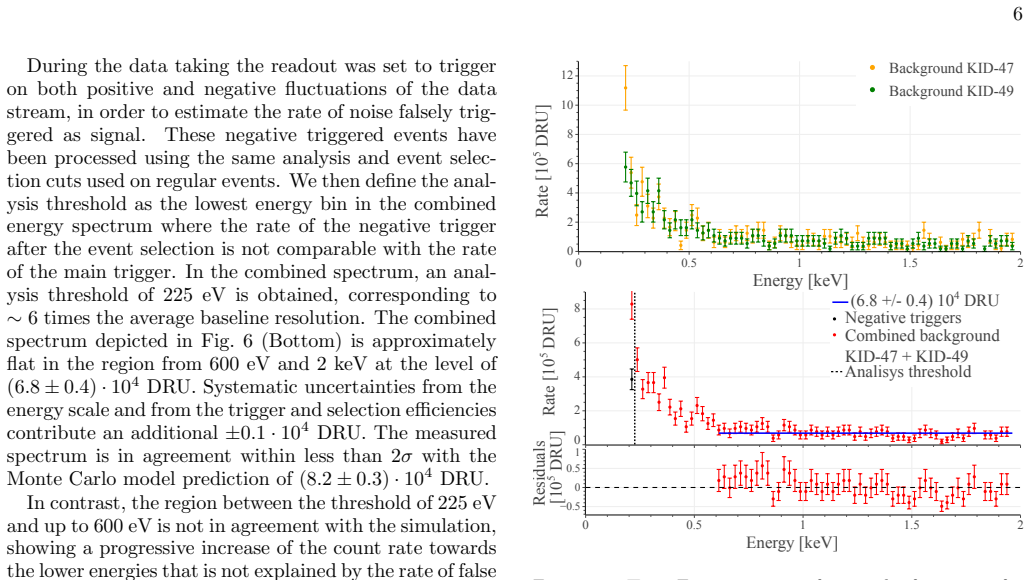
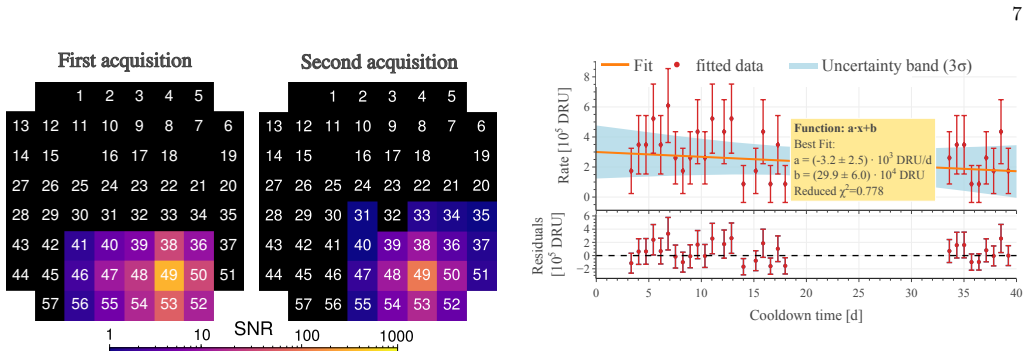
With external and internal radiation shields in place, the BULLKID array of 60 cubic silicon absorbers of 0.34 g each, sensed by cryogenic kinetic inductance detectors, records a low-energy background spectrum from 15 elements that is compatible with simulations at the level of (6.8 ± 0.4 stat. ± 0.1 syst.) × 10^4 counts / keV kg days from 2 keV down to 600 eV. The region between 225 eV and 600 eV shows a background rise in disagreement with the simulations, while not sharing some of the key traits of the low energy excess observed in other cryogenic experiments. The high energy spectrum shape is in overall agreement with the simulations and displays the typical particle-induced X-ray lines.
What carries the argument
An array of silicon particle absorbers with central units used for background measurement and surrounding units acting as an active veto, operated together with moderate external and internal radiation shields.
If this is right
- Background levels in the keV range become predictable by simulation when moderate shielding and veto are applied, allowing reliable estimates for surface-based runs.
- Surrounding detector elements successfully reject a substantial fraction of ambient background events.
- High-energy particle interactions produce X-ray emissions from the lead shield that match the expected pattern.
- Surface operation of low-threshold cryogenic arrays becomes practical for light dark matter or coherent neutrino scattering searches.
Where Pith is reading between the lines
- If the unexplained rise below 600 eV can be reduced by additional material or geometry changes, the detector threshold could be lowered further for lighter dark matter particles.
- Surface testing with this shielded veto setup could shorten development time for similar cryogenic detectors before moving to underground sites.
- The specific form of the low-energy rise may point to surface or material effects that differ from those in other experiments and could be isolated with targeted runs.
Load-bearing premise
The Monte Carlo simulations accurately include every relevant surface background component and the surrounding detectors function as a perfect veto without leaving unmodeled contributions.
What would settle it
A measured rate or spectral shape between 600 eV and 2 keV that differs from the simulated value by more than the combined statistical and systematic uncertainties quoted in the paper.
Figures




read the original abstract
We present the operation with moderate radiation shield in a surface laboratory of BULLKID (BULky and Low-threshold Kinetic Inductance Detector), a cryogenic detector for searches of light Dark Matter or Coherent Elastic Neutrino-Nucleus Scattering. The detector consists of an array of 60 cubic silicon particle absorbers of 0.34 g each, sensed by cryogenic kinetic inductance detectors. The analysis presented focuses on data from 15 elements of the array, with two central units used to evaluate the background and with their surrounding elements used as veto. The low energy spectrum resulting from an exposure of 290 hours to ambient backgrounds, acquired with the use of external and internal radiation shields, is compatible with the simulations at the level of $(6.8\pm0.4\,{\rm stat.}\pm0.1\,{\rm syst.})\times10^4$ counts / keV kg days from 2 keV down to an energy of 600 eV. The region between 225 eV and 600 eV shows a rise in background in disagreement with the simulations, while not sharing some of the key traits of the low energy excess observed in other cryogenic experiments. The high energy spectrum shape is in overall agreement with the simulations and displays the typical particle-induced X-ray emission of the surrounding lead.
Editorial analysis
A structured set of objections, weighed in public.
Referee Report
Summary. This manuscript presents results from operating the BULLKID array of 60 silicon absorbers read out by kinetic inductance detectors in a surface laboratory with moderate radiation shielding. The analysis focuses on 15 elements, using two central absorbers to measure the background spectrum while employing the surrounding 13 elements as a veto. After an exposure of 290 hours, the authors report a background level of (6.8 ± 0.4 statistical ± 0.1 systematic) × 10^4 counts per keV per kg per day between 2 keV and 600 eV, which is compatible with their Monte Carlo simulations. They observe a rise in the background rate in the 225–600 eV range that deviates from the simulations but does not share key features with low-energy excesses reported by other cryogenic experiments. The high-energy spectrum is in agreement with simulations and exhibits typical particle-induced X-ray emission from the lead shielding.
Significance. Should the central claims be substantiated, this work is significant as it provides one of the first detailed background characterizations for a KID-based detector array targeting low-energy rare events. The quantitative agreement with independent simulations, including statistical and systematic uncertainties, and the use of an internal veto strategy represent strengths. It offers practical insights for surface-based testing of such detectors and identifies a potential new background component at sub-keV energies that warrants further study. This contributes to the field by benchmarking background levels for future underground deployments or improved shielding designs.
major comments (2)
- [Abstract and data analysis section] The headline result of spectral compatibility with simulations from 2 keV to 600 eV is predicated on the surrounding detectors functioning as an effective veto for the central absorbers. The manuscript does not report the coincidence window used, the energy-dependent veto efficiency, or the accidental coincidence rate. A direct comparison of the spectrum with and without the veto applied would help validate this assumption and rule out leakage of surface-induced events into the central detectors.
- [Simulation comparison section] While the Monte Carlo is stated to include ambient and surface backgrounds, no sensitivity study or variation of key parameters (e.g., surface contamination levels, lead shield leakage, or low-energy neutron/X-ray contributions) is presented. Given the noted disagreement below 600 eV, such a study is necessary to assess whether the simulations fully capture the relevant physics or if an unmodeled component is present.
minor comments (2)
- [Results figures] The energy spectrum plots would be clearer if the simulation uncertainty bands were overlaid on the data points for direct visual assessment of the agreement.
- The units in the background rate expression could be written more conventionally as counts keV^{-1} kg^{-1} day^{-1} to avoid ambiguity in the slash notation.
Simulated Author's Rebuttal
We thank the referee for the thorough review and valuable suggestions. We address the major comments below and have made revisions to the manuscript to incorporate the requested information and clarifications.
read point-by-point responses
-
Referee: [Abstract and data analysis section] The headline result of spectral compatibility with simulations from 2 keV to 600 eV is predicated on the surrounding detectors functioning as an effective veto for the central absorbers. The manuscript does not report the coincidence window used, the energy-dependent veto efficiency, or the accidental coincidence rate. A direct comparison of the spectrum with and without the veto applied would help validate this assumption and rule out leakage of surface-induced events into the central detectors.
Authors: We agree that these details are important for validating the veto strategy. The original manuscript omitted explicit reporting of these parameters. In the revised version, we will add a description of the coincidence analysis, specifying the time window used for vetoing, the calculated veto efficiency as a function of energy, and the estimated accidental coincidence rate. We will also include a figure showing the background spectrum before and after applying the veto to demonstrate its effectiveness in reducing the event rate. revision: yes
-
Referee: [Simulation comparison section] While the Monte Carlo is stated to include ambient and surface backgrounds, no sensitivity study or variation of key parameters (e.g., surface contamination levels, lead shield leakage, or low-energy neutron/X-ray contributions) is presented. Given the noted disagreement below 600 eV, such a study is necessary to assess whether the simulations fully capture the relevant physics or if an unmodeled component is present.
Authors: We acknowledge the value of a sensitivity study to better understand the disagreement below 600 eV. While a comprehensive variation of all parameters would require significant additional computational resources, we will include in the revised manuscript a limited sensitivity analysis focusing on the impact of varying surface contamination levels and low-energy X-ray contributions. This will help assess whether the observed excess can be attributed to unmodeled components or variations in the input parameters. revision: partial
Circularity Check
No significant circularity: measured background rates compared to independent Monte Carlo
full rationale
The paper reports an experimental measurement of background count rates from 290 hours of data taking with the BULLKID array, using two central detectors for the spectrum and surrounding elements as veto. The quoted rate of (6.8±0.4 stat.±0.1 syst.)×10^4 counts / keV kg days is extracted directly from the observed data spectrum between 2 keV and 600 eV and compared to separate Monte Carlo simulations of ambient and surface backgrounds. No equations, ansatzes, or self-citations reduce this measured rate to a fitted parameter defined by the same dataset. The high-energy spectrum shape is likewise compared to simulation without self-referential derivation. Veto usage and simulation fidelity are assumptions whose validation is external to the reported numbers; they do not create a definitional loop. This is a standard data-vs-simulation comparison with no load-bearing self-definition or fitted-input-called-prediction.
Axiom & Free-Parameter Ledger
axioms (2)
- domain assumption Monte Carlo simulations accurately model ambient radiation backgrounds and detector response in a surface laboratory with moderate shielding.
- domain assumption Surrounding detector elements provide an effective veto that isolates true background events in the central units.
Reference graph
Works this paper leans on
-
[1]
Silk et al.,Particle Dark Matter: Observations, Models and Searches
G. Bertone, D. Hooper, and J. Silk, Phys. Rept.405, https://doi.org/10.1017/CBO9780511770739 (2005)
-
[3]
G. Angloher, S. Banik, G. Benato, A. Bento, A. Bertolini, R. Breier, C. Bucci, J. Burkhart, L. Canonica, A. D’Addabbo, S. Di Lorenzo, L. Einfalt, A. Erb, F. v. Feilitzsch, S. Fichtinger, D. Fuchs, and Others, Physical Review D110, 10.1103/physrevd.110.083038 (2024)
-
[4]
Armengaud, Q
E. Armengaud, Q. Arnaud, M. Augier,et al.(EDEL- WEISS), JCAP05, 019
-
[5]
Strauss, J
R. Strauss, J. Rothe, G. Angloher,et al., Eur. Phys. J. C77, 506 (2017)
2017
-
[6]
C. Augier, G. Baulieu, V. Belov, L. Berg´ e, J. Bil- lard, G. Bres, J. . L. Bret, A. Broniatowski, M. Calvo, A. Cazes, and Others., The European Physical Journal C84, 10.1140/epjc/s10052-024-12433-1 (2024)
-
[7]
Ackermann, H
N. Ackermann, H. Bonet, A. Bonhomme, C. Buck, K. F¨ ulber, J. Hakenm¨ uller, J. Hempfling, G. Heusser, M. Lindner, W. Maneschg, K. Ni, M. Rank, T. Rink, E. S´ anchez Garc´ ıa, I. Stalder, H. Strecker, R. Wink, and J. Woenckhaus, Nature643, 1229–1233 (2025)
2025
-
[8]
Mondal, W
D. Mondal, W. Baker, M. Chaudhuri, J. B. Dent, R. Dey, B. Dutta, V. Iyer, A. Jastram, V. K. S. Kashyap, A. Ku- bik, K. Lang, R. Mahapatra, S. Maludze, N. Mirabol- fathi, M. Mirzakhani, B. Mohanty, H. Neog, J. L. New- stead, M. Platt, S. Sahoo, J. Sander, L. E. Strigari, and J. Walker, Cevns search with cryogenic sapphire detec- tors at miner: Results from...
2025
-
[9]
Belov, A
V. Belov, A. Bystryakov, M. Danilov, S. Evseev, M. Fom- ina, G. Ignatov, and (vGeN Collaboration), Chinese Physics C49, 053004 (2025)
2025
-
[10]
Agnese, T
R. Agnese, T. Aramaki, I. Arnquist,et al.(SuperCDMS), Phys. Rev. Lett.120, 061802 (2018)
2018
-
[11]
A. H. Abdelhameed, G. Angloher, P. Bauer,et al., Phys. Rev. D100, 102002 (2019)
2019
-
[12]
Adariet al., SciPost Phys
P. Adariet al., SciPost Phys. Proc.009, 001 (2022)
2022
-
[13]
G. Angloher, S. Banik, G. Benato, A. Bento, A. Bertolini, R. Breier, C. Bucci, and Others., SciPost Physics Pro- ceedings 10.21468/scipostphysproc.12.013 (2023)
-
[14]
Baxter, R
D. Baxter, R. Essig, Y. Hochberg, M. Kaznacheeva, B. von Krosigk, F. Reindl, R. K. Romani, and F. Wag- ner, Annual Review of Nuclear and Particle Science75, 301–326 (2025)
2025
-
[15]
M. Folcarelliet al., Projected sensitivity to light wimp- like particles of the bullkid-dm experiment (2026), arXiv:2601.13766 [physics.ins-det]
-
[16]
Crucianiet al., Appl
A. Crucianiet al., Appl. Phys. Lett.121, 213504 (2022)
2022
-
[17]
Delicato, D., Ahmad, A., Bandiera, L., Calvo, M., Cap- pelli, M., Del Castello, G., del Gallo Roccagiovine, M., Giammei, M., Guidi, V., Maiello, D., Pettinacci, V., Ro- magnoni, M., Tamisari, M., Cruciani, A., Mazzolari, A., Monfardini, A., and Vignati, M., Eur. Phys. J. C84, 353 (2024)
2024
-
[18]
Ettus x300 sdr specifications
-
[19]
Minutolo, B
L. Minutolo, B. Steinbach, A. Wandui, and R. O’Brient, IEEE Trans. Appl. Supercond.29, 1 (2019)
2019
-
[20]
Radeka and N
V. Radeka and N. Karlovac, Nucl. Instrum. Methods52, 86 (1967)
1967
-
[21]
S. Di Domizio, F. Orio, and M. Vignati, JINST6, P02007, arXiv:1012.1263 [astro-ph.IM]
-
[22]
Cardani, N
L. Cardani, N. Casali, I. Colantoni,et al., Eur. Phys. J. C81, 636 (2021)
2021
-
[23]
Del Castello, Nuclear Instruments and Methods in Physics Research Section A: Accelerators, Spectrome- ters, Detectors and Associated Equipment1068, 169728 (2024)
G. Del Castello, Nuclear Instruments and Methods in Physics Research Section A: Accelerators, Spectrome- ters, Detectors and Associated Equipment1068, 169728 (2024)
2024
-
[24]
M. Folcarelli, D. Delicato, A. Acevedo-Renter´ ıa, L. E. Ardila-Perez, L. Bandiera, M. Calvo,et al., The Euro- pean Physical Journal C86, 10.1140/epjc/s10052-026- 15523-4 (2026)
-
[25]
Allisonet al., Nuclear Instruments and Methods in Physics Research Section A: Accelerators, Spectrometers, Detectors and Associated Equipment835, 186 (2016)
J. Allisonet al., Nuclear Instruments and Methods in Physics Research Section A: Accelerators, Spectrometers, Detectors and Associated Equipment835, 186 (2016)
2016
-
[26]
Allisonet al., IEEE Transactions on Nuclear Science 53, 270 (2006)
J. Allisonet al., IEEE Transactions on Nuclear Science 53, 270 (2006)
2006
-
[27]
Agostinelliet al., Nuclear Instruments and Methods in Physics Research Section A: Accelerators, Spectrometers, Detectors and Associated Equipment506, 250 (2003)
S. Agostinelliet al., Nuclear Instruments and Methods in Physics Research Section A: Accelerators, Spectrometers, Detectors and Associated Equipment506, 250 (2003)
2003
-
[28]
Reference physics lists / shielding
-
[29]
Cardaniet al., Nature Communications12, 2733 (2021)
L. Cardaniet al., Nature Communications12, 2733 (2021)
2021
-
[30]
Meister,Deconvolution problems in nonparametric statistics(Springer Berlin, Heidelberg, 2009)
A. Meister,Deconvolution problems in nonparametric statistics(Springer Berlin, Heidelberg, 2009)
2009
-
[31]
Polaet al., Nuclear Instruments and Methods in Physics Research Section A: Accelerators, Spectrome- ters, Detectors and Associated Equipment969, 164078 (2020)
A. Polaet al., Nuclear Instruments and Methods in Physics Research Section A: Accelerators, Spectrome- ters, Detectors and Associated Equipment969, 164078 (2020)
2020
-
[32]
Byrne,Neutrons, nuclei, and matter: an exploration of the physics of slow neutrons(Institute of Physics Pub., Bristol ; Philadelphia, 1994)
J. Byrne,Neutrons, nuclei, and matter: an exploration of the physics of slow neutrons(Institute of Physics Pub., Bristol ; Philadelphia, 1994)
1994
-
[33]
Hagmannet al., in2007 IEEE Nuclear Science Sym- posium Conference Record, Vol
C. Hagmannet al., in2007 IEEE Nuclear Science Sym- posium Conference Record, Vol. 2 (2007) pp. 1143–1146
2007
-
[34]
M. Rodrigueset al., Applied Radiation and Isotopes109, 500 (2016), proceedings of the 20th International Con- ference on Radionuclide Metrology and its Applications 8–11 June 2015, Vienna, Austria
2016
-
[35]
Paul and J
H. Paul and J. Sacher, Atomic Data and Nuclear Data Tables42, 105 (1989)
1989
-
[36]
Paul and O
H. Paul and O. Bolik, Atomic Data and Nuclear Data Tables54, 75 (1993)
1993
-
[37]
Orlicet al., Atomic Data and Nuclear Data Tables56, 159 (1994)
I. Orlicet al., Atomic Data and Nuclear Data Tables56, 159 (1994)
1994
-
[38]
A. Tabordaet al., X-Ray Spectrometry40, 127 (2011), https://analyticalsciencejournals.onlinelibrary.wiley.com /doi/pdf/10.1002/xrs.1305
-
[39]
A. Tabordaet al., X-Ray Spectrometry42, 177 (2013), https://analyticalsciencejournals.onlinelibrary.wiley.com /doi/pdf/10.1002/xrs.2483
-
[40]
Bakret al., Nuclear Instruments and Methods in Physics Research Section B: Beam Interactions with Ma- terials and Atoms507, 11 (2021)
S. Bakret al., Nuclear Instruments and Methods in Physics Research Section B: Beam Interactions with Ma- terials and Atoms507, 11 (2021)
2021
-
[41]
Mazin,Microwave Kinetic Inductance Detectors, Ph.D
B. Mazin,Microwave Kinetic Inductance Detectors, Ph.D. thesis, California Institute of Technology (2004)
2004
-
[42]
A. G. Kozorezov, J. K. Wigmore, D. Martin, P. Verhoeve, and A. Peacock, Physical Review B75, 10.1103/phys- revb.75.094513 (2007)
-
[43]
SNOLAB, Snolab low background counting facility (2025), last accessed 9 December 2025
2025
-
[44]
C. L. Chang, Y.-Y. Chang, M. Garcia-Sciveres,et al., Applied Physics Letters127, 263502 (2025)
2025
-
[45]
Alkhatib, D
I. Alkhatib, D. Amaral, T. Aralis,et al.(SuperCDMS Collaboration), Phys. Rev. Lett.127, 061801 (2021)
2021
-
[46]
Abele, G
H. Abele, G. Angloher, B. Arnold, M. A. Corona, A. Bento, E. Bossio, and Others, Characterization of the low energy excess using a nucleusal 2o3 detector (2026)
2026
-
[47]
Thompsonet al.,X-ray Data Booklet(Center for X- ray Optics and Advanced Light Source, Lawrence Berke- ley National Laboratory, 2009)
A. Thompsonet al.,X-ray Data Booklet(Center for X- ray Optics and Advanced Light Source, Lawrence Berke- ley National Laboratory, 2009)
2009
-
[48]
Maiello,Background identification in the BULLKID detector for neutrino and Dark Matter searches, Master’s thesis, Universit` a di Roma la Sapienza (2024)
D. Maiello,Background identification in the BULLKID detector for neutrino and Dark Matter searches, Master’s thesis, Universit` a di Roma la Sapienza (2024). Appendix A: LEAD-INDUCED ENERGY CALIBRA TION The preliminary LED calibration of the main KIDs is cross-checked using the lead-induced lines listed in Tab. I. These lines are reconstructed by fitting ...
2024
discussion (0)
Sign in with ORCID, Apple, or X to comment. Anyone can read and Pith papers without signing in.