Recognition: 3 theorem links
· Lean TheoremCertified Qualitative Analysis of the SIR ODE and Reusable Scalar Lemmas in Isabelle/HOL
Pith reviewed 2026-05-08 18:14 UTC · model grok-4.3
The pith
Isabelle/HOL proofs transfer local Picard-Lindelof flows to a unique global forward SIR solution with conservation, invariance, and threshold conditions.
A machine-rendered reading of the paper's core claim, the machinery that carries it, and where it could break.
Core claim
The central claim is that the local AFP flow segments for the SIR vector field satisfy the classical Kermack-McKendrick phase-plane relation, nonnegative orthant invariance, total-population conservation, infectious-compartment monotonicity governed by the basic reproduction ratio, and compartment bounds; these facts lift to the unique global forward flow on [0,b] for arbitrary b>0 because the nonnegative simplex is compact and forward-invariant.
What carries the argument
The reusable layer of homogeneous-linear scalar compartment lemmas for equations X'(t)=f(t)X(t) together with the AFP Picard-Lindelof local-flow construction and the nonnegative simplex as compactness witness.
If this is right
- The SIR model admits a unique global forward solution on every interval [0,b] with b>0.
- The nonnegative orthant is forward-invariant under the SIR flow.
- Total population is exactly conserved for all forward time.
- Infectious-compartment growth or decay is governed by whether the initial susceptible fraction exceeds the threshold ratio.
- The classical Kermack-McKendrick conserved quantity holds along every trajectory of the constructed solution.
Where Pith is reading between the lines
- The scalar lemmas for X'(t)=f(t)X(t) and derivative-sign monotonicity can be instantiated for other three-compartment mass-action systems such as SEIR without repeating the AFP bridge.
- Because the proofs apply to the concrete AFP-constructed flow rather than to an arbitrary solution, they can serve as a verified kernel for further certified statements about finite-time bounds or threshold phenomena.
- The separation between reusable scalar infrastructure and the specific SIR transfer bridge makes it feasible to replace the SIR vector field with a nearby model while preserving the qualitative lemmas.
Load-bearing premise
The SIR vector field must satisfy the local Lipschitz condition so that the AFP Picard-Lindelof infrastructure produces unique local flow segments that can be extended globally using compactness of the nonnegative simplex.
What would settle it
An explicit counterexample, inside the Isabelle artifact, in which either total population is not conserved, the nonnegative orthant is left by some trajectory, or the Kermack-McKendrick relation fails to hold along the constructed global forward flow on [0,b].
Figures


read the original abstract
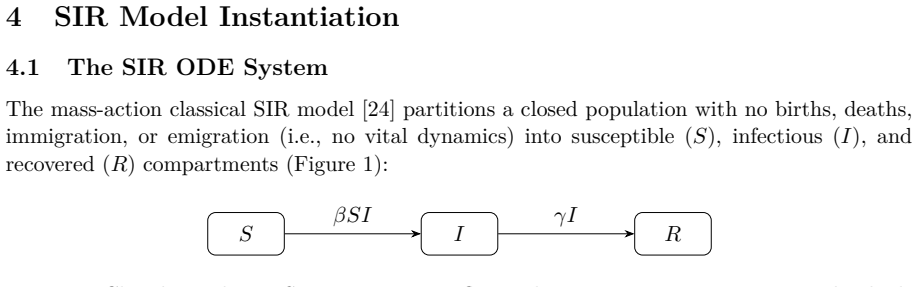
We present a mechanically checked Isabelle/HOL bridge from the Picard-Lindelof flow infrastructure in the Archive of Formal Proofs (AFP) to selected qualitative facts for the mass-action, closed-population SIR epidemic ODE. The epidemiological facts are classical; the contribution is reusable theorem infrastructure connecting the AFP local-flow construction to global forward existence, uniqueness, forward invariance of the nonnegative orthant, conservation, monotonicity, the Kermack-McKendrick conserved phase-plane relation, compartment bounds, and threshold-ratio conditions for infectious growth and monotonicity. The proof first establishes sign and conservation facts for local AFP flow segments, then uses the conserved nonnegative simplex as the compactness witness for extending the flow to all forward times. The finite-interval qualitative facts are then transferred to the unique AFP forward flow on arbitrary intervals [0,b] with b>0, so the results apply to the constructed Isabelle/AFP SIR solution rather than to an assumed trajectory. The reusable layer provides homogeneous-linear scalar compartment lemmas for equations X'(t)=f(t)X(t), derivative-sign monotonicity, three-compartment conservation, and an SIR transfer bridge to the AFP flow infrastructure. We do not formalize stability, final-size, or asymptotic theory. The accompanying Isabelle artifact builds with Isabelle 2024 and AFP 2024 and contains no sorry or oops proof placeholders.
Editorial analysis
A structured set of objections, weighed in public.
Referee Report
Summary. The paper presents a mechanically checked Isabelle/HOL formalization bridging the AFP Picard-Lindelöf local-flow infrastructure to global forward existence, uniqueness, and selected qualitative properties of the closed-population mass-action SIR ODE. It proves forward invariance of the nonnegative simplex, conservation, monotonicity, the Kermack-McKendrick phase-plane relation, compartment bounds, and threshold conditions for infectious growth, then transfers these facts to the unique global forward flow on arbitrary intervals [0,b]. A reusable layer of homogeneous-linear scalar lemmas for equations of the form X'(t)=f(t)X(t), derivative-sign monotonicity, and three-compartment conservation is provided, with all steps verified without placeholders.
Significance. The work supplies certified, reusable theorem infrastructure that applies directly to the constructed AFP global SIR flow rather than to an assumed trajectory. Strengths include the mechanically checked proofs, the parameter-free reusable scalar lemmas independent of SIR nonlinearity, the compactness argument for global extension, and the clean build on Isabelle 2024/AFP 2024. This strengthens formal methods support for classical qualitative results in mathematical epidemiology.
Simulated Author's Rebuttal
We thank the referee for the careful reading of the manuscript and for the positive assessment. We appreciate the recommendation to accept and are pleased that the reusable theorem infrastructure, the bridge from AFP local flows to global SIR solutions, and the parameter-free scalar lemmas were highlighted as strengths.
Circularity Check
No significant circularity; derivation is mechanically verified against external AFP infrastructure
full rationale
The paper's derivation chain consists of formal Isabelle/HOL proofs that transfer sign, conservation, monotonicity, and Kermack-McKendrick facts from local AFP Picard-Lindelöf flow segments to a unique global forward flow on the nonnegative simplex. All steps are machine-checked with no placeholders. The reusable scalar lemmas apply to homogeneous-linear equations X'(t)=f(t)X(t) and are independent of the SIR nonlinearity. The central results rest on the external AFP library and standard ODE theory (local Lipschitz condition, compactness of the invariant simplex) rather than any self-definition, fitted parameter renamed as prediction, or load-bearing self-citation. No quantity is defined in terms of itself, and the artifact builds cleanly under stated Isabelle/AFP versions.
Axiom & Free-Parameter Ledger
axioms (2)
- standard math Picard-Lindelof theorem for local existence and uniqueness of flows (AFP library)
- domain assumption The SIR right-hand side is locally Lipschitz continuous
Lean theorems connected to this paper
-
Cost.FunctionalEquation (J = ½(x+x⁻¹)−1)washburn_uniqueness_aczel unclear?
unclearRelation between the paper passage and the cited Recognition theorem.
Generic integrating-factor representation for scalar equations X'=f(t)X with continuous coefficient f.
What do these tags mean?
- matches
- The paper's claim is directly supported by a theorem in the formal canon.
- supports
- The theorem supports part of the paper's argument, but the paper may add assumptions or extra steps.
- extends
- The paper goes beyond the formal theorem; the theorem is a base layer rather than the whole result.
- uses
- The paper appears to rely on the theorem as machinery.
- contradicts
- The paper's claim conflicts with a theorem or certificate in the canon.
- unclear
- Pith found a possible connection, but the passage is too broad, indirect, or ambiguous to say the theorem truly supports the claim.
Reference graph
Works this paper leans on
-
[1]
R. M. Anderson and R. M. May.Infectious Diseases of Humans: Dynamics and Control. Oxford University Press, 1991. doi:10.1093/oso/9780198545996.001.0001
-
[2]
C. Ballarin. Locales: A module system for mathematical theories.Journal of Automated Reasoning, 52(2):123–153, 2014. doi:10.1007/s10817-013-9284-7
-
[3]
S. Boldo, C. Lelay, and G. Melquiond. Coquelicot: A user-friendly library of real analysis for Coq.Mathematics in Computer Science, 9(1):41–62, 2015. doi:10.1007/s11786-014-0181-1
-
[4]
F. Brauer and C. Castillo-Chávez.Mathematical Models in Population Biology and Epi- demiology, volume 40 ofTexts in Applied Mathematics. Springer, 2nd edition, 2012. doi:10.1007/978-1-4614-1686-9
-
[5]
F. Brauer, C. Castillo-Chávez, and Z. Feng.Mathematical Models in Epidemiology, vol- ume 69 ofTexts in Applied Mathematics. Springer, 2019. doi:10.1007/978-1-4939-9828-9. 30
-
[6]
Ciocchetta and J
F. Ciocchetta and J. Hillston. Bio-PEPA: A framework for the modelling and analysis of biological systems.Theoretical Computer Science, 410(33–34):3065–3084, 2009. doi:10.101 6/j.tcs.2009.02.037
2009
-
[7]
Diekmann, H
O. Diekmann, H. Heesterbeek, and T. Britton.Mathematical Tools for Understanding Infectious Disease Dynamics. Princeton Series in Theoretical and Computational Biology. Princeton University Press, 2013
2013
-
[8]
Diekmann and J
O. Diekmann and J. A. P. Heesterbeek.Mathematical Epidemiology of Infectious Diseases: Model Building, Analysis and Interpretation. Wiley, 2000
2000
-
[9]
O. Diekmann, J. A. P. Heesterbeek, and J. A. J. Metz. On the definition and the compu- tation of the basic reproduction ratioR0 in models for infectious diseases in heterogeneous populations.Journal of Mathematical Biology, 28(4):365–382, 1990. doi:10.1007/BF0017 8324
-
[10]
O. Diekmann, J.A. P. Heesterbeek, and M. G.Roberts. Theconstruction of next-generation matrices for compartmental epidemic models.Journal of the Royal Society Interface, 7(47):873–885, 2010. doi:10.1098/rsif.2009.0386
-
[11]
J. Fisher and T. A. Henzinger. Executable cell biology.Nature Biotechnology, 25(11):1239– 1249, 2007. doi:10.1038/nbt1356
-
[12]
N. Fulton. Analyzing disease spread models using a theorem prover. Web note, 2020. https://nfulton.org/2020/03/27/SIR-Models-In-KeYmaeraX/, last checked 3 May 2026
2020
-
[13]
KeYmaera X: An Axiomatic Tactical Theorem Prover for Hybrid Systems
N. Fulton, S. Mitsch, J.-D. Quesel, M. Völp, and A. Platzer. KeYmaera X: An axiomatic tactical theorem prover for hybrid systems. InAutomated Deduction – CADE-25, volume 9195 ofLNCS, pages 527–538. Springer, 2015. doi:10.1007/978-3-319-21401-6_36
-
[14]
J. Harrison. The HOL Light theory of euclidean space.Journal of Automated Reasoning, 50(2):173–190, 2013. doi:10.1007/s10817-012-9250-9
-
[15]
H. W. Hethcote. Qualitative analyses of communicable disease models.Mathematical Biosciences, 28(3–4):335–356, 1976. doi:10.1016/0025-5564(76)90132-2
-
[16]
H. W. Hethcote. The mathematics of infectious diseases.SIAM Review, 42(4):599–653,
-
[17]
doi:10.1137/S0036144500371907
-
[18]
J. Hölzl. Markov models.Archive of Formal Proofs, 2012. Archive of Formal Proofs entry, https://www.isa-afp.org/entries/Markov_Models.html
2012
-
[19]
J. Hölzl, F. Immler, and B. Huffman. Type classes and filters for mathematical analysis in Isabelle/HOL. InInteractive Theorem Proving (ITP 2013), volume 7998 ofLNCS, pages 279–294. Springer, 2013. doi:10.1007/978-3-642-39634-2_21
-
[20]
F. Immler. Verified reachability analysis of continuous systems. InTools and Algorithms for the Construction and Analysis of Systems (TACAS 2015), volume 9035 ofLNCS, pages 37–51. Springer, 2015. doi:10.1007/978-3-662-46681-0_3
-
[21]
F. Immler. A verified ODE solver and the Lorenz attractor.Journal of Automated Reason- ing, 61(1–4):73–111, 2018. doi:10.1007/s10817-017-9448-y
-
[22]
F. Immler and J. Hölzl. Numerical analysis of ordinary differential equations in Is- abelle/HOL. InInteractive Theorem Proving (ITP 2012), volume 7406 ofLNCS, pages 377–392. Springer, 2012. doi:10.1007/978-3-642-32347-8_26. 31
-
[23]
Immler and J
F. Immler and J. Hölzl. Ordinary differential equations.Archive of Formal Proofs, 2012. Archive of Formal Proofs entry, https://www.isa-afp.org/entries/Ordinary_Differential_ Equations.html
2012
-
[24]
ThePoincaré-BendixsontheoreminIsabelle/HOL
F.ImmlerandY.K.Tan. ThePoincaré-BendixsontheoreminIsabelle/HOL. InProceedings of the 9th ACM SIGPLAN International Conference on Certified Programs and Proofs, pages 338–352. ACM, 2020. doi:10.1145/3372885.3373833
-
[25]
W. O. Kermack and A. G. McKendrick. A contribution to the mathematical theory of epidemics.Proceedings of the Royal Society A, 115(772):700–721, 1927. doi:10.1098/rspa.1 927.0118
-
[26]
M. Maggesi. A formalization of metric spaces in HOL Light.Journal of Automated Rea- soning, 60(2):237–254, 2018. doi:10.1007/s10817-017-9412-x
-
[27]
E. Makarov and B. Spitters. The Picard algorithm for ordinary differential equations in Coq. InInteractive Theorem Proving (ITP 2013), volume 7998 ofLNCS, pages 463–468. Springer, 2013. doi:10.1007/978-3-642-39634-2_34
-
[28]
J. D. Murray.Mathematical Biology I: An Introduction, volume 17 ofInterdisciplinary Applied Mathematics. Springer, 3rd edition, 2002. doi:10.1007/b98868
-
[29]
M. Nagumo. Über die lage der integralkurven gewöhnlicher differentialgleichungen.Pro- ceedings of the Physico-Mathematical Society of Japan. 3rd Series, 24:551–559, 1942
1942
-
[30]
T. Nipkow, L. C. Paulson, and M. Wenzel.Isabelle/HOL: A Proof Assistant for Higher- Order Logic, volume 2283 ofLNCS. Springer, 2002. doi:10.1007/3-540-45949-9
-
[31]
S. Park and H. Thies. A Coq formalization of Taylor models and power series for solv- ing ordinary differential equations. In15th International Conference on Interactive The- orem Proving (ITP 2024), volume 309 ofLeibniz International Proceedings in Informat- ics (LIPIcs), pages 30:1–30:19. Schloss Dagstuhl – Leibniz-Zentrum für Informatik, 2024. doi:10.4...
-
[32]
A. Platzer. Differential dynamic logic for hybrid systems.Journal of Automated Reasoning, 41(2):143–189, 2008. doi:10.1007/s10817-008-9103-8
-
[33]
Ilyes Batatia, David Peter Kovacs, Gregor N
A. Platzer.Logical Foundations of Cyber-Physical Systems. Springer, 2018. doi:10.1007/97 8-3-319-63588-0
work page doi:10.1007/97 2018
-
[34]
Y. K. Tan and A. Platzer. An axiomatic approach to existence and liveness for differential equations.Formal Aspects of Computing, 33(4):461–518, 2021. doi:10.1007/s00165-020-0 0525-0
-
[35]
Teschl.Ordinary Differential Equations and Dynamical Systems, volume 140 ofGraduate Studies in Mathematics
G. Teschl.Ordinary Differential Equations and Dynamical Systems, volume 140 ofGraduate Studies in Mathematics. American Mathematical Society, 2012
2012
-
[36]
The mathlib Community. The Lean mathematical library. InProceedings of the 9th ACM SIGPLAN International Conference on Certified Programs and Proofs, pages 367–381. ACM, 2020. doi:10.1145/3372885.3373824
-
[37]
P. van den Driessche and J. Watmough. Reproduction numbers and sub-threshold endemic equilibria for compartmental models of disease transmission.Mathematical Biosciences, 180:29–48, 2002. doi:10.1016/S0025-5564(02)00108-6
-
[38]
Wenzel.Isabelle/Isar—a Versatile Environment for Human-Readable Formal Proof Documents
M. Wenzel.Isabelle/Isar—a Versatile Environment for Human-Readable Formal Proof Documents. PhD thesis, Technische Universität München, 2002. https://isabelle.in.tu m.de/Isar/isar-thesis-Isabelle2002.pdf. 32
2002
discussion (0)
Sign in with ORCID, Apple, or X to comment. Anyone can read and Pith papers without signing in.