Recognition: 3 theorem links
· Lean TheoremNonlinear isotropic odd elasticity
Pith reviewed 2026-05-08 18:17 UTC · model grok-4.3
The pith
Odd elasticity in two dimensions suppresses bifurcations in a square under dead-load tension.
A machine-rendered reading of the paper's core claim, the machinery that carries it, and where it could break.
Core claim
We establish the description of large, nonlinear deformations of isotropic two-dimensional Cauchy elastic solids. Surprisingly, we find that oddness suppresses the bifurcations of a passive Rivlin square. By contrast, we discover that the bifurcations of a three-dimensional Rivlin cube survive oddness even though there is no isotropic, odd linear elasticity in three dimensions.
What carries the argument
The nonlinear isotropic odd Cauchy-elastic constitutive relation in two dimensions, which augments the classical hyperelastic energy with nonconservative stress contributions and is closed under finite-strain kinematics.
If this is right
- Active 2D sheets can sustain large uniform expansions without the symmetry-breaking instabilities of passive elasticity.
- The absence of linear odd elasticity in 3D does not prevent nonlinear odd effects from altering bifurcation thresholds in cubes.
- Biological tissues modeled as odd-elastic solids may exhibit qualitatively different shape changes under growth or contraction than passive models predict.
- Minimal dead-load problems become sensitive probes of nonconservative elasticity once finite strains are considered.
Where Pith is reading between the lines
- The suppression mechanism may allow engineered active metamaterials to avoid wrinkling or folding instabilities during large expansion.
- Extending the framework to include anisotropy or surface tension could reveal new classes of stable large-amplitude modes.
- Direct measurement of stress response in cyclically loaded 2D active gels would test whether the predicted bifurcation suppression is observable.
Load-bearing premise
A consistent nonlinear constitutive framework for isotropic odd Cauchy elasticity exists in 2D and can be applied to the Rivlin problem without introducing inconsistencies or additional constraints.
What would settle it
A laboratory observation that an isotropic 2D odd-elastic sheet under dead-load tension still develops the same bifurcation modes as its passive counterpart would falsify the suppression result.
Figures
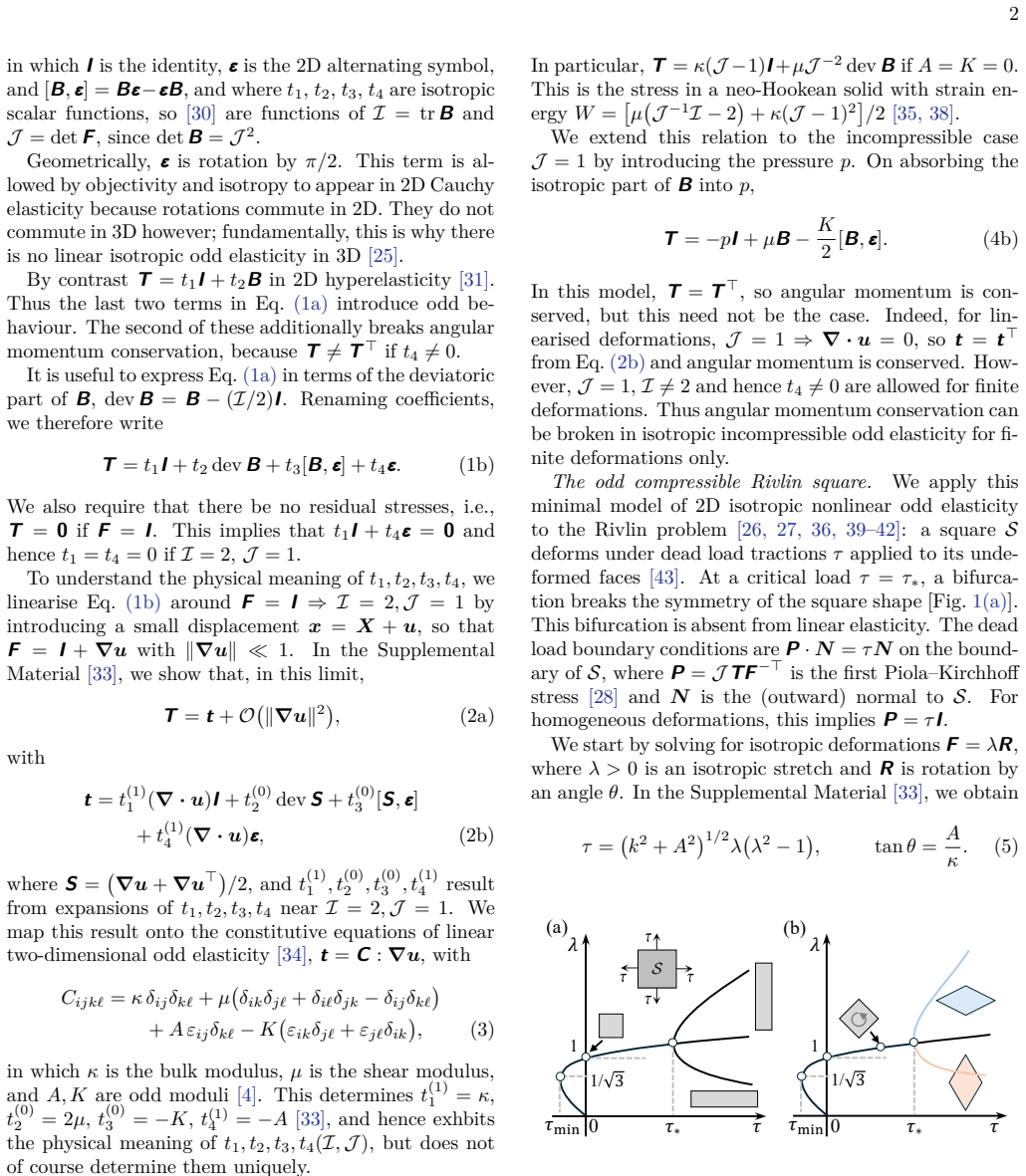

read the original abstract
The nonconservative elastic responses of active solids have driven a recent explosion of interest in two-dimensional "odd" elasticity: small, linear deformations of these Cauchy elastic solids enable new behaviour absent from classical, passive elasticity. Here, we establish the description of large, nonlinear deformations of isotropic two-dimensional Cauchy elastic solids. We apply our framework to the Rivlin problem, perhaps the simplest problem of elasticity lacking a linear analogue: a square deforms under dead load tractions. Surprisingly, we find that oddness suppresses the bifurcations of a passive Rivlin square. By contrast, we discover that the bifurcations of a three-dimensional Rivlin cube survive oddness even though there is no isotropic, odd linear elasticity in three dimensions. Our results thus form the basis for describing large deformations of active, biological solids while revealing their unexpected nonlinear behaviour that arises even in minimal problems.
Editorial analysis
A structured set of objections, weighed in public.
Referee Report
Summary. The manuscript develops a constitutive framework for finite-strain, isotropic odd Cauchy elasticity in two dimensions. It applies the framework to the classic Rivlin dead-load problems, reporting that odd elasticity suppresses the bifurcations of a 2D square while the bifurcations of a 3D cube persist, even though no isotropic odd linear elasticity exists in 3D.
Significance. If the constitutive construction is consistent with objectivity, stress symmetry, and the correct linear limits, the work supplies a minimal nonlinear extension of odd elasticity that is directly applicable to large-deformation active solids. The contrasting 2D/3D bifurcation results are unexpected and could guide experiments on biological tissues or metamaterials.
major comments (2)
- [§3.1, Eq. (7)] §3.1, Eq. (7): The isotropic odd contribution to the Cauchy stress is written as a function of the deformation gradient; the manuscript must explicitly verify that this term is objective (frame-indifferent) and yields a symmetric stress tensor. Without this check the reported suppression of the Rivlin-square bifurcations cannot be guaranteed to follow from the stated assumptions.
- [§4.2] §4.2, bifurcation analysis: The linearization of the full nonlinear constitutive law around the homogeneous Rivlin solution must be shown to recover the known 2D odd modulus while producing zero odd contribution in 3D. The eigenvalue problem for the incremental equations should be presented so that the claimed suppression (2D) versus survival (3D) of bifurcations can be traced to the odd terms rather than to auxiliary choices in the numerical scheme.
minor comments (2)
- [Introduction] The abstract states that the framework is for 'Cauchy elastic solids' but the introduction should briefly recall the distinction from hyperelasticity and confirm that the odd extension preserves the Cauchy-elastic (non-hyperelastic) character.
- [Figure 3] Figure 3 (bifurcation diagrams): axis labels and legend entries are too small; the passive and odd curves should be plotted on the same scale with explicit critical-load values annotated.
Simulated Author's Rebuttal
We thank the referee for their careful reading of our manuscript and for the constructive major comments. We address each point below and have revised the manuscript accordingly to strengthen the presentation.
read point-by-point responses
-
Referee: [§3.1, Eq. (7)] The isotropic odd contribution to the Cauchy stress is written as a function of the deformation gradient; the manuscript must explicitly verify that this term is objective (frame-indifferent) and yields a symmetric stress tensor. Without this check the reported suppression of the Rivlin-square bifurcations cannot be guaranteed to follow from the stated assumptions.
Authors: We agree that an explicit verification of objectivity and symmetry for the odd term in Eq. (7) is required for rigor. In the revised manuscript we will add a short appendix (or subsection) that demonstrates the transformation properties of the isotropic odd Cauchy stress under superposed rigid rotations and confirms that the total stress tensor remains symmetric. This verification will establish that the reported suppression of bifurcations in the 2D Rivlin problem follows directly from the constitutive assumptions. revision: yes
-
Referee: [§4.2] The linearization of the full nonlinear constitutive law around the homogeneous Rivlin solution must be shown to recover the known 2D odd modulus while producing zero odd contribution in 3D. The eigenvalue problem for the incremental equations should be presented so that the claimed suppression (2D) versus survival (3D) of bifurcations can be traced to the odd terms rather than to auxiliary choices in the numerical scheme.
Authors: We accept this recommendation. The revised §4.2 will contain the explicit linearization of the nonlinear constitutive law about the homogeneous Rivlin solution, recovering the standard 2D odd modulus and confirming that the odd contribution vanishes identically in the 3D linearization (consistent with the absence of isotropic odd linear elasticity in 3D). We will also state the eigenvalue problems for the incremental equations in both dimensions, together with a brief description of the numerical discretization, so that the contrasting bifurcation behaviors can be traced unambiguously to the odd elastic terms. revision: yes
Circularity Check
No significant circularity; framework extends standard finite-strain elasticity
full rationale
The derivation begins from the standard requirements of frame-indifference and isotropy for the Cauchy stress response function in 2D, then incorporates an odd component consistent with the linear odd modulus. Application to the Rivlin dead-load problem follows directly from solving the resulting equilibrium equations and bifurcation analysis. No equation reduces to a fitted parameter renamed as prediction, no self-definition of oddness via the target result, and no load-bearing uniqueness theorem imported from self-citation. The 3D contrast is noted as a consistency check rather than a derived claim. The central results on bifurcation suppression therefore rest on independent constitutive assumptions.
Axiom & Free-Parameter Ledger
axioms (2)
- ad hoc to paper Isotropic two-dimensional Cauchy elastic solids admit a consistent nonlinear odd extension
- domain assumption The Rivlin problem can be posed and solved within this nonlinear odd framework
Lean theorems connected to this paper
-
IndisputableMonolith.Cost.FunctionalEquation (washburn_uniqueness_aczel)washburn_uniqueness_aczel unclear?
unclearRelation between the paper passage and the cited Recognition theorem.
T = t₁ I + t₂ B + t₃[B,ε] + t₄ ε ... where t₁,t₂,t₃,t₄ are isotropic scalar functions ... functions of I = trB and J = detF
-
IndisputableMonolith.Foundation.BranchSelection (RCLCombiner / branch_selection)branch_selection unclear?
unclearRelation between the paper passage and the cited Recognition theorem.
α(I₁,I₂) = α₀₀ + α₁₀(I₁−3) + α₀₁(I₂−3); β(I₁,I₂) = β₀₀ + β₁₀(I₁−3) + β₀₁(I₂−3) ... a six-dimensional space of Cauchy elastic materials, with a four-dimensional subspace of hyperelastic materials.
What do these tags mean?
- matches
- The paper's claim is directly supported by a theorem in the formal canon.
- supports
- The theorem supports part of the paper's argument, but the paper may add assumptions or extra steps.
- extends
- The paper goes beyond the formal theorem; the theorem is a base layer rather than the whole result.
- uses
- The paper appears to rely on the theorem as machinery.
- contradicts
- The paper's claim conflicts with a theorem or certificate in the canon.
- unclear
- Pith found a possible connection, but the passage is too broad, indirect, or ambiguous to say the theorem truly supports the claim.
Reference graph
Works this paper leans on
-
[1]
R. W. Ogden,Non-linear elastic deformations(Dover, Mineola, NY, 1997) Chap. 3 & 4, pp. 140–222
1997
-
[2]
Truesdell and W
C. Truesdell and W. Noll,The Non-Linear Field Theories of Mechanics, edited by S. S. Antman (Springer, Berlin, Heidelberg, 2004)
2004
-
[3]
Yavari and A
A. Yavari and A. Goriely, Nonlinear Cauchy elasticity, Arch. Rational Mech. Anal.249, 57 (2025)
2025
-
[4]
Scheibner, A
C. Scheibner, A. Souslov, D. Banerjee, P. Sur´ owka, W. T. Irvine, and V. Vitelli, Odd elasticity, Nat. Phys.16, 475 (2020)
2020
-
[5]
Fruchart, C
M. Fruchart, C. Scheibner, and V. Vitelli, Odd viscosity and odd elasticity, Annu. Rev. Condens. Matter Phys. 14, 471 (2023)
2023
-
[6]
Y. Chen, X. Li, C. Scheibner, V. Vitelli, and G. Huang, Realization of active metamaterials with odd micropolar elasticity, Nat. Commun.12, 5935 (2021)
2021
-
[7]
S. J. Kole, G. P. Alexander, S. Ramaswamy, and A. Maitra, Layered chiral active matter: Beyond odd elasticity, Phys. Rev. Lett.126, 248001 (2021)
2021
-
[8]
Banerjee, V
D. Banerjee, V. Vitelli, F. J¨ ulicher, and P. Sur´ owka, Ac- tive viscoelasticity of odd materials, Phys. Rev. Lett. 126, 138001 (2021)
2021
-
[9]
Bordiga, A
G. Bordiga, A. Piccolroaz, and D. Bigoni, A way to hypo- elastic artificial materials without a strain potential and displaying flutter instability, J. Mech. Phys. Solids158, 104665 (2022)
2022
-
[10]
T. H. Tan, A. Mietke, J. Li, Y. Chen, H. Higinbotham, P. J. Foster, S. Gokhale, J. Dunkel, and N. Fakhri, Odd dynamics of living chiral crystals, Nature607, 287 (2022)
2022
-
[11]
R. Lier, J. Armas, S. Bo, C. Duclut, F. J¨ ulicher, and P. Sur´ owka, Passive odd viscoelasticity, Phys. Rev. E 105, 054607 (2022)
2022
-
[12]
Sur´ owka, A
P. Sur´ owka, A. Souslov, F. J¨ ulicher, and D. Banerjee, Odd Cosserat elasticity in active materials, Phys. Rev. E 108, 064609 (2023)
2023
-
[13]
Shankar and L
S. Shankar and L. Mahadevan, Active hydraulics and odd elasticity of muscle fibres, Nat. Phys.20, 1501 (2024)
2024
-
[14]
Zhang and Z
Y.-H. Zhang and Z. Yao, Anisotropic odd elasticity with Hamiltonian curl forces, J. Phys. A: Math. Theor.57, 455204 (2024)
2024
-
[15]
L.-S. Lin, K. Yasuda, K. Ishimoto, and S. Komura, Emer- gence of odd elasticity in a microswimmer using deep re- inforcement learning, Phys. Rev. Res.6, 033016 (2024)
2024
- [16]
- [17]
- [18]
-
[19]
Y.-C. Chao, S. Gokhale, L. Lin, A. Hastewell, A. Ba- canu, Y. Chen, J. Li, J. Liu, H. Lee, J. Dunkel, and N. Fakri, Selective excitation of work-generating cycles in non-reciprocal living solids, Nat. Phys.22, 474 (2026)
2026
- [20]
- [21]
- [22]
-
[23]
Binysh, G
J. Binysh, G. Baardink, J. Veenstra, C. Coulais, and A. Souslov, More is less in unpercolated active solids, Phys. Rev. X16, 021012 (2026)
2026
-
[24]
W. Shakespeare,The most exellent and lamentable tragedie, of Romeo and Iuliet(Cuthbert Burby, London, England, 1599) Act 2, Scene 2; for a modern edition, see, e.g.,Romeo and Juliet, edited by A. Poole (Penguin, London, England, 2015)
2015
-
[25]
J. E. Avron, Odd viscosity, J. Stat. Phys.92, 543 (1998)
1998
-
[26]
R. S. Rivlin, Stability of pure homogeneous deformations of an elastic cube under dead loading, Quart. Appl. Math. 32, 265 (1974)
1974
-
[27]
J. M. Ball and D. G. Schaeffer, Bifurcation and stability of homogeneous equilibrium configurations of an elastic body under dead-load tractions, Math. Proc. Camb. Phi- los. Soc.94, 315 (1983)
1983
-
[28]
Goriely,The Mathematics and Mechanics of Biological Growth(Springer, Berlin, Germany, 2017) Chap
A. Goriely,The Mathematics and Mechanics of Biological Growth(Springer, Berlin, Germany, 2017) Chap. 11, pp. 261–344
2017
-
[29]
In hyperelasticity [28], an analogous argument establishes that the energy densityWis a (scalar) isotropic function ofB, but we are not aware of a reference for this result in Cauchy elasticity
-
[30]
Zheng, Theory of representations for tensor func- tions - a unified invariant approach to constitutive equa- tions, Appl
Q.-S. Zheng, Theory of representations for tensor func- tions - a unified invariant approach to constitutive equa- tions, Appl. Mech. Rev.47, 545 (1994)
1994
-
[31]
Thus, unlike in Eq
The corresponding result in 3D hyperelasticity is well- known [28, 32], but we are not aware of an exact ref- erence for the 2D result: since the energy densityWis a scalar function ofBonly [29], it is a function ofI,J only; the definitionT=J −1 F∂W/∂F[28] then yields the representationT=t 1I+t 2B, wheret 1 =∂W/∂J andt 2 = 2J −1∂W/∂I. Thus, unlike in Eq. ...
-
[32]
R. S. Rivlin and J. L. Ericksen, Stress-deformation rela- tions for isotropic materials, inCollected Papers of R.S. Rivlin: Volume I and II, edited by G. I. Barenblatt and D. D. Joseph (Springer New York, New York, NY, 1997) pp. 911–1013
1997
-
[33]
[1, 3, 28, 34–37], for details of the calcula- tions
See Supplemental Material at [url to be inserted], which includes Refs. [1, 3, 28, 34–37], for details of the calcula- tions
-
[34]
Ostoja-Starzewski and P
M. Ostoja-Starzewski and P. Sur´ owka, Generalizing odd elasticity theory to odd thermoelasticity for planar ma- terials, Phys. Rev. B109, 064107 (2024)
2024
-
[35]
The constitutive relations of neo–Hookean elasticity are, again, better known in the 3D case [1, 2, 28]; for the 2D case, see, e.g., L. Chen, Z. Chang, and T. Qin, Elas- tic wave propagation in simple-sheared hyperelastic ma- terials with different constitutive models, Int. J. Solids Struct.126–127, 1 (2017) and S. Zhao and Z. Chang, Elastic wave velociti...
2017
-
[36]
J. T. B. Overvelde, D. M. J. Dykstra, R. de Rooij, J. Weaver, and K. Bertoldi, Tensile instability in a thick elastic body, Phys. Rev. Lett.117, 094301 (2016)
2016
-
[37]
P. A. Haas and R. E. Goldstein, Morphoelasticity of large bending deformations of cell sheets during development, Phys. Rev. E103, 022411 (2021)
2021
-
[38]
We have chosen the simplest volumetric penalty,J−1, 6 here; other choices (e.g., logJ) are common, too, but our calculations [33] show that this does not affect the subsequent results
-
[39]
R. S. Rivlin and M. F. Beatty, Dead loading of a unit cube of compressible isotropic elastic material, Z. angew. Math. Phys.54, 954 (2003)
2003
-
[40]
D. M. Haughton, A comparison of stability and bifurca- tion criteria for a compressible elastic cube, J. Eng. Math. 53, 79 (2005)
2005
-
[41]
A. M. Tarantino, Homogeneous equilibrium configura- tions of a hyperelastic compressible cube under equitri- axial dead-load tractions, J. Elast.92, 227 (2008)
2008
-
[42]
L. A. Mihai, T. E. Woolley, and A. Goriely, Likely equi- libria of the stochastic Rivlin cube, Phil. Trans. R. Soc. A377, 20180068 (2019)
2019
-
[43]
The Rivlin problem is a solvable paradigm of nonlinear elasticity [42], but experimental realisations are tricky, if not impossible [36] because, with the assumed dead loads, the total force on each side ofSis constant, so the (Cauchy) stress on the deformed faces is not constant
-
[44]
Roychowdhury, M
A. Roychowdhury, M. Rao, and L. Truskinovsky, Active drive towards elastic spinodals, Phys. Rev. E111, 065416 (2025)
2025
-
[45]
For even materials, thermodynamic stability,W⩾0, re- quiresκ⩾0 andµ⩾0: see, e.g., L. D. Landau and E. M. Lifshitz,Theory of Elasticity, 3rd ed., Course of Theoret- ical Physics, Vol. 7 (Elsevier, Oxford, United Kingdom,
-
[46]
Chap. 4, pp. 9–11, but this argument cannot be made for odd materials
-
[47]
M. L. Boas,Mathematical Methods in the Physical Sci- ences, 3rd ed. (John Wiley & Sons, Hoboken, NJ, 2006) Chap. 6.11, pp. 324–336
2006
-
[48]
R. S. Rivlin, D. W. Saunders, and E. N. D. C. Andrade, Large elastic deformations of isotropic materials VII. Ex- periments on the deformation of rubber, Phil. Trans. R. Soc. A243, 251 (1951)
1951
-
[49]
Zhao and P
S. Zhao and P. A. Haas, Mechanics of poking a cyst, Phys. Rev. Lett.134, 228402 (2025). Nonlinear isotropic odd elasticity •Supplemental Material• Shiheng Zhao (赵世恒) and Pierre A. Haas Max Planck Institute for the Physics of Complex Systems, N ¨othnitzer Straße 38, 01187 Dresden, Germany Max Planck Institute of Molecular Cell Biology and Genetics, Pfotenh...
2025
discussion (0)
Sign in with ORCID, Apple, or X to comment. Anyone can read and Pith papers without signing in.