pith. machine review for the scientific record. sign in

arxiv: 2605.02482 · v1 · submitted 2026-05-04 · ❄️ cond-mat.stat-mech

Recognition: 3 theorem links

· Lean Theorem

Topological defects in out-of-equilibrium systems

Ylann Rouzaire

Pith reviewed 2026-05-08 18:02 UTC · model grok-4.3

classification ❄️ cond-mat.stat-mech
keywords topological defectsXY modelKuramoto modelnon-reciprocal interactionsactive matterBerezinskii-Kosterlitz-Thouless transitionnon-equilibrium systems
0
0 comments X

The pith

Allowing oscillators to move restores quasi-long-range order through a Berezinskii-Kosterlitz-Thouless transition despite frequency heterogeneity.

A machine-rendered reading of the paper's core claim, the machinery that carries it, and where it could break.

The work examines topological defects in active extensions of the two-dimensional XY model that incorporate noise, mobility, and non-reciprocal couplings. In fixed-position lattices with heterogeneous intrinsic frequencies, order breaks down into finite domains at all temperatures, with defects unbinding and undergoing superdiffusive motion while being carried along by shifting boundaries. When the oscillators are instead free to change position, the system exhibits a Berezinskii-Kosterlitz-Thouless transition that binds the defects and recovers algebraic order, indicating that spatial movement itself stabilizes coherence. A separate analysis of a non-reciprocal O(2) model with vision-cone interactions yields a continuum description in which asymmetry selects defect shapes, modifies pairwise annihilation, and drives large-scale pattern advection.

Core claim

In a noisy Kuramoto lattice with short-range coupling, intrinsic frequency heterogeneity destroys quasi-long-range order and fragments the system into finite domains where defects unbind at all temperatures and follow superdiffusive random walks advected by evolving boundaries. By contrast, when oscillators are allowed to move in space the system undergoes a Berezinskii-Kosterlitz-Thouless transition and regains quasi-long-range order. In the non-reciprocal O(2) model with vision-cone couplings, the derived continuum theory shows that non-reciprocity selects defect shapes, enriches the annihilation process, and reshapes patterns through advection.

What carries the argument

Motility of oscillators in the active XY lattice, which enables a Berezinskii-Kosterlitz-Thouless transition that binds vortex defects and restores algebraic order.

Load-bearing premise

The continuum theory derived for the non-reciprocal model accurately reproduces the large-scale defect motion and annihilation seen in the underlying discrete lattice without hidden parameters or approximations that alter those dynamics.

What would settle it

A direct simulation or experiment in which oscillators with heterogeneous frequencies are allowed to move and either shows persistent unbound defects at all temperatures or a clear transition to bound defects and algebraic order below a critical motility threshold.

Figures

Figures reproduced from arXiv: 2605.02482 by Ylann Rouzaire.
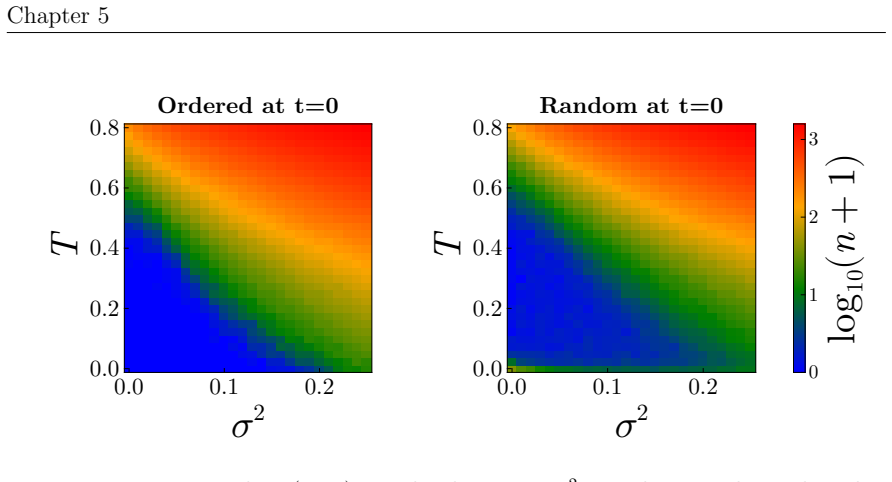
Figure 1.1
Figure 1.1. Figure 1.1: Sketches of different topological defects, of charge view at source ↗
Figure 1.2
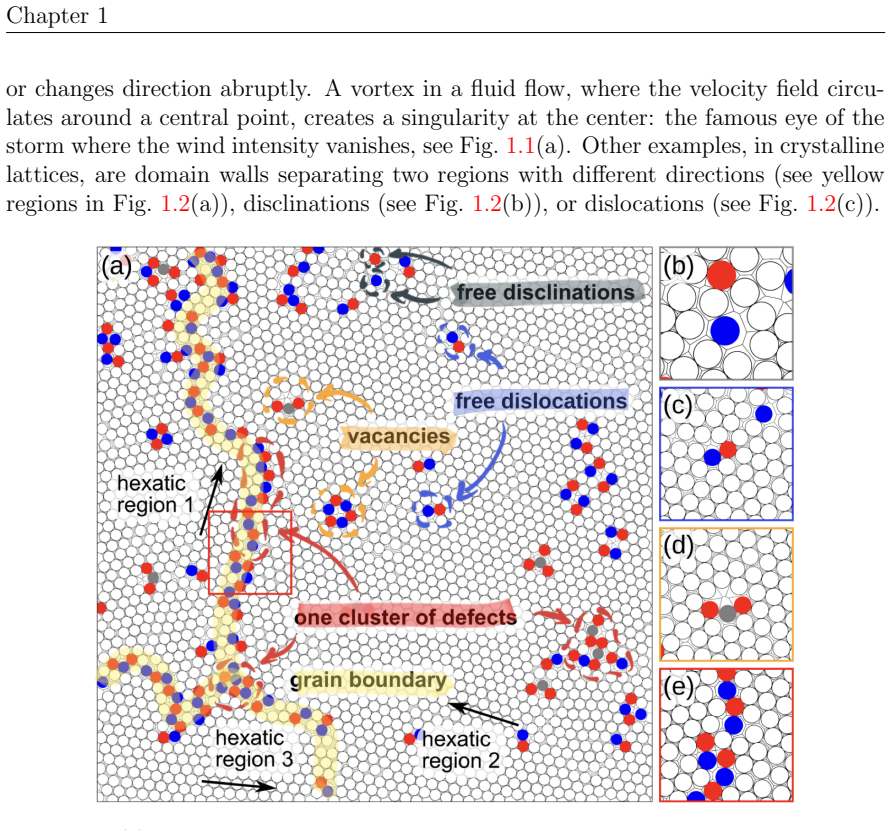
Figure 1.2. Figure 1.2: (a) Typical topological defects in a 2d crystal lattice of densely packed spherical particles. Image and caption from [48]. Particles in 5-fold cells are colored in red, 7-fold ones in blue, and all others in grey. Two disclinations are shown in (b), a dislocation and a disclination in (c), a vacancy in (d), and a detailed view of two clusters of defects belonging to the same grain boundary (shown in yel… view at source ↗
Figure 1.3
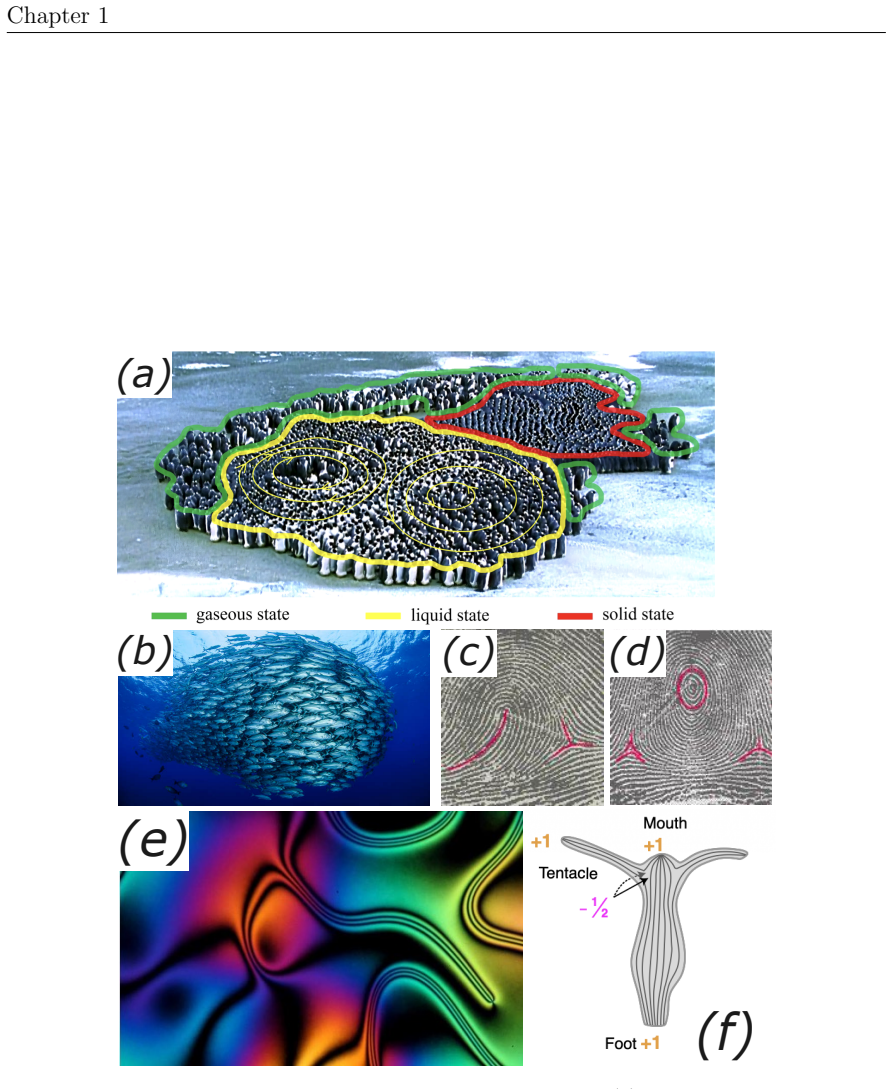
Figure 1.3. Figure 1.3: Examples of topological defects in various systems: view at source ↗
Figure 2.1
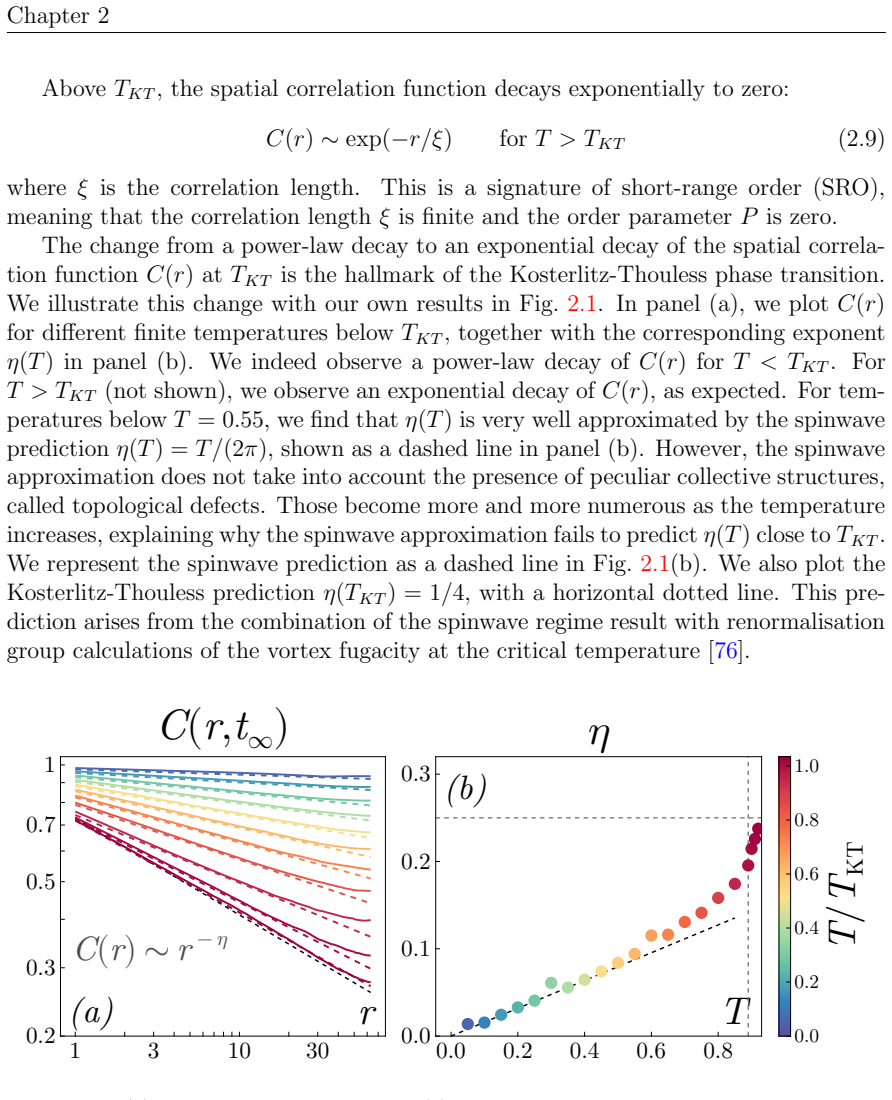
Figure 2.1. Figure 2.1: (a) The correlation function C(r). The coloured dashed lines are the best fits ∼ r −η . The black dash line is 0.71r −1/4 . (b) The correlation length η, extracted from C(r) ∼ r −η . The dashed line is T /(2π), the dotted horizontal line is η = 1/4, the vertical dotted line is T = TKT = 0.89. These measurements were performed for L = 128 because they are numerically more demanding (average over more real… view at source ↗
Figure 2.2
Figure 2.2. Figure 2.2: Four +1 defects with different shapes (a) µ+ = 0 (b) µ+ = π/2 (c) µ+ = 3π/4 (d) µ+ = π. White dots show the defect core, on the dual (hexagonal) lattice. The colour code displays the phase θ of each spin view at source ↗
Figure 2.3
Figure 2.3. Figure 2.3: The defects (red) live at the center of the dual plaquettes. The spins (black) live view at source ↗
Figure 2.4
Figure 2.4. Figure 2.4: Spatial correlation function C(r) computed for a L = 256 system. (left) Square lattice, we obtain TKT ≈ 0.89 (right) Triangular lattice, we obtain TKT ≈ 1.4. where c is a non-universal constant that appears to be small, at most of the order of 0.3 (given that with L = 256 we obtain the correct value with an asbolute error of 0.01 = c(log L) −2 ). This scaling law Eq. (2.25) is a direct consequence of the… view at source ↗
Figure 2.5
Figure 2.5. Figure 2.5: (a) The distance R(t) is averaged over 120 independent runs, for three different initial separation distances R0. (blue: R0 = 10, orange: R0 = 20 and green: R0 = 30). Black dashed lines are the predictions for an overdamped dynamics with a Coulomb interaction potential. (b) We recover the results of Ref. [119] (see their view at source ↗
Figure 2.6
Figure 2.6. Figure 2.6: Dynamics of the XY model following a quench from view at source ↗
Figure 2.7
Figure 2.7. Figure 2.7: Snapshots of L = 128 systems (square lattice, so TKT = 0.89) in the steady state (t = 105 ) following a quench from T = ∞ to (a) T /TKT = 0 (b) T /TKT = 0.054 (c) T /TKT = 0.952 view at source ↗
Figure 3.1
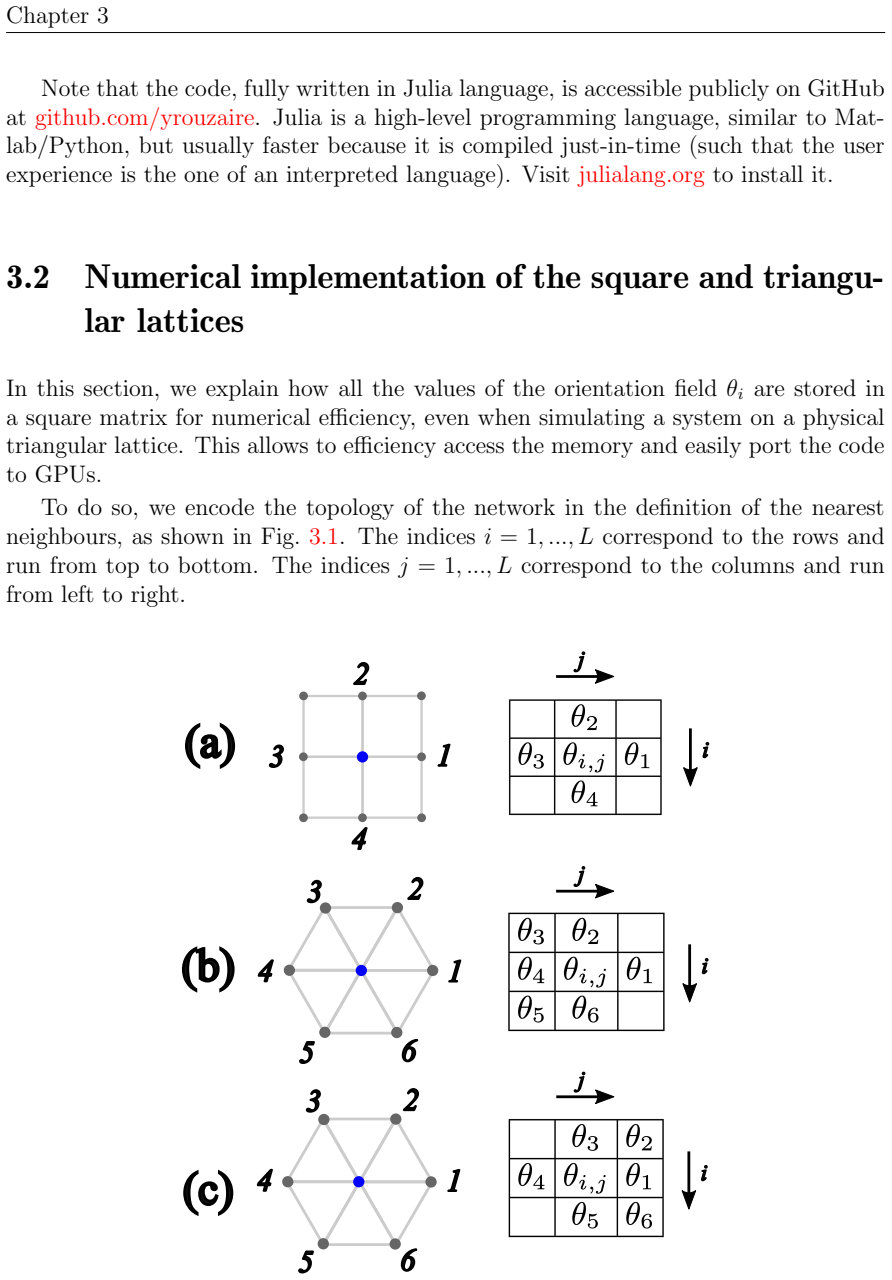
Figure 3.1. Figure 3.1: Nearest neighbours structure for (a) square lattice, for all i, j. (b) triangular lattice, for i even and all j. (c) triangular lattice, for i odd and all j. A triangular lattice can be thought as a square lattice with all odd rows laterally displaced by one half of the lattice spacing view at source ↗
Figure 3.2
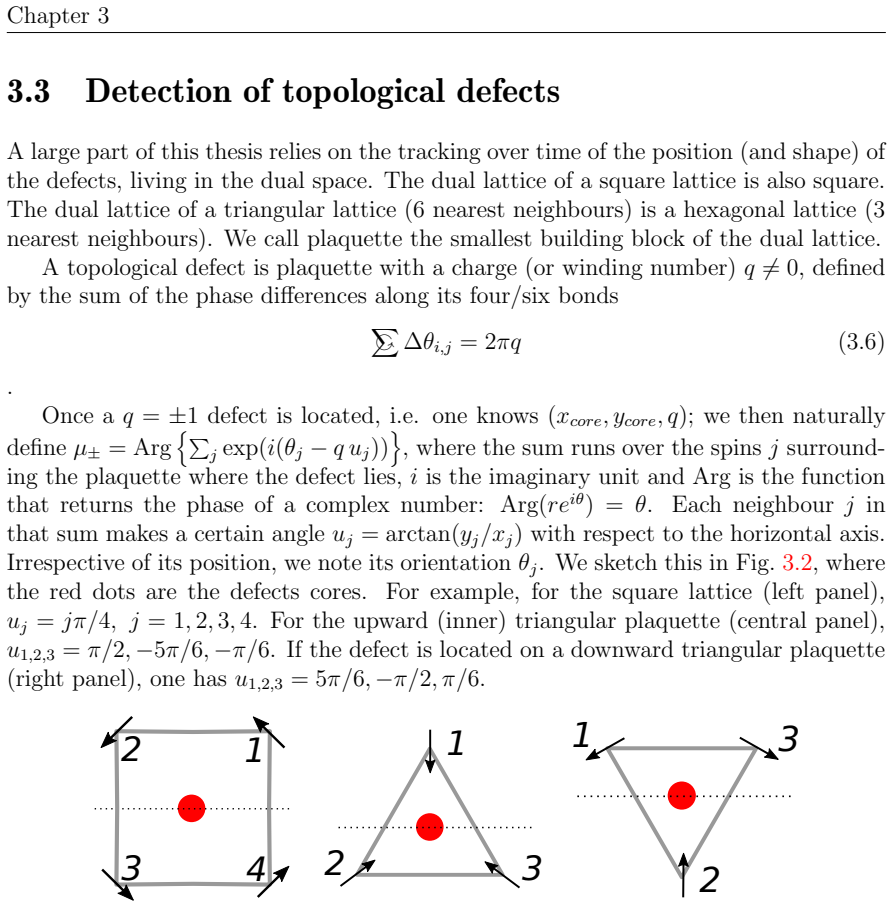
Figure 3.2. Figure 3.2: Defects (red) lie at the centre of the dual plaquettes while the spins live on the view at source ↗
Figure 3.3
Figure 3.3. Figure 3.3: Sketch of a pair of defects and definition of the polar angle view at source ↗
Figure 3.4
Figure 3.4. Figure 3.4: (a-c) Three snapshots of L = 256 system during the coarsening process, at different times t and spin-spin correlation lengths ξ indicated above. The white bars at the bottom right of each panel represent the length 2ξ (with a factor 2 for the sake of readability of panel (a)) (d) Spatial correlation function C(r) for three different times corresponding to the panels (a-c): Naive implementation in red das… view at source ↗
Figure 3.5
Figure 3.5. Figure 3.5: (a) Computational time of a single Langevin update of R = 32 systems (blue crosses), of the computation of C(r) with the Fourier method (green diamonds) and with the real space method (orange circles), as a function of the system size L. The dotted line is 2 · 10−6L 2 and the dashed line is 10−6L 3 . (b) Ratio of the computational times of the real space and Fourier space methods view at source ↗
Figure 4.1
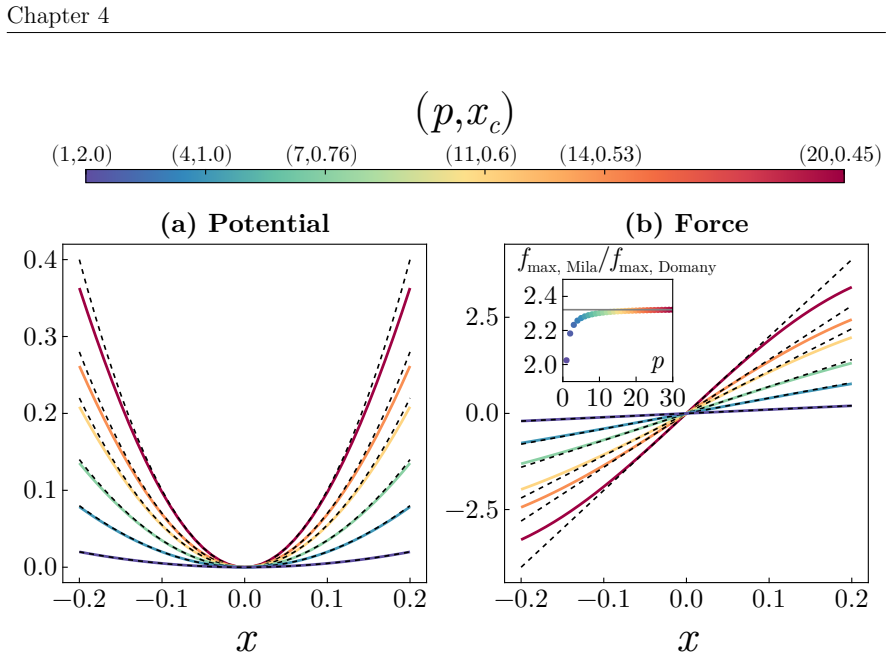
Figure 4.1. Figure 4.1: (a) Energy E/J of the steep XY model, for increasing p from blue to red (see colorscale to the right). (b) Force − 1 J dE/dx. The circles represent the maximum of the force profile fmax = f(∆θmax) for each p. Inset: ∆θmax(p). The black line is p 2/p, see main text. The potential Eq. (4.1) exhibits interesting properties as p varies. Let us first examine the derivatives of E. The sum of the forces imposed… view at source ↗
Figure 4.2
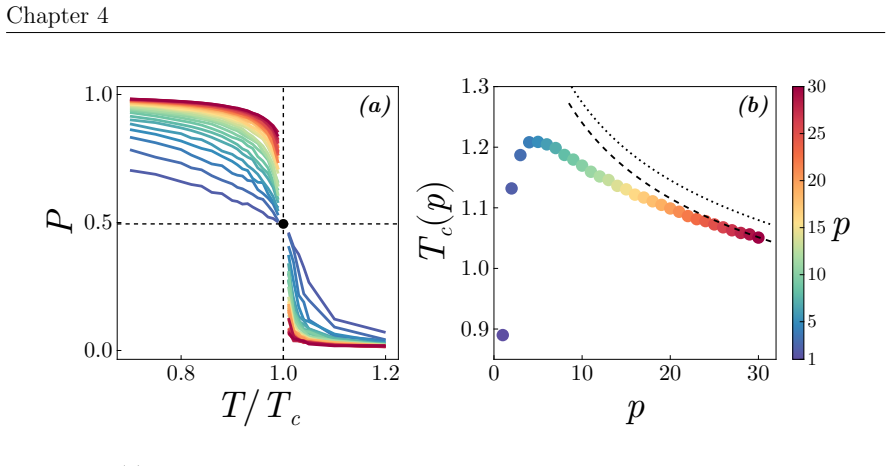
Figure 4.2. Figure 4.2: (a) L = 128, P is averaged over 32 independent realizations of the thermal noise. No hysteresis is observed and random initial configurations give noisier results, so we start from an ordered configuration. The central point T = Tc , P = 0.495 is common to all curves, by definition of Tc. We have removed on purpose the lines connecting to the central point to highlight the increasingly sharp jump between… view at source ↗
Figure 4.3
Figure 4.3. Figure 4.3: Steady-state spatial correlation functions view at source ↗
Figure 4.4
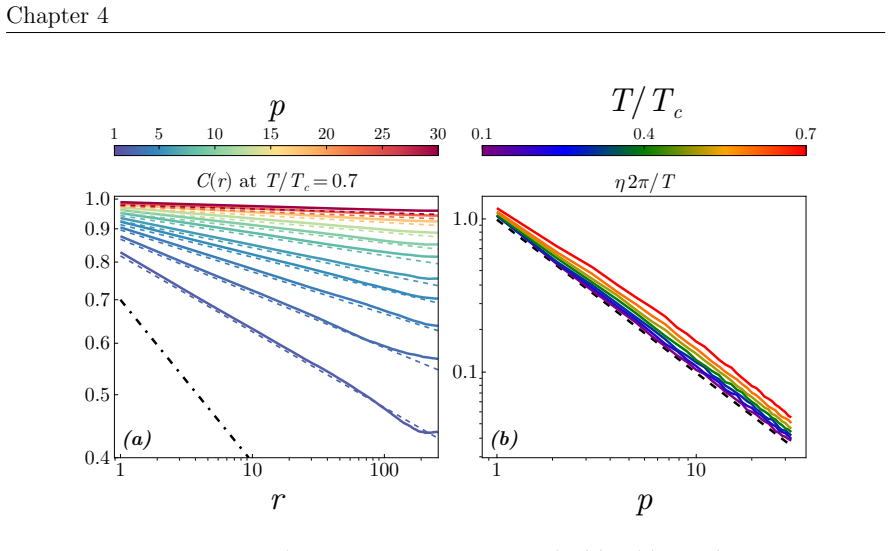
Figure 4.4. Figure 4.4: L = 512, R = 16 (ordered initial configuration). (a) C(r) at T /Tc = 0.7. Dashed lines are power law of the form a r−η , where a and η are fitted to the curves for 1 ≤ r ≤ 100 (the straight part only). The fit curves are shifted down by 1% on purpose for better visualization: we plot 0.99a r−η . (b) The value of the exponent η fitted in the left panel. The dashed line is 1/p. 4.4 Topological defects In t… view at source ↗
Figure 4.5
Figure 4.5. Figure 4.5: (a-c) Orientation field around defect pairs for p = 10 (zooms on regions of a larger system). The +1/2 (resp. −1/2) defects are represented with filled (resp. empty) circles. ℓ is the line length in units of the lattice spacing. The color scale on the right corresponds to the orientation of the spins, also indicated by the arrows. (a) total charge +1, T /Tc = 0.1, ℓ = 13 (b) total charge −1, T /Tc = 0.4,… view at source ↗
Figure 4.6
Figure 4.6. Figure 4.6: The nested subsystems of linear size r used to compute the energy of a single defect configuration. We have not plotted the smallest square sizes to leave the θ field close to the defect visible. The largest square is 0.75L. Here, L = 300, p = 30, T = 0, t = tmax = 2 · 105 . The same linear relation was obtained by Mila in a simplified model designed to mimic the Domany model [136]. Instead of a continuo… view at source ↗
Figure 4.7
Figure 4.7. Figure 4.7: For both the Domany (solid colored lines) and modified Mila (dashed black lines) view at source ↗
Figure 4.8
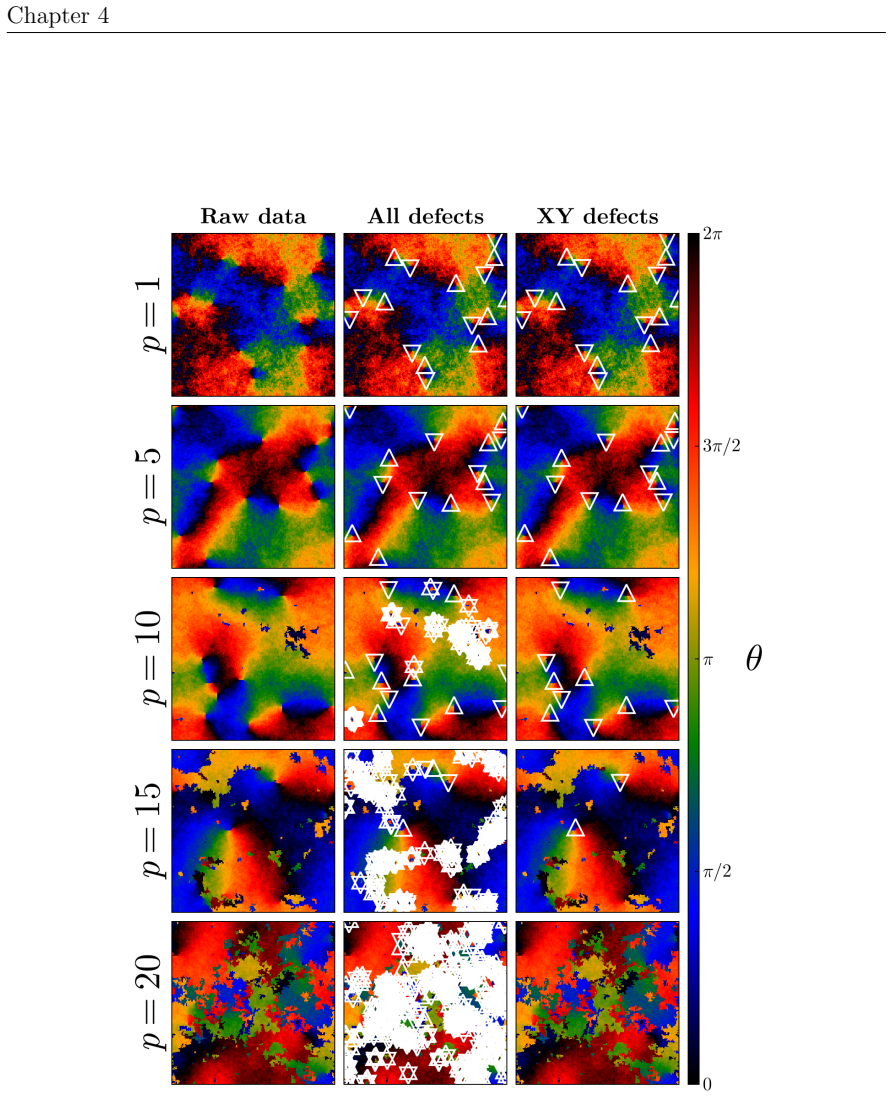
Figure 4.8. Figure 4.8: Snapshots of 5 systems during the coarsening dynamics. For all the systems, view at source ↗
Figure 4.9
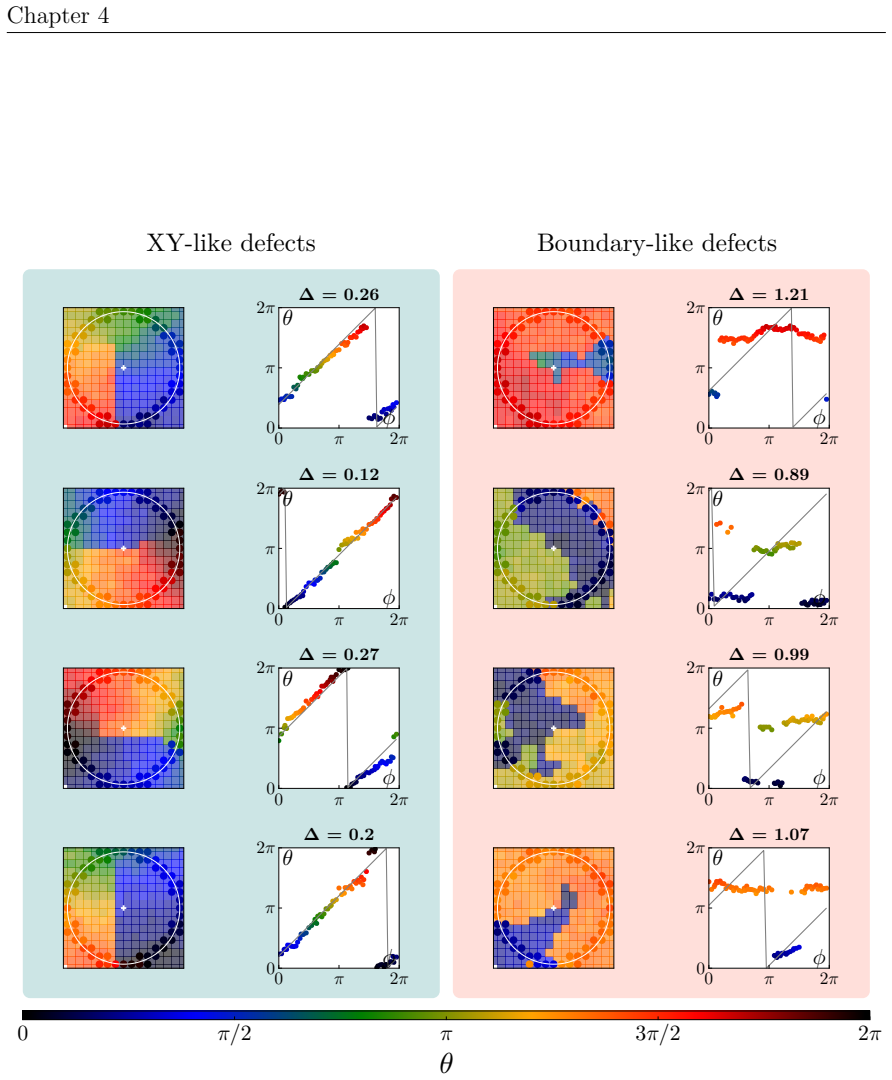
Figure 4.9. Figure 4.9: Illustration of the protocol to discriminate between split defects (left block, light view at source ↗
Figure 4.10
Figure 4.10. Figure 4.10: (a) Number of XY defects nXY over time, for a L = 256 system. The black line is (log t)/t, the usual XY coarsening scaling. For all the panels, T /Tc = 0.2 . (b) nXY against p for different system sizes L (different symbols). The black line is 0.85/p3 . Inset: tpeak, the time at which the XY defect density reaches a maximum. The black line is (0.85/p3 ) −1 . (c) ρ p3 as a function of t/p3 . The black da… view at source ↗
Figure 4.11
Figure 4.11. Figure 4.11: For both the Domany (solid colored lines) and Zukovic (dashed black lines) view at source ↗
Figure 5.1
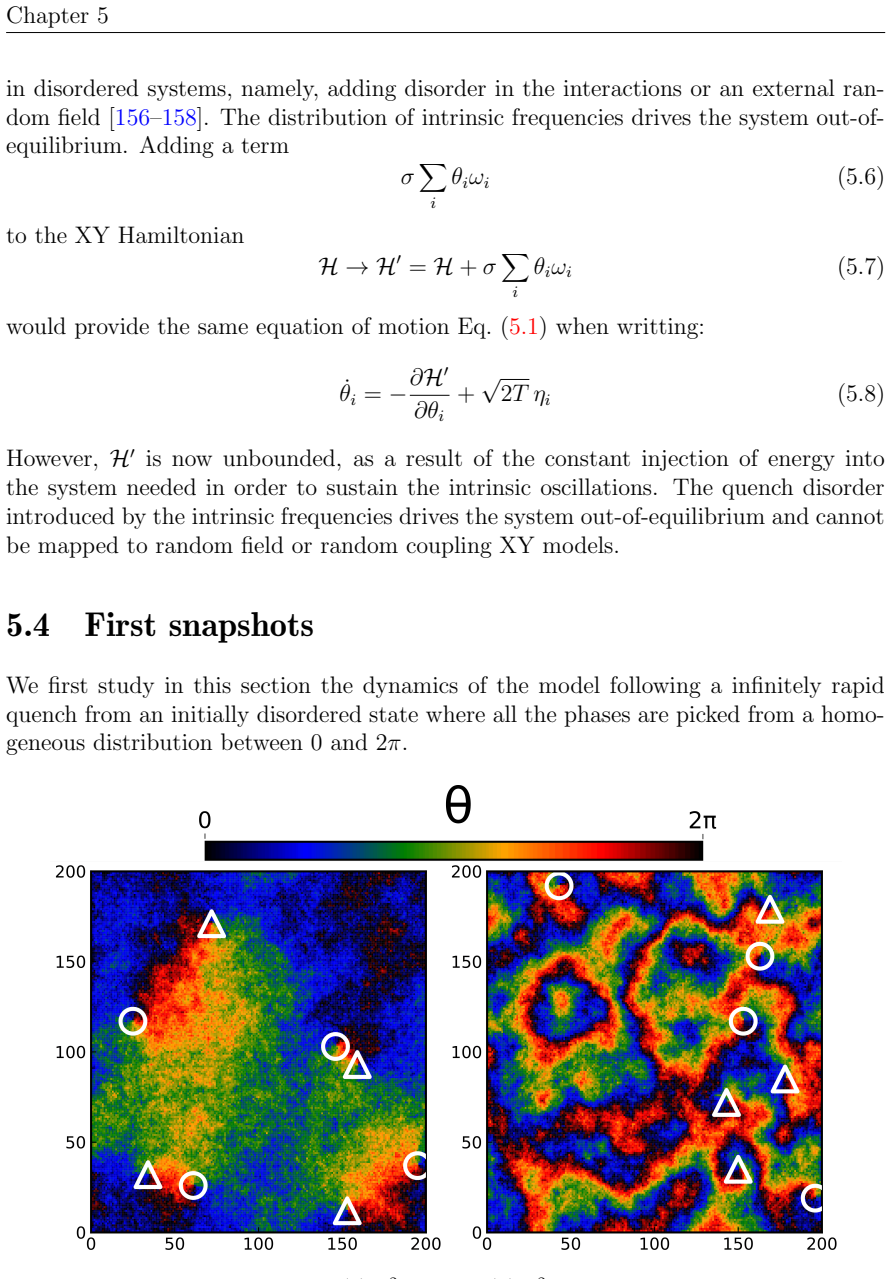
Figure 5.1. Figure 5.1: Snapshots for T = 0.2, (a) σ 2 = 0 and (b) σ 2 = 0.1. The phase of each oscillator is represented by a colour scale. Vortices (antivortices) are represented by circles (triangles). In order to illustrate the nature of the low temperature state, we show in view at source ↗
Figure 5.2
Figure 5.2. Figure 5.2: (a) C(r) (in log-log) at T = 0.2 and σ 2 = 0, 0.005, 0.01, 0.02, 0.03, 0.06 (from blue/top to brown/bottom). Inset : the σ 2 = 0 case, showing C(r) ∼ r −η , with η(T) = T /2π. (b) Time evolution of the space correlation function C(r, t) at different times t ≈ 4, 20, 100, 400, 2000, 10000 Greater times are represented by lighter colours, as the arrows indicate. (c) Time evolution of the rescaled correlati… view at source ↗
Figure 5.3
Figure 5.3. Figure 5.3: Time evolution of the characteristic length scale (a-b) illustrated by typical view at source ↗
Figure 5.4
Figure 5.4. Figure 5.4: The left panels illustrate two typical independent situations selected from the view at source ↗
Figure 5.5
Figure 5.5. Figure 5.5: Time evolution of (a) the total number of defects n for different forcing intensities and T = 0.4 (b) the quantity ξ √ρ where ρ = n/L2 is the defect density. Note that because the defects are (statistically) homogeneously distributed, √ρ is the average distance between two of them. For the equilibrium XY model (purple), one obtains n(t) ∼ log t / t. The similarity of the equilibrium long-term scaling for… view at source ↗
Figure 5.6
Figure 5.6. Figure 5.6: We represent log10(1+n) over the phase space σ 2−T, where n is the total number of defects of a L = 200 system in the steady state for (a) an initially ordered configuration and (b) an initially disordered configuration. The number of defects in the steady state increases with the temperature and the self-spinning intensity σ, as expected. As T and σ 2 decrease, the dynamics gets slower and slower, up to… view at source ↗
Figure 5.7
Figure 5.7. Figure 5.7: Three snapshots over time of the fields ˙θ(x, y) (a-c) and θ(x, y) (d-f ) for a system initially ordered with T = 0.05 and σ 2 = 0.2. In panel (c), defects are clearly identified thanks to the localized and intense amplitude of the instantaneous frequencies. In panel (f), +1 defects are highlighted by a circle, −1 defects are highlighted by a triangle. After very few time steps, a clear picture appears: … view at source ↗
Figure 5.8
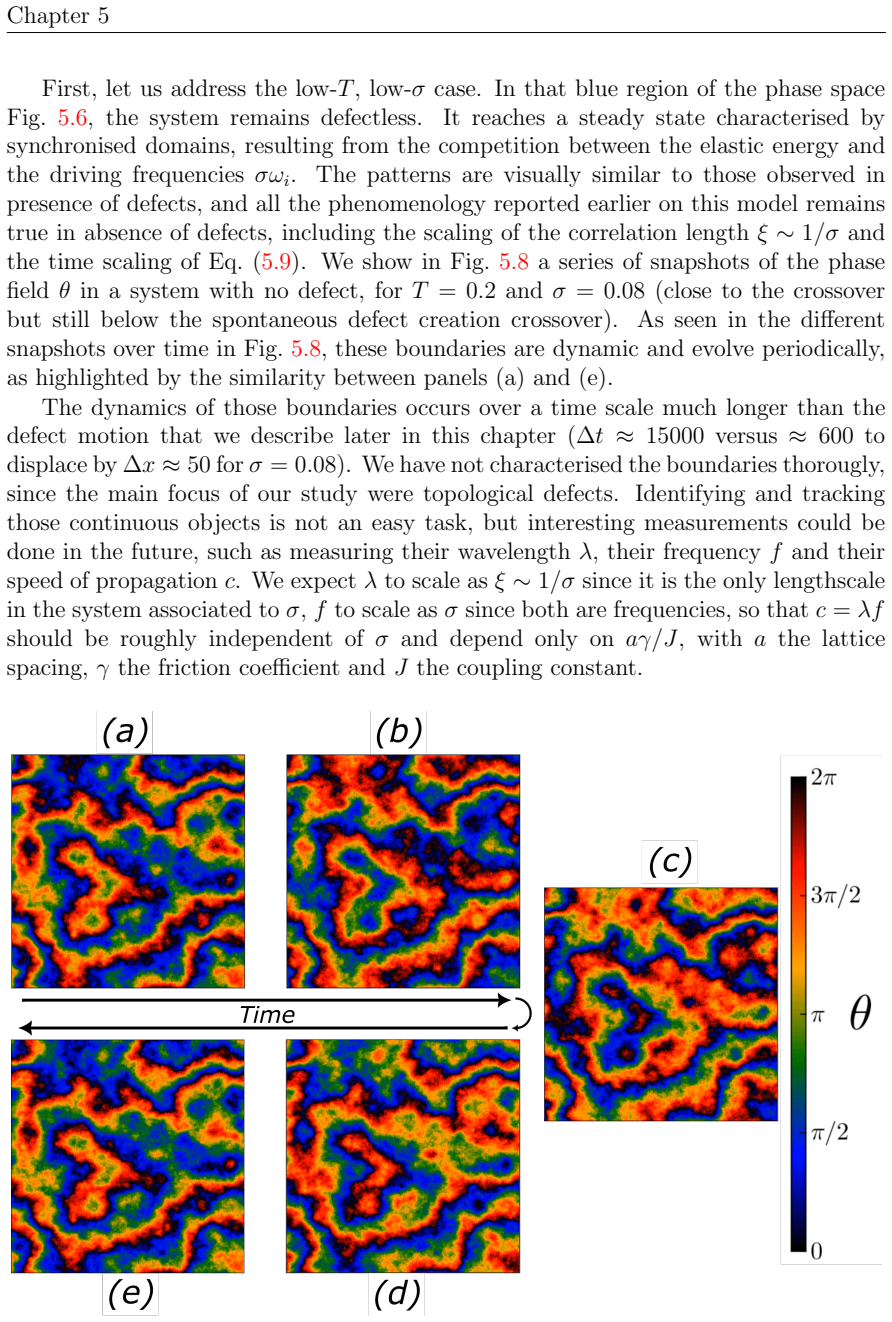
Figure 5.8. Figure 5.8: Phase field θ for a square system of size L = 256, with T = 0.2, σ = 0.08, initially ordered. The differents panels are snapshots at times t = (a) 27500 (b) 34700 (c) 40300 (d) 46400 (e) 51400. No defect is present in those configurations. Note the similarity between panels (a) and (e), highlighting the time periodicity of the patterns. Those patterns are mainly shaped by the realisation of the quenched … view at source ↗
Figure 5.9
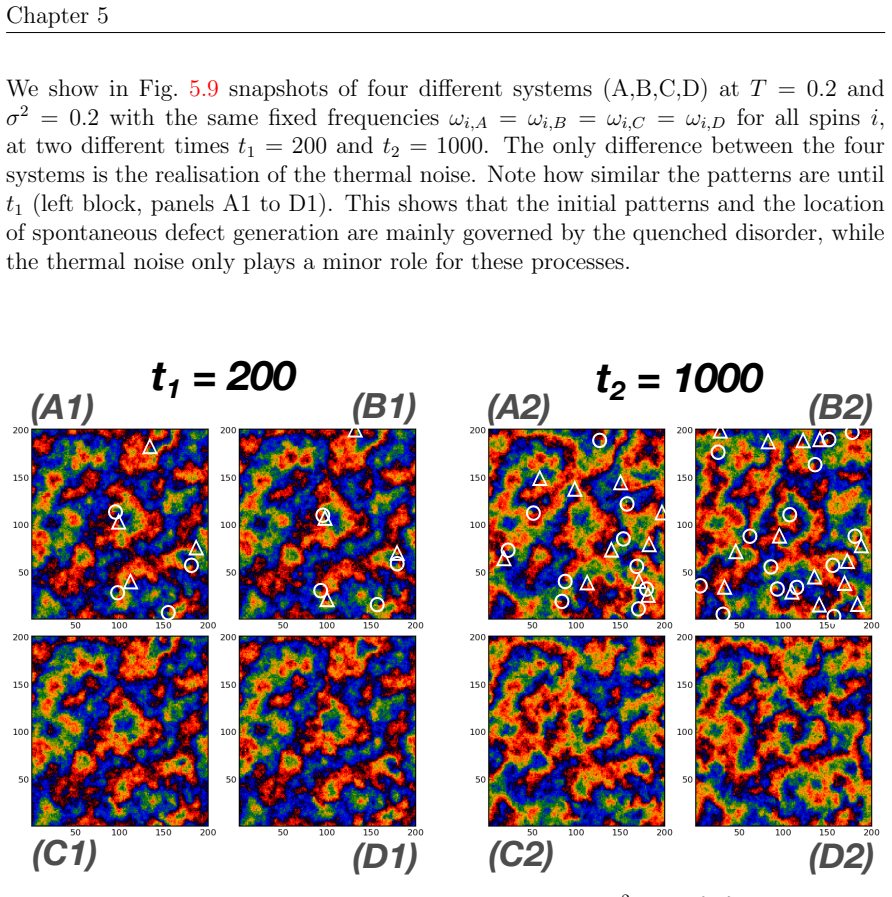
Figure 5.9. Figure 5.9: Snapshots of four different systems at T = 0.2 and σ 2 = 0.2 {ωi}, with the same fixed frequencies : ωi,A = ωi,B = ωi,C = ωi,D for all spins i, at two different times t1 = 200 and t2 = 1000. The only difference between the four systems is the realisation of the thermal noise. The initial condition are completely ordered, i.e. θi(t = 0) = 0 for all i. The phase of each oscillator is represented by the usu… view at source ↗
Figure 5.10
Figure 5.10. Figure 5.10: Vortex-antivortex separation R(t), averaged over 120 independent runs, for three different initial vortex-antivortex distances R0 (blue: R0 = 10, orange: R0 = 20 and green: R0 = 30). Full coloured lines correspond to T = 0.1 and σ 2 = 0. Dotted coloured lines correspond to T = 0.1 and σ 2 = 0.1. Black dashed lines are the XY predictions for an overdamped dynamics with a Coulomb interaction potential, se… view at source ↗
Figure 5.11
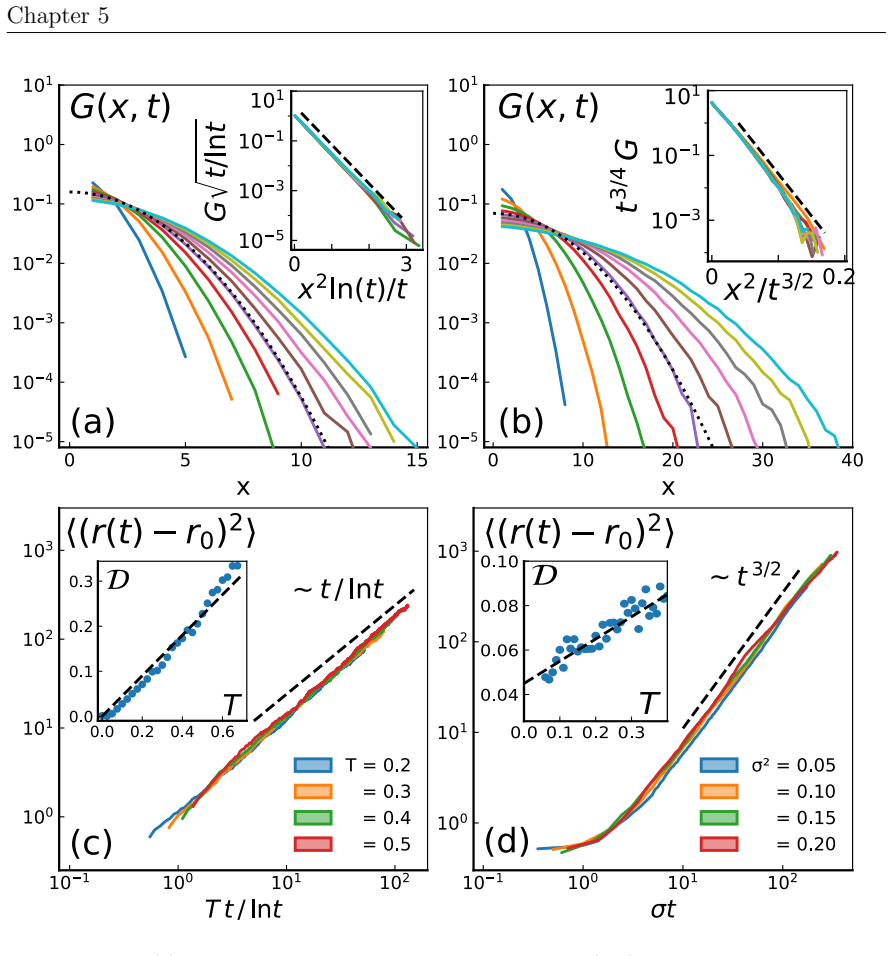
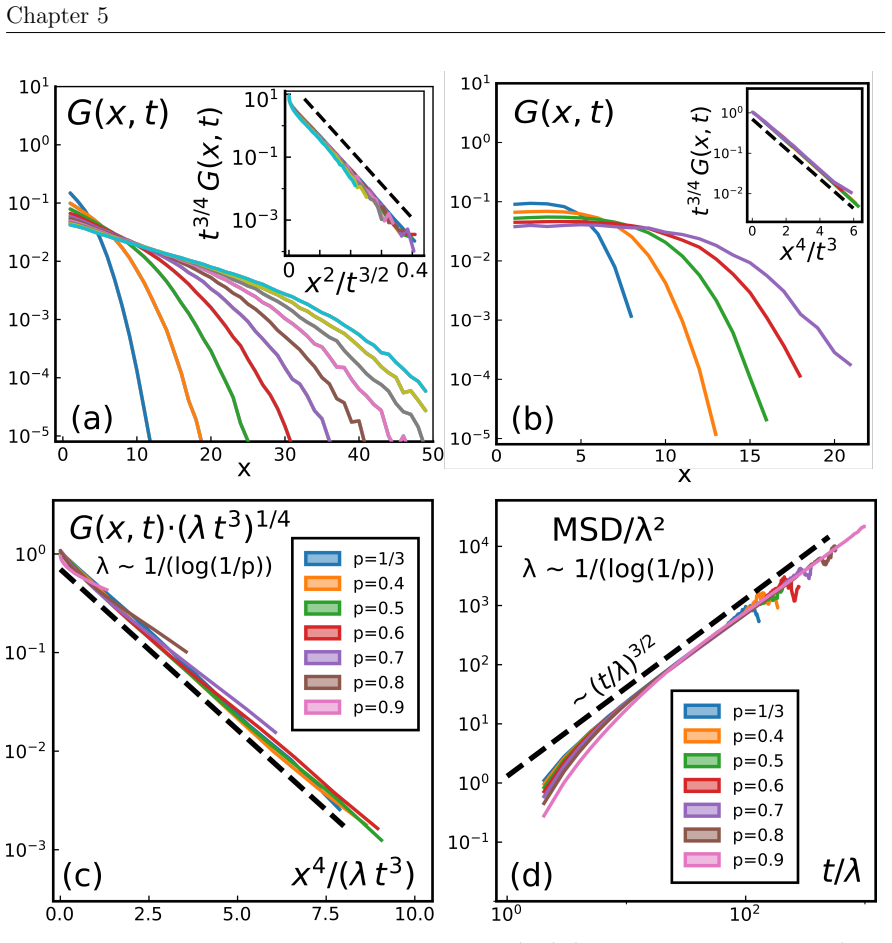
Figure 5.11. Figure 5.11: (a) Distribution of vortex displacements G(x, t) at different times t = 50, 100, ..., 500 (from left to right) and fixed σ = 0, T = 0.2. The dotted line shows Eq. (5.25) with D = 0.069 and t = 250. Inset: these curves collapse when using the scaling Eq. (5.25). The exponential decay of slope 1/(4D) is shown in dash. (b) G(x, t) (same times as in (a)) for σ 2 = 0.025 and T = 0.2. The dotted line shows Eq… view at source ↗
Figure 5.12
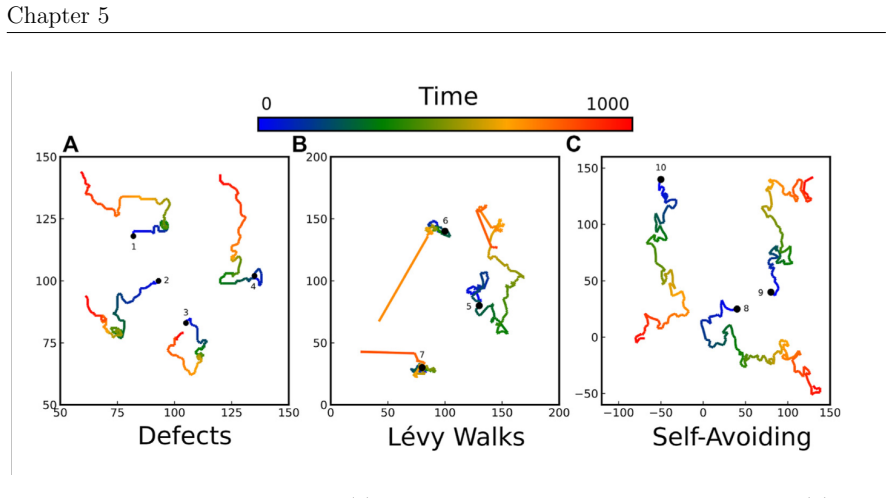
Figure 5.12. Figure 5.12: Sample trajectories of (a) topological defects in the actual spin model (b) L´evy walks with exponent γ = 3/2 (c) self-avoiding random walks (SAW). Each path departs from a black circle and lasts for ∆t = 103 , indicated by the colour code. As a domain boundary separates two neighbouring ordered domains, it is characterised by an excess elastic energy, providing a preferential direction for the motion o… view at source ↗
Figure 5.13
Figure 5.13. Figure 5.13: Probability densities of displacement G(x, t) (see main text for definition) for different cases. Both insets represent rescaled data in order to higlight the functional form of G. We considered (a) topological defects with σ 2 = 0.025 and T = 0.2, at times (from left to right) t = 50, 100, 150, ..., 500. Inset: the dashed line follows f(x) ∼ exp(−60x) (b) SAW (∆t = 1) at times (from left to right) t = … view at source ↗
Figure 5.14
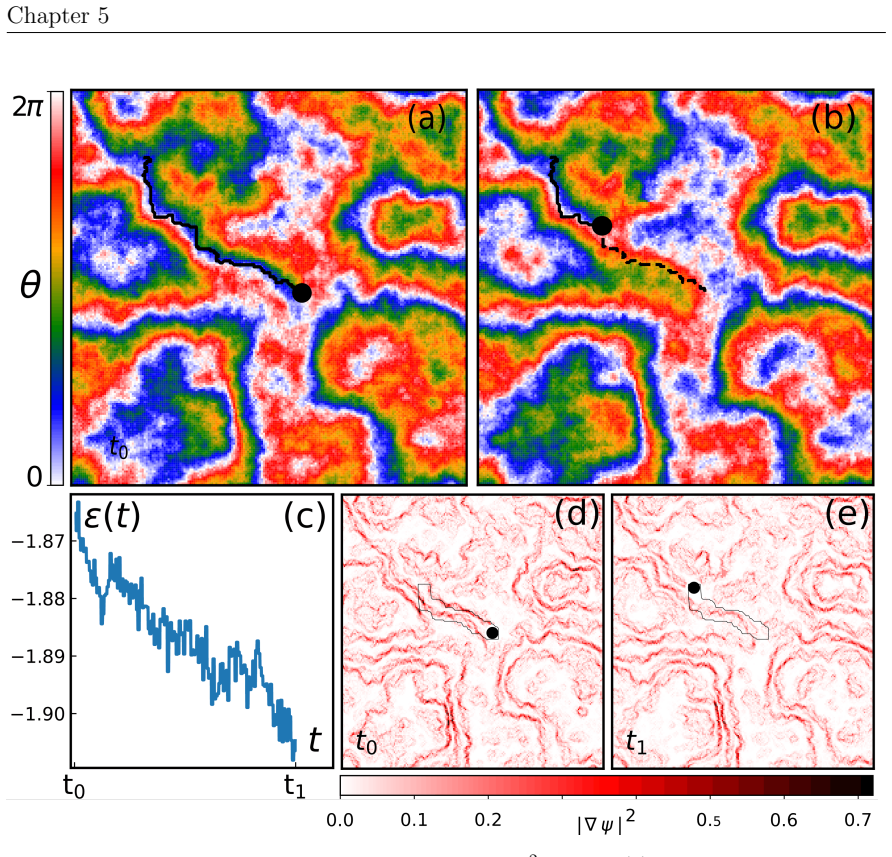
Figure 5.14. Figure 5.14: Typical vortex trajectory at T = 0.05, σ2 = 0.1. (a) Snapshot of the system at t0, showing a vortex with a dot alongside a section of its (upcoming) trajectory and (b) at t1 = t0 + 500, showing the path followed by the vortex in broken lines. (c) Decay of the energy per spin of an area around the domain boundary due to the motion of the vortex. Panels (d) and (e) display |∇ψ| 2 at t0 and t1, showing how… view at source ↗
Figure 5.15
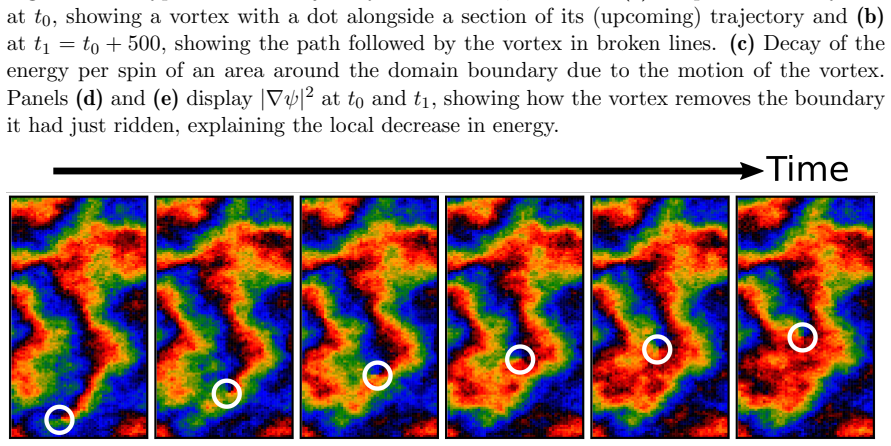
Figure 5.15. Figure 5.15: Successive snapshots of a fixed 50×120 portion of a 200×200 system evolving with T = 0.1 and σ 2 = 0.15. The topological defect of charge +1 is highlighted with a white circle. It moves along the domain boundary (thin black line) and erases it in its wake, leaving an aligned region behind view at source ↗
Figure 5.16
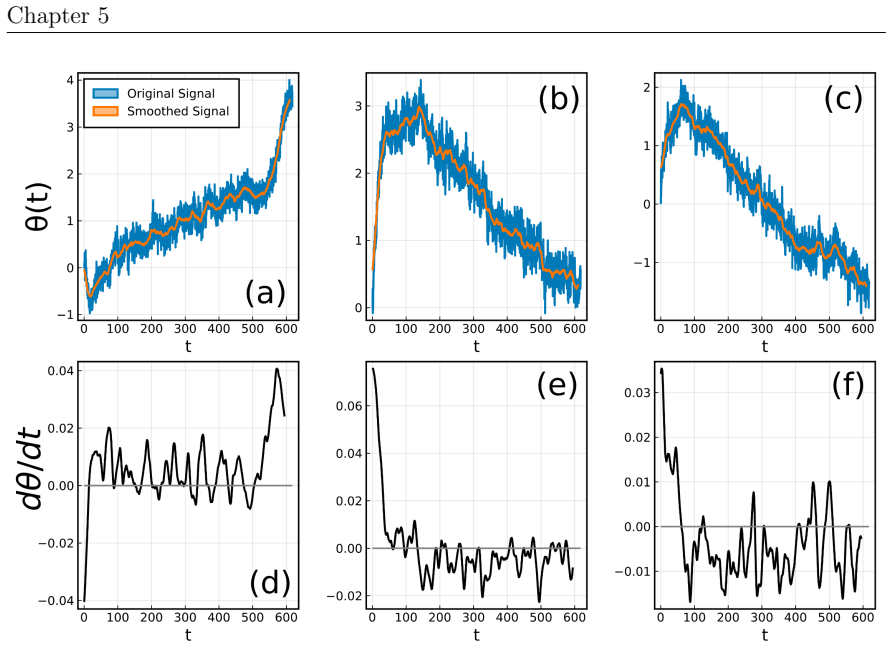
Figure 5.16. Figure 5.16: Each column corresponds to a different rotor in the system. view at source ↗
Figure 6.1
Figure 6.1. Figure 6.1: (a) Steady polarization P map in the v0 − σ plane for N = 103 , ρ = 1. Symbols correspond to the snapshots shown in (b)-(e) and the horizontal dotted line to the parameters scanned in view at source ↗
Figure 6.2
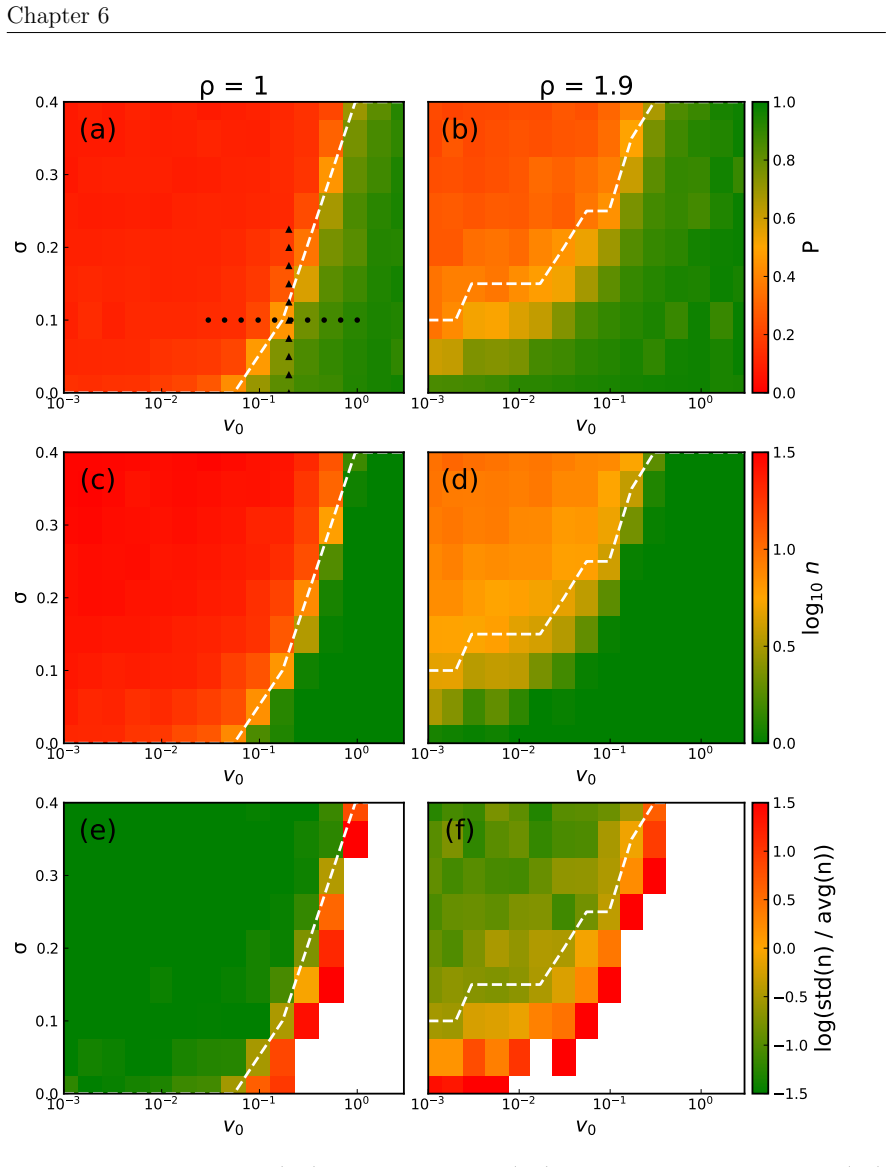
Figure 6.2. Figure 6.2: Phase spaces of (a,b) the polar order P, (c,d) the number of defects n, and (e,f ) the fluctuations of the number of defects (standard deviation divided by the mean), on a logarithmic scale. Left column: At particle density ρ = 1.0 and Right column: At particle density ρ = 1.9. Dots mark the horizontal scan through the transition of view at source ↗
Figure 6.3
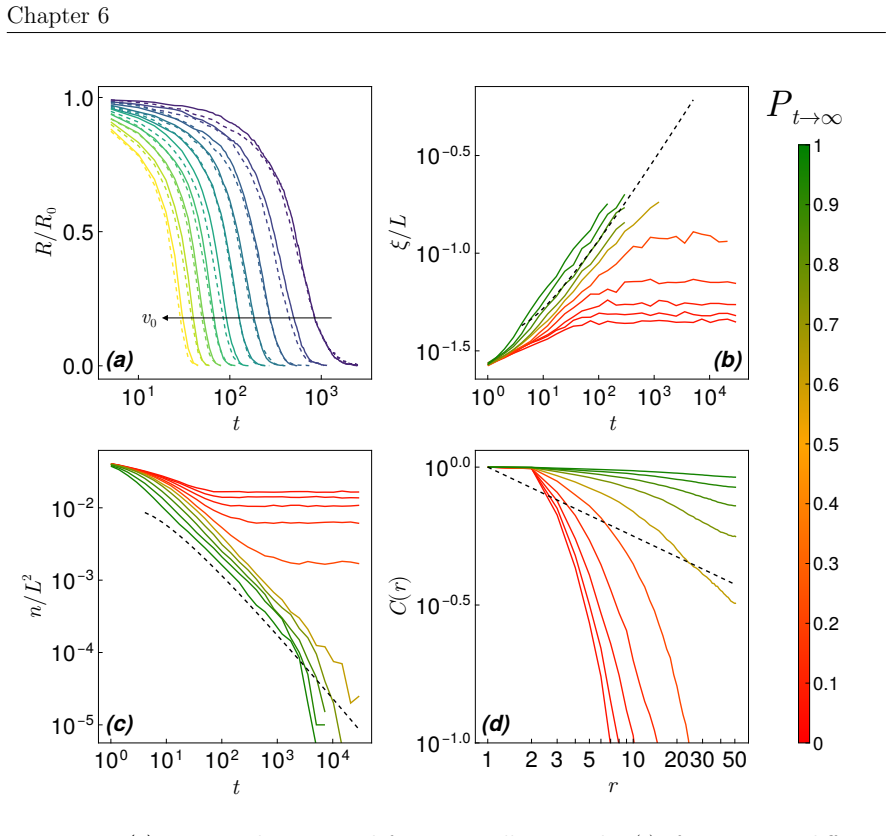
Figure 6.3. Figure 6.3: Time evolution of: (a) the spatial correlation length; (b) defect density. Inset : characteristic length normalised by the average distance between defects. (c) Spatial decay of the correlation function in steady conditions. (d) Finite size scaling analysis of the polar￾ization, to confirming the different nature of the D and O phases. In all cases: dashed lines are XY predictions, the colour of each cur… view at source ↗
Figure 6.4
Figure 6.4. Figure 6.4: (a) Inter-defect separation R(t) for different velocities (in the QLRO phase), σ = 0.1, averaged over 260 realizations. Inset: Histogram of annihilation times τ for 3 selected velocities. (b) Same data plotted against the time to annihilation t ∗ . Inset: Rescaling time by v 1/2 0 and distance by v −1/2 0 makes the curves collapse onto the XY predictions (in black). t 101 102 103 0.0 0.2 0.4 0.6 0.8 1.0 … view at source ↗
Figure 6.5
Figure 6.5. Figure 6.5: (a) Decay of the distance between two defects manually created at an initial distance R0, for T = 0.1. Results are averaged over 400 independent realizations. Each group of lines is a different v0 = 1, 1.5, 2 from right to left. Each colour is from a different distribution of the ω. For each distribution, we keep the same standard deviation σ = 0.1 (see text for details). (b) Same data but on rescaled ax… view at source ↗
Figure 6.6
Figure 6.6. Figure 6.6: (a) Representative topologically protected pattern (TPP) pattern, here for a N = 104 , ρ = 1 system. (b) Probability to observe a TPP against v0 and σ, for N = 4000, ρ = 1, averaged over 780 realizations. Using disordered initial conditions, a TPP is identified with a defect free configuration with P < 0.5. Such arbitrary threshold does not impact the results as the vast majority of the detected TPP have… view at source ↗
Figure 6.7
Figure 6.7. Figure 6.7: (a) Distance between 2 defects manually created R(t), for σ = 0.1, different v0 = 0.5, 1, 1.5, ..., 5. In dash, T = 0, in solid line T = 0.1. (b-d) Coarsening dynamics for the T = 0 case, for various parameters v0, σ crossing the transition horizontally (circles in view at source ↗
Figure 6.8
Figure 6.8. Figure 6.8: Measurements on a system with N = 104 particles. Each curve is coloured by its corresponding steady-state polarization. For the horizontal scan (circles, a-c), σ = 0.1 and 0.03 ≤ v0 ≤ 1. For the vertical scan (triangles d-f), v0 = 0.2 and 0.025 ≤ σ ≤ 0.225. a,d: defect density over time.b,e: normalised characteristic length over time.c,f: Spatial correlation functions in the steady state. 6.10 Appendix B… view at source ↗
Figure 6.9
Figure 6.9. Figure 6.9: A manually created pair of defects, with view at source ↗
Figure 6.10
Figure 6.10. Figure 6.10: (left) Finite size scaling of the polarization P against N, for v0 = 1, σ = 0.1, for different times t = 27, 166, 1035, ..., 40 000. (exponentially spaced, from bottom/blue to top/brown). (right) Relaxation time, defined as the time necessary to reach 95% of the final polarization value, for different number of particles N. The solid black line is 0.025 N log N. The dashed black line is 0.15 N view at source ↗
Figure 7.1
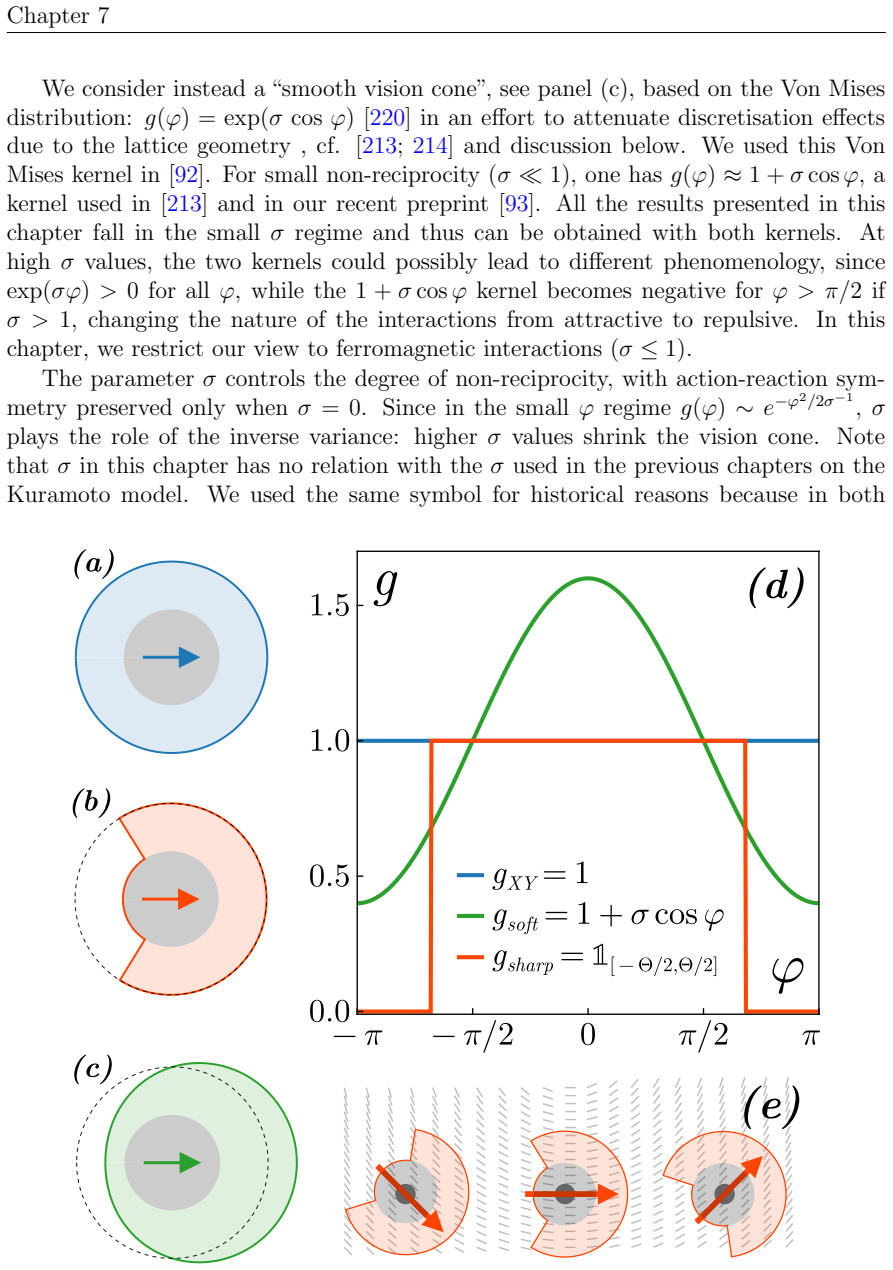
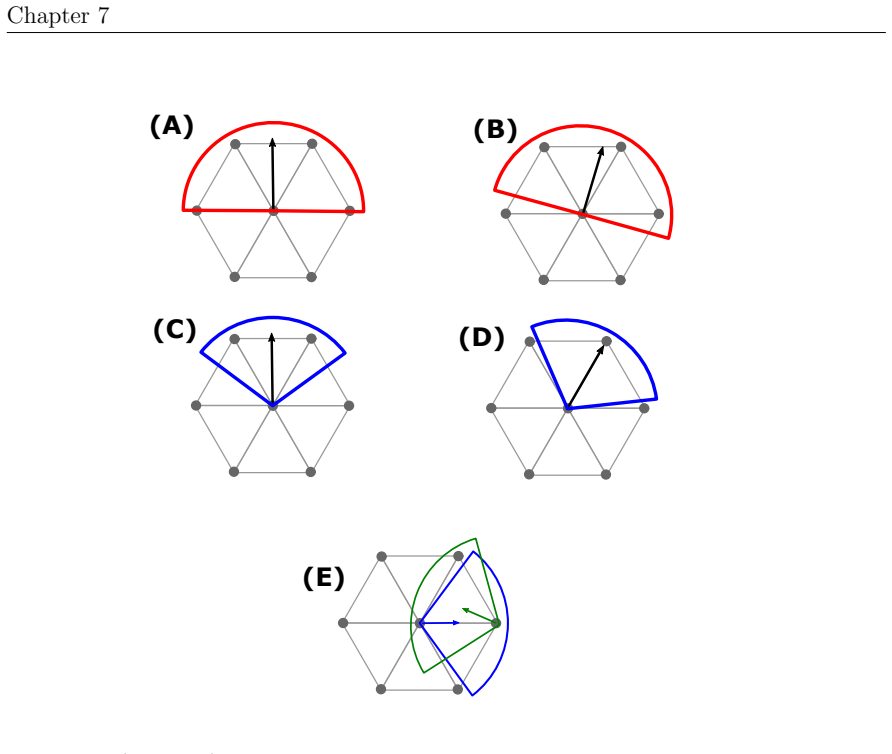
Figure 7.1. Figure 7.1: Three possible kernels describing the angular dependence of the coupling strength: view at source ↗
Figure 7.2
Figure 7.2. Figure 7.2: (a, b, c, d) A spin can brutally lose or gain one neighbour within its sharp vision cone during the dynamics. (e) The effective temperature felt by two neighbouring spins can be different if their number of neighbours is different. the worst-case scenario. The sum over the angular weights gives: Gi ≡ X 4 j=1 g (φij ) = X 4 j=1 e σ cos(θi−uj ) = X 4 j=1 e σ cos(θi−(j−1) π 2 ) = e σ cos θi + e σ sin θi + e… view at source ↗
Figure 7.3
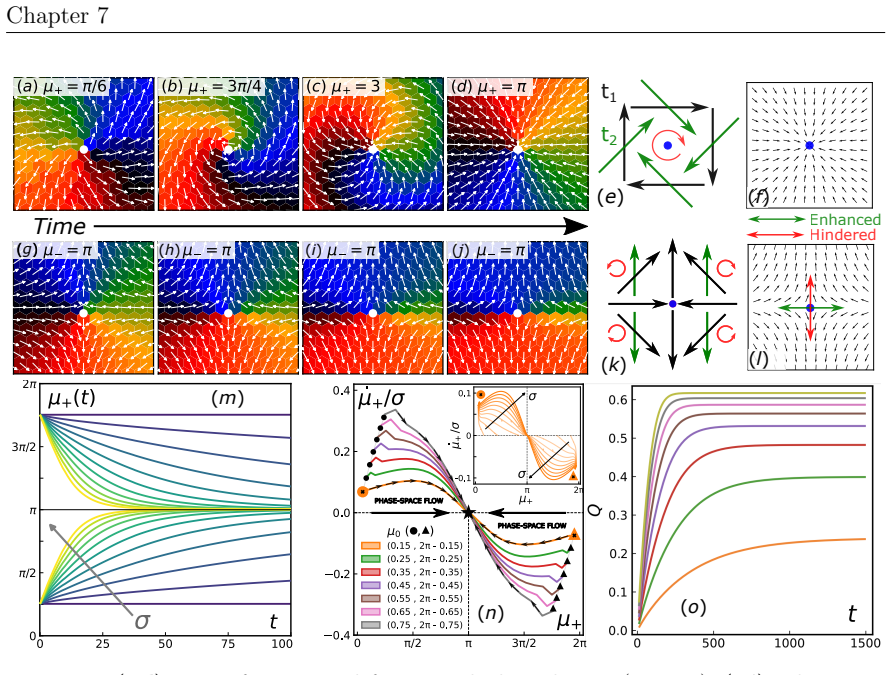
Figure 7.3. Figure 7.3: (a-d) Twist of a positive defect towards the sink state (µ+ = π). (g-j) Polarisation of a negative defect, leaving µ− unchanged. (e,k) Reshaping mechanism for +1 (e) and −1 (k) defects, at time t1 (black) and t2 > t1 (green). The blue circles are the defect cores; the red arrows represent the non-reciprocal torques. (f,l) Analytical final states computed in Appendix G, for +1 (f) and −1 (l) defects. For … view at source ↗
Figure 7.4
Figure 7.4. Figure 7.4: (a,b,c) Configurations of two defects of opposite charge at T = 0, σ = 0.35 with µ+ = 0 , π , π/2, respectively. Arrows indicate their velocity. (d) Inter-defect distance R(t) between a µ+ = 0 and a µ− = π (dashed lines) and a µ+ = π and a µ− = 0 (solid lines) pair, for σ = 0, 0.01, 0.02, 0.05, 0.1, 0.15, 0.2, 0.3, increasing along the arrows from blue to yellow. In both cases, T = 0.08 TKT , L = 2R0 = 2… view at source ↗
Figure 7.5
Figure 7.5. Figure 7.5: Distance separating two defects over time in the enhanced annihilation configu view at source ↗
Figure 7.6
Figure 7.6. Figure 7.6: (a) Snapshot of a L = 100 system at t = 200, T = 0, σ = 0.3. Sink defects (q = +1, µ+ = π) are circled. The other q = +1 defects are squared. Negative defects are not highlighted so the underlying snapshot remains visible, but the total topological charge is 0 due to PBC. (b) Characteristic lengthscale ξ/L and (c) defect density n/L2 for L = 200, T = 0.08 TKT and σ = 0, 0.1, 0.2, 0.3, 0.4. Black lines ar… view at source ↗
Figure 7.7
Figure 7.7. Figure 7.7: Evolution of an initial 1d gaussian excitation over time. We show a partial rectangular window of a Ngrid = 256 system. The orientation field θ is plotted in panels (a-c) for t = 0, 0.004, 0.01 respectively. The other parameters are α = 100, σ¯ = 100, θ0 = 0. The initial profile travels to the left (black arrow) and develops a front/back asymmetry (smoother at the front, sharper at the back) view at source ↗
Figure 7.8
Figure 7.8. Figure 7.8: (a) Propagation of a perturbation θ = δ(x) across the system over time. Pa￾rameters: small non-reciprocity σ¯ = 10, tmax = 0.2, Ngrid = 256, α = 100, θ0 = 0. Inset: rescaled data θ √ Dt as a function of x˜ = (x − xpeak)/L√ Dt ˜ , with the diffusion coeffi￾cient D˜ = 2.53 D = 1 · K/γ, see Appendix A for details. The curves collapse, indicating that the flattening of the profile follows the diffusion equat… view at source ↗
Figure 7.9
Figure 7.9. Figure 7.9: (a) Definition of the width w and asymmetry of the profile. (b) Time evolution of w and asymmetry, up to tmax = 0.5, for σ¯ = 100. While the other results are obtained at T = 0, this simulation is performed with a small temperature T = 0.02, and averaged over 32 independent realizations. The dash line fitting the width is w0/L+0.8 √ t, with w0/L = 0.025. The dotted line fitting the asymmetry is 0.095 − 0… view at source ↗
Figure 7.10
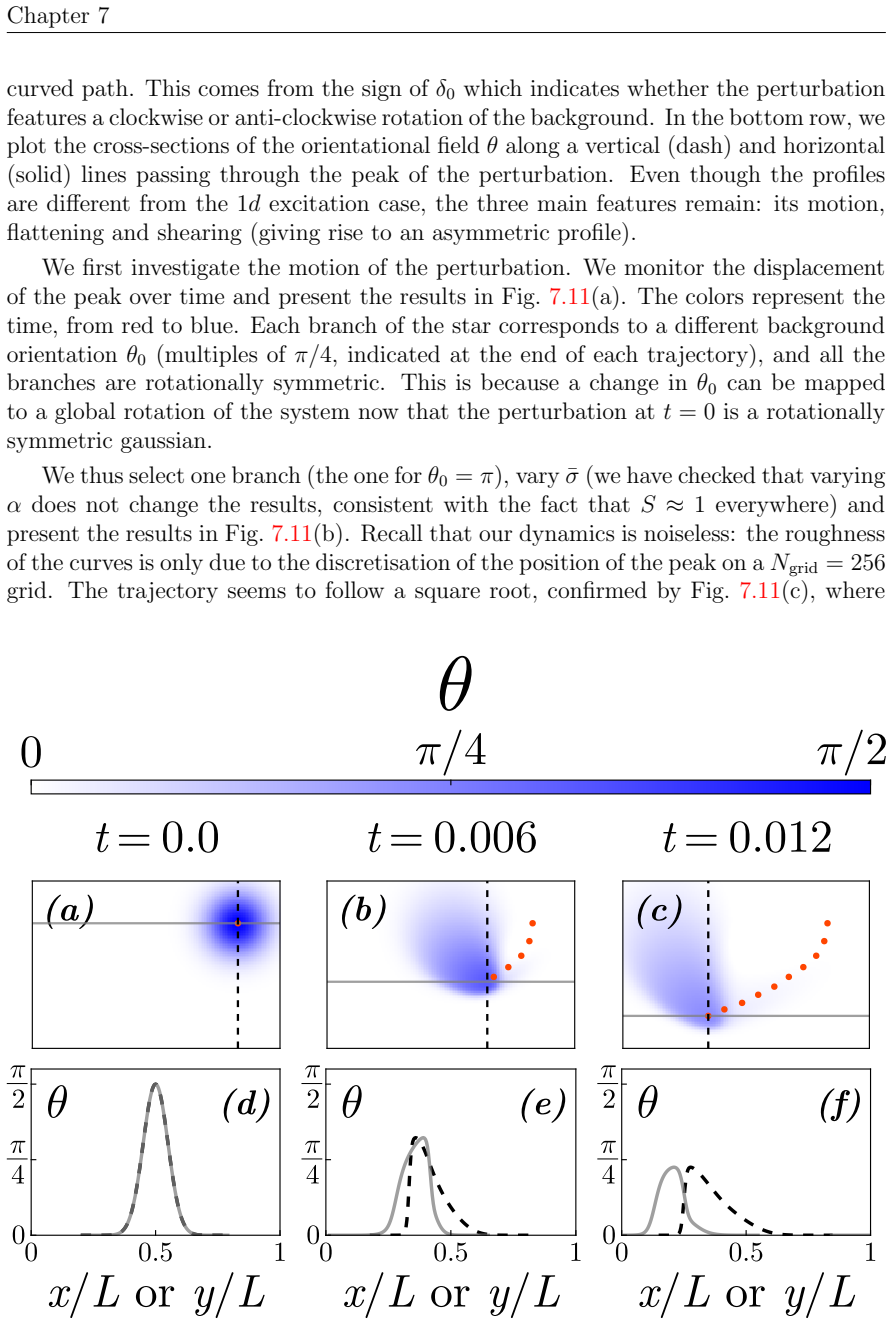
Figure 7.10. Figure 7.10: Evolution of an initial isotropic 2d gaussian perturbation over time, with θ0 = 0, δ0 = π/2. We show a partial rectangular window of a Ngrid = 256 system. The orientation field θ is plotted in panels (a-c) for t = 0, 0.006, 0.012 respectively. The dots track the past positions of the peak. Other parameters: α = 100, σ¯ = 100. (d-f ) cross-sections of the orientational field θ along a vertical (dash, aga… view at source ↗
Figure 7.11
Figure 7.11. Figure 7.11: (a) Trajectory of the peak, from its initial location (x0, y0). x, ˜ y˜ are defined as (xpeak − x0)/L and (ypeak − y0)/L. The colorbar indicates time, from red (t = 0) to blue (tmax = 1.8). The different branches of the star are the trajectories for different background orientations θ0, indicated at the end of each branch. For this panel, σ¯ = 100. For all 4 panels: δ0 = π/2 (the initial height), α = 10… view at source ↗
Figure 7.12
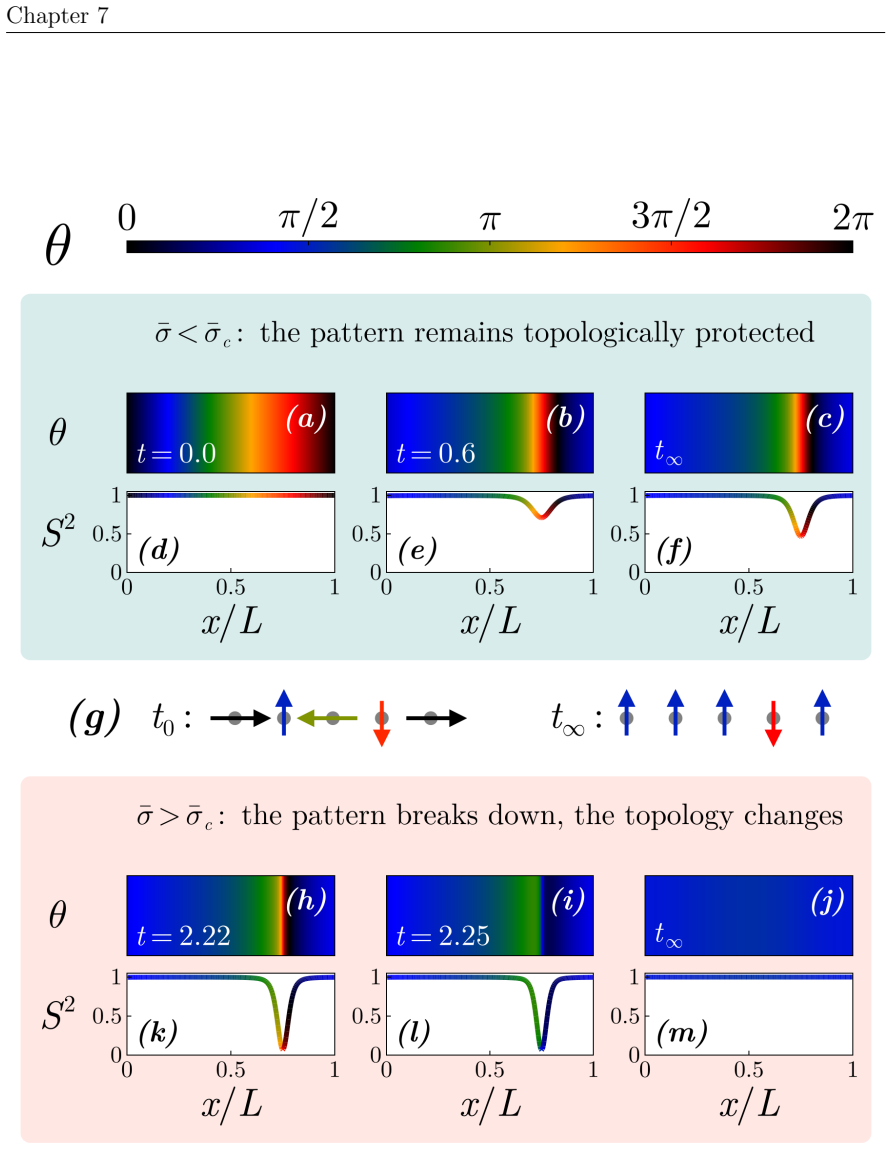
Figure 7.12. Figure 7.12: Evolution of a topologically protected state over time, for 2 different values of view at source ↗
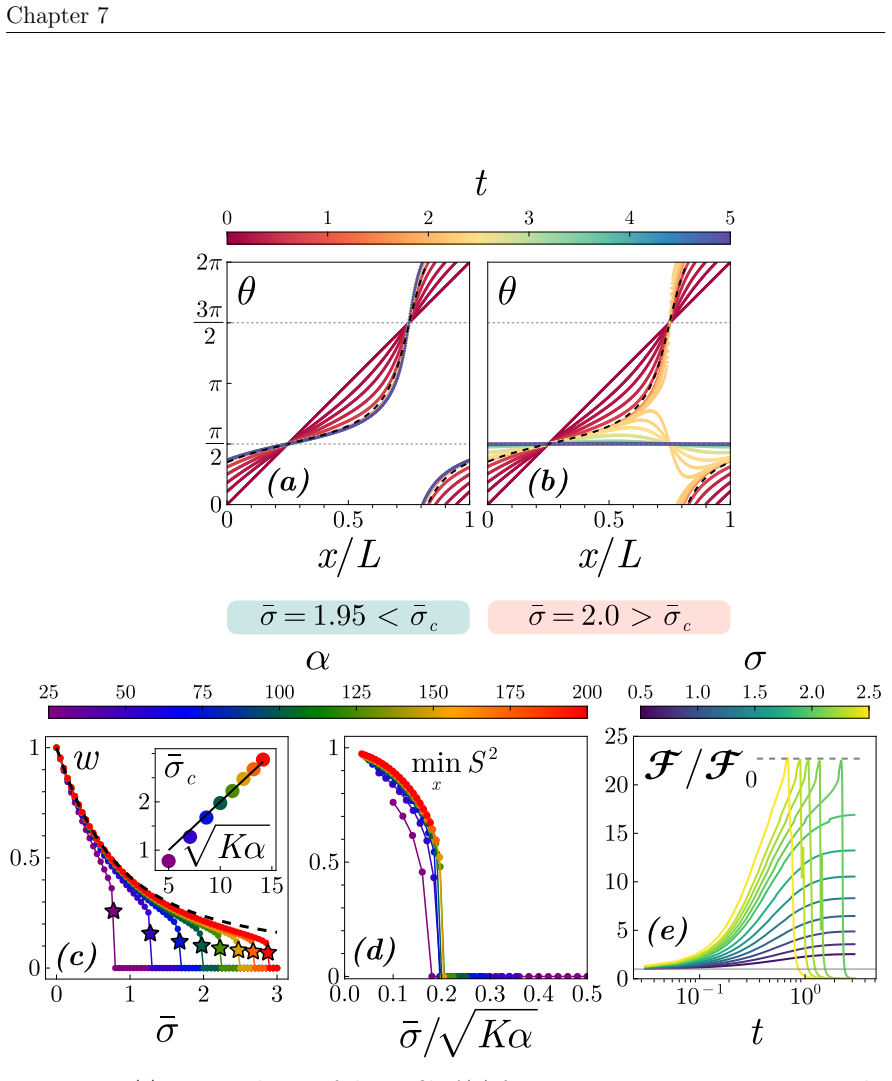
Figure 7.13
Figure 7.13. Figure 7.13: (a) Time evolution of the profile θ(x) for α = 100, σ¯ = 1.95, Ngrid = 512. The different lines and colors correspond to different times, from red (t = 0, θ(x) = 2π x/L) to blue (steady state). The dash line corresponds to Eq. (7.32). (b) Same as in panel (a) but for σ¯ = 2. The topologically protected state breaks down at t = 2.24 . (c) The width w as a function of σ¯, for different α, in different col… view at source ↗
Figure 7.14
Figure 7.14. Figure 7.14: Propagation of a perturbation θ = δ(x) across the system over time. Same parameters for both panels: small non-reciprocity σ¯ = 10, tmax = 0.2, Ngrid = 256, α = 100, θ0 = 0. (a) In units of the code (with tilde). The length x˜ is unitless. Inset: rescaled data θ √ Dt ˜ as a function of x¯ = (˜x − x˜peak) √ D˜t˜, with D˜ = 2.53 D. (b) In units compatible with the main Equation (7.16) (without tilde). The… view at source ↗
Figure 7.15
Figure 7.15. Figure 7.15: Coordinate system for the calculation. In this coordinate system, the new director field can now be written relative to the rˆ direction as: θ ′ (r, ϕ) = θ(x) − ϕ =⇒ ˙θ ′ = ˙θ (7.84) view at source ↗
Figure 7.16
Figure 7.16. Figure 7.16: Stable configurations for +1 (left) and -1 (right) defect. Both solutions obtained view at source ↗
Figure 7.17
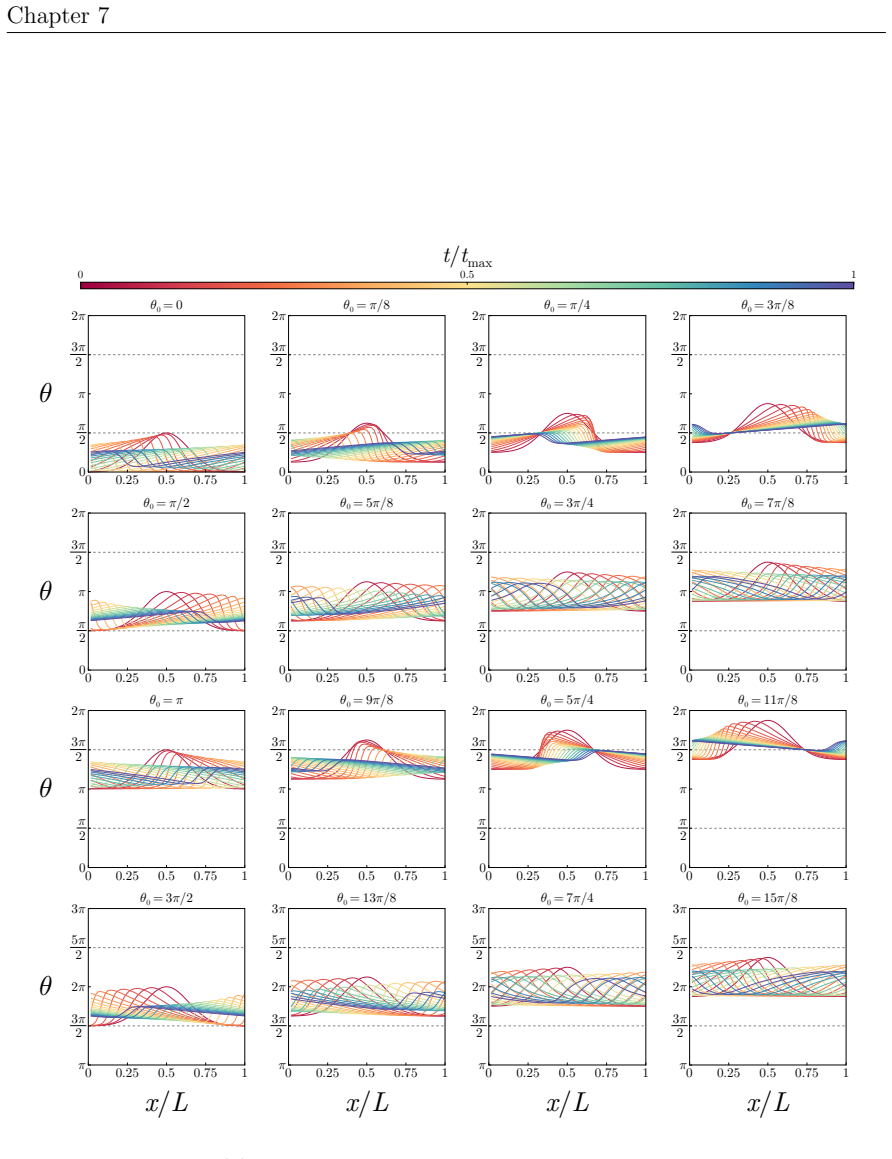
Figure 7.17. Figure 7.17: Profiles θ(x) of a 1d perturbation over time, from t = 0 in red to tmax = 0.2 in blue, for different background orientations θ0 = nπ/8, with n = 0, ..., 15, as indicated above each panel. We plot horizontal dashed lines to mark the θ = π/2 and θ = 3π/2 lines, where the in￾formation flux changes sign and orientation. For π/2 < θ < 3π/2, the profiles are pushed to the right, for θ < π/2 and θ > 3π/2, the … view at source ↗
read the original abstract

In this PhD thesis, we study topological defects in two-dimensional non-equilibrium systems, focusing on active extensions of the XY model, including activity, mobility and non-reciprocity. In a noisy Kuramoto lattice with short-range coupling, intrinsic frequency heterogeneity destroys quasi-long-range order and fragments the system into finite domains. Defects unbind at all temperatures and exhibit superdiffusive random walks, advected by evolving domain boundaries. By contrast, when oscillators are allowed to move in space, the system undergoes a Berezinskii-Kosterlitz-Thouless transition and regains quasi-long-range order, revealing the fundamental role of motility in sustaining coherence. We also analyse a non-reciprocal O(2) model with vision-cone couplings and derive a continuum theory that captures the same large-scale physics. Non-reciprocity selects defect shapes, enriches the annihilation process, and reshapes patterns through advection. Together, these results elucidate the fundamental role of activity and non-reciprocity in shaping topological defects and ordering in non-equilibrium systems. Keywords: Topological defects, XY model, Steep XY model, Kuramoto model, Non-reciprocal interactions, Active matter, Phase transitions, Berezinskii-Kosterlitz-Thouless transition, Non-equilibrium statistical mechanics
Editorial analysis

A structured set of objections, weighed in public.

Desk editor's note, referee report, simulated authors' rebuttal, and a circularity audit. Tearing a paper down is the easy half of reading it; the pith above is the substance, this is the friction.

Referee Report

2 major / 2 minor

Summary. The manuscript is a PhD thesis studying topological defects in two-dimensional non-equilibrium systems, with focus on active extensions of the XY/Kuramoto model that incorporate activity, mobility, and non-reciprocity. In a noisy Kuramoto lattice with short-range coupling, intrinsic frequency heterogeneity destroys quasi-long-range order, fragments the system into finite domains, and produces superdiffusive defect walks advected by domain boundaries. Allowing oscillators to move spatially restores a Berezinskii-Kosterlitz-Thouless transition and quasi-long-range order. A non-reciprocal O(2) model with vision-cone couplings is also analyzed; a continuum theory is derived that reproduces the large-scale physics, with non-reciprocity selecting defect shapes, enriching annihilation, and driving advection-induced pattern reshaping.

Significance. If the central claims hold, the work establishes motility as a key mechanism for sustaining coherence and quasi-long-range order in active oscillator systems, extending the BKT framework to non-equilibrium settings with non-reciprocal interactions. Strengths include direct lattice simulations of defect dynamics and the explicit derivation of hydrodynamic equations from microscopic rules, which together provide falsifiable predictions for defect advection and annihilation rates.

major comments (2)
  1. [Continuum theory derivation] Continuum theory derivation (vision-cone non-reciprocal O(2) model): the claim that the hydrodynamic equations faithfully reproduce discrete-lattice defect advection and annihilation requires an explicit parameter mapping and a quantitative check that predicted defect-density scaling matches lattice data. Without this, higher-order correlations between defect positions and the local velocity field could alter the effective core energy or renormalized stiffness, converting a true BKT transition into a crossover.
  2. [Motility and BKT restoration] Motility and BKT restoration section: the assertion that spatial mobility restores the BKT transition and quasi-long-range order rests on numerical evidence whose details (how the continuum limit is taken, error bars on defect densities, and the precise diagnostic for the transition such as helicity modulus jump or defect-unbinding criterion) are not yet sufficient to rule out finite-size or post-hoc interpretation effects.
minor comments (2)
  1. Abstract and introduction should explicitly state the microscopic parameters (coupling strength, noise amplitude, motility speed) used in the lattice simulations so that the continuum coefficients can be directly compared.
  2. Figure captions for defect trajectories and density plots should include the system size, averaging procedure, and how the superdiffusive exponent is extracted.

Simulated Author's Rebuttal

2 responses · 0 unresolved

We thank the referee for their careful reading of the manuscript and for the constructive comments, which help clarify the presentation of our results on topological defects in active oscillator systems. We address each major comment point by point below.

read point-by-point responses
  1. Referee: [Continuum theory derivation] Continuum theory derivation (vision-cone non-reciprocal O(2) model): the claim that the hydrodynamic equations faithfully reproduce discrete-lattice defect advection and annihilation requires an explicit parameter mapping and a quantitative check that predicted defect-density scaling matches lattice data. Without this, higher-order correlations between defect positions and the local velocity field could alter the effective core energy or renormalized stiffness, converting a true BKT transition into a crossover.

    Authors: We agree that an explicit parameter mapping and quantitative validation would strengthen the link between the microscopic lattice model and the derived hydrodynamic equations. In the revised manuscript we will add a dedicated subsection providing the full parameter mapping (including how microscopic coupling strengths, vision-cone angles, and noise amplitudes translate to continuum coefficients) together with a direct numerical comparison of defect-density scaling between lattice simulations and the continuum theory, including ensemble error bars. This addition will also allow us to discuss the possible influence of higher-order correlations on core energies and stiffness renormalization. revision: yes

  2. Referee: [Motility and BKT restoration] Motility and BKT restoration section: the assertion that spatial mobility restores the BKT transition and quasi-long-range order rests on numerical evidence whose details (how the continuum limit is taken, error bars on defect densities, and the precise diagnostic for the transition such as helicity modulus jump or defect-unbinding criterion) are not yet sufficient to rule out finite-size or post-hoc interpretation effects.

    Authors: We appreciate the referee’s request for greater transparency in the numerical diagnostics. The BKT transition is diagnosed via the universal jump in the helicity modulus and the associated unbinding of defect pairs, with defect densities averaged over independent realizations and shown with error bars. The continuum limit is approached by increasing linear system size at fixed oscillator density while monitoring finite-size scaling of the helicity modulus. In the revision we will expand the methods and results sections to include explicit descriptions of these procedures, additional finite-size scaling plots, and a clear statement of the defect-unbinding criterion used, thereby addressing concerns about post-hoc interpretation and finite-size effects. revision: yes

Circularity Check

0 steps flagged

No circularity: results rest on lattice simulations and independent continuum derivation.

full rationale

The abstract and available text describe direct numerical results on the noisy Kuramoto lattice (defect unbinding, superdiffusion, domain advection) and the motility extension that restores BKT order, plus a separate derivation of hydrodynamic equations for the vision-cone non-reciprocal O(2) model. No quoted equations, parameter fits, or self-citations are shown that would make any prediction equivalent to its input by construction. The continuum theory is presented as capturing the same large-scale physics without evidence of closure assumptions that tautologically enforce the claimed advection or annihilation behaviors. This is the common honest case of a self-contained derivation chain.

Axiom & Free-Parameter Ledger

0 free parameters · 1 axioms · 0 invented entities

The claims rest on standard extensions of the XY and Kuramoto models with added activity, mobility, and non-reciprocity; no explicit free parameters, new axioms beyond domain standards, or invented entities are introduced in the provided abstract.

axioms (1)
  • domain assumption Standard assumptions of the two-dimensional XY model and Kuramoto oscillator lattice for describing phase ordering and synchronization.
    The thesis builds directly on these established frameworks for topological defects and transitions.

pith-pipeline@v0.9.0 · 5528 in / 1405 out tokens · 92036 ms · 2026-05-08T18:02:28.408743+00:00 · methodology

discussion (0)

Sign in with ORCID, Apple, or X to comment. Anyone can read and Pith papers without signing in.

Lean theorems connected to this paper

Citations machine-checked in the Pith Canon. Every link opens the source theorem in the public Lean library.

Reference graph

Works this paper leans on

12 extracted references · 5 canonical work pages

  1. [1]

    Self-propelled rods: Insights and perspectives for active matter.Annu

    Markus B ¨ar, Robert Großmann, Sebastian Heidenreich, and Fernando Peruani. Self-propelled rods: Insights and perspectives for active matter.Annu. Rev. Condens. Matter Phys., 11:441–466, 2020

  2. [2]

    Noise-aware neural network for stochastic dynamics simulation.arXiv preprint arXiv:2403.09370, 2024

    Pei-Fang Wu, Wei-Chen Guo, and Liang He. Noise-aware neural network for stochastic dynamics simulation.arXiv preprint arXiv:2403.09370, 2024

  3. [3]

    Uncertainty in ai-driven monte carlo simulations.arXiv preprint arXiv:2506.14594, 2025

    Dimitrios Tzivrailis, Alberto Rosso, and Eiji Kawasaki. Uncertainty in ai-driven monte carlo simulations.arXiv preprint arXiv:2506.14594, 2025

  4. [4]

    Controlling dynamics of stochastic systems with deep reinforcement learning.arXiv preprint arXiv:2502.18111, 2025

    Ruslan Mukhamadiarov. Controlling dynamics of stochastic systems with deep reinforcement learning.arXiv preprint arXiv:2502.18111, 2025

  5. [5]

    Discovering governing equations from data by sparse identification of nonlinear dynamical systems

    Steven L Brunton, Joshua L Proctor, and J Nathan Kutz. Discovering governing equations from data by sparse identification of nonlinear dynamical systems. Proc. Natl. Acad. Sci., 113(15):3932–3937, 2016

  6. [6]

    Interpreting neural operators: How nonlinear waves propagate in nonreciprocal solids.Phys

    Jonathan Colen, Alexis Poncet, Denis Bartolo, and Vincenzo Vitelli. Interpreting neural operators: How nonlinear waves propagate in nonreciprocal solids.Phys. Rev. Lett., 133(10):107301, 2024

  7. [7]

    Discovering novel order parameters in the potts model: A bridge between machine learning and critical phenomena

    Yi-Lun Du, Nan Su, and Konrad Tywoniuk. Discovering novel order parameters in the potts model: A bridge between machine learning and critical phenomena. arXiv preprint arXiv:2505.06159, 2025

  8. [8]

    Machine learning of phase transitions in the percolation and xy models.Phys

    Wanzhou Zhang, Jiayu Liu, and Tzu-Chieh Wei. Machine learning of phase transitions in the percolation and xy models.Phys. Rev. E, 99(3):032142, 2019

  9. [9]

    Machine learning topological defect formation.arXiv preprint arXiv:2508.20347, 2025

    Fumika Suzuki, Ying Wai Li, and Wojciech H Zurek. Machine learning topological defect formation.arXiv preprint arXiv:2508.20347, 2025

  10. [10]

    Variational autoencoders understand knot topology.Phys

    Anna Braghetto, Sumanta Kundu, Marco Baiesi, and Enzo Orlandini. Variational autoencoders understand knot topology.Phys. Rev. E, 112(2):025418, 2025

  11. [11]

    Attention is all you need

    Ashish Vaswani, Noam Shazeer, Niki Parmar, Jakob Uszkoreit, Llion Jones, Aidan N Gomez, Lukasz Kaiser, and Illia Polosukhin. Attention is all you need. Adv. Neural Inf. Process. Syst., 30, 2017

  12. [12]

    First language acquisition.The handbook of linguistics, pages 397–413, 2017

    Brian MacWhinney. First language acquisition.The handbook of linguistics, pages 397–413, 2017. PhD Thesis in Physics Topological defects in out-of-equilibrium systems Author:Ylann Rouzaire PhD Supervisors:Demian Levis and Ignacio Pagonabarraga We study topological defects in two-dimensional non-equilibrium systems, focusing on active extensions of the XY ...