Recognition: 3 theorem links
· Lean TheoremPhysics-Informed Neural Learning for State Reconstruction and Parameter Identification in Coupled Greenhouse Climate Dynamics
Pith reviewed 2026-05-08 18:52 UTC · model grok-4.3
The pith
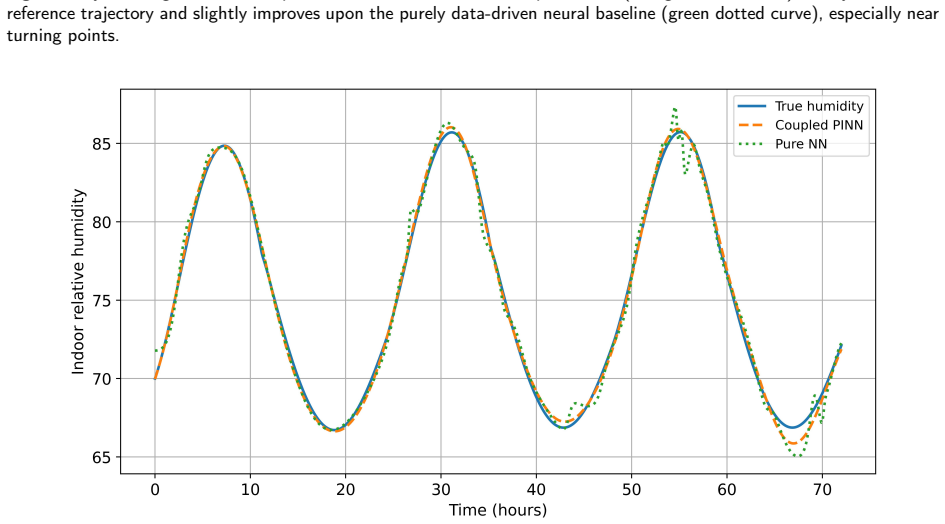
A coupled physics-informed neural network reconstructs greenhouse temperature and humidity more accurately than data-driven methods while identifying physical parameters.
A machine-rendered reading of the paper's core claim, the machinery that carries it, and where it could break.
Core claim
The coupled PINN framework integrates the governing dynamical constraints of a reduced-order physically motivated model into the neural network loss function, enabling consistent estimation of indoor temperature and humidity under sparse noisy data while simultaneously recovering the dominant physical parameters that govern the system dynamics.
What carries the argument
Coupled physics-informed neural network that incorporates the reduced-order physically motivated model of coupled temperature-humidity dynamics directly into the training loss for simultaneous state reconstruction and parameter identification.
If this is right
- Reduces temperature and humidity reconstruction errors relative to data-driven networks while maintaining high coefficients of determination.
- Improvements are most pronounced in humidity by better capturing latent moisture dynamics from limited measurements.
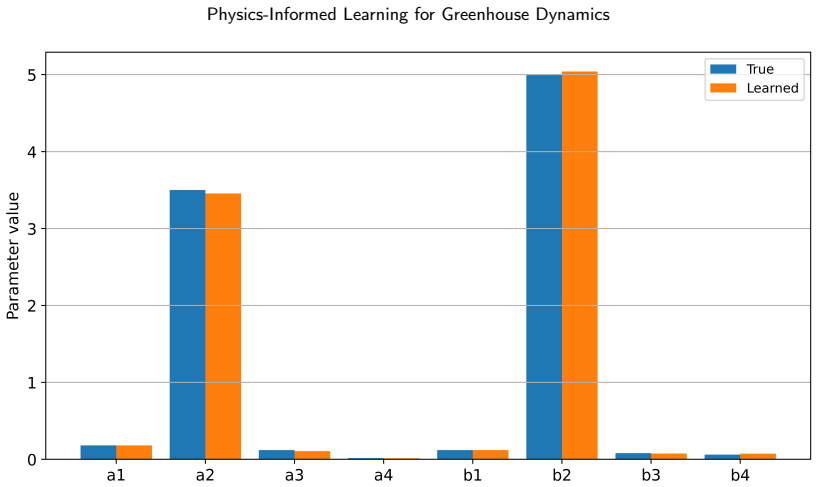
- Successfully recovers the dominant physical parameters governing the system dynamics beyond data interpolation.
- Highlights applicability of physics-informed learning to greenhouse climate modeling and other data-scarce environmental systems.
Where Pith is reading between the lines
- The framework could enable physically consistent real-time climate control and optimization in operational greenhouses.
- Analogous coupled PINNs may address other coupled environmental dynamics such as soil-plant-atmosphere systems.
- Testing on experimental rather than synthetic data would directly verify parameter recovery against known greenhouse constants.
Load-bearing premise
The reduced-order physically motivated model incorporated into the PINN loss accurately represents the essential coupled dynamics of indoor temperature and humidity under the tested conditions.
What would settle it
Applying the method to real experimental greenhouse measurements and checking whether recovered parameters match independently measured physical values and whether reconstruction still outperforms the data-driven baseline on actual noise and sparsity patterns.
Figures



read the original abstract
Physics-informed neural networks (PINNs) have recently emerged as a promising framework for integrating data-driven learning with physical knowledge. In this work, we propose a coupled PINN approach for the joint reconstruction of indoor temperature and humidity dynamics in greenhouse environments, together with simultaneous identification of key model parameters. The method incorporates a reduced-order physically motivated model into the learning process, enabling consistent estimation under sparse and noisy observations. The artificial intelligence contribution lies in the development of a coupled physics-informed neural learning framework that integrates governing dynamical constraints into neural network training, while the engineering application focuses on greenhouse climate state reconstruction and parameter identification. The proposed framework is evaluated on a controlled synthetic benchmark that mimics diurnal forcing conditions. Compared with a purely data-driven neural network baseline, the coupled PINN achieves improved reconstruction accuracy, reducing temperature and humidity errors while maintaining high coefficients of determination. The improvement is particularly pronounced in the humidity channel, where latent moisture dynamics are more difficult to infer from limited measurements. In addition to accurate state reconstruction, the method successfully recovers the dominant physical parameters governing the system dynamics, demonstrating its ability to learn interpretable representations beyond data interpolation. These results highlight the potential of physics-informed learning for greenhouse climate modeling and, more broadly, for data-scarce environmental systems.
Editorial analysis
A structured set of objections, weighed in public.
Referee Report
Summary. The paper proposes a coupled physics-informed neural network (PINN) framework that embeds a reduced-order physically motivated model of greenhouse temperature and humidity dynamics into the training loss. This enables joint state reconstruction from sparse noisy observations and simultaneous identification of dominant physical parameters (heat and moisture transfer rates). The method is evaluated on a synthetic benchmark mimicking diurnal forcing, where it outperforms a purely data-driven neural network baseline in reconstruction accuracy (particularly for humidity) while recovering the governing parameters with high fidelity.
Significance. If the reduced-order model accurately captures essential coupled dynamics, the framework offers a promising route to interpretable, physics-consistent learning for data-scarce environmental systems. The ability to recover physically meaningful parameters alongside improved state estimates is a clear strength, and the emphasis on the humidity channel (where latent dynamics are harder to infer) is well-motivated. However, the exclusive use of matched synthetic data limits the assessed significance for practical greenhouse applications.
major comments (1)
- [Abstract and numerical experiments] Abstract and numerical experiments: the reported gains in reconstruction accuracy and successful parameter recovery are demonstrated exclusively on synthetic trajectories generated from the identical reduced-order ODE system that is embedded in the PINN loss. Under this matched condition the physics residual is exactly zero for the ground-truth solution, so any improvement over the data-driven baseline is expected by construction and does not probe robustness to model mismatch (e.g., unmodeled ventilation, radiation, or crop transpiration terms). No ablation on model discrepancy, no comparison against a higher-fidelity simulator, and no experimental data are reported, leaving the central claim of practical utility for real greenhouses dependent on an unverified modeling assumption.
minor comments (2)
- The abstract states that the coupled PINN maintains high coefficients of determination but does not report error bars, full training specifications (optimizer, learning-rate schedule, number of collocation points), or the precise weighting between data and physics loss terms.
- Notation for the coupled loss function and the parameterization of the physical coefficients should be made fully explicit (e.g., how the dominant transfer rates appear in the residual and whether they are optimized jointly with network weights).
Simulated Author's Rebuttal
We thank the referee for the constructive feedback. The major comment correctly identifies that our evaluation relies on matched synthetic data, and we have revised the manuscript to clarify the scope of the contribution, add discussion of model mismatch, and moderate claims about immediate practical utility.
read point-by-point responses
-
Referee: Abstract and numerical experiments: the reported gains in reconstruction accuracy and successful parameter recovery are demonstrated exclusively on synthetic trajectories generated from the identical reduced-order ODE system that is embedded in the PINN loss. Under this matched condition the physics residual is exactly zero for the ground-truth solution, so any improvement over the data-driven baseline is expected by construction and does not probe robustness to model mismatch (e.g., unmodeled ventilation, radiation, or crop transpiration terms). No ablation on model discrepancy, no comparison against a higher-fidelity simulator, and no experimental data are reported, leaving the central claim of practical utility for real greenhouses dependent on an unverified modeling assumption.
Authors: We agree that the evaluation uses trajectories generated from the exact reduced-order ODE embedded in the PINN loss. This controlled synthetic benchmark was selected to provide known ground-truth states and parameters, enabling rigorous quantitative assessment of joint state reconstruction and parameter identification under sparse noisy observations. The improvement over the data-driven baseline demonstrates the benefit of the physics residual term for recovering latent dynamics (especially humidity) even when the model is perfectly matched. We acknowledge that this setup does not test robustness to model mismatch or unmodeled terms. In the revised manuscript we have added a dedicated subsection in the Discussion that examines the effects of potential discrepancies (ventilation, radiation, crop transpiration) and outlines extensions to higher-fidelity simulators. We have also updated the abstract and conclusions to frame the results as a proof-of-concept on synthetic diurnal benchmarks rather than claiming direct practical utility for real greenhouses. revision: partial
- Absence of validation against real greenhouse experimental data or higher-fidelity mismatched simulators, which would require new data collection or simulation campaigns beyond the current scope.
Circularity Check
Synthetic benchmark generated from the embedded reduced-order model renders reconstruction gains and parameter recovery tautological
specific steps
-
fitted input called prediction
[Abstract / Evaluation on synthetic benchmark]
"The proposed framework is evaluated on a controlled synthetic benchmark that mimics diurnal forcing conditions. Compared with a purely data-driven neural network baseline, the coupled PINN achieves improved reconstruction accuracy, reducing temperature and humidity errors while maintaining high coefficients of determination. ... the method successfully recovers the dominant physical parameters governing the system dynamics"
The synthetic benchmark is generated from the same reduced-order physically motivated model incorporated into the PINN loss. Consequently the physics residual is exactly zero on the ground-truth trajectories, making both the accuracy improvement and the parameter recovery expected by construction rather than a test of generalization under model discrepancy.
full rationale
The paper's central empirical claims rest on evaluation exclusively against trajectories synthesized from the identical reduced-order ODE system that is hard-coded into the PINN physics loss. Under this matched condition the residual term vanishes identically for the ground-truth solution, so any reported improvement over a data-only baseline and any recovered parameter values are statistically forced rather than independently validated. No model-mismatch experiments, real greenhouse data, or higher-fidelity simulator comparisons are provided, leaving the practical utility dependent on an untested modeling assumption.
Axiom & Free-Parameter Ledger
free parameters (1)
- Dominant physical parameters (heat/moisture transfer rates)
axioms (1)
- domain assumption The reduced-order physically motivated model accurately captures the coupled temperature-humidity dynamics
Lean theorems connected to this paper
-
IndisputableMonolith.Cost.FunctionalEquation (washburn_uniqueness_aczel)washburn_uniqueness_aczel unclear?
unclearRelation between the paper passage and the cited Recognition theorem.
d𝑇/d𝑡 = a₁(T_out−T) + a₂R − a₃V(T−T_out) + a₄(H−H_out); ... a₁..a₄, b₁..b₄ are unknown nonnegative parameters to be identified from data.
-
IndisputableMonolith.Foundation.AlphaDerivationExplicitAlphaProvenanceCert (parameter-free derivation contrast) unclear?
unclearRelation between the paper passage and the cited Recognition theorem.
(a₁..a₄)=(0.18,3.50,0.12,0.015), (b₁..b₄)=(0.12,5.00,0.08,0.06) ... 25% of grid retained, Gaussian noise σ=0.30 and 1.00 added.
-
IndisputableMonolith.Foundation.BranchSelectionbranch_selection unclear?
unclearRelation between the paper passage and the cited Recognition theorem.
L(θ,λ) = ω_data L_data + ω_phys L_phys + ω_ic L_ic, with weights chosen and parameters λ trained alongside network.
What do these tags mean?
- matches
- The paper's claim is directly supported by a theorem in the formal canon.
- supports
- The theorem supports part of the paper's argument, but the paper may add assumptions or extra steps.
- extends
- The paper goes beyond the formal theorem; the theorem is a base layer rather than the whole result.
- uses
- The paper appears to rely on the theorem as machinery.
- contradicts
- The paper's claim conflicts with a theorem or certificate in the canon.
- unclear
- Pith found a possible connection, but the passage is too broad, indirect, or ambiguous to say the theorem truly supports the claim.
Reference graph
Works this paper leans on
-
[1]
Greenhouse climate modelling and robust control
Bennis, N., Duplaix, J., Enéa, G., Haloua, M., Youlal, H., 2008. Greenhouse climate modelling and robust control. Comput. Electron. Agric. 61, 96–107
2008
-
[2]
A review of environmental control strategies and models for modern agricultural greenhouses
Chen, S., Liu, A., Tang, F., Hou, P., Lu, Y., Yuan, P., 2025. A review of environmental control strategies and models for modern agricultural greenhouses. Sensors 25, 1388
2025
-
[3]
Development of physics-informed neural networks (pinns) for the natural ventilation of a greenhouse – part 2: Development of prediction models for variable wind conditions
Choi, Y.B., Lee, I.B., 2026. Development of physics-informed neural networks (pinns) for the natural ventilation of a greenhouse – part 2: Development of prediction models for variable wind conditions. Biosyst. Eng. 265, 104441
2026
-
[4]
Scientific machine learning through physics-informed neural networks: Where we are and what is next
Cuomo, S., Di Cola, V.S., Giampaolo, F., Rozza, G., Raissi, M., Piccialli, F., 2022. Scientific machine learning through physics-informed neural networks: Where we are and what is next. J. Sci. Comput. 92, 88
2022
-
[5]
Dataset of temperature, humidity, and actuator states of an east-facing south african greenhouse tunnel
Hull, K., Mabitsela, M., Phiri, E., Booysen, M., 2023. Dataset of temperature, humidity, and actuator states of an east-facing south african greenhouse tunnel. Data Brief 51, 109633
2023
-
[6]
Physics-informed machine learning
Karniadakis, G.E., Kevrekidis, I.G., Lu, L., Perdikaris, P., Wang, S., Yang, L., 2021. Physics-informed machine learning. Nat. Rev. Phys. 3, 422–440
2021
-
[7]
Lstm-gru hybrid model for multi-layer microclimate prediction in solar greenhouses
Li, B., Wang, Z., Guo, Y., Zhou, X., Qiao, B., Han, L., 2026. Lstm-gru hybrid model for multi-layer microclimate prediction in solar greenhouses. Sci. Rep
2026
-
[8]
Prediction of greenhouse temperature and humidity across growing seasons: Hybridization of process-based model and deep neural networks
Liu, K., Ji, T., Li, M., Yang, X., Sun, J., Liu, H., Liu, R., 2025. Prediction of greenhouse temperature and humidity across growing seasons: Hybridization of process-based model and deep neural networks. Inf. Process. Agric
2025
-
[9]
Physics-informed neural networks: A deep learning framework for solving forward and inverse problems involving nonlinear partial differential equations
Raissi, M., Perdikaris, P., Karniadakis, G.E., 2019. Physics-informed neural networks: A deep learning framework for solving forward and inverse problems involving nonlinear partial differential equations. J. Comput. Phys. 378, 686–707
2019
-
[10]
Reviewofoptimumtemperature,humidity,andvapour pressure deficit for microclimate evaluation and control in greenhouse cultivation of tomato: A review
Shamshiri,R.R.,Jones,J.W.,Thorp,K.R.,Ahmad,D.,CheMan,H.,Taheri,S.,2018. Reviewofoptimumtemperature,humidity,andvapour pressure deficit for microclimate evaluation and control in greenhouse cultivation of tomato: A review. Int. Agrophys. 32, 287–302
2018
-
[11]
Prediction of greenhouse micro-climate using artificial neural network
Singh, V.K., Tiwari, K.N., 2017. Prediction of greenhouse micro-climate using artificial neural network. Appl. Ecol. Environ. Res. 15, 767–778
2017
-
[12]
Optimal Control of Greenhouse Cultivation
van Straten, G., van Willigenburg, G., van Henten, E., van Ooteghem, R., 2010. Optimal Control of Greenhouse Cultivation. CRC Press
2010
-
[13]
Multistepaheadpredictionoftemperatureandhumidityinsolargreenhouse based on fam-lstm
Yang,Y.,Gao,P.,Sun,Z.,Wang,H.,Lu,M.,Liu,Y.,Hu,J.,2023. Multistepaheadpredictionoftemperatureandhumidityinsolargreenhouse based on fam-lstm. Comput. Electron. Agric. 213, 108261
2023
-
[14]
Prediction and control of greenhouse temperature
Yu, J., Zhang, Y., Wang, L., Li, X., 2025. Prediction and control of greenhouse temperature. Comput. Electron. Agric. 237, 110603. S. Biswas et al.: Page 12 of 12
2025
discussion (0)
Sign in with ORCID, Apple, or X to comment. Anyone can read and Pith papers without signing in.