Recognition: 3 theorem links
· Lean TheoremHow neutrinos could help solving cosmological anomalies and tensions
Pith reviewed 2026-05-08 18:33 UTC · model grok-4.3
The pith
Invisible decays of relic neutrinos can reconcile cosmological mass limits with lab measurements, and a boomerang dark-sector process can explain the radio background excess via radiative decays.
A machine-rendered reading of the paper's core claim, the machinery that carries it, and where it could break.
Core claim
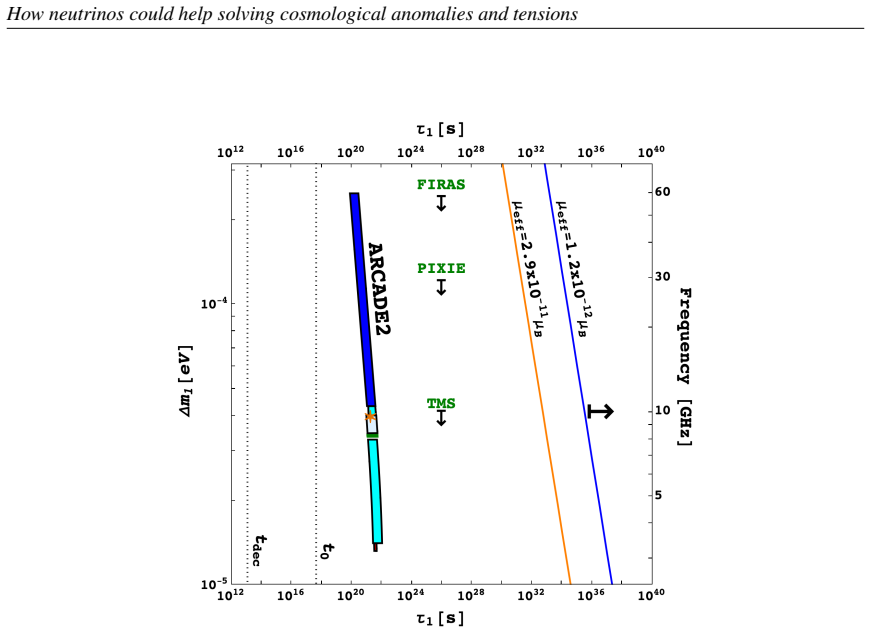
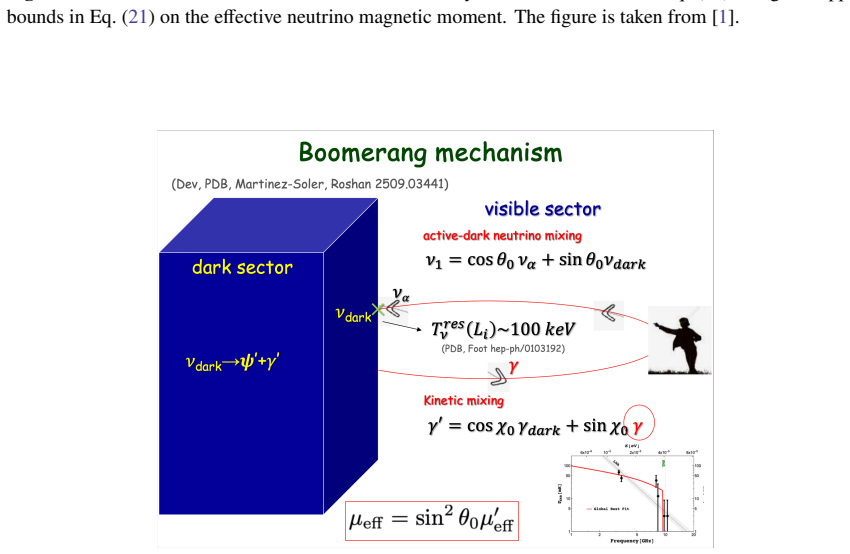
The author claims that invisible decays of the heaviest relic neutrinos provide a way to solve the neutrino mass tension between cosmological observations and neutrino oscillation experiments, while a recently proposed boomerang mechanism allows radiative decays of relic neutrinos to explain the excess radio background mystery by transferring neutrinos to the dark sector at t ~ 100 s and returning photons at present times, predicting an effective neutrino magnetic moment within reach of next experiments and some contribution to the 21 cm signal.
What carries the argument
The boomerang mechanism, a two-stage transfer where the visible sector sends dark neutrinos into the dark sector early and the dark sector returns photons to the visible sector late, enabling radiative decays without violating magnetic moment constraints.
If this is right
- The neutrino mass tension between cosmology and oscillation experiments is resolved if the heaviest neutrinos decay invisibly.
- The excess radio background arises from photons returned by the dark sector at late times.
- The predicted effective neutrino magnetic moment falls within the sensitivity of upcoming laboratory experiments.
- The 21 cm cosmological signal receives an additional contribution from the decay process.
Where Pith is reading between the lines
- Laboratory bounds on the neutrino magnetic moment could directly test the dark sector coupling proposed here.
- If the mechanism holds, similar hidden-sector transfers might address other early-universe anomalies without new visible particles.
- Radio surveys targeting late-time photon injection could provide independent evidence alongside magnetic moment searches.
Load-bearing premise
The dark sector must couple to neutrinos in a way that allows early transfer without affecting standard cosmology and later photon return while producing the required magnetic moment, details of which are not specified.
What would settle it
A measurement of the effective neutrino magnetic moment by next-generation experiments that falls outside the range allowed by the boomerang mechanism, or the absence of the expected 21 cm signal contribution, would rule out this explanation for the radio background.
Figures



read the original abstract
In this talk I discuss how neutrinos might help solving or alleviating different anomalies and tensions in cosmology. Invisible decays of the heaviest relic neutrinos might provide a way to solve the neutrino mass tension between cosmological observations and neutrino oscillation experiments. The excess radio background mystery could be explained by radiative decays of relic neutrinos. However, the upper bound on the neutrino effective magnetic moment requires some trick to be circumvented. To this extent, I discuss a recently proposed boomerang mechanism in which the visible sector throws dark neutrinos into the dark sector at $t \sim 100\,{\rm s}$ and $T \sim 100\,{\rm keV}$, and much later (basically at the present time) the dark sector throws back photons into the visible sector. The mechanism predicts an effective neutrino magnetic moment that might be within the reach of next experiments. Some contribution to the 21 cm cosmological signal is also expected. These are exciting times for cosmological searches of BSM physics.
Editorial analysis
A structured set of objections, weighed in public.
Referee Report
Summary. The manuscript discusses how neutrinos could alleviate cosmological tensions and anomalies: invisible decays of the heaviest relic neutrinos are proposed to resolve the neutrino mass tension between cosmology and oscillation data, while radiative decays via a 'boomerang' mechanism (transfer of neutrinos to a dark sector at t ~ 100 s and T ~ 100 keV, with photon return at late times) are suggested to explain the excess radio background. The mechanism is claimed to yield an effective neutrino magnetic moment within reach of future experiments and a contribution to the 21 cm signal.
Significance. If the mechanisms can be shown to be consistent with all bounds through explicit calculations, the ideas could offer a unified BSM neutrino explanation for multiple cosmological puzzles with testable predictions for magnetic moments and dark-sector effects. The work identifies potentially fruitful directions for connecting neutrino physics to cosmology, though its current qualitative nature limits immediate impact.
major comments (2)
- [Boomerang mechanism] Boomerang mechanism (described in the main text following the abstract): no explicit Lagrangian, coupling constants, or decay-rate calculations are provided to demonstrate that the dark-sector transfer at T ~ 100 keV can occur without violating BBN constraints, overproducing invisible decays, or exceeding the current upper bound on the neutrino magnetic moment while still generating the required late-time photon flux to explain the radio excess.
- [Invisible decays] Invisible decays proposal (main text): the assertion that decays of the heaviest relic neutrinos resolve the cosmological neutrino-mass tension is presented without any derivation, parameter scan, or consistency check against existing limits on neutrino lifetimes or the required suppression of the effective mass in cosmological observables.
minor comments (1)
- The text refers to 'this talk' and 'I discuss,' indicating it is likely a proceedings summary of a presentation; for journal publication, rephrase to standard manuscript style and expand the qualitative sketches into at least schematic calculations.
Simulated Author's Rebuttal
We thank the referee for the detailed and constructive report. The comments correctly identify the qualitative nature of the current presentation, which stems from its origin as a conference talk. We address each major point below and will revise the manuscript to incorporate additional details and references for improved rigor.
read point-by-point responses
-
Referee: [Boomerang mechanism] Boomerang mechanism (described in the main text following the abstract): no explicit Lagrangian, coupling constants, or decay-rate calculations are provided to demonstrate that the dark-sector transfer at T ~ 100 keV can occur without violating BBN constraints, overproducing invisible decays, or exceeding the current upper bound on the neutrino magnetic moment while still generating the required late-time photon flux to explain the radio excess.
Authors: We agree that the manuscript as written does not contain the explicit Lagrangian or rate calculations. These are provided in the original proposal paper on the boomerang mechanism, which we will cite explicitly. The couplings are chosen such that the visible-to-dark transfer occurs after BBN (T ~ 100 keV) with rates that avoid overproduction of invisible decays, remain below the current magnetic-moment bound, and produce the required late-time photon flux for the radio excess. In the revised version we will add a concise summary of the relevant Lagrangian terms, the key decay-rate expressions, and a brief consistency argument with BBN and existing bounds. revision: yes
-
Referee: [Invisible decays] Invisible decays proposal (main text): the assertion that decays of the heaviest relic neutrinos resolve the cosmological neutrino-mass tension is presented without any derivation, parameter scan, or consistency check against existing limits on neutrino lifetimes or the required suppression of the effective mass in cosmological observables.
Authors: The claim relies on prior literature in which invisible decays of the heaviest neutrino eigenstate suppress the effective mass inferred from cosmology while remaining compatible with oscillation data. We will revise the text to include a short derivation of the effective-mass suppression and cite the relevant lifetime bounds and parameter ranges that satisfy them. A full scan is beyond the scope of this talk-style manuscript, but the key consistency relations will be stated explicitly. revision: yes
Circularity Check
No internal derivation chain or self-referential reductions present
full rationale
The document is a conference talk that qualitatively discusses possible neutrino decay scenarios to address cosmological tensions, attributing the central 'boomerang mechanism' to a recently proposed idea without providing equations, Lagrangians, rate calculations, or parameter fits within this text. No load-bearing steps reduce by construction to inputs, self-citations, or ansatzes defined here; claims are presented as exploratory possibilities rather than derived predictions. The content is therefore self-contained as an overview without circularity.
Axiom & Free-Parameter Ledger
axioms (1)
- standard math Standard Big Bang cosmology and relic neutrino decoupling hold at T ~ 100 keV.
invented entities (1)
-
Dark neutrinos in a hidden sector
no independent evidence
Lean theorems connected to this paper
-
IndisputableMonolith.Cost.FunctionalEquationwashburn_uniqueness_aczel unclear?
unclearRelation between the paper passage and the cited Recognition theorem.
τ_{ν_i→ν_j+φ} ≃ 7×10^17 s · (0.05 eV/m_νi) · (10^-15/λ²_ij)²
What do these tags mean?
- matches
- The paper's claim is directly supported by a theorem in the formal canon.
- supports
- The theorem supports part of the paper's argument, but the paper may add assumptions or extra steps.
- extends
- The paper goes beyond the formal theorem; the theorem is a base layer rather than the whole result.
- uses
- The paper appears to rely on the theorem as machinery.
- contradicts
- The paper's claim conflicts with a theorem or certificate in the canon.
- unclear
- Pith found a possible connection, but the passage is too broad, indirect, or ambiguous to say the theorem truly supports the claim.
Reference graph
Works this paper leans on
- [1]
- [2]
-
[3]
NuFit-6.0: Updated global analysis of three-flavor neutrino oscillations
I. Esteban, M. C. Gonzalez-Garcia, M. Maltoni, I. Martinez-Soler, J. P. Pinheiro and T.Schwetz,NuFit-6.0: updatedglobalanalysisofthree-flavorneutrinooscillations,JHEP12 (2024), 216 [arXiv:2410.05380 [hep-ph]]
work page internal anchor Pith review arXiv 2024
-
[4]
M. Tristram, A. J. Banday, M. Douspis, X. Garrido, K. M. Górski, S. Henrot-Versillé, L.T.Hergt,S.Ilić,R.KeskitaloandG.Lagache,etal.Cosmologicalparametersderivedfrom the final Planck data release (PR4), Astron. Astrophys.682(2024), A37 [arXiv:2309.10034 [astro-ph.CO]]. 11 How neutrinos could help solving cosmological anomalies and tensions
-
[5]
M.AbdulKarimetal.[DESI],DESIDR2results.II.Measurementsofbaryonacousticoscilla- tionsandcosmologicalconstraints,Phys.Rev.D112(2025)no.8,083515[arXiv:2503.14738 [astro-ph.CO]]
work page Pith review arXiv 2025
- [6]
- [7]
- [8]
- [9]
-
[10]
M. Escudero and M. Fairbairn,Cosmological Constraints on Invisible Neutrino Decays Re- visited, Phys. Rev. D100(2019) no.10, 103531 [arXiv:1907.05425 [hep-ph]]
- [11]
- [12]
- [13]
-
[14]
D.J.Fixsen,A.Kogut,S.Levin,M.Limon,P.Lubin,P.Mirel,M.Seiffert,J.Singal,E.Wollack and T. Villela,et al. ARCADE 2 Measurement of the Extra-Galactic Sky Temperature at 3-90 GHz, Astrophys. J.734(2011), 5 [arXiv:0901.0555 [astro-ph.CO]]
-
[15]
Lett.50(2024), 159-185 [arXiv:2408.01858 [astro-ph.HE]]
S.A.GrebenevandR.A.Sunyaev,IncreaseintheBrightnessoftheCosmicRadioBackground toward Galaxy Clusters, Astron. Lett.50(2024), 159-185 [arXiv:2408.01858 [astro-ph.HE]]
-
[16]
M. Chianese, P. Di Bari, K. Farrag and R. Samanta,Probing relic neutrino radiative decays with 21 cm cosmology, Phys. Lett. B790(2019), 64-70 [arXiv:1805.11717 [hep-ph]]
-
[17]
E. Masso and R. Toldra,Photon spectrum produced by the late decay of a cosmic neutrino background, Phys. Rev. D60(1999), 083503 [arXiv:astro-ph/9903397 [astro-ph]]
-
[18]
Planck 2018 results. VI. Cosmological parameters
N. Aghanimet al.[Planck],Planck 2018 results. VI. Cosmological parameters, Astron. Astrophys.641(2020), A6 [erratum: Astron. Astrophys.652(2021), C4] [arXiv:1807.06209 [astro-ph.CO]]
work page Pith review arXiv 2018
-
[19]
Di Bari,Cosmology and the Early Universe, CRC Press, 2018, ISBN 978-1-4987-6170-3, 978-1-138-49690-3
P. Di Bari,Cosmology and the Early Universe, CRC Press, 2018, ISBN 978-1-4987-6170-3, 978-1-138-49690-3. 12 How neutrinos could help solving cosmological anomalies and tensions
2018
-
[20]
J. Dowell and G. B. Taylor,The Radio Background Below 100 MHz, Astrophys. J. Lett.858 (2018) no.1, L9 [arXiv:1804.08581 [astro-ph.CO]]
-
[21]
R.N.MohapatraandP.B.Pal,Massiveneutrinosinphysicsandastrophysics.Secondedition, World Sci. Lect. Notes Phys.60(1998), 1-397
1998
-
[22]
Z. z. Xing and S. Zhou,Neutrinos in particle physics, astronomy and cosmology
- [23]
-
[24]
G. G. Raffelt,New bound on neutrino dipole moments from globular cluster stars, Phys. Rev. Lett.64(1990), 2856-2858
1990
-
[25]
Enqvist, K
K. Enqvist, K. Kainulainen and J. Maalampi,Refraction and Oscillations of Neutrinos in the Early Universe, Nucl. Phys. B349(1991), 754-790
1991
-
[26]
P. Di Bari and R. Foot,Active sterile neutrino oscillations in the early universe: Asymmetry generationatlow|deltam**2|andtheLandau-Zenerapproximation,Phys.Rev.D65(2002), 045003 [arXiv:hep-ph/0103192 [hep-ph]]
- [27]
- [28]
-
[29]
J. R. Pritchard and A. Loeb,21-cm cosmology, Rept. Prog. Phys.75(2012), 086901 [arXiv:1109.6012 [astro-ph.CO]]
work page Pith review arXiv 2012
-
[30]
J.608(2004), 622-635 [arXiv:astro-ph/0311514 [astro-ph]]
M.Zaldarriaga,S.R.FurlanettoandL.Hernquist,21Centimeterfluctuationsfromcosmicgas at high redshifts, Astrophys. J.608(2004), 622-635 [arXiv:astro-ph/0311514 [astro-ph]]
-
[31]
J.D.Bowman,A.E.E.Rogers,R.A.Monsalve,T.J.MozdzenandN.Mahesh,Anabsorption profilecentredat78megahertzinthesky-averagedspectrum,Nature555(2018)no.7694,67
2018
- [32]
- [33]
discussion (0)
Sign in with ORCID, Apple, or X to comment. Anyone can read and Pith papers without signing in.