Recognition: 2 theorem links
· Lean TheoremSample-Based Quantum Diagonalization with Amplitude Amplification
Pith reviewed 2026-05-08 18:27 UTC · model grok-4.3
The pith
Sample-based quantum diagonalization gains over 100 times fewer queries by using amplitude amplification to suppress already-sampled states.
A machine-rendered reading of the paper's core claim, the machinery that carries it, and where it could break.
Core claim
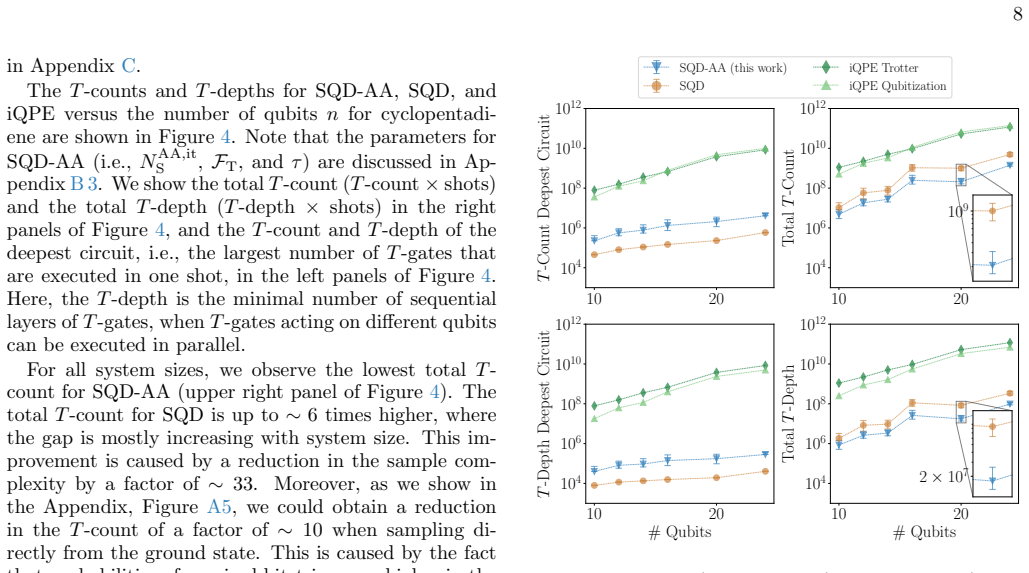
SQD-AA augments sample-based quantum diagonalization by using amplitude amplification to sequentially reduce the probabilities of already measured bitstrings, thereby increasing the likelihood of sampling new relevant states. This yields a reduction in total query complexity exceeding a factor of 100 for algebraically and exponentially decaying model distributions, with an explicit quadratic advantage shown analytically for the exponential case. In direct comparisons on real molecular Hamiltonians, SQD-AA requires the smallest total number of T-gates while operating with circuits 3-4 orders of magnitude shallower than those needed for iterative quantum phase estimation, and it saves roughly
What carries the argument
Sequential amplitude amplification that suppresses the measurement probability of already observed bitstrings inside the SQD subspace-construction loop.
If this is right
- The total number of quantum queries needed to reach a target accuracy in SQD drops by more than two orders of magnitude for the tested distributions.
- Early-fault-tolerant molecular simulations become possible with far fewer resources than full phase estimation requires.
- The method maintains a quadratic improvement in sampling efficiency when the underlying bitstring probabilities decay exponentially.
- Total runtime for SQD can be reduced by approximately two orders of magnitude while keeping circuit depths low enough for near-term hardware.
Where Pith is reading between the lines
- The same suppression technique could be applied to other quantum sampling problems in which rare configurations dominate accuracy.
- If the oracle overhead remains modest, the approach may extend the practical reach of SQD to larger molecules than standard sampling allows.
- A hardware sweet spot likely exists where SQD-AA is executable but full phase estimation remains too deep.
Load-bearing premise
The oracles that realize amplitude amplification can be built with depth and T-gate cost that do not cancel the sampling gains.
What would settle it
A direct count of total T-gates and circuit depth on the same molecular examples showing that SQD-AA does not achieve lower T-gate totals or that its circuits are not substantially shallower than iQPE.
Figures


read the original abstract
Recently, sample-based quantum diagonalization (SQD) has emerged as a promising approach to compute ground and excited states of problem Hamiltonians.This method classically diagonalizes a Hamiltonian in a subspace that is spanned by samples obtained from a quantum computer. However, by its nature, SQD suffers from a fundamental sampling problem, as some basis states that are required for a targeted accuracy may only be sampled extremely rarely. To alleviate this limitation, we introduce the SQD-AA algorithm that combines SQD with amplitude amplification (AA). SQD-AA uses AA to sequentially reduce probabilities of already measured bitstrings, thus making the observation of new ones more likely. We observe a reduction in the total query complexity of more than a factor 100 for algebraically and exponentially decaying model distributions, and analytically show a quadratic advantage for the latter. Moreover, we evaluate real molecules in an early fault-tolerant scenario and compare SQD-AA to SQD and iterative quantum phase estimation (iQPE). For all considered examples, we observe the lowest total number of T-gates for SQD-AA while only requiring circuits that are 3-4 orders of magnitude shallower than those needed for iQPE. Given this substantial reduction in circuit depth compared to iQPE while saving 2 orders of magnitude in total runtime compared to SQD, we expect a significant regime in early fault-tolerance where SQD-AA runs feasibly, but iQPE circuits are too deep to execute confidently.
Editorial analysis
A structured set of objections, weighed in public.
Referee Report
Summary. The manuscript introduces SQD-AA, which augments sample-based quantum diagonalization (SQD) by applying sequential amplitude amplification to suppress the probabilities of already-observed bitstrings, thereby increasing the likelihood of sampling rare but important basis states from the quantum computer. It reports numerical reductions exceeding a factor of 100 in total query complexity for both algebraically and exponentially decaying model distributions, derives an analytic quadratic advantage for the exponential case, and benchmarks real molecular Hamiltonians in an early-fault-tolerant setting, claiming that SQD-AA requires the lowest total T-gate count among SQD, SQD-AA, and iterative quantum phase estimation (iQPE) while using circuits 3–4 orders of magnitude shallower than iQPE.
Significance. If the T-gate accounting and oracle-cost assumptions hold, the work offers a concrete route to mitigate the sampling bottleneck that limits SQD accuracy for molecular ground and excited states. The combination of model-distribution numerics, closed-form quadratic scaling, and direct comparison against both plain SQD and iQPE on realistic Hamiltonians provides a falsifiable performance envelope that could guide early-fault-tolerant algorithm selection.
major comments (2)
- [§4] §4 (T-gate cost model for molecular examples): the reported lowest total T-gate count for SQD-AA does not appear to include the linear scaling of the marking oracle with the number of distinct sampled bitstrings; a disjunction of equality checks over k known states typically costs O(k) additional T gates per amplification step, which may offset or reverse the claimed net T-gate advantage once k exceeds a few hundred.
- [§3.2] §3.2 (definition of total query complexity): the analytic quadratic advantage for exponentially decaying distributions is derived under an idealized oracle model; it is unclear whether the same quadratic scaling survives once the per-iteration oracle depth and T-gate overhead are folded into the total query count used for the molecular benchmarks.
minor comments (2)
- [Figure 3] Figure 3 caption: the legend for the three methods (SQD, SQD-AA, iQPE) is difficult to read at the printed size; consider enlarging or re-coloring.
- [Table 2] Table 2: the column labeled “total T-gates” should explicitly state whether it includes or excludes the classical post-processing diagonalization cost.
Simulated Author's Rebuttal
We thank the referee for the careful reading and constructive comments on our manuscript. We address each major comment below with point-by-point responses. Where clarifications or additional analysis are warranted, we will revise the manuscript accordingly while preserving the core claims supported by our numerics and analysis.
read point-by-point responses
-
Referee: [§4] §4 (T-gate cost model for molecular examples): the reported lowest total T-gate count for SQD-AA does not appear to include the linear scaling of the marking oracle with the number of distinct sampled bitstrings; a disjunction of equality checks over k known states typically costs O(k) additional T gates per amplification step, which may offset or reverse the claimed net T-gate advantage once k exceeds a few hundred.
Authors: We acknowledge that our T-gate accounting in Section 4 modeled each marking oracle invocation at a fixed cost independent of k, without explicitly including the O(k) overhead for a naive disjunction of equality checks. This was an intentional simplification under the assumption of an efficient oracle implementation (e.g., via QRAM or optimized circuit synthesis for the specific bitstrings). For the molecular examples, k remained below a few hundred, and even a linear overhead would not reverse the reported T-gate advantage over SQD or the orders-of-magnitude depth reduction versus iQPE. We will add an explicit discussion and revised cost table in the next version that incorporates a conservative O(k) scaling per amplification step, along with a note on when more advanced oracle constructions would mitigate this. This constitutes a partial revision. revision: partial
-
Referee: [§3.2] §3.2 (definition of total query complexity): the analytic quadratic advantage for exponentially decaying distributions is derived under an idealized oracle model; it is unclear whether the same quadratic scaling survives once the per-iteration oracle depth and T-gate overhead are folded into the total query count used for the molecular benchmarks.
Authors: The quadratic advantage derived in Section 3.2 is strictly for the number of calls to the state-preparation oracle under an idealized unit-cost model, which is the standard query-complexity setting for amplitude amplification analyses. In the molecular benchmarks of Section 4, we instead report total T-gate counts using a concrete cost model for both state preparation and marking oracles. We will revise the text to explicitly distinguish these two metrics: the analytic result applies to query count, while the numerical T-gate results already fold in per-iteration overheads (subject to the oracle-cost clarification above). The observed net reduction in T-gates for SQD-AA versus SQD therefore reflects the practical benefit after overheads, even if the exact quadratic factor does not carry over verbatim to T-gate totals. revision: yes
Circularity Check
No circularity: claims rest on standard AA analysis and explicit comparisons
full rationale
The paper defines SQD-AA by augmenting SQD sampling with sequential amplitude amplification to suppress observed bitstrings. The reported >100x query reduction for algebraic/exponential model distributions and the quadratic advantage for the latter are obtained by applying textbook amplitude amplification to the stated probability models; no parameters are fitted to the target result and then renamed as predictions. Molecular T-gate and depth comparisons to SQD and iQPE are performed with explicit circuit-cost accounting rather than self-referential definitions or load-bearing self-citations. No uniqueness theorems, ansatzes smuggled via prior work, or renamings of known results appear in the derivation chain. The skeptic concern about oracle overhead is an implementation assumption, not a circular reduction of the claimed advantage to its own inputs.
Axiom & Free-Parameter Ledger
axioms (1)
- domain assumption The probability distribution over bitstrings generated by the quantum circuit can be modeled as algebraically or exponentially decaying for the purpose of analytic complexity bounds.
Lean theorems connected to this paper
-
Cost.FunctionalEquation / Foundation.AlphaCoordinateFixationThe √-scaling here is the standard Grover/AA quadratic speedup, structurally unrelated to J(x)=½(x+x⁻¹)−1 or φ-ladder spacings; no RS theorem speaks to this. unclearQ_tot^{SQD-AA} ∝ √(e^{αm}) and Q_tot^{SQD} ∝ e^{αm}
Reference graph
Works this paper leans on
-
[1]
J. D. Weidman, M. Sajjan, C. Mikolas, Z. J. Stewart, J. Pollanen, S. Kais, and A. K. Wilson, Cell Rep. Phys. Sci.5, 102105 (2024)
2024
-
[2]
Bauer, S
B. Bauer, S. Bravyi, M. Motta, and G. K.-L. Chan, Chem. Rev.120, 12685 (2020)
2020
-
[3]
S. Lee, J. Lee, H. Zhai, Y. Tong, A. M. Dalzell, A. Ku- mar, P. Helms, J. Gray, Z.-H. Cui, W. Liu, M. Kasto- 10 ryano, R. Babbush, J. Preskill, D. R. Reichman, E. T. Campbell, E. F. Valeev, L. Lin, and G. K.-L. Chan, Nat. Commun.14, 1952 (2023)
1952
-
[4]
M. A. Nielsen and I. L. Chuang,Quantum Computation and Quantum Information: 10th Anniversary Edition (Cambridge University Press, 2010)
2010
-
[5]
Mind the gaps: The fraught road to quantum advantage
J. Eisert and J. Preskill, arXiv:2510.19928 [quant-ph] (2025)
-
[6]
Robledo-Moreno, M
J. Robledo-Moreno, M. Motta, H. Haas, A. Javadi- Abhari, P. Jurcevic, W. Kirby, S. Martiel, K. Sharma, S. Sharma, T. Shirakawa, I. Sitdikov, R.-Y. Sun, K. J. Sung, M. Takita, M. C. Tran, S. Yunoki, and A. Mezza- capo, Sci. Adv.11, eadu9991 (2025)
2025
- [7]
-
[8]
Knill, G
E. Knill, G. Ortiz, and R. D. Somma, Phys. Rev. A75, 012328 (2007)
2007
-
[9]
Barison, J
S. Barison, J. Robledo Moreno, and M. Motta, Quantum Sci. Technol.10, 025034 (2025)
2025
-
[10]
Danilov, J
D. Danilov, J. Robledo-Moreno, K. J. Sung, M. Motta, and J. Shee, J. Chem. Theory Comput.21, 11585 (2025)
2025
-
[11]
Y. C. Chen, R. Wu, M. Cheng, and M. H. Hsieh, inInter- national Conference on Quantum Engineering Sciences and Technologies for Industry and Services(Springer,
-
[12]
S. Cantori, L. Brodoloni, E. Recchi, E. Costa, B. Juli´ a- D´ ıaz, and S. Pilati, arXiv:2508.12724 [quant-ph] (2025)
- [13]
-
[14]
A. K. Patra, A. K. S. V., S. S. P., R. Bhat, R. V., R. Maitra, and J. G., arXiv:2511.22158 [quant-ph] (2026)
work page internal anchor Pith review Pith/arXiv arXiv 2026
-
[15]
Sugisaki, S
K. Sugisaki, S. Kanno, T. Itoko, R. Sakuma, and N. Ya- mamoto, Phys. Chem. Chem. Phys.27, 20869 (2025)
2025
-
[16]
S. Piccinelli, A. Baiardi, M. Rossmannek, A. C. Vazquez, F. Tacchino, S. Mensa, E. Altamura, A. Alavi, M. Motta, J. Robledo-Moreno, W. Kirby, K. Sharma, A. Mez- zacapo, and I. Tavernelli, arXiv:2508.02578 [quant-ph] (2025)
-
[17]
N¨ utzel, A
L. N¨ utzel, A. Gresch, L. Hehn, L. Marti, R. Freund, A. Steiner, C. D. Marciniak, T. Eckstein, N. Stockinger, S. Wolf, T. Monz, M. K¨ uhn, and M. J. Hartmann, Quan- tum Sci. Technol.10, 015066 (2025)
2025
-
[18]
arXiv preprint arXiv:2512.17130 , year =
A. Shajan, D. Kaliakin, F. Liang, T. Pellegrini, H. Doga, S. Bhowmik, S. Das, A. Mezzacapo, M. Motta, and K. M. Merz, arXiv:2512.17130 [quant-ph] (2026)
- [19]
- [20]
-
[21]
Kaliakin, A
D. Kaliakin, A. Shajan, F. Liang, and K. M. J. Merz, J. Phys. Chem. B129, 5788 (2025)
2025
-
[22]
arXiv preprint arXiv:2506.20825 , year =
M. Bazayeva, Z. Li, D. Kaliakin, F. Liang, A. Shajan, S. Das, and K. M. Merz, arXiv:2506.20825 [physics.hist- ph] (2025)
-
[23]
J. Yu, J. R. Moreno, J. T. Iosue, L. Bertels, D. Claudino, B. Fuller, P. Groszkowski, T. S. Humble, P. Jurcevic, W. Kirby, T. A. Maier, M. Motta, B. Pokharel, A. Seif, A. Shehata, K. J. Sung, M. C. Tran, V. Tripathi, A. Mez- zacapo, and K. Sharma, arXiv:2501.09702 [quant-ph] (2025)
- [24]
-
[25]
M. M¨ orchen, G. H. Low, T. Weymuth, H. Liu, M. Troyer, and M. Reiher, arXiv:2409.08910 [physics] (2024)
-
[26]
Reinholdt, K
P. Reinholdt, K. M. Ziems, E. R. Kjellgren, S. Coriani, S. P. Sauer, and J. Kongsted, J. Chem. Theory Comput. 21, 6811 (2025)
2025
-
[27]
G. Brassard, P. Hoyer, M. Mosca, and A. Tapp, arXiv:quant-ph/0005055 [quant-ph] (2000)
-
[28]
J. M. Martyn, Z. M. Rossi, A. K. Tan, and I. L. Chuang, PRX Quantum2, 040203 (2021)
2021
-
[29]
Hwang, Am
S.-G. Hwang, Am. Math. Mon.111, 157 (2004)
2004
-
[30]
T. J. Yoder, G. H. Low, and I. L. Chuang, Phys. Rev. Lett.113, 210501 (2014)
2014
- [31]
-
[32]
R. G. Shirazi, V. V. Rybkin, M. Marthaler, and D. S. Golubev, J. Chem. Phys.161, 114110 (2024)
2024
-
[33]
H. Q. S. GmbH, Hqsstage examples (2026), computer software, BSD 3-Clause License, accessed March 16, 2026
2026
-
[34]
I. D. Kivlichan, C. Gidney, D. W. Berry, N. Wiebe, J. McClean, W. Sun, Z. Jiang, N. Rubin, A. Fowler, A. Aspuru-Guzik, H. Neven, and R. Babbush, Quantum 4, 296 (2020)
2020
-
[35]
Babbush, C
R. Babbush, C. Gidney, D. W. Berry, N. Wiebe, J. Mc- Clean, A. Paler, A. Fowler, and H. Neven, Phys. Rev. X 8, 041015 (2018)
2018
-
[36]
Dobsicek, G
M. Dobsicek, G. Johansson, V. S. Shumeiko, and G. Wendin, Phys. Rev. A76, 030306 (2007)
2007
-
[37]
H. R. Larsson, H. Zhai, C. J. Umrigar, and G. K.-L. Chan, J. Am. Chem. Soc.144, 15932 (2022)
2022
-
[38]
Motta, K
M. Motta, K. J. Sung, K. B. Whaley, M. Head-Gordon, and J. Shee, Chem. Sci.14, 11213 (2023)
2023
-
[39]
Shivpuje, T
S. Shivpuje, T. P. Gujarati, R. Van, F. C. P. IV, T. Friedhoff, I. Liepuoniute, W. Davis, G. O. Jones, and A. Galda, arXiv:510.00484 [physics] (2025)
2025
-
[40]
Hoefler, T
T. Hoefler, T. H¨ aner, and M. Troyer, Commun. ACM66, 82 (2023)
2023
-
[41]
W. H. Miller and K. A. White, J. Chem. Phys.84, 5059 (1986)
1986
-
[42]
M. A. Nielsen, School of Physical Sciences The University of Queensland59, 75 (2005)
2005
-
[43]
Y.-K. Choe, Y. Nakao, and K. Hirao, J. Chem. Phys. 115, 621 (2001)
2001
-
[44]
Q. Sun, X. Zhang, S. Banerjee, P. Bao, M. Barbry, N. S. Blunt, N. A. Bogdanov, G. H. Booth, J. Chen, Z.-H. Cui, J. J. Eriksen, Y. Gao, S. Guo, J. Hermann, M. R. Hermes, K. Koh, P. Koval, S. Lehtola, Z. Li, J. Liu, N. Mardirossian, J. D. McClain, M. Motta, B. Mussard, H. Q. Pham, A. Pulkin, W. Purwanto, P. J. Robinson, E. Ronca, E. Sayfutyarova, M. Scheure...
2020
-
[45]
R. D. J. III, NIST Computational Chemistry Compar- ison and Benchmark Database, NIST Standard Refer- ence Database Number 101, Release 22, May 2022,http: //cccbdb.nist.gov/(2022), editor: Russell D. Johnson 11 III, DOI: 10.18434/T47C7Z, National Institute of Stan- dards and Technology
-
[46]
K. B. Wiberg, J. Comput. Chem.25, 1342 (2004)
2004
-
[47]
Zheng, X
J. Zheng, X. Xu, and D. G. Truhlar, Theor. Chem. Acc. 128, 295 (2011)
2011
-
[48]
Tranter, P
A. Tranter, P. J. Love, F. Mintert, and P. V. Coveney, J. Chem. Theory Comput.14, 5617 (2018)
2018
-
[49]
F. A. Evangelista, G. K.-L. Chan, and G. E. Scuseria, J. Chem. Phys.151, 244112 (2019)
2019
-
[50]
Matsuzawa and Y
Y. Matsuzawa and Y. Kurashige, J. Chem. Theory Com- put.16, 944 (2020)
2020
-
[51]
Motta, E
M. Motta, E. Ye, J. R. McClean, Z. Li, A. J. Minnich, R. Babbush, and G. K.-L. Chan, npj Quantum Inf.7, 83 (2021)
2021
- [52]
-
[53]
N. J. Glaser, F. Roy, and S. Filipp, Phys. Rev. Appl.19, 044001 (2023)
2023
-
[54]
Bocharov, M
A. Bocharov, M. Roetteler, and K. M. Svore, Phys. Rev. Lett.114, 080502 (2015)
2015
-
[55]
Sun, J.-Y
Y. Sun, J.-Y. Zhang, M. S. Byrd, and L.-A. Wu, New J. Phys.22, 053012 (2020)
2020
-
[56]
Suzuki, J
M. Suzuki, J. Math. Phys.26, 601 (1985)
1985
-
[57]
Granet and H
E. Granet and H. Dreyer, npj Quantum Inf.10, 82 (2024)
2024
-
[58]
Granet, K
E. Granet, K. Ghanem, and H. Dreyer, Phys. Rev. A 111, 022428 (2025)
2025
-
[59]
Kiumi and B
C. Kiumi and B. Koczor, Quantum Sci. Technol.10, 045071 (2025)
2025
-
[60]
L. N¨ utzel, M. J. Hartmann, H. Dreyer, and E. Granet, arXiv:2512.14415 [quant-ph] (2025)
-
[61]
J. G. Smith, C. H. Barnes, and D. R. Arvidsson-Shukur, Phys. Rev. A106, 062615 (2022)
2022
-
[62]
Wiebe and C
N. Wiebe and C. E. Granade, Phys. Rev. Lett.117, 010503 (2016)
2016
-
[63]
P. M. Q. Cruz, G. Catarina, R. Gautier, and J. Fern´ andez-Rossier, Quantum Sci. Technol.5, 044005 (2020)
2020
- [64]
-
[65]
A. M. Childs, Y. Su, M. C. Tran, N. Wiebe, and S. Zhu, Phys. Rev. X11, 011020 (2021)
2021
-
[66]
J. G¨ unther, F. Witteveen, A. Schmidhuber, M. Miller, M. Christandl, and A. Harrow, arXiv:2503.05647 [quant- ph] (2025)
-
[67]
M. B. Mansky, V. R. Puigvert, S. L. Castillo, and C. Linnhoff-Popien, in2023 IEEE International Confer- ence on Quantum Computing and Engineering (QCE), Vol. 01 (2023) pp. 434–442
2023
-
[68]
H¨ aner, D
T. H¨ aner, D. S. Steiger, K. Svore, and M. Troyer, Quan- tum Sci. Technol.3, 020501 (2018)
2018
-
[69]
Gidney, Quantum2, 74 (2018)
C. Gidney, Quantum2, 74 (2018)
2018
-
[70]
Morisaki, K
H. Morisaki, K. Mitarai, K. Fujii, and Y. O. Nakagawa, Phys. Rev. Res.6, 043186 (2024). Appendix A: Analysis of SQD-AA In this section, we evaluate SQD-AA and SQD for different distributions, followed by a comparison of SQD-AA using AA and fixed-point AA
2024
-
[71]
For all cases, we estimate the total query complexity to obtain themmost probable bitstrings as a measure for the total runtime
Analytic Comparison of SQD-AA and SQD for different Distributions Here, we provide a detailed derivation of the results of Section III A, comparing SQD-AA and SQD for different model distributions. For all cases, we estimate the total query complexity to obtain themmost probable bitstrings as a measure for the total runtime. First, we consider an exponent...
-
[72]
Here, we first give a brief introduction to fixed-point AA [30] and then compare SQD-AA using standard AA and the fixed-point version for various systems
Comparison of AA and fixed-point AA As mentioned in Section II B, over-rotations can be avoided using the fixed-point version of AA at the cost of a larger optimal number of stepss k+1. Here, we first give a brief introduction to fixed-point AA [30] and then compare SQD-AA using standard AA and the fixed-point version for various systems. As in standard A...
-
[73]
For Cr 2, H2O and Mo2, we express the Hamiltonian in second-quantized form, whereas for cyclopentadiene an effective Hamilto- nian is derived using RPA
Quantum Chemical Methods Within this paper, we use different formulations of the electronic structure Hamiltonian. For Cr 2, H2O and Mo2, we express the Hamiltonian in second-quantized form, whereas for cyclopentadiene an effective Hamilto- nian is derived using RPA. In the following, we detail the construction of these Hamiltonians. a) Molecular Hamilton...
-
[74]
In contrast, for the RPA Hamiltonian (b), we apply adiabatic state preparation (ASP), which is suitable here as this Hamiltonian contains only a low number of Pauli strings
State Preparation For the electronic-structure Hamiltonian (a), we use a classically pre-optimized UCJ ansatz to prepare an approximate ground state. In contrast, for the RPA Hamiltonian (b), we apply adiabatic state preparation (ASP), which is suitable here as this Hamiltonian contains only a low number of Pauli strings. a) UCJ ansatz:The UCJ ansatz|Ψ UC...
-
[75]
For that, we plot the reduction in theT-count compared to SQD for different parameters and molecules in Figure A2
Optimization of Parameters for SQD-AA In this section, we determine the ideal number of shots NAA,it S , target fidelityF T and thresholdτfor SQD-AA. For that, we plot the reduction in theT-count compared to SQD for different parameters and molecules in Figure A2. In the first row of Figure A2, we vary the number of shots per iterationN AA,it S at fixedF ...
-
[76]
In the main text, the re- sults for Cr 2 are shown (see Figure 5)
Results for different Molecules In the following, we compareT-depth andT-count for SQD, SQD-AA and iQPE with Trotterization and qubiti- zation for different molecules. In the main text, the re- sults for Cr 2 are shown (see Figure 5). Here, we discuss the same plots for Mo 2 and H 2O. For Mo 2 results are shown in Figure A3. Overall, we observe similar tr...
-
[77]
Additionally, we explain how we obtain 20 n |0⟩ H Rz(ωk) H ϕk | ˜ΨGS⟩ U2k−1 Figure A6.Circuit that implements thekth iteration of iQPE.The angleω k =−2π(0.0ϕ k+1ϕk+2
and then describe explicit methods to implement the HamiltonianHas a unitary, that is, via Trotterization and qubitization. Additionally, we explain how we obtain 20 n |0⟩ H Rz(ωk) H ϕk | ˜ΨGS⟩ U2k−1 Figure A6.Circuit that implements thekth iteration of iQPE.The angleω k =−2π(0.0ϕ k+1ϕk+2 . . . ϕm) depends on previous iterations andω m = 0. T-count andT-d...
-
[78]
In the JW representation, the Hamiltonian is expressed as a sum of Pauli stringsPi, H= PL i=1 ciPi, where we use a lexicographic ordering
iQPE with Trotterization The natural choice to implementHas a unitary is via an exponential of the form U=e −iHt .(C2) In this case,E GS =−2πϕ GS/t. In the JW representation, the Hamiltonian is expressed as a sum of Pauli stringsPi, H= PL i=1 ciPi, where we use a lexicographic ordering. Since the individual terms generally do not commute, a common approac...
-
[79]
iQPE with Qubitization Another approach for encoding eigenvalues of a Hamil- tonianHexactly into a unitaryQis qubitization [28]. The corresponding qubitization unitaryQis defined as Q= PSP H ·(2|0⟩⟨0| −I).(C13) Here, PSP H denotes a linear combination of unitaries (LCU) representation ofHwhich we describe below. SinceHcan be expressed as sum of Pauli stri...
discussion (0)
Sign in with ORCID, Apple, or X to comment. Anyone can read and Pith papers without signing in.