Recognition: 2 theorem links
· Lean TheoremA general thermodynamic approach for diffusion on a lattice
Pith reviewed 2026-05-08 17:52 UTC · model grok-4.3
The pith
A relation connects the Onsager matrix for interacting lattice diffusion to its ideal counterpart through the covariance determinant.
A machine-rendered reading of the paper's core claim, the machinery that carries it, and where it could break.
Core claim
Treating each lattice site as an open thermodynamic system allows the microscopic interactions to be represented through the chemical potential. A fundamental relationship is then demonstrated between the Onsager matrix L and the ideal-system matrix L_id that involves the determinant of the covariance matrix. This permits the transport coefficients to be calculated from their ideal values combined with thermodynamic properties, successfully reproducing the Darken equation for substitutional diffusion and deriving the non-diagonal diffusion matrix of the Zhdanov model for Langmuir particles, with validation by simulations.
What carries the argument
The determinant of the covariance matrix that relates the full Onsager matrix L to the ideal L_id by incorporating thermodynamic fluctuations.
If this is right
- The approach reproduces the Darken equation for diffusion in solids.
- It derives the diffusion matrix for the Zhdanov model of surface diffusion.
- Transport coefficients are computed using ideal values adjusted by thermodynamic factors.
- Predictions are confirmed by numerical simulations for different interaction potentials.
Where Pith is reading between the lines
- The method may allow experimentalists to extract diffusion parameters from measured fluctuations and chemical potentials rather than kinetic measurements alone.
- It could be extended to multi-component systems or driven lattices by generalizing the covariance term.
- This thermodynamic separation suggests that interaction effects in diffusion are equilibrium properties that can be tabulated independently of the dynamics.
Load-bearing premise
Each lattice site acts as an independent open thermodynamic system in which all effects of particle interactions are fully captured by the chemical potential.
What would settle it
A lattice model simulation in which the directly measured Onsager coefficients do not satisfy the predicted relation with the ideal coefficients and the computed covariance determinant.
Figures


read the original abstract
This work presents a general thermodynamic approach to describe particle diffusion on a lattice, a model used to study transport processes in solids and on surfaces. By treating each lattice site as an open thermodynamic system, the effects of microscopic particle interactions are represented through the chemical potential. A fundamental relationship between the Onsager matrix ($L$) and its ideal-system counterpart ($L_\text{id}$, where interactions are neglected) using the determinant of the covariance matrix is demonstrated. This framework allows for the calculation of transport coefficients using the combination of their ideal values and thermodynamic properties. The general result is successfully applied to reproduce the Darken equation for substitutional diffusion in solids and to derive the non-diagonal diffusion matrix of the Zhdanov model for surface diffusion of Langmuir particles. In the last case, analytical predictions are further validated through numerical simulations across various interaction potentials.
Editorial analysis
A structured set of objections, weighed in public.
Referee Report
Summary. The manuscript presents a general thermodynamic approach to particle diffusion on a lattice by treating each site as an independent open thermodynamic system whose interactions enter via the chemical potential. It derives a fundamental relationship between the Onsager matrix L and its ideal counterpart L_id using the determinant of the covariance matrix of occupation numbers, applies the result to recover the Darken equation and the Zhdanov non-diagonal diffusion matrix, and validates the latter via numerical simulations for various interaction potentials.
Significance. If the central relation is rigorously derived and holds beyond the independence assumption, the framework would offer a practical route to transport coefficients from ideal-system values plus measurable thermodynamic quantities (chemical potentials and fluctuations). Credit is due for the explicit reproduction of the Darken and Zhdanov limits together with numerical checks that confirm consistency in the tested cases.
major comments (2)
- [Thermodynamic derivation section] The derivation of the claimed general relation L = f(L_id, det(C)) (described in the abstract and the section introducing the thermodynamic approach) relies on modeling each lattice site as an independent open system, allowing the grand partition function to factor and the covariance matrix C to be diagonal. No explicit algebraic steps from the thermodynamic identities to this mapping are supplied, preventing verification of whether the determinant enters as an independent fluctuation measure or by construction.
- [Application to interacting systems] The independence assumption for lattice sites is load-bearing for the central claim. In the presence of interactions the full grand-canonical measure on the lattice produces non-zero off-diagonal covariances between neighboring sites; the determinant of this full C differs from the product of single-site variances. The manuscript should demonstrate whether the L-to-L_id mapping survives once these correlations are restored, or whether it is restricted to mean-field chemical potentials.
minor comments (1)
- [Numerical simulations] The numerical validation for the Zhdanov model is stated to agree with analytics, but the simulation protocol, system size, sampling method, and quantitative error measures are not reported; adding these details would improve reproducibility.
Simulated Author's Rebuttal
We appreciate the referee's positive assessment of the significance of our work and the constructive criticism provided. We address the major comments in detail below and have prepared revisions to improve the clarity and rigor of the manuscript.
read point-by-point responses
-
Referee: [Thermodynamic derivation section] The derivation of the claimed general relation L = f(L_id, det(C)) (described in the abstract and the section introducing the thermodynamic approach) relies on modeling each lattice site as an independent open system, allowing the grand partition function to factor and the covariance matrix C to be diagonal. No explicit algebraic steps from the thermodynamic identities to this mapping are supplied, preventing verification of whether the determinant enters as an independent fluctuation measure or by construction.
Authors: We agree that the derivation would benefit from more explicit steps. In the revised manuscript, we will expand the thermodynamic derivation section to include the full algebraic derivation. Starting from the grand potential for independent sites, we will show how the Onsager coefficients L are obtained from the ideal L_id multiplied by factors involving the determinant of the covariance matrix C, derived from the second derivatives of the grand potential with respect to chemical potentials. This will demonstrate that det(C) enters as the fluctuation measure from the thermodynamic identity, not by construction. We will also provide the intermediate steps connecting the thermodynamic relations to the diffusion matrix. revision: yes
-
Referee: [Application to interacting systems] The independence assumption for lattice sites is load-bearing for the central claim. In the presence of interactions the full grand-canonical measure on the lattice produces non-zero off-diagonal covariances between neighboring sites; the determinant of this full C differs from the product of single-site variances. The manuscript should demonstrate whether the L-to-L_id mapping survives once these correlations are restored, or whether it is restricted to mean-field chemical potentials.
Authors: The proposed framework explicitly adopts the independent-site approximation, where each lattice site is modeled as an open system and interactions are accounted for through an effective chemical potential, typically within a mean-field treatment. This is the standard approach underlying the Darken equation and the Zhdanov model that we recover. In the revised manuscript, we will add a dedicated paragraph in the introduction and discussion sections clarifying this assumption and its implications. We will note that the full lattice correlations would indeed modify the covariance matrix, but our numerical simulations for the Zhdanov model with different interaction potentials already validate the predictions under this approximation. Extending the mapping to include explicit inter-site correlations would require a more advanced treatment beyond the current scope, but the current relation offers a practical and accurate method for many lattice diffusion problems. revision: partial
Circularity Check
Thermodynamic derivation from independent-site fluctuation identities; no reduction to inputs by construction
full rationale
The central relation between the Onsager matrix L and its ideal counterpart L_id is obtained by modeling lattice sites as independent open systems and expressing interactions solely through the local chemical potential, with the covariance determinant entering as an independent fluctuation quantity derived from the grand partition function. This follows standard thermodynamic identities rather than fitting L to data or re-expressing L_id. Applications reproduce the Darken equation and derive the Zhdanov matrix as consequences of the same identities, with external validation via simulations; no self-citation chains, ansatz smuggling, or definitional loops are present in the derivation. The independence assumption is a modeling choice whose validity is separate from circularity.
Axiom & Free-Parameter Ledger
axioms (2)
- domain assumption Each lattice site behaves as an independent open thermodynamic system
- standard math Onsager linear-response theory applies to the lattice transport
Lean theorems connected to this paper
-
Cost.FunctionalEquation / Foundation.LogicAsFunctionalEquationwashburn_uniqueness_aczel (no relation: paper uses Hessian determinant ratio, not J-cost) unclearL = det(C)/det(C_id) · L_id ... transport coefficients of an interacting system can be determined solely from its thermodynamic equation of state and the transport properties of a corresponding ideal system.
-
Foundation.AlexanderDuality / Constants laddern/a — paper's information-geometric Hessian is standard equilibrium thermodynamics, not the φ-ladder or J-cost geometry unclear2 Δ S_e = − ln(det(C)/det(C_id)); the Hessian matrix H of the entropy defines the metric tensor of the state space (Ruppeiner geometry).
Reference graph
Works this paper leans on
-
[1]
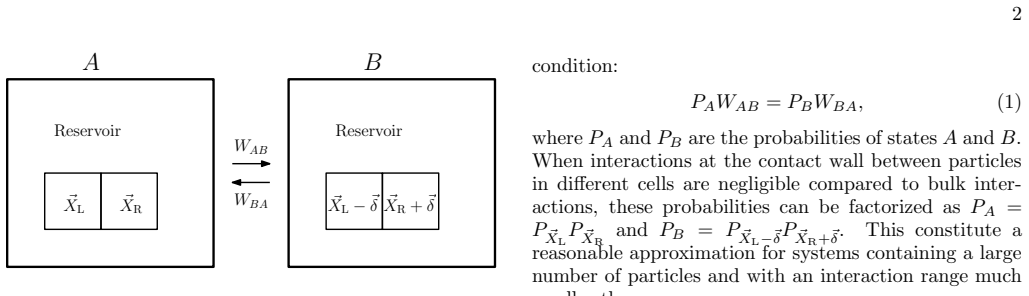
The transition rates fromAtoBand fromBtoA, denoted byW AB andW BA, satisfy the detailed balance condition: PAWAB =P BWBA,(1) whereP A andP B are the probabilities of statesAandB. When interactions at the contact wall between particles in different cells are negligible compared to bulk inter- actions, these probabilities can be factorized asP A = P ⃗XL P ⃗...
-
[2]
A. Paul, T. Laurila, V. Vuorinen, and S. V. Divinski, Thermodynamics, Diffusion and the Kirkendall Effect in Solids(Springer, Heidelberg, 2014)
2014
-
[3]
Mehrer,Diffusion in Solids(Springer, Berlin, 2007)
H. Mehrer,Diffusion in Solids(Springer, Berlin, 2007)
2007
-
[4]
Shewmon,Diffusion in solids(Springer, Cham, 2016)
P. Shewmon,Diffusion in solids(Springer, Cham, 2016)
2016
-
[5]
Collective and single particle diffusion on surfaces,
T. Ala-Nissila, R. Ferrando, and S. C. Ying, “Collective and single particle diffusion on surfaces,” Advances in Physics51, 949 (2002)
2002
-
[6]
Diffusion of adsorbates on metal surfaces,
R. Gomer, “Diffusion of adsorbates on metal surfaces,” Rep. Prog. Phys.53, 917–1002 (1990)
1990
-
[7]
Antczak and G
G. Antczak and G. Ehrlich,Surface Diffusion, Metals, Metal Atoms, and Clusters(Cambridge University Press, Cambridge, 2010)
2010
-
[8]
Mechanisms of surface diffusion,
T. T. Tsong, “Mechanisms of surface diffusion,” Progress in Surface Science67, 235 (2001)
2001
-
[9]
Diffusion, mobility and their interrelation through free energy in binary metallic systems,
L. S. Darken, “Diffusion, mobility and their interrelation through free energy in binary metallic systems,” Trans. AIME175, 184 (1948)
1948
-
[10]
On the theory of surface diffusion: kinetic versus lattice gas approach,
S.Yu. Krylov, J.J.M. Beenakker, and M.C. Tringides, “On the theory of surface diffusion: kinetic versus lattice gas approach,” Surface Science420, 233 (1999)
1999
-
[11]
Diffusion of coadsorbed particles,
V. P. Zhdanov, “Diffusion of coadsorbed particles,” Sur- face Science194, 1 (1988)
1988
-
[12]
Manifestation of Onsager’s off-diagonal fluxes in diffusion of coadsorbed particles,
V. P. Zhdanov, “Manifestation of Onsager’s off-diagonal fluxes in diffusion of coadsorbed particles,” Surface Sci- ence704, 121740 (2021)
2021
-
[13]
Chemical diffusivity and wave propagation in surface reactions: Lattice-gas model mimicking CO-oxidation with high CO-mobility,
M. Tammaro and J. W. Evans, “Chemical diffusivity and wave propagation in surface reactions: Lattice-gas model mimicking CO-oxidation with high CO-mobility,” The Journal of Chemical Physics108, 762 (1998)
1998
-
[14]
Quasi- chemical models of multicomponent nonlinear diffusion,
A. N. Gorban, H. P. Sargsyan, and H. A. Wahab, “Quasi- chemical models of multicomponent nonlinear diffusion,” Math. Model. Nat. Phenom.6, 184 (2011)
2011
-
[15]
Modelling of the “sur- face explosion
V. Skakauskas and P. Katauskis, “Modelling of the “sur- face explosion” of the reaction over supported catalysts,” J. Math. Chem.58, 1531 (2020)
2020
-
[16]
Application of the Widom insertion formula to transition rates in a lattice,
M. A. Di Muro and M. Hoyuelos, “Application of the Widom insertion formula to transition rates in a lattice,” Phys. Rev. E104, 044104 (2021)
2021
-
[17]
Markoff random processes and the sta- tistical mechanics of time-dependent phenomena. II. ir- reversible processes in fluids,
M. S. Green, “Markoff random processes and the sta- tistical mechanics of time-dependent phenomena. II. ir- reversible processes in fluids,” The Journal of Chemical Physics22, 398 (1954)
1954
-
[18]
Statistical-mechanical theory of irreversible processes. I. General theory and simple applications to magnetic and conduction problems,
R. Kubo, “Statistical-mechanical theory of irreversible processes. I. General theory and simple applications to magnetic and conduction problems,” Journal of the Phys- ical Society of Japan12, 570 (1957)
1957
-
[19]
H. B. Callen,Thermodynamics and an Introduction to Thermostatistics, 2nd ed. (John Wiley & Sons, Singa- pore, 1985)
1985
-
[20]
Physical meaning of non-extensive term in Massieu functions,
M. Hoyuelos and M. A. Di Muro, “Physical meaning of non-extensive term in Massieu functions,” Preprint (2024)
2024
-
[21]
Information geometry,
S.-I. Amari, “Information geometry,” Contemporary Mathematics203, 81 (1997)
1997
-
[22]
Amari,Information Geometry and Its Applications (Springer, Japan, 2016)
S.-I. Amari,Information Geometry and Its Applications (Springer, Japan, 2016)
2016
-
[23]
Geometric theory of heat from Souriau Lie groups thermodynamics and Koszul Hessian geome- try: Applications in information geometry for exponen- tial families,
F. Barbaresco, “Geometric theory of heat from Souriau Lie groups thermodynamics and Koszul Hessian geome- try: Applications in information geometry for exponen- tial families,” Entropy18, 386 (2016)
2016
-
[24]
An elementary introduction to information geometry,
F. Nielsen, “An elementary introduction to information geometry,” Entropy22, 1100 (2020)
2020
-
[25]
Riemannian geometry in thermodynamic fluctuation theory,
G. Ruppeiner, “Riemannian geometry in thermodynamic fluctuation theory,” Rev. Mod. Phys.67, 605 (1995)
1995
-
[26]
How Monte Carlo simulations can clarify complex problems in Statistical Physics,
K. Binder, “How Monte Carlo simulations can clarify complex problems in Statistical Physics,” International Journal of Modern Physics B15, 1193 (2001). 11
2001
-
[27]
Molecular dynamics simulation of self- and mutual diffusion coefficients for confined mixtures,
L. Zhang, Y.-C. Liu, and Q. Wang, “Molecular dynamics simulation of self- and mutual diffusion coefficients for confined mixtures,” J. Chem. Phys.123, 144701 (2005)
2005
-
[28]
Onsager’s coefficients and diffusion laws— a Monte Carlo study,
M. A. Hartmann, R. Weinkamer, P. Fratzl, J. Svoboda, and F. D. Fischer, “Onsager’s coefficients and diffusion laws— a Monte Carlo study,” Philosophical Magazine85, 1243 (2005)
2005
-
[29]
T. M. Liggett,Interacting Particle Systems(Springer, New York, 1985)
1985
discussion (0)
Sign in with ORCID, Apple, or X to comment. Anyone can read and Pith papers without signing in.