Recognition: unknown
New Procedure for the Evaluation of Fission Product Yields: Application to the Spontaneous Fission of ²⁵²Cf
Pith reviewed 2026-05-08 02:46 UTC · model grok-4.3
The pith
A Bayesian Kalman filter evaluates fission product yields with full correlations for 252Cf spontaneous fission.
A machine-rendered reading of the paper's core claim, the machinery that carries it, and where it could break.
Core claim
The central claim is that a Bayesian Kalman filter can be used to fit experimental and library fission product yields, producing mean values and covariances, and that the resulting parameters yield consistent predictions for neutron and gamma multiplicities in the spontaneous fission of 252Cf.
What carries the argument
Bayesian Kalman filter applied to cumulative fission product yields within the BeoH Hauser-Feshbach fission fragment decay model.
If this is right
- The evaluation produces full covariance matrices for the fission products.
- Prompt and delayed neutron and γ-ray multiplicities calculated from the fitted yields show reasonable agreement with experiment.
- The method allows for consistent evaluations across multiple fission observables.
- Independent yields can be derived consistently from the fitted cumulative data.
Where Pith is reading between the lines
- This method could be applied to other fission reactions to generate correlated data libraries.
- The covariances may enhance predictive power in applications like nuclear reactor design and decay heat estimation.
- Future inclusion of multiplicity data in the fit could further refine the model parameters.
Load-bearing premise
The BeoH model's initial fission fragment distributions and decay physics stay accurate enough after the filter adjustment to give consistent results for unfitted observables.
What would settle it
A significant discrepancy between the model's predicted multiplicities or other independent observables and new experimental measurements would indicate the adjustment has compromised physical consistency.
Figures





read the original abstract
Over the last decade, there has been significant improvement in the understanding and modeling of the decay of fission fragments by both prompt and delayed emission. These model improvements open the door for performing consistent evaluations across multiple fission observables, providing not only mean values but also covariances between observables. One such model is the Hauser-Feshbach Fission Fragment Decay model implemented in $\texttt{BeoH}$, which uses distributions of initial conditions of fission fragments to perform a Hauser-Feshbach decay for prompt neutron and $\gamma$-ray emission and evaluated decay data to calculate cumulative fission product yields. This manuscript describes a new evaluation procedure for independent and cumulative fission product yields, including full correlations among the fission products. We use a Bayesian Kalman filter to fit both experimental cumulative fission product yields and those from the ENDF/B-VIII.0 evaluated library, producing mean values and covariances. In addition to comparing the fission products from these optimizations, we calculate prompt and delayed neutron and $\gamma$-ray multiplicities using the fitted parameters and compare to some available experimental data. We see reasonable agreement, even when these quantities are not included in the optimization.
Editorial analysis
A structured set of objections, weighed in public.
Referee Report
Summary. The paper introduces a new evaluation procedure for independent and cumulative fission product yields in the spontaneous fission of 252Cf. It employs a Bayesian Kalman filter within the BeoH Hauser-Feshbach fission-fragment decay model to adjust parameters of the initial fission-fragment distributions, fitting simultaneously to experimental cumulative yields and those from the ENDF/B-VIII.0 library. The resulting mean values and covariances are then used to compute prompt and delayed neutron and γ-ray multiplicities, which are compared to experimental data and reported to show reasonable agreement despite not being included in the optimization.
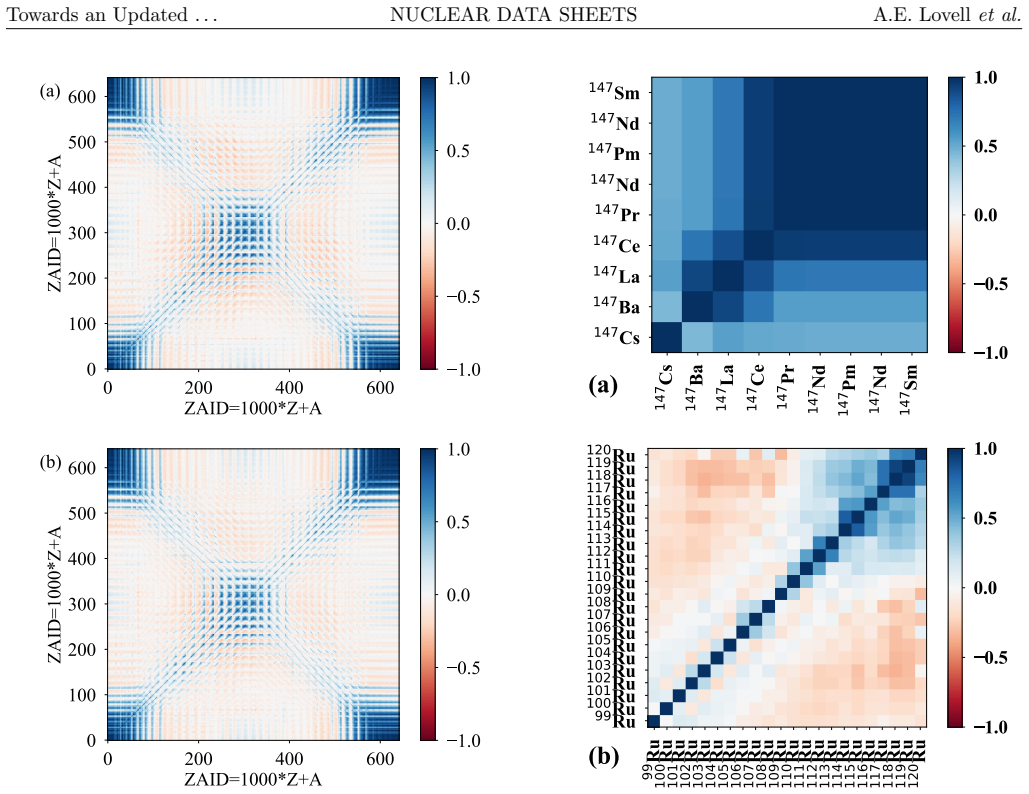
Significance. If the post-adjustment fragment distributions remain physically consistent with the model's decay physics, the approach offers a promising route to correlated evaluations across yields and multiplicities, addressing a long-standing need for covariance data in fission observables. The out-of-sample multiplicity comparisons provide an external consistency check that strengthens the case for unified modeling, and the Kalman-filter framework for propagating uncertainties is a clear methodological advance over traditional independent evaluations.
major comments (2)
- [Abstract] The abstract states that 'reasonable agreement' is obtained for prompt and delayed multiplicities not included in the optimization, yet no quantitative fit metrics (χ², residuals, or correlation coefficients) or error-propagation details are supplied for either the yield fit or the multiplicity comparisons. This absence prevents assessment of whether the external validation is statistically meaningful or merely qualitative.
- [Results] The central claim relies on the assumption that the Kalman-filter-adjusted initial fission-fragment distributions remain inside the domain where the BeoH Hauser-Feshbach decay physics remains valid. No demonstration is given that post-fit distributions obey mass/charge conservation, reproduce independent fragment-yield measurements, or lie within the ranges previously validated for BeoH; without this, the multiplicity agreement could be an artifact of compensatory adjustments rather than evidence of a unified model.
minor comments (1)
- [Methods] Notation for the fitted parameters and the precise form of the Kalman-filter update equations should be defined explicitly in the methods section to allow reproducibility.
Simulated Author's Rebuttal
We thank the referee for the careful and constructive review of our manuscript. The comments highlight opportunities to strengthen the presentation of quantitative validation and physical consistency checks. We address each major comment below and will revise the manuscript accordingly.
read point-by-point responses
-
Referee: [Abstract] The abstract states that 'reasonable agreement' is obtained for prompt and delayed multiplicities not included in the optimization, yet no quantitative fit metrics (χ², residuals, or correlation coefficients) or error-propagation details are supplied for either the yield fit or the multiplicity comparisons. This absence prevents assessment of whether the external validation is statistically meaningful or merely qualitative.
Authors: We agree that quantitative metrics would improve the rigor and allow readers to better judge the strength of the external validation. In the revised manuscript we will report the reduced χ² for the Bayesian Kalman filter optimization against both experimental cumulative yields and the ENDF/B-VIII.0 library values, together with the corresponding χ² for the out-of-sample prompt and delayed multiplicity comparisons. We will also expand the description of uncertainty propagation through the full covariance matrices produced by the filter, including how these covariances are used to obtain uncertainty bands on the multiplicities. revision: yes
-
Referee: [Results] The central claim relies on the assumption that the Kalman-filter-adjusted initial fission-fragment distributions remain inside the domain where the BeoH Hauser-Feshbach decay physics remains valid. No demonstration is given that post-fit distributions obey mass/charge conservation, reproduce independent fragment-yield measurements, or lie within the ranges previously validated for BeoH; without this, the multiplicity agreement could be an artifact of compensatory adjustments rather than evidence of a unified model.
Authors: The referee correctly identifies a point that requires explicit verification. The BeoH Hauser-Feshbach framework enforces mass and charge conservation at the level of each fission fragment by construction, and the Kalman filter adjusts only the parameters of the initial fragment distributions (means and widths of the mass, charge, and excitation-energy distributions) within the same physically motivated bounds used in prior BeoH validations. Nevertheless, to remove any ambiguity we will add a dedicated subsection that (i) confirms global mass and charge conservation for the post-fit distributions, (ii) compares the resulting independent fission-fragment yields to available experimental data, and (iii) documents that all adjusted parameters remain inside the previously validated ranges for BeoH. These additions will demonstrate that the reported multiplicity agreement arises from the model’s physics rather than unconstrained compensation. revision: yes
Circularity Check
No significant circularity: fit to yields, external multiplicity check
full rationale
The paper fits initial fission-fragment distributions inside BeoH via Bayesian Kalman filter to cumulative yields (experimental plus ENDF/B-VIII.0). It then computes prompt/delayed neutron and γ multiplicities from the same fitted parameters and compares them to independent experimental data not used in the optimization. This is a genuine out-of-sample test rather than a self-referential loop. No equation or procedure reduces a claimed prediction to a fitted input by construction, no self-citation is load-bearing for the central claim, and the model assumptions are not smuggled in via prior-author uniqueness theorems. The derivation chain is therefore self-contained against external benchmarks.
Axiom & Free-Parameter Ledger
free parameters (1)
- parameters of initial fission fragment distributions
axioms (1)
- domain assumption The Hauser-Feshbach statistical model accurately describes prompt neutron and gamma emission from fission fragments
Reference graph
Works this paper leans on
-
[1]
The results from the Kalman filter depend strongly on the experimental uncertainties
were removed entirely. The results from the Kalman filter depend strongly on the experimental uncertainties. Uncertainties that are small will influence the fit significantly. If these uncer- tainties are unrealistic, the model parameters can there- fore be biased by these values, especially when the mag- nitude of the data is also relatively small. For t...
-
[2]
ENDF/B- VIII.1: Updated Nuclear Reaction Data Library for Sci- ence and Applications,
G. P. A. Nobre, R. Capote, M. T. Pigni,et al., “ENDF/B- VIII.1: Updated Nuclear Reaction Data Library for Sci- ence and Applications,” (2025)
2025
-
[3]
Japanese evaluated nuclear data library version 5: JENDL-5,
O. Iwamoto, N. Iwamoto, S. Kunieda,et al., “Japanese evaluated nuclear data library version 5: JENDL-5,”J. Nucl. Sci. Technol.60, 1 (2023)
2023
-
[4]
JEFF-4.0 Evaluated Data [Data set],
Organisation for Economic Co-operation and Develop- ment Nuclear Energy Agency Nuclear Energy Agency, “JEFF-4.0 Evaluated Data [Data set],” (2025)
2025
-
[5]
ENDF/B-VII.1 Nuclear Data for Science and Technol- ogy: Cross Sections, Covariances, Fission Product Yields and Decay Data,
M. Chadwick, M. Herman, P. Obloˇ zinsk´ y,et al., “ENDF/B-VII.1 Nuclear Data for Science and Technol- ogy: Cross Sections, Covariances, Fission Product Yields and Decay Data,”Nucl. Data Sheets112, 2887 (2011). Special Issue on ENDF/B-VII.1 Library
2011
-
[6]
Fission Prod- uct Yields from Fission Spectrum n+239Pu for ENDF/B- VII.1,
M. Chadwick, T. Kawano, D. Barr,et al., “Fission Prod- uct Yields from Fission Spectrum n+239Pu for ENDF/B- VII.1,”Nucl. Data Sheets111, 2923 (2010). Nuclear Reaction Data
2010
-
[7]
Evaluation and compi- lation of fission product yields,
T. R. England and B. F. Rider, “Evaluation and compi- lation of fission product yields,” tech. rep., Los Alamos Nat. Lab. LA-UR-94-3106 (1994)
1994
-
[8]
Revision of fission yields uncertainties in ENDF/B-VIII.0,
A. Mattera and A. Sonzogni, “Revision of fission yields uncertainties in ENDF/B-VIII.0,” Tech. Rep. BNL-220804-2021-INRE, Brookhaven National Labora- tory (BNL), Upton, NY (United States) (2021)
2021
-
[9]
Independent and cumulative ther- mal neutron-induced fission yields of 241Pu for ENDF/B-VIII.1,
A. Mattera, “Independent and cumulative ther- mal neutron-induced fission yields of 241Pu for ENDF/B-VIII.1,” Tech. Rep. BNL-225087-2023-INRE, Brookhaven National Laboratory (BNL), Upton, NY (United States) (2023)
2023
-
[10]
The Extension of the Hauser- Feshbach Fission Fragment Decay Model to Multi-chance Fission and its Application to 239Pu - LA-UR-22-29923,
A. E. Lovell, T. Kawano, S. Okumura, M. R. Mumpower, I. Stetcu, and P. Talou, “The Extension of the Hauser- Feshbach Fission Fragment Decay Model to Multi-chance Fission and its Application to 239Pu - LA-UR-22-29923,” EPJ Web Conf.284, 04015 (2023)
2023
-
[11]
Fis- sion Product Yield Modeling and Evaluation,
A. E. Lovell, T. Kawano, P. Talou, and G. Rusev, “Fis- sion Product Yield Modeling and Evaluation,”EPJ Web Conf.322, 07003 (2025)
2025
-
[12]
235U(n, f) Independent Fission Product Yield and Isomeric Ratio Calculated with the Statisti- cal Hauser-Feshbach Theory,
S. Okumura, T. Kawano, P. Talou, P. Jaffke, and S. Chiba, “ 235U(n, f) Independent Fission Product Yield and Isomeric Ratio Calculated with the Statisti- cal Hauser-Feshbach Theory,”J. Nucl. Sci. Tech.55, 1009 (2018)
2018
-
[13]
Extension of the Hauser- Feshbach fission fragment decay model to multichance fission,
A. E. Lovell, T. Kawano, S. Okumura, I. Stetcu, M. R. Mumpower, and P. Talou, “Extension of the Hauser- Feshbach fission fragment decay model to multichance fission,”Phys. Rev. C103, 014615 (2021)
2021
-
[14]
The inelastic scattering of neutrons,
W. Hauser and H. Feshbach, “The inelastic scattering of neutrons,”Phys. Rev.87, 366 (1952)
1952
-
[15]
Systematics of fission-product yields,
A. C. Wahl, “Systematics of fission-product yields,” tech. rep., Los Alamos Nat. Lab. LA-13928 (2002)
2002
-
[16]
Energy dependent calculations of fission product, prompt, and delayed neutron yields for neutron induced fission on 235U, 238U, and 239Pu,
S. Okumura, T. Kawano, A. E. Lovell, and T. Yoshida, “Energy dependent calculations of fission product, prompt, and delayed neutron yields for neutron induced fission on 235U, 238U, and 239Pu,”J. Nucl. Sci. Tech- nol.59, 96 (2022)
2022
-
[17]
A composite nuclear- level density formula with shell corrections,
A. Gilbert and A. G. W. Cameron, “A composite nuclear- level density formula with shell corrections,”Can. J. Phys.43, 1446 (1965). 11 Towards an Updated. . .NUCLEAR DATA SHEETS A.E. Lovellet al. 50 75 100 125 150 175 200 A 0 1 2 3 4 5 6Ypre(A) (%) (a) BeoH baseline BeoH data fit BeoH ENDF fit Gook et al., 2014 50 75 100 125 150 175 200 A 10 5 10 4 10 3 10...
1965
-
[18]
ENDF/B- VIII.0: The 8th Major Release of the Nuclear Reaction Data Library with CIELO-project Cross Sections, New Standards and Thermal Scattering Data,
D. Brown, M. Chadwick, R. Capote,et al., “ENDF/B- VIII.0: The 8th Major Release of the Nuclear Reaction Data Library with CIELO-project Cross Sections, New Standards and Thermal Scattering Data,”Nucl. Data Sheets148, 1 (2018). Special Issue on Nuclear Reaction Data
2018
-
[19]
A new approach to linear filtering and prediction problems,
R. E. Kalman, “A new approach to linear filtering and prediction problems,”Trans. ASME–Journal Basic Eng.82, 35 (1960)
1960
-
[20]
Evaluation and Uncertainty Quantification of Prompt Fission Neutron Spectra of Uranium and Plutonium Iso- topes,
M. E. Rising, P. Talou, T. Kawano, and A. K. Prinja, “Evaluation and Uncertainty Quantification of Prompt Fission Neutron Spectra of Uranium and Plutonium Iso- topes,”Nucl. Sci. Eng.175, 81 (2013)
2013
-
[21]
Apply- ing a Template of Expected Uncertainties to Updating 239Pu(n,f) Cross-section Covariances in the Neutron Data Standards Database,
D. Neudecker, D. Smith, F. Tovesson,et al., “Apply- ing a Template of Expected Uncertainties to Updating 239Pu(n,f) Cross-section Covariances in the Neutron Data Standards Database,”Nucl. Data Sheets163, 228 (2020)
2020
-
[22]
Tem- plates of expected measurement uncertainties,
D. Neudecker, A. M. Lewis, E. F. Matthews,et al., “Tem- plates of expected measurement uncertainties,”EPJ Nucl. Sci. Technol.9, 35 (2023)
2023
-
[23]
Templates of expected measurement uncertainties for fission yields,
E. F. Matthews, B. D. Pierson, A. E. Lovell, D. L. Duke, K. M. Montoya, F. Tovesson, B. Pritychenko, B. Gold- blum, L. A. Bernstein, and S. W. Finch, “Templates of expected measurement uncertainties for fission yields,” Eur. Phys. J. Nsubmitted(2023)
2023
-
[24]
Fission fragment decay simulations with the CGMF code,
P. Talou, I. Stetcu, P. Jaffke, M. Rising, A. Lovell, and T. Kawano, “Fission fragment decay simulations with the CGMF code,”Comput. Phys. Commun.269, 108087 (2021)
2021
-
[25]
Towards a More Complete and Accurate Experimental Nuclear Re- action Data Library (EXFOR): International Collabora- tion Between Nuclear Reaction Data Centres (NRDC),
N. Otuka, E. Dupont, V. Semkova,et al., “Towards a More Complete and Accurate Experimental Nuclear Re- action Data Library (EXFOR): International Collabora- tion Between Nuclear Reaction Data Centres (NRDC),” Nucl. Data Sheets120, 272 (2014). 13 Towards an Updated. . .NUCLEAR DATA SHEETS A.E. Lovellet al. 0 200 400 600 ZAID=1000*Z+A 0 100 200 300 400 500 ...
2014
-
[26]
Yields of fragments of the spontaneous fis- sion of Cf 252,
N. V. Skovorodkin, G. E. Lozhkomoev, K. A. Petrzhak, A. V. Sorokina, B. M. Aleksandrov, and A. S. Kri- vokhatskii, “Yields of fragments of the spontaneous fis- sion of Cf 252,”Sov. At. Energy34, 449 (1973)
1973
-
[27]
Cf-252 spontaneous fission short-lived ( T(1/2) less than 3 min) products yields determination,
V. P. Bugrov, A. A. Byalko, N. G. Volkov, V. M. Kolobashkin, and A. I. Slyusarenko, “Cf-252 spontaneous fission short-lived ( T(1/2) less than 3 min) products yields determination,” tech. rep., USSR report to the I.N.D.C., No.244, p.66 (1985)
1985
-
[28]
Yields and isomer ratio in A = 134 chain for the spontaneous fission on 252Cf,
H. N. Erten, O. Birgul, and N. K. Aras, “Yields and isomer ratio in A = 134 chain for the spontaneous fission on 252Cf,”J. Inorg. Nucl. Chem.40, 185 (1978)
1978
-
[29]
Measurement of the fission yields of selected prompt and decay fission product gamma-rays of spon- taneously fissioning 252Cf and 244Cm,
E. L. Reber, R. J. Gehrke, R. Aryaeinejad, and J. K. Hartwell, “Measurement of the fission yields of selected prompt and decay fission product gamma-rays of spon- taneously fissioning 252Cf and 244Cm,”J. Radioanal. Nucl. Chem.264, 243 (2005)
2005
-
[30]
Yields of prod- ucts in the spontaneous fission of 252Cf by directγ-ray spectroscopy,
L. Toppare, H. N. Erten, and N. K. Aras, “Yields of prod- ucts in the spontaneous fission of 252Cf by directγ-ray spectroscopy,”Can. J. Chem.61, 649 (1982). 147Cs 147Ba 147La 147Ce 147Pr 147Nd 147Pm 147Nd 147Sm 147Cs 147Ba 147La 147Ce 147Pr 147Nd 147Pm 147Nd 147Sm 1.0 0.5 0.0 0.5 1.0 (a) 99Ru100Ru101Ru102Ru103Ru104Ru105Ru106Ru107Ru108Ru109Ru110Ru111Ru112R...
1982
-
[31]
Impact of current decay data on fast neu- trons 238U fission yields measured with the activation technique,
A. Mattera, “Impact of current decay data on fast neu- trons 238U fission yields measured with the activation technique,” tech. rep., Brookhaven National Lab. (BNL), Upton, NY (United States) (2020)
2020
-
[32]
Prompt neu- tron multiplicity in correlation with fragments from spon- taneous fission of 252Cf,
A. G¨ o¨ ok, F.-J. Hambsch, and M. Vidali, “Prompt neu- tron multiplicity in correlation with fragments from spon- taneous fission of 252Cf,”Phys. Rev. C90, 064611 (2014)
2014
-
[33]
Reevaluation of prompt neu- tron emission multiplicity distributions for spontaneous fission,
P. Santi and M. Miller, “Reevaluation of prompt neu- tron emission multiplicity distributions for spontaneous fission,”Nucl. Sci. Eng.160, 190 (2008)
2008
-
[34]
Facility for neutron multiplicity measurements in fission,
V. Dushin, F.-J. Hambsch, V. Jakovlev,et al., “Facility for neutron multiplicity measurements in fission,”Nucl. Inst. Meth. Phys. Res. Sect. A: Accel. Spectrom- eters, Detect. Assoc. Equip.516, 539 (2004)
2004
-
[35]
Prompt neutron emis- sion multiplicity distribution and average values (nubar) at 2200 m/s for the fissile nuclides,
N. E. Holden and M. S. Zucker, “Prompt neutron emis- sion multiplicity distribution and average values (nubar) at 2200 m/s for the fissile nuclides,”Nucl. Sci. Eng.98, 174 (1988)
1988
-
[36]
A measurement of the average number of prompt neutrons from sponta- neous fission of californium-252,
R. R. Spencer, R. Gwin, and R. Ingle, “A measurement of the average number of prompt neutrons from sponta- neous fission of californium-252,”Nucl. Sci. Eng.80, 14 Towards an Updated. . .NUCLEAR DATA SHEETS A.E. Lovellet al. 75 100 125 150 175 A 30 40 50 60 70Z ENDF/B-VIII.0 (a) 0 10 20 30 40 50 60 Relative uncertainty (%) 75 100 125 150 175 A 30 40 50 60 ...
1982
-
[37]
Measurements of prompt νand variance for the spontaneous fission of 252Cf and 242Pu,
G. Edwards, D. Findlay, and E. Lees, “Measurements of prompt νand variance for the spontaneous fission of 252Cf and 242Pu,”Annals Nucl. Energy9, 127 (1982)
1982
-
[38]
Delayed Neutrons from the Spontaneous Fission of Cf 252,
S. Cox, P. Fields, A. Friedman, R. Sjoblom, and A. Smith, “Delayed Neutrons from the Spontaneous Fission of Cf 252,”Phys. Rev.112, 960 (1958)
1958
-
[39]
Diven and J
B. Diven and J. Hopkins,Numbers of prompt neutrons per fission for U233, U235, Pu239, and Cf252. Globus, Druck- und Verlagsanstalt, Vienna (1962)
1962
-
[40]
Proper- ties of prompt-fissionγrays,
I. Stetcu, P. Talou, T. Kawano, and M. Jandel, “Proper- ties of prompt-fissionγrays,”Phys. Rev. C90, 024617 (2014)
2014
-
[41]
Stochastically estimated covariance matrices for inde- pendent and cumulative fission yields in the endf/b-viii.0 and jeff-3.3 evaluations,
E. F. Matthews, L. A. Bernstein, and W. Younes, “Stochastically estimated covariance matrices for inde- pendent and cumulative fission yields in the endf/b-viii.0 and jeff-3.3 evaluations,”At. Data Nucl. Data Tables 140, 101441 (2021)
2021
-
[42]
235U(nth,f)mass yield eval- uation with associated covariance matrix,
S. M. Cheikh, G. Kessedjian, O. Serot, A. Chebboubi, D. Bernard, and V. Vallet, “ 235U(nth,f)mass yield eval- uation with associated covariance matrix,”The Eur. Phys. J. A60, 222 (2024). 15 Towards an Updated. . .NUCLEAR DATA SHEETS A.E. Lovellet al. TABLE I. InitialBeoHparameter values (column two) and fitted parameter values when experimental data (ENDF...
2024
discussion (0)
Sign in with ORCID, Apple, or X to comment. Anyone can read and Pith papers without signing in.