Recognition: 3 theorem links
· Lean TheoremAstrochemical Inheritance of Terrestrial Planets Water from Local Wet Silicates
Pith reviewed 2026-05-08 17:49 UTC · model grok-4.3
The pith
Water binds twice as strongly to silicate grains as to amorphous ice, enabling local sources for terrestrial planet oceans.
A machine-rendered reading of the paper's core claim, the machinery that carries it, and where it could break.
Core claim
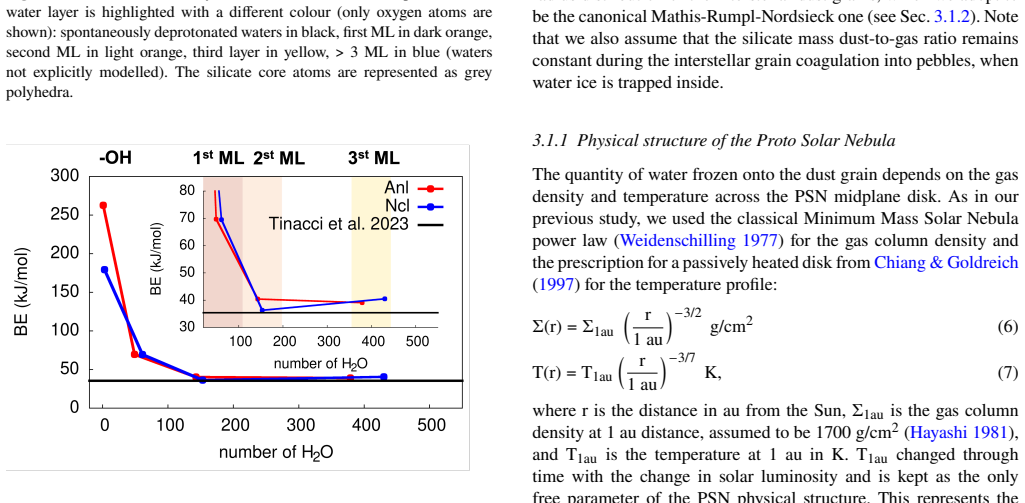
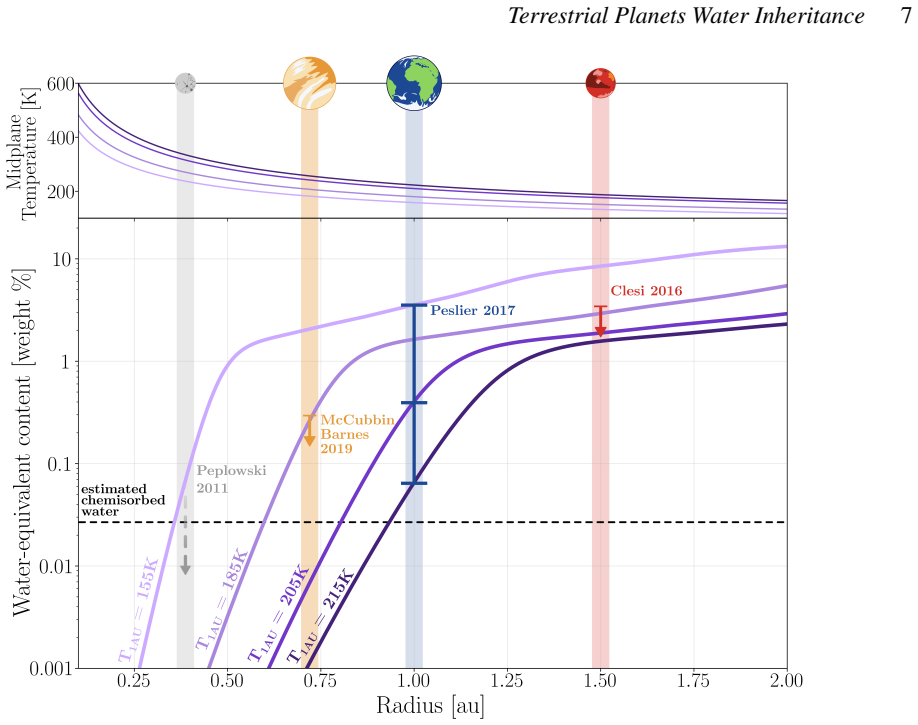
New QM calculations show that the binding energy of water frozen on silicate grain surfaces is on average about twice larger than on amorphous ice. This first layer of frozen water raises the dust temperature at which water can be retained, providing a local source for the water content of Earth and the inner rocky planets. Model predictions agree with available estimates, suggesting that delivery from the outer Solar System may not be required.
What carries the argument
Quantum mechanical calculations of water binding energies on modeled silicate surfaces, which are approximately double those on amorphous ice and increase the temperature threshold for water retention during planetary formation.
Load-bearing premise
The quantum mechanical binding energies calculated for idealized silicate surfaces apply directly to real grain surfaces in the protosolar nebula, and the kinetic model accurately predicts water retention on pebbles and planetesimals.
What would settle it
A direct laboratory measurement of water desorption temperatures from natural or analog silicate grains under relevant conditions showing retention temperatures similar to those on ice rather than significantly higher.
Figures


read the original abstract
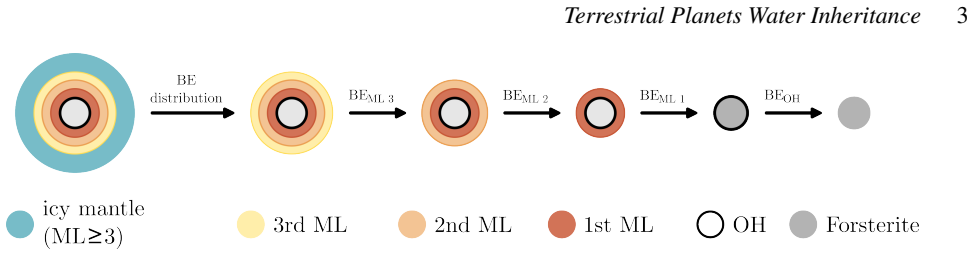
The delivery of water to the inner Solar System rocky planets, including Earth, remains debated, as standard models assume that they formed from dry grains, inside the snowline of the protosolar nebula. However, a recent work showed that a not-negligible amount of water formed during the prestellar phase could have been retained by pebbles and planetesimals at the Earth's orbit in enough quantities to reproduce its water content. This study was based based on quantum mechanics (QM) calculations of the binding energy (BE) of water on amorphous ice and on a kinetic approach. Here, we present new QM calculations of the BE of water frozen on the surface of silicate grains, and show that it is on average about twice larger than that on the amorphous ice. The contribution of this first layer of frozen water increases the dust temperature at which frozen water can be retained. This provides a local source of water not only for the Earth, but also for the inner rocky planets. The predictions from our model are in agreement with the available estimates of water content in terrestrial planets. This suggests that water delivery from the outer Solar System may not be required.
Editorial analysis
A structured set of objections, weighed in public.
Referee Report
Summary. The paper presents new quantum mechanics calculations showing that the binding energy of water adsorbed on silicate grain surfaces is on average approximately twice that computed previously for amorphous ice. These higher binding energies are incorporated into a kinetic retention model for pebbles and planetesimals, which the authors argue permits sufficient water to be preserved inside the snowline at 1 AU to account for the observed water budgets of the terrestrial planets, thereby suggesting that delivery from beyond the snowline is not required.
Significance. If the QM binding energies prove robust and transferable to nebular grain conditions, the work supplies a concrete local mechanism for water inheritance by inner planets and aligns model predictions with available water-content estimates. It extends earlier ice-focused QM studies with independent silicate computations rather than relying on fitted parameters, and the absence of free parameters in the core derivation is a positive feature.
major comments (3)
- [Methods] Methods section: The manuscript provides no details on the silicate surface models (specific compositions such as forsterite or enstatite, surface terminations, or adsorption sites sampled), the level of QM theory (functional, basis set, cluster size or periodic boundary conditions), or convergence/error estimates for the reported binding energies. Because the central claim that these energies are ~2× higher than on ice directly determines the retention temperature and the “no outer delivery needed” conclusion, this omission is load-bearing and prevents verification of the result.
- [Kinetic model] Kinetic model and results: The integration of the new binding energies into the retention calculation lacks explicit parameter values, the assumed thermal history of pebbles/planetesimals, and any treatment of additional loss channels (photodesorption, cosmic-ray processing). Without these, it is impossible to confirm that the higher BE yields water abundances matching terrestrial-planet estimates under realistic nebular conditions.
- [Results and discussion] Comparison to observations: The statement that “predictions from our model are in agreement with the available estimates of water content” is not supported by quantitative tables or figures showing model outputs versus specific observational constraints (e.g., Earth’s mantle water, Mars’ D/H or surface inventory). This quantitative link is required to substantiate the claim that outer-Solar-System delivery may be unnecessary.
minor comments (3)
- [Abstract] Abstract: repeated word “based based on”.
- Notation: binding energy is referred to both as “BE” and “binding energy” without consistent definition or units in the text.
- The manuscript would benefit from a table listing the individual computed binding energies for different silicate sites together with the corresponding ice values for direct comparison.
Simulated Author's Rebuttal
We thank the referee for the constructive and detailed review. We have revised the manuscript to address all major comments by expanding the Methods section, providing explicit details on the kinetic model, and adding quantitative comparisons to observations. These changes improve the clarity and verifiability of our results.
read point-by-point responses
-
Referee: [Methods] Methods section: The manuscript provides no details on the silicate surface models (specific compositions such as forsterite or enstatite, surface terminations, or adsorption sites sampled), the level of QM theory (functional, basis set, cluster size or periodic boundary conditions), or convergence/error estimates for the reported binding energies. Because the central claim that these energies are ~2× higher than on ice directly determines the retention temperature and the “no outer delivery needed” conclusion, this omission is load-bearing and prevents verification of the result.
Authors: We agree that the original Methods section lacked sufficient detail. In the revised manuscript we have added a dedicated subsection specifying the silicate models (forsterite with defined surface terminations and sampled adsorption sites), the QM methodology (DFT-PBE functional with a standard basis set and periodic boundary conditions), cluster/slab sizes, and convergence criteria together with error estimates on the binding energies. These additions directly support the reported factor-of-two increase relative to ice. revision: yes
-
Referee: [Kinetic model] Kinetic model and results: The integration of the new binding energies into the retention calculation lacks explicit parameter values, the assumed thermal history of pebbles/planetesimals, and any treatment of additional loss channels (photodesorption, cosmic-ray processing). Without these, it is impossible to confirm that the higher BE yields water abundances matching terrestrial-planet estimates under realistic nebular conditions.
Authors: We accept that the kinetic-model description required more transparency. The revised text now lists all parameter values, describes the adopted thermal histories for pebbles and planetesimals based on standard nebula models, and addresses additional loss channels. Photodesorption and cosmic-ray effects are shown to be negligible inside the snowline under the conditions considered, confirming that the higher binding energies enable sufficient local water retention. revision: yes
-
Referee: [Results and discussion] Comparison to observations: The statement that “predictions from our model are in agreement with the available estimates of water content” is not supported by quantitative tables or figures showing model outputs versus specific observational constraints (e.g., Earth’s mantle water, Mars’ D/H or surface inventory). This quantitative link is required to substantiate the claim that outer-Solar-System delivery may be unnecessary.
Authors: We have added a new figure and accompanying table that quantitatively compare model water abundances for Earth, Mars and Venus against observational constraints (mantle water estimates, D/H ratios, and surface inventories). The revised discussion shows agreement within stated uncertainties, thereby strengthening the link between the higher binding energies and the conclusion that outer-Solar-System delivery is not required. revision: yes
Circularity Check
No significant circularity; central result from independent QM computations
full rationale
The paper derives its key claim from newly performed quantum mechanical calculations of water binding energies on modeled silicate surfaces, reported as approximately twice those on amorphous ice. These computations are presented as first-principles inputs rather than parameters fitted to planetary water budgets or defined in terms of the retention outcome. The kinetic retention model and ice reference values are cited from prior work, but this citation supports the baseline comparison and does not reduce the silicate-specific extension to a self-referential definition or fitted prediction. Agreement with terrestrial planet water estimates is framed as consistency check, not a constructed output. No self-definitional, ansatz-smuggling, or uniqueness-imported steps appear in the derivation chain.
Axiom & Free-Parameter Ledger
axioms (2)
- domain assumption Quantum mechanics calculations of binding energies on silicate surfaces are representative of conditions in the protosolar nebula.
- domain assumption The kinetic model accurately predicts water retention quantities on evolving dust, pebbles, and planetesimals.
Lean theorems connected to this paper
-
IndisputableMonolith.Cost (J = ½(x + x⁻¹) − 1)washburn_uniqueness_aczel unclearwe present new QM calculations of the BE of water frozen on the surface of silicate grains, and show that it is on average about twice larger than that on the amorphous ice
Reference graph
Works this paper leans on
-
[1]
The Astrophysical Journal , volume=
Theoretical water binding energy distribution and snowline in protoplanetary disks , author=. The Astrophysical Journal , volume=. 2023 , publisher=
2023
-
[2]
Annual review of physical chemistry , volume=
Crossed-beam studies of reaction dynamics , author=. Annual review of physical chemistry , volume=. 1999 , publisher=
1999
-
[3]
Accounts of Chemical Research , volume=
Exploring the gas phase synthesis of the elusive class of boronyls and the mechanism of boronyl radical reactions under single collision conditions , author=. Accounts of Chemical Research , volume=. 2017 , publisher=
2017
-
[4]
Review of scientific instruments , volume=
A versatile source to produce high-intensity, pulsed supersonic radical beams for crossed-beam experiments: The cyanogen radical CN (X ^2 ^+ ) as a case study , author=. Review of scientific instruments , volume=. 1999 , publisher=
1999
-
[5]
Balucani, Nadia and Vanuzzo, Gianmarco and Recio, Pedro and Caracciolo, Adriana and Rosi, Marzio and Cavallotti, Carlo and Baggioli, Alberto and Della Libera, Andrea and Casavecchia, Piergiorgio. Crossed molecular beam experiments and theoretical simulations on the multichannel reaction of toluene with atomic oxygen. Faraday Discuss. 2024. doi:10.1039/D3FD00181D
-
[6]
Nature Chemistry , volume=
Intersystem crossing in the entrance channel of the reaction of O( ^3 P) with pyridine , author=. Nature Chemistry , volume=. 2022 , publisher=
2022
-
[7]
Carbon , volume=
Oxidation and nitridation of vitreous carbon at high temperatures , author=. Carbon , volume=. 2020 , publisher=
2020
-
[8]
Journal of Physical Chemistry C, under revision , year=
Oxidation of silicon carbide with atomic oxygen through the passive-to-active transition , author=. Journal of Physical Chemistry C, under revision , year=
-
[9]
The Journal of Physical Chemistry A , volume=
OH( ^2 ) + C _2 H _4 reaction: a combined crossed molecular beam and theoretical study , author=. The Journal of Physical Chemistry A , volume=. 2023 , publisher=
2023
-
[10]
Faraday Discussions , volume=
An experimental and theoretical investigation of the N( ^2 D)+ C _6 H _6 (benzene) reaction with implications for the photochemical models of Titan , author=. Faraday Discussions , volume=. 2023 , publisher=
2023
-
[11]
The Birth Environment of the Solar System. , keywords =. doi:10.1146/annurev-astro-081309-130830 , archivePrefix =. 1001.5444 , primaryClass =
-
[12]
Chemistry of Dark Clouds: Databases, Networks, and Models. Chem.Rev. , keywords =. doi:10.1021/cr4001176 , archivePrefix =. 1310.3651 , primaryClass =
-
[13]
A broad view of the chemical composition of a core around a Class 0 object
A sensitive 3 mm line survey of L483. A broad view of the chemical composition of a core around a Class 0 object. , keywords =. doi:10.1051/0004-6361/201935164 , archivePrefix =. 1904.06565 , primaryClass =
-
[14]
Discovery of the propargyl radical (CH _ 2 CCH) in TMC-1: One of the most abundant radicals ever found and a key species for cyclization to benzene in cold dark clouds. , keywords =. doi:10.1051/0004-6361/202140553 , archivePrefix =. 2103.03807 , primaryClass =
-
[15]
arXiv e-prints , keywords =
First detection of doubly deuterated methyl acetylene (CHD2CCH and CH2DCCD). arXiv e-prints , keywords =
-
[16]
Multiple Paths of Deuterium Fractionation in Protoplanetary Disks. , keywords =. doi:10.3847/1538-4357/aaad6c , archivePrefix =. 1803.02498 , primaryClass =
-
[17]
Chemical Variation among Protostellar Cores: Dependence on Prestellar Core Conditions. , keywords =. doi:10.3847/1538-4357/ab994a , archivePrefix =. 2006.11696 , primaryClass =
-
[18]
Analytical Formulae of Molecular Ion Abundances and the N _ 2 H ^ + Ring in Protoplanetary Disks. , keywords =. doi:10.1088/0004-637X/807/2/120 , archivePrefix =. 1505.07550 , primaryClass =
-
[19]
Interplay of Chemistry and Dynamics in the Low-Mass Star Formation. Chem.Rev. , year = 2013, month = dec, volume =. doi:10.1021/cr4003193 , adsurl =
-
[20]
From Prestellar to Protostellar Cores. II. Time Dependence and Deuterium Fractionation. , keywords =. doi:10.1088/0004-637X/760/1/40 , archivePrefix =. 1210.2476 , primaryClass =
-
[21]
Molecular Evolution and Star Formation: From Prestellar Cores to Protostellar Cores. , keywords =. doi:10.1086/524096 , archivePrefix =. 0710.0712 , primaryClass =
-
[22]
Cold CO Gas in Protoplanetary Disks. , keywords =. doi:10.1086/512674 , archivePrefix =. astro-ph/0701366 , primaryClass =
-
[23]
Physical and Chemical Structure of Protoplanetary Disks with Grain Growth. , keywords =. doi:10.1086/501114 , archivePrefix =. astro-ph/0601230 , primaryClass =
-
[24]
Molecular Evolution in Collapsing Prestellar Cores. III. Contraction of a Bonnor-Ebert Sphere. , keywords =. doi:10.1086/427017 , archivePrefix =. astro-ph/0410582 , primaryClass =
-
[25]
Molecular Evolution in Collapsing Prestellar Cores. II. The Effect of Grain-Surface Reactions. , keywords =. doi:10.1086/376616 , archivePrefix =. astro-ph/0305054 , primaryClass =
-
[26]
Warm molecular layers in protoplanetary disks. , keywords =. doi:10.1051/0004-6361:20020037 , archivePrefix =. astro-ph/0202060 , primaryClass =
-
[27]
Two-dimensional distributions and column densities of gaseous molecules in protoplanetary disks. II. Deuterated species and UV shielding by ambient clouds. , keywords =. doi:10.1051/0004-6361:20010416 , archivePrefix =. astro-ph/0202062 , primaryClass =
-
[28]
Molecular Evolution in Collapsing Prestellar Cores. , keywords =. doi:10.1086/320551 , archivePrefix =. astro-ph/0202061 , primaryClass =
-
[29]
Grain Surface Recombination of HCO ^ +. , keywords =. doi:10.1086/308079 , adsurl =
-
[30]
1999, , 526, 314, 10.1086/307973
Deuterium Fractionation in Protoplanetary Disks. , keywords =. doi:10.1086/307973 , adsurl =
-
[31]
Two-dimensional distributions and column densities of gaseous molecules
Molecular evolution in protoplanetary disks. Two-dimensional distributions and column densities of gaseous molecules. , keywords =
-
[32]
Cometary Volatiles and the Origin of Comets. , keywords =. doi:10.1088/0004-637X/758/1/29 , adsurl =
-
[33]
Chemical composition of the Earth and the volatility control on planetary genetics. Earth and Planetary Science Letters , year = 2001, month = feb, volume =. doi:10.1016/S0012-821X(00)00359-9 , adsurl =
-
[34]
The origin of inner Solar System water. Philosophical Transactions of the Royal Society of London Series A , year = 2017, month = apr, volume =. doi:10.1098/rsta.2015.0384 , adsurl =
-
[35]
Accurate simultaneous constraints on the dust mass, temperature, and emissivity index of a galaxy at redshift 7.31. , keywords =. doi:10.1093/mnras/stae1994 , archivePrefix =. 2408.02267 , primaryClass =
-
[36]
The 2014 ALMA Long Baseline Campaign: First Results from High Angular Resolution Observations toward the HL Tau Region. , archivePrefix = "arXiv", eprint =. doi:10.1088/2041-8205/808/1/L3 , adsurl =
-
[37]
Prebiotic chemicals--amino acid and phosphorus--in the coma of comet 67P/Churyumov-Gerasimenko. Sci.Adv. , year = 2016, month = may, volume =. doi:10.1126/sciadv.1600285 , adsurl =
-
[38]
Organics in comet 67P - a first comparative analysis of mass spectra from ROSINA-DFMS, COSAC and Ptolemy. , keywords =. doi:10.1093/mnras/stx1415 , adsurl =
-
[39]
Cometary Chemistry and the Origin of Icy Solar System Bodies: The View After Rosetta. , keywords =. doi:10.1146/annurev-astro-091918-104409 , archivePrefix =. 1908.04046 , primaryClass =
-
[40]
Evidence of ammonium salts in comet 67P as explanation for the nitrogen depletion in cometary comae. Nat.Astr. , keywords =. doi:10.1038/s41550-019-0991-9 , archivePrefix =. 1911.13005 , primaryClass =
-
[41]
Bridget C. Andersen and Ian W. Stephens and Michael M. Dunham and Riwaj Pokhrel and Jes K. J. The Mass Evolution of Protostellar Disks and Envelopes in the Perseus Molecular Cloud , journal =. doi:10.3847/1538-4357/ab05c7 , url =
-
[42]
Destruction of Refractory Carbon in Protoplanetary Disks. , keywords =. doi:10.3847/1538-4357/aa7da1 , archivePrefix =. 1707.08982 , primaryClass =
-
[43]
Submillimeter continuum observations of Rho Ophiuchi A - The candidate protostar VLA 1623 and prestellar clumps. , keywords =. doi:10.1086/172425 , adsurl =
-
[44]
Protostars and Planets IV , year = 2000, editor =
From Prestellar Cores to Protostars: the Initial Conditions of Star Formation. Protostars and Planets IV , year = 2000, editor =
2000
-
[45]
2014, in Protostars and Planets VI, ed
From Filamentary Networks to Dense Cores in Molecular Clouds: Toward a New Paradigm for Star Formation. Protostars and Planets VI , archivePrefix = "arXiv", eprint =. doi:10.2458/azu_uapress_9780816531240-ch002 , adsurl =
-
[46]
The role of molecular filaments in the origin of the prestellar core mass function and stellar initial mass function. , keywords =. doi:10.1051/0004-6361/201935915 , archivePrefix =. 1907.13448 , primaryClass =
-
[47]
Probing the cold magnetised Universe with SPICA-POL (B-BOP). , keywords =. doi:10.1017/pasa.2019.20 , archivePrefix =. 1905.03520 , primaryClass =
-
[48]
Ringed Substructure and a Gap at 1 au in the Nearest Protoplanetary Disk. , archivePrefix = "arXiv", eprint =. doi:10.3847/2041-8205/820/2/L40 , adsurl =
-
[49]
A high HDO/H _ 2 O ratio in the Class I protostar L1551 IRS5. , keywords =. doi:10.1051/0004-6361/202347484 , archivePrefix =. 2309.01688 , primaryClass =
-
[50]
The Disk Substructures at High Angular Resolution Project (DSHARP). I. Motivation, Sample, Calibration, and Overview. , archivePrefix = "arXiv", eprint =. doi:10.3847/2041-8213/aaf741 , adsurl =
-
[51]
Discovery of a Subarcsecond Radio Binary Associated with the SVS 13 Star in the HH 7-11 Region. , keywords =. doi:10.1086/312933 , adsurl =
-
[52]
Reactivity of OH and CH _ 3 OH between 22 and 64 K: Modeling the Gas Phase Production of CH _ 3 O in Barnard 1b. , keywords =. doi:10.3847/0004-637X/823/1/25 , archivePrefix =. 1603.04244 , primaryClass =
-
[53]
M., Kamp, I., Henning, T., et al
Abundant hydrocarbons in the disk around a very-low-mass star. Science , keywords =. doi:10.1126/science.adi8147 , archivePrefix =. 2406.14293 , primaryClass =
-
[54]
Number of stars in the Sun's birth cluster revisited. , keywords =. doi:10.1051/0004-6361/202244743 , adsurl =
-
[55]
, archivePrefix = "arXiv", eprint =
Complex Molecules in the L1157 Molecular Outflow. , archivePrefix = "arXiv", eprint =. doi:10.1086/590110 , adsurl =
-
[56]
Extraterrestrial prebiotic molecules: photochemistry vs. radiation chemistry of interstellar ices. Chem.Soc.Rev. , year = 2019, month = feb, volume =. doi:10.1039/C7CS00443E , adsurl =
-
[57]
Destruction of dimethyl ether and methyl formate by collisions with He ^ +. , keywords =. doi:10.1051/0004-6361/201834585 , archivePrefix =. 1903.07204 , primaryClass =
-
[58]
, archivePrefix = "arXiv", eprint =
Deuterium chemistry of dense gas in the vicinity of low-mass and massive star-forming regions. , archivePrefix = "arXiv", eprint =. doi:10.1093/mnras/stu1141 , adsurl =
-
[59]
Dissociative electron recombination of NH _ 2 CHOH ^ + and implications for interstellar formamide abundance. , keywords =. doi:10.1093/mnras/stz2658 , adsurl =
-
[60]
, keywords =
The relation between carbon monoxide emission and visual extinction in the local Perseus dark clouds. , keywords =
-
[61]
, keywords =
Methanol enhancemant in young bipolar outflows. , keywords =
-
[62]
Shock Chemistry in the Young Bipolar Outflow L1157. , keywords =. doi:10.1086/310877 , adsurl =
-
[63]
Single-dish and interferometric maps of NGC 1333/IRAS 2
Methanol in protostellar outflows. Single-dish and interferometric maps of NGC 1333/IRAS 2. , keywords =
-
[64]
, keywords =
A molecular jet from SVS 13B near HH 7-11. , keywords =
-
[65]
Chemically active outflow L 1157. , keywords =. doi:10.1051/0004-6361:20010519 , adsurl =
-
[66]
The degree of CO depletion in pre-stellar cores. , keywords =. doi:10.1051/0004-6361:20020652 , archivePrefix =. astro-ph/0205154 , primaryClass =
-
[67]
CO Depletion and Deuterium Fractionation in Prestellar Cores. , eprint =. doi:10.1086/374263 , adsurl =
-
[68]
2012, A&A, 541, L12, doi: 10.1051/0004-6361/201219207
Detection of complex organic molecules in a prestellar core: a new challenge for astrochemical models. , keywords =. doi:10.1051/0004-6361/201219207 , adsurl =
-
[69]
, archivePrefix = "arXiv", eprint =
The origin of gas-phase HCO and CH _ 3 O radicals in prestellar cores. , archivePrefix = "arXiv", eprint =. doi:10.1051/0004-6361/201526198 , adsurl =
-
[70]
Complex Organic Molecules Detected in 12 High-mass Star-forming Regions with Atacama Large Millimeter/submillimeter Array. , keywords =. doi:10.3847/1538-4357/ac81d3 , archivePrefix =. 2207.08223 , primaryClass =
-
[71]
, year = 1970, month = dec, volume =
Detection of Methyl Alcohol in Sagittarius. , year = 1970, month = dec, volume =. doi:10.1086/180654 , adsurl =
-
[72]
Handbook of Star Forming Regions, Volume I , year = 2008, month = dec, editor =
The Perseus Cloud. Handbook of Star Forming Regions, Volume I , year = 2008, month = dec, editor =
2008
-
[73]
Formation of Nitriles in the Interstellar Medium via Reactions of Cyano Radicals, CN(X ^ 2 ^ + ), with Unsaturated Hydrocarbons. , keywords =. doi:10.1086/317848 , adsurl =
-
[74]
Journal of Physical Chemistry A , year = 2002, month = may, volume =
Formation of Three C4H3N Isomers from the Reaction of CN (X2 +) with Allene, H2CCCH2(X1A1), and Methylacetylene, CH3CCH (X1A1): A Combined Crossed Beam and Ab Initio Study. Journal of Physical Chemistry A , year = 2002, month = may, volume =. doi:10.1021/jp0116104 , adsurl =
-
[75]
, title =
Balucani, Nadia and Zhang, Fangtong and Kaiser, Ralf I. , title =. Chem.Rev. , volume =. 2010 , doi =
2010
-
[76]
PCCP , year = 2011, month = jan, volume =
Crossed-beam dynamics studies of the radical-radical combustion reaction O(3P) + CH3 (methyl). PCCP , year = 2011, month = jan, volume =. doi:10.1039/C0CP01623C , adsurl =
-
[77]
, archivePrefix = "arXiv", eprint =
Formation of complex organic molecules in cold objects: the role of gas-phase reactions. , archivePrefix = "arXiv", eprint =. doi:10.1093/mnrasl/slv009 , adsurl =
-
[78]
A theoretical investigation of the reaction between the amidogen, NH, and the ethyl, C _ 2 H _ 5 , radicals: a possible gas-phase formation route of interstellar and planetary ethanimine. Mol.Astr. , keywords =. doi:10.1016/j.molap.2018.10.001 , archivePrefix =. 1810.10416 , primaryClass =
-
[79]
The Kinematics and Excitation of Infrared Water Vapor Emission from Planet-forming Disks: Results from Spectrally Resolved Surveys and Guidelines for JWST Spectra. , keywords =. doi:10.3847/1538-3881/aca80b , archivePrefix =. 2209.08216 , primaryClass =
-
[80]
Carbon-rich dust in comet 67P/Churyumov-Gerasimenko measured by COSIMA/Rosetta. , keywords =. doi:10.1093/mnras/stx2640 , adsurl =
discussion (0)
Sign in with ORCID, Apple, or X to comment. Anyone can read and Pith papers without signing in.