Recognition: unknown
Equilibrium Adsorption of Hard Disks on Patterned Adhesive Surfaces: A Monte Carlo Simulation Study
Pith reviewed 2026-05-08 17:35 UTC · model grok-4.3
The pith
Pattern geometry controls hard disk adsorption on adhesive surfaces, with peak efficiency when domains match particle size.
A machine-rendered reading of the paper's core claim, the machinery that carries it, and where it could break.
Core claim
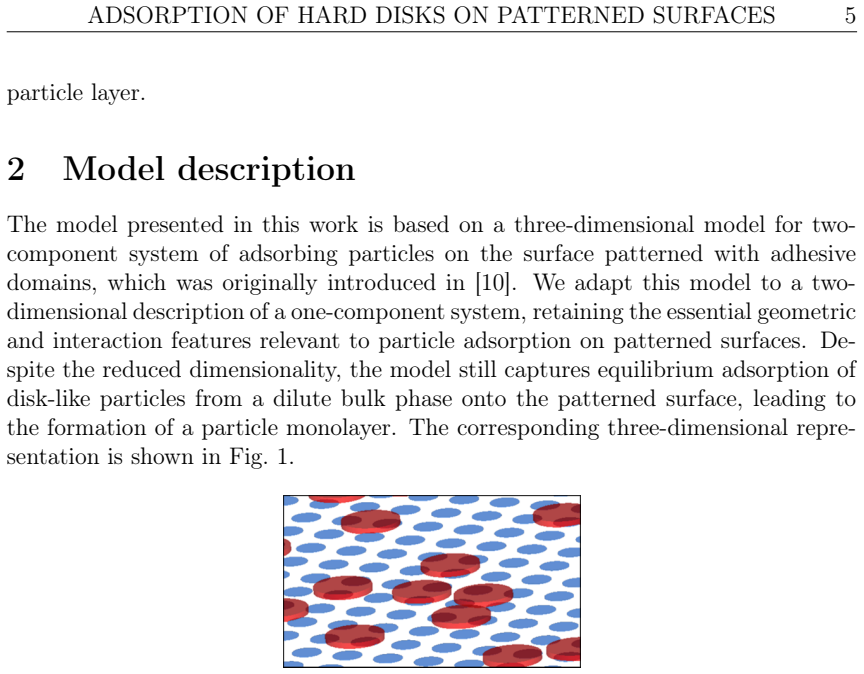
Monte Carlo simulations of hard disks on a two-dimensional plane with circular adhesive domains arranged regularly or randomly demonstrate that adsorption behavior is controlled not only by the total area of adhesive regions but also by the geometry of the surface pattern. Domain size has a significant effect on adsorption efficiency, with the most pronounced enhancement when particle and domain sizes are equal, leading to higher adsorption at intermediate chemical potentials. At high chemical potentials, steric effects become dominant and reduce the influence of pattern geometry.
What carries the argument
Monte Carlo sampling of hard-disk configurations on a plane, with particle-surface binding energy set by the area of overlap between each disk and the circular adhesive domains.
If this is right
- Adsorption efficiency can be increased by setting adhesive domain diameter equal to particle diameter at moderate chemical potentials.
- Both the size and the regular versus random placement of domains affect how particles organize on the surface.
- At high surface coverage, steric blocking between particles reduces the role of pattern geometry.
- Surface coverage and organization can be adjusted by varying domain size, fraction covered, and arrangement.
- The findings support design of patterned surfaces for selective adsorption or particle sorting.
Where Pith is reading between the lines
- The size-matching enhancement might appear in colloidal experiments or with non-disk shapes if contact-area energetics hold.
- Biosensor or cell-sorting devices could exploit domain sizing to improve selectivity at specific binding strengths.
- Random patterns may show more variability in real systems with thermal motion than the simulated cases indicate.
- Extending the model to include weak interactions with non-adhesive regions could reveal further geometric sensitivities.
Load-bearing premise
The energy between a particle and the surface comes only from the area where the disk overlaps an adhesive domain, with nothing added by domain edges or non-adhesive regions.
What would settle it
Monte Carlo runs or experiments that show identical adsorption for matched and mismatched domain sizes at intermediate chemical potentials, or no boost when sizes are equal, would falsify the geometry-control claim.
Figures


read the original abstract
Equilibrium adsorption of disk-like particles on patterned adhesive surfaces is studied using Monte Carlo simulations. The surface is represented as a two-dimensional plane with circular adhesive domains arranged either regularly or randomly, while the particles are modelled as hard disks. The interaction energy between a particle and the surface is defined by the contact area between the particle and the adhesive domains. It is shown that the adsorption behaviour is controlled not only by the total area of the adhesive regions, but also by the geometry of the surface pattern. In particular, the domain size is found to have a significant effect on the adsorption efficiency. The most pronounced effect is observed when the particle and domain sizes are equal, which leads to enhanced adsorption at intermediate values of the chemical potential. At high values of the chemical potential, however, when the particle surface coverage increases, steric effects become important, which weakens the influence of the surface pattern geometry. The obtained results demonstrate that the adsorption efficiency and surface organization of particles can be tuned by choosing the size, coverage, and spatial arrangement of adhesive domains. This study may be useful in the design of functional surfaces, selective adsorption platforms, biosensors, and affinity-based cell sorting systems.
Editorial analysis
A structured set of objections, weighed in public.
Referee Report
Summary. The manuscript reports grand-canonical Monte Carlo simulations of hard-disk particles adsorbing on a 2D surface patterned with circular adhesive domains (regular or random). The central claim is that adsorption isotherms and particle organization depend on domain size and spatial arrangement even at fixed total adhesive area fraction; the effect is strongest when domain radius equals particle radius, producing enhanced adsorption at intermediate chemical potentials, while steric crowding reduces pattern sensitivity at high coverage.
Significance. If the quantitative trends hold, the work demonstrates that surface geometry provides an independent control knob for adsorption efficiency beyond simple coverage fraction. The approach is a direct, parameter-light simulation with no fitted models or analytical approximations, yielding falsifiable predictions relevant to biosensor design and affinity-based sorting.
major comments (2)
- [Results] Results section: the adsorption data and domain-size comparisons are presented without error bars, standard deviations, or any description of Monte Carlo sampling statistics, equilibration checks, or finite-size effects. This omission prevents assessment of whether the reported non-monotonic enhancement at matched particle/domain size is statistically significant or reproducible.
- [Methods] Methods: no validation against known limits (e.g., uniform adhesive surface or zero-coverage Langmuir limit) or convergence tests with respect to run length and system size is supplied, leaving the quantitative strength of the geometry-dependent claims unverified.
minor comments (2)
- The interaction model is clearly defined in the abstract, but the main text should explicitly state the precise functional form of the energy (overlap area only) and confirm that non-adhesive regions contribute zero energy.
- Figure captions and axis labels should indicate the precise values of chemical potential, domain coverage fraction, and number of independent runs used for each curve.
Simulated Author's Rebuttal
We thank the referee for the constructive comments. We address each major point below and will revise the manuscript to strengthen the statistical presentation and validation of the results.
read point-by-point responses
-
Referee: [Results] Results section: the adsorption data and domain-size comparisons are presented without error bars, standard deviations, or any description of Monte Carlo sampling statistics, equilibration checks, or finite-size effects. This omission prevents assessment of whether the reported non-monotonic enhancement at matched particle/domain size is statistically significant or reproducible.
Authors: We agree that explicit statistical measures are necessary to establish the reliability of the reported trends. In the revised manuscript we will add error bars to all adsorption isotherms and coverage plots, obtained from five or more independent Monte Carlo runs initiated with different random seeds. A new subsection in Methods will report the total number of Monte Carlo steps used for equilibration and production, the observed acceptance rates, and the results of finite-size checks performed on lattices of 100×100 and 200×200. These additions will allow readers to judge the statistical significance of the non-monotonic enhancement observed when domain radius matches particle radius. revision: yes
-
Referee: [Methods] Methods: no validation against known limits (e.g., uniform adhesive surface or zero-coverage Langmuir limit) or convergence tests with respect to run length and system size is supplied, leaving the quantitative strength of the geometry-dependent claims unverified.
Authors: We acknowledge that direct validation against limiting cases strengthens the credibility of the geometry-dependent findings. The revised Methods section will include new simulation results for a uniformly adhesive surface (recovering the expected Langmuir-like behavior at low coverage) and explicit comparisons to the analytical zero-coverage Langmuir isotherm. We will also present convergence data demonstrating that the isotherms become independent of run length beyond a stated number of steps and that results are insensitive to system size within the range examined. These tests will confirm that the reported pattern effects are not artifacts of insufficient sampling. revision: yes
Circularity Check
No significant circularity
full rationale
This is a pure Monte Carlo simulation study. The model defines hard-disk particles whose interaction energy with the surface equals the overlap area with adhesive domains; all reported isotherms, coverages, and organization patterns are direct numerical outputs of grand-canonical sampling under that explicit rule set. No analytical derivation, no parameter fitted to one observable and then relabeled as a prediction for another, and no load-bearing self-citation chain appear in the described workflow. The central observation that domain size modulates adsorption efficiency at fixed total adhesive area is therefore an independent consequence of the simulation, not a restatement of the input definitions.
Axiom & Free-Parameter Ledger
free parameters (2)
- chemical potential
- domain coverage fraction
axioms (2)
- domain assumption Particles interact only via hard-disk exclusions and contact-area adhesion with no long-range forces.
- domain assumption The surface is an ideal two-dimensional plane with perfectly circular adhesive domains.
Reference graph
Works this paper leans on
-
[1]
Maury P. A., Reinhoudt D. N., Huskens J., Current Opinion in Colloid & Interface Science, 2008,13, No. 1–2, 74–80, doi:10.1016/j.cocis.2007.08.013
-
[2]
van Dommelen R., Fanzio P., Sasso L., Advances in Colloid and Interface Sci- ence, 2018,251, 97–114, doi:10.1016/j.cis.2017.10.007
-
[3]
15, 3523–3531, doi:10.1002/cphc.201300516
Steinbach A., Paust T., Pluntke M., Marti O., Volkmer D., ChemPhysChem, 2013,14, No. 15, 3523–3531, doi:10.1002/cphc.201300516. ADSORPTION OF HARD DISKS ON PATTERNED SURFACES 17
-
[4]
BurkhardtC.J., FuchsbergerK., NischW., StelzleM., In: Lithography, InTech, 2010, doi:10.5772/8197
-
[5]
Xing X., Man Z., Bian J., Yin Y., Zhang W., Lu Z., Nature Communications, 2020,11, 6002, doi:10.1038/s41467-020-19771-0
-
[6]
Beggiato M., Rastogi R., Dupont-Gillain C., Krishnamoorthy S., Sensors and Actuators B: Chemical, 2022,366, 131945, doi:10.1016/j.snb.2022.131945
-
[7]
V., Sundaravadivelan B., Sun A., Xu W., Yang S., Kannan A
Jambhulkar S., Ravichandran D., Zhu Y., Thippanna V., Ramanathan A., Patil D., Fonseca N., Thummalapalli S. V., Sundaravadivelan B., Sun A., Xu W., Yang S., Kannan A. M., Golan Y., Lancaster J., Chen L., Joyee E. B., Song K., Small, 2024,20, No. 6, 2306394, doi:10.1002/smll.202306394
-
[8]
Rao S. G., Results in Surfaces and Interfaces, 2024,17, 100326, doi:10.1016/j. rsurfi.2024.100326
work page doi:10.1016/j 2024
-
[9]
F., Tabrizian M., Lab on a Chip, 2010,10, No
Didar T. F., Tabrizian M., Lab on a Chip, 2010,10, No. 22, 3043–3053, doi: 10.1039/C0LC00130A
-
[10]
Badenhorst R., Makaev S. V., Parker M., Marunych R., Reukov V., Bedzin- ska A., Korchynskyi O., Kalyuzhnyi O., Yaremchuk D., Ilnytskyi J., Patsa- han T., Minko S., ACS Applied Materials & Interfaces, 2025,17, No. 35, 49193–49209, doi:10.1021/acsami.5c08747
-
[11]
J., Genzer J., Journal of Chemical Physics, 2003,119, No
Semler J. J., Genzer J., Journal of Chemical Physics, 2003,119, No. 10, 5274–5280, doi:10.1063/1.1597872
-
[12]
J., Genzer J., Macromolecular Theory and Simulations, 2004,13, No
Semler J. J., Genzer J., Macromolecular Theory and Simulations, 2004,13, No. 3, 219–229, doi:10.1002/mats.200300039
-
[13]
I., Heinrich G., The Journal of Chemical Physics, 2006,125, No
Chervanyov A. I., Heinrich G., The Journal of Chemical Physics, 2006,125, No. 8, 084703, doi:10.1063/1.2335454
-
[14]
5, 903–908, doi: 10.1021/la950957t
Nitta T., Kiriyama H., Shigeta T., Langmuir, 1997,13, No. 5, 903–908, doi: 10.1021/la950957t
-
[15]
Stojiljković D. L., Vrhovac S. B., Physica A: Statistical Mechanics and its Ap- plications, 2017,488, 16–29, doi:10.1016/j.physa.2017.06.031
-
[16]
1-3, 255–285, doi:10.1016/ S0927-7757(99)00413-6
Senger B., Voegel J.-C., Schaaf P., Colloids and Surfaces A: Physicochem- ical and Engineering Aspects, 2000,165, No. 1-3, 255–285, doi:10.1016/ S0927-7757(99)00413-6
2000
-
[17]
10, 2204–2214, doi:10.1021/jp9933065
Schaaf P., Voegel J.-C., Senger B., The Journal of Physical Chemistry B, 2000, 104, No. 10, 2204–2214, doi:10.1021/jp9933065
-
[18]
24, 244704, doi:10.1063/1.4954332
Privman V., Yan H., The Journal of Chemical Physics, 2016,144, No. 24, 244704, doi:10.1063/1.4954332
-
[19]
41, 13051–13058, doi:10.1021/jp804857w
Talbot J., Tarjus G., Viot P., The Journal of Physical Chemistry B, 2008,112, No. 41, 13051–13058, doi:10.1021/jp804857w. ADSORPTION OF HARD DISKS ON PATTERNED SURFACES 18
-
[20]
Oleyar C., Talbot J., Physica A: Statistical Mechanics and its Applications, 2007,376, 27–37, doi:10.1016/j.physa.2006.10.085
-
[21]
6, 065124, doi:10.1088/0953-8984/19/6/065124
Cadilhe A., Araújo N., Privman V., Journal of Physics: Condensed Matter, 2007,19, No. 6, 065124, doi:10.1088/0953-8984/19/6/065124
-
[22]
3, 031603, doi:10.1103/PhysRevE.77
Araújo N., Cadilhe A., Privman V., Physical Review E: Statistical, Nonlinear, and Soft Matter Physics, 2008,77, No. 3, 031603, doi:10.1103/PhysRevE.77. 031603
-
[23]
6, 061122, doi:10.1103/ PhysRevE.85.061122
Marques J., Lima A., Araújo N., Cadilhe A., Physical Review E: Statistical, Nonlinear, and Soft Matter Physics, 2012,85, No. 6, 061122, doi:10.1103/ PhysRevE.85.061122
2012
-
[24]
Lebovka N., Petryk M., Tatochenko M., Vygornitskii N., Physical Review E, 2023,108, 024109, doi:10.1103/PhysRevE.108.024109
-
[25]
4, 5861–5875, doi:10.1021/acsnano.0c09999
Barad H.-N., Kwon H., Alarcón-Correa M., Fischer P., ACS Nano, 2021,15, No. 4, 5861–5875, doi:10.1021/acsnano.0c09999
-
[26]
Khalili A. A., Ahmad M. R., International journal of molecular sciences, 2015, 16, No. 8, 18149–18184, doi:10.3390/ijms160818149
-
[27]
1, 971–989, doi:10.1515/ntrev-2020-0076
Cai S., Wu C., Yang W., Liang W., Yu H., Liu L., Nanotechnology Reviews, 2020,9, No. 1, 971–989, doi:10.1515/ntrev-2020-0076
-
[28]
Carbone G., Pierro E., Gorb S. N., Soft Matter, 2011,7, No. 12, 5545–5552, doi:10.1039/C0SM01482F
-
[29]
1, 85–93, doi:10.1039/C4BM00233D
Chen S., Lu X., Hu Y., Lu Q., Biomaterials Science, 2015,3, No. 1, 85–93, doi:10.1039/C4BM00233D
-
[30]
A., Mathur A., Roca- Cusachs P., Sheetz M
Ghassemi S., Meacci G., Liu S., Gondarenko A. A., Mathur A., Roca- Cusachs P., Sheetz M. P., Hone J., Proceedings of the National Academy of Sciences, 2012,109, No. 14, 5328–5333, doi:10.1073/pnas.111988610
-
[31]
Polacheck W. J., Chen C. S., Nature Methods, 2016,13, No. 5, 415–423, doi: 10.1038/nmeth.3834
-
[32]
23, 19913–19919, doi:10.1021/acsomega.2c01703
Zhang X., Zhang T., Liu B., Zhang Y., Ji Z., Wang X., ACS Omega, 2022,7, No. 23, 19913–19919, doi:10.1021/acsomega.2c01703
-
[33]
47, 22636–22663, doi:10.1039/ C9NR05870B
Li Z., Guo Z., Nanoscale, 2019,11, No. 47, 22636–22663, doi:10.1039/ C9NR05870B
2019
-
[34]
1, 81, doi:10.3390/jmse10010081
Uesugi K., Nagayama K., Hirose E., Journal of Marine Science and Engineering, 2022,10, No. 1, 81, doi:10.3390/jmse10010081
-
[35]
Eskhan A., Johnson D., Advances in Colloid and Interface Science, 2022,310, 102796, doi:10.1016/j.cis.2022.102796
-
[36]
A., Journal of Biomedical Materials Research Part B: Applied Biomaterials, 2017,105, No
Xu L.-C., Siedlecki C. A., Journal of Biomedical Materials Research Part B: Applied Biomaterials, 2017,105, No. 3, 668–678, doi:10.1002/jbm.b.33592. ADSORPTION OF HARD DISKS ON PATTERNED SURFACES 19
-
[37]
9, 4907–4918, doi:10
Rizwan T., Bhattacharjee S., Langmuir, 2009,25, No. 9, 4907–4918, doi:10. 1021/la804075g
2009
-
[38]
Yu Q., Johnson L. M., López G. P., Advanced Functional Materials, 2014,24, No. 24, 3751–3759, doi:10.1002/adfm.201304274
-
[39]
17, 4581–4587, doi:10.1021/jp068509p
Kumar N., Parajuli O., Hahm J.-I., The Journal of Physical Chemistry B, 2007, 111, No. 17, 4581–4587, doi:10.1021/jp068509p
discussion (0)
Sign in with ORCID, Apple, or X to comment. Anyone can read and Pith papers without signing in.