Recognition: 3 theorem links
· Lean TheoremGeometric Formulation of Power-Efficiency Bounds in Carnot-like Engines
Pith reviewed 2026-05-08 17:47 UTC · model grok-4.3
The pith
Power-efficiency optimization in Carnot-like engines reduces to bounding the slope of lines in a dissipation plane.
A machine-rendered reading of the paper's core claim, the machinery that carries it, and where it could break.
Core claim
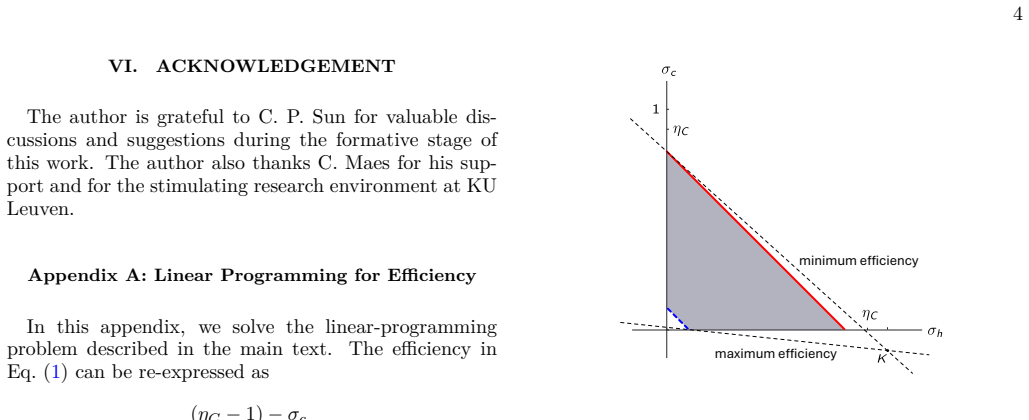
We formulate the power-efficiency constraint of Carnot-like heat engines as a geometric optimization problem in the plane of normalized branch dissipations. Efficiency contours are straight lines in this plane, so maximizing efficiency at fixed power reduces to bounding the slope of an admissible line. We apply this framework to branch-resolved power-law dissipation, where the irreversible loss on each isothermal branch decays with the branch duration with a common exponent rather than following the standard inverse-time law. After optimizing over the dissipation-asymmetry parameter, the fixed-power attainable set becomes a two-dimensional region, and the resulting slope-bound problem is a (
What carries the argument
The plane of normalized branch dissipations, in which efficiency contours are straight lines and maximization of efficiency at fixed power reduces to a slope-bounding problem that becomes linear programming after asymmetry optimization.
If this is right
- The exact power-efficiency frontier is obtained for the branch-resolved power-law dissipation model.
- Closed-form constraints are derived for representative dissipation exponents.
- The maximum-power limit is recovered as a special case of the same constraints.
- The slope-bound problem reduces to linear programming after the dissipation-asymmetry parameter is optimized.
Where Pith is reading between the lines
- The same geometric construction could be applied to other dissipation laws by first determining the corresponding attainable set in the normalized-dissipation plane.
- Engine design might use the linear-programming step to add explicit constraints on branch durations or temperature ratios.
- Separate measurement of dissipation on each isothermal branch would allow experimental checks of the predicted frontiers.
Load-bearing premise
Efficiency contours remain straight lines in the plane of normalized branch dissipations.
What would settle it
A direct calculation or measurement for a chosen power-law exponent that produces a higher efficiency at fixed power than the slope bound obtained from the linear program.
Figures

read the original abstract
We formulate the power-efficiency constraint of Carnot-like heat engines as a geometric optimization problem in the plane of normalized branch dissipations. Efficiency contours are straight lines in this plane, so maximizing efficiency at fixed power reduces to bounding the slope of an admissible line. We apply this framework to branch-resolved power-law dissipation, where the irreversible loss on each isothermal branch decays with the branch duration with a common exponent rather than following the standard inverse-time law. After optimizing over the dissipation-asymmetry parameter, the fixed-power attainable set becomes a two-dimensional region, and the resulting slope-bound problem reduces to linear programming. The framework yields the exact power-efficiency frontier within this model and gives closed-form constraints for representative dissipation exponents, including the maximum-power limit.
Editorial analysis
A structured set of objections, weighed in public.
Referee Report
Summary. The paper claims to reformulate the power-efficiency constraint in Carnot-like heat engines as a geometric optimization problem in the plane of normalized branch dissipations, where efficiency contours are straight lines. This reduces maximization of efficiency at fixed power to a slope-bounding problem. The framework is applied to a branch-resolved power-law dissipation model (irreversible losses decaying as a power of branch duration with a common exponent). Optimizing over the dissipation-asymmetry parameter yields a two-dimensional attainable set, converting the slope-bound problem into linear programming and producing exact power-efficiency frontiers along with closed-form constraints for representative dissipation exponents, including the maximum-power limit.
Significance. If the geometric reduction and linearity hold, the work supplies a systematic method for obtaining exact bounds in finite-time thermodynamics under generalized dissipation laws beyond the conventional inverse-time form. The reduction to linear programming after asymmetry optimization, together with the closed-form constraints, constitutes a technical strength that enables precise, non-approximate results and could extend to other irreversibility models. This approach is grounded in standard thermodynamic definitions without introducing extraneous fitted parameters.
major comments (1)
- The assertion that efficiency contours are straight lines in the plane of normalized branch dissipations is load-bearing for the entire reduction to slope-bounding and subsequent linear programming. An explicit derivation of this linearity from the efficiency expression in terms of the normalized dissipations should be supplied (likely in the section defining the geometric setup), including verification that it remains exact under the power-law dissipation law without hidden assumptions.
minor comments (3)
- Provide a clear early definition of the normalized branch dissipations and their relation to branch durations and the common power-law exponent.
- Include at least one illustrative figure of the two-dimensional attainable set in the dissipation plane for a representative exponent to visualize the linear-programming reduction.
- Consider adding a compact table summarizing the closed-form constraints obtained for the main dissipation exponents discussed.
Simulated Author's Rebuttal
We thank the referee for the positive assessment and the constructive comment on the geometric formulation. We address the point below and will revise the manuscript to incorporate the requested derivation.
read point-by-point responses
-
Referee: The assertion that efficiency contours are straight lines in the plane of normalized branch dissipations is load-bearing for the entire reduction to slope-bounding and subsequent linear programming. An explicit derivation of this linearity from the efficiency expression in terms of the normalized dissipations should be supplied (likely in the section defining the geometric setup), including verification that it remains exact under the power-law dissipation law without hidden assumptions.
Authors: We agree that an explicit derivation will improve clarity and rigor. The linearity follows directly from the definition of efficiency in terms of the normalized dissipations: starting from η = 1 − (T_c/T_h)(Q_c/Q_h) and expressing the heat transfers via the normalized branch dissipations σ_h and σ_c (where the irreversible losses enter as multiplicative factors on the reversible heats), the iso-efficiency condition rearranges to a linear relation between σ_h and σ_c. This algebraic property is independent of the functional form of the dissipation law and holds exactly for any model in which the dissipations are defined on the isothermal branches. The power-law dissipation affects only the shape of the attainable set in the (σ_h, σ_c) plane, not the geometry of the efficiency contours themselves. We will add a short dedicated derivation (including the intermediate algebraic steps) in the section that introduces the normalized-dissipation plane, together with an explicit statement confirming that the linearity remains exact under the branch-resolved power-law model with no additional assumptions. revision: yes
Circularity Check
No significant circularity; derivation self-contained
full rationale
The paper's geometric reformulation starts from standard thermodynamic definitions of power and efficiency in Carnot-like engines, defines normalized branch dissipations directly from the irreversible losses, and shows that efficiency contours are straight lines as an algebraic consequence of those normalizations. The branch-resolved power-law dissipation model is introduced as an explicit ansatz on the loss-duration relation (not fitted from data), the attainable set after asymmetry optimization is computed from that model, and the slope-bounding problem is solved via linear programming whose feasible region is constructed from the same definitions. No step renames a fitted parameter as a prediction, invokes a self-citation as a uniqueness theorem, or reduces the claimed frontier to an input by construction. The closed-form constraints for representative exponents are explicit outputs of the LP, not presupposed inputs. This is the normal case of an independent geometric derivation.
Axiom & Free-Parameter Ledger
free parameters (2)
- dissipation exponent
- dissipation-asymmetry parameter
axioms (1)
- domain assumption Efficiency contours are straight lines in the plane of normalized branch dissipations
Lean theorems connected to this paper
-
IndisputableMonolith.Cost.FunctionalEquationwashburn_uniqueness_aczel unclear?
unclearRelation between the paper passage and the cited Recognition theorem.
Q^(ir)_{h,c} = M_{h,c} τ^{-α}_{h,c}. For α = 1, this recovers the well-studied low-dissipation case.
-
IndisputableMonolith.Cost (Jcost = ½(x+x⁻¹)−1)Jcost_pos_of_ne_one unclear?
unclearRelation between the paper passage and the cited Recognition theorem.
η = η_C − (σ_h − σ_c)/(1 − σ_h) ... Efficiency contours are straight lines in this plane, so maximizing efficiency at fixed power reduces to bounding the slope of an admissible line.
-
IndisputableMonolith.Foundation.BranchSelectionbranch_selection unclear?
unclearRelation between the paper passage and the cited Recognition theorem.
For ε = 2 ... S_+ = (η_C/3)[1 + 2 cos(⅓ arccos(1−2P̃₀))] ... For ε = 3 ... closed-form constraints for representative dissipation exponents
What do these tags mean?
- matches
- The paper's claim is directly supported by a theorem in the formal canon.
- supports
- The theorem supports part of the paper's argument, but the paper may add assumptions or extra steps.
- extends
- The paper goes beyond the formal theorem; the theorem is a base layer rather than the whole result.
- uses
- The paper appears to rely on the theorem as machinery.
- contradicts
- The paper's claim conflicts with a theorem or certificate in the canon.
- unclear
- Pith found a possible connection, but the passage is too broad, indirect, or ambiguous to say the theorem truly supports the claim.
Reference graph
Works this paper leans on
-
[1]
Huang, Statistical mechanics, 2nd ed
K. Huang, Statistical mechanics, 2nd ed. (Wiley, Canada, 1987)
1987
-
[2]
Ma, Statistical Mechanics, 3rd ed
S.-K. Ma, Statistical Mechanics, 3rd ed. (World Scientific Publ., Philadelphia [u.a.], 2004) translated from Chinese
2004
-
[3]
Salamon and R
P. Salamon and R. S. Berry, Phys. Rev. Lett. 51, 1127 (1983)
1983
-
[4]
Andresen, P
B. Andresen, P. Salamon, and R. S. Berry, Phys. Today 37, 62 (1984)
1984
-
[5]
Yvon, The saclay reactor: two years experience on heat transfer by means of a compressed gas , Tech
J. Yvon, The saclay reactor: two years experience on heat transfer by means of a compressed gas , Tech. Rep. (CEA Saclay, 1955)
1955
-
[6]
Chambadal, Las centrales nucleares (Paris, 1957) pp
P. Chambadal, Las centrales nucleares (Paris, 1957) pp. 41 – 58
1957
-
[7]
Novikov, Journal of Nuclear Energy (1954) 7, 125 (1958)
I. Novikov, Journal of Nuclear Energy (1954) 7, 125 (1958)
1954
-
[8]
F. L. Curzon and B. Ahlborn, Am. J. Phys. 43, 22 (1975)
1975
-
[9]
Tu, Chinese Phys
Z.-C. Tu, Chinese Phys. B 21, 020513 (2012)
2012
-
[10]
Van den Broeck, Phys
C. Van den Broeck, Phys. Rev. Lett. 95, 190602 (2005)
2005
-
[11]
Schmiedl and U
T. Schmiedl and U. Seifert, EPL 81, 20003 (2008)
2008
-
[12]
Z. C. Tu, J. Phys. A: Math. Theor. 41, 312003 (2008)
2008
-
[13]
Izumida and K
Y. Izumida and K. Okuda, Europhys. Lett. 83, 60003 (2008)
2008
-
[14]
A. E. Allahverdyan, R. S. Johal, and G. Mahler, Phys. Rev. E 77, 041118 (2008)
2008
-
[15]
Rutten, M
B. Rutten, M. Esposito, and B. Cleuren, Phys. Rev. B 80, 235122 (2009)
2009
-
[16]
Sheng and Z
S. Sheng and Z. C. Tu, Phys. Rev. E 91, 022136 (2015)
2015
-
[17]
Brandner and U
K. Brandner and U. Seifert, Phys. Rev. E 91, 012121 (2015)
2015
-
[18]
Z. C. Tu, Phys. Rev. E 89, 052148 (2014)
2014
-
[19]
I. A. Martinez, E. Roldan, L. Dinis, D. Petrov, J. M. R. Parrondo, and R. A. Rica, Nature Physics 12, 67 (2015)
2015
-
[20]
Rossnagel, S
J. Rossnagel, S. T. Dawkins, K. N. Tolazzi, O. Abah, E. Lutz, F. Schmidt-Kaler, and K. Singer, Science 352, 325 (2016)
2016
-
[21]
Josefsson, A
M. Josefsson, A. Svilans, A. M. Burke, E. A. Hoffmann, 5 S. Fahlvik, C. Thelander, M. Leijnse, and H. Linke, Nat. Nanotechnol. 13, 920 (2018)
2018
-
[22]
Josefsson, A
M. Josefsson, A. Svilans, H. Linke, and M. Leijnse, Phys. Rev. B 99, 235432 (2019)
2019
-
[23]
Liang, Y.-H
S. Liang, Y.-H. Ma, D. M. Busiello, and P. De Los Rios, Phys. Rev. Lett. 134, 027101 (2025)
2025
- [24]
-
[25]
Esposito, R
M. Esposito, R. Kawai, K. Lindenberg, and C. Van den Broeck, Phys. Rev. Lett. 105, 150603 (2010)
2010
-
[26]
Holubec and A
V. Holubec and A. Ryabov, J. Stat. Mech: Theory Exp. 2016, 073204 (2016)
2016
-
[27]
Ryabov and V
A. Ryabov and V. Holubec, Phys. Rev. E 93, 050101 (2016)
2016
-
[28]
Y.-H. Ma, D. Xu, H. Dong, and C.-P. Sun, Phys. Rev. E 98, 042112 (2018)
2018
-
[29]
R.-X. Zhai, X. Yue, and C. P. Sun, Phys. Rev. E 113, L012103 (2026)
2026
-
[30]
Long and W
R. Long and W. Liu, Phys. Rev. E 94, 052114 (2016)
2016
-
[31]
Shiraishi, K
N. Shiraishi, K. Saito, and H. Tasaki, Phys. Rev. Lett. 117, 190601 (2016)
2016
-
[32]
Holubec and A
V. Holubec and A. Ryabov, Physical Review E 96, 062107 (2017)
2017
-
[33]
Pietzonka and U
P. Pietzonka and U. Seifert, Phys. Rev. Lett. 120, 190602 (2018)
2018
-
[34]
Chen, Phys
J.-F. Chen, Phys. Rev. E 106, 054108 (2022)
2022
-
[35]
Zhao, Z.-N
X.-H. Zhao, Z.-N. Gong, and Z. C. Tu, Phys. Rev. E 106, 064117 (2022)
2022
-
[36]
Zhai and H
R.-X. Zhai and H. Dong, Phys. Rev. E 111, 024404 (2025)
2025
-
[37]
Ma, R.-X
Y.-H. Ma, R.-X. Zhai, J. Chen, C. P. Sun, and H. Dong, Phys. Rev. Lett. 125, 210601 (2020)
2020
-
[38]
Zhai, F.-M
R.-X. Zhai, F.-M. Cui, Y.-H. Ma, C. P. Sun, and H. Dong, Phys. Rev. E 107, l042101 (2023)
2023
-
[39]
Deffner, Phys
S. Deffner, Phys. Rev. E 96, 052125 (2017)
2017
-
[40]
Wu, J.-F
Y.-X. Wu, J.-F. Chen, and H. T. Quan, Phys. Rev. Lett. 134, 177101 (2025)
2025
-
[41]
Chen, X.-H
M. Chen, X.-H. Zhao, and Y.-H. Ma, Phys. Rev. E 113, 034124 (2026)
2026
-
[42]
Pancotti, M
N. Pancotti, M. Scandi, M. T. Mitchison, and M. Perarnau-Llobet, Phys. Rev. X 10, 031015 (2020)
2020
-
[43]
Lutz, Phys
E. Lutz, Phys. Rev. E 64, 051106 (2001)
2001
-
[44]
Burov and E
S. Burov and E. Barkai, Phys. Rev. Lett. 100, 070601 (2008)
2008
-
[45]
Wang and Z
Y. Wang and Z. C. Tu, Europhys. Lett. 98, 40001 (2012)
2012
-
[46]
Wang and Z
Y. Wang and Z. C. Tu, Commun. Theor. Phys. 59, 175 (2013)
2013
-
[47]
Ma and C
Y.-H. Ma and C. Fu, Phys. Rev. E 112, 054130 (2025)
2025
-
[48]
Y. Wang, M. Li, Z. C. Tu, A. C. Hernandez, and J. M. M. Roco, Phys. Rev. E 86, 011127 (2012)
2012
-
[49]
de Tomas, J
C. de Tomas, J. M. M. Roco, A. C. Hernandez, Y. Wang, and Z. C. Tu, Phys. Rev. E 87, 012105 (2013)
2013
-
[50]
Holubec and Z
V. Holubec and Z. Ye, Phys. Rev. E 101, 052124 (2020)
2020
-
[51]
Ye and V
Z. Ye and V. Holubec, Phys. Rev. E 105, 024139 (2022)
2022
-
[52]
Ye and V
Z. Ye and V. Holubec, Phys. Rev. E 112, 034115 (2025)
2025
discussion (0)
Sign in with ORCID, Apple, or X to comment. Anyone can read and Pith papers without signing in.