Recognition: 2 theorem links
· Lean TheoremExact Microcanonical Formulation and Thermodynamics of Equispaced Finite-Level Systems
Pith reviewed 2026-05-08 17:43 UTC · model grok-4.3
The pith
A generating function and saddle-point analysis supply exact microcanonical entropy and temperature for noninteracting particles with any finite number of equally spaced energy levels.
A machine-rendered reading of the paper's core claim, the machinery that carries it, and where it could break.
Core claim
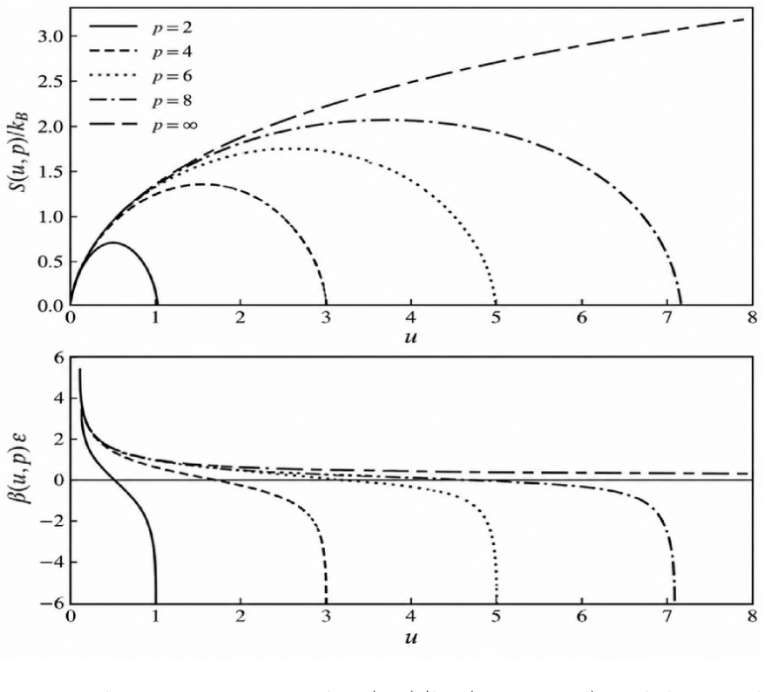
Writing the microcanonical multiplicity Ω_p(E,N) as the coefficient of a generating function and evaluating the resulting representation by saddle-point analysis, we derive analytical expressions for the entropy per particle s(u,p) and inverse temperature β(u,p), with u=E/(Nε) in the interval [0,p-1]. The formulation applies to arbitrary p and recovers the known cases p=2, p=3, and p→∞. For finite p, the bounded spectrum implies an entropy maximum at u_c=(p-1)/2, where β vanishes and changes sign. In the limit p→∞, the upper spectral bound is lost, the finite-energy entropy maximum disappears, and no negative-temperature branch remains.
What carries the argument
The generating function whose coefficient is the multiplicity Ω_p(E,N) of ways to obtain total energy E with N particles each having p levels; its saddle-point evaluation in the large-N limit produces closed expressions for entropy and temperature.
Load-bearing premise
The saddle-point evaluation of the generating-function coefficient becomes exact only in the thermodynamic limit of infinitely many particles.
What would settle it
Exact numerical enumeration of the multiplicity for large finite N and p=4 at several values of u, followed by direct comparison of the resulting entropy to the analytic saddle-point formula, would confirm or refute the derivation.
Figures
read the original abstract
We present an exact microcanonical formulation, in the thermodynamic limit, for a system of $N$ noninteracting particles with $p$ equally spaced energy levels $\{0,\epsilon,2\epsilon,\ldots,(p-1)\epsilon\}$. Writing the microcanonical multiplicity $\Omega_p(E,N)$ as the coefficient of a generating function and evaluating the resulting representation by saddle-point analysis, we derive analytical expressions for the entropy per particle $s(u,p)$ and inverse temperature $\beta(u,p)$, with $u=E/(N\epsilon)$ in the interval $[0,p-1]$. The formulation applies to arbitrary $p$ and recovers the known cases $p=2$, $p=3$, and $p\to\infty$. For finite $p$, the bounded spectrum implies an entropy maximum at $u_c=(p-1)/2$, where $\beta$ vanishes and changes sign. In the limit $p\to\infty$, the upper spectral bound is lost, the finite-energy entropy maximum disappears, and no negative-temperature branch remains. To our knowledge, this is the first general thermodynamic-limit microcanonical solution for arbitrary $p$. It therefore provides a unified framework for the thermodynamics of equispaced finite-level systems and their bounded-spectrum crossover with increasing $p$.
Editorial analysis
A structured set of objections, weighed in public.
Referee Report
Summary. The paper claims to provide an exact microcanonical formulation in the thermodynamic limit for a system of N noninteracting particles with p equally spaced energy levels {0, ε, ..., (p-1)ε}. It expresses the multiplicity Ω_p(E,N) as the coefficient of the generating function (1 + x + ... + x^{p-1})^N, applies saddle-point analysis to obtain closed-form expressions for the entropy per particle s(u,p) and inverse temperature β(u,p) with u = E/(Nε) in [0, p-1], recovers the known p=2, p=3, and p→∞ cases, and notes the entropy maximum at u_c = (p-1)/2 with a sign-changing β for finite p (absent as p→∞).
Significance. If the result holds, the work supplies the first general thermodynamic-limit microcanonical solution for arbitrary p, yielding a unified analytical framework for equispaced finite-level systems and the bounded-spectrum crossover with increasing p. The derivation is parameter-free, starts from the standard combinatorial generating function, recovers special cases as internal consistency checks, and explicitly qualifies the saddle-point result as holding only for N→∞.
minor comments (2)
- [Abstract] The abstract and introduction use the term 'exact' for the thermodynamic-limit expressions; add a brief explicit statement that the closed forms for s(u,p) and β(u,p) are leading-order saddle-point results that become exact only as N→∞ (as already noted in the weakest-assumption discussion).
- The saddle-point evaluation is standard, but the manuscript should include a short paragraph recalling the conditions under which the leading exponential term gives the exact entropy density in the large-N limit (e.g., the location of the saddle and the Gaussian fluctuation correction).
Simulated Author's Rebuttal
We thank the referee for their careful reading and positive evaluation of our manuscript. The referee summary accurately describes our derivation of the analytical expressions for s(u,p) and β(u,p) via saddle-point analysis of the generating function, the recovery of the p=2, p=3 and p→∞ limits, and the entropy maximum at u_c=(p-1)/2 with the associated sign change in β for finite p. We appreciate the recognition that this provides the first general thermodynamic-limit microcanonical solution for arbitrary p.
Circularity Check
No significant circularity; derivation is self-contained
full rationale
The paper starts from the standard combinatorial definition of the microcanonical multiplicity Ω_p(E,N) as the coefficient of x^E in the generating function (1 + x + ... + x^{p-1})^N, then applies saddle-point analysis in the N→∞ limit to extract the entropy density s(u,p) and inverse temperature β(u,p). This is a direct asymptotic evaluation of the input definition with no fitted parameters, no self-referential normalizations, and no load-bearing self-citations. The method recovers the known p=2, p=3, and p→∞ cases as consistency checks rather than inputs, and the paper explicitly qualifies all closed-form results as holding only in the thermodynamic limit. No step reduces by construction to its own outputs.
Axiom & Free-Parameter Ledger
axioms (2)
- standard math The multiplicity Ω_p(E,N) is exactly the coefficient of x^E in the generating function (1 + x^ε + … + x^{(p-1)ε})^N.
- domain assumption Saddle-point evaluation of the coefficient becomes exact in the thermodynamic limit N→∞.
Lean theorems connected to this paper
-
IndisputableMonolith.Cost (J = ½(x+x⁻¹)−1)Jcost_unit0 / washburn_uniqueness_aczel unclearΩ_p(E,N) = [x^q] ((1−x^p)/(1−x))^N ... the contour-integral form and asymptotic evaluation follow standard methods of coefficient extraction and saddle-point analysis
-
IndisputableMonolith.Foundation (ratio-symmetric cost / 8-tick / φ-ladder)n/a — no RS analogue invoked unclearu_c = (p−1)/2 ... at this point the inverse temperature vanishes, and its subsequent sign change marks the continuation to the negative-temperature branch
Reference graph
Works this paper leans on
-
[1]
N. F. Ramsey,Thermodynamics and statistical mechanics at negative absolute temperatures,Phys. Rev.103, 20 (1956)
1956
-
[2]
Baldovin, S
M. Baldovin, S. Iubini, R. Livi, and A. Vulpiani,Statistical mechanics of systems with negative temperature,Phys. Rep.923, 1 (2021)
2021
-
[3]
E. M. Purcell and R. V. Pound,A nuclear spin system at negative temperature,Phys. Rev.81, 279 (1951)
1951
-
[4]
R. H. Swendsen,Thermodynamics of finite systems: a key issues review,Rep. Prog. Phys.81, 072001 (2018)
2018
-
[5]
P. C. Burke and M. Haque,Entropy and temperature in finite isolated quantum systems,Phys. Rev. E107, 034125 (2023)
2023
-
[6]
Pol.52, 467 (2021)
Yi Liao,Entropy and temperature of the three-level system: The micro-canonical ensemble method, Acta Phys. Pol.52, 467 (2021)
2021
-
[7]
R. K. Pathria & P. D. Beale,Statistical Mechanics, 4th ed., Elsevier, 2021
2021
-
[8]
N. G. de Bruijn,Asymptotic Methods in Analysis, Dover, New York, 1981
1981
-
[9]
P. J. Flory,Statistical Mechanics of Chain Molecules, Wiley, New York, 1969. 7
1969
-
[10]
B. H. Zimm and J. K. Bragg,Theory of the Phase Transition between Helix and Random Coil in Polypeptide Chains,J. Chem. Phys.31, 526 (1959). 8
1959
discussion (0)
Sign in with ORCID, Apple, or X to comment. Anyone can read and Pith papers without signing in.