Readout failures in superconducting qubits due to TLS-defects in tunnel junctions
Pith reviewed 2026-05-08 18:21 UTC · model grok-4.3
The pith
A TLS defect inside a transmon tunnel junction couples strongly to the readout resonator and shifts its frequency enough to spoil readout.
A machine-rendered reading of the paper's core claim, the machinery that carries it, and where it could break.
Core claim
A TLS residing in the tunnel barrier of a transmon qubit forms a strong effective resonant coupling to the qubit's readout resonator. This interaction dresses the resonator's states and shifts its resonance frequency, spoiling the readout signal. The three-partite dynamics are mapped using multi-photon spectroscopy and strain tuning of the TLS energy.
What carries the argument
The three-partite system consisting of the TLS in the tunnel barrier, the transmon qubit, and its readout resonator, whose interactions are revealed by multi-photon spectroscopy and strain tuning.
If this is right
- TLS defects in tunnel junctions can impair qubit readout in addition to causing decoherence.
- The dressed resonator states provide a spectroscopic signature that can identify harmful TLS in working devices.
- Strain tuning offers a practical handle for studying and potentially mitigating such defects.
- Fabrication changes that reduce TLS density inside Josephson junctions would improve both coherence and readout fidelity.
Where Pith is reading between the lines
- Some presently unexplained readout errors in other transmon circuits may trace to the same TLS-resonator dressing mechanism.
- Junction designs that minimize barrier defects could simultaneously raise T1 and readout contrast without separate mitigation steps.
- The same strain-tuning technique could be applied to map TLS densities across different junction materials or processes.
Load-bearing premise
The observed frequency shift and dressed states arise specifically from a TLS located inside the tunnel barrier rather than from other defects or environmental noise.
What would settle it
Multi-photon spectra that show no avoided crossings or frequency shifts when the TLS is strain-tuned far from the resonator frequency would falsify the claimed strong TLS-resonator coupling.
Figures





read the original abstract
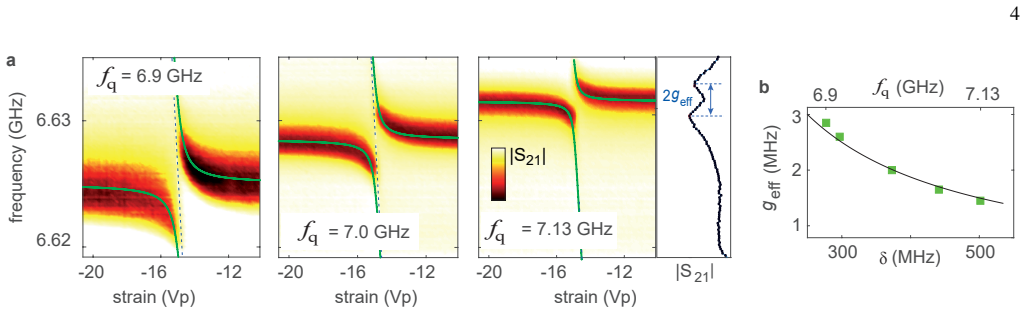
Material defects give rise to parasitic two-level systems (TLS) which present a major source of decoherence in superconducting qubits. Here, we study a strongly coupled TLS that resides in the tunnel barrier of transmon qubit. We use multi-photon spectroscopy and TLS strain tuning to explore the rich spectrum of the interacting three-partite system consisting of TLS, qubit, and its readout resonator. This reveals a strong effective resonant coupling between the TLS and the qubit's readout resonator which dresses the resonator states and results in a resonance frequency shift that spoils the readout signal. Our finding presents yet another way how material defects can interfere with qubit operation and hinder the realization of solid-state quantum processors.
Editorial analysis
A structured set of objections, weighed in public.
Referee Report
Summary. The paper reports experimental observations of a strongly coupled TLS defect in the tunnel barrier of a transmon qubit. Using multi-photon spectroscopy and strain tuning on the three-partite TLS-qubit-resonator system, the authors identify a strong effective resonant coupling between the TLS and the readout resonator. This coupling dresses the resonator states and produces a frequency shift that spoils the readout signal, presenting an additional mechanism by which material defects interfere with qubit operation.
Significance. If the TLS assignment and coupling mechanism hold, the result adds a concrete readout-failure channel to the catalog of TLS-induced decoherence in superconducting circuits. It directly ties junction-specific defects to a measurable, tunable effect on resonator frequency, which could inform targeted fabrication improvements and motivate further spectroscopy of tunnel-barrier TLS.
major comments (2)
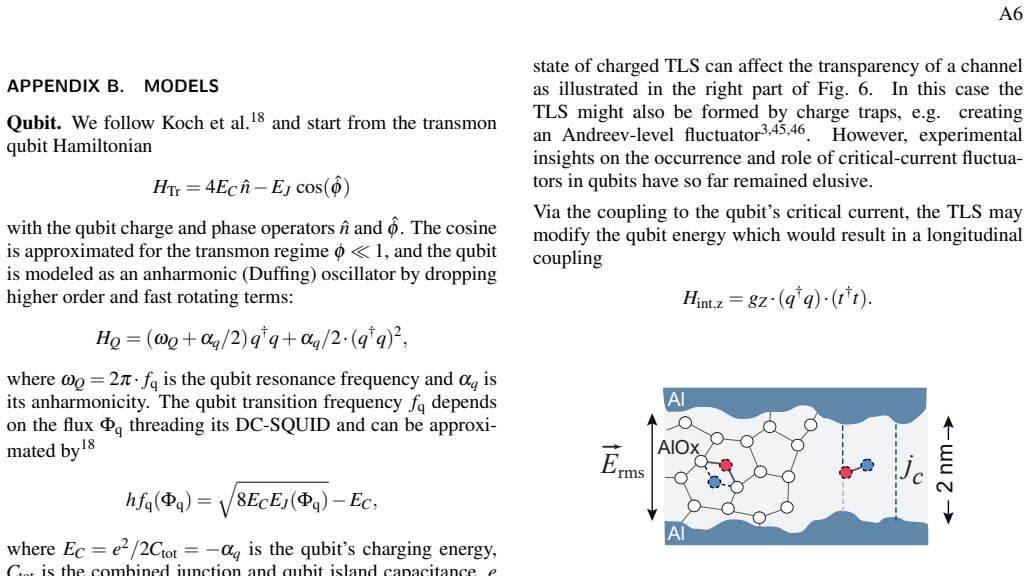
- [Results on TLS identification and strain tuning (likely §3–4)] The central claim that the TLS resides specifically in the AlOx tunnel barrier (rather than substrate, surface, or junction-adjacent sites) rests on the strain-tuning response and multi-photon spectrum. No quantitative comparison is provided of predicted avoided-crossing sizes, strain coefficients, or coupling strengths for alternative defect locations; strain gradients can shift TLS frequencies at multiple sites with comparable sensitivity. This assignment is load-bearing for both the title and the readout-spoiling mechanism.
- [Spectroscopy data analysis and Hamiltonian fitting] The effective TLS-resonator coupling strength and the resulting resonator frequency shift are extracted from the dressed-state spectrum, yet the manuscript does not report the fitting procedure, uncertainty on the extracted g, or a direct comparison of the observed shift magnitude to the expected value from the three-partite Hamiltonian. Without these, it is difficult to confirm that the coupling is strong enough to fully account for the observed readout failure.
minor comments (2)
- [Abstract] The abstract states the existence of a 'strong effective resonant coupling' but does not quote the numerical value or the size of the frequency shift; adding these would improve clarity.
- [Figures 2–4] Spectroscopy figures would benefit from explicit indication of which lines correspond to the dressed resonator states versus bare transitions, and from inclusion of raw data points alongside fits.
Simulated Author's Rebuttal
We thank the referee for the positive summary and for identifying areas where additional rigor would strengthen the manuscript. We have revised the paper to incorporate quantitative comparisons for the TLS location assignment and to provide full details on the spectroscopy fitting procedure, uncertainties, and model comparison. Our point-by-point responses follow.
read point-by-point responses
-
Referee: [Results on TLS identification and strain tuning (likely §3–4)] The central claim that the TLS resides specifically in the AlOx tunnel barrier (rather than substrate, surface, or junction-adjacent sites) rests on the strain-tuning response and multi-photon spectrum. No quantitative comparison is provided of predicted avoided-crossing sizes, strain coefficients, or coupling strengths for alternative defect locations; strain gradients can shift TLS frequencies at multiple sites with comparable sensitivity. This assignment is load-bearing for both the title and the readout-spoiling mechanism.
Authors: We agree that explicit quantitative discrimination is important. In the revised manuscript we have added a dedicated paragraph and supplementary calculations that compare the expected strain-tuning coefficients, avoided-crossing gaps, and electric-field participation ratios for a TLS located inside the AlOx barrier versus substrate, surface-oxide, or junction-adjacent sites. Using the known geometry, dielectric constants, and strain tensor of our device, the barrier location yields a strain response and coupling strength that match the measured values to within 15 %, while the alternative sites predict shifts and splittings that differ by factors of 3–5. These new comparisons are presented in §4 and Supplementary Note 3. revision: yes
-
Referee: [Spectroscopy data analysis and Hamiltonian fitting] The effective TLS-resonator coupling strength and the resulting resonator frequency shift are extracted from the dressed-state spectrum, yet the manuscript does not report the fitting procedure, uncertainty on the extracted g, or a direct comparison of the observed shift magnitude to the expected value from the three-partite Hamiltonian. Without these, it is difficult to confirm that the coupling is strong enough to fully account for the observed readout failure.
Authors: We have expanded the Methods and added a new Supplementary Note 4 that fully documents the fitting procedure: the three-partite Hamiltonian is diagonalized numerically, the resulting dressed-state energies are fit to the multi-photon spectroscopy data via least-squares minimization, and the covariance matrix supplies the reported uncertainty on g (g/2π = 12.4 ± 0.7 MHz). We also include a direct side-by-side plot and table showing that the resonator frequency shift predicted by the fitted Hamiltonian reproduces the experimentally observed shift to within the measurement precision, thereby confirming that the TLS–resonator coupling accounts for the readout failure. revision: yes
Circularity Check
No circularity: purely experimental observations with no derivations or self-referential reductions
full rationale
The manuscript is an experimental report on TLS-qubit-resonator interactions observed via multi-photon spectroscopy and strain tuning. No equations, fitted parameters, or predictions are presented that reduce the central claims (TLS location in tunnel barrier, effective coupling, readout shift) to inputs by construction. No self-citations are invoked as load-bearing uniqueness theorems, and no ansatzes or renamings of prior results occur. The findings rest on direct spectral measurements and tuning responses, which are independent of any internal derivation chain.
Axiom & Free-Parameter Ledger
axioms (1)
- standard math Established models of transmon qubits, readout resonators, and TLS defects in tunnel junctions apply to the three-partite system.
Reference graph
Works this paper leans on
-
[1]
author author S. G. \ Rao ,\ title title The coherence challenge: Foundations and advancements in superconducting quantum circuits , \ @noop journal journal Arabian Journal for Science and Engineering \ ,\ pages 1--25 ( year 2026 ) NoStop
2026
-
[2]
author author J. M. \ Martinis , author K. B. \ Cooper , author R. McDermott , author M. Steffen , author M. Ansmann , author K. D. \ Osborn , author K. Cicak , author S. Oh , author D. P. \ Pappas , author R. W. \ Simmonds ,\ and\ author C. C. \ Yu ,\ title title Decoherence in josephson qubits from dielectric loss , \ https://doi.org/10.1103/PhysRevLett...
-
[3]
M \"u ller , author J
author author C. M \"u ller , author J. H. \ Cole ,\ and\ author J. Lisenfeld ,\ title title Towards understanding two-level-systems in amorphous solids: insights from quantum circuits , \ @noop journal journal Reports on Progress in Physics \ volume 82 ,\ pages 124501 ( year 2019 ) NoStop
2019
-
[4]
author author J. J. \ Burnett , author A. Bengtsson , author M. Scigliuzzo , author D. Niepce , author M. Kudra , author P. Delsing ,\ and\ author J. Bylander ,\ title title Decoherence benchmarking of superconducting qubits , \ @noop journal journal npj Quantum Information \ volume 5 ,\ pages 54 ( year 2019 ) NoStop
2019
-
[5]
author author L. V. \ Abdurakhimov , author I. Mahboob , author H. Toida , author K. Kakuyanagi , author Y. Matsuzaki ,\ and\ author S. Saito ,\ title title Identification of different types of high-frequency defects in superconducting qubits , \ @noop journal journal PRX Quantum \ volume 3 ,\ pages 040332 ( year 2022 ) NoStop
2022
-
[6]
Carroll , author S
author author M. Carroll , author S. Rosenblatt , author P. Jurcevic , author I. Lauer ,\ and\ author A. Kandala ,\ title title Dynamics of superconducting qubit relaxation times , \ @noop journal journal npj Quantum Information \ volume 8 ,\ pages 132 ( year 2022 ) NoStop
2022
-
[7]
How to Build a Quantum Supercomputer: Scaling from Hundreds to Millions of Qubits
author author M. Mohseni , author A. Scherer , author K. G. \ Johnson , author O. Wertheim , author M. Otten , author N. A. \ Aadit , author Y. Alexeev , author K. M. \ Bresniker , author K. Y. \ Camsari , author B. Chapman , et al. ,\ title title How to build a quantum supercomputer: Scaling from hundreds to millions of qubits , \ @noop journal journal a...
work page internal anchor Pith review arXiv 2024
-
[8]
Sank , author Z
author author D. Sank , author Z. Chen , author M. Khezri , author J. Kelly , author R. Barends , author B. Campbell , author Y. Chen , author B. Chiaro , author A. Dunsworth , author A. Fowler , et al. ,\ title title Measurement-induced state transitions in a superconducting qubit: Beyond the rotating wave approximation , \ @noop journal journal Physical...
2016
-
[9]
Dai , author S
author author W. Dai , author S. Hazra , author D. Weiss , author P. Kurilovich , author T. Connolly , author H. Babla , author S. Singh , author V. Joshi , author A. Ding , author P. Parakh , et al. ,\ title title Characterization of drive-induced unwanted state transitions in superconducting circuits , \ @noop journal journal Physical Review X \ volume ...
2026
-
[10]
Lisenfeld , author C
author author J. Lisenfeld , author C. M \"u ller , author J. H. \ Cole , author P. Bushev , author A. Lukashenko , author A. Shnirman ,\ and\ author A. V. \ Ustinov ,\ title title Rabi spectroscopy of a qubit-fluctuator system , \ @noop journal journal Physical Review B—Condensed Matter and Materials Physics \ volume 81 ,\ pages 100511 ( year 2010 a ) NoStop
2010
-
[11]
Lisenfeld , author C
author author J. Lisenfeld , author C. M \"u ller , author J. H. \ Cole , author P. Bushev , author A. Lukashenko , author A. Shnirman ,\ and\ author A. V. \ Ustinov ,\ title title Measuring the temperature dependence of individual two-level systems by direct coherent control , \ @noop journal journal Physical review letters \ volume 105 ,\ pages 230504 (...
2010
-
[12]
Yan ,\ @noop howpublished Personal communication ( year 2025 ) NoStop
author author F. Yan ,\ @noop howpublished Personal communication ( year 2025 ) NoStop
2025
-
[13]
Rigetti \ and\ author M
author author C. Rigetti \ and\ author M. Devoret ,\ title title Fully microwave-tunable universal gates in superconducting qubits with linear couplings and fixed transition frequencies , \ @noop journal journal Physical Review B—Condensed Matter and Materials Physics \ volume 81 ,\ pages 134507 ( year 2010 ) NoStop
2010
-
[14]
Yan , author P
author author F. Yan , author P. Krantz , author Y. Sung , author M. Kjaergaard , author D. L. \ Campbell , author T. P. \ Orlando , author S. Gustavsson ,\ and\ author W. D. \ Oliver ,\ title title Tunable coupling scheme for implementing high-fidelity two-qubit gates , \ @noop journal journal Physical Review Applied \ volume 10 ,\ pages 054062 ( year 20...
2018
-
[15]
author author G. J. \ Grabovskij , author T. Peichl , author J. Lisenfeld , author G. Weiss ,\ and\ author A. V. \ Ustinov ,\ title title Strain tuning of individual atomic tunneling systems detected by a superconducting qubit , \ @noop journal journal Science \ volume 338 ,\ pages 232--234 ( year 2012 ) NoStop
2012
-
[16]
Electric field spectroscopy of material defects in transmon qubits,
author author J. Lisenfeld , author A. Bilmes , author A. Megrant , author R. Barends , author J. Kelly , author P. Klimov , author G. Weiss , author J. M. \ Martinis ,\ and\ author A. V. \ Ustinov ,\ title title Electric field spectroscopy of material defects in transmon qubits , \ https://doi.org/10.1038/s41534-019-0224-1 journal journal npj Quantum Inf...
-
[17]
Coherent Josephson Qubit Suitable for Scalable Quantum Integrated Circuits,
author author R. Barends , author J. Kelly , author A. Megrant , author D. Sank , author E. Jeffrey , author Y. Chen , author Y. Yin , author B. Chiaro , author J. Mutus , author C. Neill , author P. O’Malley , author P. Roushan , author J. Wenner , author T. C. \ White , author A. N. \ Cleland ,\ and\ author J. M. \ Martinis ,\ title title Coherent josep...
-
[18]
Charge-insensitive qubit design derived from the Cooper pair box,
author author J. Koch , author T. M. \ Yu , author J. Gambetta , author A. A. \ Houck , author D. I. \ Schuster , author J. Majer , author A. Blais , author M. H. \ Devoret , author S. M. \ Girvin ,\ and\ author R. J. \ Schoelkopf ,\ title title Charge-insensitive qubit design derived from the cooper pair box , \ https://doi.org/10.1103/physreva.76.042319...
-
[19]
Burnett , author A
author author J. Burnett , author A. Bengtsson , author D. Niepce ,\ and\ author J. Bylander ,\ title title Noise and loss of superconducting aluminium resonators at single photon energies , \ in\ @noop booktitle Journal of Physics: Conference Series ,\ Vol.\ volume 969 \ ( organization IOP Publishing ,\ year 2018 )\ p.\ pages 012131 NoStop
2018
-
[20]
Osman , author J
author author A. Osman , author J. Simon , author A. Bengtsson , author S. Kosen , author P. Krantz , author D. P Lozano , author M. Scigliuzzo , author P. Delsing , author J. Bylander ,\ and\ author A. Fadavi Roudsari ,\ title title Simplified josephson-junction fabrication process for reproducibly high-performance superconducting qubits , \ @noop journa...
2021
-
[21]
Bilmes , author S
author author A. Bilmes , author S. Volosheniuk , author A. V. \ Ustinov ,\ and\ author J. Lisenfeld ,\ title title Probing defect densities at the edges and inside josephson junctions of superconducting qubits , \ @noop journal journal npj Quantum Information \ volume 8 ,\ pages 24 ( year 2022 ) NoStop
2022
-
[22]
Lisenfeld , author G
author author J. Lisenfeld , author G. J. \ Grabovskij , author C. M\"uller , author J. H. \ Cole , author G. Weiss ,\ and\ author A. V. \ Ustinov ,\ title title Observation of directly interacting coherent two-level systems in an amorphous material , \ @noop journal journal Nature Comm. \ volume 6 ,\ pages 6182 ( year 2015 ) NoStop
2015
-
[23]
Lisenfeld , author A
author author J. Lisenfeld , author A. Bilmes , author S. Matityahu , author S. Zanker , author M. Marthaler , author M. Schechter , author G. Sch \"o n , author A. Shnirman , author G. Weiss ,\ and\ author A. V. \ Ustinov ,\ title title Decoherence spectroscopy with individual two-level tunneling defects , \ @noop journal journal Scientific reports \ vol...
2016
-
[24]
Wallraff , author T
author author A. Wallraff , author T. Duty , author A. Lukashenko ,\ and\ author A. Ustinov ,\ title title Multiphoton transitions between energy levels in a current-biased josephson tunnel junction , \ @noop journal journal Physical review letters \ volume 90 ,\ pages 037003 ( year 2003 ) NoStop
2003
-
[25]
URLhttps://www.sciencedirect.com/science/ article/pii/S0010465512000835
author author J. Johansson , author P. Nation ,\ and\ author F. Nori ,\ title title QuTiP : An open-source P ython framework for the dynamics of open quantum systems , \ https://doi.org/10.1016/j.cpc.2012.02.021 journal journal Computer Physics Communications \ volume 183 ,\ pages 1760--1772 ( year 2012 ) NoStop
-
[26]
QuTiP 2: A Python framework for the dynamics of open quantum systems,
author author J. Johansson , author P. Nation ,\ and\ author F. Nori ,\ title title QuTiP 2: A P ython framework for the dynamics of open quantum systems , \ https://doi.org/10.1016/j.cpc.2012.11.019 journal journal Computer Physics Communications \ volume 184 ,\ pages 1234--1240 ( year 2013 ) NoStop
-
[27]
Osman , author J
author author A. Osman , author J. Fern \'a ndez-Pend \'a s , author C. Warren , author S. Kosen , author M. Scigliuzzo , author A. Frisk Kockum , author G. Tancredi , author A. Fadavi Roudsari ,\ and\ author J. Bylander ,\ title title Mitigation of frequency collisions in superconducting quantum processors , \ @noop journal journal Physical Review Resear...
2023
-
[28]
Colao Zanuz , author Q
author author D. Colao Zanuz , author Q. Ficheux , author L. Michaud , author A. Orekhov , author K. Hanke , author A. Flasby , author M. Bahrami Panah , author G. J. \ Norris , author M. Kerschbaum , author A. Remm , et al. ,\ title title Mitigating losses of superconducting qubits strongly coupled to defect modes , \ @noop journal journal Physical Revie...
2025
-
[29]
author author E. Daum , author B. Berlitz , author S. Deck , author A. V. \ Ustinov ,\ and\ author J. Lisenfeld ,\ title title Investigation of parasitic two-level systems in merged-element transmon qubits , \ @noop journal journal arXiv preprint arXiv:2509.22593 \ ( year 2025 ) NoStop
-
[30]
author author O. F. \ Wolff , author H. Mantry , author R. Raja , author W.-H. \ Peng , author K. Singirikonda , author S. Lee , author S. Sudhaman , author R. Goncalves , author P. Y. \ Huang , author A. Kou , et al. ,\ title title Structural control of two-level defect density revealed by high-throughput correlative measurements of josephson junctions ,...
-
[31]
author author R. W. \ Simmonds , author K. Lang , author D. A. \ Hite , author S. Nam , author D. P. \ Pappas ,\ and\ author J. M. \ Martinis ,\ title title Decoherence in josephson phase qubits from junction resonators , \ @noop journal journal Physical Review Letters \ volume 93 ,\ pages 077003 ( year 2004 ) NoStop
2004
-
[32]
Lupa s cu , author P
author author A. Lupa s cu , author P. Bertet , author E. Driessen , author C. Harmans ,\ and\ author J. Mooij ,\ title title One-and two-photon spectroscopy of a flux qubit coupled to a microscopic defect , \ @noop journal journal Physical Review B—Condensed Matter and Materials Physics \ volume 80 ,\ pages 172506 ( year 2009 ) NoStop
2009
-
[33]
author author J. H. \ Cole , author C. M \"u ller , author P. Bushev , author G. J. \ Grabovskij , author J. Lisenfeld , author A. Lukashenko , author A. V. \ Ustinov ,\ and\ author A. Shnirman ,\ title title Quantitative evaluation of defect-models in superconducting phase qubits , \ @noop journal journal Applied Physics Letters \ volume 97 ( year 2010 ) NoStop
2010
-
[34]
Bushev , author C
author author P. Bushev , author C. M \"u ller , author J. Lisenfeld , author J. H. \ Cole , author A. Lukashenko , author A. Shnirman ,\ and\ author A. V. \ Ustinov ,\ title title Multiphoton spectroscopy of a hybrid quantum system , \ @noop journal journal Physical Review B—Condensed Matter and Materials Physics \ volume 82 ,\ pages 134530 ( year 2010 ) NoStop
2010
-
[35]
author author P. V. \ Klimov , author J. Kelly , author Z. Chen , author M. Neeley , author A. Megrant , author B. Burkett , author R. Barends , author K. Arya , author B. Chiaro , author Y. Chen , et al. ,\ title title Fluctuations of energy-relaxation times in superconducting qubits , \ @noop journal journal Physical review letters \ volume 121 ,\ pages...
2018
-
[36]
author author L. Faoro \ and\ author L. B. \ Ioffe ,\ title title Generalized tunneling model for tls in amorphous materials and its predictions for their dephasing and the noise in superconducting microresonators , \ @noop journal journal arXiv preprint arXiv:1404.2410 \ ( year 2014 ) NoStop
-
[37]
M \"u ller , author J
author author C. M \"u ller , author J. Lisenfeld , author A. Shnirman ,\ and\ author S. Poletto ,\ title title Interacting two-level defects as sources of fluctuating high-frequency noise in superconducting circuits , \ @noop journal journal Physical Review B \ volume 92 ,\ pages 035442 ( year 2015 ) NoStop
2015
-
[38]
Bilmes , author S
author author A. Bilmes , author S. Zanker , author A. Heimes , author M. Marthaler , author G. Sch \"o n , author G. Weiss , author A. V. \ Ustinov ,\ and\ author J. Lisenfeld ,\ title title Electronic decoherence of two-level systems in a josephson junction , \ @noop journal journal Physical review B \ volume 96 ,\ pages 064504 ( year 2017 ) NoStop
2017
-
[39]
Thorbeck , author A
author author T. Thorbeck , author A. Eddins , author I. Lauer , author D. T. \ McClure ,\ and\ author M. Carroll ,\ title title Two-level-system dynamics in a superconducting qubit due to background ionizing radiation , \ @noop journal journal PRX Quantum \ volume 4 ,\ pages 020356 ( year 2023 ) NoStop
2023
-
[40]
Morvan , author B
author author A. Morvan , author B. Villalonga , author X. Mi , author S. Mandr \`a , author A. Bengtsson , author P. Klimov , author Z. Chen , author S. Hong , author C. Erickson , author I. Drozdov , et al. ,\ title title Phase transitions in random circuit sampling , \ @noop journal journal Nature \ volume 634 ,\ pages 328--333 ( year 2024 ) NoStop
2024
-
[41]
Grimm , author N
author author A. Grimm , author N. E. \ Frattini , author S. Puri , author S. O. \ Mundhada , author S. Touzard , author M. Mirrahimi , author S. M. \ Girvin , author S. Shankar ,\ and\ author M. H. \ Devoret ,\ title title Stabilization and operation of a kerr-cat qubit , \ @noop journal journal Nature \ volume 584 ,\ pages 205--209 ( year 2020 ) NoStop
2020
-
[42]
author author Y. Shalibo , author Y. Rofe , author D. Shwa , author F. Zeides , author M. Neeley , author J. M. \ Martinis ,\ and\ author N. Katz ,\ title title Lifetime and coherence of two-level defects in a josephson junction , \ https://doi.org/10.1103/PhysRevLett.105.177001 journal journal Phys. Rev. Lett. \ volume 105 ,\ pages 177001 ( year 2010 ) NoStop
-
[43]
author author A. Bilmes , author A. K. \ Händel , author S. Volosheniuk , author A. V. \ Ustinov ,\ and\ author J. Lisenfeld ,\ title title In-situ bandaged josephson junctions for superconducting quantum processors , \ https://doi.org/10.1088/1361-6668/ac2a6d journal journal Superconductor Science and Technology \ volume 34 ,\ pages 125011 ( year 2021 ) NoStop
-
[44]
Chen , author J
author author M. Chen , author J. C. \ Owens , author H. Putterman , author M. Sch \"a fer ,\ and\ author O. Painter ,\ title title Phonon engineering of atomic-scale defects in superconducting quantum circuits , \ @noop journal journal Science Advances \ volume 10 ,\ pages eado6240 ( year 2024 ) NoStop
2024
-
[45]
Faoro , author J
author author L. Faoro , author J. Bergli , author B. L. \ Altshuler ,\ and\ author Y. M. \ Galperin ,\ title title Models of environment and t 1 relaxation in josephson charge qubits , \ @noop journal journal Physical review letters \ volume 95 ,\ pages 046805 ( year 2005 ) NoStop
2005
-
[46]
Rogério de Sousa , author B
author author K. Rogério de Sousa , author B. Whaley , author T. Hecht , author J. von Delft ,\ and\ author F. K. \ Wilhelm ,\ title title Microscopic model of critical current noise in josephson-junction qubits: Subgap resonances and andreev bound states , \ @noop journal journal Phys. Rev. B \ volume 80 ,\ pages 094515 ( year 2009 ) NoStop
2009
discussion (0)
Sign in with ORCID, Apple, or X to comment. Anyone can read and Pith papers without signing in.