Recognition: 3 theorem links
· Lean TheoremOperator spreading and recoverability of local quantum Fisher information in a U(1)-broken spin chain
Pith reviewed 2026-05-08 18:15 UTC · model grok-4.3
The pith
Transverse field depletes local quantum Fisher information recoverability at second order through two-magnon scattering.
A machine-rendered reading of the paper's core claim, the machinery that carries it, and where it could break.
Core claim
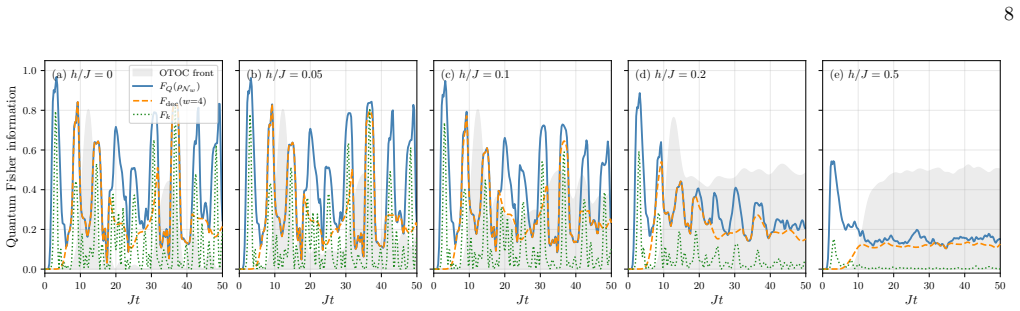
We analytically demonstrate that the local QFI has no first-order correction in field strength; the leading depletion enters at O(h²) through two-magnon scattering. As the field strength increases, the decoded QFI falls below the exact block QFI -- a gap reflecting a generic finite-dimensional compression limitation, as a single output qubit generically cannot capture the full QFI of a block state whose parameter dependence spans more than an effective two-dimensional subspace. The block QFI itself falls below the conserved global value, confirming that the sensitivity has spread beyond the block into non-local correlations. This operational hierarchy provides a precise quantitative distinc
What carries the argument
Two-magnon scattering induced by the transverse field, which couples the single-magnon parameter tangent state to higher sectors and produces the leading O(h²) depletion of locally recoverable QFI.
If this is right
- In the integrable limit a single-qubit decoder recovers the full block QFI carried by the one-magnon packet.
- The gap between decoded and block QFI grows with h because one qubit cannot represent sensitivity that spans more than a two-dimensional subspace.
- Block QFI is strictly smaller than the global conserved value once the field is nonzero, showing non-local spreading of sensitivity.
- The hierarchy local QFI < decoded QFI < block QFI < global QFI quantifies the successive losses of metrological accessibility.
Where Pith is reading between the lines
- Local sensing protocols may need multi-qubit decoders once interactions break conservation laws and scatter sensitivity into higher particle sectors.
- The finite-dimensional compression limit suggests that any single-qubit output channel will lose information whenever parameter dependence involves effective dimension greater than two.
- The O(h²) scaling could be tested directly in small trapped-ion or superconducting spin chains by varying the transverse field strength.
Load-bearing premise
The variational sweep decoder on a finite block is assumed to be the relevant local recovery procedure and the leading-order perturbation analysis captures the dominant depletion mechanism.
What would settle it
Measuring or computing the local or decoded QFI at small field strengths h and checking that the first correction scales as h squared rather than linearly would confirm or refute the claimed absence of a first-order term.
Figures



read the original abstract
While out-of-time-order correlators establish a causal light cone for operator spreading, they do not guarantee that the parameter sensitivity carried by the operator remains locally recoverable. We examine the distinction between operator spreading and metrological recoverability for a parameter encoded in a single site of an XX spin chain subjected to a $U(1)$-breaking transverse field. We evaluate three levels of local metrological accessibility: the bare single-site quantum Fisher information (QFI), the QFI recovered by a variational sweep decoder acting on a finite spatial block, and the exact block QFI. In the integrable limit, the sensitivity propagates as a one-magnon wave packet, and a single-qubit decoder recovers the full block QFI. Breaking magnon-number conservation couples the parameter tangent state to multi-magnon sectors. We analytically demonstrate that the local QFI has no first-order correction in field strength; the leading depletion enters at $\mathcal{O}(h^2)$ through two-magnon scattering. As the field strength increases, the decoded QFI falls below the exact block QFI -- a gap reflecting a generic finite-dimensional compression limitation, as a single output qubit generically cannot capture the full QFI of a block state whose parameter dependence spans more than an effective two-dimensional subspace. The block QFI itself falls below the conserved global value, confirming that the sensitivity has spread beyond the block into non-local correlations. This operational hierarchy provides a precise quantitative distinction between the arrival of operator support and the local accessibility of metrological information.
Editorial analysis
A structured set of objections, weighed in public.
Referee Report
Summary. The paper studies the distinction between operator spreading and local metrological recoverability in an XX spin chain with a U(1)-breaking transverse field h. It defines and compares three quantities: the bare single-site quantum Fisher information (QFI), the QFI recovered by a variational sweep decoder on a finite spatial block, and the exact block QFI. In the integrable limit, a single-qubit decoder recovers the full block QFI as sensitivity propagates via a one-magnon wave packet. Breaking magnon-number conservation couples the parameter tangent state to multi-magnon sectors; the authors analytically demonstrate that the local QFI receives no first-order correction in h, with leading depletion at O(h²) from two-magnon scattering. As h increases, the decoded QFI falls below the block QFI (due to finite-dimensional compression limits of a single output qubit when the tangent space exceeds two dimensions), while the block QFI itself falls below the conserved global value, indicating spreading into non-local correlations.
Significance. If the central analytic results hold, the work supplies a quantitative, operational hierarchy that separates the causal light-cone arrival of operator support from the local accessibility of parameter sensitivity. The absence of an O(h) correction to local QFI and the generic compression-gap argument are both internally consistent with standard time-dependent perturbation theory and the definition of QFI as the norm of the parameter tangent vector. The explicit comparison of bare, decoded, and block QFI in a concrete many-body model offers a useful benchmark for metrology in open quantum systems and for studies of information scrambling.
minor comments (3)
- The abstract refers to 'the model Hamiltonian' without an explicit expression or equation number; adding a brief inline definition or pointer to the section containing the XX Hamiltonian plus transverse-field term would improve readability for readers who encounter the abstract first.
- The variational sweep decoder is introduced as the relevant local recovery procedure; a short paragraph clarifying its optimization objective and the finite-block truncation (e.g., how the sweep range is chosen relative to the light-cone velocity) would make the numerical implementation reproducible.
- Figure captions should explicitly state the system size, block size, and value of h used for each panel so that the O(h²) scaling and the decoded-versus-block gap can be directly compared to the analytic expressions.
Simulated Author's Rebuttal
We thank the referee for the careful reading and positive assessment of our manuscript. The provided summary accurately captures the central results on the distinction between operator spreading and local metrological recoverability, the absence of an O(h) correction to the local QFI, and the compression gap between decoded and block QFI. We are encouraged by the recognition that these findings supply a quantitative benchmark for metrology in many-body systems. No specific major comments were raised in the report.
Circularity Check
No significant circularity; derivation is self-contained
full rationale
The central claims follow from direct application of time-dependent perturbation theory to the XX Hamiltonian with transverse field term, combined with the standard definition of QFI as the squared norm of the parameter tangent vector in the state manifold. The absence of O(h) correction and the O(h²) two-magnon contribution are obtained by explicit expansion of the evolved state and inner-product calculations; the finite-dimensional compression gap is a general fact about the dimension of the tangent space versus the output Hilbert space. No fitted parameters are relabeled as predictions, no self-referential definitions appear, and no load-bearing uniqueness theorems or ansatzes are imported via self-citation. The hierarchy of QFI quantities is therefore an independent consequence of the model and the definitions.
Axiom & Free-Parameter Ledger
axioms (2)
- domain assumption The system evolves under the XX Hamiltonian plus a transverse field term proportional to h that breaks magnon-number conservation.
- domain assumption Perturbative expansion in small h captures the leading correction to local QFI.
Reference graph
Works this paper leans on
-
[1]
The estimate is not intended to re- produce finite-open-chain prefactors; it only identifies the perturbative order inhand the density-of-states scale set byJ
Perturbative two-magnon leakage estimate In this subsection we give only a scaling estimate for leakage from the one-magnon tangent channel into the two-magnon sector. The estimate is not intended to re- produce finite-open-chain prefactors; it only identifies the perturbative order inhand the density-of-states scale set byJ. Under the Jordan–Wigner trans...
-
[2]
Swingle, Nat
B. Swingle, Nat. Phys.14, 988 (2018)
2018
-
[3]
Xu and B
S. Xu and B. Swingle, PRX Quantum5, 010201 (2024)
2024
-
[4]
Swingle, G
B. Swingle, G. Bentsen, M. Schleier-Smith, and P. Hay- den, Phys. Rev. A94, 040302(R) (2016)
2016
-
[5]
Gärttner, J
M. Gärttner, J. G. Bohnet, A. Safavi-Naini, M. L. Wall, J. J. Bollinger, and A. M. Rey, Nat. Phys.13, 781 (2017)
2017
-
[6]
Xu and B
S. Xu and B. Swingle, Nat. Phys.16, 199 (2020)
2020
-
[7]
E. H. Lieb and D. W. Robinson, Commun. Math. Phys. 28, 251 (1972)
1972
-
[8]
S. L. Braunstein and C. M. Caves, Phys. Rev. Lett.72, 3439 (1994)
1994
-
[9]
Hyllus, W
P. Hyllus, W. Laskowski, R. Krischek, C. Schwemmer, W. Wieczorek, H. Weinfurter, L. Pezzè, and A. Smerzi, Phys. Rev. A85, 022321 (2012)
2012
-
[10]
Tóth, Phys
G. Tóth, Phys. Rev. A85, 022322 (2012)
2012
-
[11]
Pezzè, A
L. Pezzè, A. Smerzi, M. K. Oberthaler, R. Schmied, and P. Treutlein, Rev. Mod. Phys.90, 035005 (2018)
2018
-
[12]
B.YoshidaandN.Y.Yao,Phys.Rev.X9,011006(2019)
2019
-
[13]
R. J. Lewis-Swan, A. Safavi-Naini, J. J. Bollinger, and A. M. Rey, Nat. Commun.10, 1581 (2019)
2019
-
[14]
M. Gärttner, P. Hauke, and A. M. Rey, Phys. Rev. Lett. 120, 040402 (2018), arXiv:1706.01616 [quant-ph]
-
[15]
M. G. A. Paris, Int. J. Quantum Inf.7, 125 (2009)
2009
-
[16]
J. Liu, H. Yuan, X.-M. Lu, and X. Wang, J. Phys. A: Math. Theor.53, 023001 (2020)
2020
-
[17]
D. A. Roberts and B. Swingle, Phys. Rev. Lett.117, 091602 (2016)
2016
-
[18]
Xu and B
S. Xu and B. Swingle, Phys. Rev. X9, 031048 (2019)
2019
-
[19]
E. Lieb, T. Schultz, and D. Mattis, Ann. Phys.16, 407 (1961)
1961
-
[20]
Lin and O
C.-J. Lin and O. I. Motrunich, Phys. Rev. B97, 144304 (2018)
2018
-
[21]
Lopez-Piqueres, B
J. Lopez-Piqueres, B. Ware, S. Gopalakrishnan, and R. Vasseur, Phys. Rev. B104, 104307 (2021)
2021
-
[22]
Colmenarez and D
L. Colmenarez and D. J. Luitz, Phys. Rev. Research2, 043047 (2020)
2020
- [23]
-
[24]
Wysocki and J
P. Wysocki and J. Chwedeńczuk, Phys. Rev. Lett.134, 020201 (2025)
2025
-
[25]
Šafránek, Phys
D. Šafránek, Phys. Rev. A95, 052320 (2017)
2017
-
[26]
Bärtschi and S
A. Bärtschi and S. Eidenbenz, inFundamentals of Computation Theory(Springer International Publishing,
-
[27]
Yang, Phys
Y. Yang, Phys. Rev. Lett.134, 010603 (2025)
2025
-
[28]
F. Ferro and M. Fagotti, arXiv:2503.21905 (2025), preprint, arXiv:2503.21905 [quant-ph]
-
[29]
Hayden and J
P. Hayden and J. Preskill, J. High Energy Phys.2007 (09), 120
2007
discussion (0)
Sign in with ORCID, Apple, or X to comment. Anyone can read and Pith papers without signing in.