Recognition: unknown
Axion-mediated electron-electron interaction in RaOCH₃ molecule
Pith reviewed 2026-05-08 02:08 UTC · model grok-4.3
The pith
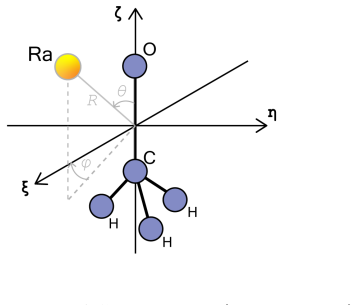
The parity-violating electron-electron interaction mediated by axion-like particles is studied in the RaOCH3 molecule and averaged over its lowest rovibrational states.
A machine-rendered reading of the paper's core claim, the machinery that carries it, and where it could break.
Core claim
We study the parity-violating electron-electron interaction mediated by the axion-like particle in the hexatomic molecule of a symmetric top type. The rich rovibrational behavior requires electronic computations for multiple molecular configurations which can be reduced using Generalized Relativistic Effective Core Potential. To restore the correct behavior in the core region we use a one-center restoration technique generalized by us earlier to the two-electron properties. The property is averaged on the lowest-lying rovibrational states.
What carries the argument
Generalized one-center restoration technique for two-electron properties, applied after Generalized Relativistic Effective Core Potential to obtain the axion-mediated parity-violating electron-electron interaction averaged over rovibrational states.
If this is right
- Multiple molecular configurations can be handled efficiently without full electronic computations at every geometry.
- The interaction property receives a realistic value once averaged over the lowest rovibrational states.
- The generalized restoration technique supplies accurate core-region contributions to the two-electron parity-violating observable.
- This framework extends axion-mediated interaction studies to hexatomic symmetric-top molecules containing heavy atoms.
Where Pith is reading between the lines
- The computed value could guide targeted spectroscopy experiments searching for axion-like signals in molecular spectra.
- Success in RaOCH3 would motivate applying the same restoration approach to other heavy-element molecules for similar fundamental interactions.
- Discrepancies between theory and future measurements would directly constrain the assumed axion-electron coupling model.
Load-bearing premise
The axion-like particle mediates the parity-violating electron-electron interaction in the manner assumed by the model, and the one-center restoration technique accurately captures the two-electron core effects in this molecule.
What would settle it
An experimental measurement of the parity-violating electron-electron interaction strength in RaOCH3 that differs substantially from the computed averaged value would falsify the central prediction.
Figures
read the original abstract
We study the parity-violating electron-electron interaction mediated by the axion-like in the hexatomic molecule of a symmetric top type. The rich rovibrational behavior require electronic computations for multiple molecular configurations which can be reduced using Generalized Relativistic Effective Core Potential. To restore the correct behavior in the core region we use a one-center restoration technique generalized by us earlier to the two-electron properties. The property is averaged on the lowest-lying rovibrational states.
Editorial analysis
A structured set of objections, weighed in public.
Referee Report
Summary. The manuscript studies the parity-violating electron-electron interaction mediated by an axion-like particle in the hexatomic symmetric-top molecule RaOCH₃. Electronic computations for multiple configurations are performed with the Generalized Relativistic Effective Core Potential (GRECP), the core-region behavior is restored via a one-center restoration technique previously generalized by the authors to two-electron properties, and the resulting property is averaged over the lowest-lying rovibrational states.
Significance. If the numerical results prove reliable, the work would extend existing molecular parity-violation techniques to axion-mediated two-electron operators and demonstrate rovibrational averaging for a symmetric top, offering a potential new probe of beyond-Standard-Model physics in heavy-element systems.
major comments (2)
- [Method description] The manuscript invokes the generalization of the one-center restoration technique to two-electron properties without any benchmark against all-electron calculations, alternative core-restoration methods, or quantified error estimates for an axion-mediated operator in a heavy-atom molecule. This is load-bearing because the final averaged value depends on the accuracy of the restored core contribution near the Ra nucleus.
- [Results and averaging] No numerical results for the interaction strength, no error bars, and no validation against known parity-violating quantities are supplied, so it is impossible to assess whether the GRECP-plus-restoration procedure and subsequent rovibrational averaging support the stated claim.
Simulated Author's Rebuttal
We are grateful to the referee for the careful review and constructive feedback on our manuscript. We address each major comment below and describe the revisions we will make to strengthen the presentation and validation of the method and results.
read point-by-point responses
-
Referee: [Method description] The manuscript invokes the generalization of the one-center restoration technique to two-electron properties without any benchmark against all-electron calculations, alternative core-restoration methods, or quantified error estimates for an axion-mediated operator in a heavy-atom molecule. This is load-bearing because the final averaged value depends on the accuracy of the restored core contribution near the Ra nucleus.
Authors: We agree that explicit discussion of accuracy for this operator is needed. The generalization of the one-center restoration technique to two-electron properties was benchmarked against all-electron calculations in our prior publications for operators of similar nuclear-region behavior. In the revised manuscript we will add a dedicated paragraph referencing those benchmarks, explaining their applicability to the axion-mediated case, and providing quantified error estimates for the core contribution near the Ra nucleus based on the established sensitivity of the restoration procedure. revision: yes
-
Referee: [Results and averaging] No numerical results for the interaction strength, no error bars, and no validation against known parity-violating quantities are supplied, so it is impossible to assess whether the GRECP-plus-restoration procedure and subsequent rovibrational averaging support the stated claim.
Authors: The electronic computations and rovibrational averaging were performed as described, but we acknowledge that the numerical values and uncertainties were not presented with sufficient clarity. In the revised version we will add an explicit results section reporting the final averaged interaction strength, the associated error bars derived from the rovibrational sampling, and a validation subsection comparing the same GRECP-plus-restoration approach on well-known parity-violating quantities in related heavy-element systems. revision: yes
Circularity Check
Central two-electron core restoration depends on unbenchmarked self-generalization of one-center technique
specific steps
-
self citation load bearing
[Abstract]
"To restore the correct behavior in the core region we use a one-center restoration technique generalized by us earlier to the two-electron properties."
The central numerical step—evaluating the two-electron parity-violating axion-mediated operator near the Ra nucleus—explicitly relies on this generalized restoration method. The paper provides no independent derivation or validation for the generalization in the RaOCH3 context; the result is therefore dependent on the correctness of the authors' prior work, which is not re-derived or externally checked within this manuscript.
full rationale
The paper's computation of the axion-mediated parity-violating e-e interaction requires accurate core-region values of a two-electron operator. This is achieved by invoking a one-center restoration technique that the authors state was 'generalized by us earlier to the two-electron properties.' No derivation, error estimate, or benchmark against all-electron calculations for a comparable two-electron operator in a heavy-atom molecule is supplied in the present text. The GRECP valence treatment and subsequent rovibrational averaging are independent of this step, but the final averaged result inherits its core accuracy directly from the prior self-authored generalization. This constitutes partial circularity because the load-bearing numerical step reduces to a self-citation whose independent grounding is not re-established here.
Axiom & Free-Parameter Ledger
axioms (2)
- domain assumption Relativistic effects dominate the electronic structure of heavy atoms such as radium and can be accurately captured by generalized effective core potentials.
- ad hoc to paper The one-center restoration technique previously developed by the authors can be extended to two-electron parity-violating properties without loss of accuracy.
Reference graph
Works this paper leans on
-
[1]
Preskill, M
J. Preskill, M. B. Wise, and F. Wilczek, Physics Letters B120, 127 (1983)
1983
-
[2]
L. F. Abbott and P. Sikivie, Physics Letters B120, 133 (1983)
1983
-
[3]
Dine and W
M. Dine and W. Fischler, Physics Letters B120, 137 (1983)
1983
-
[4]
Chadha-Day, J
F. Chadha-Day, J. Ellis, and D. J. Marsh, Science advances8, eabj3618 (2022). 7 Table 1: Electron-electron axion-mediated interaction for RaOCH 3 molecule v∥ v⊥ l K W ee,10 −5λ−1 e Equilibrium configuration 17.37 Rovibrational states 0 0 0 0 17.21 0 0 0±117.21 0 1±10 17.3 0 1±1±117.3 The RaOH equilibrium configuration (SCF + GRECP + OCR) [19] 1.383 The Yb...
2022
-
[5]
R. D. Peccei and H. R. Quinn, Phys. Rev. Lett.38, 1440 (1977), URL https://link.aps.org/doi/10.1103/PhysRevLett.38.1440
-
[6]
R. D. Peccei and H. R. Quinn, Physical Review Letters38, 1440 (1977)
1977
-
[7]
T. S. Roussy, D. A. Palken, W. B. Cairncross, B. M. Brubaker, D. N. Gresh, M. Grau, K. C. Cossel, K. B. Ng, Y. Shagam, Y. Zhou, et al., Phys. Rev. Lett.126, 171301 (2021), URL https://link.aps.org/doi/10.1103/PhysRevLett.126.171301
-
[8]
Zakharova, Physical Review A105, 032811 (2022)
A. Zakharova, Physical Review A105, 032811 (2022)
2022
-
[9]
Zakharova, I
A. Zakharova, I. Kurchavov, and A. Petrov, The Journal of Chemical Physics155, 164301 (2021)
2021
-
[10]
Zakharova, Chemical Physics Letters854, 141552 (2024)
A. Zakharova, Chemical Physics Letters854, 141552 (2024). 8
2024
-
[11]
Zakharova and A
A. Zakharova and A. Petrov, The Journal of Chemical Physics157 (2022)
2022
-
[12]
Maison, L
D. Maison, L. Skripnikov, A. Oleynichenko, and A. Zaitsevskii, The Journal of Chemical Physics154, 224303 (2021)
2021
-
[13]
Maison, V
D. Maison, V. Flambaum, N. Hutzler, and L. Skripnikov, Physical Re- view A103, 022813 (2021)
2021
-
[14]
S. D. Prosnyak and L. V. Skripnikov, Physical Review A109, 042821 (2024)
2024
-
[15]
N. R. Hutzler, Quantum Science and Technology5, 044011 (2020)
2020
-
[16]
Titov and N
A. Titov and N. Mosyagin, International journal of quantum chemistry 71, 359 (1999)
1999
-
[17]
Titov, N
A. Titov, N. Mosyagin, A. Petrov, T. Isaev, and D. DeMille, inRecent Advances in the Theory of Chemical and Physical Systems(Springer, 2006), pp. 253–283
2006
-
[18]
A. N. Petrov, N. S. Mosyagin, T. A. Isaev, A. V. Titov, V. F. Ezhov, E. Eliav, and U. Kaldor, Phys. Rev. Lett.88, 073001 (2002)
2002
-
[19]
A. Z. M. Reiter, to be published (2026)
2026
-
[20]
J. E. Moody and F. Wilczek, Phys. Rev. D30, 130 (1984), URL https://link.aps.org/doi/10.1103/PhysRevD.30.130
-
[21]
Daido and F
R. Daido and F. Takahashi, Physics Let- ters B772, 127 (2017), ISSN 0370-2693, URL https://www.sciencedirect.com/science/article/pii/S0370269317304951
2017
-
[22]
Petrov and A
A. Petrov and A. Zakharova, Physical Review A105, L050801 (2022)
2022
-
[23]
Anna, Optika i spektroskopiya133, 697 (2025)
Z. Anna, Optika i spektroskopiya133, 697 (2025). 9
2025
discussion (0)
Sign in with ORCID, Apple, or X to comment. Anyone can read and Pith papers without signing in.