Recognition: unknown
Search for a new heavy scalar resonance decaying into the Higgs boson and a new scalar particle in the bbar{b}bbar{b} final state using proton-proton collisions at sqrt{s} = 13 TeV
Pith reviewed 2026-05-08 02:13 UTC · model grok-4.3
The pith
CMS search finds no significant signal for new heavy scalar X decaying to Higgs and Y in bbbb final state
A machine-rendered reading of the paper's core claim, the machinery that carries it, and where it could break.
Core claim
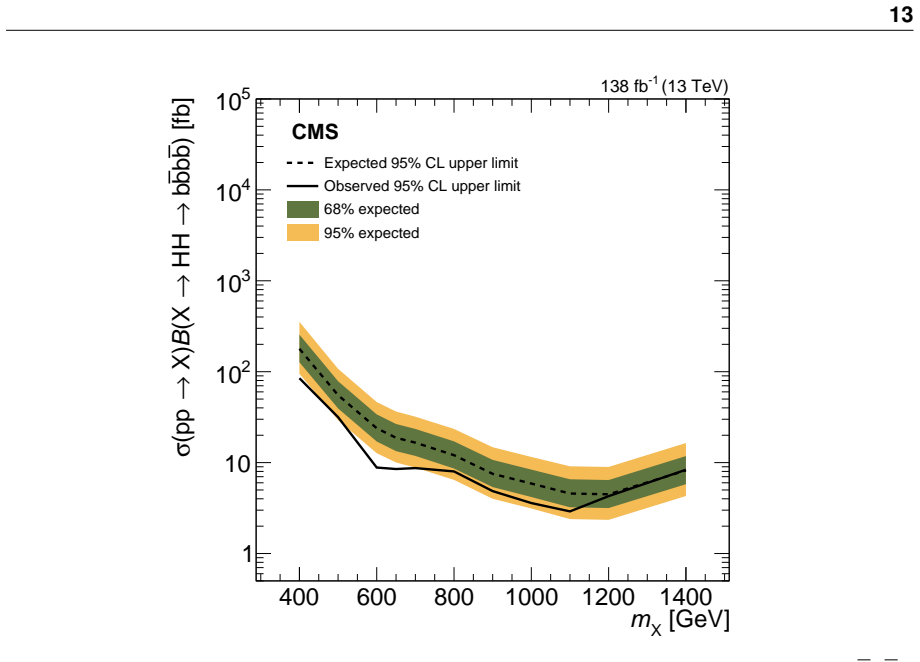
The observations are in agreement with the background-only hypothesis. The largest excess, with a local (global) significance of 3.47 (2.44) standard deviations, is observed for hypothetical X and Y masses of 600 and 400 GeV, respectively. Upper limits at 95% confidence level on the production cross section times branching fraction are presented for signal mass hypotheses in the range of the search. Results are interpreted within the next-to-minimal supersymmetric standard model scenario.
What carries the argument
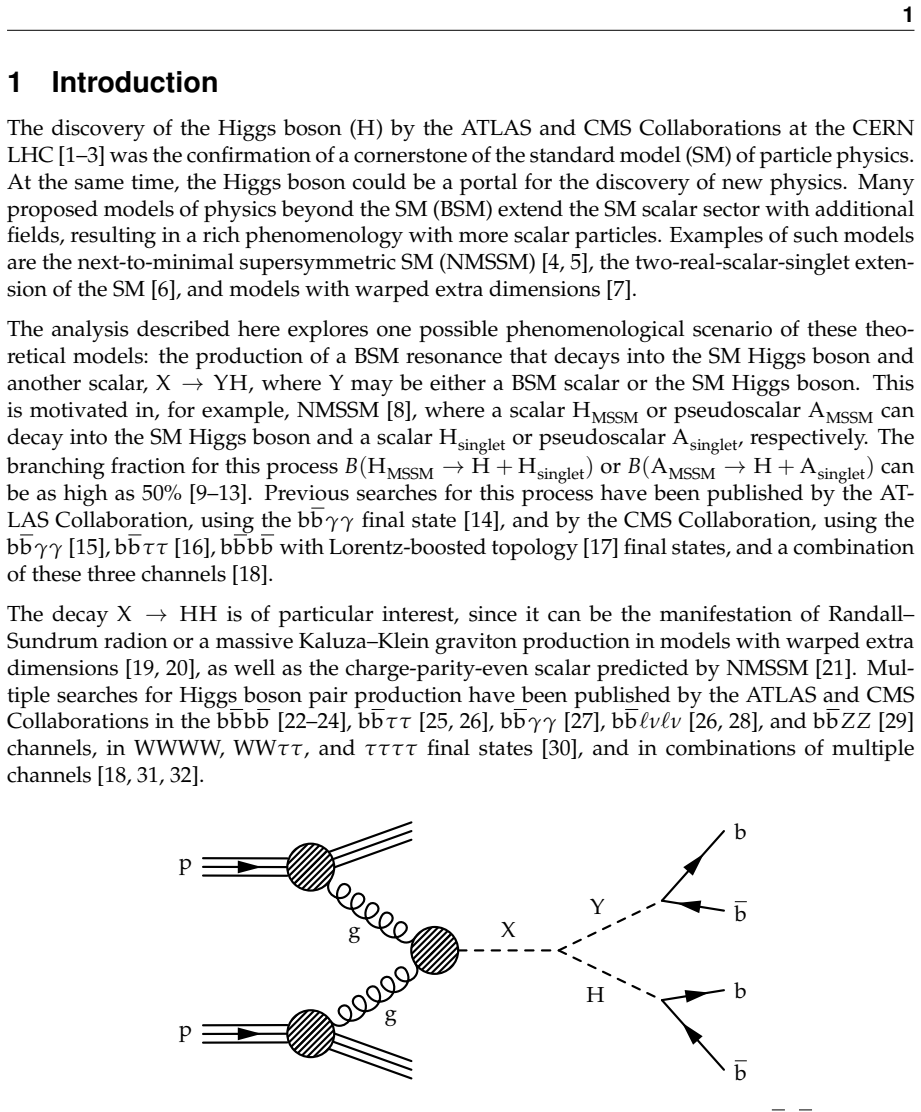
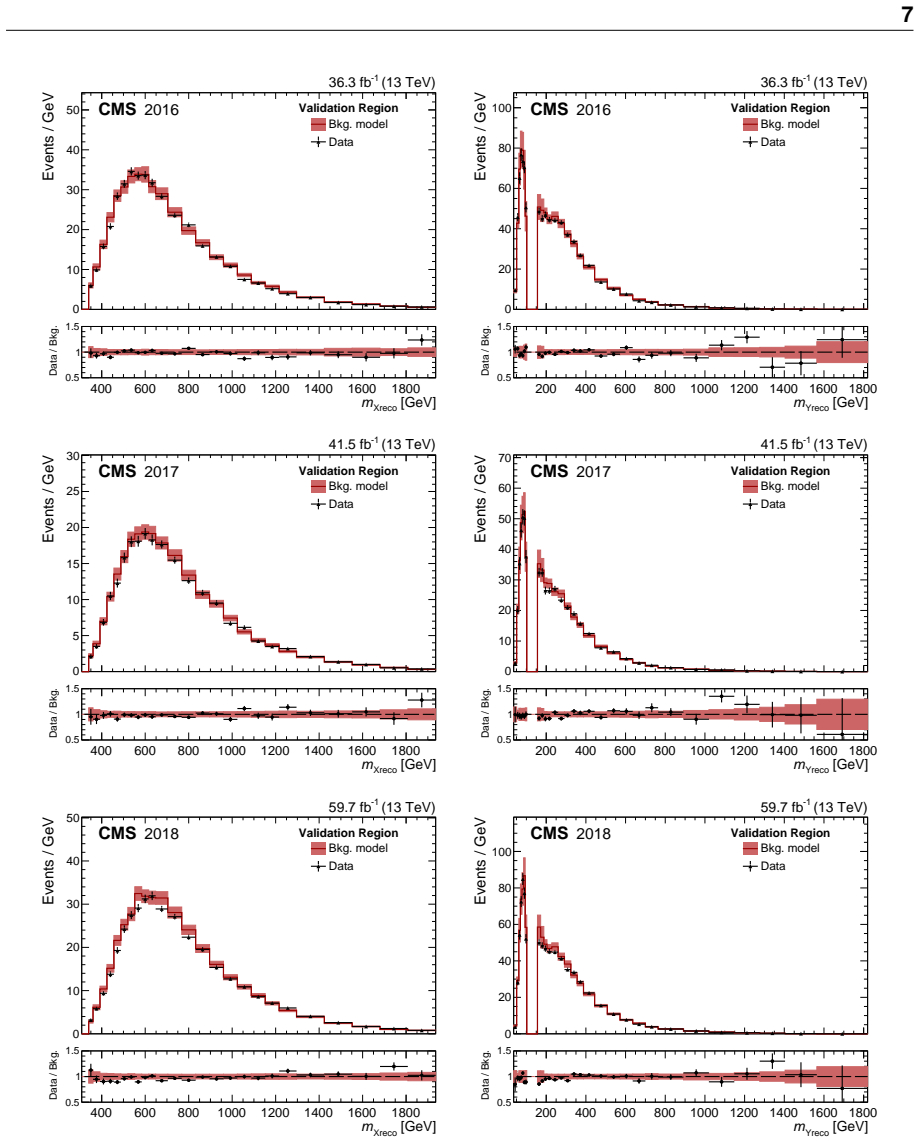
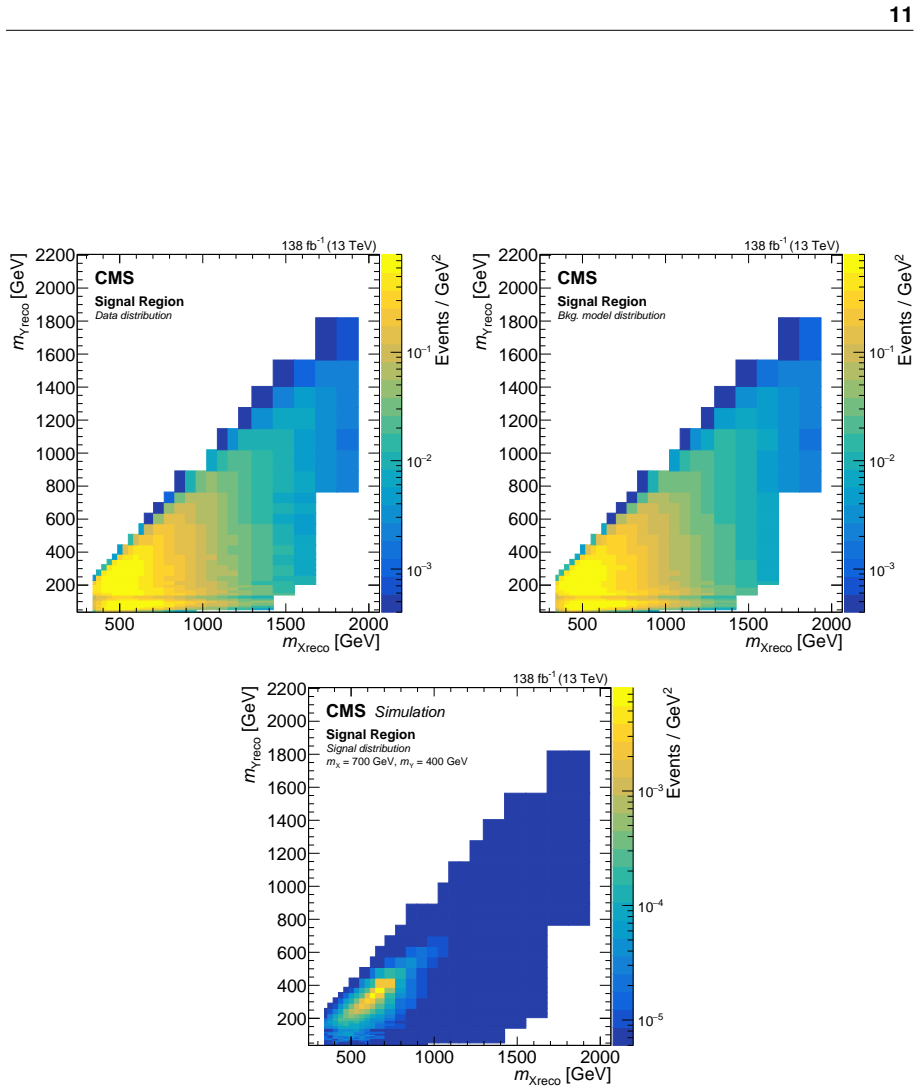
The reconstruction of two dijet systems from four b-tagged jets to identify the Higgs boson and the new scalar Y, with a search for a peak in the distribution of the invariant mass of the combined system corresponding to the heavy resonance X.
If this is right
- The results constrain possible new scalar particles in extensions of the standard model.
- Upper limits exclude certain production rates for X and Y in the probed mass ranges.
- No evidence supports the existence of such resonances in the next-to-minimal supersymmetric standard model.
- Additional data from future LHC runs could improve these limits or reveal a signal if present.
Where Pith is reading between the lines
- The observed mild excess might be investigated further with more data or different analysis techniques to confirm if it persists.
- This search complements other LHC analyses looking for extended Higgs sectors in different final states.
- If similar excesses appear in independent channels, it could motivate dedicated follow-up studies on potential new physics.
Load-bearing premise
The Monte Carlo simulations used to model the standard model backgrounds and signal efficiencies provide an accurate description of the observed data in the four b-jet events.
What would settle it
A reanalysis or new dataset showing the local significance at 600 and 400 GeV masses rising above 5 standard deviations globally would indicate the presence of a new resonance rather than a background fluctuation.
Figures



read the original abstract
A search for a new heavy scalar resonance (X) decaying into the 125 GeV standard model Higgs boson (H) and a new scalar particle (Y) in proton-proton collisions at a center-of-mass energy of 13 TeV is presented. The analysis is performed using a data sample corresponding to an integrated luminosity of 138 fb$^{-1}$ collected with the CMS detector during LHC Run 2. The $\mathrm{b}\bar{\mathrm{b}}\mathrm{b}\bar{\mathrm{b}}$ final state is used as a probe to search for phenomena beyond the standard model where, in the X $\to$ YH process, the Y and H each decay into a bottom quark-antiquark pair. A range of masses from 400 GeV to 1.6 TeV for the resonance X and from 60 GeV to 1.4 TeV for the scalar Y is investigated. The observations are in agreement with the background-only hypothesis. The largest excess, with a local (global) significance of 3.47 (2.44) standard deviations, is observed for hypothetical X and Y masses of 600 and 400 GeV, respectively. Upper limits at 95% confidence level on the production cross section times branching fraction are presented for signal mass hypotheses in the range of the search. Results are interpreted within the next-to-minimal supersymmetric standard model scenario.
Editorial analysis
A structured set of objections, weighed in public.
Referee Report
Summary. The manuscript presents a search for a new heavy scalar resonance X decaying to the 125 GeV SM Higgs boson H and a new scalar Y, with both H and Y decaying to b b-bar pairs, using 138 fb^{-1} of 13 TeV pp collision data recorded with the CMS detector. The search spans X masses 400 GeV–1.6 TeV and Y masses 60 GeV–1.4 TeV in the bbbb final state. No significant excess over the background-only hypothesis is found; the largest deviation has local (global) significance 3.47 (2.44) sigma at m_X=600 GeV, m_Y=400 GeV. 95% CL upper limits on the production cross section times branching fraction are reported for all tested mass hypotheses, with results interpreted in the NMSSM.
Significance. If the background modeling and limit-setting procedure hold, the result meaningfully constrains extended Higgs sectors, particularly NMSSM scenarios with additional scalars. The analysis uses standard CMS MC-based signal modeling, data-driven background estimation, and asymptotic CL_s limits with proper local-to-global significance correction, providing a clean null result that strengthens exclusion bounds in the bbbb channel.
minor comments (2)
- The abstract states the global significance correctly but does not explicitly note the number of trials or the look-elsewhere effect calculation method; adding a brief clause referencing the asymptotic formula or toy-based procedure used would improve clarity for readers.
- Section on systematic uncertainties (presumably §6 or equivalent) should tabulate the dominant sources (e.g., b-tagging efficiency, jet energy scale) with their impact on the final limits for the benchmark point at 600/400 GeV to allow direct assessment of robustness.
Simulated Author's Rebuttal
We thank the referee for their positive assessment of our manuscript, including the recognition that the analysis employs standard CMS techniques for signal modeling, data-driven background estimation, and asymptotic CL_s limits with appropriate significance corrections. We appreciate the recommendation to accept the paper, as it confirms that the null result provides meaningful constraints on extended Higgs sectors such as the NMSSM.
Circularity Check
No circularity: direct data-to-MC comparison with standard statistical interpretation
full rationale
The paper reports a search for X → YH → bbbb using 138 fb⁻¹ of 13 TeV data. The central claim (agreement with background-only hypothesis, local/global significances, and 95% CL upper limits) is obtained by comparing observed events in data to Monte Carlo predictions for SM backgrounds and signal hypotheses, followed by a standard profile-likelihood fit and asymptotic CLs limit setting. No equation or procedure reduces a claimed prediction to a fitted input by construction, no self-citation supplies a uniqueness theorem or ansatz that bears the result, and the background modeling is not defined in terms of the signal excess being tested. The analysis chain is therefore self-contained against external benchmarks (collision data and independently generated MC).
Axiom & Free-Parameter Ledger
axioms (1)
- domain assumption Standard Model background processes are correctly modeled by Monte Carlo simulations in the bbbb final state
invented entities (2)
-
Heavy scalar resonance X
no independent evidence
-
New scalar particle Y
no independent evidence
Reference graph
Works this paper leans on
-
[1]
ATLAS Collaboration, “Observation of a new particle in the search for the standard model Higgs boson with the ATLAS detector at the LHC”,Phys. Lett. B716(2012) 1, doi:10.1016/j.physletb.2012.08.020,arXiv:1207.7214
work page internal anchor Pith review doi:10.1016/j.physletb.2012.08.020 2012
-
[2]
CMS Collaboration, “Observation of a new boson at a mass of 125 GeV with the CMS experiment at the LHC”,Phys. Lett. B716(2012) 30, doi:10.1016/j.physletb.2012.08.021,arXiv:1207.7235
-
[3]
Observation of a new boson with mass near 125 GeV in pp collisions at √s=7 and 8 TeV
CMS Collaboration, “Observation of a new boson with mass near 125 GeV in pp collisions at √s= 7 and 8 TeV”,JHEP06(2013) 081, doi:10.1007/JHEP06(2013)081,arXiv:1303.4571
-
[4]
The next-to-minimal supersymmetric standard model
U. Ellwanger, C. Hugonie, and A. M. Teixeira, “The next-to-minimal supersymmetric standard model”,Phys. Rep.496(2010) 1,doi:10.1016/j.physrep.2010.07.001, arXiv:0910.1785. References 17
-
[5]
The next-to-minimal supersymmetric extension of the standard model reviewed
M. Maniatis, “The next-to-minimal supersymmetric extension of the standard model reviewed”,Int. J. Mod. Phys. A25(2010) 3505,doi:10.1142/S0217751X10049827, arXiv:0906.0777
-
[6]
Two-real-scalar-singlet extension of the SM: LHC phenomenology and benchmark scenarios
T. Robens, T. Stefaniak, and J. Wittbrodt, “Two-real-scalar-singlet extension of the SM: LHC phenomenology and benchmark scenarios”,Eur. Phys. J. C80(2020) 151, doi:10.1140/epjc/s10052-020-7655-x,arXiv:1908.08554
-
[7]
Gravity particles from warped extra dimensions, predictions for LHC
A. Carvalho, “Gravity particles from warped extra dimensions, predictions for LHC”, 2014.arXiv:1404.0102
-
[8]
Simultaneous search for extra light and heavy Higgs bosons via cascade decays
U. Ellwanger and M. Rodriguez-Vazquez, “Simultaneous search for extra light and heavy Higgs bosons via cascade decays”,JHEP11(2017) 008, doi:10.1007/JHEP11(2017)008,arXiv:1707.08522
-
[9]
Z. Kang et al., “Probing the CP-even Higgs sector viaH 3 →H 2H1 in the natural next-to-minimal supersymmetric standard model”,Phys. Rev. D88(2013) 015006, doi:10.1103/PhysRevD.88.015006,arXiv:1301.0453
-
[10]
Discovery prospects for NMSSM Higgs bosons at the high-energy Large Hadron Collider
S. F. King, M. M ¨uhlleitner, R. Nevzorov, and K. Walz, “Discovery prospects for NMSSM Higgs bosons at the high-energy Large Hadron Collider”,Phys. Rev. D90(2014) 095014, doi:10.1103/PhysRevD.90.095014,arXiv:1408.1120
-
[11]
Alignment limit of the NMSSM Higgs sector
M. Carena et al., “Alignment limit of the NMSSM Higgs sector”,Phys. Rev. D93(2016) 035013,doi:10.1103/PhysRevD.93.035013,arXiv:1510.09137
-
[12]
Discovery prospects of a light scalar in the NMSSM
U. Ellwanger and M. Rodriguez-Vazquez, “Discovery prospects of a light scalar in the NMSSM”,JHEP02(2016) 096,doi:10.1007/JHEP02(2016)096, arXiv:1512.04281
-
[13]
Singlet extensions of the standard model at LHC Run 2: benchmarks and comparison with the NMSSM
R. Costa, M. M ¨uhlleitner, M. O. P . Sampaio, and R. Santos, “Singlet extensions of the standard model at LHC Run 2: benchmarks and comparison with the NMSSM”,JHEP 06(2016) 034,doi:10.1007/JHEP06(2016)034,arXiv:1512.05355
-
[14]
ATLAS Collaboration, “Search for a resonance decaying into a scalar particle and a Higgs boson in the final state with two bottom quarks and two photons in proton–proton collisions at √s= 13 TeV with the ATLAS detector”,JHEP11(2024) 047, doi:10.1007/JHEP11(2024)047,arXiv:2404.12915
-
[15]
CMS Collaboration, “Search for a new resonance decaying into two spin-0 bosons in a final state with two photons and two bottom quarks in proton-proton collisions at √s= 13 TeV”,JHEP05(2024) 316,doi:10.1007/JHEP05(2024)316, arXiv:2310.01643
-
[16]
CMS Collaboration, “Search for a heavy Higgs boson decaying into two lighter Higgs bosons in theττbb final state at 13 TeV”,JHEP11(2021) 057, doi:10.1007/JHEP11(2021)057,arXiv:2106.10361
-
[17]
CMS Collaboration, “Search for a massive scalar resonance decaying to a light scalar and a Higgs boson in the four b quarks final state with boosted topology”,Phys. Lett. B842 (2023) 137392,doi:10.1016/j.physletb.2022.137392,arXiv:2204.12413
-
[18]
Searches for Higgs boson production through decays of heavy resonances
CMS Collaboration, “Searches for Higgs boson production through decays of heavy resonances”,Phys. Rept.(2025) 368,doi:10.1016/j.physrep.2024.09.004, arXiv:2403.16926. 18
-
[19]
Radion phenomenology in realistic warped space models
C. Cs ´aki, J. Hubisz, and S. J. Lee, “Radion phenomenology in realistic warped space models”,Phys. Rev. D76(2007) 125015,doi:10.1103/PhysRevD.76.125015, arXiv:0705.3844
-
[20]
Scale-invariant resonance tagging in multijet events and new physics in Higgs pair production
M. Gouzevitch et al., “Scale-invariant resonance tagging in multijet events and new physics in Higgs pair production”,JHEP07(2013) 148, doi:10.1007/JHEP07(2013)148,arXiv:1303.6636
-
[21]
Exploring the Higgs sector of a most natural NMSSM
R. Barbieri et al., “Exploring the Higgs sector of a most natural NMSSM”,Phys. Rev. D 87(2013) 115018,doi:10.1103/PhysRevD.87.115018,arXiv:1304.3670
-
[22]
CMS Collaboration, “Search for resonant pair production of Higgs bosons decaying to bottom quark-antiquark pairs in proton-proton collisions at 13 TeV”,JHEP08(2018) 152, doi:10.1007/JHEP08(2018)152,arXiv:1806.03548
-
[23]
ATLAS Collaboration, “Search for pair production of Higgs bosons in the b bbb final state using proton-proton collisions at √s=13 TeV with the ATLAS detector”,JHEP01 (2019) 30,doi:10.1007/JHEP01(2019)030,arXiv:1804.06174
-
[24]
ATLAS Collaboration, “Search for resonant pair production of Higgs bosons in theb ¯bb¯b final state usingppcollisions at √s= 13 TeV with the ATLAS detector”,Phys. Rev. D105 (2022) 092002,doi:10.1103/PhysRevD.105.092002,arXiv:2202.07288
-
[25]
CMS Collaboration, “Search for Higgs boson pair production in events with two bottom quarks and two tau leptons in proton-proton collisions at √s= 13 TeV”,Phys. Lett. B778 (2018) 101,doi:10.1016/j.physletb.2018.01.001,arXiv:1707.02909
-
[26]
ATLAS Collaboration, “Combination of searches for heavy resonances decaying into bosonic and leptonic final states using 36 fb−1 of proton-proton collision data at√s=13 TeV with the ATLAS detector”,Phys. Rev. D98(2018) 052008, doi:10.1103/PhysRevD.98.052008,arXiv:1808.02380
-
[27]
Search for Higgs boson pair production in theγγb b final state in pp collisions at √s=13 TeV
CMS Collaboration, “Search for Higgs boson pair production in theγγb b final state in pp collisions at √s=13 TeV”,Phys. Lett. B788(2019) 7, doi:10.1016/j.physletb.2018.10.056,arXiv:1806.00408
-
[28]
CMS Collaboration, “Search for resonant and nonresonant Higgs boson pair production in the bbℓνℓνfinal state in proton-proton collisions at √s=13 TeV”,JHEP01(2018) 54, doi:10.1007/JHEP01(2018)054,arXiv:1708.04188
-
[29]
CMS Collaboration, “Search for resonant pair production of Higgs bosons in thebbZZ channel in proton-proton collisions at √s=13 TeV”,Phys. Rev. D102(2020) 032003, doi:10.1103/PhysRevD.102.032003,arXiv:2006.06391
-
[30]
CMS Collaboration, “Search for Higgs boson pairs decaying to WW*WW*, WW*ττ, and ττττin proton-proton collisions at √s= 13 TeV”,JHEP07(2023) 095, doi:10.1007/JHEP07(2023)095,arXiv:2206.10268
-
[31]
ATLAS Collaboration, “Combination of searches for resonant Higgs boson pair production using pp collisions at √s= 13 TeV with the ATLAS detector”,Phys. Rev. Lett. 132(2024) 231801,doi:10.1103/PhysRevLett.132.231801,arXiv:2311.15956
-
[32]
ATLAS Collaboration, “Combination of searches for Higgs boson pair production in pp collisions at √s= 13 TeV with the ATLAS detector”,Phys. Rev. Lett.133(2024) 101801, doi:10.1103/PhysRevLett.133.101801,arXiv:2406.09971. References 19
-
[33]
HEPData record for this analysis, 2026.doi:10.17182/hepdata.154245
-
[34]
The CMS experiment at the CERN LHC
CMS Collaboration, “The CMS experiment at the CERN LHC”,JINST3(2008) S08004, doi:10.1088/1748-0221/3/08/S08004
-
[35]
Development of the CMS detector for the CERN LHC Run 3
CMS Collaboration, “Development of the CMS detector for the CERN LHC Run 3”, JINST19(2024) P05064,doi:10.1088/1748-0221/19/05/P05064, arXiv:2309.05466
-
[36]
Performance of the CMS Level-1 trigger in proton-proton collisions at √s=13 TeV
CMS Collaboration, “Performance of the CMS Level-1 trigger in proton-proton collisions at √s=13 TeV”,JINST15(2020) P10017, doi:10.1088/1748-0221/15/10/P10017,arXiv:2006.10165
-
[37]
CMS Collaboration, “The CMS trigger system”,JINST12(2017) P01020, doi:10.1088/1748-0221/12/01/P01020,arXiv:1609.02366
-
[38]
Electron and photon reconstruction and identification with the CMS experiment at the CERN LHC
CMS Collaboration, “Electron and photon reconstruction and identification with the CMS experiment at the CERN LHC”,JINST16(2021) P05014, doi:10.1088/1748-0221/16/05/P05014,arXiv:2012.06888
-
[39]
CMS Collaboration, “Performance of the CMS muon detector and muon reconstruction with proton-proton collisions at √s=13 TeV”,JINST13(2018) P06015, doi:10.1088/1748-0221/13/06/P06015,arXiv:1804.04528
work page internal anchor Pith review doi:10.1088/1748-0221/13/06/p06015 2018
-
[40]
Description and performance of track and primary-vertex reconstruction with the CMS tracker
CMS Collaboration, “Description and performance of track and primary-vertex reconstruction with the CMS tracker”,JINST9(2014) P10009, doi:10.1088/1748-0221/9/10/P10009,arXiv:1405.6569
-
[41]
Particle-flow reconstruction and global event description with the CMS detector
CMS Collaboration, “Particle-flow reconstruction and global event description with the CMS detector”,JINST12(2017) P10003,doi:10.1088/1748-0221/12/10/P10003, arXiv:1706.04965
work page internal anchor Pith review doi:10.1088/1748-0221/12/10/p10003 2017
-
[42]
CMS Collaboration, “Performance of reconstruction and identification ofτleptons decaying to hadrons andν τ in pp collisions at √s=13 TeV”,JINST13(2018) P10005, doi:10.1088/1748-0221/13/10/P10005,arXiv:1809.02816
-
[43]
Jet energy scale and resolution in the CMS experiment in pp collisions at 8 TeV
CMS Collaboration, “Jet energy scale and resolution in the CMS experiment in pp collisions at 8 TeV”,JINST12(2017) P02014, doi:10.1088/1748-0221/12/02/P02014,arXiv:1607.03663
-
[44]
CMS Collaboration, “Performance of missing transverse momentum reconstruction in proton-proton collisions at √s=13 TeV using the CMS detector”,JINST14(2019) P07004,doi:10.1088/1748-0221/14/07/P07004,arXiv:1903.06078
-
[45]
Performance of the CMS high-level trigger during LHC Run 2
CMS Collaboration, “Performance of the CMS high-level trigger during LHC Run 2”, JINST19(2024) P11021,doi:10.1088/1748-0221/19/11/P11021, arXiv:2410.17038
-
[46]
M. Cacciari, G. P . Salam, and G. Soyez, “The anti-kT jet clustering algorithm”,JHEP04 (2008) 063,doi:10.1088/1126-6708/2008/04/063,arXiv:0802.1189
-
[47]
M. Cacciari, G. P . Salam, and G. Soyez, “FastJet user manual”,Eur. Phys. J. C72(2012) 1896,doi:10.1140/epjc/s10052-012-1896-2,arXiv:1111.6097. 20
-
[48]
The CMS Phase-1 pixel detector - experience and lessons learned from two years of operation
CMS Collaboration, “The CMS Phase-1 pixel detector - experience and lessons learned from two years of operation”,JINST14(2019) C07008, doi:10.1088/1748-0221/14/07/C07008
-
[49]
Pileup mitigation at CMS in 13 TeV data
CMS Collaboration, “Pileup mitigation at CMS in 13 TeV data”,JINST15(2020) P09018, doi:10.1088/1748-0221/15/09/P09018,arXiv:2003.00503
-
[50]
Jet flavour classification using DeepJet
E. Bols et al., “Jet flavour classification using DeepJet”,JINST15(2020) P12012, doi:10.1088/1748-0221/15/12/P12012,arXiv:2008.10519
-
[51]
Identification of heavy-flavour jets with the CMS detector in pp collisions at 13 TeV
CMS Collaboration, “Identification of heavy-flavour jets with the CMS detector in pp collisions at 13 TeV”,JINST13(2018) P05011, doi:10.1088/1748-0221/13/05/P05011,arXiv:1712.07158
work page Pith review doi:10.1088/1748-0221/13/05/p05011 2018
-
[52]
J. Alwall et al., “The automated computation of tree-level and next-to-leading order differential cross sections, and their matching to parton shower simulations”,JHEP07 (2014) 079,doi:10.1007/JHEP07(2014)079,arXiv:1405.0301
-
[53]
Ball, et al., JHEP04, 040 (2015)
NNPDF Collaboration, “Parton distributions for the LHC run II”,JHEP04(2015) 040, doi:10.1007/JHEP04(2015)040,arXiv:1410.8849
-
[54]
Parton distributions from high-precision collider data
NNPDF Collaboration, “Parton distributions from high-precision collider data”,Eur. Phys. J. C77(2017) 663,doi:10.1140/epjc/s10052-017-5199-5, arXiv:1706.00428
work page Pith review doi:10.1140/epjc/s10052-017-5199-5 2017
-
[55]
NLO vector-boson production matched with shower in POWHEG
S. Alioli, P . Nason, C. Oleari, and E. Re, “NLO vector-boson production matched with shower in POWHEG”,JHEP07(2008) 060, doi:10.1088/1126-6708/2008/07/060,arXiv:0805.4802
-
[56]
A New Method for Combining NLO QCD with Shower Monte Carlo Algorithms
P . Nason, “A new method for combining NLO QCD with shower Monte Carlo algorithms”,JHEP11(2004) 040,doi:10.1088/1126-6708/2004/11/040, arXiv:hep-ph/0409146
work page internal anchor Pith review doi:10.1088/1126-6708/2004/11/040 2004
-
[57]
Top++: A Program for the Calculation of the Top-Pair Cross-Section at Hadron Colliders
M. Czakon and A. Mitov, “Top++: A program for the calculation of the top-pair cross-section at hadron colliders”,Comput. Phys. Commun.185(2014) 2930, doi:10.1016/j.cpc.2014.06.021,arXiv:1112.5675
-
[58]
Vector boson pair production at the LHC
J. M. Campbell, R. K. Ellis, and C. Williams, “Vector boson pair production at the LHC”, JHEP07(2011) 018,doi:10.1007/JHEP07(2011)018,arXiv:1105.0020
-
[59]
T. Sj ¨ostrand et al., “An introduction to PYTHIA 8.2”,Comput. Phys. Commun.191(2015) 159,doi:10.1016/j.cpc.2015.01.024,arXiv:1410.3012
-
[60]
GEANT4 Collaboration, “GEANT4—a simulation toolkit”,Nucl. Instrum. Meth. A506 (2003) 250,doi:10.1016/S0168-9002(03)01368-8
-
[61]
Jet algorithms performance in 13 TeV data
CMS Collaboration, “Jet algorithms performance in 13 TeV data”, CMS Physics Analysis Summary CMS-PAS-JME-16-003, 2017
2017
-
[62]
A Deep Neural Network for Simultaneous Estimation of b Jet Energy and Resolution
CMS Collaboration, “A deep neural network for simultaneous estimation of b jet energy and resolution”,Comput. Softw. Big Sci.4(2020) 10, doi:10.1007/s41781-020-00041-z,arXiv:1912.06046
-
[63]
Fitting of event topologies with external kinematic constraints in CMS
J. D’Hondt et al., “Fitting of event topologies with external kinematic constraints in CMS”, CMS Note CERN-CMS-NOTE-2006-023, 2006. References 21
2006
-
[64]
Reweighting with boosted decision trees
A. Rogozhnikov, “Reweighting with boosted decision trees”,J. Phys. Conf. Ser.762(2016) 012036,doi:10.1088/1742-6596/762/1/012036,arXiv:1608.05806
-
[65]
Handbook of Methods of Applied Statistics, Volume I
I. M. Chakravarti, R. G. Laha, and J. Roy, “Handbook of Methods of Applied Statistics, Volume I”. John Wiley and Sons, 1967
1967
-
[66]
Measurement of the inelastic proton-proton cross section at√s=13 TeV
CMS Collaboration, “Measurement of the inelastic proton-proton cross section at√s=13 TeV”,JHEP07(2018) 161,doi:10.1007/JHEP07(2018)161, arXiv:1802.02613
-
[67]
CMS Collaboration, “Search for Higgs boson pair production in the four b quark final state in proton-proton collisions at √s= 13 TeV”,Phys. Rev. Lett.129(2022) 081802, doi:10.1103/PhysRevLett.129.081802,arXiv:2202.09617
-
[68]
Precision luminosity measurement in proton-proton collisions at√s=13 TeV in 2015 and 2016 at CMS
CMS Collaboration, “Precision luminosity measurement in proton-proton collisions at√s=13 TeV in 2015 and 2016 at CMS”,Eur. Phys. J. C81(2021) 800, doi:10.1140/epjc/s10052-021-09538-2,arXiv:2104.01927
-
[69]
CMS luminosity measurement for the 2017 data-taking period at√s= 13 TeV
CMS Collaboration, “CMS luminosity measurement for the 2017 data-taking period at√s= 13 TeV”, CMS Physics Analysis Summary CMS-PAS-LUM-17-004, 2018
2017
-
[70]
CMS luminosity measurement for the 2018 data-taking period at√s= 13 TeV
CMS Collaboration, “CMS luminosity measurement for the 2018 data-taking period at√s= 13 TeV”, CMS Physics Analysis Summary CMS-PAS-LUM-18-002, 2019
2018
-
[71]
The CMS statistical analysis and combination tool: COMBINE
CMS Collaboration, “The CMS statistical analysis and combination tool: COMBINE”, Comput. Softw. Big Sci.8(2024) 19,doi:10.1007/s41781-024-00121-4, arXiv:2404.06614
-
[72]
The RooFit toolkit for data modeling
W. Verkerke and D. P . Kirkby, “The RooFit toolkit for data modeling”,eConf0303241 (2003) MOLT007,doi:10.48550/arXiv.physics/0306116, arXiv:physics/0306116
work page Pith review doi:10.48550/arxiv.physics/0306116 2003
-
[73]
L. Moneta et al., “The RooStats Project”,PoSACAT2010(2010) 057, doi:10.22323/1.093.0057,arXiv:1009.1003
-
[74]
Confidence Level Computation for Combining Searches with Small Statistics
T. Junk, “Confidence level computation for combining searches with small statistics”, Nucl. Instrum. Meth. A434(1999) 435,doi:10.1016/S0168-9002(99)00498-2, arXiv:hep-ex/9902006
work page Pith review doi:10.1016/s0168-9002(99)00498-2 1999
-
[75]
Presentation of search results: the CL s technique
A. L. Read, “Presentation of search results: theCL s technique”,J. Phys. G28(2002) 2693, doi:10.1088/0954-3899/28/10/313
-
[76]
Asymptotic formulae for likelihood-based tests of new physics
G. Cowan, K. Cranmer, E. Gross, and O. Vitells, “Asymptotic formulae for likelihood-based tests of new physics”,Eur. Phys. J. C71(2011) 1554, doi:10.1140/epjc/s10052-011-1554-0,arXiv:1007.1727. [Erratum: doi:10.1140/epjc/s10052-013-2501-z]
work page internal anchor Pith review doi:10.1140/epjc/s10052-011-1554-0 2011
-
[77]
Trial factors for the look elsewhere effect in high energy physics
E. Gross and O. Vitells, “Trial factors for the look elsewhere effect in high energy physics”,Eur. Phys. J. C70(2010) 525,doi:10.1140/epjc/s10052-010-1470-8, arXiv:1005.1891
-
[78]
Estimating the significance of a signal in a multi-dimensional search
O. Vitells and E. Gross, “Estimating the significance of a signal in a multi-dimensional search”,Astropart. Phys.35(2011) 230, doi:10.1016/j.astropartphys.2011.08.005,arXiv:1105.4355. 22
-
[79]
Benchmark planes for Higgs-to-Higgs decays in the NMSSM
U. Ellwanger and C. Hugonie, “Benchmark planes for Higgs-to-Higgs decays in the NMSSM”,Eur. Phys. J. C82(2022) 406,doi:10.1140/epjc/s10052-022-10364-3, arXiv:2203.05049. 23 A The CMS Collaboration Yerevan Physics Institute, Yerevan, Armenia A. Hayrapetyan, V . Makarenko , A. Tumasyan1 Institut f ¨ ur Hochenergiephysik, Vienna, Austria W. Adam , L. Benato ...
discussion (0)
Sign in with ORCID, Apple, or X to comment. Anyone can read and Pith papers without signing in.