Recognition: unknown
Foundations for Discovery: A Coordinated Fleet Approach to NASA Astrophysics
Pith reviewed 2026-05-08 17:10 UTC · model grok-4.3
The pith
NASA astrophysics should pursue a coordinated fleet of one-to-two billion dollar missions to complement its flagship observatories.
A machine-rendered reading of the paper's core claim, the machinery that carries it, and where it could break.
Core claim
A coordinated fleet of missions costing one to two billion dollars each can be strategically designed to provide complementarity to larger flagship observatories, thereby maximizing scientific return on investment for Astro2020 priorities through better inter-division coordination and external partnerships.
What carries the argument
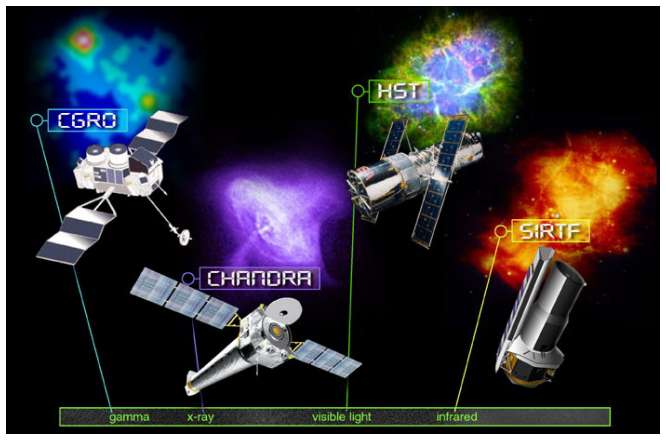
The Next Generation Great Observatories program, a fleet of coordinated one-to-two billion dollar missions that together address gaps left by flagships.
If this is right
- More flexible responses to evolving science questions from the Astro2020 survey through simultaneous observations from multiple platforms.
- Higher overall return on investment by spreading risk across several missions instead of concentrating it in one flagship.
- Stronger cross-division and external partnerships that reduce duplication and leverage combined resources.
- Faster incorporation of new technologies into the astrophysics portfolio without waiting for the next flagship cycle.
Where Pith is reading between the lines
- This architecture could shorten the time between major scientific advances by allowing incremental updates to the fleet rather than waiting for single large missions.
- It might encourage similar coordinated approaches in other NASA science divisions or international space agencies facing comparable budget constraints.
- The emphasis on partnerships could create new data-sharing standards that benefit the broader research community beyond the original mission teams.
Load-bearing premise
Missions in the one-to-two billion dollar range can be designed, built, and operated to deliver scientifically meaningful complementarity to flagship observatories while staying on budget and schedule.
What would settle it
A technical and cost study that demonstrates either that the proposed missions cannot achieve the required complementary data products or that coordination across divisions repeatedly causes delays and overruns beyond the two billion dollar ceiling.
Figures




read the original abstract
This white paper presents an analysis of Astro2020 science priorities and NASA's future astrophysics mission architecture, advocating for a coordinated fleet of \$1--2B missions, smaller than typical Flagship observatories, but strategically designed to complement them, i.e. a ``Next Generation Great Observatories" program. The study addresses opportunities in current mission planning, design, and implementation and proposes a strategic approach to maximize scientific return on investment while strengthening partnerships across NASA divisions, other government organizations, universities, and industry.
Editorial analysis
A structured set of objections, weighed in public.
Referee Report
Summary. This white paper analyzes Astro2020 science priorities and NASA's astrophysics mission architecture. It advocates for a 'Next Generation Great Observatories' program consisting of a coordinated fleet of $1--2B missions that are smaller than typical Flagship observatories but strategically designed to complement them, with the goal of maximizing scientific return on investment and strengthening partnerships across NASA divisions, other agencies, universities, and industry.
Significance. If the coordinated fleet concept holds, it could improve the efficiency of NASA's astrophysics program by filling observational gaps around Flagship missions, enabling more targeted responses to Astro2020 priorities, and fostering cross-division collaboration. The proposal is framed as an opportunity analysis rather than a technical proof, so its value lies in guiding future planning; adoption would depend on follow-on feasibility work.
major comments (1)
- The central claim that a fleet of $1--2B missions can provide meaningful complementarity to Flagships (Abstract and proposed strategic approach) is load-bearing for the recommendation but rests on unstated details of technical feasibility, cost control, and inter-division coordination. No specific mission concepts, preliminary trade studies, or quantitative complementarity metrics are supplied to support this premise.
minor comments (2)
- The manuscript would benefit from explicit cross-references to specific Astro2020 priority areas when discussing how the proposed fleet addresses them.
- Clarify the scope of the $1--2B cost range (e.g., total mission cost including operations) and provide context on how this compares to recent Probe-class or Explorer missions.
Simulated Author's Rebuttal
We thank the referee for their constructive review of our white paper. The feedback highlights an important consideration regarding the level of detail needed to support the proposed strategic approach. We address the major comment below and indicate the revisions planned for the next version of the manuscript.
read point-by-point responses
-
Referee: The central claim that a fleet of $1--2B missions can provide meaningful complementarity to Flagships (Abstract and proposed strategic approach) is load-bearing for the recommendation but rests on unstated details of technical feasibility, cost control, and inter-division coordination. No specific mission concepts, preliminary trade studies, or quantitative complementarity metrics are supplied to support this premise.
Authors: We agree with the referee that the manuscript does not supply specific mission concepts, preliminary trade studies, or quantitative complementarity metrics. As a white paper, its scope is limited to analyzing Astro2020 priorities and outlining a high-level strategic framework for a coordinated fleet, rather than conducting or presenting detailed technical or cost analyses. These elements would require dedicated follow-on studies beyond the current document's purpose. To address the concern, we will revise the manuscript by adding a dedicated paragraph in the strategic approach section that references existing NASA concept studies (e.g., from the Astrophysics Probe and Explorer programs) and discusses qualitative complementarity examples at a conceptual level. We will also explicitly state the paper's scope and recommend that quantitative assessments be pursued in future work. This partial revision will better ground the central claim while preserving the white paper's focus on opportunity analysis and coordination strategy. revision: partial
Circularity Check
No significant circularity detected in this policy white paper
full rationale
This is a strategic policy white paper with no equations, derivations, fitted parameters, or quantitative models. The central claim is a high-level recommendation for a coordinated fleet of $1-2B missions to complement Flagships, framed as an opportunity analysis of Astro2020 priorities rather than a falsifiable technical derivation. No load-bearing steps reduce by construction to inputs, self-citations, or ansatzes; the document contains no closed logical system whose predictions are equivalent to its premises. The argument is self-contained as an advocacy piece and does not invoke uniqueness theorems or renamings that would trigger circularity flags.
Axiom & Free-Parameter Ledger
axioms (1)
- domain assumption Astro2020 science priorities accurately represent the highest-value opportunities for future NASA astrophysics missions.
Reference graph
Works this paper leans on
-
[1]
Leisawitz
D. Leisawitz. The Space Infrared Interferometric Telescope (SPIRIT):A Far-IR Observatory for High-resolution Imaging and Spectroscopy.https: //asd.gsfc.nasa.gov/spice/documents/SPIRIT_PPP_RFI_final.pdf,
-
[2]
Accessed: 2026-05-01
2026
-
[3]
M. Harwit and V. Neal. The great observatories for space astrophysics. Technical Report NTRS 19860015241, NASA, 1986. URLhttps://ntrs .nasa.gov/citations/19860015241
-
[4]
D. M. Miles. Great observatories maturation: a review of NASA as- trophysics development through suborbital rocket and balloon programs. Journal of Astronomical Telescopes, Instruments, and Systems, 11(4): 042220, 2025. doi: 10.1117/1.JATIS.11.4.042220. URLhttps: //doi.org/10.1117/1.JATIS.11.4.042220
-
[5]
Astrophysics Fleet Chart.https://science.nasa.gov/astro physics/astrophysics- fleet- chart/, 2025
NASA. Astrophysics Fleet Chart.https://science.nasa.gov/astro physics/astrophysics- fleet- chart/, 2025. Updated: June 2025; Accessed: 2026-04-28
2025
-
[6]
The National Academies Press, Washington, DC, 2017
National Academies of Sciences Engineering and Medicine.Powering Sci- ence: NASA’s Large Strategic Science Missions. The National Academies Press, Washington, DC, 2017. ISBN 978-0-309-46386-7. doi: 10.17226/248
-
[7]
URLhttps://nap.nationalacademies.org/catalog/24857/poweri ng-science-nasas-large-strategic-science-missions
-
[8]
National Academies of Sciences Engineering and Medicine.Pathways to Discovery in Astronomy and Astrophysics for the 2020s. The National Academies Press, Washington, DC, 2023. ISBN 978-0-309-46734-6. doi: 10.17226/26141. URLhttps://nap.nationalacademies.org/catalog/ 26141/pathways-to-discovery-in-astronomy-and-astrophysics-for -the-2020s
-
[9]
The National Academies Press, Washington, DC,
National Academies of Sciences Engineering and Medicine.Origins, Worlds, and Life: A Decadal Strategy for Planetary Science and As- trobiology 2023-2032. The National Academies Press, Washington, DC,
2023
-
[10]
https://doi.org/10.17226/26522, URL https://doi.org/10.17226/26522
ISBN 978-0-309-47578-5. doi: 10.17226/26522. URLhttps: //nap.nationalacademies.org/catalog/26522/origins-worlds-a nd-life-a-decadal-strategy-for-planetary-science
-
[11]
How much does the James Webb Space Telescope cost?https://www.planetary.org/articles/cost-of-the-jwst, 2021
The Planetary Society. How much does the James Webb Space Telescope cost?https://www.planetary.org/articles/cost-of-the-jwst, 2021. Accessed: 2025-09-17
2021
-
[12]
Historical NASA Budget Data.https://docs.g oogle.com/spreadsheets/d/e/2PACX-1vTU9FhDV4U6X4suHtvoiMLYDN-y 56ipoGh-N7n9fNq7BW1PiMsx5fVlj10LsgvTYVbu3CiUDO_WD0We/pubhtml,
The Planetary Society. Historical NASA Budget Data.https://docs.g oogle.com/spreadsheets/d/e/2PACX-1vTU9FhDV4U6X4suHtvoiMLYDN-y 56ipoGh-N7n9fNq7BW1PiMsx5fVlj10LsgvTYVbu3CiUDO_WD0We/pubhtml,
-
[13]
Accessed: 2025-09-17. 30
2025
-
[14]
ASSESSING SCIENTIFIC PRODUCTIVITY OF NASA’S SPACE MISSIONS BY COST.https://www.hou.usra.edu/m eetings/lpsc2026/pdf/1606.pdf, 2026
The Planetary Society. ASSESSING SCIENTIFIC PRODUCTIVITY OF NASA’S SPACE MISSIONS BY COST.https://www.hou.usra.edu/m eetings/lpsc2026/pdf/1606.pdf, 2026. 57th LPSC (2026) Accessed: 2026-04-28. 31
2026
discussion (0)
Sign in with ORCID, Apple, or X to comment. Anyone can read and Pith papers without signing in.