Recognition: 3 theorem links
· Lean TheoremOpen-Closed-Open Triality Beyond Matrix Models
Pith reviewed 2026-05-08 18:07 UTC · model grok-4.3
The pith
Integrating out open strings from one brane stack generates an effective potential that exactly captures the backreaction of the other stack, matching probe actions to giant gravitons in the deformed conifold.
A machine-rendered reading of the paper's core claim, the machinery that carries it, and where it could break.
Core claim
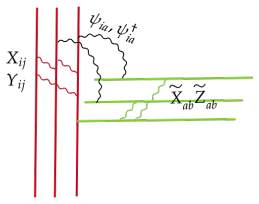
Starting from two transverse stacks of branes in the B-model on the resolved conifold, we obtain two equivalent open string descriptions. Both are full-fledged field theories. In the appropriate limit, they simplify to gauged βγ-systems with determinant insertions, as expected from open string field theory. The ρ-matrix models arise from an on-shell analysis of the field-theory actions. Most importantly, the effective potential generated by integrating out the open strings on the other stack exactly captures their backreaction on the geometry, matching the action of the probe branes to that of giant gravitons in the deformed conifold.
What carries the argument
The effective potential generated by integrating out open strings from one stack of branes, which encodes their backreaction on the geometry and reproduces giant graviton dynamics.
If this is right
- The ρ-matrix models emerge directly from the on-shell analysis of the full field-theory actions rather than being postulated separately.
- The second open string description diagnoses the emergent bulk spacetime by capturing the backreaction geometry.
- Probe branes in this setup behave exactly as giant gravitons once the effective potential is included.
- The triality between open and closed descriptions holds at the level of complete field theories, not only in matrix model reductions.
Where Pith is reading between the lines
- This structure suggests that backreaction in other Calabi-Yau compactifications could be derived similarly by integrating out open string modes without matrix model intermediates.
- The approach may generalize to compute emergent geometries in twisted holography setups beyond the conifold, providing a direct open-string route to closed-string data.
- It implies that matrix models are on-shell truncations of richer field theories whose off-shell content encodes more complete geometric information.
Load-bearing premise
The two open-string descriptions remain full-fledged field theories whose on-shell reduction yields the previously studied ρ-matrix models and that simplify in a suitable limit to gauged beta-gamma systems with determinant insertions.
What would settle it
An explicit computation of the effective potential from integrating out one stack's open strings that fails to reproduce the known giant graviton action in the deformed conifold.
Figures



read the original abstract
We explore the ideas of open-closed-open triality within twisted holography. Starting from two transverse stacks of branes in the B-model on the resolved conifold, we obtain two equivalent open string descriptions. Both are full-fledged field theories. In the appropriate limit, they simplify to gauged $\beta\gamma$-systems with determinant insertions, as expected from open string field theory. The $\rho$-matrix models that have appeared previously in the literature appear from an on-shell analysis of the field-theory actions. Most importantly, we show that the effective potential generated by integrating out the open strings on the other stack of branes exactly captures their backreaction on the geometry. In particular, we match the action of the probe branes to that of giant gravitons in the $\textit{deformed}$ conifold. The second open string description of the triality thus directly diagnoses the emergent bulk spacetime.
Editorial analysis
A structured set of objections, weighed in public.
Referee Report
Summary. The paper explores open-closed-open triality in twisted holography. Starting from two transverse stacks of branes in the B-model on the resolved conifold, it constructs two equivalent full-fledged open string field theories. In an appropriate limit these reduce to gauged βγ-systems with determinant insertions. An on-shell analysis of the actions recovers the ρ-matrix models from the literature. The central claim is that the effective potential obtained by integrating out the open strings on one stack exactly captures their backreaction on the geometry, with the probe-brane action matching that of giant gravitons in the deformed conifold; the second open-string description thereby diagnoses the emergent bulk spacetime.
Significance. If the exact matching of the effective potential to geometric backreaction holds, the result strengthens the open-closed-open triality by moving beyond matrix models to complete field-theoretic descriptions whose on-shell sector reproduces known ρ-models while directly encoding backreaction. The explicit match to giant-graviton actions on the deformed conifold supplies a concrete, falsifiable link between open-string dynamics and emergent geometry, which is a notable advance for twisted holography.
minor comments (3)
- The abstract and introduction state that the on-shell reduction yields the ρ-matrix models, but an explicit side-by-side comparison of the resulting effective potential (including the precise form of the determinant insertions) with the expressions in the cited prior literature would strengthen the claim of reproduction.
- Notation for the gauged βγ-systems (e.g., the precise definition of the gauge group and the insertion of the determinant operators) is introduced only briefly; a short dedicated paragraph or appendix collecting the field content and BRST transformations would improve readability.
- The limit in which the full open-string field theories simplify to the gauged βγ-systems is described qualitatively; stating the scaling of the string coupling or the relevant moduli that define this limit would make the reduction step more transparent.
Simulated Author's Rebuttal
We thank the referee for the positive assessment of our manuscript on open-closed-open triality and for recommending minor revision. The referee's summary accurately reflects the central results: the construction of equivalent open-string field theories from transverse brane stacks on the resolved conifold, their reduction to gauged beta-gamma systems, the recovery of rho-matrix models on-shell, and the demonstration that integrating out one stack produces an effective potential matching the backreaction and giant-graviton actions on the deformed conifold. Since the report lists no specific major comments, we will incorporate minor improvements for clarity and presentation in the revised version.
Circularity Check
No significant circularity; derivation chain is self-contained
full rationale
The paper starts from two transverse stacks of branes in the B-model on the resolved conifold and constructs two equivalent full-fledged open-string field theories. It then identifies a limit reducing them to gauged βγ-systems with determinant insertions, performs an on-shell analysis to recover the ρ-matrix models, and shows that integrating out one stack generates an effective potential matching the backreaction (including probe-brane action equaling giant-graviton action on the deformed conifold). No step in the supplied abstract or claim structure reduces the target result to a fitted parameter, a self-citation chain, or a definition that presupposes the output; the ρ-models are recovered as a derived consequence rather than imposed by construction, and the central matching claim follows from the triality construction itself.
Axiom & Free-Parameter Ledger
axioms (2)
- domain assumption The B-model on the resolved conifold admits two transverse stacks of branes whose open-string descriptions are full-fledged field theories.
- domain assumption There exists an appropriate limit in which the open-string theories simplify to gauged beta-gamma systems with determinant insertions.
Reference graph
Works this paper leans on
-
[1]
Gopakumar,Open-closed-open string duality, 2010.https://www.icts.res.in/ sites/default/files/media/attachments/files/joburg.pdf
R. Gopakumar,Open-closed-open string duality, 2010.https://www.icts.res.in/ sites/default/files/media/attachments/files/joburg.pdf. Talk at Second Joburg Workshop on String Theory
2010
-
[2]
Gopakumar and E
R. Gopakumar and E. A. Mazenc,Deriving the Simplest Gauge-String Duality – I: Open-Closed-Open Triality, 2023
2023
-
[3]
R. Gopakumar, R. Kaushik, S. Komatsu, E. A. Mazenc, and D. Sarkar,Strings from Feynman Diagrams,arXiv:2412.13397 [hep-th]
-
[4]
K. Costello and D. Gaiotto,Twisted Holography,arXiv:1812.09257 [hep-th]
-
[5]
Jarov,Twisted holography from the B-model on a 7-fold,arXiv:2512.07412 [hep-th]
S. Jarov,Twisted holography from the B-model on a 7-fold,arXiv:2512.07412 [hep-th]
-
[6]
R. Gopakumar and C. Vafa,On the gauge theory / geometry correspondence, Adv. Theor. Math. Phys.3(1999)1415–1443,arXiv:hep-th/9811131
-
[7]
H. Ooguri and C. Vafa,World sheet derivation of a large N duality, Nucl. Phys. B641 (2002)3–34,arXiv:hep-th/0205297
-
[8]
R. Dijkgraaf and C. Vafa,Matrix models, topological strings, and supersymmetric gauge theories, Nuclear Physics B6441-2, (Nov, 2002)3–20. http://dx.doi.org/10.1016/S0550-3213(02)00766-6
-
[9]
Two Dimensional Kodaira-Spencer Theory and Three Dimensional Chern-Simons Gravity
R. Dijkgraaf and C. Vafa,Two Dimensional Kodaira-Spencer Theory and Three Dimensional Chern-Simons Gravity,arXiv:0711.1932 [hep-th]
work page Pith review arXiv 1932
-
[10]
M. Aganagic, R. Dijkgraaf, A. Klemm, M. Marino, and C. Vafa,Topological Strings and Integrable Hierarchies, Communications in Mathematical Physics2612, (Oct, 2005)451–516.http://dx.doi.org/10.1007/s00220-005-1448-9. 23
-
[11]
K. Costello, N. M. Paquette, and A. Sharma,Top-Down Holography in an Asymptotically Flat Spacetime, Phys. Rev. Lett.1306, (2023)061602, arXiv:2208.14233 [hep-th]
-
[12]
K. Costello, N. M. Paquette, and A. Sharma,Burns space and holography, JHEP10 (2023)174,arXiv:2306.00940 [hep-th]
-
[13]
K. Costello and N. M. Paquette,Twisted Supergravity and Koszul Duality: A case study in AdS 3, Commun. Math. Phys.3841, (2021)279–339,arXiv:2001.02177 [hep-th]
- [14]
-
[15]
K. Costello and N. M. Paquette,Celestial holography meets twisted holography: 4d amplitudes from chiral correlators, JHEP10(2022)193,arXiv:2201.02595 [hep-th]
- [16]
-
[17]
J. M. Maldacena,The Large N limit of superconformal field theories and supergravity, Adv. Theor. Math. Phys.2(1998)231–252,arXiv:hep-th/9711200
work page internal anchor Pith review arXiv 1998
-
[18]
Witten,Two-dimensional gravity and intersection theory on moduli space, Surveys Diff
E. Witten,Two-dimensional gravity and intersection theory on moduli space, Surveys Diff. Geom.1(1991)243–310
1991
-
[19]
Kontsevich,Intersection theory on the moduli space of curves and the matrix Airy function, Commun
M. Kontsevich,Intersection theory on the moduli space of curves and the matrix Airy function, Commun. Math. Phys.147(1992)1–23
1992
-
[20]
D. Gaiotto and L. Rastelli,A Paradigm of open / closed duality: Liouville D-branes and the Kontsevich model, JHEP07(2005)053,arXiv:hep-th/0312196
-
[21]
J. Maldacena, G. Moore, N. Seiberg, and D. Shih,Exact vs. Semiclassical Target Space of the Minimal String, Journal of High Energy Physics200410, (Oct, 2004)020–020.http://dx.doi.org/10.1088/1126-6708/2004/10/020
-
[22]
Structure constants inN= 4 SYM at finite cou- pling as worldsheet g-function,
Y. Jiang, S. Komatsu, and E. Vescovi,Structure constants inN= 4 SYM at finite coupling as worldsheet g-function, JHEP0707, (2020)037,arXiv:1906.07733 [hep-th]
-
[23]
N. Berkovits,Topological A-Model forAdS 5 ×S 5 Superstring and the Maldacena Conjecture,arXiv:2506.10907 [hep-th]
-
[24]
N. Berkovits,Instanton Solutions of the Topological A-model Dual to Free Super-Yang-Mills,arXiv:2602.19985 [hep-th]
-
[25]
K. Budzik and D. Gaiotto,Giant gravitons in twisted holography,arXiv:2106.14859 [hep-th]. 24
- [26]
-
[27]
S. Caron-Huot, F. Coronado, and B. M¨ uhlmann,Determinants in self-dualN= 4 SYM and twistor space, JHEP08(2023)008,arXiv:2304.12341 [hep-th]
-
[28]
Invasion of the Giant Gravitons from Anti-de Sitter Space
J. McGreevy, L. Susskind, and N. Toumbas,Invasion of the giant gravitons from Anti-de Sitter space, JHEP06(2000)008,arXiv:hep-th/0003075
work page Pith review arXiv 2000
-
[29]
Large branes in AdS and their field theory dual
A. Hashimoto, S. Hirano, and N. Itzhaki,Large branes in AdS and their field theory dual, JHEP08(2000)051,arXiv:hep-th/0008016
work page Pith review arXiv 2000
-
[30]
Giant Gravitons in Conformal Field Theory
V. Balasubramanian, M. Berkooz, A. Naqvi, and M. J. Strassler,Giant gravitons in conformal field theory, JHEP04(2002)034,arXiv:hep-th/0107119
work page Pith review arXiv 2002
-
[31]
Witten,Chern-Simons gauge theory as a string theory,Prog
E. Witten,Chern-Simons gauge theory as a string theory, Prog. Math.133 (1995)637–678,arXiv:hep-th/9207094
-
[32]
M. Bershadsky, S. Cecotti, H. Ooguri, and C. Vafa,Kodaira-Spencer theory of gravity and exact results for quantum string amplitudes, Commun. Math. Phys.165 (1994)311–428,arXiv:hep-th/9309140
-
[33]
M. Bershadsky, S. Cecotti, H. Ooguri, and C. Vafa,Holomorphic anomalies in topological field theories, Nucl. Phys. B405(1993)279–304,arXiv:hep-th/9302103
-
[34]
Vafa,Superstrings and topological strings at large N, J
C. Vafa,Superstrings and topological strings at large N, J. Math. Phys.42 (2001)2798–2817,arXiv:hep-th/0008142
-
[35]
K. Costello and S. Li,Quantization of open-closed BCOV theory, I, arXiv:1505.06703 [hep-th]
-
[36]
Hofman,On the open closed B model, JHEP11(2003)069,arXiv:hep-th/0204157
C. Hofman,On the open closed B model, JHEP11(2003)069,arXiv:hep-th/0204157
-
[37]
A. L´ opez-Raven,D-Brane Systems in Twisted Holography and SO/Sp Chiral Algebras, arXiv:2412.01905 [hep-th]
-
[38]
Gopakumar, arXiv:1104.2386 [hep-th] (2011)
R. Gopakumar,What is the Simplest Gauge-String Duality?,arXiv:1104.2386 [hep-th]
-
[39]
Gopakumar,From free fields to AdS: III, Phys
R. Gopakumar,From free fields to AdS: III, Phys. Rev. D72(2005)066008, arXiv:hep-th/0504229
-
[40]
N. Ishtiaque, S. Faroogh Moosavian, and Y. Zhou,Topological holography: The example of the D2-D4 brane system, SciPost Phys.92, (2020)017,arXiv:1809.00372 [hep-th]
-
[41]
Budzik,Supergroup Invariants and the Brane/Negative Brane Expansion,2509.20451
K. Budzik,Supergroup Invariants and the Brane/Negative Brane Expansion, arXiv:2509.20451 [hep-th]. 25
-
[42]
Exact Correlators of Giant Gravitons from dual N=4 SYM
S. Corley, A. Jevicki, and S. Ramgoolam,Exact correlators of giant gravitons from dual N=4 SYM theory, Adv. Theor. Math. Phys.5(2002)809–839, arXiv:hep-th/0111222
work page internal anchor Pith review arXiv 2002
- [43]
- [44]
- [45]
discussion (0)
Sign in with ORCID, Apple, or X to comment. Anyone can read and Pith papers without signing in.