Recognition: 2 theorem links
· Lean TheoremPost-Recombination Fluctuations from a Sequestered Dark Sector
Pith reviewed 2026-05-08 17:45 UTC · model grok-4.3
The pith
Late-time energy injections from a sequestered dark sector modify photon geodesics and leave imprints on the CMB dominated by anisotropic stress.
A machine-rendered reading of the paper's core claim, the machinery that carries it, and where it could break.
Core claim
We develop a formalism to characterize the imprints of late-time sources of cosmological fluctuations under the sole assumption that the injection occurs on timescales short compared to the horizon. For post-recombination injections, we derive the general modification of photon geodesics in the presence of scalar, vector, and tensor perturbations, and compute the resulting impact on the Cosmic Microwave Background through the integrated Sachs-Wolfe effect. We show that the signal is generically dominated by instantaneous injections of anisotropic stress. As an application, we consider first-order phase transitions in a sequestered dark sector and show that current observations constrain the
What carries the argument
General modification of photon geodesics from scalar, vector, and tensor perturbations induced by short-timescale post-recombination energy injections, with the dominant contribution arising from instantaneous anisotropic stress.
If this is right
- The CMB temperature anisotropy gains an extra integrated Sachs-Wolfe contribution from the induced perturbations.
- The effect is generically dominated by anisotropic stress, while vector and tensor modes remain subdominant.
- First-order phase transitions in sequestered dark sectors are limited to fractional energy injections below the permille level by current data.
- The formalism applies to any post-recombination fluctuation source that satisfies the short-timescale condition.
Where Pith is reading between the lines
- The same geodesic modification could be adapted to bound other late-time processes such as dark matter decays or late-time energy releases from new physics.
- Future high-sensitivity CMB polarization data might better separate vector and tensor contributions from the dominant scalar anisotropic stress signal.
- Analogous calculations could probe pre-recombination injections through different observables like the 21 cm signal or spectral distortions.
Load-bearing premise
The energy injection occurs on timescales short compared to the cosmological horizon at the relevant epoch.
What would settle it
CMB power spectrum measurements that show no excess temperature anisotropy at the amplitude predicted for a fractional energy injection of order 0.001 would directly challenge the derived constraints.
Figures
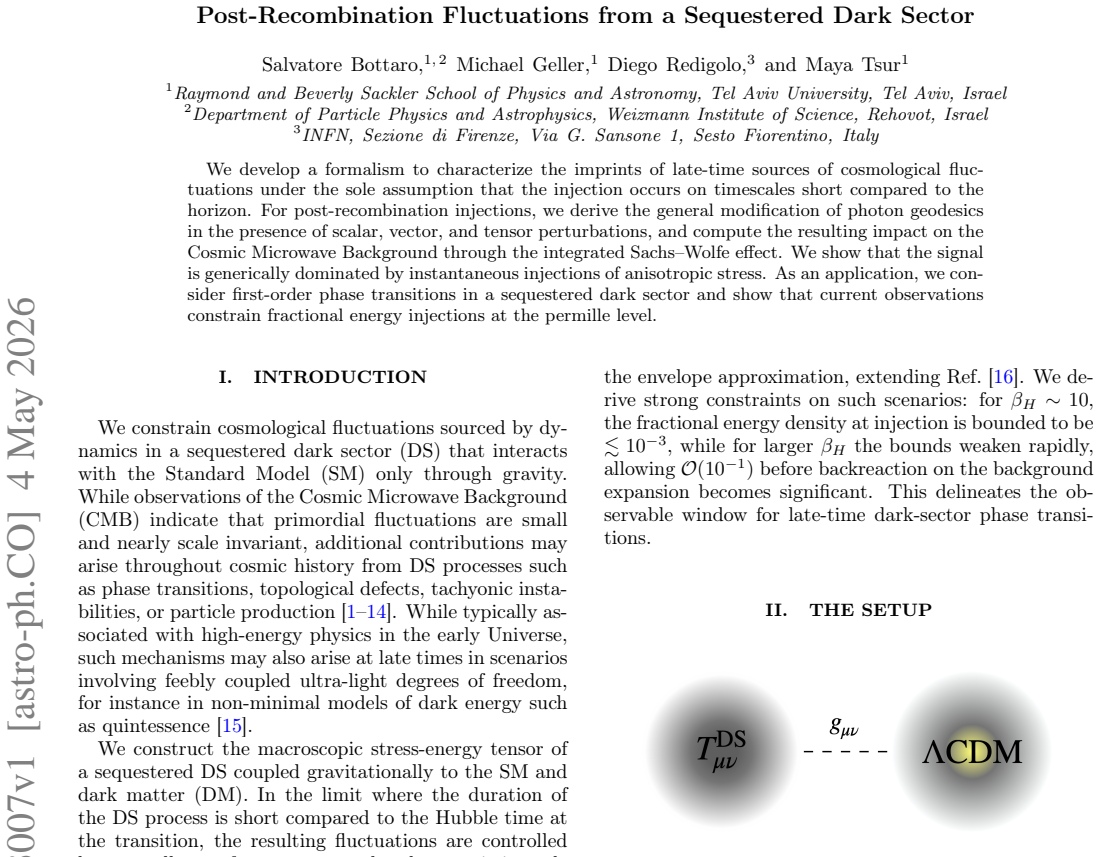


read the original abstract
We develop a formalism to characterize the imprints of late-time sources of cosmological fluctuations under the sole assumption that the injection occurs on timescales short compared to the horizon. For post-recombination injections, we derive the general modification of photon geodesics in the presence of scalar, vector, and tensor perturbations, and compute the resulting impact on the Cosmic Microwave Background through the integrated Sachs-Wolfe effect. We show that the signal is generically dominated by instantaneous injections of anisotropic stress. As an application, we consider first-order phase transitions in a sequestered dark sector and show that current observations constrain fractional energy injections at the permille level.
Editorial analysis
A structured set of objections, weighed in public.
Referee Report
Summary. The manuscript develops a formalism to characterize the imprints of late-time sources of cosmological fluctuations under the sole assumption that the injection occurs on timescales short compared to the horizon. For post-recombination injections, it derives the general modification of photon geodesics in the presence of scalar, vector, and tensor perturbations and computes the resulting impact on the Cosmic Microwave Background through the integrated Sachs-Wolfe effect. The authors show that the signal is generically dominated by instantaneous injections of anisotropic stress. As an application, they consider first-order phase transitions in a sequestered dark sector and derive constraints on fractional energy injections at the permille level from current observations.
Significance. If the central claims hold, this provides a useful general framework for constraining late-time energy injections from dark sectors via CMB observations, with the minimal short-timescale assumption enabling broad applicability. The derivation of geodesic modifications across perturbation types and the concrete permille-level bounds on sequestered phase transitions are strengths that could inform future probes of hidden sectors. No machine-checked proofs or fully parameter-free derivations are highlighted, but the general formalism under a single external assumption is a positive feature.
major comments (1)
- [Abstract] Abstract and the section deriving the ISW effect: the claim that the signal is generically dominated by instantaneous injections of anisotropic stress follows from the short-timescale assumption alone. However, the integrated Sachs-Wolfe integral receives contributions from scalar density perturbations and vector velocity terms in addition to tensor anisotropic stress; the timescale condition permits an instantaneous treatment but does not suppress the former relative to the latter without further restrictions on the stress-energy tensor (e.g., tracelessness or vanishing isotropic pressure perturbations). This is load-bearing for the generic-domination statement and the subsequent observational constraints.
minor comments (1)
- The term 'sequestered dark sector' is introduced without a concise definition or reference to prior literature in the opening paragraphs; a brief explanatory sentence would improve accessibility.
Simulated Author's Rebuttal
We thank the referee for their thorough review and constructive feedback on our manuscript. We address the major comment below, providing clarification on the assumptions underlying our claims.
read point-by-point responses
-
Referee: [Abstract] Abstract and the section deriving the ISW effect: the claim that the signal is generically dominated by instantaneous injections of anisotropic stress follows from the short-timescale assumption alone. However, the integrated Sachs-Wolfe integral receives contributions from scalar density perturbations and vector velocity terms in addition to tensor anisotropic stress; the timescale condition permits an instantaneous treatment but does not suppress the former relative to the latter without further restrictions on the stress-energy tensor (e.g., tracelessness or vanishing isotropic pressure perturbations). This is load-bearing for the generic-domination statement and the subsequent observational constraints.
Authors: We thank the referee for highlighting this important nuance. The short-timescale assumption indeed enables the instantaneous approximation for the injection, allowing us to model the perturbations as occurring at a specific conformal time. However, the generic domination by anisotropic stress arises in our framework because we consider injections from a sequestered dark sector, where the stress-energy tensor perturbations are dominated by anisotropic stress (e.g., from bubble walls in phase transitions, which are traceless and have no isotropic pressure component in the relevant gauge). Scalar density and vector velocity contributions are subdominant under these conditions, as the dark sector does not source direct density perturbations in the visible sector without coupling. We have revised the abstract and the relevant section to explicitly state the additional assumptions on the stress-energy tensor that lead to this domination. This clarification strengthens the presentation without altering the derived constraints, which apply specifically to the phase transition scenario considered. revision: yes
Circularity Check
No circularity; formalism built from standard perturbation theory and external short-timescale assumption
full rationale
The paper states it develops the formalism under the sole external assumption of short-timescale injections relative to the horizon. It then derives the general photon geodesic modifications for scalar/vector/tensor perturbations and the ISW impact directly from those equations. No quoted step reduces a prediction to a fitted input, renames a known result, or relies on a load-bearing self-citation whose content is itself unverified or defined by the present work. The central claim of generic domination by anisotropic stress is presented as following from the general equations rather than being presupposed by definition or prior self-work. The derivation chain is therefore self-contained against external benchmarks of cosmological perturbation theory.
Axiom & Free-Parameter Ledger
axioms (1)
- domain assumption Injection occurs on timescales short compared to the horizon
invented entities (1)
-
Sequestered dark sector
no independent evidence
Lean theorems connected to this paper
-
IndisputableMonolith.Constants (RSUnits, c, ℏ, G as φ-powers)Bounds on Ω_DS are empirical fits to Planck data, not parameter-free derivations from a cost functional; no analogue to RS's φ-ladder constants. unclearcurrent observations constrain fractional energy injections at the permille level... for βH ∼ 10, the fractional energy density at injection is bounded to be ≲10^-3
Reference graph
Works this paper leans on
-
[1]
T. W. B. Kibble, Physics Reports67, 183 (1980)
1980
-
[2]
Witten, Physical Review D30, 272 (1984)
E. Witten, Physical Review D30, 272 (1984)
1984
-
[3]
A. H. Guth and S.-H. H. Tye, Physical Review Letters 44, 631 (1980)
1980
-
[4]
T. W. B. Kibble, Journal of Physics A9, 1387 (1976)
1976
-
[5]
W. H. Zurek, Nature317, 505 (1985)
1985
-
[6]
Vilenkin and E
A. Vilenkin and E. P. S. Shellard,Cosmic Strings and Other Topological Defects(Cambridge University Press, 1994)
1994
-
[7]
Hindmarsh and T
M. Hindmarsh and T. W. B. Kibble, Reports on Progress in Physics58, 477 (1995)
1995
-
[8]
Felder, L
G. Felder, L. Kofman, and A. Linde, Physical Review D 64, 123517 (2001)
2001
-
[9]
G.Felder, L.Kofman, A.Linde, andI.Tkachev,Physical Review Letters87, 011601 (2001)
2001
-
[10]
Parker, Physical Review Letters21, 562 (1968)
L. Parker, Physical Review Letters21, 562 (1968)
1968
-
[11]
Kofman, A
L. Kofman, A. Linde, and A. Starobinsky, Physical Re- view Letters73, 3195 (1994)
1994
-
[12]
Kofman, A
L. Kofman, A. Linde, and A. Starobinsky, Physical Re- view D56, 3258 (1997)
1997
-
[13]
Mazumdar and G
A. Mazumdar and G. White, Reports on Progress in Physics82, 076901 (2019)
2019
-
[14]
M. A. Amin, M. P. Hertzberg, D. I. Kaiser, and J. Karouby, International Journal of Modern Physics D 24, 1530003 (2014)
2014
-
[15]
P. Creminelli, G. D’Amico, J. Norena, and F. Vernizzi, JCAP02, 018 (2009), arXiv:0811.0827 [astro-ph]
-
[16]
R. Jinno and M. Takimoto, Phys. Rev. D95, 024009 (2017), arXiv:1605.01403 [astro-ph.CO]
-
[17]
M. S. Turner, E. J. Weinberg, and L. M. Widrow, Phys. Rev. D46, 2384 (1992)
1992
-
[18]
C. Caprini, R. Durrer, T. Konstandin, and G. Servant, Phys. Rev. D79, 083519 (2009), arXiv:0901.1661 [astro- ph.CO]
- [19]
-
[20]
D. S. Gorbunov and V. A. Rubakov,Introduction to the theory of the early universe: Cosmological perturbations and inflationary theory(2011)
2011
-
[21]
M. LoVerde and N. Afshordi, Phys. Rev. D78, 123506 (2008), arXiv:0809.5112 [astro-ph]
-
[22]
A. Kosowsky and M. S. Turner, Phys. Rev. D47, 4372 (1993), arXiv:astro-ph/9211004
- [23]
- [24]
- [25]
- [26]
-
[27]
Unveiling dark fifth forces with linear cosmology,
M. Archidiacono, E. Castorina, D. Redigolo, and E. Salvioni, JCAP10, 074 (2022), arXiv:2204.08484 [astro-ph.CO]
-
[28]
S. Bottaro, E. Castorina, M. Costa, D. Redigolo, and E. Salvioni, Phys. Rev. Lett.132, 201002 (2024), arXiv:2309.11496 [astro-ph.CO]
-
[29]
D. Blas, J. Lesgourgues, and T. Tram, JCAP07, 034 (2011), arXiv:1104.2933 [astro-ph.CO]
work page internal anchor Pith review arXiv 2011
-
[30]
Bottaro, M
S. Bottaro, M. Cipressi, B. Hatzofe, and T. Opferkuch, (to appear)
-
[31]
M. A. Amin, M. S. Delos, and M. Mirbabayi, JCAP01, 016 (2026), arXiv:2503.20881 [astro-ph.CO]. 7 Appendix A: Transfer functions Here, we go through the derivation of the transfer functions that relate the sources to the metric fluctuations whose definition is repeated here for simplicity Ψ(η, k) = ΩDS βH h Tσ(η, k)ˆσ(⃗k) +T p(η, k)ˆp(⃗k) i ,(A1) Wi(η, k) ...
discussion (0)
Sign in with ORCID, Apple, or X to comment. Anyone can read and Pith papers without signing in.