Recognition: unknown
Rigorous error bounds for dissipative thermal state preparation from weak system-bath coupling
Pith reviewed 2026-05-09 15:33 UTC · model grok-4.3
The pith
The unitary evolution from the system Hamiltonian in collision models tightens the fixed-point error bound for thermal states, scaling as the square of the coupling strength.
A machine-rendered reading of the paper's core claim, the machinery that carries it, and where it could break.
Core claim
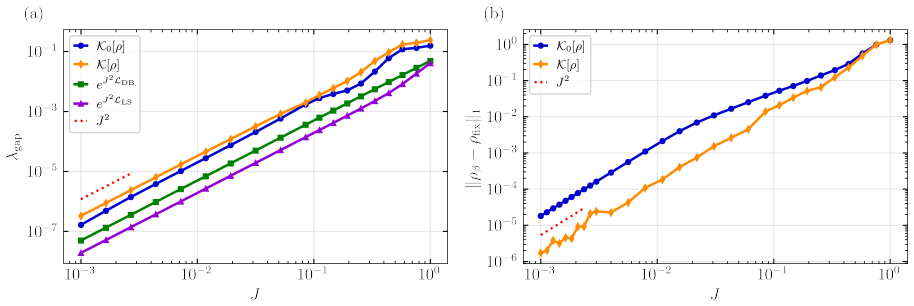
In collision-model constructions that approximate Lindblad dynamics for thermal state preparation, the full evolution includes both the desired dissipative part and a unitary evolution generated by the system Hamiltonian. We demonstrate that this unitary contribution tightens the fixed-point error bound and that the effect is rigorously controlled by the weak system-bath coupling strength J, scaling as J². This shows that the spurious Lamb shift term can be controlled by tuning J. We also clarify how randomization suppresses resonances with the many-body spectrum and bound the extra variance it imposes on observables, while numerically examining the mixing time.
What carries the argument
Collision model with time-dependent couplings to resettable ancilla qubits that simultaneously implements Lindblad dissipators and an additional unitary Lamb-shift term from the system Hamiltonian.
If this is right
- The fixed-point error bound improves when the unitary contribution is retained rather than discarded.
- The Lamb-shift error can be made arbitrarily small by reducing the coupling strength J while still approximating the desired dissipative dynamics.
- Randomization of the drive suppresses resonances with the many-body spectrum at the cost of only bounded extra variance on observables.
- Mixing times remain accessible to numerical study and can guide practical parameter choices.
Where Pith is reading between the lines
- Balancing weaker J against longer mixing times could optimize total preparation time on hardware with limited coherence.
- The same J² control may apply to other analog open-system simulations where unitary corrections naturally appear.
- Direct experimental measurement of the error versus J on small systems would test the scaling prediction.
Load-bearing premise
The analysis assumes the weak-coupling regime in which higher-order terms in the system-bath interaction can be neglected and the collision model faithfully approximates the target Lindbladian dynamics.
What would settle it
A calculation or simulation in which the fixed-point error fails to scale as J² or fails to tighten when the unitary Lamb-shift term is included as J is varied.
Figures



read the original abstract
Thermal state preparation is a central challenge in the simulation of quantum many-body systems. Yet, provably efficient algorithms for this task were only introduced recently [Chen et al. Nature 646, 561 (2025)]. These algorithms are based on dissipative Lindbladian evolution which exactly fixes the thermal state. Controlled and efficient digital simulation of this evolution, although possible in principle, remains out of reach for present-day quantum hardware. Subsequent work has therefore focused on analog approximations of the proposed Lindbladians via `collision models' with relatively modest requirements -- a resettable bath of ancilla qubits whose couplings to the system can be tuned in time-dependent fashion -- while still admitting rigorous fixed-point error bounds. Existing rigorous approaches, however, do not exploit the fact that these constructions generically implement not only the desired Lindblad dynamics, but also an additional unitary evolution generated by the system Hamiltonian which may aid convergence to the thermal state [Lloyd and Abanin arXiv:2506.21318 (2025)]. Here, we show that this unitary contribution does indeed tighten the fixed-point error bound and demonstrate that it is rigorously controlled by the system-bath coupling strength $J$, scaling as $J^2$. This demonstrates that the effect of the spurious `Lamb shift' term generated by the system-bath interaction can be controlled by tuning $J$. We clarify the role, previously observed, of a randomized implementation in suppressing possible resonances of the drive with the many-body spectrum, and bound the additional variance that this randomization imposes on observables. Finally, we numerically study aspects of the protocol which are relevant for its practical realization, such as the mixing time.
Editorial analysis
A structured set of objections, weighed in public.
Referee Report
Summary. The manuscript develops rigorous error bounds for analog simulation of dissipative thermal state preparation via collision models in the weak system-bath coupling regime. It shows that the additional unitary evolution generated by the system Hamiltonian (the spurious Lamb shift) tightens the fixed-point error bound and is rigorously controlled by the coupling strength J with scaling O(J²). The paper also clarifies how randomized implementations suppress resonances with the many-body spectrum while bounding the induced variance on observables, and provides numerical studies of mixing times relevant to practical implementation.
Significance. If the claimed O(J²) bounds hold under the stated weak-coupling assumptions, this work meaningfully strengthens the theoretical basis for collision-model approximations of Lindbladian thermal-state preparation. By demonstrating explicit control over the unitary contribution through tuning J, it addresses a practical limitation in existing analog approaches and could facilitate more accurate near-term quantum simulations of many-body thermal states. The variance bounds and numerical mixing-time analysis further enhance the result's utility for hardware implementation.
major comments (1)
- The central O(J²) scaling for the fixed-point error tightening due to the unitary term rests on the weak-coupling expansion of the collision model; the derivation must explicitly show that higher-order terms in J do not alter the leading-order bound or introduce system-size dependence that would undermine the claim for large many-body systems.
minor comments (2)
- The numerical section on mixing times would benefit from explicit statements of the system sizes, Hamiltonian parameters, and number of samples used, along with direct comparison of observed mixing times to any analytic estimates derived earlier in the manuscript.
- Clarify the precise definition of the randomized implementation (e.g., the distribution over collision sequences) when bounding the additional variance, to ensure the bound is stated in terms of observable operators rather than abstract norms.
Simulated Author's Rebuttal
We thank the referee for their positive assessment and recommendation of minor revision. We address the major comment below with a clarification of the weak-coupling analysis and its uniformity with respect to system size.
read point-by-point responses
-
Referee: The central O(J²) scaling for the fixed-point error tightening due to the unitary term rests on the weak-coupling expansion of the collision model; the derivation must explicitly show that higher-order terms in J do not alter the leading-order bound or introduce system-size dependence that would undermine the claim for large many-body systems.
Authors: We appreciate the referee drawing attention to the need for explicit control over higher-order terms. The derivation in Section III proceeds from the exact collision map and performs a perturbative expansion in the system-bath coupling J. The desired Lindblad generator appears at order J, while the additional unitary (Lamb-shift) contribution enters at order J² and tightens the fixed-point distance by an amount proportional to J². All remaining terms in the expansion of the collision operator are O(J³) and higher; because the weak-coupling regime assumes J ≪ 1 (with the small parameter independent of system size), these terms are strictly subdominant and cannot cancel or alter the leading O(J²) correction to the fixed-point error. The error bounds themselves are obtained via a norm estimate that depends only on the local interaction strength and the bounded per-site norm of the system Hamiltonian; consequently the O(J²) scaling remains uniform in the number of sites N. The randomization analysis in Section IV further guarantees that any potential many-body resonances are suppressed with a variance bound that grows at most logarithmically in N, not exponentially. In the revised manuscript we will insert a short paragraph immediately after Eq. (12) that explicitly states the order of the neglected terms and reiterates the N-independence of the constants appearing in the bound. revision: yes
Circularity Check
No significant circularity; derivation follows from weak-coupling expansion
full rationale
The paper's central result—that the unitary Lamb-shift contribution tightens the fixed-point error bound with rigorous O(J²) control—is obtained by perturbative expansion of the collision model under the explicit weak-coupling assumptions. This expansion starts from the system-bath interaction Hamiltonian and the resettable-ancilla collision protocol, without reducing to a fitted parameter, a self-defined quantity, or a load-bearing self-citation. Prior works cited (Chen et al., Lloyd-Abanin) supply the target Lindbladian and the basic collision-model setup but are not invoked to justify uniqueness or to smuggle in an ansatz; the present analysis adds an independent bound on the unitary term and on randomization variance. The derivation chain therefore remains self-contained against the stated model assumptions and does not collapse to its inputs by construction.
Axiom & Free-Parameter Ledger
axioms (2)
- domain assumption Weak system-bath coupling allows truncation after second order in the interaction Hamiltonian.
- domain assumption The time-dependent collision model with resettable ancillae implements the desired dissipative Lindbladian plus a controllable unitary term.
Reference graph
Works this paper leans on
-
[1]
Approximation of the channel As a first step, the channelK[ρ] is approximated by another channel that is easier to analyze (Sec. IV A). Denote the propagator of the system dynamics asU 0(t) =e −iHt. Define KLS[ρ] = Z ∞ −∞ dx p(x)U0(T+x) e J 2LLS ρ U † 0(T+x).(B1) The LindbladianL LS[ρ] agrees up to a coherent term with the detailed balance LindbladianL DB...
-
[2]
An ansatz for the approximate fixed point ˜ρis obtained using degenerate perturbation theory, as outlined in Ref
Approximate fixed point ofK LS To bound∥ρ β −ρ LS∥1, we construct an approximate fixed point ofK LS,K LS[˜ρ]−˜ρ=O(J4) and split the bound using the triangle inequality ∥ρβ −ρ LS∥1 ≤ ∥ρ β −˜ρ∥1 +∥˜ρ−ρ LS∥1 ≤ϵ+∥ρ β −˜ρ∥1 + tmix,J(ϵ) J2 ∥˜ρ− KLS[˜ρ]∥1,(B7) where the last inequality makes use of Lemma 1. An ansatz for the approximate fixed point ˜ρis obtained...
-
[3]
(B6) and Eq
Combining the bounds Finally, combining Eq. (B6) and Eq. (B15) gives the total fixed-point error: ∥ρβ −ρ fix∥1 ≤ ∥ρ β −ρ LS∥1 +∥ρ fix −ρ LS∥1 ≤2ϵ+O J2 nBβ σ3 T 6 T 4 0 e 9β2 4σ2 +t mix,J(ϵ)O nBe β2 4σ2 e − T 2 2σ2 +4T 2 0 +J 2n2 Be β2 2σ2 +t mix,J(ϵ)O J2n2 B 1 + β σ3 T 6 T 4 0 e 5β2 2σ2 . (B16) Eq. (B16) is the explicit expression for the fixed-point erro...
-
[4]
Z T /2+x −T /2 dt∥V(t)∥ ∞ #4 . (C8) 17 Odd orders inJvanish after tracing out the bath degrees of freedom. At orderJ 2, there are three contribu- tions: TrB
Bounds on the channel distance In this subsection, the bound for the channel distance∥K − K LS∥1→1 stated in Eq. (B5) is derived. To do so, observe: ∥K − KLS∥1→1 ≤ Z ∞ −∞ dx p(x) Kx[·]−e −iH(T+x) eJ 2LLS[·]eiH(T+x) 1→1 .(C1) The channelK x[ρ] can be represented as Kx[ρ] =e −iH(T+x) TrB h ˜Ux[ρ⊗ρ 0 B] ˜U † x i eiH(T+x) ≡e −iH(T+x) ˜Kx[ρ]eiH(T+x) ,(C2) wher...
-
[5]
(B13) is derived, where ˜ρis defined byK LS[˜ρ]−˜ρ=O(J 4)
Bounds on the approximate fixed point In this subsection, the bound for the approximate fixed point∥ρ β −˜ρ∥1 =J 2∥σ∥1 stated in Eq. (B13) is derived, where ˜ρis defined byK LS[˜ρ]−˜ρ=O(J 4). From the definition in Eq. (B12), it follows thatσcan be expressed as σ=ρ 1/2 β Ωρ1/2 β ,(C19) where Ω is a matrix whose components in the energy eigenbasis are give...
-
[6]
Bounds on∥˜ρ− K LS[˜ρ]∥1 In this subsection, we derive a bound for∥˜ρ− K LS[˜ρ]∥1, which is the last ingredient needed to obtain the fixed-point error bound in App. B. Using the expansion ˜ρ=ρ β +J 2σande J 2LLS =ρ+J 2LLS[ρ] +O J4n2 Be β2 2σ2 , this gives at orderJ 4: ∥˜ρ− KLS[˜ρ]∥1 ≤J 4 Z ∞ −∞ dx p(x) e−iH(T+x) LLS[σ]eiH(T+x) 1 +O J4n2 Be β2 2σ2 .(C48) D...
-
[7]
For a controlled comparison with our protocol [Fig
These works propose a randomization of the bath Hamiltonian, and a randomization of jump operators in order to derive a tractable bound for the mixing time of the channel in terms of the exact Gibbs sampler. For a controlled comparison with our protocol [Fig. 5], we only test the randomization of the bath Hamil- tonian. We use the same protocol parameters...
-
[8]
Metropolis, A
N. Metropolis, A. W. Rosenbluth, M. N. Rosen- bluth, A. H. Teller, and E. Teller, Equation of state calculations by fast computing machines, The Jour- nal of Chemical Physics21, 1087 (1953)
1953
-
[9]
Levin and Y
D. Levin and Y. Peres,Markov Chains and Mix- ing Times, MBK (American Mathematical Society, 2017)
2017
-
[10]
Motta, C
M. Motta, C. Sun, A. T. K. Tan, M. J. O’Rourke, E. Ye, A. J. Minnich, F. G. S. L. Brand˜ ao, and G. K.-L. Chan, Determining eigenstates and ther- mal states on a quantum computer using quantum imaginary time evolution, Nature Physics16, 205 (2020)
2020
-
[11]
Consiglio, Variational quantum algorithms for gibbs state preparation, inNumerical Compu- tations: Theory and Algorithms(Springer Nature Switzerland, 2025) p
M. Consiglio, Variational quantum algorithms for gibbs state preparation, inNumerical Compu- tations: Theory and Algorithms(Springer Nature Switzerland, 2025) p. 56–70
2025
-
[12]
A. Deshpande, M. Hinsche, K. Najafi, K. Sharma, R. Sweke, and C. Zoufal, Dynamic parameterized quantum circuits: expressive and barren-plateau 25 free, arXiv:2411.05760 (2025)
-
[13]
Ilin and I
Y. Ilin and I. Arad, Dissipative variational quan- tum algorithms for Gibbs state preparation, IEEE Transactions on Quantum Engineering6, 1 (2025)
2025
-
[14]
Poulin and P
D. Poulin and P. Wocjan, Sampling from the ther- mal quantum Gibbs state and evaluating partition functions with a quantum computer, Phys. Rev. Lett.103, 220502 (2009)
2009
-
[15]
B. M. Terhal and D. P. DiVincenzo, Problem of equilibration and the computation of correlation functions on a quantum computer, Phys. Rev. A 61, 022301 (2000)
2000
-
[16]
S. Roy, J. T. Chalker, I. V. Gornyi, and Y. Gefen, Measurement-induced steering of quantum systems, Phys. Rev. Res.2, 033347 (2020)
2020
- [17]
-
[18]
Lin, Dissipative preparation of many-body quan- tum states: Toward practical quantum advantage, APL Computational Physics1, 010901 (2025)
L. Lin, Dissipative preparation of many-body quan- tum states: Toward practical quantum advantage, APL Computational Physics1, 010901 (2025)
2025
-
[19]
C.-F. Chen, M. Kastoryano, F. G. Brand˜ ao, and A. Gily´ en, Efficient quantum thermal simulation, Nature646, 561 (2025)
2025
- [20]
-
[21]
Z. Ding, B. Li, and L. Lin, Efficient quantum Gibbs samplers with Kubo–Martin–Schwinger de- tailed balance condition, Communications in Math- ematical Physics406, 67 (2025)
2025
-
[22]
G. S. Agarwal, Open quantum Markovian systems and the microreversibility, Zeitschrift f¨ ur Physik A Hadrons and nuclei258, 409 (1973)
1973
-
[23]
Alicki, On the detailed balance condition for non-hamiltonian systems, Reports on Mathematical Physics10, 249 (1976)
R. Alicki, On the detailed balance condition for non-hamiltonian systems, Reports on Mathematical Physics10, 249 (1976)
1976
-
[24]
Kossakowski, A
A. Kossakowski, A. Frigerio, V. Gorini, and M. Verri, Quantum detailed balance and KMS con- dition, Communications in Mathematical Physics 57, 97 (1977)
1977
-
[25]
Fagnola and V
F. Fagnola and V. Umanita, Generators of detailed balance quantum Markov semigroups, Infinite Di- mensional Analysis, Quantum Probability and Re- lated Topics10, 335 (2007)
2007
-
[26]
A. Gily´ en, C.-F. Chen, J. F. Doriguello, and M. J. Kastoryano, Quantum generalizations of glauber and metropolis dynamics, arXiv:2405.20322 (2026)
-
[27]
E. B. Davies, Markovian master equations, Commu- nications in Mathematical Physics39, 91 (1974)
1974
-
[28]
E. B. Davies, Markovian master equations. ii, Math- ematische Annalen219, 147 (1976)
1976
-
[29]
Rouze, D
C. Rouze, D. Stilck Franca, and A. M. Alham- bra, Efficient thermalization and universal quantum computing with quantum Gibbs samplers, Nature Physics (2026)
2026
-
[30]
Rouze, D
C. Rouze, D. Stilck Franca, and A. M. Alhambra, Optimal quantum algorithm for Gibbs state prepa- ration, Physical Review Letters136(2026)
2026
- [31]
-
[32]
Y. Tong and Y. Zhan, Fast mixing of weakly in- teracting fermionic systems at any temperature, arXiv:2501.00443 (2024)
-
[33]
S. Smid, R. Meister, M. Berta, and R. Bonde- san, Polynomial-time quantum Gibbs sampling for the weak and strong coupling regime of the Fermi- Hubbard model at any temperature, Nature Com- munications16(2025)
2025
-
[34]
T. Bergamaschi and C.-F. Chen, Fast mixing of quantum spin chains at all temperatures, arXiv:2510.08533 (2026)
- [35]
-
[36]
T. Rakovszky, B. Placke, N. P. Breuckmann, and V. Khemani, Bottlenecks in quantum chan- nels and finite temperature phases of matter, arXiv:2412.09598 (2024)
-
[37]
D. Gamarnik, B. T. Kiani, and A. Zlokapa, Slow mixing of quantum Gibbs samplers, arXiv:2411.04300 (2024)
-
[38]
H. Chen, B. Li, J. Lu, and L. Ying, A randomized method for simulating Lindblad equations and ther- mal state preparation, Quantum9, 1917 (2025)
1917
-
[39]
D. Hahn, R. Sweke, A. Deshpande, and O. Shtanko, Efficient quantum Gibbs sampling with local cir- cuits, PRX Quantum7, 020314 (2026)
2026
-
[40]
Brunner, L
E. Brunner, L. Coopmans, G. Matos, M. Rosenkranz, F. Sauvage, and Y. Kikuchi, Lindblad engineering for quantum Gibbs state preparation under the eigenstate thermalization hypothesis, Quantum9, 1843 (2025)
2025
-
[41]
O. Shtanko and R. Movassagh, Preparing thermal states on noiseless and noisy programmable quan- tum processors, arXiv:2112.14688 (2023)
- [42]
- [43]
-
[44]
Quantum thermal state preparation for near-term quantum processors.arXiv preprint arXiv:2506.21318,
J. Lloyd and D. Abanin, Quantum thermal state preparation for near-term quantum processors (2025), arXiv:2506.21318 (2025)
-
[45]
Scandi and A
M. Scandi and A. M. Alhambra, Thermalization in open many-body systems and KMS detailed bal- ance, Phys. Rev. X16, 011040 (2026)
2026
-
[46]
K. Wang and Z. Ding, Beyond Lindblad dynam- ics: Rigorous guarantees for thermal and ground state preservation under system bath interactions, arXiv:2512.03457 (2026)
-
[47]
J. Guo, O. Hart, C.-F. Chen, A. J. Friedman, and A. Lucas, Designing open quantum systems with known steady states: Davies generators and beyond, 26 Quantum9, 1612 (2025)
2025
-
[48]
Lloyd, A
J. Lloyd, A. A. Michailidis, X. Mi, V. Smelyan- skiy, and D. A. Abanin, Quasiparticle cooling algo- rithms for quantum many-body state preparation, PRX Quantum6, 010361 (2025)
2025
-
[49]
Szehr, D
O. Szehr, D. Reeb, and M. M. Wolf, Spectral conver- gence bounds for classical and quantum markov pro- cesses, Communications in Mathematical Physics 333, 565–595 (2014)
2014
-
[50]
Kim and D
H. Kim and D. A. Huse, Ballistic spreading of entan- glement in a diffusive nonintegrable system, Phys. Rev. Lett.111, 127205 (2013)
2013
-
[51]
Temme, M
K. Temme, M. J. Kastoryano, M. B. Ruskai, M. M. Wolf, and F. Verstraete, Theχ2-divergence and mixing times of quantum Markov processes, Jour- nal of Mathematical Physics51(2010)
2010
-
[52]
H. Chen, Z. Ding, and R. Zhang, Overcoming the Lamb shift in system-bath models via KMS detailed balance: High-accuracy thermalization with time- bounded interactions, arXiv:2604.15616 (2026). 27
work page internal anchor Pith review Pith/arXiv arXiv 2026
discussion (0)
Sign in with ORCID, Apple, or X to comment. Anyone can read and Pith papers without signing in.