Recognition: 3 theorem links
· Lean TheoremPreparing High-Fidelity Thermofield Double States
Pith reviewed 2026-05-08 19:33 UTC · model grok-4.3
The pith
A gapped parent Hamiltonian built from two copies of a target Hamiltonian plus ultra-local inter-copy couplings allows adiabatic preparation of high-fidelity thermofield double states for ETH-obeying systems.
A machine-rendered reading of the paper's core claim, the machinery that carries it, and where it could break.
Core claim
For target systems with a bounded energy spectrum that obey the eigenstate thermalization hypothesis (ETH), we present a parent Hamiltonian built from two copies of the target Hamiltonian and ultra-local couplings between the copies, which we argue is gapped with a ground state that approximates a TFD state of the target Hamiltonian.
Load-bearing premise
The parent Hamiltonian remains gapped for large system sizes and its ground state continues to approximate the thermofield double with only small per-site error, even though global overlap decays exponentially in the basic variant.
Figures


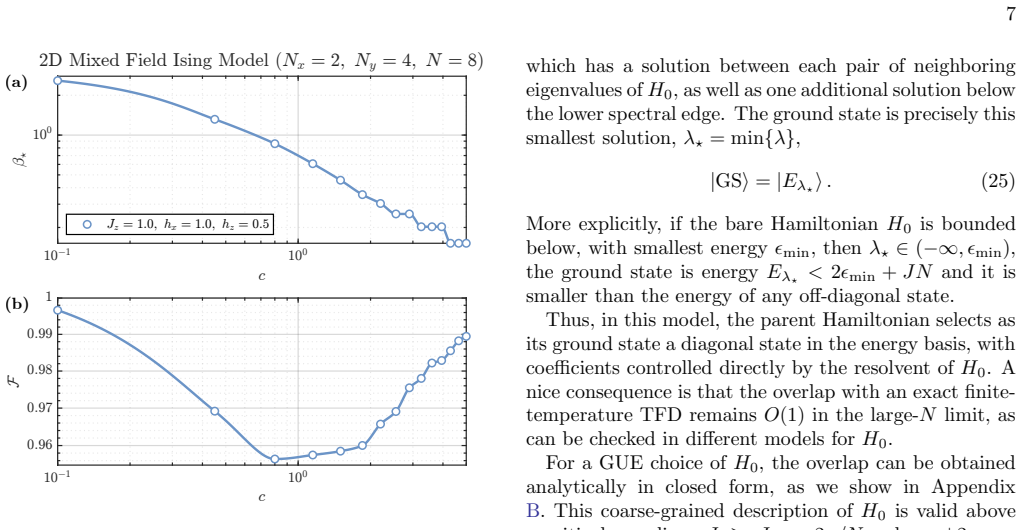
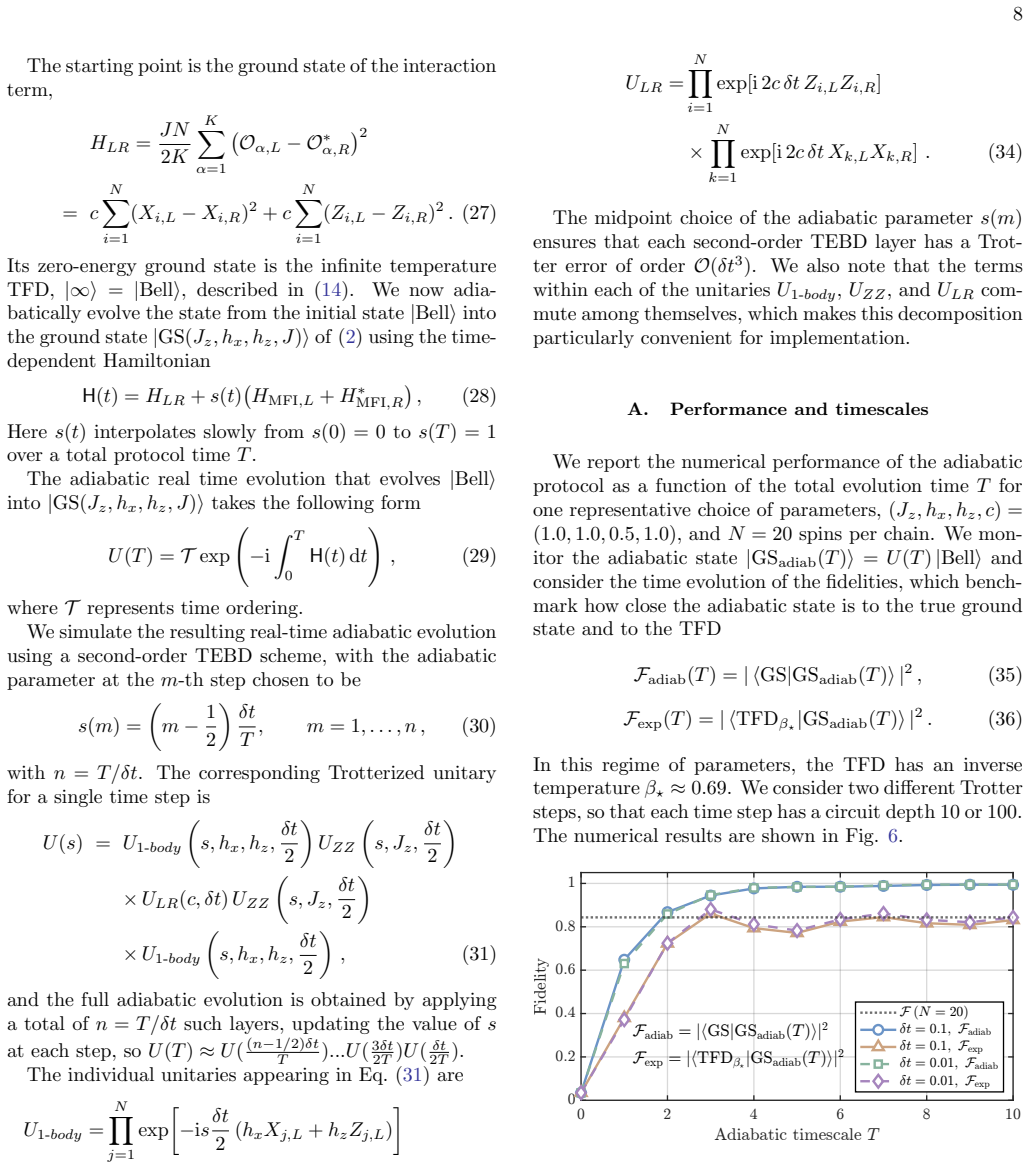

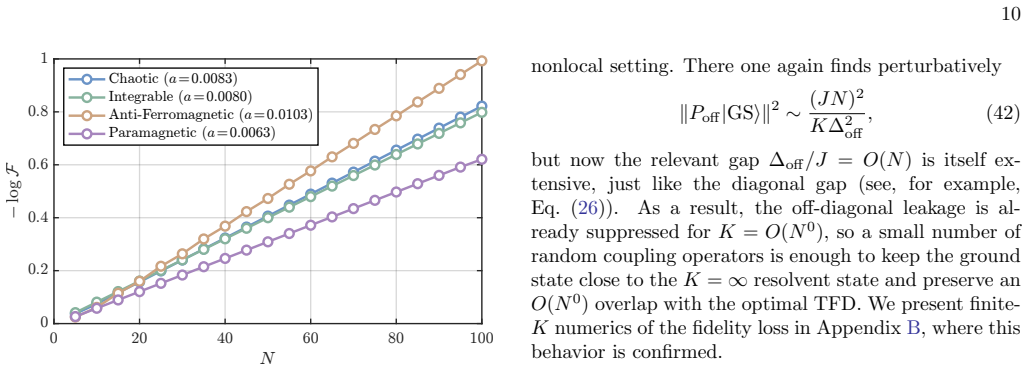


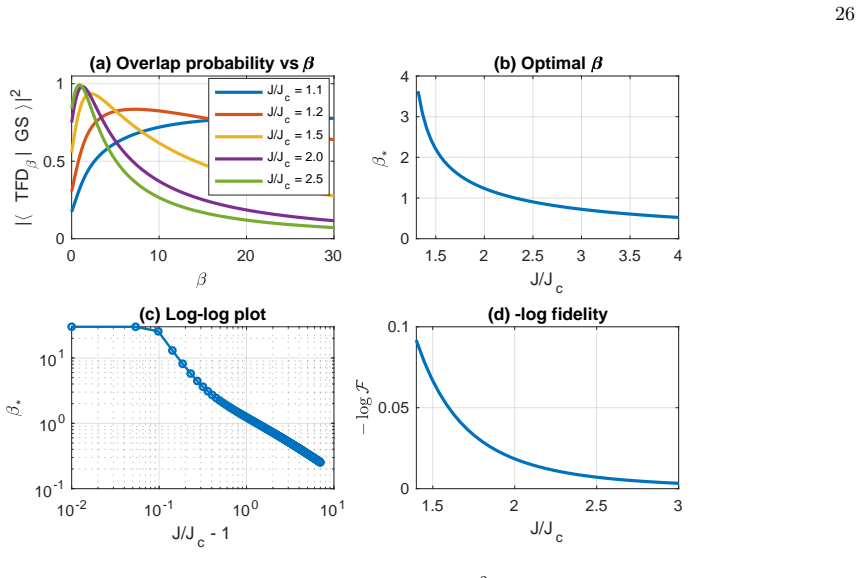


read the original abstract
A major promise of quantum computers is the controlled preparation of many-body quantum states beyond the reach of efficient classical computation. Among the most important targets are thermal mixed states and their thermofield double (TFD) purifications, which play central roles in quantum many-body physics and quantum gravity. For target systems with a bounded energy spectrum that obey the eigenstate thermalization hypothesis (ETH), we present a parent Hamiltonian built from two copies of the target Hamiltonian and ultra-local couplings between the copies, which we argue is gapped with a ground state that approximates a TFD state of the target Hamiltonian. By adiabatically evolving down from strong coupling, we can thus prepare a high-fidelity TFD state. We study two variants of the parent Hamiltonian using numerical methods in two classes of models: mixed field Ising models in one and two dimensions and non-local "spin Sachdev-Ye-Kitaev'' models. In the simpler variant, the parent Hamiltonian ground state has high overlap with a TFD for system sizes accessible to near-term quantum devices. However, the global overlap decays exponentially with the number of qubits, with a small error per degree of freedom. The second variant introduces an additional penalty term which can be tuned to reduce or remove the decay of the overlap with system size. Together with a general ETH-based analysis, these results suggest a broadly applicable method for TFD preparation that is not limited to particular temperatures or geometric locality.
Editorial analysis
A structured set of objections, weighed in public.
Referee Report
Summary. The manuscript claims that for target systems with bounded spectra obeying the eigenstate thermalization hypothesis (ETH), a parent Hamiltonian formed from two copies of the target Hamiltonian plus ultra-local inter-copy couplings (and an optional tunable penalty term) is gapped, with its ground state approximating the thermofield double (TFD) state of the target. Adiabatic evolution from strong coupling is proposed to prepare high-fidelity TFD states. Numerical evidence from mixed-field Ising models (1D/2D) and non-local SYK-like models shows high overlap for small system sizes accessible to near-term devices; the basic variant exhibits exponential decay of global overlap (small per-site error), which the penalty term can mitigate.
Significance. If the gap and per-site TFD approximation hold in the thermodynamic limit, the construction would supply a broadly applicable, hardware-friendly protocol for TFD preparation with relevance to thermal many-body physics and holographic models. The concrete numerical benchmarks on Ising and SYK systems strengthen the near-term utility case, and the ETH-based framing offers a route beyond model-specific methods.
major comments (3)
- [ETH-based analysis] The ETH-based argument that the parent Hamiltonian remains gapped (theoretical analysis section) is heuristic and supplies no rigorous lower bound on the gap or its N-scaling. This is load-bearing for the adiabatic-preparation claim, since the numerics are confined to small N and the central scalability assertion requires a finite gap persisting to the thermodynamic limit.
- [Numerical results, basic variant] In the basic variant (results section and abstract), global overlap with the target TFD decays exponentially with N while per-site error stays small. No finite-size scaling analysis or extrapolation is provided to show that the approximation remains useful for system sizes beyond near-term devices.
- [Penalty-term variant] For the penalty-term variant (results section), the tunable coefficient is shown to reduce overlap decay on small systems, but no scaling study or analytic argument demonstrates that the gap stays open and per-site fidelity remains bounded as N grows. This leaves the central claim that the method works for large systems without demonstrated support.
minor comments (3)
- [Hamiltonian construction] The explicit form of the ultra-local inter-copy coupling terms should be written as an equation rather than described only in words, to allow direct reproduction.
- [Figures] Overlap plots versus system size would be clearer if they included multiple independent runs or error bars and explicitly labeled the system sizes used.
- [Results summary] A brief comparison table of the two variants (gap estimates, overlap values, and penalty coefficients) would help readers assess the trade-offs.
Simulated Author's Rebuttal
We thank the referee for their careful reading and constructive comments, which have helped clarify the scope and limitations of our work. We address each major comment below and have revised the manuscript accordingly.
read point-by-point responses
-
Referee: The ETH-based argument that the parent Hamiltonian remains gapped (theoretical analysis section) is heuristic and supplies no rigorous lower bound on the gap or its N-scaling. This is load-bearing for the adiabatic-preparation claim, since the numerics are confined to small N and the central scalability assertion requires a finite gap persisting to the thermodynamic limit.
Authors: We agree that the ETH-based argument is heuristic and does not supply a rigorous lower bound on the gap or its scaling with N. The analysis relies on ETH to argue that the parent Hamiltonian's ground state is close to the TFD with an effective gap arising from the suppression of high-energy fluctuations between the two copies. While this is not a proof, it is consistent with the numerical evidence across models. In the revised manuscript we have expanded the theoretical analysis section to explicitly state the heuristic nature of the argument, list the key ETH assumptions, and note that a rigorous bound remains an open question. We do not claim a proof of gap persistence in the thermodynamic limit. revision: partial
-
Referee: In the basic variant (results section and abstract), global overlap with the target TFD decays exponentially with N while per-site error stays small. No finite-size scaling analysis or extrapolation is provided to show that the approximation remains useful for system sizes beyond near-term devices.
Authors: The manuscript already reports the exponential decay of global overlap together with the small per-site error. We have added a finite-size scaling analysis of both the global overlap decay rate and the per-site fidelity in the revised results section. The new analysis shows that the per-site error remains O(1/N) or smaller in the studied models, supporting the utility of the construction for local observables even when global overlap is small. The abstract has been updated to emphasize this distinction between global and local fidelity. revision: yes
-
Referee: For the penalty-term variant (results section), the tunable coefficient is shown to reduce overlap decay on small systems, but no scaling study or analytic argument demonstrates that the gap stays open and per-site fidelity remains bounded as N grows. This leaves the central claim that the method works for large systems without demonstrated support.
Authors: We have added both additional numerical scaling data (where computationally accessible) and a perturbative analytic argument in the revised results section showing that the penalty term can be tuned to keep the gap open and the per-site fidelity bounded away from zero under the ETH assumption. These additions provide further support for scalability while still relying on the same heuristic framework as the basic variant. revision: yes
Axiom & Free-Parameter Ledger
free parameters (2)
- inter-copy coupling strength
- penalty-term coefficient
axioms (1)
- domain assumption Target systems obey the eigenstate thermalization hypothesis (ETH)
Lean theorems connected to this paper
-
IndisputableMonolith.Cost (J(x) = ½(x+x⁻¹)−1)washburn_uniqueness_aczel unclear?
unclearRelation between the paper passage and the cited Recognition theorem.
H = H_{0,L} + H*_{0,R} + (J N / 2K) Σ_α (O_{α,L} − O*_{α,R})²
-
IndisputableMonolith.Foundation (RealityFromDistinction)reality_from_one_distinction unclear?
unclearRelation between the paper passage and the cited Recognition theorem.
|TFD_β⟩ = (1/√Z(β)) Σ_n e^{−βε_n/2} |ε_n⟩|ε*_n⟩
What do these tags mean?
- matches
- The paper's claim is directly supported by a theorem in the formal canon.
- supports
- The theorem supports part of the paper's argument, but the paper may add assumptions or extra steps.
- extends
- The paper goes beyond the formal theorem; the theorem is a base layer rather than the whole result.
- uses
- The paper appears to rely on the theorem as machinery.
- contradicts
- The paper's claim conflicts with a theorem or certificate in the canon.
- unclear
- Pith found a possible connection, but the passage is too broad, indirect, or ambiguous to say the theorem truly supports the claim.
Reference graph
Works this paper leans on
-
[1]
The Problem of Equilibration and the Computation of Correlation Functions on a Quantum Computer
B. M. Terhal, D. P. DiVincenzo, “The Problem of Equilibration and the Computation of Correlation Functions on a Quantum Computer” Physical Review A61no. 2, (Jan., 2000) 022301,quant-ph/9810063
-
[2]
K. Temme, T. J. Osborne, K. G. Vollbrecht, D. Poulin, F. Verstraete, “Quantum Metropolis Sampling” Nature 471no. 7336, (Mar., 2011) 87–90,arXiv:0911.3635 [quant-ph]
-
[3]
arXiv:0905.2199 [quant-ph] , Title =
D. Poulin, P. Wocjan, “Sampling from the Thermal Quantum Gibbs State and Evaluating Partition Functions with a Quantum Computer” Physical Review Letters103no. 22, (Nov., 2009) 220502,0905.2199 [quant-ph]
-
[4]
Quantum thermal state preparation
C.-F. Chen, M. J. Kastoryano, F. G. S. L. Brandao, A. Gilyen, “Quantum Thermal State Preparation” arXiv:2303.18224 [quant-ph]
-
[5]
Theory of Dynamic Critical Phenomena
P. C. Hohenberg, B. I. Halperin, “Theory of Dynamic Critical Phenomena” Reviews of Modern Physics49 no. 3, (July, 1977) 435–479
1977
-
[6]
Nonuniversal Critical Dynamics in Monte Carlo Simulations
R. H. Swendsen, J.-S. Wang, “Nonuniversal Critical Dynamics in Monte Carlo Simulations” Physical 14 Review Letters58no. 2, (Jan., 1987) 86–88
1987
-
[7]
J. M. Maldacena, “Eternal black holes in anti-de Sitter ” JHEP04(2003) 021,arXiv:hep-th/0106112
work page Pith review arXiv 2003
-
[8]
J. Maldacena, X.-L. Qi, “Eternal traversable wormhole ” 2018.https://arxiv.org/abs/1804.00491
work page Pith review arXiv 2018
-
[9]
Quantum Gravity in the Lab. I. Teleportation by Size and Traversable Wormholes
A. R. Brown, H. Gharibyan, S. Leichenauer, H. W. Lin, S. Nezami, G. Salton, L. Susskind, B. Swingle, M. Walter, “Quantum Gravity in the Lab. I. Teleportation by Size and Traversable Wormholes” PRX Quantum4(Feb, 2023) 010320
2023
-
[10]
Traversable wormholes via a double trace deformation
P. Gao, D. L. Jafferis, A. C. Wall, “Traversable wormholes via a double trace deformation” Journal of High Energy Physics2017no. 12, (Dec., 2017)
2017
-
[11]
Variational Thermal Quantum Simulation via Thermofield Double States
J. Wu, T. H. Hsieh, “Variational Thermal Quantum Simulation via Thermofield Double States” Phys. Rev. Lett.123no. 22, (2019) 220502,arXiv:1811.11756 [cond-mat.str-el]
-
[12]
Product Spectrum Ansatz and the Simplicity of Thermal States
J. Martyn, B. Swingle, “Product Spectrum Ansatz and the Simplicity of Thermal States” Phys. Rev. A100 no. 3, (2019) 032107,arXiv:1812.01015 [cond-mat.str-el]
-
[13]
Complexity and Entanglement for Thermofield Double States
S. Chapman, J. Eisert, L. Hackl, M. P. Heller, R. Jefferson, H. Marrochio, R. C. Myers, “Complexity and Entanglement for Thermofield Double States” SciPost Physics6no. 3, (Mar., 2019) 034, arXiv:1810.05151 [hep-th]
-
[14]
Quantum statistical mechanics in a closed system
J. M. Deutsch, “Quantum statistical mechanics in a closed system” Phys. Rev. A43(Feb, 1991) 2046–2049
1991
-
[15]
Srednicki,Chaos and Quantum Thermalization,Phys
M. Srednicki, “Chaos and Quantum Thermalization” Phys. Rev. E50(3, 1994) ,arXiv:cond-mat/9403051
-
[16]
Quantum Hamiltonian-Based Models and the Variational Quantum Thermalizer Algorithm
G. Verdon, J. Marks, S. Nanda, S. Leichenauer, J. Hidary, “Quantum Hamiltonian-Based Models and the Variational Quantum Thermalizer Algorithm” Oct., 2019
2019
-
[17]
Variational Preparation of Finite-Temperature States on a Quantum Computer
R. Sagastizabal, S. P. Premaratne, B. A. Klaver, M. A. Rol, V. Negˆ ırneac, M. Moreira, X. Zou, S. Johri, N. Muthusubramanian, M. Beekman, C. Zachariadis, V. P. Ostroukh, N. Haider, A. Bruno, A. Y. Matsuura, L. DiCarlo, “Variational Preparation of Finite-Temperature States on a Quantum Computer” npj Quantum Information7no. 1, (Aug., 2021) 130, arXiv:2012....
-
[18]
Thermal Multi-scale Entanglement Renormalization Ansatz for Variational Gibbs State Preparation
T. J. Sewell, C. D. White, B. Swingle, “Thermal Multi-scale Entanglement Renormalization Ansatz for Variational Gibbs State Preparation” 2022. https://arxiv.org/abs/2210.16419
-
[19]
Thermal state preparation of the SYK model using a variational quantum algorithm
J. Y. Araz, R. G. Jha, F. Ringer, B. Sambasivam, “Thermal state preparation of the SYK model using a variational quantum algorithm”arXiv:2406.15545 [quant-ph]
-
[20]
Generation of Thermofield Double States and Critical Ground States with a Quantum Computer
D. Zhu, S. Johri, N. M. Linke, K. A. Landsman, C. Huerta Alderete, N. H. Nguyen, A. Y. Matsuura, T. H. Hsieh, C. Monroe, “Generation of Thermofield Double States and Critical Ground States with a Quantum Computer” Proc. Natl. Acad. Sci. U.S.A. 117no. 41, (2020) 25402–25406,arXiv:1906.02699 [quant-ph]
-
[21]
Determining eigenstates and thermal states on a quantum computer using quantum imaginary time evolution
M. Motta, C. Sun, A. T. K. Tan, M. J. O’Rourke, E. Ye, A. J. Minnich, F. G. S. L. B. ao, G. K.-L. Chan, “Determining eigenstates and thermal states on a quantum computer using quantum imaginary time evolution” Nature Physics16no. 2, (2020) 205–210
2020
-
[22]
Quantum Computation of Finite-Temperature Static and Dynamical Properties of Spin Systems Using Quantum Imaginary Time Evolution
S.-N. Sun, M. Motta, R. N. Tazhigulov, A. T. K. Tan, G. K.-L. Chan, A. J. Minnich, “Quantum Computation of Finite-Temperature Static and Dynamical Properties of Spin Systems Using Quantum Imaginary Time Evolution” PRX Quantum2no. 1, (2021) 010317
2021
- [23]
-
[24]
Efficient thermalization and universal quantum computing with quantum Gibbs samplers
C. Rouze, D. Stilck Franca, A. M. Alhambra, “Efficient Thermalization and Universal Quantum Computing with Quantum Gibbs Samplers” inProceedings of the 57th Annual ACM Symposium on Theory of Computing, pp. 1488–1495. 2025.arXiv:2403.12691 [quant-ph]
work page internal anchor Pith review Pith/arXiv arXiv 2025
-
[25]
Efficient quantum thermal simulation
C.-F. Chen, M. Kastoryano, F. G. S. L. Brand˜ ao, A. Gily´ en, “Efficient quantum thermal simulation” Nature646no. 8085, (2025) 561–566
2025
-
[26]
End-to-End Efficient Quantum Thermal and Ground State Preparation Made Simple
Z. Ding, Y. Zhan, J. Preskill, L. Lin, “End-to-End Efficient Quantum Thermal and Ground State Preparation Made Simple” Aug., 2025
2025
-
[27]
Thermal State Preparation via Rounding Promises
P. Rall, C. Wang, P. Wocjan, “Thermal State Preparation via Rounding Promises” Quantum7(Oct.,
- [28]
-
[29]
Quantum thermal state preparation for near-term quantum processors.arXiv preprint arXiv:2506.21318,
J. Lloyd, D. A. Abanin, “Quantum thermal state preparation for near-term quantum processors” 2026. https://arxiv.org/abs/2506.21318
-
[30]
How to build the thermofield double state
W. Cottrell, B. Freivogel, D. M. Hofman, S. F. Lokhande, “How to build the thermofield double state” Journal of High Energy Physics2019no. 2, (Feb.,
-
[31]
Entanglement and Confinement in Coupled Quantum Systems
F. Alet, M. Hanada, A. Jevicki, C. Peng, “Entanglement and Confinement in Coupled Quantum Systems” JHEP 02(2021) 034,arXiv:2001.03158 [hep-th]
-
[32]
Variational preparation of the thermofield double state of the Sachdev-Ye-Kitaev model
V. P. Su, “Variational preparation of the thermofield double state of the Sachdev-Ye-Kitaev model” Phys. Rev. A104no. 1, (2021) 012427,arXiv:2009.04488 [hep-th]
-
[33]
Hamiltonian forging of a thermofield double
D. Fa´ ılde, J. Santos-Su´ arez, D. A. Herrera-Mart´ ı, J. Mas, “Hamiltonian forging of a thermofield double” Phys. Rev. A111no. 1, (2025) 012432, arXiv:2311.10566 [quant-ph]
-
[34]
Approximate Quantum Codes From Long Wormholes
G. Bentsen, P. Nguyen, B. Swingle, “Approximate Quantum Codes From Long Wormholes” Quantum8 (2024) 1439,arXiv:2310.07770 [quant-ph]
-
[35]
Cooling the sachdev-ye-kitaev model using thermofield double states.arXiv preprint arXiv:2511.09620,
T. Schuster, B. Kobrin, V. P. Su, H. Marrochio, N. Y. Yao, “Cooling the Sachdev-Ye-Kitaev model using thermofield double states” 2025. https://arxiv.org/abs/2511.09620
-
[36]
Hermitian and non-Hermitian thermal Hamiltonians
A. E. Feiguin, I. Klich, “Hermitian and non-Hermitian thermal Hamiltonians” 2013. https://arxiv.org/abs/1308.0756
-
[37]
Mixed s-sourcery: Building many-body states using bubbles of Nothing
B. Swingle, J. McGreevy, “Mixed s-sourcery: Building many-body states using bubbles of Nothing” Phys. Rev. B94no. 15, (2016) 155125,arXiv:1607.05753 [cond-mat.str-el]
-
[38]
J. Maldacena, D. Stanford, Z. Yang, “Diving into traversable wormholes” Fortsch. Phys.65no. 5, (2017) 1700034,arXiv:1704.05333 [hep-th]
-
[39]
Quantum Gravity in the Lab. II. Teleportation by Size and Traversable Wormholes
S. Nezami, H. W. Lin, A. R. Brown, H. Gharibyan, S. Leichenauer, G. Salton, L. Susskind, B. Swingle, M. Walter, “Quantum Gravity in the Lab. II. Teleportation by Size and Traversable Wormholes” PRX Quantum4(Feb, 2023) 010321
2023
-
[40]
Quantum Channel Capacity of Traversable Wormhole
J. Lu, Z. Yang, J. Zheng, “Quantum Channel Capacity of Traversable Wormhole”arXiv:2603.26051 [hep-th]
-
[41]
The density-matrix renormalization group in the age of matrix product states
U. Schollwoeck, “The Density-Matrix Renormalization 15 Group in the Age of Matrix Product States” Annals of Physics326no. 1, (Jan., 2011) 96–192,1008.3477 [cond-mat]
work page Pith review arXiv 2011
-
[42]
Linear growth of circuit complexity from Brownian dynamics
S.-K. Jian, G. Bentsen, B. Swingle, “Linear growth of circuit complexity from Brownian dynamics” JHEP08 (2023) 190,arXiv:2206.14205 [quant-ph]
-
[43]
Complexity is not enough for randomness
S. Guo, M. Sasieta, B. Swingle, “Complexity is not enough for randomness” SciPost Phys.17no. 6, (2024) 151,arXiv:2405.17546 [hep-th]
-
[44]
A. M. Garc´ ıa-Garc´ ıa, T. Nosaka, D. Rosa, J. J. M. Verbaarschot, “Quantum chaos transition in a two-site Sachdev-Ye-Kitaev model dual to an eternal traversable wormhole” Phys. Rev. D100no. 2, (2019) 026002, arXiv:1901.06031 [hep-th]
-
[45]
Diagnosing quantum chaos in many-body systems using entanglement as a resource
´E. Lantagne-Hurtubise, S. Plugge, O. Can, M. Franz, “Diagnosing quantum chaos in many-body systems using entanglement as a resource” Phys. Rev. Res.2no. 1, (2020) 013254,arXiv:1907.01628 [cond-mat.str-el]
-
[46]
A Model of Randomly-Coupled Pauli Spins
M. Hanada, A. Jevicki, X. Liu, E. Rinaldi, M. Tezuka, “A Model of Randomly-Coupled Pauli Spins” Journal of High Energy Physics2024no. 5, (May, 2024) 280
2024
-
[47]
Bosonic Model of Quantum Holography
B. Swingle, M. Winer, “Bosonic Model of Quantum Holography” Physical Review B109no. 9, (Mar.,
-
[48]
Bounds for the adiabatic approximation with applications to quantum computation
S. Jansen, M.-B. Ruskai, R. Seiler, “Bounds for the adiabatic approximation with applications to quantum computation” Journal of Mathematical Physics48 no. 10, (2007) 102111
2007
-
[49]
T. Albash, D. A. Lidar, “Adiabatic Quantum Computing” Reviews of Modern Physics90no. 1, (Jan., 2018) 015002,arXiv:1611.04471 [quant-ph]
-
[50]
Comments on the Sachdev-Ye-Kitaev model
J. Maldacena, D. Stanford, “Remarks on the Sachdev-Ye-Kitaev model” Phys. Rev. D94no. 10, (2016) 106002,arXiv:1604.07818 [hep-th]
work page Pith review arXiv 2016
-
[51]
Random circuits in the black hole interior
J. M. Magan, M. Sasieta, B. Swingle, “Random circuits in the black hole interior” SciPost Phys.19no. 1, (2025) 007,arXiv:2412.08693 [hep-th]
-
[52]
J. M. Mag´ an, M. Sasieta, B. Swingle, “ER for typical EPR” Phys. Rev. Lett.135no. 16, (2025) 161601, arXiv:2504.07171 [hep-th]
-
[53]
T. G. Mertens, G. J. Turiaci, H. L. Verlinde, “Solving the Schwarzian via the Conformal Bootstrap” JHEP08 (2017) 136,arXiv:1705.08408 [hep-th]. Supplementary Material Contents Appendix A. General aspects of the ground state in chaotic systems 15 Appendix B. Ground state in random matrix theory 22 Appendix C. Details of the Maldacena-Qi wormhole calculatio...
-
[54]
ODE for ground state wavefunction Consider a smooth diagonal state|ψ⟩= P n ϱ(ϵn)−1/2 an |ϵn⟩ |ϵ∗ n⟩. To study the thermodynamic limit, it is conve- nient to work with a canonically normalized continuum wavefunction, where energy eigenstates|ϵ⟩are delta-function normalized,⟨ϵ|ϵ ′⟩=δ(ϵ−ϵ ′). We therefore write the smooth diagonal state as |ψ⟩= Z dϵ a(ϵ)|ϵ⟩ ...
-
[55]
The corresponding fidelity is F= max β | ⟨TFD|GS⟩ |2 = 2σσβ⋆ σ2 +σ 2 β⋆ ,(A33) which remains finite in the thermodynamic limit, as bothσ 2 andσ 2 β⋆ are extensive
Overlap with TFD The TFD has a Gaussian wavefunction in the thermodynamic limit |TFD⟩= 1p Z(β) Z dϵ p ϱ(ϵ)e−βϵ/2 |ϵ⟩ |ϵ∗⟩ ≈ 1 (πσ2 β)1/4 Z dϵexp −(ϵ−ϵ β)2 2σ2 β ! |ϵ⟩ |ϵ∗⟩,(A29) where the usual thermodynamic relations determine the canonical mean energy and variance, S′(ϵβ) =β ,(∆H 0)2 β :=⟨H 2 0 ⟩β − ⟨H0⟩2 β = C(ϵ β) β2 .(A30) Sinceσ 2 β is the width par...
-
[56]
Physical examples We now consider some specific examples where we can evaluate the width parameterσ 2, the corresponding fidelity F, and the energy gap ∆ := 2λ 1 −2λ 0 as a function of the couplingJof theLRinteraction. It is convenient to note that in the thermodynamic limit one has V(ϵ) = J N 2 ⟨TFDβ|(O L − O∗ R)2 |TFDβ⟩ β=β(ϵ) =J N[G β(0)−G β(β/2)] β=β(...
-
[57]
At finiteK, leakage out of the diagonal subspace is generated by fluctuations of all three pieces in (OL − O∗ R)2 =O 2 L +O ∗2 R −2O LO∗ R
Fidelity loss at finiteK The analysis above determines the ground state forK=∞because the Hamiltonian converges, by the law of large numbers, to the operator-averaged HamiltonianH ∞, where it preserves the diagonal subspace spanned by {|ϵn⟩ |ϵ∗ n⟩}. At finiteK, leakage out of the diagonal subspace is generated by fluctuations of all three pieces in (OL − ...
-
[58]
Exact diagonalization The off-diagonal states|ϵ n⟩ |ϵ∗ m⟩are eigenvectors ofH ∞ with energyϵ n +ϵ m +J N. In the diagonal subspace, we write an eigenfunction as the Choi state of the diagonal operator |A⟩= LX n=1 An |ϵn⟩ |ϵ∗ n⟩ ⇔A= LX n=1 An |ϵn⟩ ⟨ϵn|.(B4) The diagonal eigenstatesH ∞ |A⟩= (2λ+J N)|A⟩satisfy (H0 −λ)A= J N 2L Tr(A)⇒ A Tr(A) = J N 2L R(λ),(B...
-
[59]
Fidelity with a finite temperature TFD The overlap probability between the ground state|GS⟩and the TFD is |⟨TFDβ|GS⟩|2 = Tr e−βH0/2R(λ⋆) 2 Tr (e−βH0) Tr (R(λ⋆)2) = hR dϵˆϱ(ϵ)e−βϵ/2 ϵ−λ⋆ i2 hR dϵˆϱ(ϵ) 1 (ϵ−λ⋆)2 i R dϵˆϱ(ϵ)e−βϵ .(B17) This quantity remains finite asN→ ∞(or equivalently asL= 2 N → ∞). For example, using (B9) and that Tr (R(λ⋆)2)≤L(ϵ min −λ ⋆...
-
[60]
We now coarse-grain the spectrum ofH 0, thinking of it as a draw from an ensemble of random Hamiltonians
Example: GUE Hamiltonian Up to this point, the analysis holds for an individualH 0 with a discrete spectrum. We now coarse-grain the spectrum ofH 0, thinking of it as a draw from an ensemble of random Hamiltonians. For simplicity, we consider a Hamiltonian drawn from the GUE. The unit-normalized large-Ndensity of states is the semicircle density ˆϱ(ϵ) = 1...
-
[61]
Finite-Kleakage into the off-diagonal subspace LetH=H ∞ +δH, whereH ∞ is theK→ ∞averaged Hamiltonian (B2) andδHis the finite-Kfluctuation. If ∆0 = 2(ϵmin −λ ⋆), standard perturbation theory gives ∥Poff|GS⟩∥2 ≲ ∥PoffδH|ψ ∞⟩∥2 ∆2 0 ,(B31) where|ψ ∞⟩is the ground state ofH ∞ andP off =P n̸=m |ϵn⟩ |ϵ∗ m⟩ ⟨ϵn| ⟨ϵ∗ m|is the orthogonal projector onto the off- di...
-
[62]
Low-energy gravitational analysis Let us first considerξ= 0. In the low-energy approximation of [8], theLRcoupling only modifies the dynamics of the reparametrization modes through a modified effective potential for the gauge-invariant geodesic length variable. At this level of approximation, the fidelity F= |⟨TFDβ⋆ |GS⟩|2 ⟨TFDβ⋆ |TFDβ⋆ ⟩⟨GS|GS⟩ (C10) is ...
discussion (0)
Sign in with ORCID, Apple, or X to comment. Anyone can read and Pith papers without signing in.