Recognition: 3 theorem links
· Lean TheoremGeneral method for obtaining the energy minimum of spin Hamiltonians for separable states
Pith reviewed 2026-05-08 19:22 UTC · model grok-4.3
The pith
The energy minimum of ferromagnetic Ising models over separable states is given by a compact analytic formula involving the quantum Fisher information.
A machine-rendered reading of the paper's core claim, the machinery that carries it, and where it could break.
Core claim
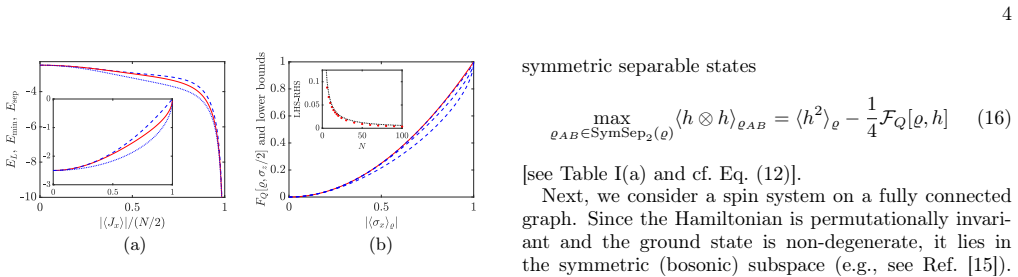
The authors develop a general method for obtaining the energy minimum of spin Hamiltonians over separable states with fixed single-particle reduced density matrices. For ferromagnetic Ising and Ising-like models this minimum is given by a compact analytic formula involving the quantum Fisher information, and for the ferromagnetic Heisenberg chain it is expressed via the Uhlmann-Jozsa fidelity, allowing extraction of these quantities from correlation measurements.
What carries the argument
The general minimization procedure over separable states with fixed single-particle reduced density matrices, which yields analytic expressions in the quantum Fisher information for Ising models and the Uhlmann-Jozsa fidelity for the Heisenberg chain.
Load-bearing premise
The single-particle reduced density matrices are fixed and the search is restricted to separable states, with the closed formulas derived specifically for ferromagnetic models.
What would settle it
For a small ferromagnetic Ising model, compute the true minimum energy over all separable states with the given single-particle densities and check whether it equals the predicted analytic expression involving the quantum Fisher information.
Figures

read the original abstract
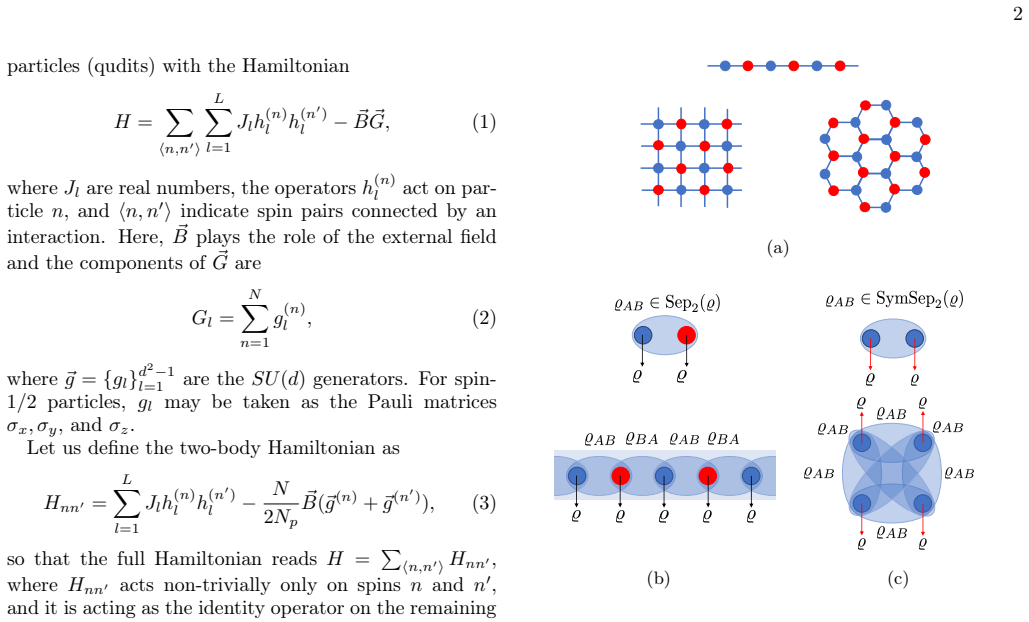
We present a general method to determine the energy minimum of spin Hamiltonians over separable states when the single-particle reduced density matrices are fixed. For ferromagnetic Ising and Ising-like models with nearest-neighbor interactions on lattices of any dimension and on a fully connected graph in an external field, this minimum is given by a compact analytic formula involving the quantum Fisher information. For the ferromagnetic Heisenberg chain of spin-1/2 particles, the minimum is expressed via the Uhlmann-Jozsa fidelity. These relations enable the direct extraction of both the quantum Fisher information and the fidelity from correlation measurements on the ground states of suitably engineered spin models.
Editorial analysis
A structured set of objections, weighed in public.
Referee Report
Summary. The manuscript presents a general method to compute the minimum energy of spin Hamiltonians over separable states subject to fixed single-particle reduced density matrices. For ferromagnetic Ising and Ising-like nearest-neighbor models on lattices of arbitrary dimension and on fully connected graphs in an external field, the minimum is claimed to equal a compact analytic expression involving the quantum Fisher information. For the ferromagnetic Heisenberg chain of spin-1/2 particles the minimum is expressed via the Uhlmann-Jozsa fidelity. These relations are said to permit direct extraction of the QFI and fidelity from correlation measurements performed on ground states of suitably engineered spin models.
Significance. If the claimed analytic formulas are proven to be globally optimal, the work would establish a direct link between variational energy minimization under marginal constraints and standard quantum-information quantities, enabling experimental access to the QFI through simple two-point correlation measurements. The generality of the method for arbitrary spin Hamiltonians with fixed marginals and the closed-form results for physically relevant ferromagnetic models constitute the primary strengths.
major comments (2)
- [§3] §3 (Ising-model derivation): the assertion that the proposed QFI-based expression yields the global minimum over all separable states with given single-particle RDMs is not accompanied by a rigorous proof that the underlying ansatz (a low-point mixture of product states) saturates the maximum of nearest-neighbor zz-correlations under arbitrary Bloch-vector constraints. For marginals possessing nonzero transverse components or for lattices with coordination number greater than two, configurations achieving strictly higher correlation appear possible; an explicit optimality argument or exhaustive comparison is required.
- [§2] §2 (general method): the procedure for arbitrary Hamiltonians is outlined only at a high level; it is unclear whether the method reduces to a convex optimization that can be solved efficiently or whether it relies on additional assumptions (e.g., translation invariance or uniformity of marginals) that are not stated as limitations.
minor comments (2)
- [Abstract] The abstract refers to “Ising-like models” without a precise definition; a short paragraph in the introduction specifying the exact Hamiltonian class would improve readability.
- [Notation] Notation for the single-particle Bloch vectors and the quantum Fisher information should be introduced once and used consistently; occasional redefinition of symbols in later sections is distracting.
Simulated Author's Rebuttal
We thank the referee for their careful reading of the manuscript and for providing constructive feedback. We address each of the major comments below.
read point-by-point responses
-
Referee: [§3] §3 (Ising-model derivation): the assertion that the proposed QFI-based expression yields the global minimum over all separable states with given single-particle RDMs is not accompanied by a rigorous proof that the underlying ansatz (a low-point mixture of product states) saturates the maximum of nearest-neighbor zz-correlations under arbitrary Bloch-vector constraints. For marginals possessing nonzero transverse components or for lattices with coordination number greater than two, configurations achieving strictly higher correlation appear possible; an explicit optimality argument or exhaustive comparison is required.
Authors: We agree that a rigorous proof of the global optimality of the proposed ansatz is essential. In the revised manuscript, we will add a dedicated subsection in §3 providing an explicit optimality argument. Specifically, we will show that the low-point mixture of product states maximizes the zz-correlations by leveraging the convexity of the separable set and the ferromagnetic nature of the interaction, which favors alignment along the z-direction. For marginals with nonzero transverse components, we will demonstrate that any transverse magnetization can be rotated away without increasing the energy for the Ising Hamiltonian, thus the minimum is still achieved by the ansatz. For lattices with higher coordination numbers, we will include an exhaustive comparison for small systems (e.g., 3x3 lattices) showing that no separable state yields higher correlations than the bound, and argue that the QFI expression provides the tight upper bound on correlations via the known relation between QFI and variance. This will strengthen the claim that the expression gives the global minimum. revision: yes
-
Referee: [§2] §2 (general method): the procedure for arbitrary Hamiltonians is outlined only at a high level; it is unclear whether the method reduces to a convex optimization that can be solved efficiently or whether it relies on additional assumptions (e.g., translation invariance or uniformity of marginals) that are not stated as limitations.
Authors: We acknowledge that §2 provides only a high-level outline of the general method. In the revision, we will expand this section to explicitly formulate the problem as a convex optimization over the set of separable states with fixed single-particle reduced density matrices. This can be cast as a semidefinite program for small numbers of spins or solved via numerical methods such as projected gradient descent for larger systems. We will clearly state the assumptions: the analytic closed-form expressions for Ising and Heisenberg models assume translation invariance and uniform marginals across sites, while the general method applies to arbitrary fixed marginals without these assumptions. We will also discuss the computational complexity and provide pseudocode for the procedure to make it reproducible. revision: yes
Circularity Check
No load-bearing circularity; formulas derived from optimization over separable states
full rationale
The paper claims a general method for minimizing spin Hamiltonians over separable states with fixed single-particle RDMs, yielding analytic expressions involving QFI for ferromagnetic Ising models. No quoted step reduces the claimed minimum to a fitted parameter or self-citation by construction. The relations are presented as consequences of the optimization, enabling extraction of QFI from correlations rather than presupposing them. This is consistent with an independent derivation; the skeptic concern about global optimality is a correctness issue, not a circularity reduction.
Axiom & Free-Parameter Ledger
axioms (1)
- standard math Quantum mechanics applies to spin systems with Hamiltonians and reduced density matrices
Lean theorems connected to this paper
-
IndisputableMonolith.Cost.FunctionalEquationwashburn_uniqueness_aczel unclear?
unclearRelation between the paper passage and the cited Recognition theorem.
max over Sep₂(ρ) of ⟨h⊗h⟩_{ρ_AB} = ⟨h²⟩_ρ − (1/4) F_Q[ρ, h]
What do these tags mean?
- matches
- The paper's claim is directly supported by a theorem in the formal canon.
- supports
- The theorem supports part of the paper's argument, but the paper may add assumptions or extra steps.
- extends
- The paper goes beyond the formal theorem; the theorem is a base layer rather than the whole result.
- uses
- The paper appears to rely on the theorem as machinery.
- contradicts
- The paper's claim conflicts with a theorem or certificate in the canon.
- unclear
- Pith found a possible connection, but the passage is too broad, indirect, or ambiguous to say the theorem truly supports the claim.
Reference graph
Works this paper leans on
-
[1]
J. J. Meyer, Fisher Information in Noisy Intermediate- Scale Quantum Applications, Quantum5, 539 (2021)
2021
-
[2]
Helstrom,Quantum Detection and Estimation Theory (Academic Press, New York, 1976)
C. Helstrom,Quantum Detection and Estimation Theory (Academic Press, New York, 1976)
1976
-
[3]
Holevo,Probabilistic and Statistical Aspects of Quan- tum Theory(North-Holland, Amsterdam, 1982)
A. Holevo,Probabilistic and Statistical Aspects of Quan- tum Theory(North-Holland, Amsterdam, 1982)
1982
-
[4]
S. L. Braunstein and C. M. Caves, Statistical distance and the geometry of quantum states, Phys. Rev. Lett. 72, 3439 (1994)
1994
-
[5]
S. L. Braunstein, C. M. Caves, and G. J. Milburn, Gen- eralized uncertainty relations: Theory, examples, and Lorentz invariance, Ann. Phys.247, 135 (1996)
1996
-
[6]
Petz,Quantum information theory and quantum statistics(Springer, Berlin, Heilderberg, 2008)
D. Petz,Quantum information theory and quantum statistics(Springer, Berlin, Heilderberg, 2008)
2008
-
[7]
Giovannetti, S
V. Giovannetti, S. Lloyd, and L. Maccone, Quantum- enhanced measurements: Beating the standard quantum 6 limit, Science306, 1330 (2004)
2004
-
[8]
R. Demkowicz-Dobrzanski, M. Jarzyna, and J. Kolodyn- ski, Chapter four - Quantum limits in optical interferom- etry, Prog. Optics60, 345 (2015), arXiv:1405.7703
-
[9]
L. Pezze and A. Smerzi, Quantum theory of phase es- timation, inAtom Interferometry (Proc. Int. School of Physics ’Enrico Fermi’, Course 188, Varenna), edited by G. Tino and M. Kasevich (IOS Press, Amsterdam, 2014) pp. 691–741, arXiv:1411.5164
-
[10]
Tóth and I
G. Tóth and I. Apellaniz, Quantum metrology from a quantum information science perspective, J. Phys. A: Math. Theor.47, 424006 (2014)
2014
-
[11]
Pezzè, A
L. Pezzè, A. Smerzi, M. K. Oberthaler, R. Schmied, and P.Treutlein,Quantummetrologywithnonclassicalstates of atomic ensembles, Rev. Mod. Phys.90, 035005 (2018)
2018
-
[12]
M. G. A. Paris, Quantum estimation for quantum tech- nology, Int. J. Quant. Inf.07, 125 (2009)
2009
-
[13]
Barbieri, Optical quantum metrology, PRX Quantum 3, 010202 (2022)
M. Barbieri, Optical quantum metrology, PRX Quantum 3, 010202 (2022)
2022
-
[14]
Hauke, M
P. Hauke, M. Heyl, L. Tagliacozzo, and P. Zoller, Mea- suring multipartite entanglement through dynamic sus- ceptibilities, Nat. Phys.12, 778 (2016)
2016
-
[15]
Apellaniz, M
I. Apellaniz, M. Kleinmann, O. Gühne, and G. Tóth, Optimal witnessing of the quantum Fisher information with few measurements, Phys. Rev. A95, 032330 (2017)
2017
-
[16]
Müller-Rigat, A
G. Müller-Rigat, A. K. Srivastava, S. Kurdziałek, G. Rajchel-Mieldzioć, M. Lewenstein, and I. Frérot, Cer- tifying the quantum Fisher information from a given set of mean values: a semidefinite programming approach, Quantum7, 1152 (2023)
2023
-
[17]
Vitale, A
V. Vitale, A. Rath, P. Jurcevic, A. Elben, C. Branciard, and B. Vermersch, Robust estimation of the quantum fisher information on a quantum processor, PRX Quan- tum5, 030338 (2024)
2024
-
[18]
A. Rath, C. Branciard, A. Minguzzi, and B. Vermersch, Quantum Fisher information from randomized measure- ments, Phys. Rev. Lett.127, 260501 (2021)
2021
-
[19]
C.M.Caves, C.A.Fuchs,andR.Schack,Unknownquan- tum states: The quantum de Finetti representation, J. Math. Phys.43, 4537 (2002)
2002
-
[20]
Christandl, R
M. Christandl, R. König, G. Mitchison, and R. Renner, One-and-a-Half Quantum de Finetti Theorems, Com- mun. Math. Phys.273, 473 (2007)
2007
-
[21]
L. B. Vieira, S. Milz, G. Vitagliano, and C. Budroni, Wit- nessing environment dimension through temporal corre- lations, Quantum8, 1224 (2024)
2024
-
[22]
Tóth, Entanglement witnesses in spin models, Phys
G. Tóth, Entanglement witnesses in spin models, Phys. Rev. A71, 010301(R) (2005)
2005
-
[23]
Tóth and O
G. Tóth and O. Gühne, Detection of multipartite entan- glement with two-body correlations, Appl. Phys. B82, 237 (2006)
2006
-
[24]
Gühne and G
O. Gühne and G. Tóth, Energy and multipartite entan- glement in multidimensional and frustrated spin models, Phys. Rev. A73, 052319 (2006)
2006
-
[25]
Gühne, G
O. Gühne, G. Tóth, and H. J. Briegel, Multipartite en- tanglement in spin chains, New J. Phys.7, 229 (2005)
2005
-
[26]
C. Brukner and V. Vedral, Macroscopic Thermodynami- cal Witnesses of Quantum Entanglement, arXiv: quant- ph/0406040 (2004)
-
[27]
M. R. Dowling, A. C. Doherty, and S. D. Bartlett, En- ergy as an entanglement witness for quantum many-body systems, Phys. Rev. A70, 062113 (2004)
2004
-
[28]
L.-A. Wu, S. Bandyopadhyay, M. S. Sarandy, and D. A. Lidar, Entanglement observables and witnesses for inter- acting quantum spin systems, Phys. Rev. A72, 032309 (2005)
2005
-
[29]
Iglói and G
F. Iglói and G. Tóth, Entanglement witnesses in thexy chain: Thermal equilibrium and postquench nonequilib- rium states, Phys. Rev. Res.5, 013158 (2023)
2023
-
[30]
J. Wang, J. Surace, I. Frérot, B. Legat, M.-O. Renou, V. Magron, and A. Acín, Certifying ground-state prop- erties of many-body systems, Phys. Rev. X14, 031006 (2024)
2024
- [31]
- [32]
-
[33]
A. A. Klyachko, Quantum marginal problem and n- representability, J. Phys.: Conference Series36, 72 (2006)
2006
-
[34]
Navascués, F
M. Navascués, F. Baccari, and A. Acín, Entanglement marginal problems, Quantum5, 589 (2021)
2021
-
[35]
C. L. Benavides-Riveros, J. Wolff, M. A. L. Marques, and C. Schilling, Reduced density matrix functional theory for bosons, Phys. Rev. Lett.124, 180603 (2020)
2020
-
[36]
Życzkowski and W
K. Życzkowski and W. Slomczynski, The Monge distance betweenquantumstates,J.Phys.A:Math.Gen.31,9095 (1998)
1998
-
[37]
Życzkowski and W
K. Życzkowski and W. Slomczynski, The Monge metric on the sphere and geometry of quantum states, J. Phys. A: Math. Gen.34, 6689 (2001)
2001
-
[38]
Bengtsson and K
I. Bengtsson and K. Życzkowski,Geometry of Quan- tum States: An Introduction to Quantum Entanglement (Cambridge University Press, 2006)
2006
-
[39]
Carlen and J
E. Carlen and J. Maas, An Analog of the 2-Wasserstein Metric in Non-Commutative Probability Under Which the Fermionic Fokker-Planck Equation is Gradient Flow for the Entropy, Commun. Math. Phys.331, 887 (2014)
2014
-
[40]
Golse, C
F. Golse, C. Mouhot, and T. Paul, On the mean field and classical limits of quantum mechanics, Commun. Math. Phys.343, 165 (2016)
2016
-
[41]
Golse and T
F. Golse and T. Paul, The Schrödinger equation in the mean-field and semiclassical regime, Arch. Ration. Mech. Anal.223, 57 (2017)
2017
-
[42]
Golse and T
F. Golse and T. Paul, Wave packets and the quadratic Monge-Kantorovich distance in quantum mechanics, Comptes Rendus Math.356, 177 (2018)
2018
-
[43]
Golse, The quantumN-body problem in the mean- fieldandsemiclassicalregime,Phil.Trans.R.Soc.A376, 20170229 (2018)
F. Golse, The quantumN-body problem in the mean- fieldandsemiclassicalregime,Phil.Trans.R.Soc.A376, 20170229 (2018)
2018
-
[44]
De Palma and D
G. De Palma and D. Trevisan, Quantum optimal trans- port with quantum channels, Ann. Henri Poincaré22, 3199 (2021)
2021
-
[45]
De Palma, M
G. De Palma, M. Marvian, D. Trevisan, and S. Lloyd, The quantum Wasserstein distance of order 1, IEEE Trans. Inf. Theory67, 6627 (2021)
2021
-
[46]
Friedland, M
S. Friedland, M. Eckstein, S. Cole, and K. Życzkowski, Quantum Monge–Kantorovich problem and transport distance between density matrices, Phys. Rev. Lett.129, 110402 (2022)
2022
-
[47]
Caglioti, F
E. Caglioti, F. Golse, and T. Paul, Quantum optimal transport is cheaper, J. Stat. Phys.181, 149 (2020)
2020
-
[48]
E. Caglioti, F. Golse, and T. Paul, Towards opti- mal transport for quantum densities, arXiv:2101.03256 (2021). 7
-
[49]
G.P.Gehér, J.Pitrik, T.Titkos,andD.Virosztek,Quan- tum Wasserstein isometries on the qubit state space, J. Math. Anal. Appl.522, 126955 (2023)
2023
-
[50]
L. Li, K. Bu, D. Enshan Koh, A. Jaffe, and S. Lloyd, Wasserstein complexity of quantum circuits, J. Phys. A: Math. Theor.58, 265302 (2025)
2025
-
[51]
Tóth and J
G. Tóth and J. Pitrik, Quantum Wasserstein distance based on an optimization over separable states, Quantum 7, 1143 (2023)
2023
-
[52]
G. Tóth and J. Pitrik, Quantum Wasserstein dis- tance and its relation to several types of fidelities, arXiv:2506.14523 (2025)
work page internal anchor Pith review arXiv 2025
-
[53]
Tóth and J
G. Tóth and J. Pitrik, Relations between different defi- nitions of the quantum Wasserstein distance for qubits, in preparation (2026)
2026
-
[54]
R. F. Werner, Quantum states with Einstein-Podolsky- Rosen correlations admitting a hidden-variable model, Phys. Rev. A40, 4277 (1989)
1989
-
[55]
See Supplemental Material for a detailed proof of Theo- rems 2 and 5, for the derivation of the bounds in Tables I and II, and also for additional derivations
-
[56]
G. Tóth, C. Knapp, O. Gühne, and H. J. Briegel, Spin squeezing and entanglement, Phys. Rev. A79, 042334 (2009)
2009
-
[57]
J. K. Korbicz, J. I. Cirac, and M. Lewenstein, Spin squeezing inequalities and entanglement ofNqubit states, Phys. Rev. Lett.95, 120502 (2005)
2005
-
[58]
Vandenberghe and S
L. Vandenberghe and S. Boyd, Semidefinite program- ming, SIAM Review38, 49 (1996)
1996
-
[59]
Horodecki, Separability criterion and inseparable mixed states with positive partial transposition, Phys
P. Horodecki, Separability criterion and inseparable mixed states with positive partial transposition, Phys. Lett. A232, 333 (1997)
1997
-
[60]
Peres, Separability criterion for density matrices, Phys
A. Peres, Separability criterion for density matrices, Phys. Rev. Lett.77, 1413 (1996)
1996
-
[61]
A. C. Doherty, P. A. Parrilo, and F. M. Spedalieri, Dis- tinguishing separable and entangled states, Phys. Rev. Lett.88, 187904 (2002)
2002
-
[62]
A. C. Doherty, P. A. Parrilo, and F. M. Spedalieri, Com- plete family of separability criteria, Phys. Rev. A69, 022308 (2004)
2004
-
[63]
A. C. Doherty, P. A. Parrilo, and F. M. Spedalieri, Detecting multipartite entanglement, Phys. Rev. A71, 032333 (2005)
2005
-
[64]
E. P. Wigner and M. M. Yanase, Information contents of distributions, Proc. Natl. Acad. Sci. U.S.A.49, 910 (1963)
1963
-
[65]
transition probability
A. Uhlmann, The "transition probability" in the state space of a *-algebra, Rep. Math. Phys.9, 273 (1976)
1976
-
[66]
41, 2315 (1994)
R.Jozsa,Fidelityformixedquantumstates,J.Mod.Opt. 41, 2315 (1994)
1994
-
[67]
Sørensen, L.-M
A. Sørensen, L.-M. Duan, J. Cirac, and P. Zoller, Many- particle entanglement with bose–einstein condensates, Nature (London)409, 63 (2001)
2001
-
[68]
G.Tóth, C.Knapp, O.Gühne,andH.J.Briegel,Optimal spin squeezing inequalities detect bound entanglement in spin models, Phys. Rev. Lett.99, 250405 (2007)
2007
-
[69]
Vitagliano, P
G. Vitagliano, P. Hyllus, I. L. Egusquiza, and G. Tóth, Spin squeezing inequalities for arbitrary spin, Phys. Rev. Lett.107, 240502 (2011)
2011
-
[70]
Vitagliano, I
G. Vitagliano, I. Apellaniz, I. L. Egusquiza, and G. Tóth, Spin squeezing and entanglement for an arbitrary spin, Phys. Rev. A89, 032307 (2014)
2014
-
[71]
Vitagliano, O
G. Vitagliano, O. Gühne, and G. Tóth,su(d)- squeezing and many-body entanglement geometry in finite-dimensional systems, Quantum9, 1844 (2025)
2025
-
[72]
Tóth and D
G. Tóth and D. Petz, Extremal properties of the variance and the quantum fisher information, Phys. Rev. A87, 032324 (2013)
2013
-
[73]
Quantum Fisher Information as the Convex Roof of Variance
S. Yu, Quantum Fisher Information as the Convex Roof of Variance, arXiv:1302.5311 (2013)
work page Pith review arXiv 2013
-
[74]
G. Tóth, T. Moroder, and O. Gühne, Evaluating con- vex roof entanglement measures, Phys. Rev. Lett.114, 160501 (2015)
2015
-
[75]
Tóth and F
G. Tóth and F. Fröwis, Uncertainty relations with the variance and the quantum Fisher information based on convex decompositions of density matrices, Phys. Rev. Research4, 013075 (2022)
2022
-
[76]
Chiew and M
S.-H. Chiew and M. Gessner, Improving sum uncertainty relations with the quantum Fisher information, Phys. Rev. Research4, 013076 (2022)
2022
-
[77]
Marvian, Operational interpretation of quantum fisher information in quantum thermodynamics, Phys
I. Marvian, Operational interpretation of quantum fisher information in quantum thermodynamics, Phys. Rev. Lett.129, 190502 (2022)
2022
-
[78]
Coffman, J
V. Coffman, J. Kundu, and W. K. Wootters, Distributed entanglement, Phys. Rev. A61, 052306 (2000)
2000
-
[79]
T. J. Osborne and F. Verstraete, General monogamy inequality for bipartite qubit entanglement, Phys. Rev. Lett.96, 220503 (2006)
2006
-
[80]
Pfeuty, The one-dimensional Ising model with a trans- verse field, Ann
P. Pfeuty, The one-dimensional Ising model with a trans- verse field, Ann. Phys.57, 79 (1970)
1970
discussion (0)
Sign in with ORCID, Apple, or X to comment. Anyone can read and Pith papers without signing in.