Recognition: 3 theorem links
· Lean TheoremTCD-Arena: Assessing Robustness of Time Series Causal Discovery Methods Against Assumption Violations
Pith reviewed 2026-05-08 18:56 UTC · model grok-4.3
The pith
TCD-Arena is a modular testing kit that measures how time series causal discovery algorithms hold up when their assumptions are progressively violated.
A machine-rendered reading of the paper's core claim, the machinery that carries it, and where it could break.
Core claim
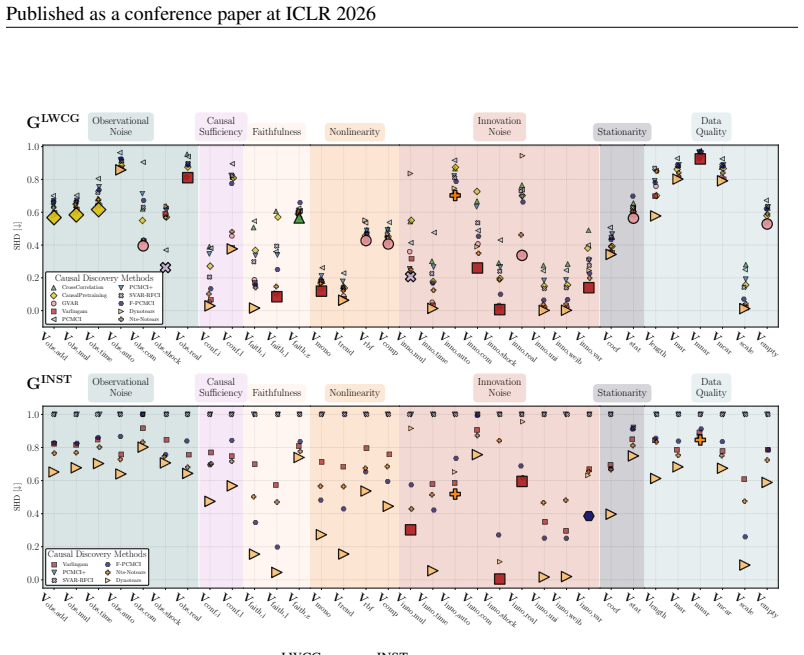
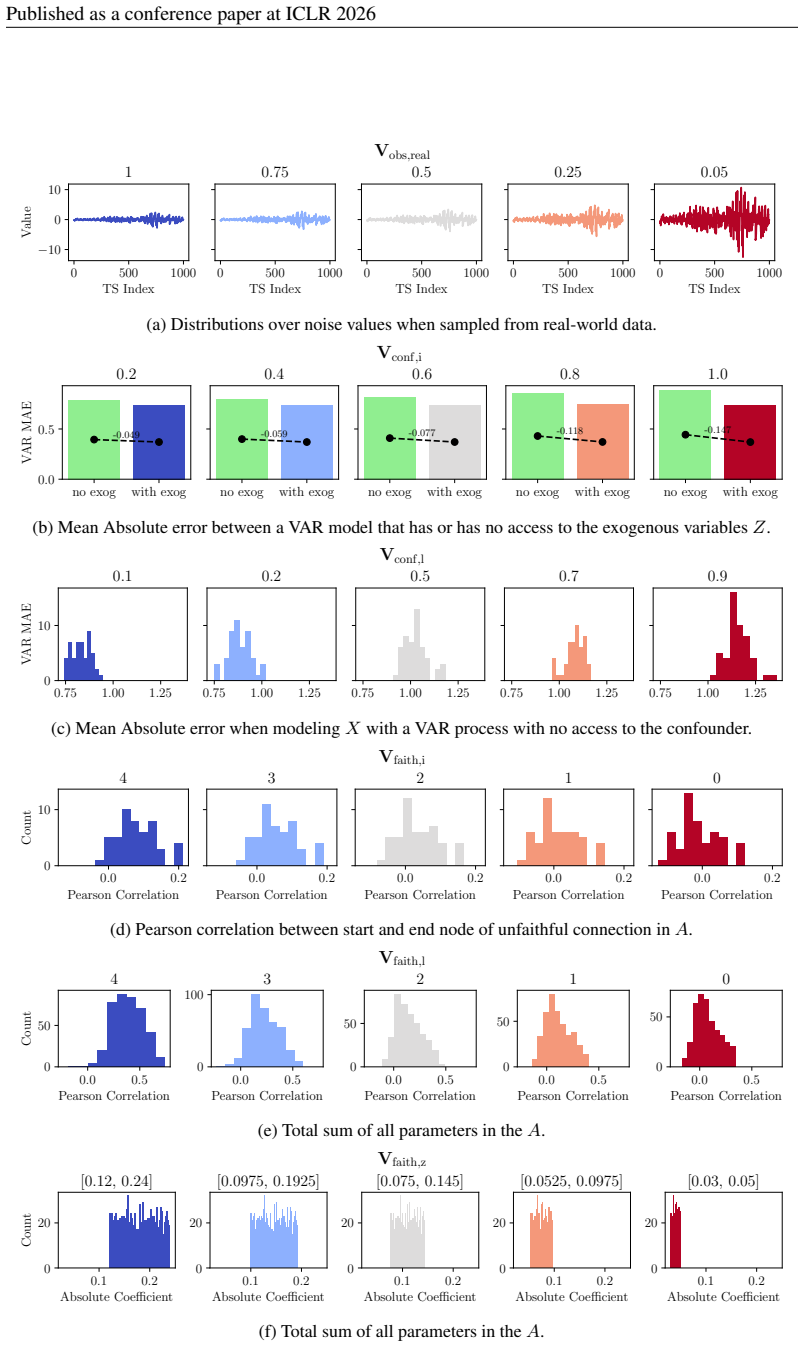
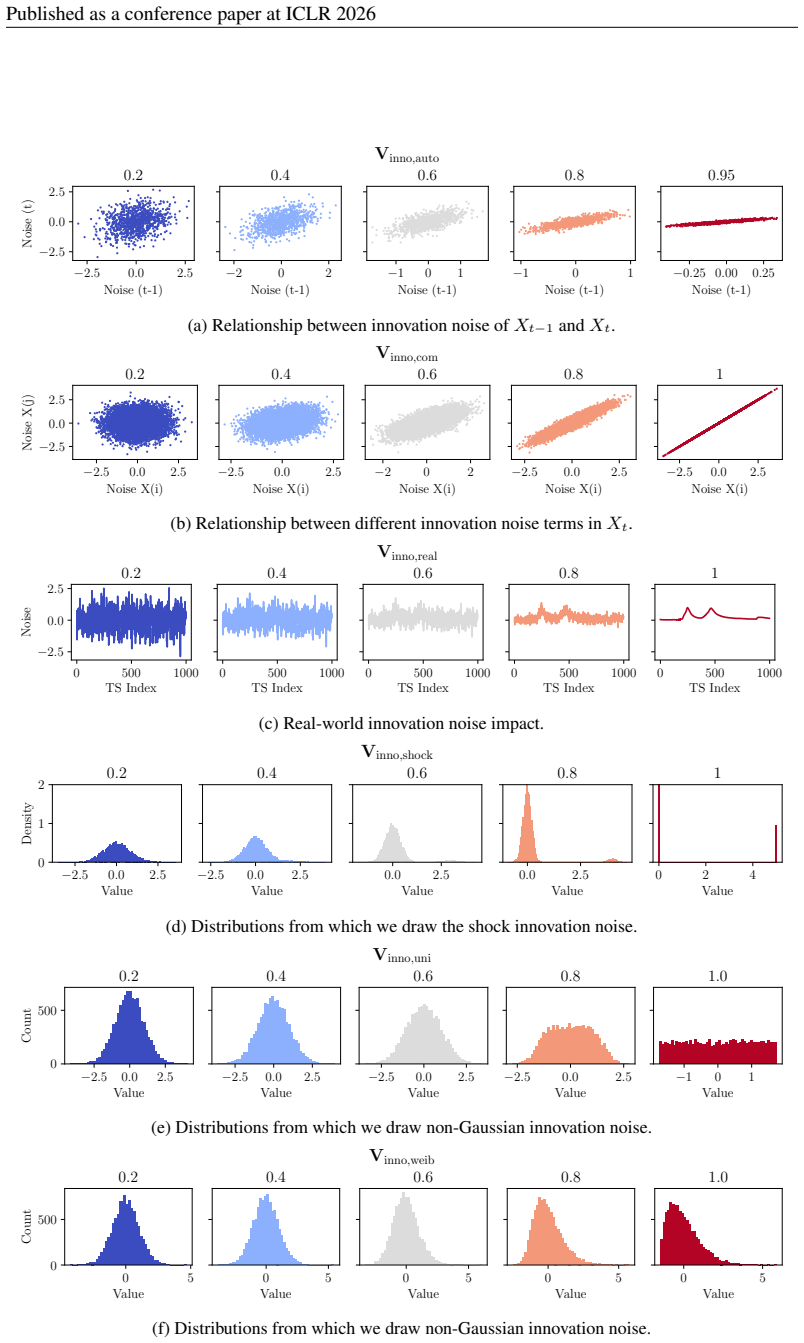
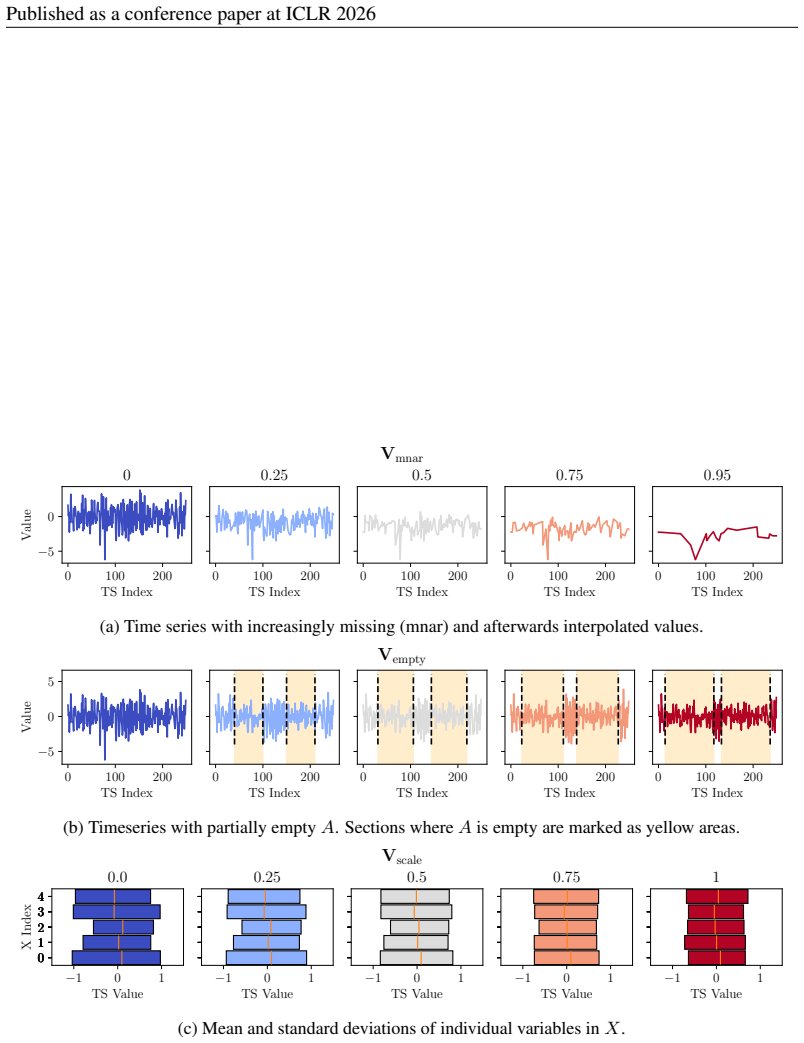
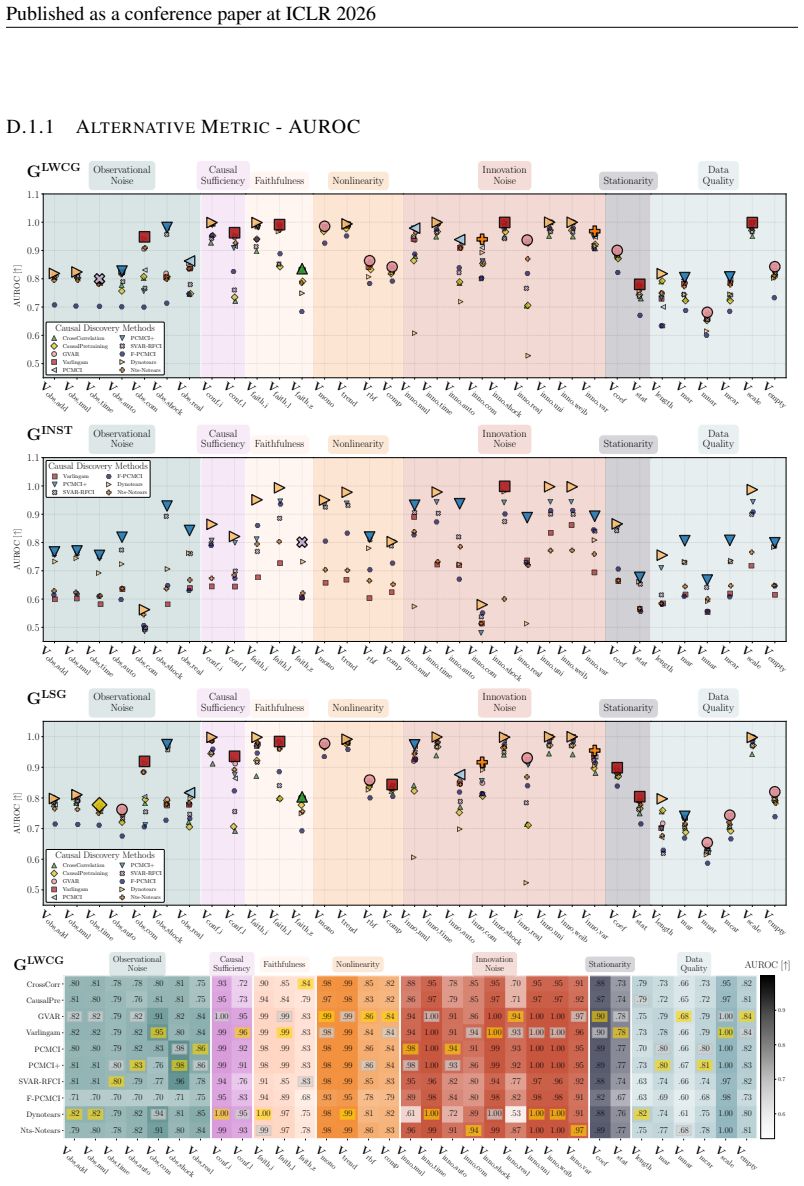
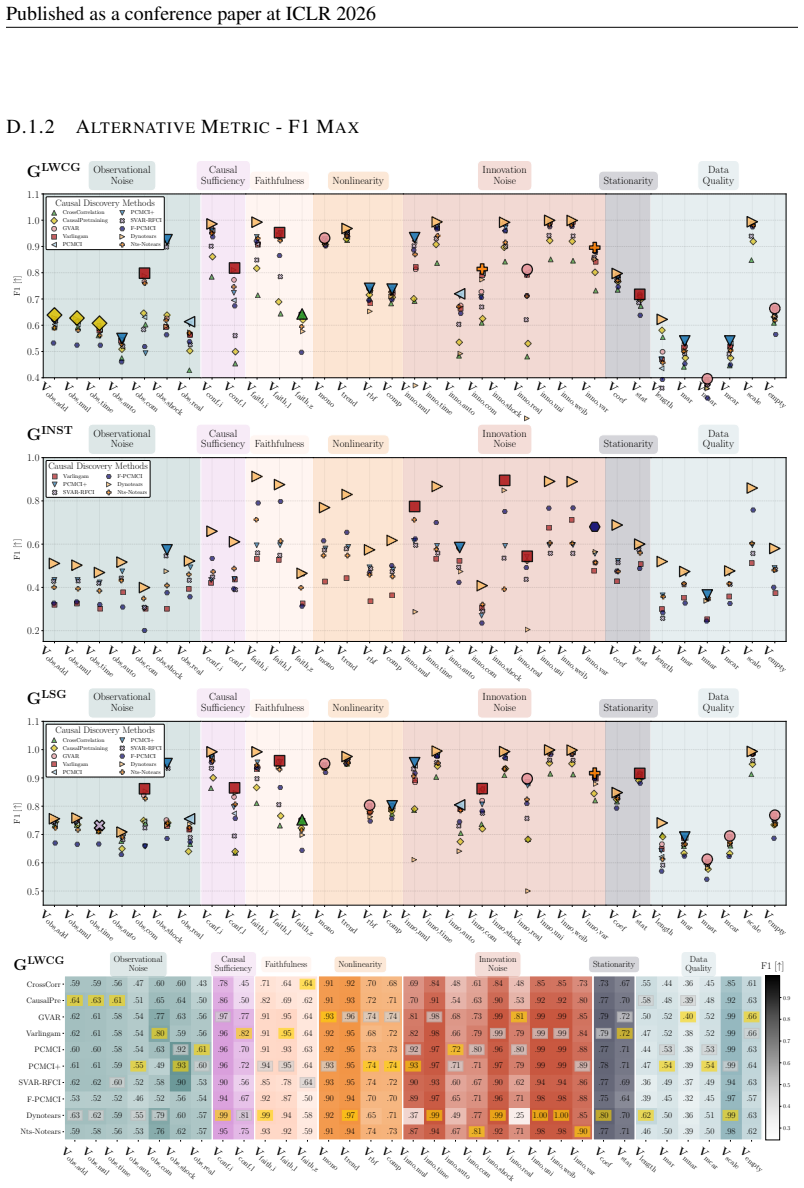
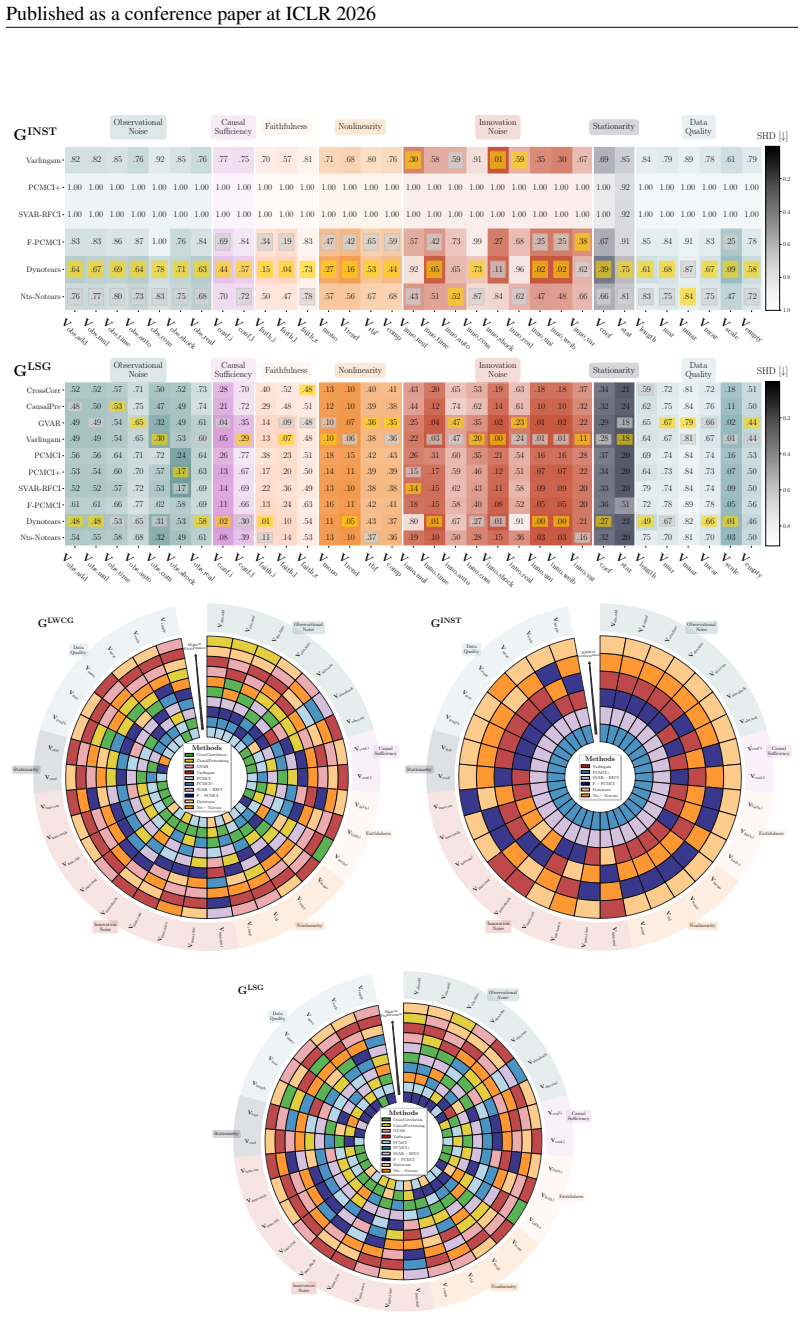
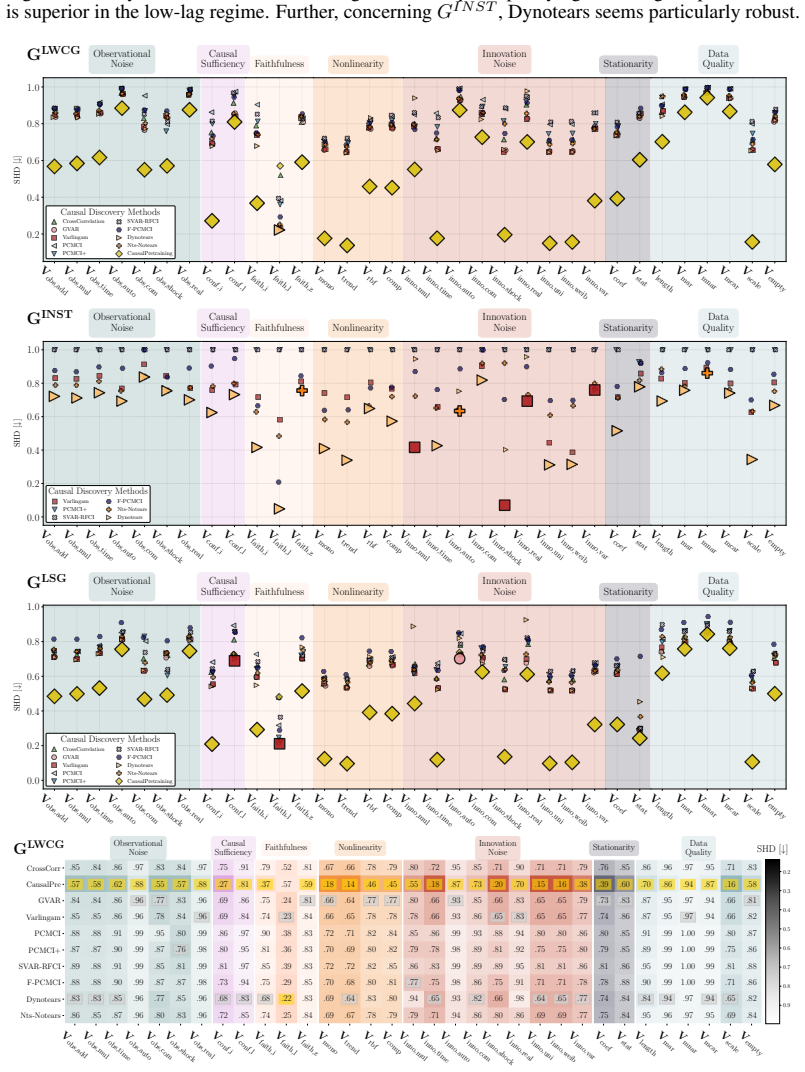
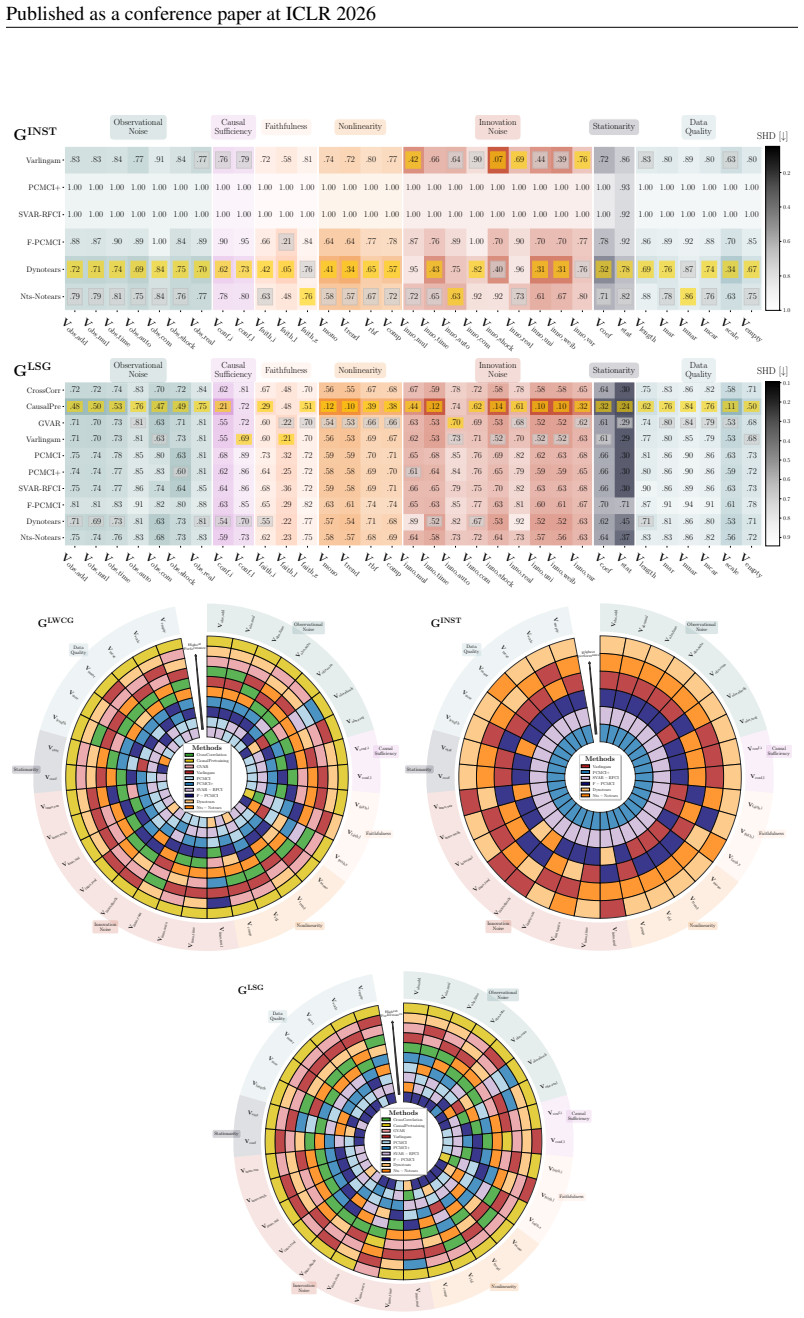
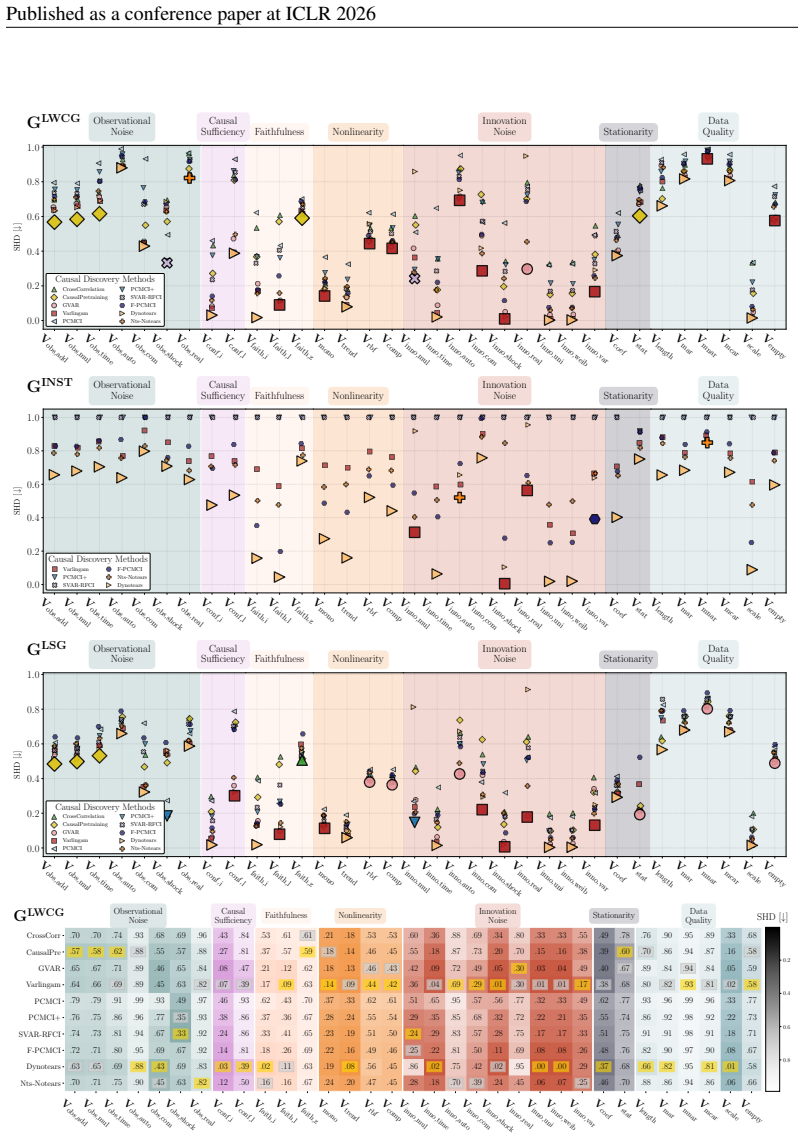
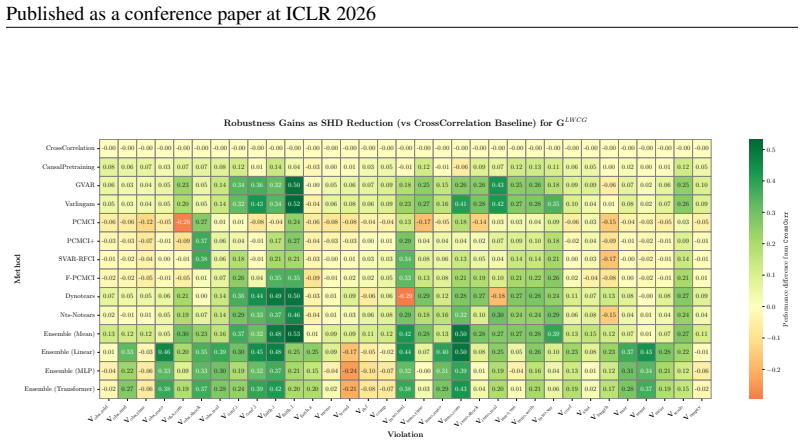
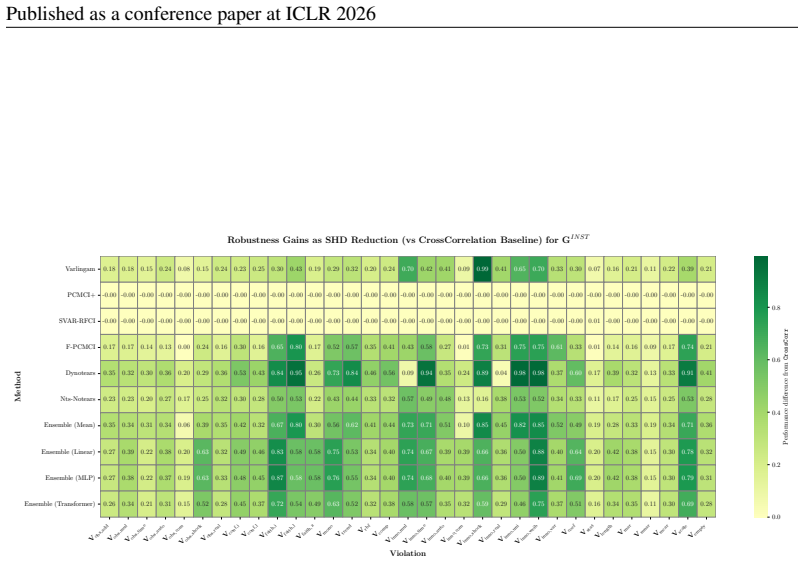
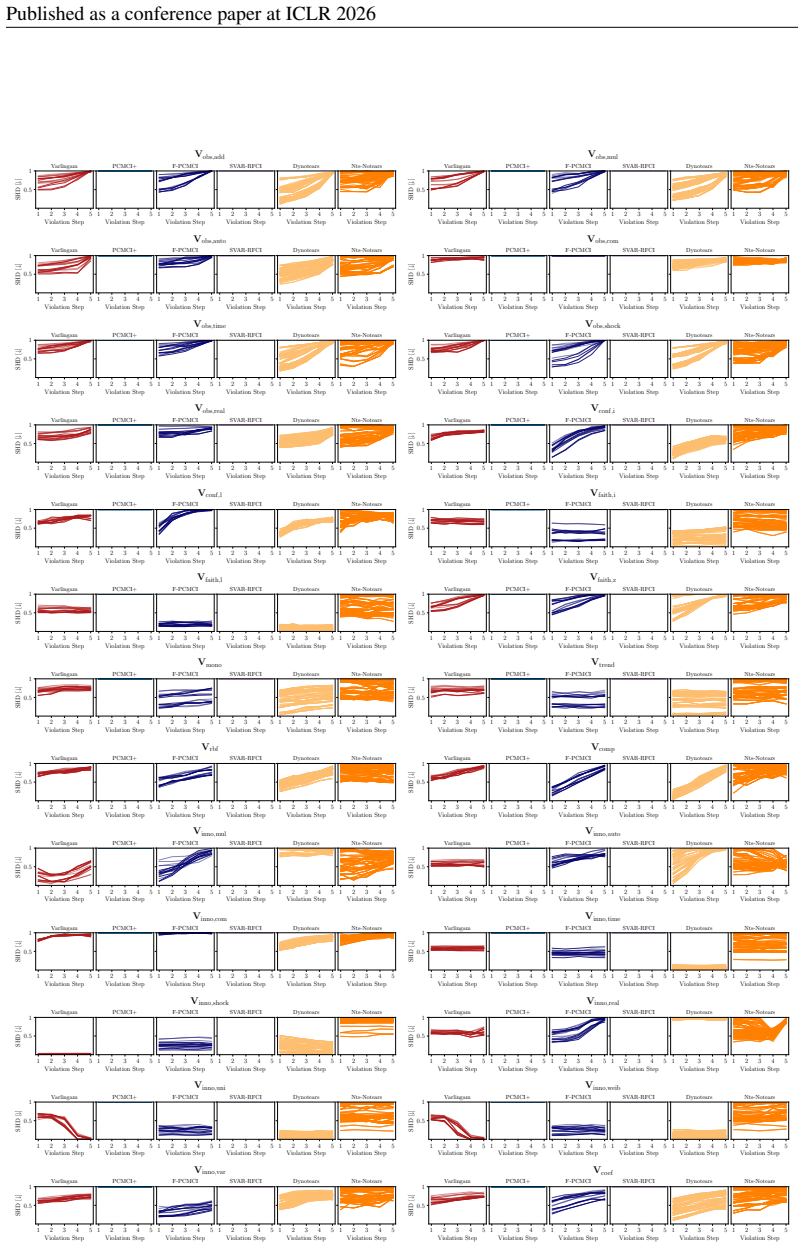
We present TCD-Arena, a modularized, highly customizable, and extendable testing kit to assess the robustness of time series CD algorithms against stepwise more severe assumption violations. For demonstration, we conduct an extensive empirical study comprising around 30 million individual CD attempts and reveal nuanced robustness profiles for 33 distinct assumption violations. Further, we investigate CD ensembles and find that they have the potential to improve general robustness, which has implications for real-world applications.
What carries the argument
TCD-Arena, a modular testing kit that creates synthetic time series data with stepwise, controlled violations of standard assumptions and applies quantitative performance metrics to compare algorithms.
If this is right
- Individual causal discovery methods exhibit distinct robustness profiles when subjected to the same set of assumption violations.
- Some assumption violations produce larger performance losses than others, varying by algorithm.
- Ensembles that combine several causal discovery algorithms can achieve higher robustness than any single method alone.
- The modular design of the toolkit makes it straightforward to add new algorithms or violation types for further testing.
- The evaluation results can inform practical selection of methods for applications where particular assumption violations are likely.
Where Pith is reading between the lines
- Practitioners could consult the reported robustness profiles when matching a causal discovery method to the expected characteristics of their data.
- Algorithm developers might focus improvement efforts on the violation types that cause the largest observed drops.
- Running TCD-Arena on real datasets alongside the synthetic tests would test whether the controlled violations predict actual performance.
- The approach supplies a template for creating standardized benchmarks that emphasize robustness rather than performance on clean data alone.
Load-bearing premise
The 33 controlled synthetic assumption violations and the chosen performance metrics accurately represent the types and impacts of assumption violations that occur in real-world time series data.
What would settle it
Direct experiments on real time series datasets that contain documented assumption violations, showing error patterns or robustness rankings that differ markedly from the patterns produced by TCD-Arena simulations.
Figures
















read the original abstract
Causal Discovery (CD) is a powerful framework for scientific inquiry. Yet, its practical adoption is hindered by a reliance on strong, often unverifiable assumptions and a lack of robust performance assessment. To address these limitations and advance empirical CD evaluation, we present TCD-Arena, a modularized, highly customizable, and extendable testing kit to assess the robustness of time series CD algorithms against stepwise more severe assumption violations. For demonstration, we conduct an extensive empirical study comprising around 30 million individual CD attempts and reveal nuanced robustness profiles for 33 distinct assumption violations. Further, we investigate CD ensembles and find that they have the potential to improve general robustness, which has implications for real-world applications. With this, we strive to ultimately facilitate the development of CD methods that are reliable for a diverse range of synthetic and potentially real-world data conditions.
Editorial analysis
A structured set of objections, weighed in public.
Referee Report
Summary. The manuscript presents TCD-Arena, a modular, customizable, and extendable testing kit for assessing the robustness of time series causal discovery (CD) algorithms against 33 controlled assumption violations. Through an extensive empirical study of approximately 30 million CD attempts, it reports nuanced robustness profiles across methods and finds that CD ensembles have the potential to improve general robustness, with implications for real-world applications.
Significance. If the synthetic violation generators faithfully isolate each assumption and the chosen metrics track practical utility, this benchmark addresses a key gap in empirical CD evaluation by enabling systematic robustness testing. The modular design, scale of the experiments (~30M runs), provision of reproducible code, and ablation tables isolating single violations are clear strengths that could guide development of more reliable CD methods.
major comments (2)
- [Section 4.2] Section 4.2 (Data Generation and Violation Implementation): The paper supplies explicit parameterization and ablation tables for the 33 violations, but lacks quantitative verification (e.g., pre/post-violation statistical tests on unaffected properties such as stationarity or noise distribution) that each generator isolates its target without side effects. This is load-bearing for the central claim of 'nuanced robustness profiles' under stepwise severity.
- [Section 5.3] Section 5.3 (Ensemble Results): The claim that ensembles improve general robustness is supported by the experiments, but the aggregation procedure (e.g., voting, averaging, or selection) and whether gains are uniform across all 33 violations versus concentrated in a subset are not fully detailed; this weakens the generalizability of the ensemble recommendation.
minor comments (3)
- [Abstract] Abstract: Replace the approximate 'around 30 million' with the exact total count and a brief breakdown by violation category for precision and transparency.
- [Figure 3] Figure 3 (Robustness Profile Plots): Add error bars or confidence intervals to the performance curves to convey variability across the large number of runs.
- [Section 6] Section 6 (Discussion): The real-world implications paragraph would be strengthened by one concrete example linking a specific robustness profile to an application domain (e.g., finance or neuroscience time series).
Simulated Author's Rebuttal
We thank the referee for the constructive review and the recommendation for minor revision. We address each major comment point-by-point below and have revised the manuscript to incorporate the suggested clarifications and additions.
read point-by-point responses
-
Referee: [Section 4.2] Section 4.2 (Data Generation and Violation Implementation): The paper supplies explicit parameterization and ablation tables for the 33 violations, but lacks quantitative verification (e.g., pre/post-violation statistical tests on unaffected properties such as stationarity or noise distribution) that each generator isolates its target without side effects. This is load-bearing for the central claim of 'nuanced robustness profiles' under stepwise severity.
Authors: We appreciate the referee highlighting the value of explicit isolation verification. While the ablation tables and parameterization already demonstrate targeted impacts, we agree that quantitative pre/post statistical checks on non-targeted properties would further substantiate the generators' specificity. In the revised manuscript, we have added such verification to Section 4.2 (and the appendix), including Augmented Dickey-Fuller tests for stationarity and Kolmogorov-Smirnov tests for distributional properties on unaffected variables across representative violations. These confirm minimal side effects, directly supporting the reported nuanced robustness profiles. revision: yes
-
Referee: [Section 5.3] Section 5.3 (Ensemble Results): The claim that ensembles improve general robustness is supported by the experiments, but the aggregation procedure (e.g., voting, averaging, or selection) and whether gains are uniform across all 33 violations versus concentrated in a subset are not fully detailed; this weakens the generalizability of the ensemble recommendation.
Authors: We thank the referee for noting the need for greater detail on the ensemble procedure and its scope. In the revised Section 5.3, we have fully specified the aggregation method (majority voting on causal edge presence across the base methods). We have also added a per-violation breakdown (new table and accompanying text) showing that robustness gains occur across 29 of the 33 violations, with larger improvements for noise-related and non-stationarity violations and more modest gains elsewhere. This provides a balanced view of generalizability while highlighting where ensembles are most beneficial. revision: yes
Circularity Check
No significant circularity identified
full rationale
The paper introduces an empirical benchmark (TCD-Arena) for testing time-series causal discovery algorithms under controlled assumption violations. It contains no mathematical derivations, parameter fits, or predictions that reduce to inputs by construction. All headline claims rest on the outcomes of ~30 million reproducible simulation runs with explicitly parameterized violation generators; no self-citation chain or ansatz is required to support the reported robustness profiles or ensemble observations. The work is therefore self-contained against external benchmarks.
Axiom & Free-Parameter Ledger
axioms (1)
- domain assumption Time series causal discovery methods rely on strong assumptions that are often violated in practice
Lean theorems connected to this paper
-
IndisputableMonolith/Cost/FunctionalEquation.lean (J(x)=½(x+x⁻¹)−1 uniqueness)washburn_uniqueness_aczel unclearX_{i,t} = Σ_{d=1}^D Σ_{l=0}^L A_{i,d,l} · f_{i,d,l}(X_{d,t-l}) + ε_{t,i}
-
RS framework as a whole (parameter-free forcing chain)reality_from_one_distinction unclearwe evaluate ten CD algorithms... 33 real-world-inspired, partly semi-synthetic assumption violations, each scaled in intensity. By performing around 30 million individual CD attempts...
-
Foundation/AlphaCoordinateFixation.lean (no adjustable parameters in RS chain)alpha_pin_under_high_calibration unclearwe perform a hyperparameter search for each method... we average the SHD scores across all data regimes and violation levels.
Reference graph
Works this paper leans on
-
[1]
doi:10.1002/aisy.202400181 , abstract =
Advanced Intelligent Systems , author =. doi:10.1002/aisy.202400181 , abstract =
-
[2]
An introduction to causal inference , journal =
Scheines, Richard , year =. An introduction to causal inference , journal =
-
[3]
Advances in neural information processing systems , author =
-
[4]
Efficient and
Li, Xiu-Chuan and Liu, Tongliang , month = oct, year =. Efficient and. Proceedings of the
-
[5]
Proceedings of the
Cheng, Yuxiao and Yang, Runzhao and Xiao, Tingxiong and Li, Zongren and Suo, Jinli and He, Kunlun and Dai, Qionghai , month = sep, year =. Proceedings of the
-
[6]
Neal, Brady and Huang, Chin-Wei and Raghupathi, Sunand , month = may, year =
-
[7]
Proceedings of the
Cheng, Yuxiao and Wang, Ziqian and Xiao, Tingxiong and Zhong, Qin and Suo, Jinli and He, Kunlun , month = oct, year =. Proceedings of the
-
[8]
Montagna, Francesco and Noceti, Nicoletta and Rosasco, Lorenzo and Zhang, Kun and Locatello, Francesco , month = mar, year =. Causal. Proceedings of the 2nd
-
[9]
Shirali, Ali and Abebe, Rediet and Hardt, Moritz , month = sep, year =. A. Proceedings of the
-
[10]
Zhang, Jiji and Spirtes, Peter L. , month = oct, year =. Strong. doi:10.48550/arXiv.1212.2506 , abstract =
-
[11]
Proceedings of the AAAI Conference on Artificial Intelligence , author =. 2025 , pages =. doi:10.1609/aaai.v39i18.34136 , abstract =
-
[12]
Günther, Wiebke and Ninad, Urmi and Runge, Jakob , month = jul, year =. Causal. Proceedings of the
-
[13]
and Devijver, Emilie and Gaussier, Eric , month = aug, year =
Assaad, Charles K. and Devijver, Emilie and Gaussier, Eric , month = aug, year =. Discovery of extended summary graphs in time series , url =. Proceedings of the
-
[14]
High-recall causal discovery for autocorrelated time series with latent confounders , volume =
Gerhardus, Andreas and Runge, Jakob , year =. High-recall causal discovery for autocorrelated time series with latent confounders , volume =. Advances in
-
[15]
Enhancing
Castri, Luca and Mghames, Sariah and Hanheide, Marc and Bellotto, Nicola , month = aug, year =. Enhancing. Proceedings of the
-
[16]
Butterworth, Stephen. On. Scribd , publisher =. 1930 , pages =
1930
-
[17]
Koukounas, Andreas and Mastrapas, Georgios and Günther, Michael and Wang, Bo and Martens, Scott and Mohr, Isabelle and Sturua, Saba and Akram, Mohammad Kalim and Martínez, Joan Fontanals and Ognawala, Saahil and Guzman, Susana and Werk, Maximilian and Wang, Nan and Xiao, Han , month = jun, year =. Jina. doi:10.48550/arXiv.2405.20204 , abstract =
-
[18]
IEEE Transactions on Pattern Analysis and Machine Intelligence , author =
Addressing. IEEE Transactions on Pattern Analysis and Machine Intelligence , author =. 2025 , keywords =. doi:10.1109/TPAMI.2025.3553957 , abstract =
-
[19]
and Wahl, Jonas and Ninad, Urmi and Runge, Jakob , month = may, year =
Herman, Rebecca J. and Wahl, Jonas and Ninad, Urmi and Runge, Jakob , month = may, year =. Unitless. doi:10.48550/arXiv.2503.17037 , abstract =
-
[20]
Deep. ACM Comput. Surv. , author =. 2025 , pages =. doi:10.1145/3762179 , abstract =
-
[21]
Results in Engineering , author =
A systematic review of monocular depth estimation for autonomous driving:. Results in Engineering , author =. 2025 , keywords =. doi:10.1016/j.rineng.2025.105359 , abstract =
-
[22]
Deep. ACM Comput. Surv. , author =. 2024 , pages =. doi:10.1145/3677327 , abstract =
-
[23]
Jyothi Unni, Suraj and Sheth, Paras and Ding, Kaize and Liu, Huan and Selcuk Candan, K. , month = jul, year =. doi:10.48550/arXiv.2307.13757 , abstract =
-
[24]
doi:10.48550/arXiv.2411.06391 , abstract =
Li, Shuqi and Sun, Yuebo and Lin, Yuxin and Gao, Xin and Shang, Shuo and Yan, Rui , month = nov, year =. doi:10.48550/arXiv.2411.06391 , abstract =
-
[25]
Kumar, Nischal Ashok and Feng, Wanyong and Lee, Jaewook and McNichols, Hunter and Ghosh, Aritra and Lan, Andrew , year =. A. doi:10.5281/zenodo.8115727 , language =
-
[26]
Transactions on Machine Learning Research , author =
Neural. Transactions on Machine Learning Research , author =
-
[27]
Advances in Neural Information Processing Systems , author =
Amortized. Advances in Neural Information Processing Systems , author =. 2022 , pages =
2022
-
[28]
Demystifying amortized causal discovery with transformers , url =
Montagna, Francesco and Cairney-Leeming, Max and Sridhar, Dhanya and Locatello, Francesco , month = oct, year =. Demystifying amortized causal discovery with transformers , url =
-
[29]
Balazadeh, Vahid , month = dec, year =. vdblm/
-
[30]
Multimodal alignment and fusion: A survey.arXiv preprint arXiv:2411.17040, 2024
Li, Songtao and Tang, Hao , month = oct, year =. Multimodal. doi:10.48550/arXiv.2411.17040 , abstract =
-
[31]
Karris, Nicholas and Durell, Luke and Flores, Javier and Emerson, Tegan , month = nov, year =. Which. doi:10.48550/arXiv.2511.12757 , abstract =
-
[32]
Olko, Mateusz and Gajewski, Mateusz and Wojciechowska, Joanna and Kuciński, Łukasz and Morzy, Mikołaj and Sankowski, Piotr and Miłoś, Piotr , month = oct, year =. Since
-
[33]
Yi, Huiyang and He, Yanyan and Chen, Duxin and Kang, Mingyu and Wang, He and Yu, Wenwu , year =. The. The
-
[34]
Standardizing
Ormaniec, Weronika and Sussex, Scott and Lorch, Lars and Schölkopf, Bernhard and Krause, Andreas , year =. Standardizing. The
-
[35]
Technological Forecasting and Social Change , author =. 2021 , keywords =. doi:10.1016/j.techfore.2021.121092 , abstract =
-
[36]
Dhir, Anish and Ashman, Matthew and Requeima, James and Wilk, Mark van der , month = mar, year =. A. doi:10.48550/arXiv.2412.16577 , abstract =
-
[37]
Journal of Economic Perspectives , author =
The. Journal of Economic Perspectives , author =. 2017 , keywords =. doi:10.1257/jep.31.2.33 , abstract =
-
[38]
Annual Review of Sociology , author =
Structural. Annual Review of Sociology , author =. 1977 , pages =
1977
-
[39]
An overview of structural equation modeling: its beginnings, historical development, usefulness and controversies in the social sciences , volume =. Quality & Quantity , author =. 2018 , keywords =. doi:10.1007/s11135-017-0469-8 , abstract =
-
[40]
and Rhemtulla, Mijke and de Vlaming, Ronald and Ritchie, Stuart J
Genomic structural equation modelling provides insights into the multivariate genetic architecture of complex traits , volume =. Nature Human Behaviour , author =. 2019 , keywords =. doi:10.1038/s41562-019-0566-x , abstract =
-
[41]
Annals of Translational Medicine , author =
Structural equation modeling in the context of clinical research , volume =. Annals of Translational Medicine , author =. 2017 , pmid =. doi:10.21037/atm.2016.09.25 , abstract =
-
[42]
Bentler, P. M. , editor =. Causal. Handbook of. 1988 , doi =
1988
-
[43]
and Pearl, Judea , editor =
Bollen, Kenneth A. and Pearl, Judea , editor =. Eight. Handbook of. 2013 , doi =
2013
-
[44]
Graphs,. Sociological Methods & Research , author =. 1998 , pages =. doi:10.1177/0049124198027002004 , abstract =
-
[45]
From patterns to causal understanding:. Pedobiologia , author =. 2015 , keywords =. doi:10.1016/j.pedobi.2015.03.002 , abstract =
-
[46]
and Hult, G
Hair, Joseph F. and Hult, G. Tomas M. and Ringle, Christian M. and Sarstedt, Marko and Danks, Nicholas P. and Ray, Soumya , editor =. An. Partial. 2021 , doi =
2021
-
[47]
Methods in Molecular Biology (Clifton, N.J.) , author =
Structural. Methods in Molecular Biology (Clifton, N.J.) , author =. 2017 , pmid =. doi:10.1007/978-1-4939-7274-6_28 , abstract =
-
[48]
Behmanesh, Maysam and Turan, Erkan and Ovsjanikov, Maks , month = sep, year =. Graph. doi:10.48550/arXiv.2509.09597 , abstract =
-
[49]
Causal discovery for time series with latent confounders , url =
Reiser, Christian , month = sep, year =. Causal discovery for time series with latent confounders , url =. doi:10.48550/arXiv.2209.03427 , abstract =
-
[50]
Learning Transferable Visual Models From Natural Language Supervision
Radford, Alec and Kim, Jong Wook and Hallacy, Chris and Ramesh, Aditya and Goh, Gabriel and Agarwal, Sandhini and Sastry, Girish and Askell, Amanda and Mishkin, Pamela and Clark, Jack and Krueger, Gretchen and Sutskever, Ilya , month = feb, year =. Learning. doi:10.48550/arXiv.2103.00020 , abstract =
work page internal anchor Pith review doi:10.48550/arxiv.2103.00020
-
[51]
Ferdous, Muhammad Hasan and Hossain, Emam and Gani, Md Osman , month = aug, year =. Proceedings of the 31st. doi:10.1145/3711896.3737439 , abstract =
-
[52]
IEEE Transactions on Image Processing , author =
Practical. IEEE Transactions on Image Processing , author =. 2014 , keywords =. doi:10.1109/TIP.2014.2347204 , abstract =
-
[53]
The American Statistician , author =
Distinguishing “. The American Statistician , author =. 1996 , pages =. doi:10.1080/00031305.1996.10474381 , number =
-
[54]
A contribution to the mathematical theory of epidemics , volume =. Proceedings of the Royal Society of London. Series A, Containing Papers of a Mathematical and Physical Character , author =. 1997 , pages =. doi:10.1098/rspa.1927.0118 , abstract =
-
[55]
A contribution to the mathematical theory of epidemics
-
[56]
Hydrology and Earth System Sciences , author =
A high-resolution dataset of water fluxes and states for. Hydrology and Earth System Sciences , author =. 2017 , pages =. doi:10.5194/hess-21-1769-2017 , abstract =
-
[57]
CausalDynamics: A large-scale benchmark for structural discovery of dynamical causal models
Herdeanu, Benjamin and Nathaniel, Juan and Roesch, Carla and Buch, Jatan and Ramien, Gregor and Haux, Johannes and Gentine, Pierre , month = may, year =. doi:10.48550/arXiv.2505.16620 , abstract =
-
[58]
Position:
Poinsot, Audrey and Panayiotou, Panayiotis and Leite, Alessandro and Chesneau, Nicolas and Şimşek, Özgür and Schoenauer, Marc , month = jun, year =. Position:
-
[59]
IEEE Transactions on Image Processing , author =
Practical. IEEE Transactions on Image Processing , author =. 2008 , keywords =. doi:10.1109/TIP.2008.2001399 , abstract =
-
[60]
Philosophy of Science , author =
When to. Philosophy of Science , author =. 2013 , pages =. doi:10.1086/673937 , number =
-
[61]
Psychology Science , author =
The robustness of parametric statistical methods , volume =. Psychology Science , author =. 2004 , pages =
2004
-
[62]
Causal network reconstruction from time series:. Chaos: An Interdisciplinary Journal of Nonlinear Science , author =. 2018 , pages =. doi:10.1063/1.5025050 , abstract =
-
[63]
Statistical Science , author =
Bayesian. Statistical Science , author =. 2024 , keywords =. doi:10.1214/23-STS905 , abstract =
-
[64]
Causal discovery and inference: concepts and recent methodological advances , volume =. Applied Informatics , author =. 2016 , keywords =. doi:10.1186/s40535-016-0018-x , abstract =
-
[65]
and Aisen, Paul and Petersen, Ronald and Jack, Clifford R
Challenges and. Scientific Reports , author =. 2020 , keywords =. doi:10.1038/s41598-020-59669-x , abstract =
-
[66]
Identifiability of. Biometrika , author =. 2014 , pages =. doi:10.1093/biomet/ast043 , abstract =
-
[67]
Advances in Neural Information Processing Systems , author =
Conditional. Advances in Neural Information Processing Systems , author =. 2022 , pages =
2022
-
[68]
, editor =
Stone, Lewi and Katriel, Guy and Hilker, Frank M. , editor =. Encyclopedia of. 2012 , pages =
2012
-
[69]
Michaelis-
Ainsworth, Stanley , editor =. Michaelis-. Steady-. 1977 , doi =
1977
-
[70]
Journal of Physics E: Scientific Instruments , author =
Temperature sensor characteristics and measurement system design , volume =. Journal of Physics E: Scientific Instruments , author =. 1984 , pages =. doi:10.1088/0022-3735/17/6/002 , abstract =
-
[71]
CEUR workshop proceedings , author =
Measurement. CEUR workshop proceedings , author =. 2016 , pmid =
2016
-
[72]
The Annals of Statistics , author =
A characterization of. The Annals of Statistics , author =. 1997 , keywords =. doi:10.1214/aos/1031833662 , abstract =
-
[73]
Learning. Bayesian Analysis , author =. 2018 , keywords =. doi:10.1214/18-BA1101 , abstract =
-
[74]
A. IEEE Access , author =. 2022 , keywords =. doi:10.1109/ACCESS.2022.3207287 , abstract =
-
[75]
Advances in Neural Information Processing Systems , author =
Ensemble of. Advances in Neural Information Processing Systems , author =. 2022 , pages =
2022
-
[76]
and Ibeling, Duligur and Icard, Thomas , month = mar, year =
Bareinboim, Elias and Correa, Juan D. and Ibeling, Duligur and Icard, Thomas , month = mar, year =. On. Probabilistic and
-
[77]
Herdeanu, Benjamin and Nathaniel, Juan and Roesch, Carla and Buch, Jatan and Ramien, Gregor and Haux, Johannes and Gentine, Pierre , month = may, year =
-
[78]
Frontiers in Genetics , author =
Review of. Frontiers in Genetics , author =. 2019 , keywords =. doi:10.3389/fgene.2019.00524 , abstract =
-
[79]
Wu, Tianhao and Wu, Xingyu and Wang, Xin and Liu, Shikang and Chen, Huanhuan , month = oct, year =. Nonlinear. Proceedings of the 31st. doi:10.1145/3511808.3557660 , abstract =
-
[80]
Monti, Ricardo Pio and Zhang, Kun and Hyvärinen, Aapo , month = aug, year =. Causal. Proceedings of
discussion (0)
Sign in with ORCID, Apple, or X to comment. Anyone can read and Pith papers without signing in.