Recognition: no theorem link
Strong Locality as a Tetrahedron: A Symmetry-Reduced Geometric Representation of the (3,3,2,2) Bell Scenario
Pith reviewed 2026-05-12 01:58 UTC · model grok-4.3
The pith
Strongly local models in the (3,3,2,2) Bell scenario form a regular tetrahedron characterized by three inequalities in a reduced three-dimensional space.
A machine-rendered reading of the paper's core claim, the machinery that carries it, and where it could break.
Core claim
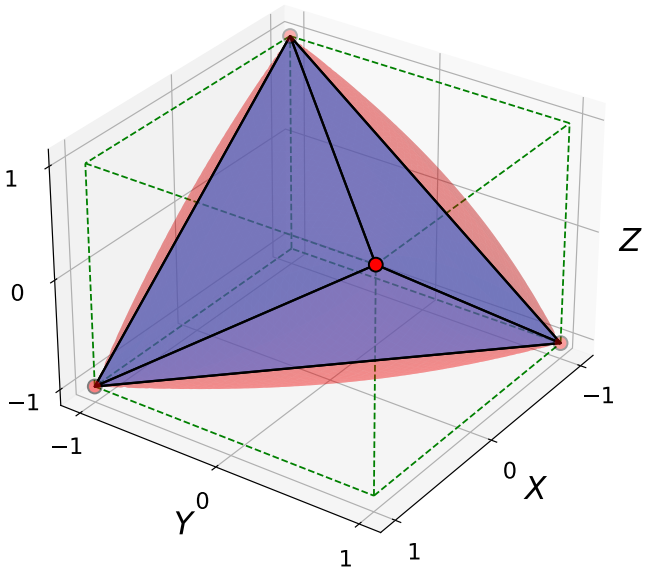
The strongly-local region assumes the form of a regular tetrahedron, the pyramid, in the three-dimensional mixed-moment space. Only three independent linear inequalities, the pyramid inequalities, are required to characterise this region and separate strongly-local models from non-strongly-local models.
What carries the argument
The pyramid inequalities, three linear inequalities that bound the tetrahedron of strongly-local models in the symmetry-reduced mixed-moment space.
If this is right
- The reduction from 684 facet-defining inequalities to three reflects normalisation, symmetry reduction, and projection to the mixed-moment space.
- The hierarchy of strongly-local, quantum, and no-signalling models appears as a tetrahedron embedded in a larger curved body inside a cube.
- This representation provides qualitative and quantitative advantages compared to the standard CHSH representation for the simpler (2,2,2,2) Bell scenario.
Where Pith is reading between the lines
- The same symmetry and projection steps may simplify geometric descriptions of local sets in other Bell scenarios with additional settings.
- The tetrahedron may serve as a starting point for deriving tight bounds on correlations when extending the approach to scenarios with more parties.
Load-bearing premise
Restricting attention to indistinguishable sites and calculating mixed moments under off-diagonal measurement settings preserves all essential features of the full (3,3,2,2) Bell polytope without introducing or losing constraints.
What would settle it
An explicit enumeration of all linear inequalities satisfied by strongly local models in the three-dimensional mixed-moment space that reveals more than three independent constraints would falsify the reduction.
Figures


read the original abstract
We present a geometric characterisation of strongly-local models in the bipartite Bell scenario with three measurement settings per site and binary outcomes, i.e.\ the (3,3,2,2) case. Restricting attention to indistinguishable sites, we introduce a three-dimensional mixed-moment space in which the mixed moments are calculated under off-diagonal measurement settings. In this reduced representation, the strongly-local region assumes the remarkably simple form of a regular tetrahedron - the 'pyramid'. We prove that only three independent linear inequalities are required to characterise this region. We call them the pyramid inequalities that separate strongly-local ($\mathcal{SL}$) models from their complement, non-strongly-local ($\mathcal{\overline{SL}}$) models. We also clarify the relation between the symmetry-reduced pyramid representation and the full (3,3,2,2) Bell polytope in the 36-dimensional conditional-probability space, which possesses 684 facet-defining inequalities. The reduction from 684 to three reflects normalisation, symmetry reduction, and projection to the mixed-moment space. In the pyramid representation, the hierarchy $\mathcal{SL} \subsetneq \mathcal{Q} \subsetneq \mathcal{NS}$ appears geometrically as a tetrahedron embedded in a somewhat larger curved body of quantum models, $\mathcal{Q}$, which in turn is embedded in a cube of no-signalling models, $\mathcal{NS}$. The qualitative and quantitative advantages of the pyramid representation over the standard CSHS representation for the (2,2,2,2) case are discussed.
Editorial analysis
A structured set of objections, weighed in public.
Referee Report
Summary. The paper claims to characterize strongly-local (SL) models in the (3,3,2,2) Bell scenario via a symmetry-reduced 3D mixed-moment space (indistinguishable sites, off-diagonal settings). In this space the SL set is exactly a regular tetrahedron bounded by three independent linear 'pyramid' inequalities; the reduction from the known 36-dimensional conditional-probability polytope (684 facets) is attributed to normalisation, symmetry, and projection. The hierarchy SL ⊂ Q ⊂ NS is visualised as the tetrahedron inside a curved quantum body inside the NS cube, with claimed advantages over the CHSH representation of the (2,2,2,2) case.
Significance. If the projection is faithful, the result supplies a strikingly simple, parameter-free geometric description of strong locality that collapses 684 inequalities to three. This offers both a visual aid for the strict inclusions SL ⊂ Q ⊂ NS and a potential tool for analysing higher Bell scenarios. The explicit mapping to the full polytope is a further strength, as is the reproducible geometric construction.
major comments (1)
- [section clarifying the relation between the symmetry-reduced pyramid and the full (3,3,2,2) Bell polytope] The central claim that the SL region coincides exactly with the tetrahedron rests on the projection (normalisation + symmetry reduction to indistinguishable sites + restriction to off-diagonal mixed moments) being faithful. The manuscript must supply an explicit argument or theorem showing that (i) every SL point in the original 36D polytope maps inside the tetrahedron and (ii) every point outside the tetrahedron is the image of a non-SL model, so that no facet inequalities of the 684-facet polytope become invisible or redundant in the chosen coordinates. Without this verification the reduction from 684 to three inequalities risks under- or over-constraining the set.
Simulated Author's Rebuttal
We thank the referee for their careful reading and for emphasizing the need to rigorously establish the faithfulness of the symmetry-reduced projection. We address the major comment below.
read point-by-point responses
-
Referee: The central claim that the SL region coincides exactly with the tetrahedron rests on the projection (normalisation + symmetry reduction to indistinguishable sites + restriction to off-diagonal mixed moments) being faithful. The manuscript must supply an explicit argument or theorem showing that (i) every SL point in the original 36D polytope maps inside the tetrahedron and (ii) every point outside the tetrahedron is the image of a non-SL model, so that no facet inequalities of the 684-facet polytope become invisible or redundant in the chosen coordinates. Without this verification the reduction from 684 to three inequalities risks under- or over-constraining the set.
Authors: We agree that an explicit verification is required to fully substantiate the equivalence. The manuscript already explains how normalisation, symmetry reduction to indistinguishable sites, and projection to off-diagonal mixed moments reduce the 36D conditional-probability space, but we acknowledge that a dedicated formal statement would make the faithfulness of the mapping clearer. In the revised version we will add a theorem (placed in the section clarifying the relation to the full polytope) proving (i) that every strongly local model in the original 36D polytope projects to a point inside or on the boundary of the tetrahedron, because the pyramid inequalities are obtained directly from the extremal local deterministic assignments after symmetry reduction, and (ii) that any point lying outside the tetrahedron is the image of a distribution that violates strong locality (hence lies outside the 684-facet polytope). The proof proceeds by showing that the three chosen mixed-moment coordinates span the invariant subspace under the symmetry group and that no facet inequality of the original polytope is rendered redundant or invisible by the projection; the three pyramid inequalities are therefore necessary and sufficient in the reduced space. revision: yes
Circularity Check
No circularity: explicit projection and proof from known polytope
full rationale
The derivation proceeds by symmetry reduction to indistinguishable sites, projection onto the three-dimensional mixed-moment space under off-diagonal settings, and an explicit proof that the strongly-local set is exactly the tetrahedron bounded by three linear inequalities. This is a direct geometric construction from the known 36-dimensional (3,3,2,2) polytope (with its 684 facets) rather than a self-definition, a fitted parameter renamed as a prediction, or a load-bearing self-citation chain. The reduction is stated to reflect normalisation, symmetry, and projection, and the central claim is the mathematical verification that the image coincides with the tetrahedron, which does not reduce to its inputs by construction.
Axiom & Free-Parameter Ledger
axioms (2)
- domain assumption Symmetry reduction for indistinguishable sites is valid and does not alter the locality properties
- domain assumption The mixed-moment projection onto off-diagonal settings preserves the separation between SL, Q, and NS sets
Reference graph
Works this paper leans on
-
[1]
J. S. Bell. On the Einstein-Podolsky-Rosen paradox.Physics Physique Fizika, 1:195–200, 1964
work page 1964
-
[2]
J. S. Bell. Bertlmann’s socks and the nature of reality.J. Phys. Colloq., 42:41–62, 1981
work page 1981
-
[3]
N. Gisin. Bell inequalities: many questions, a few answers. 5 2007
work page 2007
-
[4]
R. Horodecki, P. Horodecki, M. Horodecki, and K. Horodecki. Quantum entanglement.Rev. Mod. Phys., 81:865–942, 2009
work page 2009
-
[5]
Z. K. Silagadze. Schrodinger’s cat versus Darwin.Electron. J. Theor. Phys., 7(24):1–56, 2010
work page 2010
-
[6]
M. G. Alford. Ghostly action at a distance: a non-technical explanation of the Bell inequality.Am. J. Phys., 84:448, 2016
work page 2016
- [7]
-
[8]
B. Hensen et al. Loophole-free Bell inequality violation using electron spins separated by 1.3 kilometres. Nature, 526:682–686, 2015
work page 2015
-
[9]
M. Giustina et al. Significant-loophole-free test of Bell’s theorem with entangled photons.Phys. Rev. Lett., 115:250401, 2015. 15
work page 2015
-
[10]
L. K. Shalm et al. Strong loophole-free test of local realism.Phys. Rev. Lett., 115:250402, 2015
work page 2015
-
[11]
N. Brunner, D. Cavalcanti, S. Pironio, V. Scarani, and S. Wehner. Bell nonlocality.Rev. Mod. Phys., 86:419, 2014
work page 2014
-
[12]
J. Larsson. Loopholes in Bell inequality tests of local realism.J. Phys. A, 47(42):424003, 2014
work page 2014
-
[13]
J. S. Bell. Free variables and local causality. InSpeakable and Unspeakable in Quantum Mechanics. Cambridge University Press, 2004
work page 2004
- [14]
-
[15]
M. J. W. Hall. Local deterministic model of singlet state correlations based on relaxing measurement independence.Phys. Rev. Lett., 105:250404, 2010. [Erratum: Phys.Rev.Lett. 116, 219902 (2016)]
work page 2010
-
[16]
S. Hossenfelder and T. N. Palmer. Rethinking Superdeterminism.Front. in Phys., 8:139, 2020
work page 2020
-
[17]
A. Bassi and G. Ghirardi. Dynamical reduction models.Phys. Rept., 379:257, 2003
work page 2003
-
[18]
F. Giacosa. On unitary evolution and collapse in Quantum Mechanics.Quanta, 3:156–170, 2014
work page 2014
-
[19]
J. F. Clauser, M. A. Horne, A. Shimony, and R. A. Holt. Proposed experiment to test local hidden- variable theories.Physical Review Letters, 23:880–884, 1969
work page 1969
- [20]
-
[21]
B. S. Tsirelson. Quantum generalizations of Bell’s inequality.Letters in Mathematical Physics, 4:93–100, 1980
work page 1980
-
[22]
S. Popescu and D. Rohrlich. Quantum nonlocality as an axiom.Found. Phys., 24(3):379–385, 1994
work page 1994
-
[23]
M. Gazdzicki, M. Gorenstein, I. Pidhurskyi, O. Savchuk, and L. Tinti. Equilibration and Locality.Acta Phys. Polon. B, 53:8–A2, 2022
work page 2022
-
[24]
B. E. Aboona et al. Measuring spin correlation between quarks during QCD confinement.Nature, 650(8100):65–71, 2026
work page 2026
-
[25]
S. Wu, C. Qian, Y.-G. Yang, and Q Wang. Generalized Quantum Measurement in Spin-Correlated Hyperon-Antihyperon Decays.Chin. Phys. Lett., 41(11):110301, 2024
work page 2024
- [26]
- [27]
-
[28]
M. Blasone, F. Dell’Anno, S. De Siena, and F. Illuminati. Flavor entanglement in neutrino oscillations in the wave packet description.EPL, 112(2):20007, 2015
work page 2015
-
[29]
R. Moessner and A. P. Ramirez. Geometrical frustration.Physics Today, 59(2):24–29, 2006. 16
work page 2006
discussion (0)
Sign in with ORCID, Apple, or X to comment. Anyone can read and Pith papers without signing in.