Coordination Requires a Common Cause in Quantum Theory
Pith reviewed 2026-05-08 18:31 UTC · model grok-4.3
The pith
In quantum theory, four parties can achieve perfect randomized coordination only if they share a common cause.
A machine-rendered reading of the paper's core claim, the machinery that carries it, and where it could break.
Core claim
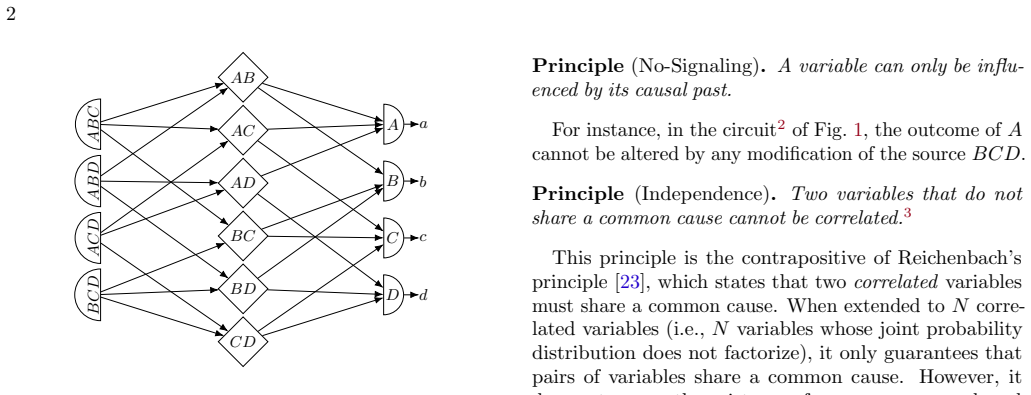
We propose the coordination principle: parties in a network can achieve perfect randomized coordination only if they all share a common cause. This principle does not follow from no-signaling and independence, as shown by an explicit theory that satisfies those conditions yet violates coordination. The principle holds in quantum theory for four parties, where noise-tolerant Bell-like inequalities certify a common cause. For the genuinely quantum coordination task with the four-partite GHZ state, a quantum common cause is required and can also be certified by experimentally accessible Bell-like inequalities.
What carries the argument
The coordination principle, which asserts that perfect randomized coordination among parties is possible only given a shared common cause, together with the derived noise-tolerant Bell-like inequalities that certify such a cause in quantum settings.
If this is right
- The coordination principle holds in quantum theory for four parties.
- Noise-tolerant Bell-like inequalities certify a common cause for coordination tasks.
- The four-partite GHZ state requires a quantum common cause.
- A quantum common cause for the GHZ coordination task can be certified by experimentally accessible Bell-like inequalities.
- The coordination principle is satisfied in quantum theory for general N parties.
Where Pith is reading between the lines
- This separation between quantum theory and other no-signaling theories may enable new experimental tests for the presence of common causes in multipartite quantum networks.
- The framework could be applied to certify common causes in other quantum information tasks involving agreement or correlation.
- Relaxing the perfect-coordination requirement to approximate versions might yield practical certification protocols for near-term devices.
- The results suggest that quantum causal structures impose stricter constraints on multipartite coordination than classical or general no-signaling models.
Load-bearing premise
The definition of perfect randomized coordination as producing a uniformly random output with probability exactly one, combined with the assumptions that the underlying theory obeys no-signaling and statistical independence.
What would settle it
An explicit four-party quantum strategy that achieves perfect randomized coordination while violating one of the derived noise-tolerant Bell-like inequalities, or an experimental observation of such coordination without a detectable common cause.
Figures

read the original abstract
We propose a novel causal principle that is a genuinely multipartite extension of Reichenbach's common cause principle, namely, the coordination principle: parties in a network can achieve perfect randomized coordination--in particular, agree on a uniformly random output--only if they all share a common cause. We show that this principle does not follow from the standard no-signaling and independence principles by providing an explicit theory satisfying all these principles while violating the coordination principle. Strikingly, we prove that the coordination principle holds, however, in quantum theory for four parties, and derive noise-tolerant Bell-like inequalities that certify a common cause. We then extend these results to a genuinely quantum coordination task, showing that the four-partite GHZ state requires a quantum common cause which can also be certified by experimentally accessible Bell-like inequalities. A companion paper generalizes these results for N parties, proving that the coordination principle is satisfied in general for quantum theory.
Editorial analysis
A structured set of objections, weighed in public.
Referee Report
Summary. The manuscript proposes the coordination principle, a multipartite extension of Reichenbach's common cause principle, according to which parties achieve perfect randomized coordination (agreeing on a uniformly random output with probability 1) only if they share a common cause. It constructs an explicit no-signaling theory that satisfies no-signaling and statistical independence yet violates the coordination principle, showing the principle is independent of those assumptions. The authors prove that the coordination principle holds in quantum theory for four parties, derive noise-tolerant Bell-like inequalities that certify a common cause, and extend the results to a genuinely quantum coordination task with the four-partite GHZ state, which requires a quantum common cause also certifiable by experimentally accessible Bell-like inequalities. A companion paper generalizes the results to N parties.
Significance. If the derivations hold, this work establishes a new causal principle that is satisfied specifically in quantum theory (but not in general no-signaling theories), along with experimentally testable inequalities for certifying common causes in multipartite settings. Strengths include the explicit counterexample theory violating the principle while obeying standard assumptions, the direct proofs inside quantum theory, and the application to the GHZ state with falsifiable predictions. These elements provide a clear separation from general theories and practical certification tools.
minor comments (2)
- The definition of 'perfect randomized coordination' (uniform random output with probability 1) is central to the principle and the separation from general theories; state it explicitly with the associated probability measure in the main text before the counterexample construction.
- In the derivation of the noise-tolerant Bell-like inequalities for four parties, include a brief remark on how the inequalities behave under the bipartite limit or when one party is traced out, to clarify the genuinely multipartite character.
Simulated Author's Rebuttal
We thank the referee for their positive assessment of the manuscript, the clear summary of its contributions, and the recommendation for minor revision. We appreciate the recognition of the work's significance in establishing a new causal principle specific to quantum theory along with experimentally testable inequalities.
Circularity Check
No significant circularity in the derivation chain
full rationale
The paper defines the coordination principle as a multipartite extension of Reichenbach's common cause, exhibits an explicit no-signaling theory that satisfies standard assumptions yet violates the principle, and then supplies a direct mathematical proof that the principle holds inside quantum theory for four parties together with the associated noise-tolerant Bell inequalities. These steps rely on the axioms of quantum mechanics and the stated no-signaling plus independence conditions without any reduction to fitted parameters, self-referential definitions, or load-bearing self-citations; the companion paper is invoked solely for the N-party generalization and plays no role in establishing the four-party result.
Axiom & Free-Parameter Ledger
axioms (1)
- domain assumption No-signaling and statistical independence principles
Lean theorems connected to this paper
-
Cost.Jcost / Foundation.LogicAsFunctionalEquationwashburn_uniqueness_aczel unclear?
unclearRelation between the paper passage and the cited Recognition theorem.
⟨AB⟩+⟨BC⟩+⟨CD⟩ ≤ ⟨A⟩⟨D⟩/2 + 3√3/2
What do these tags mean?
- matches
- The paper's claim is directly supported by a theorem in the formal canon.
- supports
- The theorem supports part of the paper's argument, but the paper may add assumptions or extra steps.
- extends
- The paper goes beyond the formal theorem; the theorem is a base layer rather than the whole result.
- uses
- The paper appears to rely on the theorem as machinery.
- contradicts
- The paper's claim conflicts with a theorem or certificate in the canon.
- unclear
- Pith found a possible connection, but the passage is too broad, indirect, or ambiguous to say the theorem truly supports the claim.
Reference graph
Works this paper leans on
-
[1]
Note that measuring this state in the computational basis yields the distribution of a perfect shared random bit, so it is clear that GHZ cannot be generated from the circuit of Fig. 1. In [1], we also show that even if the four sources ABC, ABD, ACD, and BCD share aclassicalcommon cause, a GHZ state still cannot be produced in quantum theory.6 More preci...
work page 2020
-
[1]
Note that measuring this state in the computational basis yields the distribution of a perfect shared random bit, so it is clear that GHZ cannot be generated from the circuit of Fig. 1. In [1], we also show that even if the four sources ABC, ABD, ACD, and BCD share aclassicalcommon cause, a GHZ state still cannot be produced in quantum theory.6 More preci...
work page 2020
-
[2]
A missing causal principle: Coordination,
D. Centeno, A. Coquet, M. C. Ala˜ n´ on, L. Tendick, M.- O. Renou, and E. Wolfe, “A missing causal principle: Coordination,” (2026), companion paper, arxiv to appear
work page 2026
-
[3]
On the einstein podolsky rosen paradox,
J. S. Bell, “On the einstein podolsky rosen paradox,” Physics Physique Fizika1, 195 (1964)
work page 1964
-
[4]
N. Brunner, D. Cavalcanti, S. Pironio, V. Scarani, and S. Wehner, “Bell nonlocality,” Rev. Mod. Phys.86, 419 (2014)
work page 2014
-
[5]
Can quantum- mechanical description of physical reality be considered complete?
A. Einstein, B. Podolsky, and N. Rosen, “Can quantum- mechanical description of physical reality be considered complete?” Phys. Rev.47, 777 (1935)
work page 1935
-
[6]
Self-testing of quantum systems: a review,
I. ˇSupi´ c and J. Bowles, “Self-testing of quantum systems: a review,” Quantum4, 337 (2020)
work page 2020
-
[7]
Quantum cryptography based on bell’s theorem,
A. K. Ekert, “Quantum cryptography based on bell’s theorem,” Phys. Rev. Lett.67, 661 (1991). 6
work page 1991
-
[8]
Device-independent security of quantum cryptography against collective attacks,
A. Ac´ ın, N. Brunner, N. Gisin, S. Massar, S. Pironio, and V. Scarani, “Device-independent security of quantum cryptography against collective attacks,” Phys. Rev. Lett. 98, 230501 (2007)
work page 2007
-
[9]
Quantum and relativistic protocols for secure multi-party computation,
R. Colbeck, “Quantum and relativistic protocols for secure multi-party computation,” (2009)
work page 2009
-
[10]
Random numbers certi- fied by bell’s theorem,
S. Pironio, A. Ac´ ın, S. Massar, A. B. de la Giroday, D. N. Matsukevich, P. Maunz, S. Olmschenk, D. Hayes, L. Luo, T. A. Manning, and C. Monroe, “Random numbers certi- fied by bell’s theorem,” Nature464, 1021–1024 (2010)
work page 2010
-
[11]
Information, physics, quantum: The search for links,
J. A. Wheeler, “Information, physics, quantum: The search for links,” inProceedings III International Sympo- sium on Foundations of Quantum Mechanics, edited by W. J. Archibald (1989) pp. 354–358
work page 1989
-
[12]
G. Chiribella and R. W. Spekkens, eds.,Quantum Theory: Informational Foundations and Foils(Springer Nether- lands, 2016)
work page 2016
-
[13]
S. Popescu and D. Rohrlich, “Generic quantum nonlocality,” Physics Letters A166, 293 (1992)
work page 1992
-
[14]
Information causality as a physical principle,
M. Paw lowski, T. Paterek, D. Kaszlikowski, V. Scarani, A. Winter, and M. ˙Zukowski, “Information causality as a physical principle,” Nature461, 1101–1104 (2009)
work page 2009
-
[15]
Local orthogonality as a multi- partite principle for quantum correlations,
T. Fritz, A. Sainz, R. Augusiak, J. B. Brask, R. Chaves, A. Leverrier, and A. Ac´ ın, “Local orthogonality as a multi- partite principle for quantum correlations,” Nature Com- munications4(2013)
work page 2013
-
[16]
Limit on nonlocality in any world in which communication complexity is not trivial,
G. Brassard, H. Buhrman, N. Linden, A. A. M´ ethot, A. Tapp, and F. Unger, “Limit on nonlocality in any world in which communication complexity is not trivial,” Phys. Rev. Lett.96, 250401 (2006)
work page 2006
-
[17]
Quan- tum nonlocality and beyond: Limits from nonlocal compu- tation,
N. Linden, S. Popescu, A. J. Short, and A. Winter, “Quan- tum nonlocality and beyond: Limits from nonlocal compu- tation,” Phys. Rev. Lett.99, 180502 (2007)
work page 2007
-
[18]
Con- straints on nonlocality in networks from no-signaling and independence,
N. Gisin, J.-D. Bancal, Y. Cai, P. Remy, A. Tavakoli, E. Zambrini Cruzeiro, S. Popescu, and N. Brunner, “Con- straints on nonlocality in networks from no-signaling and independence,” Nature Communications11(2020)
work page 2020
-
[19]
M. Navascu´ es, Y. Guryanova, M. J. Hoban, and A. Ac´ ın, “Almost quantum correlations,” Nature Communications 6(2015)
work page 2015
-
[20]
Any physical theory of nature must be boundlessly multipartite nonlocal,
X. Coiteux-Roy, E. Wolfe, and M.-O. Renou, “Any physical theory of nature must be boundlessly multipartite nonlocal,” Physical Review A104, 052207 (2021)
work page 2021
-
[21]
No bipartite- nonlocal causal theory can explain nature’s correlations,
X. Coiteux-Roy, E. Wolfe, and M.-O. Renou, “No bipartite- nonlocal causal theory can explain nature’s correlations,” Physical review letters127, 200401 (2021)
work page 2021
-
[22]
Theory-independent limits on correlations from generalized Bayesian networks,
J. Henson, R. Lal, and M. F. Pusey, “Theory-independent limits on correlations from generalized Bayesian networks,” New J. Phys.16, 113043 (2014)
work page 2014
-
[23]
The Inflation Technique for Causal Inference with Latent Variables,
E. Wolfe, R. W. Spekkens, and T. Fritz, “The Inflation Technique for Causal Inference with Latent Variables,” J. Causal Inference7, 0020 (2019)
work page 2019
-
[24]
Reichenbach,The Direction of Time, Dover Books on Physics (Dover Publications, 2012)
H. Reichenbach,The Direction of Time, Dover Books on Physics (Dover Publications, 2012)
work page 2012
-
[25]
Quantum nonlocality as an axiom,
S. Popescu and D. Rohrlich, “Quantum nonlocality as an axiom,” Foundations of Physics24, 379 (1994)
work page 1994
-
[26]
Information-theoretic inference of common ancestors,
B. Steudel and N. Ay, “Information-theoretic inference of common ancestors,” Entropy17, 2304 (2015)
work page 2015
-
[27]
Comparing causality principles,
J. Henson, “Comparing causality principles,” Studies In History and Philosophy of Science Part B: Studies In History and Philosophy of Modern Physics36, 519 (2005)
work page 2005
-
[28]
The principle of the common cause faces the bernstein paradox,
J. Uffink, “The principle of the common cause faces the bernstein paradox,” Philosophy of Science66, S512 (1999)
work page 1999
-
[29]
G. M. D’Ariano, G. Chiribella, and P. Perinotti,Quantum theory from first principles: an informational approach (Cambridge University Press, 2017)
work page 2017
-
[30]
D. Centeno and E. Wolfe, “Distinguishing quantum causal scenarios with indistinguishable classical analogs: The significance of intermediate latents,” Physical Review A 112, 042206 (2025)
work page 2025
-
[31]
Quantum inflation: A gen- eral approach to quantum causal compatibility,
E. Wolfe, A. Pozas-Kerstjens, M. Grinberg, D. Rosset, A. Ac´ ın, and M. Navascu´ es, “Quantum inflation: A gen- eral approach to quantum causal compatibility,” Physical Review X11, 021043 (2021)
work page 2021
-
[32]
Experimental demonstration that no tripartite-nonlocal causal theory explains nature’s correlations,
H. Cao, M.-O. Renou, C. Zhang, G. Mass´ e, X. Coiteux-Roy, B.-H. Liu, Y.-F. Huang, C.-F. Li, G.-C. Guo, and E. Wolfe, “Experimental demonstration that no tripartite-nonlocal causal theory explains nature’s correlations,” Physical Re- view Letters129, 150402 (2022)
work page 2022
-
[33]
Heralded three-photon entanglement from a single-photon source on a photonic chip,
S. Chen, L.-C. Peng, Y.-P. Guo, X.-M. Gu, X. Ding, R.- Z. Liu, J.-Y. Zhao, X. You, J. Qin, Y.-F. Wang,et al., “Heralded three-photon entanglement from a single-photon source on a photonic chip,” Physical Review Letters132, 130603 (2024)
work page 2024
-
[34]
Photonic source of her- alded greenberger-horne-zeilinger states,
H. Cao, L. Hansen, F. Giorgino, L. Carosini, P. Zah´ alka, F. Zilk, J. Loredo, and P. Walther, “Photonic source of her- alded greenberger-horne-zeilinger states,” Physical Review Letters132, 130604 (2024)
work page 2024
-
[35]
Ruling out N-partite quantum causal networks as a complete theory of Nature,
A. Coquet, “Ruling out N-partite quantum causal networks as a complete theory of Nature,” ETH Z¨ urich Master’s thesis supervised by Prof. Marc-Olivier Renou and Prof. Renato Renner (2024)
work page 2024
discussion (0)
Sign in with ORCID, Apple, or X to comment. Anyone can read and Pith papers without signing in.