Recognition: 3 theorem links
· Lean Theoremffsim: Faster simulation of fermionic quantum circuits
Pith reviewed 2026-05-08 18:20 UTC · model grok-4.3
The pith
ffsim exploits particle-number and spin-z conservation to simulate fermionic quantum circuits with far less memory and time than general-purpose simulators.
A machine-rendered reading of the paper's core claim, the machinery that carries it, and where it could break.
Core claim
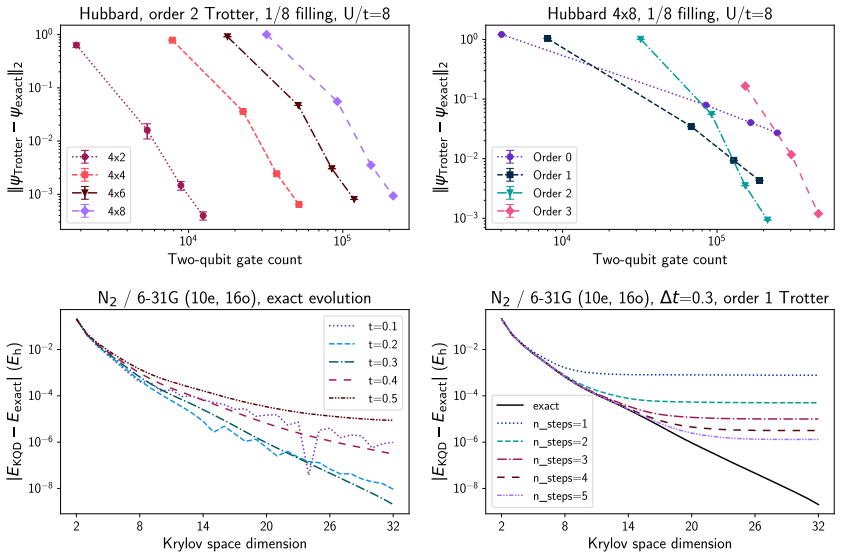
ffsim exploits conservation of particle number and the z component of spin, symmetries present in a wide range of fermionic systems, to dramatically reduce memory usage and simulation time compared to general-purpose quantum circuit simulators, while supplying additional capabilities including variational ansatzes, Trotter-Suzuki Hamiltonian evolution, efficient Slater-determinant sampling, and seamless integration with Qiskit and PySCF.
What carries the argument
Particle-number and spin-z conservation symmetries used to restrict the state-vector representation and gate operations to a smaller, symmetry-preserving subspace.
If this is right
- Circuits with up to 64 qubits become practical on ordinary hardware.
- Variational and Trotter-based algorithms run with lower resource cost.
- Slater-determinant sampling and Qiskit/PySCF workflows integrate directly.
- Performance exceeds that of FQE on the reported benchmark set.
Where Pith is reading between the lines
- The same symmetry-reduction pattern could be applied to other conserved quantities such as total spin or momentum in lattice models.
- Users could combine ffsim with classical embedding techniques to treat larger molecular systems than full-configuration-interaction methods allow.
- The library's modular design may simplify addition of new fermionic gates or noise models without rebuilding the core simulator.
Load-bearing premise
The target fermionic circuits preserve particle number and spin-z, so the reduced subspace still contains the correct dynamics.
What would settle it
A benchmark run on circuits known to conserve both quantities where ffsim uses equal or greater memory and wall time than a symmetry-unaware simulator, or returns different expectation values.
Figures


read the original abstract
We present ffsim, an open-source software library for fast simulation of fermionic quantum circuits. ffsim exploits conservation of particle number and the z component of spin, symmetries present in a wide range of fermionic systems, to dramatically reduce memory usage and simulation time compared to general-purpose quantum circuit simulators. Compared to FQE, a library with similar functionality, ffsim differs in software design and is faster on a representative set of simulation benchmarks. Beyond state vector evolution by basic fermionic gates, ffsim offers a number of additional features including variational ansatzes, Hamiltonian time evolution via Trotter-Suzuki product formulas, efficient sampling of Slater determinants, seamless integration with Qiskit and PySCF, and comprehensive documentation. We demonstrate ffsim's capabilities on scientific applications involving quantum circuits of up to 64 qubits.
Editorial analysis
A structured set of objections, weighed in public.
Referee Report
Summary. The manuscript presents ffsim, an open-source Python library for simulating fermionic quantum circuits. It exploits conservation of particle number and Sz to reduce the effective state space dimension, claiming dramatically lower memory use and faster runtimes than general-purpose simulators. The library supports state-vector evolution under fermionic gates, variational ansatzes, Trotter-Suzuki Hamiltonian evolution, efficient Slater-determinant sampling, and integrations with Qiskit and PySCF. Performance is compared empirically to FQE on a set of benchmarks, and the capabilities are demonstrated on scientific applications involving circuits of up to 64 qubits.
Significance. If the reported speedups hold under scrutiny, ffsim would provide a practical tool for classical simulation of fermionic systems in quantum chemistry and variational quantum algorithms, where particle-number and Sz symmetries are ubiquitous. The open-source release, documentation, and additional algorithmic features (ansatzes, Trotter evolution, sampling) add value beyond a pure performance comparison. The empirical baseline against FQE is a useful reference point for users.
major comments (2)
- [Abstract] Abstract: the statement that ffsim demonstrates capabilities on 'quantum circuits of up to 64 qubits' omits the particle number N and Sz values used in those examples. For M=64 spin-orbitals the symmetry-reduced dimension is binomial(M,N) (or the appropriate Sz subspace), which remains tractable only for small N (typically N ≲ 10–12). Without these parameters it is impossible to assess whether the 64-qubit demonstrations represent realistic scientific workloads or only the low-filling regime where the memory reduction is largest.
- [Results / benchmarks] Benchmark comparison (results section): the claim that ffsim 'is faster on a representative set of simulation benchmarks' is presented without explicit definitions of the circuits, gate sets, system sizes (M,N,Sz), hardware platform, or precise timing/memory metrics. Because the central performance advantage rests on this empirical comparison rather than an analytic derivation, the absence of these details prevents independent verification of the speedup magnitude and its dependence on filling factor.
minor comments (2)
- [Results] The manuscript would benefit from a short table in the results section listing M, N, Sz, circuit depth, and wall-clock times for each benchmark point, including the 64-qubit examples.
- [Code availability] Ensure that the repository contains the exact benchmark scripts and environment specifications so that the reported speedups can be reproduced.
Simulated Author's Rebuttal
We thank the referee for their constructive comments and positive assessment of ffsim's potential utility. We address the two major comments point by point below. Both concerns are valid and we have revised the manuscript to improve clarity and reproducibility.
read point-by-point responses
-
Referee: [Abstract] Abstract: the statement that ffsim demonstrates capabilities on 'quantum circuits of up to 64 qubits' omits the particle number N and Sz values used in those examples. For M=64 spin-orbitals the symmetry-reduced dimension is binomial(M,N) (or the appropriate Sz subspace), which remains tractable only for small N (typically N ≲ 10–12). Without these parameters it is impossible to assess whether the 64-qubit demonstrations represent realistic scientific workloads or only the low-filling regime where the memory reduction is largest.
Authors: We agree that the abstract should specify the particle numbers and Sz values to allow readers to evaluate the regime of the demonstrations. The full manuscript already states the system sizes in the applications section, but the abstract was overly brief. In the revised version we have updated the final sentence of the abstract to: 'We demonstrate ffsim's capabilities on scientific applications involving quantum circuits of up to 64 qubits with N ≤ 12 particles in the Sz = 0 subspace.' This addition directly addresses the referee's concern while remaining faithful to the content of the paper. revision: yes
-
Referee: [Results / benchmarks] Benchmark comparison (results section): the claim that ffsim 'is faster on a representative set of simulation benchmarks' is presented without explicit definitions of the circuits, gate sets, system sizes (M,N,Sz), hardware platform, or precise timing/memory metrics. Because the central performance advantage rests on this empirical comparison rather than an analytic derivation, the absence of these details prevents independent verification of the speedup magnitude and its dependence on filling factor.
Authors: We acknowledge that the original results section provided only high-level descriptions of the benchmarks and did not include a consolidated table of parameters. Although the manuscript referenced the gate sets (fermionic Givens rotations, number-conserving gates) and compared against FQE, the lack of explicit (M, N, Sz) tuples, hardware details, and quantitative metrics for each benchmark point is a legitimate gap. In the revised manuscript we have added a new subsection and accompanying table that lists, for every benchmark: the exact circuit family, gate set, system sizes (M, N, Sz), computing platform, and measured wall-clock time plus peak memory. These additions enable independent verification and make the dependence on filling factor transparent. revision: yes
Circularity Check
No significant circularity; empirical library benchmarks are self-contained
full rationale
The paper describes an open-source library implementing standard particle-number and Sz symmetry reductions for fermionic state-vector simulation, with performance claims resting on direct wall-clock and memory comparisons to the independent FQE library across a set of benchmarks. No equations, parameters, or predictions are fitted to the target results and then re-presented as outputs; the symmetry subspaces are computed from the input circuit and Hamiltonian in the usual way (binomial dimensions for given N and Sz). No self-citations are load-bearing for the central claims, and the 64-qubit demonstrations are feasible precisely because the paper restricts to low-N regimes where the reduced dimension remains tractable—an explicit engineering choice rather than a hidden tautology. The work is therefore a conventional software-engineering contribution whose correctness can be verified by re-running the supplied benchmarks.
Axiom & Free-Parameter Ledger
axioms (1)
- domain assumption Fermionic systems conserve particle number and the z-component of spin.
Lean theorems connected to this paper
-
Foundation/ArithmeticFromLogic.leanno overlap — combinatorial sector dimension, not Peano/orbit forcing unclearThe dimension of the state vector is C(N,Nα)·C(N,Nβ)... ffsim restricts simulation to a single such sector.
-
Cost/FunctionalEquation.leanno contact with J-cost or cosh classification; this is standard Suzuki recursion unclearTrotter-Suzuki product formulas... Sk(t) = S_{k-1}^2(uk t) S_{k-1}((1-4uk)t) S_{k-1}^2(uk t) where uk = 1/(4-4^{1/(2k-1)})
Reference graph
Works this paper leans on
-
[1]
The Fermionic Quantum Emula- tor
Nicholas C. Rubin, Klaas Gunst, Alec White, Leon Freitag, Kyle Throssell, Garnet Kin-Lic Chan, Ryan Babbush, and Toru Shiozaki. “The Fermionic Quantum Emula- tor”. Quantum5, 568 (2021)
2021
-
[2]
Ali Javadi-Abhari, Matthew Treinish, Kevin Krsulich, Christopher J. Wood, Jake Lishman, Julien Gacon, Simon Martiel, Paul D. Nation, Lev S. Bishop, Andrew W. Cross, Blake R. Johnson, and Jay M. Gambetta. “Quantum computing with Qiskit” (2024). arXiv:2405.08810
work page internal anchor Pith review arXiv 2024
-
[3]
PySCF: the Python-based simulations of chemistry framework
Qiming Sun, Timothy C. Berkelbach, Nick S. Blunt, George H. Booth, Sheng Guo, Zhendong Li, Junzi Liu, James D. McClain, Elvira R. Sayfutyarova, Sandeep Sharma, Sebastian Wouters, and Garnet Kin-Lic Chan. “PySCF: the Python-based simulations of chemistry framework”. WIREs Computational Molecular Science8, e1340 (2018)
2018
-
[4]
Recent developments in the PySCF program package
Qiming Sun, Xing Zhang, Samragni Banerjee, Peng Bao, Marc Barbry, Nick S. Blunt, Nikolay A. Bogdanov, George H. Booth, Jia Chen, Zhi-Hao Cui, Janus J. Eriksen, Yang Gao, Sheng Guo, Jan Hermann, Matthew R. Hermes, Kevin Koh, Peter Koval, Susi Lehtola, Zhendong Li, Junzi Liu, Narbe Mardirossian, James D. McClain, Mario Motta, Bastien Mussard, Hung Q. Pham, ...
2020
-
[5]
The Python Simulations of Chemistry Framework: 10 years of an open-source quantum chemistry project
Qiming Sun, Matthew R Hermes, Xiaojie Wu, Huanchen Zhai, Xing Zhang, Ab- delrahman M. Ahmed, Juan José Aucar, Oliver J. Backhouse, Samragni Banerjee, Peng Bao, Nikolay A. Bogdanov, Kyle Bystrom, Frédéric Chapoton, Ning-Yuan Chen, Ivan Yu. Chernyshov, Helen S. Clifford, Sander Cohen-Janes, Zhi-Hao Cui, Yann D. Damour, Nike Dattani, Linus Bjarne Dittmer, Se...
work page internal anchor Pith review Pith/arXiv arXiv 2026
-
[6]
Molecular Electronic-Structure Theory
Trygve Helgaker, Poul Jørgensen, and Jeppe Olsen. “Molecular Electronic-Structure Theory”. John Wiley & Sons, Ltd. (2000)
2000
-
[7]
Low rank representations for quantum simula- tion of electronic structure
Mario Motta, Erika Ye, Jarrod R. McClean, Zhendong Li, Austin J. Minnich, Ryan Babbush, and Garnet Kin-Lic Chan. “Low rank representations for quantum simula- tion of electronic structure”. npj Quantum Information7, 83 (2021)
2021
-
[8]
Low-depth quantum simulation of materials
Ryan Babbush, Nathan Wiebe, Jarrod McClean, James McClain, Hartmut Neven, and Garnet Kin-Lic Chan. “Low-depth quantum simulation of materials”. Phys. Rev. X8, 011044 (2018)
2018
-
[9]
Quantum simulation of electronic struc- ture with linear depth and connectivity
Ian D. Kivlichan, Jarrod McClean, Nathan Wiebe, Craig Gidney, Alán Aspuru-Guzik, Garnet Kin-Lic Chan, and Ryan Babbush. “Quantum simulation of electronic struc- ture with linear depth and connectivity”. Phys. Rev. Lett.120, 110501 (2018)
2018
-
[10]
Fermionic quantum computation
Sergey B. Bravyi and Alexei Yu. Kitaev. “Fermionic quantum computation”. Annals of Physics298, 210–226 (2002)
2002
-
[11]
A new determinant-based full configuration interac- tion method
P. J. Knowles and N. C. Handy. “A new determinant-based full configuration interac- tion method”. Chemical Physics Letters111, 315–321 (1984)
1984
-
[12]
Deter- minant based configuration interaction algorithms for complete and restricted config- uration interaction spaces
Jeppe Olsen, Björn O. Roos, Poul Jørgensen, and Hans Jørgen Aa. Jensen. “Deter- minant based configuration interaction algorithms for complete and restricted config- uration interaction spaces”. The Journal of Chemical Physics89, 2185–2192 (1988)
1988
-
[13]
Über das paulische äquivalenzverbot
P. Jordan and E. Wigner. “Über das paulische äquivalenzverbot”. Zeitschrift für Physik47, 631–651 (1928)
1928
-
[14]
Orbital transformations and configura- tional transformations of electronic wavefunctions
Gregory J. Atchity and Klaus Ruedenberg. “Orbital transformations and configura- tional transformations of electronic wavefunctions”. The Journal of Chemical Physics 111, 2910–2920 (1999)
1999
-
[15]
Solving strongly correlated electron models on a quantum computer
Dave Wecker, Matthew B. Hastings, Nathan Wiebe, Bryan K. Clark, Chetan Nayak, and Matthias Troyer. “Solving strongly correlated electron models on a quantum computer”. Phys. Rev. A92, 062318 (2015). 20
2015
-
[16]
LAPACK Users’ Guide
E. Anderson, Z. Bai, C. Bischof, L. S. Blackford, J. Demmel, J. Dongarra, J. Du Croz, A. Greenbaum, S. Hammarling, A. McKenney, and D. Sorensen. “LAPACK Users’ Guide”. Society for Industrial and Applied Mathematics. (1999). Third edition
1999
-
[17]
ArrayprogrammingwithNumPy
Charles R. Harris, K. Jarrod Millman, Stéfan J. van der Walt, Ralf Gommers, Pauli Virtanen, DavidCournapeau, Eric Wieser, Julian Taylor, SebastianBerg, NathanielJ. Smith, Robert Kern, Matti Picus, Stephan Hoyer, Marten H. van Kerkwijk, Matthew Brett, Allan Haldane, Jaime Fernández del Río, Mark Wiebe, Pearu Peterson, Pierre Gérard-Marchant, Kevin Sheppard...
2020
-
[18]
SciPy 1.0: Fundamental Algorithms for Scientific Computing in Python
Pauli Virtanen, Ralf Gommers, Travis E. Oliphant, Matt Haberland, Tyler Reddy, David Cournapeau, Evgeni Burovski, Pearu Peterson, Warren Weckesser, Jonathan Bright, Stéfan J. van der Walt, Matthew Brett, Joshua Wilson, K. Jarrod Mill- man, Nikolay Mayorov, Andrew R. J. Nelson, Eric Jones, Robert Kern, Eric Larson, C J Carey, İlhan Polat, Yu Feng, Eric W. ...
2020
-
[19]
Quantum algorithms to simulate many-body physics of correlated fermions
Zhang Jiang, Kevin J. Sung, Kostyantyn Kechedzhi, Vadim N. Smelyanskiy, and Sergio Boixo. “Quantum algorithms to simulate many-body physics of correlated fermions”. Phys. Rev. Applied9, 044036 (2018)
2018
-
[20]
Bridging physical intuition and hardware efficiency for correlated electronic states: the local unitary cluster Jastrow ansatz for electronic structure
Mario Motta, Kevin J. Sung, K. Birgitta Whaley, Martin Head-Gordon, and James Shee. “Bridging physical intuition and hardware efficiency for correlated electronic states: the local unitary cluster Jastrow ansatz for electronic structure” (2023)
2023
-
[21]
Optimal design for universal multiport interferometers
William R. Clements, Peter C. Humphreys, Benjamin J. Metcalf, W. Steven Koltham- mer, and Ian A. Walmsley. “Optimal design for universal multiport interferometers”. Optica3, 1460–1465 (2016)
2016
-
[22]
A variational eigenvalue solver on a photonic quantum processor
Alberto Peruzzo, Jarrod McClean, Peter Shadbolt, Man-Hong Yung, Xiao-Qi Zhou, Peter J. Love, Alán Aspuru-Guzik, and Jeremy L. O’Brien. “A variational eigenvalue solver on a photonic quantum processor”. Nature Communications5, 4213 (2014)
2014
- [23]
-
[24]
Jastrow-type decomposition in quantum chem- istry for low-depth quantum circuits
Yuta Matsuzawa and Yuki Kurashige. “Jastrow-type decomposition in quantum chem- istry for low-depth quantum circuits”. Journal of Chemical Theory and Computation 16, 944–952 (2020)
2020
-
[25]
Alternative coupled- cluster ansätze II. The unitary coupled-cluster method
Rodney J. Bartlett, Stanislaw A. Kucharski, and Jozef Noga. “Alternative coupled- cluster ansätze II. The unitary coupled-cluster method”. Chemical Physics Letters 155, 133–140 (1989)
1989
-
[26]
Javier Robledo Moreno, Jeffrey Cohn, Dries Sels, and Mario Motta. “Enhancing the expressivity of variational neural, and hardware-efficient quantum states through orbital rotations” (2023). arXiv:2302.11588
-
[27]
Improved parameter initialization for the (local) unitary cluster Jastrow ansatz,
Wan-Hsuan Lin, Fangchun Liang, Mario Motta, Haimeng Zhang, Kenneth M. Merz Jr., and Kevin J. Sung. “Improved parameter initialization for the (local) unitary cluster Jastrow ansatz” (2025). arXiv:2511.22476
-
[28]
Optimization of quantum Monte Carlo wave func- tions by energy minimization
Julien Toulouse and C. J. Umrigar. “Optimization of quantum Monte Carlo wave func- tions by energy minimization”. The Journal of Chemical Physics126, 084102 (2007). 21
2007
-
[29]
Implementation of the linear method for the optimization of Jastrow–Feenberg and backflow correlations
M. Motta, G. Bertaina, D.E. Galli, and E. Vitali. “Implementation of the linear method for the optimization of Jastrow–Feenberg and backflow correlations”. Com- puter Physics Communications190, 62–71 (2015)
2015
-
[30]
Quantumalgorithmsforthevariational optimization of correlated electronic states with stochastic reconfiguration and the linear method
MarioMotta, KevinJ.Sung, andJamesShee. “Quantumalgorithmsforthevariational optimization of correlated electronic states with stochastic reconfiguration and the linear method”. The Journal of Physical Chemistry A128, 8762–8776 (2024)
2024
-
[31]
A limited mem- ory algorithm for bound constrained optimization
Richard H. Byrd, Peihuang Lu, Jorge Nocedal, and Ciyou Zhu. “A limited mem- ory algorithm for bound constrained optimization”. SIAM J. Sci. Comp16, 1190– 1208 (1995)
1995
-
[32]
Algorithm 778: L- BFGS-B: Fortran subroutines for large-scale bound-constrained optimization
Ciyou Zhu, Richard H. Byrd, Peihuang Lu, and Jorge Nocedal. “Algorithm 778: L- BFGS-B: Fortran subroutines for large-scale bound-constrained optimization”. ACM Trans. Math. Softw.23, 550–560 (1997)
1997
-
[33]
Efficient and noise resilient mea- surements for quantum chemistry on near-term quantum computers
William J. Huggins, Jarrod R. McClean, Nicholas C. Rubin, Zhang Jiang, Nathan Wiebe, K. Birgitta Whaley, and Ryan Babbush. “Efficient and noise resilient mea- surements for quantum chemistry on near-term quantum computers”. npj Quantum Information7, 23 (2021)
2021
-
[34]
Quantum filter diagonalization with compressed double-factorized hamiltonians
Jeffrey Cohn, Mario Motta, and Robert M. Parrish. “Quantum filter diagonalization with compressed double-factorized hamiltonians”. PRX Quantum2, 040352 (2021)
2021
-
[35]
Universal quantum simulators
Seth Lloyd. “Universal quantum simulators”. Science273, 1073–1078 (1996)
1996
-
[36]
On the relationship between continuous- and discrete-time quan- tum walk
Andrew M. Childs. “On the relationship between continuous- and discrete-time quan- tum walk”. Communications in Mathematical Physics294, 581–603 (2010)
2010
-
[37]
Optimal Hamiltonian simulation by quantum signal processing
Guang Hao Low and Isaac L. Chuang. “Optimal Hamiltonian simulation by quantum signal processing”. Phys. Rev. Lett.118, 010501 (2017)
2017
-
[38]
General theory of fractal path integrals with applications to many- body theories and statistical physics
Masuo Suzuki. “General theory of fractal path integrals with applications to many- body theories and statistical physics”. Journal of Mathematical Physics32, 400– 407 (1991)
1991
-
[39]
To- ward the first quantum simulation with quantum speedup
Andrew M. Childs, Dmitri Maslov, Yunseong Nam, Neil J. Ross, and Yuan Su. “To- ward the first quantum simulation with quantum speedup”. Proceedings of the Na- tional Academy of Sciences115, 9456–9461 (2018)
2018
-
[40]
Theory of Trotter error with commutator scaling
AndrewM.Childs, YuanSu, MinhC.Tran, NathanWiebe, andShuchenZhu. “Theory of Trotter error with commutator scaling”. Phys. Rev. X11, 011020 (2021)
2021
-
[41]
Quantum algorithms for fermionic simulations
G. Ortiz, J. E. Gubernatis, E. Knill, and R. Laflamme. “Quantum algorithms for fermionic simulations”. Phys. Rev. A64, 022319 (2001)
2001
-
[42]
Initial state preparation for quantum chemistry on quantum computers
Stepan Fomichev, Kasra Hejazi, Modjtaba Shokrian Zini, Matthew Kiser, Joana Frax- anet, Pablo Antonio Moreno Casares, Alain Delgado, Joonsuk Huh, Arne-Christian Voigt, Jonathan E. Mueller, and Juan Miguel Arrazola. “Initial state preparation for quantum chemistry on quantum computers”. PRX Quantum5, 040339 (2024)
2024
-
[43]
Hartree-Fock on a su- perconducting qubit quantum computer
Frank Arute, Kunal Arya, Ryan Babbush, Dave Bacon, Joseph C. Bardin, Rami Barends, Sergio Boixo, Michael Broughton, Bob B. Buckley, David A. Buell, Brian Burkett, Nicholas Bushnell, Yu Chen, Zijun Chen, Benjamin Chiaro, Roberto Collins, William Courtney, Sean Demura, Andrew Dunsworth, Edward Farhi, Austin Fowler, Brooks Foxen, Craig Gidney, Marissa Giusti...
2020
-
[44]
Determinantal point processes for machine learning
Alex Kulesza and Ben Taskar. “Determinantal point processes for machine learning”. Foundations and Trends in Machine Learning5, 123–286 (2012)
2012
-
[45]
Fermion sampling made more efficient
Haoran Sun, Jie Zou, and Xiaopeng Li. “Fermion sampling made more efficient”. Phys. Rev. B107, 035119 (2023)
2023
-
[46]
OpenFermion: the electronic structure package for quantum com- puters
Jarrod R McClean, Nicholas C Rubin, Kevin J Sung, Ian D Kivlichan, Xavier Bonet- Monroig, Yudong Cao, Chengyu Dai, E Schuyler Fried, Craig Gidney, Brendan Gimby, Pranav Gokhale, Thomas Häner, Tarini Hardikar, Vojtěch Havlíček, Oscar Higgott, Cupjin Huang, Josh Izaac, Zhang Jiang, Xinle Liu, Sam McArdle, Matthew Nee- ley, Thomas O’Brien, Bryan O’Gorman, Is...
2020
-
[47]
Calculation of transition density matrices by nonunitary orbital transformations
PerÅke Malmqvist. “Calculation of transition density matrices by nonunitary orbital transformations”. International Journal of Quantum Chemistry30, 479–494 (1986). arXiv:https://onlinelibrary.wiley.com/doi/pdf/10.1002/qua.560300404
-
[48]
Calculation of transition moments between internally contracted MRCI wave functions with non-orthogonal orbitals
A. Mitrushchenkov and H.-J. Werner. “Calculation of transition moments between internally contracted MRCI wave functions with non-orthogonal orbitals”. Molecular Physics105, 1239–1249 (2007)
2007
-
[49]
Aer - high performance quantum circuit simulation for Qiskit
The Qiskit Aer developers. “Aer - high performance quantum circuit simulation for Qiskit”.https://github.com/Qiskit/qiskit-aer
-
[50]
DPPy: DPP Sampling with Python
Guillaume Gautier, Guillermo Polito, Rémi Bardenet, and Michal Valko. “DPPy: DPP Sampling with Python”. Journal of Machine Learning Research - Machine Learn- ing Open Source Software (JMLR-MLOSS) (2019). url:http://jmlr.org/papers/ v20/19-179.html
2019
-
[51]
Airspeed Velocity: A simple Python benchmarking tool with web-based reporting
The asv developers. “Airspeed Velocity: A simple Python benchmarking tool with web-based reporting”.https://github.com/airspeed-velocity/asv
-
[52]
Chemistrybeyondthescaleofexactdiagonalization on a quantum-centric supercomputer
JavierRobledo-Moreno, MarioMotta, HolgerHaas, AliJavadi-Abhari, PetarJurcevic, William Kirby, Simon Martiel, Kunal Sharma, Sandeep Sharma, Tomonori Shirakawa, Iskandar Sitdikov, Rong-Yang Sun, Kevin J. Sung, Maika Takita, Minh C. Tran, Seiji Yunoki, andAntonioMezzacapo. “Chemistrybeyondthescaleofexactdiagonalization on a quantum-centric supercomputer”. Sc...
2025
-
[53]
Quantum-centric algorithm for sample-based krylov diagonalization
Jeffery Yu, Javier Robledo Moreno, Joseph T. Iosue, Luke Bertels, Daniel Claudino, Bryce Fuller, Peter Groszkowski, Travis S. Humble, Petar Jurcevic, William Kirby, Thomas A. Maier, Mario Motta, Bibek Pokharel, Alireza Seif, Amir Shehata, Kevin J. Sung, Minh C. Tran, Vinay Tripathi, Antonio Mezzacapo, and Ku- nal Sharma. “Quantum-centric algorithm for sam...
-
[54]
Quantum-centric computational study of methylene singlet and triplet states
IevaLiepuoniute, KirstinD.Doney, JavierRobledoMoreno, JoshuaA.Job, WilliamS. Friend, and Gavin O. Jones. “Quantum-centric computational study of methylene singlet and triplet states”. Journal of Chemical Theory and Computation21, 5062– 5070 (2025)
2025
-
[55]
Implicit 23 solvent sample-based quantum diagonalization
Danil Kaliakin, Akhil Shajan, Fangchun Liang, and Kenneth M. Jr. Merz. “Implicit 23 solvent sample-based quantum diagonalization”. The Journal of Physical Chemistry B129, 5788–5796 (2025)
2025
-
[56]
Qiaohong Wang, Mario Motta, Ruhee D’Cunha, Kevin J. Sung, Matthew R. Her- mes, Tanvi Gujarati, Yukio Kawashima, Yu ya Ohnishi, Gavin O. Jones, and Laura Gagliardi. “Sample-based quantum diagonalization as parallel fragment solver for the localized active space self-consistent field method” (2025). arXiv:2512.14936
-
[57]
Samuele Piccinelli, Alberto Baiardi, Stefano Barison, Max Rossmannek, Almu- dena Carrera Vazquez, Francesco Tacchino, Stefano Mensa, Edoardo Altamura, Ali Alavi, Mario Motta, Javier Robledo-Moreno, William Kirby, Kunal Sharma, Antonio Mezzacapo, and Ivano Tavernelli. “Quantum chemistry with provable convergence via randomized sample-based Krylov quantum d...
-
[58]
Quantum-selected configuration interac- tion with time-evolved state
Mathias Mikkelsen and Yuya O. Nakagawa. “Quantum-selected configuration interac- tion with time-evolved state”. Phys. Rev. Res.7, 043043 (2025)
2025
-
[59]
Electron correlations in narrow energy bands
J. Hubbard. “Electron correlations in narrow energy bands”. Proceedings of the Royal Society of London. A. Mathematical and Physical Sciences276, 238–257 (1963)
1963
-
[60]
Stripe order in the underdoped region of the two-dimensional hubbard model
Bo-Xiao Zheng, Chia-Min Chung, Philippe Corboz, Georg Ehlers, Ming-Pu Qin, Rein- hard M. Noack, Hao Shi, Steven R. White, Shiwei Zhang, and Garnet Kin-Lic Chan. “Stripe order in the underdoped region of the two-dimensional hubbard model”. Sci- ence358, 1155–1160 (2017)
2017
-
[61]
Robert M. Parrish and Peter L. McMahon. “Quantum filter diagonalization: Quantum eigendecompositionwithoutfullquantumphaseestimation” (2019). arXiv:1909.08925
-
[62]
A multireference quantum Krylov algorithm for strongly correlated electrons
Nicholas H. Stair, Renke Huang, and Francesco A. Evangelista. “A multireference quantum Krylov algorithm for strongly correlated electrons”. Journal of Chemical Theory and Computation16, 2236–2245 (2020)
2020
-
[63]
Krylov diagonalization of large many-body hamiltonians on a quantum processor
Nobuyuki Yoshioka, Mirko Amico, William Kirby, Petar Jurcevic, Arkopal Dutt, Bryce Fuller, Shelly Garion, Holger Haas, Ikko Hamamura, Alexander Ivrii, Rita- jit Majumdar, Zlatko Minev, Mario Motta, Bibek Pokharel, Pedro Rivero, Kunal Sharma, Christopher J. Wood, Ali Javadi-Abhari, and Antonio Mezzacapo. “Krylov diagonalization of large many-body hamiltoni...
2025
-
[64]
A theory of quantum subspace diagonalization
Ethan N. Epperly, Lin Lin, and Yuji Nakatsukasa. “A theory of quantum subspace diagonalization”. SIAM Journal on Matrix Analysis and Applications43, 1263– 1290 (2022)
2022
-
[65]
Analysis of quantum Krylov algorithms with errors
William Kirby. “Analysis of quantum Krylov algorithms with errors”. Quantum8, 1457 (2024). 24
2024
discussion (0)
Sign in with ORCID, Apple, or X to comment. Anyone can read and Pith papers without signing in.