Recognition: unknown
Quantum Geometric Quadrupole of Cooper Pairs
Pith reviewed 2026-05-08 02:45 UTC · model grok-4.3
The pith
Berry curvature and quantum metric impose a geometric lower bound on Cooper pair size.
A machine-rendered reading of the paper's core claim, the machinery that carries it, and where it could break.
Core claim
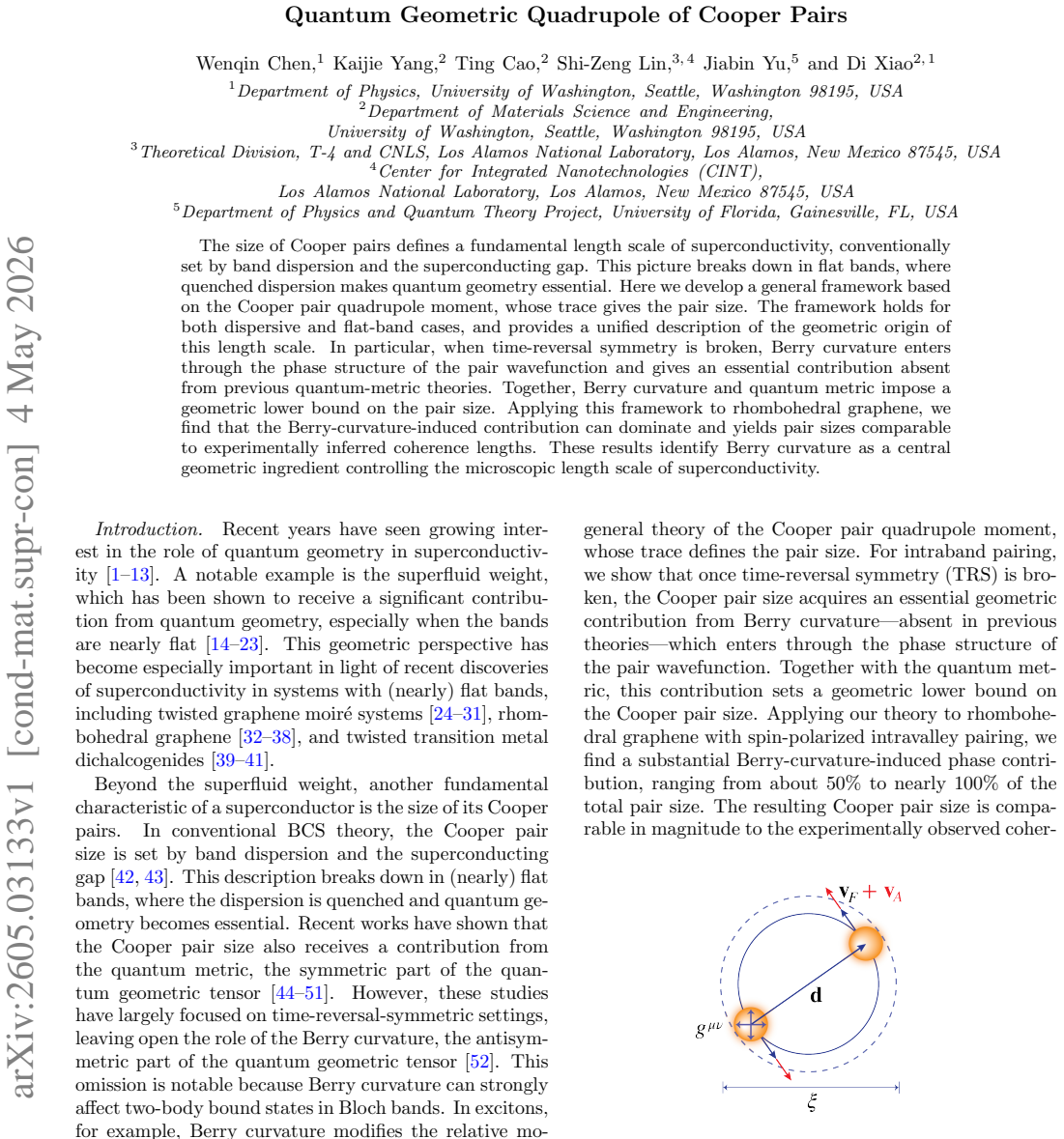
The trace of the Cooper pair quadrupole moment gives the pair size and holds for both dispersive and flat-band cases. When time-reversal symmetry is broken, Berry curvature enters through the phase structure of the pair wavefunction and supplies an essential contribution absent from earlier quantum-metric treatments. Together, Berry curvature and quantum metric impose a geometric lower bound on the pair size. In rhombohedral graphene the Berry-curvature-induced part can dominate and yields pair sizes comparable to experimentally inferred coherence lengths.
What carries the argument
The Cooper pair quadrupole moment, whose trace extracts the pair size from the wavefunction that inherits the band's quantum geometry.
If this is right
- Pair size acquires a dispersion-independent geometric contribution from both metric and Berry curvature.
- Berry curvature supplies a contribution to pair size that previous metric-only theories missed.
- In rhombohedral graphene the predicted sizes align with experimental coherence lengths.
- The same quadrupole framework unifies the description for both flat and dispersive bands.
Where Pith is reading between the lines
- The bound suggests searching for flat-band superconductors whose measured coherence length approaches the geometric limit.
- Engineering larger Berry curvature in candidate materials could systematically increase the minimal pair size.
- The approach may connect to geometric effects already studied in other pairing phenomena such as topological superconductivity.
Load-bearing premise
The Cooper-pair wavefunction is assumed to inherit the quantum geometry of the bands directly, so that the quadrupole moment remains a faithful measure of physical pair size even when dispersion is quenched.
What would settle it
An experimental measurement in a flat-band superconductor that finds a Cooper pair size smaller than the lower bound computed from the band's quantum metric plus Berry curvature.
Figures

read the original abstract
The size of Cooper pairs defines a fundamental length scale of superconductivity, conventionally set by band dispersion and the superconducting gap. This picture breaks down in flat bands, where quenched dispersion makes quantum geometry essential. Here we develop a general framework based on the Cooper pair quadrupole moment, whose trace gives the pair size. The framework holds for both dispersive and flat-band cases, and provides a unified description of the geometric origin of this length scale. In particular, when time-reversal symmetry is broken, Berry curvature enters through the phase structure of the pair wavefunction and gives an essential contribution absent from previous quantum-metric theories. Together, Berry curvature and quantum metric impose a geometric lower bound on the pair size. Applying this framework to rhombohedral graphene, we find that the Berry-curvature-induced contribution can dominate and yields pair sizes comparable to experimentally inferred coherence lengths. These results identify Berry curvature as a central geometric ingredient controlling the microscopic length scale of superconductivity.
Editorial analysis
A structured set of objections, weighed in public.
Referee Report
Summary. The manuscript develops a general framework for the Cooper-pair quadrupole moment, whose trace defines the pair size. The framework incorporates both the quantum metric and Berry curvature (when time-reversal symmetry is broken) to derive a geometric lower bound on pair size that applies to both dispersive and flat-band superconductors. When applied to rhombohedral graphene, the Berry-curvature contribution is found to dominate, producing pair sizes comparable to experimentally inferred coherence lengths.
Significance. If the central derivations hold and the assumptions about the pair wavefunction are justified, the work would provide a useful unification of geometric contributions to the microscopic length scale of superconductivity. It correctly identifies the phase structure from Berry curvature as an ingredient missing from prior quantum-metric treatments and supplies a concrete geometric bound that could be tested in flat-band systems. The rhombohedral-graphene application illustrates a regime where geometry, rather than dispersion, sets the scale.
major comments (2)
- [Section II] Section II (general framework): the mapping from single-particle Bloch states to the Cooper-pair wavefunction assumes a direct projection that inherits the quantum metric and Berry curvature without renormalization by the pairing interaction. This assumption is load-bearing for both the lower bound and the claim that the quadrupole remains a faithful measure of physical pair size; the manuscript provides no explicit analysis of its validity for finite-range or interband pairing, which is the precise concern raised by the stress-test note.
- [Section IV] Section IV (rhombohedral-graphene application): the numerical result that the Berry-curvature term dominates and yields pair sizes comparable to coherence lengths is presented without reported checks against variations in interaction range or strength. Because the central claim rests on this dominance, the absence of such robustness tests leaves the comparison to experiment difficult to evaluate as support for the geometric framework.
minor comments (2)
- [Section II] Notation for the quadrupole tensor components and their relation to the trace (pair size) is introduced without a compact summary table; adding one would improve readability when comparing dispersive and flat-band limits.
- [Abstract] The abstract states that the framework 'holds for both dispersive and flat-band cases' but does not explicitly list the limiting-case checks performed; a short paragraph or appendix entry confirming recovery of the conventional BCS coherence length when dispersion is restored would strengthen the presentation.
Simulated Author's Rebuttal
We thank the referee for the positive overall assessment and for the constructive comments on the projection approximation and numerical robustness. We address each major point below and have revised the manuscript to incorporate additional analysis and checks.
read point-by-point responses
-
Referee: [Section II] Section II (general framework): the mapping from single-particle Bloch states to the Cooper-pair wavefunction assumes a direct projection that inherits the quantum metric and Berry curvature without renormalization by the pairing interaction. This assumption is load-bearing for both the lower bound and the claim that the quadrupole remains a faithful measure of physical pair size; the manuscript provides no explicit analysis of its validity for finite-range or interband pairing, which is the precise concern raised by the stress-test note.
Authors: We agree that the direct-projection assumption is central and that its range of validity merits explicit discussion. In the revised manuscript we have added a new paragraph in Section II that justifies the approximation in the weak-coupling regime, where the pairing interaction acts as a perturbation on the normal-state Bloch states. We show that finite-range interactions renormalize the quadrupole only at sub-leading order in the interaction strength, leaving the geometric lower bound intact to leading order. For interband pairing we outline how the quadrupole can be defined via the full Bogoliubov-de Gennes eigenvectors while preserving the geometric contributions. A complete strong-coupling renormalization-group treatment lies beyond the present scope but is flagged as a natural extension. revision: yes
-
Referee: [Section IV] Section IV (rhombohedral-graphene application): the numerical result that the Berry-curvature term dominates and yields pair sizes comparable to coherence lengths is presented without reported checks against variations in interaction range or strength. Because the central claim rests on this dominance, the absence of such robustness tests leaves the comparison to experiment difficult to evaluate as support for the geometric framework.
Authors: We thank the referee for this observation. The revised manuscript now includes additional numerical results in Section IV and the supplementary material. We vary both the overall interaction strength (via the gap parameter) and the interaction range (on-site, nearest-neighbor, and next-nearest-neighbor pairing). In all cases the Berry-curvature contribution remains dominant and the extracted pair sizes stay comparable to the experimentally reported coherence lengths. These checks are presented with explicit parameter sweeps and are discussed in the main text. revision: yes
Circularity Check
No significant circularity; framework derives pair-size bound from standard quantum geometry without reduction to inputs.
full rationale
The paper constructs the Cooper-pair quadrupole moment from the wavefunction inheriting single-particle Berry curvature and quantum metric, then derives a geometric lower bound on its trace (pair size). This is a direct calculation under the stated modeling assumption rather than a self-referential definition or fitted parameter renamed as prediction. No self-citations are invoked as load-bearing uniqueness theorems, no ansatz is smuggled via prior work, and the rhombohedral-graphene application compares to external experimental coherence lengths. The derivation chain remains self-contained against the definitions of quantum geometry.
Axiom & Free-Parameter Ledger
axioms (1)
- domain assumption The Cooper-pair wavefunction can be expressed in a form that directly inherits the quantum geometry of the bands.
Reference graph
Works this paper leans on
-
[1]
T¨ orm¨ a, S
P. T¨ orm¨ a, S. Peotta, and B. A. Bernevig, Superconduc- tivity, superfluidity and quantum geometry in twisted multilayer systems, Nature Reviews Physics4, 528 (2022)
2022
-
[2]
T¨ orm¨ a, L
P. T¨ orm¨ a, L. Liang, and S. Peotta, Quantum metric and effective mass of a two-body bound state in a flat band, Phys. Rev. B98, 220511 (2018)
2018
-
[3]
Huhtinen, J
K.-E. Huhtinen, J. Herzog-Arbeitman, A. Chew, B. A. Bernevig, and P. T¨ orm¨ a, Revisiting flat band supercon- ductivity: Dependence on minimal quantum metric and band touchings, Phys. Rev. B106, 014518 (2022)
2022
-
[4]
J. Yu, M. Xie, F. Wu, and S. Das Sarma, Euler- obstructed nematic nodal superconductivity in twisted bilayer graphene, Phys. Rev. B107, L201106 (2023)
2023
-
[5]
T¨ orm¨ a, Essay: Where can quantum geometry lead us?, Phys
P. T¨ orm¨ a, Essay: Where can quantum geometry lead us?, Phys. Rev. Lett.131, 240001 (2023)
2023
-
[6]
H. Tian, X. Gao, Y. Zhang, S. Che, T. Xu, P. Che- ung, K. Watanabe, T. Taniguchi, M. Randeria, F. Zhang, et al., Evidence for dirac flat band superconductivity en- abled by quantum geometry, Nature614, 440 (2023)
2023
-
[7]
Daido, T
A. Daido, T. Kitamura, and Y. Yanase, Quantum geome- try encoded to pair potentials, Phys. Rev. B110, 094505 (2024)
2024
-
[8]
Kitamura, T
T. Kitamura, T. Yamashita, J. Ishizuka, A. Daido, and Y. Yanase, Superconductivity in monolayer fese enhanced by quantum geometry, Phys. Rev. Res.4, 023232 (2022)
2022
-
[9]
Kitamura, A
T. Kitamura, A. Daido, and Y. Yanase, Quantum geo- metric effect on fulde-ferrell-larkin-ovchinnikov supercon- ductivity, Phys. Rev. B106, 184507 (2022)
2022
-
[10]
Kitamura, S
T. Kitamura, S. Kanasugi, M. Chazono, and Y. Yanase, Quantum geometry induced anapole superconductivity, Phys. Rev. B107, 214513 (2023)
2023
-
[11]
Kitamura, A
T. Kitamura, A. Daido, and Y. Yanase, Spin-triplet superconductivity from quantum-geometry-induced fer- romagnetic fluctuation, Phys. Rev. Lett.132, 036001 (2024)
2024
-
[12]
Jahin and S.-Z
A. Jahin and S.-Z. Lin, Enhanced kohn-luttinger su- perconductivity in geometric bands, Phys. Rev. B113, 014504 (2026)
2026
-
[13]
C. Xu, N. Zou, N. Peshcherenko, A. Jahin, T. Li, S.-Z. Lin, and Y. Zhang, Chiral superconductivity from spin polarized chern band in twisted mote 2, Phys. Rev. Lett. 135, 266005 (2025)
2025
-
[14]
Peotta and P
S. Peotta and P. T¨ orm¨ a, Superfluidity in topologically nontrivial flat bands, Nature communications6, 8944 (2015)
2015
-
[15]
Julku, S
A. Julku, S. Peotta, T. I. Vanhala, D.-H. Kim, and P. T¨ orm¨ a, Geometric origin of superfluidity in the lieb- lattice flat band, Phys. Rev. Lett.117, 045303 (2016)
2016
-
[16]
Liang, T
L. Liang, T. I. Vanhala, S. Peotta, T. Siro, A. Harju, and P. T¨ orm¨ a, Band geometry, berry curvature, and super- fluid weight, Phys. Rev. B95, 024515 (2017)
2017
-
[17]
X. Hu, T. Hyart, D. I. Pikulin, and E. Rossi, Geometric and conventional contribution to the superfluid weight in twisted bilayer graphene, Phys. Rev. Lett.123, 237002 (2019). 6
2019
-
[18]
F. Xie, Z. Song, B. Lian, and B. A. Bernevig, Topology- bounded superfluid weight in twisted bilayer graphene, Phys. Rev. Lett.124, 167002 (2020)
2020
-
[19]
Julku, T
A. Julku, T. J. Peltonen, L. Liang, T. T. Heikkil¨ a, and P. T¨ orm¨ a, Superfluid weight and berezinskii- kosterlitz-thouless transition temperature of twisted bi- layer graphene, Phys. Rev. B101, 060505 (2020)
2020
-
[20]
Herzog-Arbeitman, V
J. Herzog-Arbeitman, V. Peri, F. Schindler, S. D. Huber, and B. A. Bernevig, Superfluid weight bounds from sym- metry and quantum geometry in flat bands, Phys. Rev. Lett.128, 087002 (2022)
2022
-
[21]
Verma, T
N. Verma, T. Hazra, and M. Randeria, Optical spectral weight, phase stiffness, andT c bounds for trivial and topological flat band superconductors, Proceedings of the National Academy of Sciences118, e2106744118 (2021)
2021
-
[22]
Hu and W
Y.-J. Hu and W. Huang, Quantum geometric superfluid weight in multiband superconductors: A microscopic in- terpretation, Phys. Rev. B111, 134511 (2025)
2025
-
[23]
Tanaka, J
M. Tanaka, J. ˆI.-j. Wang, T. H. Dinh, D. Rodan-Legrain, S. Zaman, M. Hays, A. Almanakly, B. Kannan, D. K. Kim, B. M. Niedzielski,et al., Superfluid stiffness of magic-angle twisted bilayer graphene, Nature638, 99 (2025)
2025
-
[24]
Y. Cao, V. Fatemi, S. Fang, K. Watanabe, T. Taniguchi, E. Kaxiras, and P. Jarillo-Herrero, Unconventional super- conductivity in magic-angle graphene superlattices, Na- ture556, 43 (2018)
2018
-
[25]
M. Yankowitz, S. Chen, H. Polshyn, Y. Zhang, K. Watanabe, T. Taniguchi, D. Graf, A. F. Young, and C. R. Dean, Tuning superconductivity in twisted bilayer graphene, Science363, 1059 (2019), https://www.science.org/doi/pdf/10.1126/science.aav1910
-
[26]
X. Lu, P. Stepanov, W. Yang, M. Xie, M. A. Aamir, I. Das, C. Urgell, K. Watanabe, T. Taniguchi, G. Zhang, et al., Superconductors, orbital magnets and correlated states in magic-angle bilayer graphene, Nature574, 653 (2019)
2019
-
[27]
Codecido, Q
E. Codecido, Q. Wang, R. Koester, S. Che, H. Tian, R. Lv, S. Tran, K. Watanabe, T. Taniguchi, F. Zhang, et al., Correlated insulating and superconducting states in twisted bilayer graphene below the magic angle, Sci- ence Advances5, eaaw9770 (2019)
2019
-
[28]
Saito, J
Y. Saito, J. Ge, K. Watanabe, T. Taniguchi, and A. F. Young, Independent superconductors and correlated in- sulators in twisted bilayer graphene, Nature Physics16, 926 (2020)
2020
-
[29]
Stepanov, I
P. Stepanov, I. Das, X. Lu, A. Fahimniya, K. Watanabe, T. Taniguchi, F. H. Koppens, J. Lischner, L. Levitov, and D. K. Efetov, Untying the insulating and supercon- ducting orders in magic-angle graphene, Nature583, 375 (2020)
2020
-
[30]
M. Oh, K. P. Nuckolls, D. Wong, R. L. Lee, X. Liu, K. Watanabe, T. Taniguchi, and A. Yazdani, Evidence for unconventional superconductivity in twisted bilayer graphene, Nature600, 240 (2021)
2021
-
[31]
J. M. Park, Y. Cao, K. Watanabe, T. Taniguchi, and P. Jarillo-Herrero, Tunable strongly coupled supercon- ductivity in magic-angle twisted trilayer graphene, Na- ture590, 249 (2021)
2021
-
[32]
G. Chen, A. L. Sharpe, P. Gallagher, I. T. Rosen, E. J. Fox, L. Jiang, B. Lyu, H. Li, K. Watanabe, T. Taniguchi,et al., Signatures of tunable superconduc- tivity in a trilayer graphene moir´ e superlattice, Nature 572, 215 (2019)
2019
-
[33]
H. Zhou, T. Xie, T. Taniguchi, K. Watanabe, and A. F. Young, Superconductivity in rhombohedral trilayer graphene, Nature598, 434 (2021)
2021
-
[34]
T. Han, Z. Lu, Z. Hadjri, L. Shi, Z. Wu, W. Xu, Y. Yao, A. A. Cotten, O. Sharifi Sedeh, H. Weldeyesus,et al., Signatures of chiral superconductivity in rhombohedral graphene, Nature643, 654 (2025)
2025
-
[35]
C. L. Patterson, O. I. Sheekey, T. B. Arp, L. F. Holleis, J. M. Koh, Y. Choi, T. Xie, S. Xu, Y. Guo, H. Stoyanov, et al., Superconductivity and spin canting in spin–orbit- coupled trilayer graphene, Nature , 1 (2025)
2025
-
[36]
J. Yang, X. Shi, S. Ye, C. Yoon, Z. Lu, V. Kakani, T. Han, J. Seo, L. Shi, K. Watanabe,et al., Impact of spin–orbit coupling on superconductivity in rhombohe- dral graphene, Nature Materials , 1 (2025)
2025
-
[37]
Y. Choi, Y. Choi, M. Valentini, C. L. Patterson, L. F. Holleis, O. I. Sheekey, H. Stoyanov, X. Cheng, T. Taniguchi, K. Watanabe,et al., Superconductivity and quantized anomalous hall effect in rhombohedral graphene, Nature , 1 (2025)
2025
- [38]
-
[39]
Y. Jia, T. Song, Z. J. Zheng, G. Cheng, A. J. Uzan, G. Yu, Y. Tang, C. J. Pollak, F. Yuan, M. Onyszczak, et al., Anomalous superconductivity in twisted mote2 nanojunctions, Science Advances11, eadq5712 (2025)
2025
-
[40]
Y. Xia, Z. Han, K. Watanabe, T. Taniguchi, J. Shan, and K. F. Mak, Superconductivity in twisted bilayer wse2, Nature637, 833 (2025)
2025
-
[41]
Y. Guo, J. Pack, J. Swann, L. Holtzman, M. Cothrine, K. Watanabe, T. Taniguchi, D. G. Mandrus, K. Barmak, J. Hone,et al., Superconductivity in 5.0°twisted bilayer wse2, Nature637, 839 (2025)
2025
-
[42]
L. N. Cooper, Bound electron pairs in a degenerate fermi gas, Phys. Rev.104, 1189 (1956)
1956
-
[43]
Bardeen, L
J. Bardeen, L. N. Cooper, and J. R. Schrieffer, Theory of superconductivity, Phys. Rev.108, 1175 (1957)
1957
-
[44]
Iskin, Extracting quantum-geometric effects from ginzburg-landau theory in a multiband hubbard model, Phys
M. Iskin, Extracting quantum-geometric effects from ginzburg-landau theory in a multiband hubbard model, Phys. Rev. B107, 224505 (2023)
2023
-
[45]
S. A. Chen and K. T. Law, Ginzburg-landau theory of flat-band superconductors with quantum metric, Phys. Rev. Lett.132, 026002 (2024)
2024
-
[46]
Iskin, Coherence length and quantum geometry in a dilute flat-band superconductor, Phys
M. Iskin, Coherence length and quantum geometry in a dilute flat-band superconductor, Phys. Rev. B110, 144505 (2024)
2024
-
[47]
Iskin, Pair size and quantum geometry in a multiband hubbard model, Phys
M. Iskin, Pair size and quantum geometry in a multiband hubbard model, Phys. Rev. B111, 014502 (2025)
2025
-
[48]
Thumin and G
M. Thumin and G. Bouzerar, Correlation functions and characteristic lengthscales in flat band superconductors, SciPost Phys.18, 025 (2025)
2025
-
[49]
J.-X. Hu, S. A. Chen, and K. T. Law, Anomalous co- herence length in superconductors with quantum metric, Communications Physics8, 20 (2025)
2025
- [50]
-
[51]
S. S. Elden and M. Iskin, Correlation lengths of flat- band superconductivity from quantum geometry (2026), arXiv:2601.12969 [cond-mat.supr-con]. 7
work page internal anchor Pith review arXiv 2026
-
[52]
Xiao, M.-C
D. Xiao, M.-C. Chang, and Q. Niu, Berry phase effects on electronic properties, Rev. Mod. Phys.82, 1959 (2010)
1959
-
[53]
Zhou, W.-Y
J. Zhou, W.-Y. Shan, W. Yao, and D. Xiao, Berry phase modification to the energy spectrum of excitons, Phys. Rev. Lett.115, 166803 (2015)
2015
-
[54]
Srivastava and A
A. Srivastava and A. m. c. Imamo˘ glu, Signatures of bloch- band geometry on excitons: Nonhydrogenic spectra in transition-metal dichalcogenides, Phys. Rev. Lett.115, 166802 (2015)
2015
-
[55]
Marzari and D
N. Marzari and D. Vanderbilt, Maximally localized gen- eralized wannier functions for composite energy bands, Phys. Rev. B56, 12847 (1997)
1997
- [56]
-
[57]
(2026), see Supplemental Material for details of the derivations of Cooper pair quadrupole moment, geomet- ric bound of Cooper pair size, two-band model, and Berry trashcan model
2026
-
[58]
J. P. Provost and G. Vallee, Riemannian structure on manifolds of quantum states, Communications in Math- ematical Physics76, 289 (1980)
1980
-
[59]
Resta, The insulating state of matter: a geometrical theory, The European Physical Journal B79, 121 (2011)
R. Resta, The insulating state of matter: a geometrical theory, The European Physical Journal B79, 121 (2011)
2011
-
[60]
J. Yu, B. A. Bernevig, R. Queiroz, E. Rossi, P. T¨ orm¨ a, and B.-J. Yang, Quantum geometry in quantum materi- als, npj Quantum Materials10, 101 (2025)
2025
-
[61]
Murakami and N
S. Murakami and N. Nagaosa, Berry phase in magnetic superconductors, Phys. Rev. Lett.90, 057002 (2003)
2003
-
[62]
Li and F
Y. Li and F. D. M. Haldane, Topological nodal cooper pairing in doped weyl metals, Phys. Rev. Lett.120, 067003 (2018)
2018
-
[63]
A. Azam, B. Lian, S. Ryu, and J. Yu, Wilson-loop-ideal bands and general idealization (2025), arXiv:2509.05410 [cond-mat.mes-hall]
work page internal anchor Pith review Pith/arXiv arXiv 2025
-
[64]
de Gennes,Superconductivity of Metals and Alloys, 1st ed
P.-G. de Gennes,Superconductivity of Metals and Alloys, 1st ed. (CRC Press, Boca Raton, 1999)
1999
-
[65]
Roy, Band geometry of fractional topological insula- tors, Physical Review B90, 165139 (2014)
R. Roy, Band geometry of fractional topological insula- tors, Physical Review B90, 165139 (2014)
2014
-
[66]
Koshino and E
M. Koshino and E. McCann, Trigonal warping and berry’s phaseN πin abc-stacked multilayer graphene, Phys. Rev. B80, 165409 (2009)
2009
-
[67]
Geier, M
M. Geier, M. Davydova, and L. Fu, Chiral and topo- logical superconductivity in isospin polarized multilayer graphene, Nature Communications (2025)
2025
-
[68]
A. S. Patri and M. Franz, Family of multilayer graphene superconductors with tunable chirality: Momentum- space vortices nucleated by a ring of berry curvature, Phys. Rev. B112, 214505 (2025)
2025
-
[69]
Davenport, F
H. Davenport, F. Schindler, and J. Knolle, Berry curva- ture of low-energy excitons in rhombohedral graphene, Phys. Rev. B113, 115102 (2026)
2026
-
[70]
Y.-Z. Chou, J. Zhu, and S. Das Sarma, Intravalley spin- polarized superconductivity in rhombohedral tetralayer graphene, Physical Review B111, 174523 (2025)
2025
-
[71]
Guerci, A
D. Guerci, A. Abouelkomsan, and L. Fu, From fraction- alization to chiral topological superconductivity in a flat chern band, Phys. Rev. Lett.135, 186601 (2025)
2025
-
[72]
G. C. Strinati, P. Pieri, G. R¨ opke, P. Schuck, and M. Ur- ban, The bcs–bec crossover: From ultra-cold fermi gases to nuclear systems, Physics Reports738, 1 (2018), the BCS–BEC crossover: From ultra-cold Fermi gases to nu- clear systems
2018
- [73]
- [74]
-
[75]
A. B. Pippard, An experimental and theoretical study of the relation between magnetic field and current in a superconductor, Proceedings of the Royal Society of Lon- don. Series A, Mathematical and Physical Sciences216, 547 (1953)
1953
-
[76]
Suter, E
A. Suter, E. Morenzoni, R. Khasanov, H. Luetkens, T. Prokscha, and N. Garifianov, Direct observation of nonlocal effects in a superconductor, Phys. Rev. Lett. 92, 087001 (2004)
2004
-
[77]
Suter, E
A. Suter, E. Morenzoni, N. Garifianov, R. Khasanov, E. Kirk, H. Luetkens, T. Prokscha, and M. Horisberger, Observation of nonexponential magnetic penetration pro- files in the meissner state: A manifestation of nonlocal ef- fects in superconductors, Phys. Rev. B72, 024506 (2005)
2005
-
[78]
Quantum Geometric Quadrupole of Cooper Pairs
V. Kozhevnikov, A. Suter, H. Fritzsche, V. Gladilin, A. Volodin, T. Moorkens, M. Trekels, J. Cuppens, B. M. Wojek, T. Prokscha, E. Morenzoni, G. J. Nieuwenhuys, M. J. Van Bael, K. Temst, C. Van Haesendonck, and J. O. Indekeu, Nonlocal effect and dimensions of cooper pairs measured by low-energy muons and polarized neu- trons in type-i superconductors, Phy...
2013
discussion (0)
Sign in with ORCID, Apple, or X to comment. Anyone can read and Pith papers without signing in.