Recognition: unknown
Flat Space Physics from AdS Actions
Pith reviewed 2026-05-08 17:27 UTC · model grok-4.3
The pith
Flat spacetimes reduce to 3D AdS and dS actions on hyperbolic slices, enabling slice-by-slice holographic dualities.
A machine-rendered reading of the paper's core claim, the machinery that carries it, and where it could break.
Core claim
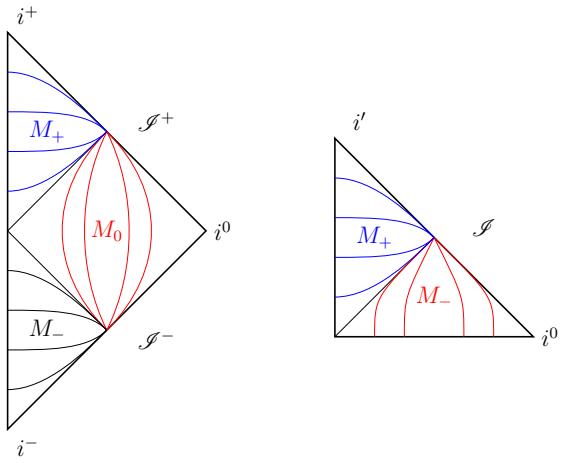
Flat spacetimes are foliated by hyperbolic slices that are geometrically three-dimensional de Sitter or anti-de Sitter spaces. Reducing 4D actions for massless scalars in both Minkowski space and Klein space and for massive scalars in Minkowski space yields 3D actions on these slices. The reduced theories possess a continuous spectrum of fields from the noncompact reduction direction. Boundary terms arising from discontinuous field configurations across the light cone link the actions in Minkowski and Klein space. Different asymptotic limits of the reduced massless field near the boundary of the unit hyperbolic slice reproduce light-cone or null-infinity limits, while the massive case admits
What carries the argument
Hyperbolic foliation of flat spacetime into 3D dS or AdS slices, followed by direct reduction of the 4D scalar action to a 3D action on each slice.
If this is right
- The continuous spectrum in the reduced theory encodes the full 4D flat-space dynamics through the noncompact direction.
- Boundary terms from light-cone discontinuities connect the massless scalar theories in Minkowski and Klein space.
- Asymptotic limits near the hyperbolic boundary recover light-cone versus null-infinity behaviors for massless fields but not for massive fields.
- The construction supplies an explicit map from 4D flat-space correlators to boundary data on successive 3D AdS or dS slices.
Where Pith is reading between the lines
- The same slice-wise reduction could be applied to gravitational or gauge-field actions to generate candidate flat-space holographic duals.
- If the continuous spectrum is retained, the approach may reproduce soft theorems or celestial sphere correlators without additional input.
- Testing the dictionary on explicit scattering amplitudes in Minkowski space would provide a direct check of whether slice-by-slice AdS/CFT reproduces flat-space results.
Load-bearing premise
The foliation by hyperbolic slices permits direct application of the AdS/CFT bulk-to-boundary dictionary without corrections from global topology, the noncompact reduction direction, or light-cone discontinuities.
What would settle it
Explicit computation of the two-point function from the reduced 3D action that fails to match the known flat-space propagator for the original 4D scalar would show the reduction does not preserve the physics.
Figures
read the original abstract
Flat spacetimes are foliated by hyperbolic slices that are geometrically three-dimensional de Sitter or anti-de Sitter spaces. As such, it is possible to construct flat space holographic dualities by applying the AdS/CFT bulk-to-boundary dictionary slice by slice. In this work, we reduce 4D actions for massless scalars in both Minkowski space and Klein space and massive scalars in Minkowski space to actions on these 3D dS and AdS slices. In both Minkowski and Klein space, the reduced theories have a continuous spectrum of fields originating from the reduction over the noncompact $x^2$ direction. These actions are linked by boundary terms arising from field configurations discontinuous across the lightcone. In the massless case, different asymptotic limits of the reduced field near the boundary of the unit hyperbolic slice replicate either light cone or null infinity limits of the field; in the massive case, only one boundary mode of the reduced field has a simple geometric interpretation.
Editorial analysis
A structured set of objections, weighed in public.
Referee Report
Summary. The manuscript proposes that flat spacetimes admit a foliation by hyperbolic slices that are geometrically 3D de Sitter or anti-de Sitter spaces. This allows flat-space holographic dualities to be constructed by applying the standard AdS/CFT bulk-to-boundary dictionary slice by slice. The work reduces 4D actions for massless scalars in Minkowski and Klein space and for massive scalars in Minkowski space to 3D actions on these hyperbolic slices. The reduced theories possess a continuous spectrum arising from the noncompact reduction direction; the Minkowski and Klein reduced actions are related by boundary terms generated by field configurations discontinuous across the light cone. In the massless case, different asymptotic limits of the reduced field near the boundary of the unit hyperbolic slice are argued to reproduce light-cone or null-infinity behavior; in the massive case only one boundary mode admits a simple geometric interpretation.
Significance. If the reduction and the treatment of the continuous spectrum and light-cone boundary terms can be shown to preserve the variational principle, fall-off conditions, and on-shell values required by the holographic dictionary, the construction would supply a concrete geometric route from AdS/CFT to flat-space holography. The explicit reduction of scalar actions and the identification of the relevant asymptotic limits constitute a tangible step toward such a dictionary, though the manuscript does not yet demonstrate that the dictionary applies without further global or interface corrections.
major comments (2)
- [Reduction procedure (abstract and main derivation)] The central claim that the 3D reduced actions on hyperbolic slices admit direct application of the AdS/CFT bulk-to-boundary dictionary (abstract) is not supported by explicit verification. The reduction over the noncompact x^2 direction produces a continuous spectrum, yet no calculation is supplied showing how these modes are integrated or regularized while preserving the precise fall-off conditions and on-shell values needed for the dictionary.
- [Boundary terms and light-cone matching] The linkage between Minkowski and Klein reduced actions via boundary terms from discontinuous configurations across the light cone (abstract) is stated but not checked. It remains unclear whether these boundary terms reproduce the correct variational principle or whether additional interface corrections arising from the light-cone discontinuities are required; no explicit evaluation of the reduced action on either side of the light cone is provided.
minor comments (2)
- [Abstract] The abstract refers to 'asymptotic limits of the reduced field near the boundary of the unit hyperbolic slice' without defining the precise coordinate chart or the radial coordinate used for the expansion; a short paragraph clarifying the foliation coordinates would improve readability.
- [Discussion of spectrum] The manuscript does not discuss whether the continuous spectrum introduces any additional global topological or compactness issues when the AdS/CFT dictionary is applied slice by slice; a brief remark on this point would help readers assess the scope of the construction.
Simulated Author's Rebuttal
We thank the referee for the careful reading of the manuscript and the constructive major comments. The report correctly identifies that while the explicit reductions and geometric identifications are carried out, additional explicit verifications are needed to fully substantiate the direct applicability of the AdS/CFT dictionary and the variational properties of the boundary terms. We address each point below and will incorporate the suggested clarifications and calculations.
read point-by-point responses
-
Referee: [Reduction procedure (abstract and main derivation)] The central claim that the 3D reduced actions on hyperbolic slices admit direct application of the AdS/CFT bulk-to-boundary dictionary (abstract) is not supported by explicit verification. The reduction over the noncompact x^2 direction produces a continuous spectrum, yet no calculation is supplied showing how these modes are integrated or regularized while preserving the precise fall-off conditions and on-shell values needed for the dictionary.
Authors: The manuscript derives the reduced 3D actions explicitly in Sections 3 and 4 by integrating the 4D scalar Lagrangians over the noncompact x^2 coordinate, yielding continuous spectra in both the massless and massive cases. The geometric equivalence of the hyperbolic slices to 3D dS/AdS spaces is used to propose slice-by-slice application of the bulk-to-boundary dictionary. We agree, however, that no explicit regularization of the continuous modes or verification of the preserved fall-off conditions and on-shell values is provided. We will add a dedicated subsection that performs this regularization (via a suitable cutoff or mode decomposition) and confirms that the boundary conditions required by the dictionary remain intact in the reduced theory. revision: yes
-
Referee: [Boundary terms and light-cone matching] The linkage between Minkowski and Klein reduced actions via boundary terms from discontinuous configurations across the light cone (abstract) is stated but not checked. It remains unclear whether these boundary terms reproduce the correct variational principle or whether additional interface corrections arising from the light-cone discontinuities are required; no explicit evaluation of the reduced action on either side of the light cone is provided.
Authors: The boundary terms are obtained during the reduction by integration by parts when the scalar field is allowed to be discontinuous across the light cone; this produces the explicit relation between the Minkowski and Klein reduced actions. We concur that the manuscript does not include an explicit evaluation of the reduced action evaluated on either side of the light cone to verify the variational principle or rule out extra interface corrections. We will revise the relevant section to supply this calculation, showing that the boundary terms already ensure the correct variational structure without further corrections. revision: yes
Circularity Check
No significant circularity; derivation applies standard AdS/CFT to geometric foliation
full rationale
The paper reduces 4D scalar actions in Minkowski and Klein space to 3D actions on hyperbolic dS/AdS slices via integration over the noncompact x^2 direction, yielding continuous spectra and boundary terms from lightcone discontinuities. It then invokes the standard bulk-to-boundary dictionary slice by slice. This relies on external geometric identification and the established AdS/CFT correspondence, with no equations showing a prediction equivalent to a fitted input, self-definitional loop, or load-bearing self-citation. The central claim remains independent of its own outputs.
Axiom & Free-Parameter Ledger
axioms (2)
- domain assumption Flat spacetimes admit a foliation by geometrically 3D hyperbolic dS or AdS slices
- domain assumption The AdS/CFT bulk-to-boundary dictionary can be applied independently to each hyperbolic slice
Reference graph
Works this paper leans on
- [1]
-
[2]
S. S. Gubser, I. R. Klebanov, and A. M. Polyakov,Gauge theory correlators from noncritical string theory,Phys. Lett. B428(1998) 105–114, [hep-th/9802109]
work page internal anchor Pith review arXiv 1998
-
[3]
S. Pasterski, S.-H. Shao, and A. Strominger,Flat Space Amplitudes and Conformal Symmetry of the Celestial Sphere,Phys. Rev.D96(2017), no. 6 065026, [arXiv:1701.00049]
-
[4]
Conformal basis for flat space amplitudes,
S. Pasterski and S.-H. Shao,Conformal basis for flat space amplitudes,Phys. Rev.D96 (2017), no. 6 065022, [arXiv:1705.01027]
- [5]
- [6]
- [7]
-
[8]
R. Marotta, K. Skenderis, and M. Verma,Flat space spinning massive amplitudes from momentum space CFT,JHEP08(2024) 226, [arXiv:2406.06447]
- [9]
-
[10]
A. Lipstein, R. Ruzziconi, and A. Yelleshpur Srikant,Towards a flat space Carrollian hologram from AdS4/CFT3,JHEP06(2025) 073, [arXiv:2504.10291]
- [11]
-
[12]
Top-Down Holography in an Asymp- totically Flat Spacetime,
K. Costello, N. M. Paquette, and A. Sharma,Top-Down Holography in an Asymptotically Flat Spacetime,Phys. Rev. Lett.130(2023), no. 6 061602, [arXiv:2208.14233]
-
[13]
J. de Boer and S. N. Solodukhin,A Holographic reduction of Minkowski space-time,Nucl. Phys.B665(2003) 545–593, [hep-th/0303006]
- [14]
- [15]
-
[16]
C. Sleight and M. Taronna,Celestial Holography Revisited,arXiv:2301.01810
-
[17]
L. Iacobacci, C. Sleight, and M. Taronna,Celestial Holography Revisited II: Correlators and K¨ all´ en-Lehmann,arXiv:2401.16591
- [18]
- [19]
- [20]
- [21]
-
[22]
B. Chen, Z. Hu, and X.-C. Mao,QFT in Klein space,Phys. Rev. D113(2026), no. 8 085005, [arXiv:2505.16436]
work page internal anchor Pith review Pith/arXiv arXiv 2026
-
[23]
Ruzziconi,Carrollian Physics and Holography,arXiv:2602.02644
R. Ruzziconi,Carrollian Physics and Holography,arXiv:2602.02644
-
[24]
Quantum Fields on Time-Periodic AdS3/Z
W. Melton, A. Strominger, and T. Wang,Quantum fields on time-periodic AdS 3/Z,JHEP 04(2026) 016, [arXiv:2510.15036]. 25
discussion (0)
Sign in with ORCID, Apple, or X to comment. Anyone can read and Pith papers without signing in.