Recognition: unknown
Nb₃Sn Thin Films Using a Cu-Sn Route for Dark Matter Detection
Pith reviewed 2026-05-08 02:35 UTC · model grok-4.3
The pith
A Cu-Sn diffusion method produces Nb3Sn films on copper cavities with 40 percent higher quality factor than bare copper at zero magnetic field.
A machine-rendered reading of the paper's core claim, the machinery that carries it, and where it could break.
Core claim
The authors establish that solid-state diffusion from Cu-Sn alloys can form uniform Nb3Sn thin films on copper substrates at compatible temperatures, yielding superconducting radio-frequency cavities with quality factors of 77,000 at zero field, 40 percent above bare copper, while providing two practical coating routes for axion search applications.
What carries the argument
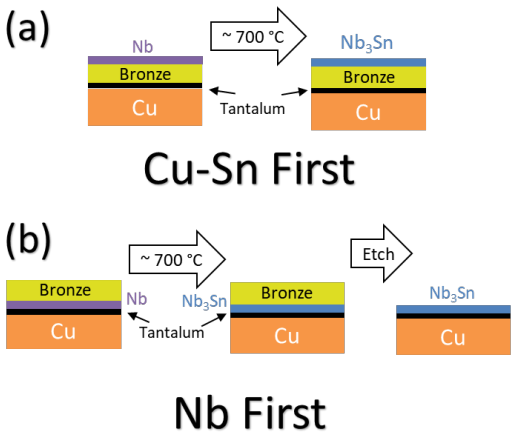
The central mechanism is solid-state diffusion of tin from high-tin Cu-Sn alloys into niobium layers to form Nb3Sn at 650-750 degrees Celsius, preserving copper substrate integrity.
If this is right
- Uniform Nb3Sn coatings become feasible on complex copper cavity shapes.
- Zero-field performance improves over bare copper, raising potential detector sensitivity.
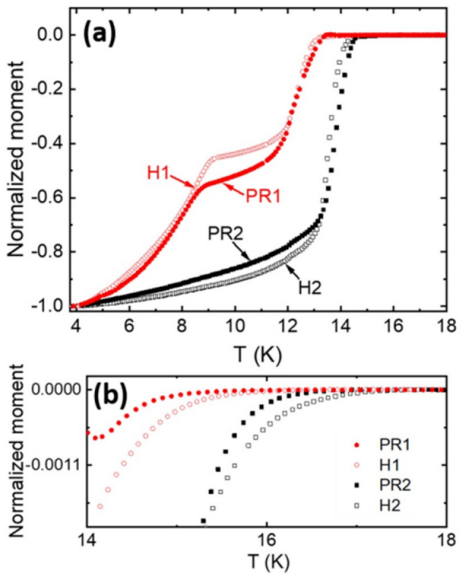
- Strain from copper substrate suppresses critical temperature to around 16 K.
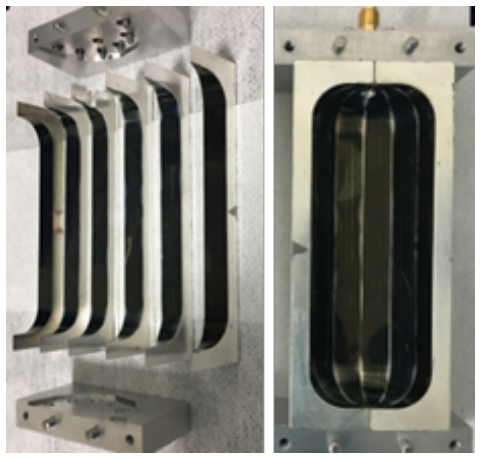
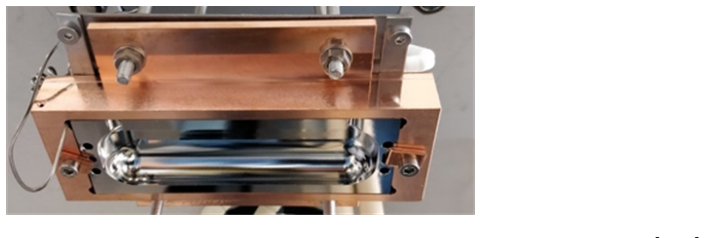
- The method was demonstrated on a hexagonal cavity tested down to 50 millikelvin and 9 tesla.
Where Pith is reading between the lines
- Mitigating the observed drop in quality factor under magnetic fields would directly enhance axion detection capabilities.
- Alternative strain-relief interlayers could restore higher critical temperatures closer to 18 K.
- This coating route may apply to other copper-based cryogenic devices beyond dark matter searches.
Load-bearing premise
The quality factor gain observed without magnetic field will carry over to the multi-tesla conditions needed for axion detection.
What would settle it
A direct comparison of the quality factor for the Nb3Sn-coated cavity versus bare copper at 9 tesla would confirm whether the improvement persists in operational magnetic fields.
Figures














read the original abstract
Axion dark matter searches require superconducting radio-frequency (SRF) cavities on copper (Cu) substrates with quality factors Q > 10^5 in multi-tesla magnetic fields. Copper reduces thermal noise and allows complex geometries. Nb3Sn is a strong candidate due to its superior superconducting properties. However, uniform high-Tc Nb3Sn thin films on Cu are challenging due to Sn loss and substrate strain. This work uses solid-state diffusion of Sn from high-Sn Cu-Sn alloys into Nb layers to form Nb3Sn at Cu-compatible temperatures (650-750{\deg}C), avoiding the traditional ~1100{\deg}C vapor method. Varying Cu-Sn composition yielded an optimal alloy that maintains high Sn activity. Compositional and thermal expansion analyses showed Tc is suppressed below 18 K by Cu substrate strain. Experiments on Nb and sapphire substrates isolated the strain effects. Two routes were developed: (1) Cu-Sn on Ta-coated Cu with hot Nb sputtering (Tc = 16 K), and (2) Nb on Ta/Cu with Cu-Sn evaporation and ex-situ reaction. Route 2 gave uniform Nb3Sn and was chosen for cavity coating. A hexagonal cavity combining designs from the University of Washington and Center for Axion and Precision Physics was coated using Route 2 and tested to 50 mK and 9 T. At zero field it reached Q = 77,000 (40% above bare Cu's Q = 55,000), but Q dropped sharply in field. Nb3Sn coatings on Cu cavities outperform bare Cu at zero field and provide practical routes for improved axion detectors.
Editorial analysis
A structured set of objections, weighed in public.
Referee Report
Summary. The manuscript reports the fabrication of Nb3Sn thin films on Cu substrates using a novel Cu-Sn solid-state diffusion method at 650-750°C to avoid high-temperature issues with Sn loss. Two routes are developed, with Route 2 (Nb on Ta/Cu with Cu-Sn evaporation and ex-situ reaction) selected for coating a hexagonal SRF cavity combining UW and CAPP designs. The coated cavity is tested at 50 mK up to 9 T, achieving zero-field Q = 77,000 (40% above bare Cu Q = 55,000) but with a sharp Q drop in applied field. Tc is suppressed to 16 K by Cu substrate strain, as isolated via tests on Nb and sapphire substrates. The authors conclude that Nb3Sn coatings on Cu outperform bare Cu at zero field and provide practical routes for improved axion detectors.
Significance. The low-temperature Cu-compatible fabrication route for Nb3Sn films represents a useful technical advance for SRF cavities on Cu, enabling complex geometries and reduced thermal noise relevant to axion dark matter searches. The zero-field Q improvement and strain-effect isolation experiments add concrete value. However, the sharp field-induced Q drop leaves the key multi-tesla performance requirement unaddressed, limiting immediate applicability.
major comments (1)
- [Abstract] Abstract: The assertion that the coatings 'provide practical routes for improved axion detectors' (requiring Q > 10^5 in multi-tesla fields) is not supported by the reported results, as the cavity test explicitly shows Q drops sharply once field is applied up to 9 T, with no mechanism (vortex dissipation, coating non-uniformity, or strain) or mitigation strategy described. This makes the extrapolation to the operating regime an untested assumption that is load-bearing for the central application claim.
minor comments (2)
- [Abstract] Abstract: The reported Q values (77,000 and 55,000), 40% improvement, and Tc = 16 K are presented without error bars, statistical details, full datasets, or controls for the field-dependent drop, which reduces verifiability of the performance claims.
- The manuscript would benefit from expanded discussion of the cavity test conditions and any preliminary steps taken to address field losses, even if preliminary.
Simulated Author's Rebuttal
We thank the referee for their careful and constructive review of our manuscript. We address the major comment regarding the abstract below and have revised the manuscript to ensure our claims accurately reflect the reported results without overstatement.
read point-by-point responses
-
Referee: [Abstract] Abstract: The assertion that the coatings 'provide practical routes for improved axion detectors' (requiring Q > 10^5 in multi-tesla fields) is not supported by the reported results, as the cavity test explicitly shows Q drops sharply once field is applied up to 9 T, with no mechanism (vortex dissipation, coating non-uniformity, or strain) or mitigation strategy described. This makes the extrapolation to the operating regime an untested assumption that is load-bearing for the central application claim.
Authors: We agree that the zero-field Q of 77,000, while 40% higher than bare Cu, falls short of the Q > 10^5 target in multi-tesla fields, and the sharp Q drop observed up to 9 T indicates that field performance requires further development. The phrasing 'practical routes for improved axion detectors' was meant to emphasize the low-temperature (650-750°C) Cu-Sn solid-state diffusion method, which enables uniform Nb3Sn films on Cu substrates and complex geometries while avoiding Sn loss and high-temperature damage to Cu. This fabrication advance directly addresses a key barrier for SRF cavities in axion searches. However, to avoid implying that the current results already achieve the full multi-tesla performance, we will revise the abstract to state that the Nb3Sn coatings on Cu outperform bare Cu at zero field and that the routes provide a practical foundation for developing improved axion detectors. The mechanism of the field-induced Q drop was outside the scope of this work, which focused on process development and zero-field characterization; no mitigation strategy is presented because none was tested here. revision: yes
Circularity Check
No circularity: purely experimental report with no derivations or fitted predictions
full rationale
The paper describes fabrication routes, substrate preparation, cavity coating, and direct RF measurements of Q at zero field and up to 9 T. No equations, ansatzes, parameter fits, or theoretical derivations appear in the provided text or abstract. All claims rest on measured values (e.g., Q = 77 000 vs. 55 000) rather than any chain that reduces to its own inputs by construction. Self-citations, if present, are not load-bearing for any derivation because none exists. This matches the default expectation of an honest non-finding for experimental work.
Axiom & Free-Parameter Ledger
Reference graph
Works this paper leans on
-
[2]
Danho Ahn et al. “Biaxially Textured YBa2Cu3O7 Microwave Cavity in a High Mag- netic Field for a Dark-Matter Axion Search.” In: Phys. Rev. Applied 17.6 (June 1, 2022), p. L061005. doi: 10.1103/PhysRevApplied.17.L061005. arXiv: 2103.14515 [physics.ins-det]
-
[3]
Donoghue, Eugene Golowich, and Barry R
John F. Donoghue, Eugene Golowich, and Barry R. Holstein. Dynamics of the Stan- dard Model. Camb. Monogr. Part. Phys. Nucl. Phys. Cosmol. 2. Cambridge: Cam- bridge University Press, 2014. doi: 10.1017/CBO9780511524370
-
[4]
Gauge Theory of Elementary Particle Physics: Prob- lems and Solutions
Ta-Pei Cheng and Ling-Fong Li. Gauge Theory of Elementary Particle Physics: Prob- lems and Solutions . 1. publ., repr. Oxford: Clarendon Press, 2000. 306 pp. isbn: 978- 0-19-850621-8
2000
-
[5]
An inverse method for the estima tion of input forces acting on non-linear structural system s,
Edward Witten. “Solutions Of Four-Dimensional Field Theories Via M Theory.” In: Nuclear Physics B 500.1–3 (Sept. 1997), pp. 3–42. issn: 05503213. doi: 10.1016/S0 550-3213(97)00416-1. arXiv: hep-th/9703166
work page doi:10.1016/s0 1997
-
[6]
CP Conservation in the Presence of Instantons
R. D. Peccei and Helen R. Quinn. “ $\mathrm{CP}$ Conservation in the Presence of Pseudoparticles.” In: Phys. Rev. Lett. 38.25 (June 20, 1977), pp. 1440–1443. doi: 10.1103/PhysRevLett.38.1440
-
[7]
A High Resolution Search for Dark-Matter Axions
L. D. Duffy et al. “A High Resolution Search for Dark-Matter Axions.” In: Phys. Rev. D 74.1 (2006), p. 012006. issn: 1550-7998, 1550-2368. doi: 10.1103/PhysRevD.74.0 12006. arXiv: astro-ph/0603108
-
[8]
H. Primakoff and S. P. Rosen. “Double Beta Decay.” In: Rep. Prog. Phys. 22.1 (Jan. 1959), p. 121. issn: 0034-4885. doi: 10.1088/0034-4885/22/1/305
-
[9]
P. Sikivie. “Experimental Tests of the ”Invisible” Axion.” In: Phys. Rev. Lett. 51.16 (1983), pp. 1415–1417. doi: 10.1103/PhysRevLett.51.1415
-
[10]
The Surface Impedance of Superconductors and Normal Metals at High Frequencies II. The Anomalous Skin Effect in Normal Metals
Alfred Brian Pippard F. R. S. and William Lawrence Bragg. “The Surface Impedance of Superconductors and Normal Metals at High Frequencies II. The Anomalous Skin Effect in Normal Metals.” In:Proc. R. Soc. Lond. A191.1026 (Nov. 18, 1947), pp. 385–
1947
-
[11]
issn: 0080-4630, 2053-9169. doi: 10.1098/rspa.1947.0122. 170
-
[12]
Introduction to Superconductivity
Michael Tinkham. Introduction to Superconductivity . Courier Corporation, Jan. 1,
-
[13]
isbn: 978-0-486-13472-7
482 pp. isbn: 978-0-486-13472-7. Google Books: VpUk3NfwDIkC
-
[14]
Surface Resistance At High Rf Fields
Gianluigi Ciovati. “Surface Resistance At High Rf Fields.” In: (), p. 56
-
[15]
High-Quality-Factor Superconducting Cavities in Tesla-Scale Mag- netic Fields for Dark-Matter Searches
S. Posen et al. “High-Quality-Factor Superconducting Cavities in Tesla-Scale Mag- netic Fields for Dark-Matter Searches.” In: Phys. Rev. Applied 20.3 (Sept. 1, 2023), p. 034004. doi: 10 . 1103 / PhysRevApplied . 20 . 034004 . arXiv: 2201 . 10733 [physics.acc-ph]
2023
-
[16]
First QUAX Galactic Axions Search with a SC Resonant Cavity
“First QUAX Galactic Axions Search with a SC Resonant Cavity.” In: Il Nuovo Cimento C 43.203 (Sept. 8, 2020), pp. 1–3. issn: 03905551, 03905551. doi: 10.1393 /ncc/i2020-20093-4
2020
-
[17]
Superconducting Cavity in a High Magnetic Field
Danho Ahn et al. “Superconducting Cavity in a High Magnetic Field.” In: arXiv:2002.08769 [physics.app-ph] (Apr. 27, 2020). doi: 10.48550/arXiv.2002.087 69
-
[18]
To Use or Not to Use Cool Superconductors?
Alex Gurevich. “To Use or Not to Use Cool Superconductors?” In: Nature Mater 10.4 (4 Apr. 2011), pp. 255–259. issn: 1476-4660. doi: 10.1038/nmat2991
-
[19]
Hasan Padamsee. RF Superconductivity. 1st ed. John Wiley & Sons, Ltd, 2009. doi: 10.1002/9783527627172
-
[20]
Claire Z. Antoine. How to Achieve the Best SRF Performance: (Practical) Limitations and Possible Solutions . Jan. 14, 2015. doi: 10.48550/arXiv.1501.03343 . arXiv: 1501 . 03343 [physics]. url: http : / / arxiv . org / abs / 1501 . 03343(visited on 12/08/2025). Pre-published
-
[21]
Theory of the Anomalous Skin Effect in Normal and Superconducting Metals
D. C. Mattis and J. Bardeen. “Theory of the Anomalous Skin Effect in Normal and Superconducting Metals.” In: Phys. Rev. 111.2 (July 15, 1958), pp. 412–417. issn: 0031-899X. doi: 10.1103/PhysRev.111.412
-
[22]
Antonino Del Popolo and Morgan Le Delliou. “Small Scale Problems of the $\Lambda$CDM Model: A Short Review.” In: Galaxies 5.1 (Feb. 20, 2017), p. 17. issn: 2075-4434. doi: 10.3390/galaxies5010017. arXiv: 1606.07790 [astro-ph]
-
[23]
Extended Rotation Curves of Spiral Galaxies: Dark Haloes and Modified Dynamics
K. G. Begeman, A. H. Broeils, and R. H. Sanders. “Extended Rotation Curves of Spiral Galaxies: Dark Haloes and Modified Dynamics.” In: Mon. Not. Roy. Astron. Soc. 249.3 (1991), p. 523. issn: 0035-8711. doi: 10.1093/mnras/249.3.523
-
[24]
A direct empirical proof of the existence of dark matter
Douglas Clowe et al. “A Direct Empirical Proof of the Existence of Dark Matter*.” In: Astrophys. J. Lett. 648.2 (2006), pp. L109–L113. issn: 0004-637X. doi: 10.1086 /508162. arXiv: astro-ph/0608407. 171
work page Pith review arXiv 2006
-
[25]
E. Komatsu et al. “SEVEN-YEAR WILKINSON MICROWAVE ANISOTROPY PROBE ( WMAP ) OBSERVATIONS: COSMOLOGICAL INTERPRETATION.” In: Astrophys. J. Suppl. 192.2 (2011), p. 18. issn: 0067-0049, 1538-4365. doi: 10.10 88/0067-0049/192/2/18. arXiv: 1001.4538 [astro-ph.CO]
work page Pith review arXiv 2011
-
[26]
Die Rotverschiebung von Extragalaktischen Nebeln
F. Zwicky. “Die Rotverschiebung von Extragalaktischen Nebeln.” In: Helvetica Phys- ica Acta 6 (Jan. 1, 1933), pp. 110–127. issn: 0018-0238
1933
-
[27]
Search for Dark Matter at the LHC Using Missing Transverse Energy
Sarah Alam Malik. “Search for Dark Matter at the LHC Using Missing Transverse Energy.” In: arXiv:1206.0753 [hep-ex] (June 4, 2012). doi: 10.48550/arXiv.1206.0
- [28]
-
[29]
Supersymmetry Searches with ATLAS and CMS
Steven Lowette. “Supersymmetry Searches with ATLAS and CMS.” In: arXiv:1205.4053 [hep-ex] (May 17, 2012). doi: 10.48550/arXiv.1205.4053
-
[30]
Searching for the Dark: The Hunt for Axions — Scientific Ameri- can
Leslie Rosenberg. Searching for the Dark: The Hunt for Axions — Scientific Ameri- can. 2018. url: https://www.scientificamerican.com/article/searching-for -the-dark-the-hunt-for-axions/ (visited on 11/29/2023)
2018
-
[31]
A New Light Boson?
Steven Weinberg. “A New Light Boson?” In: Phys. Rev. Lett. 40.4 (1978), pp. 223–
1978
-
[32]
doi: 10.1103/PhysRevLett.40.223
-
[33]
Invisible Axion Search Methods
Pierre Sikivie. “Invisible Axion Search Methods.” In: Rev. Mod. Phys. 93.1 (Feb. 18, 2021), p. 015004. issn: 0034-6861, 1539-0756. doi: 10.1103/RevModPhys.93.015004. arXiv: 2003.02206 [hep-ph]
-
[34]
Wilhelm Conrad R¨ ontgen and the Early History of the Roentgen Rays
Otto Glasser. Wilhelm Conrad R¨ ontgen and the Early History of the Roentgen Rays. Norman Publishing, 1993. 524 pp. isbn: 978-0-930405-22-9. Google Books: 5GJs4tyb 7wEC
1993
-
[35]
Charles Thomson Rees Wilson. On a Method of Making Visible the Paths of Ionising Particles through a Gas — Proceedings of the Royal Society of London. Series A, Containing Papers of a Mathematical and Physical Character . 1911. url: https : //royalsocietypublishing.org/doi/abs/10.1098/rspa.1911.0041 (visited on 11/09/2025)
-
[36]
Carl D. Anderson. “The Positive Electron.” In: Phys. Rev. 43.6 (Mar. 15, 1933), pp. 491–494. issn: 0031-899X. doi: 10.1103/PhysRev.43.491
-
[37]
Cloud Chamber Observations of Cosmic Rays at 4300 Meters Elevation and Near Sea-Level
Carl D. Anderson and Seth H. Neddermeyer. “Cloud Chamber Observations of Cosmic Rays at 4300 Meters Elevation and Near Sea-Level.” In: Phys. Rev. 50.4 (Aug. 15, 1936), pp. 263–271. issn: 0031-899X. doi: 10.1103/PhysRev.50.263. 172
-
[38]
Evidence for the Existence of New Unstable Elementary Particles
G. D. ROCHESTERDr. and C. C. BUTLERDr. “Evidence for the Existence of New Unstable Elementary Particles.” In: Nature 160.4077 (Dec. 1947), pp. 855–857. issn: 0028-0836, 1476-4687. doi: 10.1038/160855a0
-
[39]
C. Greskovich and S. Duclos. “CERAMIC SCINTILLATORS.” In: Annual Review of Materials Research 27 (Volume 27, 1997 Aug. 1, 1997), pp. 69–88. issn: 1531-7331, 1545-4118. doi: 10.1146/annurev.matsci.27.1.69
-
[40]
Cryogenic Particle Detection , year = 2005, editor =
K.D. Irwin and G.C. Hilton. “Transition-Edge Sensors.” In: Cryogenic Particle De- tection. Ed. by Christian Enss. Berlin, Heidelberg: Springer, 2005, pp. 63–150. isbn: 978-3-540-31478-3. doi: 10.1007/10933596_3
-
[41]
Superconducting Materials for Microwave Kinetic Inductance Detectors
Benjamin A. Mazin. “Superconducting Materials for Microwave Kinetic Inductance Detectors.” In: Handbook of Superconductivity. 2nd ed. CRC Press, 2021
2021
-
[42]
Reports on Progress in Physics, 55, 1855 (doi: 10.1088/0034- 4885/55/11/001)
B.P. Abbott, R. Abbott, R. Adhikari, et al. “LIGO: The Laser Interferometer Gravitational-Wave Observatory.” In:Rept. Prog. Phys. 72.7 (2009), p. 076901. issn: 0034-4885, 1361-6633. doi: 10.1088/0034- 4885/72/7/076901 . arXiv: 0711.3041 [gr-qc]
-
[43]
Deep Underground Neutrino Experiment (DUNE) Near De- tector Conceptual Design Report
A. Abed Abud et al. “Deep Underground Neutrino Experiment (DUNE) Near De- tector Conceptual Design Report.” In: Instruments 5.4 (Sept. 29, 2021), p. 31. doi: 10.3390/instruments5040031. arXiv: 2103.13910 [physics.ins-det]
-
[44]
Search for Invisible Axion Dark Matter with the Axion Dark Matter Experiment
N. Du et al. “Search for Invisible Axion Dark Matter with the Axion Dark Matter Experiment.” In: Phys. Rev. Lett. 120.15 (Apr. 9, 2018), p. 151301. issn: 0031-9007, 1079-7114. doi: 10.1103/PhysRevLett.120.151301. arXiv: 1804.05750 [hep-ex]
-
[45]
Results from Phase 1 of the HAYSTAC Microwave Cavity Axion Experiment
L. Zhong et al. “Results from Phase 1 of the HAYSTAC Microwave Cavity Axion Experiment.” In: Phys. Rev. D 97.9 (May 5, 2018), p. 092001. issn: 2470-0010, 2470-
2018
-
[46]
doi: 10.1103/PhysRevD.97.092001. arXiv: 1803.03690 [hep-ex]
-
[47]
Design Overview of the DM Radio Pathfinder Ex- periment
Maximiliano Silva-Feaver et al. “Design Overview of the DM Radio Pathfinder Ex- periment.” In: IEEE Trans. Appl. Supercond. 27.4 (Nov. 21, 2016), p. 1400204. doi: 10.1109/TASC.2016.2631425. arXiv: 1610.09344 [astro-ph.IM]
-
[48]
First Search for Axion Dark Matter with a Madmax Prototype
B. Ary dos Santos Garcia et al. “First Search for Axion Dark Matter with a Madmax Prototype.” In: Phys. Rev. Lett. 135.4 (July 23, 2025), p. 041001. issn: 0031-9007, 1079-7114. doi: 10.1103/c749-419q. arXiv: 2409.11777 [hep-ex]
- [49]
-
[50]
Broadband Solenoidal Haloscope for Terahertz Axion Detection
Jesse Liu et al. “Broadband Solenoidal Haloscope for Terahertz Axion Detection.” In: Phys. Rev. Lett. 128.13 (Mar. 28, 2022), p. 131801. issn: 0031-9007, 1079-7114. doi: 10.1103/PhysRevLett.128.131801. arXiv: 2111.12103 [physics.ins-det]
-
[51]
Ciaran A. J. O’Hare. AxionLimits. AxionLimits. 2020. url: https://cajohare.git hub.io/AxionLimits/ (visited on 11/08/2025)
2020
-
[52]
Detection Rates for “invisible
P. Sikivie. “Detection Rates for “invisible”-Axion Searches.” In: Phys. Rev. D 32.11 (1985), p. 2988. doi: 10.1103/PhysRevD.36.974
-
[53]
G. Battaglia et al. “The Radial Velocity Dispersion Profile of the Galactic Halo: Constraining the Density Profile of the Dark Halo of the Milky Way.” In: Mon. Not. Roy. Astron. Soc. 364.2 (2005), pp. 433–442. issn: 0035-8711, 1365-2966. doi: 10.1111/j.1365-2966.2005.09367.x. arXiv: astro-ph/0506102
-
[54]
On the Shoulders of Giants: Properties of the Stellar Halo and the Milky Way Mass Distribution
Prajwal R. Kafle et al. “On the Shoulders of Giants: Properties of the Stellar Halo and the Milky Way Mass Distribution.” In: Astrophys. J. 794.1 (Sept. 24, 2014), p. 59. issn: 1538-4357. doi: 10 . 1088 / 0004 - 637X / 794 / 1 / 59. arXiv: 1408 . 1787 [astro-ph.GA]
2014
-
[55]
SQUID-Based Microwave Cavity Search for Dark-Matter Ax- ions
S. J. Asztalos et al. “SQUID-Based Microwave Cavity Search for Dark-Matter Ax- ions.” In: Phys. Rev. Lett. 104.4 (2010), p. 041301. doi: 10.1103/PhysRevLett.104 .041301. arXiv: 0910.5914 [astro-ph.CO]
-
[56]
On the Electrodynmaics of Moving Bodies
Albert Einstein. “On the Electrodynmaics of Moving Bodies.” In: (1905)
1905
-
[57]
Griffiths
David J. Griffiths. Introduction to Electrodynamics . Cambridge University Press, Nov. 2, 2023. 623 pp. isbn: 978-1-009-39775-9. Google Books: I9jbEAAAQBAJ
2023
-
[58]
The Challenges of Integrating A 9.4T MR Scanner for Human Brain Imaging
Keith R. Thulborn. “The Challenges of Integrating A 9.4T MR Scanner for Human Brain Imaging.” In: Ultra High Field Magnetic Resonance Imaging . Ed. by Pierre- Marie Robitaille and Lawrence Berliner. Boston, MA: Springer US, 2006, pp. 105–
2006
-
[59]
doi: 10.1007/978-0-387-49648-1_5
isbn: 978-0-387-49648-1. doi: 10.1007/978-0-387-49648-1_5
-
[60]
ADMX Extended Frequency Range (EFR): Searching for 2-4GHz Axions with 18 Cavities
Stefan Knirck and ADMX Collaboration Team. “ADMX Extended Frequency Range (EFR): Searching for 2-4GHz Axions with 18 Cavities.” In: APS April Meeting Ab- stracts. Vol. 2023. Jan. 1, 2023, p. CCC01.002
2023
-
[61]
J. D. Lewin and P. F. Smith. “Review of Mathematics, Numerical Factors, and Correc- tions for Dark Matter Experiments Based on Elastic Nuclear Recoil.” In:Astroparticle Physics 6.1 (Dec. 1, 1996), pp. 87–112. issn: 0927-6505. doi: 10.1016/S0927-6505 (96)00047-3. 174
-
[62]
Refinement of the Standard Halo Model for Dark Matter Searches in Light of the Gaia Sausage
N. Wyn Evans, Ciaran A. J. O’Hare, and Christopher McCabe. “Refinement of the Standard Halo Model for Dark Matter Searches in Light of the Gaia Sausage.” In: Phys. Rev. D 99.2 (Jan. 17, 2019), p. 023012. doi: 10.1103/PhysRevD.99.023012
-
[63]
Raphael Cervantes et al. “Deepest Sensitivity to Wavelike Dark Photon Dark Matter with Superconducting Radio Frequency Cavities.” In: Phys. Rev. D 110.4 (Aug. 12, 2024), p. 043022. issn: 2470-0010, 2470-0029. doi: 10.1103/PhysRevD.110.043022. arXiv: 2208.03183 [hep-ex]
-
[64]
Ashcroft and David N
Neil W. Ashcroft and David N. Mermin. Solid State Physics. New York: Holt, Rinehart and Winston, 1976. xxi, 826. isbn: 978-0-03-083993-1
1976
-
[65]
Theory of the Meissner Effect in Superconductors
J. Bardeen. “Theory of the Meissner Effect in Superconductors.” In: Phys. Rev. 97.6 (Mar. 15, 1955), pp. 1724–1725. doi: 10.1103/PhysRev.97.1724
-
[66]
The Response of Pinned Flux Vortices to Low-Frequency Fields
A. M. Campbell. “The Response of Pinned Flux Vortices to Low-Frequency Fields.” In: J. Phys. C: Solid State Phys. 2.8 (Aug. 1969), p. 1492. issn: 0022-3719. doi: 10.1088/0022-3719/2/8/318
-
[67]
A New Signal Model for Axion Cavity Searches from N-body Simulations
Erik W. Lentz et al. “A New Signal Model for Axion Cavity Searches from N-body Simulations.” In: Astrophys. J. 845.2 (Aug. 18, 2017), p. 121. issn: 0004-637X. doi: 10.3847/1538-4357/aa80dd. arXiv: 1703.06937 [astro-ph.GA]
-
[68]
Axion Dark Matter eXperiment: Run 1A Analysis Details
C. Boutan et al. “Axion Dark Matter eXperiment: Run 1A Analysis Details.” In: Phys. Rev. D 109.1 (Jan. 1, 2024), p. 012009. doi: 10.1103/PhysRevD.109.012009. arXiv: 2312.16668 [hep-ex]
-
[69]
Quench Protection and Powering in a String of Superconducting Magnets for the Large Hadron Collider
G. Krainz. “Quench Protection and Powering in a String of Superconducting Magnets for the Large Hadron Collider.” In: (1997)
1997
-
[70]
Classical Electrodynamics (Third Edition)
John David Jackson. Classical Electrodynamics (Third Edition). 1999
1999
-
[71]
Signatures of Enhanced Superconducting Properties in Niobium Cav- ities
D. Bafia et al. “Signatures of Enhanced Superconducting Properties in Niobium Cav- ities.” In: Phys. Rev. Applied 23.5 (May 20, 2025), p. 054052. issn: 2331-7019. doi: 10.1103/PhysRevApplied.23.054052. arXiv: 2103.10601 [physics]
-
[72]
H. Kamerlingh Onnes. ““The Liquefaction of Helium.”” In: Through Measurement to Knowledge: The Selected Papers of Heike Kamerlingh Onnes 1853–1926. Ed. by Heike Kamerlingh Onnes, Kostas Gavroglu, and Yorgos Goudaroulis. Dordrecht: Springer Netherlands, 1991, pp. 164–187. isbn: 978-94-009-2079-8. doi: 10.1007/978-94-00 9-2079-8_7. 175
-
[73]
Business Models to Assure Availability of Advanced Superconduc- tors for the Accelerator Sector and Promote Stewardship of Superconducting Magnet Technology for the US Economy
L. Cooley et al. “Business Models to Assure Availability of Advanced Superconduc- tors for the Accelerator Sector and Promote Stewardship of Superconducting Magnet Technology for the US Economy.” In: (2023)
2023
-
[74]
On the Problem of the Molecular Theory of Superconductivity
F. London. “On the Problem of the Molecular Theory of Superconductivity.” In: Phys. Rev. 74.5 (Sept. 1, 1948), pp. 562–573. doi: 10.1103/PhysRev.74.562
-
[75]
On the Theory of Superconductivity
V. L. Ginzburg and L. D. Landau. “On the Theory of Superconductivity.” In: On Superconductivity and Superfluidity: A Scientific Autobiography . Ed. by Vitaly L. Ginzburg. Berlin, Heidelberg: Springer, 1950, pp. 113–137. isbn: 978-3-540-68008-6. doi: 10.1007/978-3-540-68008-6_4
-
[76]
J. Bardeen, L. N. Cooper, and J. R. Schrieffer. “Theory of Superconductivity.” In: Phys. Rev. 108.5 (1957), pp. 1175–1204. doi: 10.1103/PhysRev.108.1175
-
[77]
On the Theory of Superfluidity
L. Landau. “On the Theory of Superfluidity.” In: Phys. Rev. 75.5 (Mar. 1, 1949), pp. 884–885. issn: 0031-899X. doi: 10.1103/PhysRev.75.884
-
[78]
The Coherence Concept in Superconductivity
A. B. Pippard. “The Coherence Concept in Superconductivity.” In: Physica 19.1 (Jan. 1, 1953), pp. 765–774. issn: 0031-8914. doi: 10.1016/S0031-8914(53)80085- 6
-
[79]
R. G. Chambers. “The Anomalous Skin Effect.” In: Proc. A 215.1123 (Dec. 22, 1952), pp. 481–497. issn: 0080-4630. doi: 10.1098/rspa.1952.0226
-
[80]
Nb3Sn for Radio Frequency Cavities
A. Godeke. “Nb3Sn for Radio Frequency Cavities.” In: (Dec. 18, 2006)
2006
-
[81]
The Magnetic Properties of Superconducting Alloys
A. A. Abrikosov. “The Magnetic Properties of Superconducting Alloys.” In: Journal of Physics and Chemistry of Solids 2.3 (Jan. 1, 1957), pp. 199–208. issn: 0022-3697. doi: 10.1016/0022-3697(57)90083-5
discussion (0)
Sign in with ORCID, Apple, or X to comment. Anyone can read and Pith papers without signing in.