Recognition: 2 theorem links
· Lean TheoremThe Algebra of Iterative Constructions
Pith reviewed 2026-05-14 21:30 UTC · model grok-4.3
The pith
A purely algebraic system derives fixed point theorems from iterative constructions on lattices.
A machine-rendered reading of the paper's core claim, the machinery that carries it, and where it could break.
Core claim
AIC supplies a finite set of equational axioms for operators diamond and star that let one derive, for continuous F, the identity F diamond F star bottom equals diamond F star bottom, thereby showing that the lattice supremum of the iteration sequence is a fixed point; more generally, under continuity, fixed points arise directly as the liminf and limsup of the sequence of iterates applied to an arbitrary starting element.
What carries the argument
The algebra AIC consisting of the binary diamond operator and the star operator for building and manipulating iterated applications, together with axioms that equate these terms to lattice limits without reference to indices.
If this is right
- The Tarski-Kantorovich principle follows by equational rewriting in AIC.
- A fixed-point-theoretic generalization of k-induction becomes available for software verification.
- Several classic fixed-point theorems receive fully automated proofs via Isabelle sledgehammer.
- Finitary axioms are sound for standard models but cannot be complete; infinitary axioms are required for completeness.
Where Pith is reading between the lines
- The algebraic treatment may simplify mechanical verification of recursive programs by replacing explicit induction on iteration depth.
- Similar equational systems could be developed for other iteration structures such as those arising in program semantics or order-theoretic fixed-point theory.
- The unavoidability of infinitary axioms indicates that finite equational reasoning alone is insufficient to capture all properties of iteration on lattices.
Load-bearing premise
The endomaps must satisfy continuity conditions so that their iteration sequences converge in the lattice order to fixed points.
What would settle it
A continuous endomap F on a complete lattice L together with a starting element x such that the liminf of the sequence x, F(x), F(F(x)), ... is computed explicitly and fails to be a fixed point of F.
Figures
read the original abstract
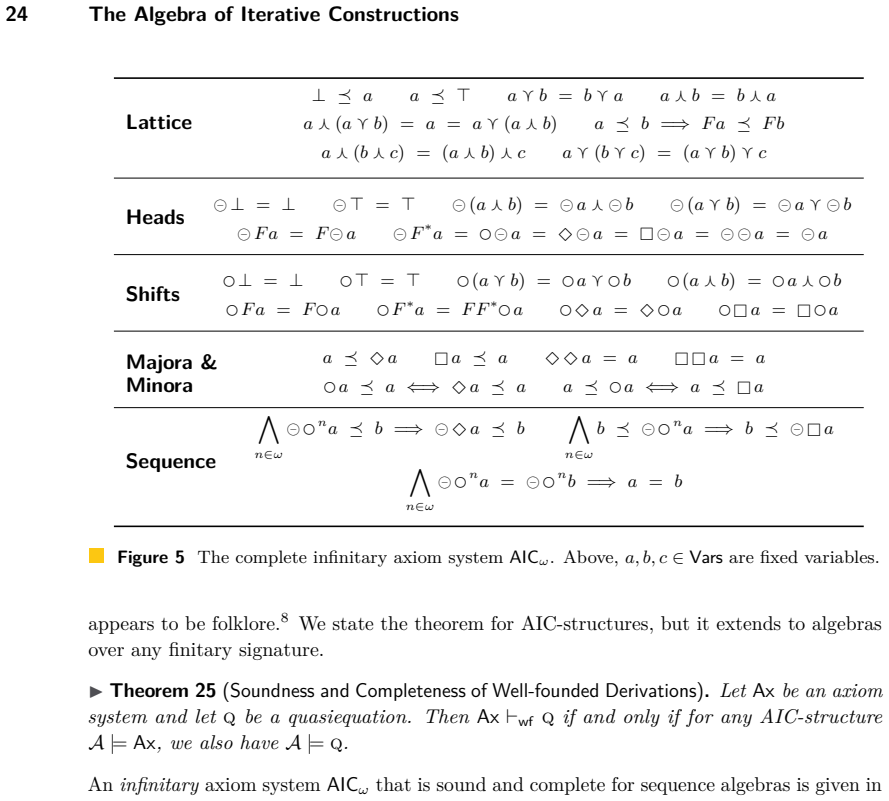
Fixed points are a recurring theme in computer science and are often constructed as limits of suitably seeded fixed point iterations. We present the algebra of iterative constructions (AIC) -- a purely algebraic approach to reasoning about fixed point iterations of continuous endomaps on complete lattices. AIC allows derivations of constructive fixed point theorems via equational logic and avoids explicit computations with indices. For example, $$F \,\Diamond\, F^{*} \bot = \Diamond\, F^{*} \bot$$ states in AIC that $\sup_n F^n (\bot)$ -- a construction known from the Kleene fixed point theorem -- is a fixed point of $F$. We demonstrate the applicability of AIC by providing algebraic proofs of several well- and less-well-known fixed point theorems: Among others, we prove the Tarski-Kantorovich principle -- a generalization of the Kleene fixed point theorem -- as well as a fixed point-theoretic generalization of $k$-induction -- a technique used in software verification. We moreover present a novel fixed point theorem. Under suitable continuity conditions, it obtains fixed points as lattice-theoretic limit inferiors and limit superiors of iterating an endomap on an arbitrary seed element. We have mechanized our algebra in Isabelle/HOL. Isabelle's sledgehammer tool is able to find proofs of the above fixed point theorems fully automatically. Finally, we investigate the completeness of our axiomatization of AIC. We prove that our finite set of finitary axioms is (a) sound but incomplete for standard models of AIC (sequences of elements from a complete lattice) and that (b) a different finite set of infinitary axioms is complete. We also prove that infinitary axioms are unavoidable: there exists no complete axiomatization of standard models given by finitely many finitary axioms.
Editorial analysis
A structured set of objections, weighed in public.
Referee Report
Summary. The manuscript introduces the Algebra of Iterative Constructions (AIC), a purely algebraic equational system for reasoning about fixed-point iterations of continuous endomaps on complete lattices. It derives standard results such as the Kleene fixed-point theorem (via the equation F ⋄ F* ⊥ = ⋄ F* ⊥) and the Tarski-Kantorovich principle without explicit index computations, presents a novel fixed-point theorem obtaining fixed points as lattice liminf/limsup of iterations from arbitrary seeds under stated continuity conditions, mechanizes the entire development in Isabelle/HOL with sledgehammer automation, and proves that a finite set of finitary axioms is sound but incomplete for sequence-based standard models while a finite set of infinitary axioms is complete, with no complete finite finitary axiomatization existing.
Significance. If the central claims hold, the paper supplies a machine-verified algebraic alternative to analytic proofs of fixed-point theorems, together with a precise completeness analysis that distinguishes finitary and infinitary axiomatizations for standard models. The Isabelle formalization, automatic proof discovery, and explicit demonstration that infinitary axioms are unavoidable constitute concrete strengths that enhance verifiability and applicability in verification and semantics.
minor comments (3)
- §3, Definition of the AIC signature: the notation for the binary operation ⋄ and the unary * is introduced without an explicit comparison table to related operators in Kleene algebra or fixed-point calculi; adding such a table would improve readability for readers familiar with those systems.
- §5.2, statement of the novel liminf/limsup theorem: the continuity conditions on the endomap are stated in terms of preservation of directed suprema and infima, but the manuscript does not include a short counter-example showing that dropping either condition falsifies the claim; a one-sentence counter-example would make the necessity of the conditions more immediate.
- §6, completeness proof for infinitary axioms: the reduction from arbitrary models to sequence models is sketched via an embedding argument; the manuscript should explicitly record the lemma number that justifies the embedding preserves the operations of AIC.
Simulated Author's Rebuttal
We thank the referee for the positive recommendation to accept the manuscript. The provided summary accurately reflects the main contributions of the Algebra of Iterative Constructions, including its equational derivations of fixed-point theorems, the Isabelle mechanization, and the completeness results distinguishing finitary and infinitary axiomatizations.
Circularity Check
No significant circularity; derivations are self-contained equational rewrites
full rationale
The paper introduces AIC as a purely algebraic system whose axioms and rules are stated explicitly upfront. All claimed fixed-point theorems (Kleene, Tarski-Kantorovich, k-induction generalization, and the novel liminf/limsup result) are obtained by equational rewriting inside this algebra; the mechanized Isabelle/HOL development supplies independent machine-checked proofs of soundness, completeness of the infinitary axiomatization, and non-existence of a finite finitary one. Standard models are defined directly as sequences over complete lattices, with soundness proved inside the formalization rather than assumed or fitted. No derivation reduces a prediction to a fitted parameter, no self-definitional loop appears, and no load-bearing step relies on a self-citation whose content is merely renamed or presupposed. The continuity conditions and modeling assumptions are stated as explicit hypotheses before any theorem is derived.
Axiom & Free-Parameter Ledger
axioms (1)
- domain assumption The finite set of finitary axioms defining AIC
Lean theorems connected to this paper
-
IndisputableMonolith/Cost/FunctionalEquation.leanwashburn_uniqueness_aczel unclearWe present the algebra of iterative constructions (AIC) — a purely algebraic approach to reasoning about fixed point iterations of continuous endomaps on complete lattices... F◇F∗⊥=◇F∗⊥
-
IndisputableMonolith/Foundation/RealityFromDistinction.leanreality_from_one_distinction unclearTheorem 14 (Tarski-Kantorovich Principle)... supn∈ωFn(ℓ)
Reference graph
Works this paper leans on
-
[1]
Samson Abramsky and Achim Jung. Domain theory. In Handbook of Logic In Computer Science , volume 3. Clarendon Press, 1994
work page 1994
-
[2]
What are iteration theories? In MFCS , Lecture Notes in Computer Science, pages 240--252
Jir \' Ad \' a mek, Stefan Milius, and Jir \' Velebil. What are iteration theories? In MFCS , Lecture Notes in Computer Science, pages 240--252. Springer, 2007
work page 2007
-
[3]
Christel Baier and Joost - Pieter Katoen. Principles of model checking . MIT Press, 2008
work page 2008
-
[4]
Paolo Baldan, Richard Eggert, Barbara K \" o nig, and Tommaso Padoan. Fixpoint theory - upside down. Log. Methods Comput. Sci. , 19(2), 2023
work page 2023
-
[5]
Systems of fixpoint equations: Abstraction, games, up-to techniques and local algorithms
Paolo Baldan, Barbara K \" o nig, and Tommaso Padoan. Systems of fixpoint equations: Abstraction, games, up-to techniques and local algorithms. Inf. Comput. , 301:105233, 2024
work page 2024
-
[6]
Latticed k-induction with an application to probabilistic programs
Kevin Batz, Mingshuai Chen, Benjamin Lucien Kaminski, Joost-Pieter Katoen, Christoph Matheja, and Philipp Schr \" o er. Latticed k-induction with an application to probabilistic programs. In CAV (2) , volume 12760 of Lecture Notes in Computer Science , pages 524--549. Springer, 2021
work page 2021
-
[7]
Pric3: Property directed reachability for mdps
Kevin Batz, Sebastian Junges, Benjamin Lucien Kaminski, Joost - Pieter Katoen, Christoph Matheja, and Philipp Schr \" o er. Pric3: Property directed reachability for mdps. In CAV (2) , Lecture Notes in Computer Science, pages 512--538. Springer, 2020
work page 2020
-
[8]
The algebra of iterative constructions
Kevin Batz, Benjamin Lucien Kaminski, Lucas Kehrer, Gerwin Klein, Todd Schmid, and Henning Urbat. The algebra of iterative constructions. In LICS , LIPIcs. Schloss Dagstuhl - Leibniz-Zentrum f \" u r Informatik, 2026. [to appear]
work page 2026
-
[9]
The algebra of iterative constructions
Kevin Batz, Benjamin Lucien Kaminski, Lucas Kehrer, Gerwin Klein, Henning Urbat, and Todd Schmid. The algebra of iterative constructions. Archive of Formal Proofs , April 2026. https://isa-afp.org/entries/Iteration_Algebra.html, Formal proof development
work page 2026
-
[10]
Boosting k-induction with continuously-refined invariants
Dirk Beyer, Matthias Dangl, and Philipp Wendler. Boosting k-induction with continuously-refined invariants. In CAV (1) , volume 9206 of Lecture Notes in Computer Science , pages 622--640. Springer, 2015
work page 2015
-
[11]
Bloom and Zolt \' a n \' E sik
Stephen L. Bloom and Zolt \' a n \' E sik. Iteration Theories - The Equational Logic of Iterative Processes . EATCS Monographs on Theoretical Computer Science. Springer, 1993. https://doi.org/10.1007/978-3-642-78034-9 doi:10.1007/978-3-642-78034-9
-
[12]
Aaron R. Bradley. Sat-based model checking without unrolling. In VMCAI , Lecture Notes in Computer Science, pages 70--87. Springer, 2011
work page 2011
-
[13]
Stanley N. Burris and H. P. Sankappanavar. A Course in Universal Algebra , volume 78 of Graduate Texts in Mathematics . Springer, New York, 1981
work page 1981
-
[14]
Edmund M. Clarke. Program invariants as fixed points. In FOCS , pages 18--29. IEEE Computer Society, 1977
work page 1977
-
[15]
Constructive versions of tarski’s fixed point theorems
Patrick Cousot and Radhia Cousot. Constructive versions of tarski’s fixed point theorems. Pacific journal of Mathematics , 82(1):43--57, 1979
work page 1979
-
[16]
Donaldson, Leopold Haller, Daniel Kroening, and Philipp R \" u mmer
Alastair F. Donaldson, Leopold Haller, Daniel Kroening, and Philipp R \" u mmer. Software verification using k-induction. In SAS , volume 6887 of Lecture Notes in Computer Science , pages 351--368. Springer, 2011
work page 2011
-
[17]
Frank M. V. Feys and Helle Hvid Hansen. Arrow's theorem through a fixpoint argument. In TARK , volume 297 of EPTCS , pages 175--188, 2019
work page 2019
-
[18]
Semantics of programming languages: structures and techniques
Carl A Gunter. Semantics of programming languages: structures and techniques . MIT press, 1992
work page 1992
-
[19]
Arie Gurfinkel and Alexander Ivrii. K-induction without unrolling. In FMCAD , pages 148--155. IEEE , 2017
work page 2017
-
[20]
M. W. Hirsch and Hal Smith. Monotone maps: a review. Journal of Difference Equations and Applications , 11(4-5):379--398, 2005. https://doi.org/10.1080/10236190412331335445 doi:10.1080/10236190412331335445
-
[21]
The tarski--kantorovitch prinicple and the theory of iterated function systems
Jacek Jachymski, Leslaw Gajek, and Piotr Pokarowski. The tarski--kantorovitch prinicple and the theory of iterated function systems. Bulletin of the Australian Mathematical Society , 61(2):247--261, 2000
work page 2000
-
[22]
Dejan Jovanovic and Bruno Dutertre. Property-directed k-induction. In FMCAD , pages 85--92. IEEE , 2016
work page 2016
-
[23]
Arithmetic, interpolation and factorization of amalgams, 2024
Tomasz Kiwerski and Jakub Tomaszewski. Arithmetic, interpolation and factorization of amalgams, 2024. URL: https://arxiv.org/abs/2401.05526, https://arxiv.org/abs/2401.05526 arXiv:2401.05526
-
[24]
Barbara K \" o nig. Approximating fixpoints of approximated functions (invited talk). In CSL , volume 288 of LIPIcs , pages 4:1--4:1. Schloss Dagstuhl - Leibniz-Zentrum f \" u r Informatik, 2024
work page 2024
-
[25]
The lattice-theoretic essence of property directed reachability analysis
Mayuko Kori, Natsuki Urabe, Shin - ya Katsumata, Kohei Suenaga, and Ichiro Hasuo. The lattice-theoretic essence of property directed reachability analysis. In CAV (1) , Lecture Notes in Computer Science, pages 235--256. Springer, 2022
work page 2022
-
[26]
D. Kozen. A completeness theorem for kleene algebras and the algebra of regular events. Information and Computation , 110(2):366--390, 1994. https://doi.org/10.1006/inco.1994.1037 doi:10.1006/inco.1994.1037
-
[27]
Results on the propositional \( \) -calculus
Dexter Kozen. Results on the propositional \( \) -calculus. In Mogens Nielsen and Erik Meineche Schmidt, editors, Automata, Languages and Programming, 9th Colloquium, Aarhus, Denmark, July 12-16, 1982, Proceedings , volume 140 of Lecture Notes in Computer Science , pages 348--359. Springer, 1982. https://doi.org/10.1007/BFB0012782 doi:10.1007/BFB0012782
-
[28]
Jean-Louis Lassez, V. L. Nguyen, and Liz Sonenberg. Fixed point theorems and semantics: A folk tale. Information Processing Letters , 14(3):112--116, 1982
work page 1982
-
[29]
H. M. MacNeille. Partially ordered sets. 1936. https://doi.org/10.1090/S0002-9947-1937-1501929-X doi:10.1090/S0002-9947-1937-1501929-X
-
[30]
A walk over the shortest path: Dijkstra's algorithm viewed as fixed-point computation
Jayadev Misra. A walk over the shortest path: Dijkstra's algorithm viewed as fixed-point computation. Inf. Process. Lett. , 77(2-4):197--200, 2001
work page 2001
-
[31]
John F. Nash. Equilibrium points in n -person games. Proceedings of the National Academy of Sciences , 36(1):48--49, 1950. https://doi.org/10.1073/pnas.36.1.48 doi:10.1073/pnas.36.1.48
-
[32]
On convergence of sequences in complete lattices
Wojciech Olszewski. On convergence of sequences in complete lattices. Order , 38:251--255, 2021
work page 2021
-
[33]
On sequences of iterations of increasing and continuous mappings on complete lattices
Wojciech Olszewski. On sequences of iterations of increasing and continuous mappings on complete lattices. Games and Economic Behavior , 126:453--459, 2021
work page 2021
-
[34]
Fixpoint induction and proofs of program properties
David Park. Fixpoint induction and proofs of program properties. Machine Intelligence , 5, 1969
work page 1969
-
[35]
The temporal logic of programs
Amir Pnueli. The temporal logic of programs. In 18th Annual Symposium on Foundations of Computer Science, Providence, Rhode Island, USA, 31 October - 1 November 1977 , pages 46--57. IEEE Computer Society, 1977. https://doi.org/10.1109/SFCS.1977.32 doi:10.1109/SFCS.1977.32
-
[36]
Marcus Rossel, Rudi Schneider, Thomas Koehler, Michel Steuwer, and Andr \' e s Goens. Towards pen-and-paper-style equational reasoning in interactive theorem provers by equality saturation. Proc. ACM Program. Lang. , 10( POPL ):718--747, 2026
work page 2026
-
[37]
Alejandro Santacruz Hidalgo and Gord Sinnamon. Core decreasing functions. Journal of Functional Analysis , 287(4):110490, 2024. https://doi.org/10.1016/j.jfa.2024.110490 doi:10.1016/j.jfa.2024.110490
-
[38]
Checking safety properties using induction and a sat-solver
Mary Sheeran, Satnam Singh, and Gunnar St lmarck. Checking safety properties using induction and a sat-solver. In FMCAD , volume 1954 of Lecture Notes in Computer Science , pages 108--125. Springer, 2000
work page 1954
-
[39]
Monotonicity in banach function spaces
Gord Sinnamon. Monotonicity in banach function spaces. Nonlinear Analysis, Function Spaces and Applications , pages 205--240, 2007
work page 2007
-
[40]
Macneille completions of lattice expansions
Mark Theunissen and Yde Venema . Macneille completions of lattice expansions. 2007. https://doi.org/10.1007/s00012-007-2033-1 doi:10.1007/s00012-007-2033-1
-
[41]
Completeness of kozen's axiomatisation of the propositional mu-calculus
Igor Walukiewicz. Completeness of kozen's axiomatisation of the propositional mu-calculus. In Proceedings, 10th Annual IEEE Symposium on Logic in Computer Science, San Diego, California, USA, June 26-29, 1995 , pages 14--24. IEEE Computer Society, 1995. https://doi.org/10.1109/LICS.1995.523240 doi:10.1109/LICS.1995.523240
-
[42]
Certificates for probabilistic pushdown automata via optimistic value iteration
Tobias Winkler and Joost-Pieter Katoen. Certificates for probabilistic pushdown automata via optimistic value iteration. In TACAS (2) , volume 13994 of Lecture Notes in Computer Science , pages 391--409. Springer, 2023
work page 2023
-
[43]
Piecewise linear expectation analysis via k-induction for probabilistic programs
Tengshun Yang, Hongfei Fu, Jingyu Ke, Naijun Zhan, and Shiyang Wu. Piecewise linear expectation analysis via k-induction for probabilistic programs. CoRR , abs/2403.17567, 2024
discussion (0)
Sign in with ORCID, Apple, or X to comment. Anyone can read and Pith papers without signing in.