Recognition: unknown
Equilibrium fluctuations of a quasi-spherical vesicle: role of the membrane dissipation
Pith reviewed 2026-05-08 02:41 UTC · model grok-4.3
The pith
Curvature in quasi-spherical vesicles makes long-wavelength undulations sensitive to membrane viscosity.
A machine-rendered reading of the paper's core claim, the machinery that carries it, and where it could break.
Core claim
The theory predicts that membrane curvature makes long-wavelength undulations sensitive to membrane viscosity and speeds up the relaxation of the lipid density fluctuations. Implications for the dynamic roughness and Dynamic Structure Factor measurements of submicron liposomes on nano-second time scales are discussed. Specifically, a clear stretched-exponential relaxation regime may not exist, in contrast to the behavior of planar membranes for which an anomalous diffusion exponent of 2/3 has been predicted.
What carries the argument
Perturbative hydrodynamic equations for small deviations from a spherical shape, with dissipation supplied by monolayer shear viscosity and intermonolayer friction.
If this is right
- Long-wavelength shape fluctuations become directly sensitive to membrane viscosity.
- Lipid density fluctuations relax faster than they would on a flat bilayer.
- Dynamic structure factor measurements on submicron liposomes will lack the stretched-exponential window seen in planar membranes.
- Anomalous diffusion with exponent 2/3 is not expected for quasi-spherical vesicles.
Where Pith is reading between the lines
- Comparing relaxation spectra across vesicles of different radii could isolate the curvature-induced viscosity sensitivity.
- The same mechanism may alter fluctuation-driven processes such as vesicle fusion or protein sorting in highly curved cellular membranes.
- Extending the model to include external fluid hydrodynamics would test whether the internal-dissipation dominance persists at all length scales.
Load-bearing premise
The vesicle stays close enough to spherical that fluctuations can be treated as small perturbations, and the dominant dissipation comes from inside the membrane rather than from flows in the surrounding fluid.
What would settle it
Observation of a clear stretched-exponential regime with exponent 2/3 in the dynamic structure factor of submicron liposomes at nanosecond times would contradict the claim that curvature removes this regime.
Figures



read the original abstract
We theoretically investigate the thermally-driven curvature and lipid density fluctuations of a quasi-spherical vesicle, accounting for the dissipation due to monolayer viscosity and intermonolayer friction. The theory predicts that membrane curvature makes long-wavelength undulations sensitive to membrane viscosity and speeds up the relaxation of the lipid density fluctuations. Implications for the dynamic roughness and Dynamic Structure Factor measurements of submicron liposomes on nano-second time scales are discussed. Specifically, a clear stretched-exponential relaxation regime may not exist, in contrast to the behavior of planar membranes for which an anomalous diffusion exponent of 2/3 has been predicted [Zilman and Granek, Phys. Rev. Lett. (1996)].
Editorial analysis
A structured set of objections, weighed in public.
Referee Report
Summary. The manuscript develops a hydrodynamic theory for thermally driven curvature and lipid density fluctuations of a quasi-spherical vesicle, incorporating dissipation from monolayer viscosity and intermonolayer friction. It predicts that curvature renders long-wavelength undulations sensitive to membrane viscosity, accelerates relaxation of lipid density fluctuations, and eliminates a clear stretched-exponential regime in the dynamic structure factor (in contrast to the planar-membrane result of Zilman and Granek).
Significance. If the derivation is robust, the work provides a useful curved-geometry extension of planar membrane hydrodynamics with direct implications for nanosecond-scale measurements on submicron liposomes. It supplies falsifiable predictions for dynamic roughness and structure-factor experiments and correctly identifies the absence of the planar 2/3 anomalous-diffusion exponent as a testable signature.
major comments (2)
- [hydrodynamic model / relaxation-rate derivation] The hydrodynamic model (main derivation): the central claim that curvature makes long-wavelength (low-l) undulations sensitive to monolayer viscosity and intermonolayer friction rests on treating dissipation as dominated by membrane-internal mechanisms. Standard quasi-spherical treatments (Stokes flow in interior/exterior domains matched to the membrane) show that solvent viscosity dominates relaxation rates for l=2,3 modes because the velocity field decays slowly into the bulk. The manuscript must demonstrate explicitly how the boundary conditions recover the full 3D Stokes solution at long wavelengths; otherwise the reported sensitivity is an artifact of the truncated dissipation model rather than a geometric effect.
- [lipid density fluctuations] Lipid-density relaxation section: the prediction that curvature speeds up density-fluctuation relaxation lacks a quantitative reduction to the planar limit (R→∞) or an error estimate on the perturbative quasi-spherical expansion. Without this check, it is unclear whether the speedup is a genuine curvature correction or a consequence of the same incomplete bulk-flow treatment.
minor comments (2)
- [introduction] The abstract cites Zilman and Granek (1996) but the introduction should quantify how the present relaxation spectrum deviates from the planar 2/3 exponent at the specific wave-numbers and times relevant to submicron liposomes.
- [notation] Notation for the intermonolayer friction coefficient and the curvature-dependent terms should be defined once at first use and used consistently; several symbols appear without prior definition in the fluctuation spectrum equations.
Simulated Author's Rebuttal
We thank the referee for the careful and constructive review. The comments highlight important points about the hydrodynamic treatment and the need for explicit limits. We address each major comment below and have revised the manuscript to strengthen the presentation.
read point-by-point responses
-
Referee: [hydrodynamic model / relaxation-rate derivation] The hydrodynamic model (main derivation): the central claim that curvature makes long-wavelength (low-l) undulations sensitive to monolayer viscosity and intermonolayer friction rests on treating dissipation as dominated by membrane-internal mechanisms. Standard quasi-spherical treatments (Stokes flow in interior/exterior domains matched to the membrane) show that solvent viscosity dominates relaxation rates for l=2,3 modes because the velocity field decays slowly into the bulk. The manuscript must demonstrate explicitly how the boundary conditions recover the full 3D Stokes solution at long wavelengths; otherwise the reported sensitivity is an artifact of the truncated dissipation model rather than a geometric effect.
Authors: We agree that a clear demonstration is required. Our model solves the incompressible Stokes equations in the interior and exterior fluids with continuity of velocity at the membrane and a stress jump that includes both the bulk viscous stresses and the membrane contributions (monolayer viscosity and intermonolayer friction). The curvature enters through the spherical geometry and the decomposition into spherical harmonics, which couples the normal and tangential velocities. In the revised manuscript we have added an appendix that explicitly recovers the known low-l relaxation rates dominated by solvent viscosity when the membrane dissipation coefficients are set to zero, and shows that the full 3D Stokes solution is recovered in that limit. When membrane dissipation is retained, the closed-surface constraint prevents the velocity field from decaying as freely as in the planar case, making the membrane terms non-negligible even at low l. This is a geometric effect, not an artifact of truncation. revision: yes
-
Referee: [lipid density fluctuations] Lipid-density relaxation section: the prediction that curvature speeds up density-fluctuation relaxation lacks a quantitative reduction to the planar limit (R→∞) or an error estimate on the perturbative quasi-spherical expansion. Without this check, it is unclear whether the speedup is a genuine curvature correction or a consequence of the same incomplete bulk-flow treatment.
Authors: We accept this criticism. The revised manuscript now contains a dedicated subsection that takes the explicit R → ∞ limit of the density-fluctuation relaxation rates. In that limit the curvature-induced speedup vanishes and the expressions reduce to the known planar-membrane results (including the correct dependence on solvent viscosity). We also provide an error estimate for the quasi-spherical expansion, showing that the leading-order correction in 1/R is O((l/R)^2) and remains small for the submicron vesicles and low-to-moderate l modes considered. These additions confirm that the reported speedup is a genuine curvature effect. revision: yes
Circularity Check
Minor self-citation to planar membrane result is not load-bearing
full rationale
The paper derives its predictions for quasi-spherical vesicle fluctuations from standard hydrodynamic equations, incorporating membrane viscosity and intermonolayer friction as dissipation sources, then adds curvature-dependent corrections. The sole self-citation (to Zilman and Granek 1996) is used only to contrast the absence of a stretched-exponential regime with the planar case; it does not justify or define the vesicle-specific results. No equations reduce by construction to fitted inputs, no ansatz is smuggled via citation, and the central claims about long-wavelength sensitivity remain independent of the referenced prior work.
Axiom & Free-Parameter Ledger
axioms (2)
- domain assumption The vesicle is quasi-spherical, permitting perturbative expansion of shape fluctuations around a spherical reference state.
- domain assumption Dissipation is dominated by in-plane monolayer viscosity and intermonolayer friction.
Reference graph
Works this paper leans on
-
[1]
1 [32, 39]
Membrane elastic energy and forces We consider a membrane composed of two identical monolayers with neutral surfaces that are distance 2 d apart, see Fig. 1 [32, 39]. Compression and expansion of the monolayers adds to the bending energy H = κ 2 Z (2H)2dA + σ0 Z dA + Km 2 Z (ϕ− + 2dH)2 + (ϕ+ − 2dH)2 dA , (2) where the integration is over the vesicle area ...
-
[2]
Dissipation in the membrane The weak intermolecular interactions between the two monolayers allow the two monolayers to slide over each other [44–46], thereby making the tangential component of the velocity discontinuous. The friction due to the relative motion gives rise to surface stresses on the monolayers facing the inner fluid (+) and the outer fluid...
-
[3]
Fluid motion at the lenghtscales of a micron-sized vesicle and smaller is 4 in the overdamped regime, where inertia effects are negligible
Dissipation in the bulk and fluid-membrane coupling Let us consider a vesicle suspended in a fluid with viscosity η− and enclosing fluid with viscosity η+; both fluids are assumed incompressible and Newtonian. Fluid motion at the lenghtscales of a micron-sized vesicle and smaller is 4 in the overdamped regime, where inertia effects are negligible. Accordi...
-
[4]
Accordingly, the time scale is tc = η−/τc and the velocity scale is Vc = Rτc/η−
Nondimensionalization Henceforth, all variables are non-dimensionalized using the radius of a sphere with the same volume as the vesicle, the viscosity of the suspending (outer) fluid, and the characteristic bending stress τc = ˜κ/R3. Accordingly, the time scale is tc = η−/τc and the velocity scale is Vc = Rτc/η−. The membrane elastic and dissipative stre...
-
[5]
Vesicle shape and energy Due to the spherical geometry of the problem, the vesicle shape and monolayer densities are expanded in spherical harmonics (see Appendix A for definitions) f(θ, φ, t) = X ℓm fℓmYℓm , ϕ ± = ϕ± 00 + X ℓm ϕ± ℓmYℓm , (22) where the sum denotes P ℓm ≡P∞ ℓ=2 Pℓ m=−ℓ. It is more convenient to work with the two alternative fields, the li...
-
[6]
(30) q takes values 0,1, and 2
Flow To solve for the flow, we use the basis of fundamental solutions of the Stokes equations in a spherical geometry [19, 60, 61], listed in Appendix D, v− = X ℓmq c− ℓmqu− ℓmq(r) , v+ = X ℓmq c+ ℓmqu+ ℓmq(r) . (30) q takes values 0,1, and 2. The functions u± ℓmq are vector solid spherical harmonics related to the harmonics in the Lamb solution. With res...
-
[7]
local area incompressibility
Shape and lipid density evolution The shape evolution equation, Eq. [19], to a leading order is ˙fℓm = c+ ℓm2 = c− ℓm2 . (31) Here the dot denotes a time derivative. The redistribution of the lipids Eq. [21] yields ˙ψℓm = −2ϕ0 ˙fℓm + 1 2 ℓ (ℓ + 1) (1 + ϕ0) c− ℓm0 − (1 − ϕ0) c+ ℓm0 , ˙ξℓm = −2 ˙fℓm + 1 2 ℓ (ℓ + 1) (1 + ϕ0) c− ℓm0 − (1 − ϕ0) c+ ℓm0 (32) We ...
-
[8]
[C20] and Eq
Interfacial stresses For a quasi-spherical vesicle, we consider small deviations from equilibrium, H = −1 − C and K = 1 + 2C, see Eq. [C20] and Eq. [C21], ϕ± = ϕ± 0 + ˜ϕ±, and the σ± = ¯σ± + ˜σ± where ¯σ± = σ0 2 − αϕ± 0 − α 2 ϕ± 0 2 , ˜σ± = −α˜ϕ± − αϕ± 0 ˜ϕ± To the linear order in the shape and lipid density deviations from equilibrium, the radial compone...
-
[9]
The “tension” αξℓm has two contributions: one balancing the elastic membrane stresses and one balancing the viscous stresses
ℓ(ℓ + 1) , τ v,Σ ℓm2 = − 2χdϕ0 1 − ϕ2 0 ˙ψℓm , (44) The condition for incompressibility, implies that ξℓm would adjust to keep ˙ξℓm = 0; αξℓm acts as a tension counter- acting imposed stresses to keep the area elements on the neutral surface from expanding/compressing. The “tension” αξℓm has two contributions: one balancing the elastic membrane stresses a...
-
[10]
Shape and lipid density evolution equations The stress boundary conditions yield the system of equations describing the shape and density dynamics. (τ hd,− jm2 + τ hd,+ jm2 ) − τ v,Σ jm2 + 4αξv ℓm = τ Σ jm2 (τ hd,− jm0 − τ hd,+ jm0 ) − τ v,∆ jm0 + τ b jm0 − 2αϕ0ξv ℓm = τ ∆ jm0 (49) The full expressions, listed in the Appendix, Eq. [E1], are well approxima...
-
[11]
in dimensional form, ˆω = ω/t˜κ. The time correlation functions are the elements of the matrix R = V e−γ1t 0 0 e−γ2t V−1E−1 Specifically ⟨fℓm(t)f ∗ ℓm(0)⟩ = R11 = ⟨f2 ℓm⟩ Q11e−γ1t + (1 − Q11)e−γ2t (54) with Q11 = γ2 − ω γ2 − γ1 , ω = C11 − E21C12 E22 . (55) where the tension is the equilibrium one. The density-density correlations ⟨ψℓm(t)ψ∗ ℓm(0)⟩ = R22 =...
-
[12]
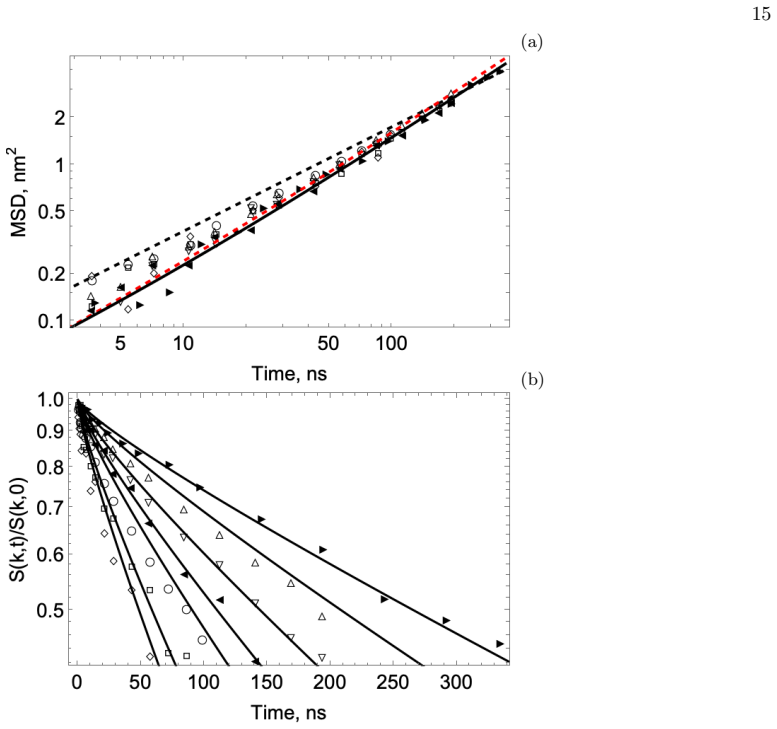
General Scattering techniques, such as neutron spin echo [22], dynamic light scattering [23], X-ray photon correlation spectroscopy [24] and some flickering experiments [25, 26] measure DSF, S(k, t), that is controlled by the single-point membrane mean square displacement (MSD), ⟨(∆h(t))2⟩, and essentially captured by [3, 27, 64] S(k, t) ∼ Exp[− k2 2 ⟨(∆h...
-
[13]
slipping
Case of relaxed lipid density At times when the lipid density is relaxed [29], and assuming vanishing tension ⟨(∆h(t))2⟩ ≡ R2⟨(∆f(t))2⟩ ≈ ( Γ[1/3] 2π42/3 kB T η2/3κ1/3 t2/3 t0 ≪ t ≪ t∗ 1 4√π kB T R√κηs t1/2 t∗ ≪ t ≪ τR (62) where t0 and τR are the shortest and longest relaxation times (respectively), t0 ≡ 1/ˆω(ℓ = ℓmax) and τR ≡ 1/ˆω(ℓ = 2), and the cross...
-
[14]
This is consistent with the definition Eq. [C6]. When adding the tensions of the two monolayers, at equilibrium ϕ− + ϕ− = 0, and the second term is Km 4 (ϕ− − ϕ+)2. At equilibrium on a sphere ϕ± = A0(1 ∓ d/R)2. Appendix D: Fundamental set of velocity fields, tractions, and solution for the flow around a sphere The velocity basis functions that are regular...
-
[15]
(E2b) A21 =(2 + ℓ)(1 − ϕ0) − 2(−2 + ℓ + ℓ2)χsϕ0 − (ℓ − 1)χ(1 + ϕ0) ℓ(ℓ + 1) (E2c) A22 = 4β + (2ℓ + 1)((ϕ0 − 1)2 + χ(ϕ0 + 1)2) + (ℓ(ℓ + 1)χd + (−2 + ℓ + ℓ2)χs) ϕ2 0 + 1 ℓ(ℓ + 1) (1− ϕ2
-
[16]
(E3) The tension ¯σ = σ0 − αϕ2 0
(E2d) B11 =(ℓ − 1)(ℓ + 2) (ℓ(ℓ + 1) + ¯σ) B12 = − (ℓ − 1)(ℓ + 2)λ , B21 = − (ℓ − 1)(ℓ + 2)λ 1 − ϕ2 0 , B22 =2α (1 − ϕ0)2 . (E3) The tension ¯σ = σ0 − αϕ2 0. The diagonal elements of the matrixA are much larger than the off-diagonal ones and the latter can be approximated by zero; for the parameters in Ref.[3] the error in the relaxation rates is size-depe...
-
[17]
The 2018 biomembrane curvature and remodeling roadmap.Journal of Physics D: Applied Physics, 51(34):343001, jul 2018
Patricia Bassereau, Rui Jin, Tobias Baumgart, Markus Deserno, Rumiana Dimova, Vadim A Frolov, Pavel V Bashkirov, Helmut Grubm ˜AŒller, Reinhard Jahn, H Jelger Risselada, Ludger Johannes, Michael M Kozlov, Reinhard Lipowsky, Thomas J Pucadyil, Wade F Zeno, Jeanne C Stachowiak, Dimitrios Stamou, Art` u Breuer, Line Lauritsen, Camille Simon, C´ ecile Sykes, ...
2018
-
[18]
Brochard and J
F. Brochard and J. F. Lennon. Frequency spectrum of the flicker phenomenon in erythrocytes. J. Phys.(France), 36:1035– 1047, 1975
1975
-
[19]
M. C. Watson, Y. Peng, Y. Zheng, and F. L. H. Brown. The intermediate scattering function for lipid bilayer membranes: From nanometers to microns. J. Chem. Phys., 135:194701, 2011
2011
-
[20]
Faizi, Cody J
Hammad A. Faizi, Cody J. Reeves, Vasil N. Georgiev, Petia M. Vlahovska, and Rumiana Dimova. Fluctuation spectroscopy of giant unilamellar vesicles using confocal and phase contrast microscopy. Soft Matter, 16:8996–9001, 2020
2020
-
[21]
Vesicle fluctuation analysis
John Hjort Ipsen, Allan Grønhøj Hansen, and Tripta Bhatia. Vesicle fluctuation analysis. In Rumiana Dimova and C. Marques, editors, The Giant Vesicle Book, page 13. CRC Press, 1st edition, 2019
2019
-
[22]
R. Dimova. Recent developments in the field of bending rigidity measurements on membranes. Adv. Coll. Int. Sci., 208:225–234, 2014
2014
-
[23]
The dynamic face of lipid membranes
Sudipta Gupta and Rana Ashkar. The dynamic face of lipid membranes. Soft Matter, 17:6910–6928, 2021
2021
-
[24]
Neutron scattering studies on dynamics of lipid membranes
Michihiro Nagao and Hideki Seto. Neutron scattering studies on dynamics of lipid membranes. Biophysics Reviews, 4(2):021306, 05 2023
2023
-
[25]
Measuring shape fluctuations in biological membranes
C Monzel and K Sengupta. Measuring shape fluctuations in biological membranes. Journal of Physics D: Applied Physics, 49(24):243002, may 2016
2016
-
[26]
and Lennon, J.F
Brochard, F. and Lennon, J.F. Frequency spectrum of the flicker phenomenon in erythrocytes.J. Phys. France, 36(11):1035– 1047, 1975
1975
-
[27]
Dynamics of the lipid-bilayer membrane taking a vesicle shape
Youhei Fujitani. Dynamics of the lipid-bilayer membrane taking a vesicle shape. Physica A: Statistical Mechanics and its Applications, 203(2):214–242, 1994
1994
-
[28]
P. Olla. The behavior of closed inextensible membranes in linear and quadratic shear flows. Physica A, 278:87–106, 2000
2000
-
[29]
S. B. Rochal, V. L. Lorman, and G. Mennessier. Viscoelastic dynamics of spherical composite vesicles. Phys. Rev. E, 71:021905, 2005
2005
-
[30]
Henle and Alex J
Mark L. Henle and Alex J. Levine. Hydrodynamics in curved membranes: The effect of geometry on particulate mobility. Phys. Rev. E, 81:011905, Jan 2010
2010
-
[31]
Woodhouse and Raymond E
Francis G. Woodhouse and Raymond E. Goldstein. Shear-driven circulation patterns in lipid membrane vesicles. Journal of Fluid Mechanics, 705:165–175, 2012
2012
-
[32]
Curved fluid membranes behave laterally as effective vis- coelastic media
Mohammad Rahimi, Antonio DeSimone, and Marino Arroyo. Curved fluid membranes behave laterally as effective vis- coelastic media. Soft Matter, 9:11033–11045, 2013
2013
-
[33]
Shape dynamics and lipid hydrodynamics of bilayer membranes: modeling, simulation and experiments
Mohammad Rahimi. Shape dynamics and lipid hydrodynamics of bilayer membranes: modeling, simulation and experiments. PhD thesis, Universitat Politecnica de Catalunya, 2013
2013
-
[34]
Atzberger
Jon Karl Sigurdsson and Paul J. Atzberger. Hydrodynamic coupling of particle inclusions embedded in curved lipid bilayer membranes. Soft Matter, 12:6685–6707, 2016
2016
-
[35]
Vlahovska
Petia M. Vlahovska. Electrohydrodynamics of drops and vesicles. Annu. Rev. Fluid Mech., 51: 305–330, 2019
2019
-
[36]
Mandadapu
Amaresh Sahu, Alec Glisman, Jo¨ el Tchoufag, and Kranthi K. Mandadapu. Geometry and dynamics of lipid membranes: The scriven-love number. Phys. Rev. E, 101:052401, May 2020
2020
-
[37]
S. T. Milner and S. A. Safran. Dynamical fluctuations of droplet microemulsions and vesicles. Phys. Rev. A, 36:4371–4379, 1987
1987
-
[38]
Kelley, Rana Ashkar, Robert Bradbury, and Paul D
Michihiro Nagao, Elizabeth G. Kelley, Rana Ashkar, Robert Bradbury, and Paul D. Butler. Probing elastic and viscous properties of phospholipid bilayers using neutron spin echo spectroscopy. The Journal of Physical Chemistry Letters, 8(19):4679–4684, 2017. PMID: 28892394
2017
-
[39]
Quasi-elastic light scattering study of highly swollen lamellar and ‘’sponge” phases.JOURNAL DE PHYSIQUE II, 7(6):913–929, JUN 1997
E Freyssingeas and D Roux. Quasi-elastic light scattering study of highly swollen lamellar and ‘’sponge” phases.JOURNAL DE PHYSIQUE II, 7(6):913–929, JUN 1997
1997
-
[40]
Falus, M
P. Falus, M. A. Borthwick, and S. G. J. Mochrie. Fluctuation dynamics of block copolymer vesicles. Phys. Rev. Lett., 94:016105, Jan 2005
2005
-
[41]
Betz and C
T. Betz and C. Sykes. Time resolved membrane fluctuation spectroscopy. Soft Matter, 8:5317–5326, 2012
2012
-
[42]
Helfer, S
E. Helfer, S. Harlepp, L. Bourdieu, J. Robert, F. C. MacKintosh, and D. Chatenay. Microrheology of biopolymer-membrane complexes. Phys. Rev. Lett., 85:457–460, 2000
2000
-
[43]
A. G. Zilman and R. Granek. Undulations and dynamic structure factor of membranes. Phys. Rev. Lett., 77:4788–4791, Dec 1996
1996
-
[44]
Kelley, Michihiro Nagao, Petia M
Rony Granek, Ingo Hoffmann, Elizabeth G. Kelley, Michihiro Nagao, Petia M. Vlahovska, and Anton Zilman. Dynamic structure factor of undulating vesicles: finite-size and spherical geometry effects with application to neutron spin echo experiments. EUROPEAN PHYSICAL JOURNAL E, 47(2), FEB 2024
2024
-
[45]
Curvature fluctuations of fluid vesicles reveal hydrodynamic dissipation within the bilayer
Hammad A Faizi, Rony Granek, and Petia M Vlahovska. Curvature fluctuations of fluid vesicles reveal hydrodynamic dissipation within the bilayer. Proceedings of the National Academy of Sciences, 121(44):e2413557121, 2024
2024
-
[46]
The effect of cholesterol on the bending modulus of dopc bilayers: re-analysis of nse data
Frank Heinrich and John F Nagle. The effect of cholesterol on the bending modulus of dopc bilayers: re-analysis of nse data. Soft Matter, 21(12):2258–2267, 2025. 22
2025
-
[47]
Lipel, Yannick A
Zachary G. Lipel, Yannick A. D. Omar, and Dimitrios Fraggedakis. Finite membrane thickness influences hydrodynamics on the nanoscale. Phys. Rev. Fluids, 10:103101, Oct 2025
2025
-
[48]
Seifert and S.A
U. Seifert and S.A. Langer. Viscous modes of fluid bilayer membranes. Europhys. Lett., 23:71–76, 1993
1993
-
[49]
L. Miao, M. A. Lomholt, and J. Kleis. Dynamics of shape fluctuations of quasi-spherical vesicles revisited. Eur. Phys. J. E., 9:143–160, 2002
2002
-
[50]
Thermal and active fluctuations of a compressible bilayer vesicle
T V Sachin Krishnan, Kento Yasuda, Ryuichi Okamoto, and Shigeyuki Komura. Thermal and active fluctuations of a compressible bilayer vesicle. Journal of Physics: Condensed Matter, 30(17):175101, apr 2018
2018
-
[51]
Evans and A
E. Evans and A. Yeung. Unexpected dynamics in shape fluctuations of bilayer vesicles. J. Phys. II, 5:1501–1523, 1995
1995
-
[52]
M. C. Watson and F. L. H. Brown. Interpreting membrane scattering experiments at the mesoscale: The contribution of dissipation within the bilayer. J. Chem. Phys., 98:L9–L11, 2010
2010
-
[53]
Rodr´ ıguez-Garc´ ıa, L
R. Rodr´ ıguez-Garc´ ıa, L. R. Arriaga, M. Mell, L. H. Moleiro, I. L´ opez-Montero, and F. Monroy. Bimodal spectrum for the curvature fluctuations of bilayer vesicles: Pure bending plus hybrid curvature-dilation modes.Phys. Rev. Lett., 102:128101, Mar 2009
2009
-
[54]
Quasi-elastic light scattering study of highly swollen lamellar and “sponge” phases
´Eric Freyssingeas, Didier Roux, and Fr´ ed´ eric Nallet. Quasi-elastic light scattering study of highly swollen lamellar and “sponge” phases. Journal de Physique II, 7(6):913–929, 1997
1997
-
[55]
U. Seifert. Configurations of fluid membranes and vesicles. Advances in physics, 46:13–137, 1997
1997
-
[56]
D. E. Discher and F. Ahmed. Polymersomes. Annu. Rev. Biomed. Eng., 8:323–341, 2006
2006
-
[57]
Evans and R
E. Evans and R. Skalak. Mechanics and Thermodynamics of Biomembranes. CRC Press, Boca Raton, Florida, 1980
1980
-
[58]
Powers, G
T.R. Powers, G. Huber, and R.E. Goldstein. Fluid-membrane tethers: Minimal surfaces and elastic boundary layers. Phys. Rev. E, 65:041901, 2003
2003
-
[59]
U. Seifert. Fluid membranes in hydrodynamic flow fields: Formalism and an application to fluctuating quasispherical vesicles in shear flow. The European Physical Journal B - Condensed Matter and Complex Systems, 8(3):405–415, Apr 1999
1999
-
[60]
Evans, A
E. Evans, A. Yeung, R. Waugh, and J. Song. Dynamic coupling and nonlocal curvature elasticity in bilayer membranes. In The Structure and Conformation of Amphiphilic Membranes, volume 66, pages 148–153. Springer Proceedings in Physics, 1992
1992
-
[61]
Evans and A
E. Evans and A. Yeung. Hidden dynamics in rapid changes of bilayer shape. Chem. Phys. Lipids, 73:39–56, 1994
1994
-
[62]
On the hydrodynamics of bilayer membranes
Jean-Baptiste Fournier. On the hydrodynamics of bilayer membranes. International Journal of Non-Linear Mechanics, 75:67–76, 2015. Instabilities and Nonlinearities in Soft Systems: From Fluids to Biomaterials
2015
-
[63]
W. K. den Otter and S. A. Shkulipa. Intermonolayer friction and surface shear viscosity of lipid bilayer membranes. Biophysical Journal, 93:423–433, 2007
2007
-
[64]
Merkel, E
R. Merkel, E. Sackmann, and E. Evans. Molecular friction and epitactic coupling between monolayers in supported bilayers. J. Phys France, 50:1535–1555, 1989
1989
-
[65]
Anthony, Osman Sahin, Murat Kaya Yapici, Daniel Rogers, and Aurelia R
Autumn A. Anthony, Osman Sahin, Murat Kaya Yapici, Daniel Rogers, and Aurelia R. Honerkamp-Smith. Systematic measurements of interleaflet friction in supported bilayers. BIOPHYSICAL JOURNAL, 121(15):2981–2993, AUG 2 2022
2022
-
[66]
D. A. Edwards, H. Brenner, and D. T. Wasan. Interfacial Transport Processes and Rheology. Butterworth-Heinemann, Boston, 1991
1991
-
[67]
D. A. Edwards and D. T. Wasan. Surface rheology ii. the curved fluid surface. J. Rheology, 32:447–472, 1988
1988
-
[68]
Effect of surface elasticity on the motion of a droplet in a viscous fluid
BU Felderhof. Effect of surface elasticity on the motion of a droplet in a viscous fluid. The Journal of chemical physics, 125(12), 2006
2006
-
[69]
Faizi, Rumiana Dimova, and Petia M
Hammad A. Faizi, Rumiana Dimova, and Petia M. Vlahovska. A vesicle microrheometer for high-throughput viscosity measurements of lipid and polymer membranes. BIOPHYSICAL JOURNAL, 121(6):910–918, MAR 15 2022
2022
-
[70]
Fitzgerald, Richard M
James E. Fitzgerald, Richard M. Venable, Richard W. Pastor, and Edward R. Lyman. Surface viscosities of lipid bilayers determined from equilibrium molecular dynamics simulations. BIOPHYSICAL JOURNAL, 122(6):1094–1104, MAR 21 2023
2023
-
[71]
Pastor, and Edward Lyman
Andrew Zgorski, Richard W. Pastor, and Edward Lyman. Surface shear viscosity and interleaflet friction from nonequi- librium simulations of lipid bilayers. Journal of Chemical Theory and Computation, 15(11):6471–6481, 2019. PMID: 31476126
2019
-
[72]
Falling ball viscosimetry of giant vesicle membranes: Finite-size effects
R Dimova, C Dietrich, A Hadjiisky, K Danov, and B Pouligny. Falling ball viscosimetry of giant vesicle membranes: Finite-size effects. EUROPEAN PHYSICAL JOURNAL B, 12(4):589–598, DEC 1999
1999
-
[73]
Dimova, S
R. Dimova, S. Aranda, N. Bezlyepkina, V. Nikolov, K. A. Riske, and R. Lipowsky. A practical guide to giant vesicles. probing the membrane nanoregime via optical microscopy. J. Phys. Cond. Matt., 18:S1151–S1176, 2006
2006
-
[74]
Eduardo Guzm´ an, Javier Tajuelo, Juan Manuel Pastor, Miguel ´Angel Rubio, Francisco Ortega, and Ram´ on G. Rubio. Shear rheology of fluid interfaces: Closing the gap between macro- and micro-rheology. Current Opinion in Colloid & Interface Science, 37:33–48, 2018. Surface analysis techniques
2018
-
[75]
Ponce-Torres, J
A. Ponce-Torres, J. M. Montanero, M. A. Herrada, E. J. Vega, and J. M. Vega. Influence of the surface viscosity on the breakup of a surfactant-laden drop. Phys. Rev. Lett., 118:024501, Jan 2017
2017
-
[76]
P. M. Vlahovska and R.S. Gracia. Dynamics of a viscous vesicle in linear flows. Phys. Rev. E, 75:016313, 2007
2007
-
[77]
Vlahovska
Petia M. Vlahovska. Dynamics of membrane bound particles: capsules and vesicles. In C. Duprat and H.A. Stone, editors, Low-Reynolds-Number Flows: Fluid-Structure Interactions. Royal Society of Chemistry Series RSC Soft Matter, 2016
2016
-
[78]
Goldstein, P
R.E. Goldstein, P. Nelson, T. Powers, and U. Seifert. Front propagation in the pearling instability of tubular vesicles. J. Phys. II France, 6:767–796, 1996
1996
-
[79]
J. T. Schwalbe, F. R. Phelan, P. M. Vlahovska, and S. D. Hudson. Interfacial effects on droplet dynamics in poiseuille 23 flow. Soft Matter, 7:7797–7804, 2011
2011
-
[80]
Zilman and Rony Granek
Anton G. Zilman and Rony Granek. Membrane dynamics and structure factor. Chemical Physics, 284(1):195–204, 2002. Strange Kinetics
2002
discussion (0)
Sign in with ORCID, Apple, or X to comment. Anyone can read and Pith papers without signing in.