Recognition: unknown
Characterisation and Monte Carlo validation of a compact AmBe neutron irradiation facility providing fast and thermal neutron fields for detector development
Pith reviewed 2026-05-08 02:02 UTC · model grok-4.3
The pith
A compact AmBe-based neutron irradiation facility with moderator was designed, commissioned, and validated via FLUKA simulations cross-checked against measurements from a CVD diamond detector to provide controlled fast and thermal neutron fields.
A machine-rendered reading of the paper's core claim, the machinery that carries it, and where it could break.
Core claim
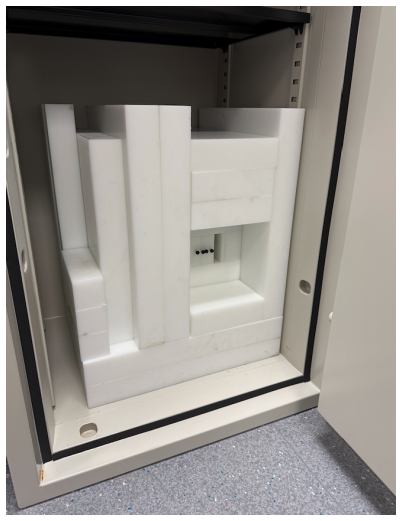
We report the design, commissioning and benchmarking of a compact AmBe-based neutron irradiation facility capable of providing both fast and thermal neutron dominated fields through multiple detector positions within a moderator assembly.
Load-bearing premise
That the FLUKA Monte Carlo model, including the embedded single-crystal CVD diamond detector geometry and surrounding housing materials, accurately reproduces the real energy-deposition mechanisms and neutron spectra at each detector position.
Figures




read the original abstract
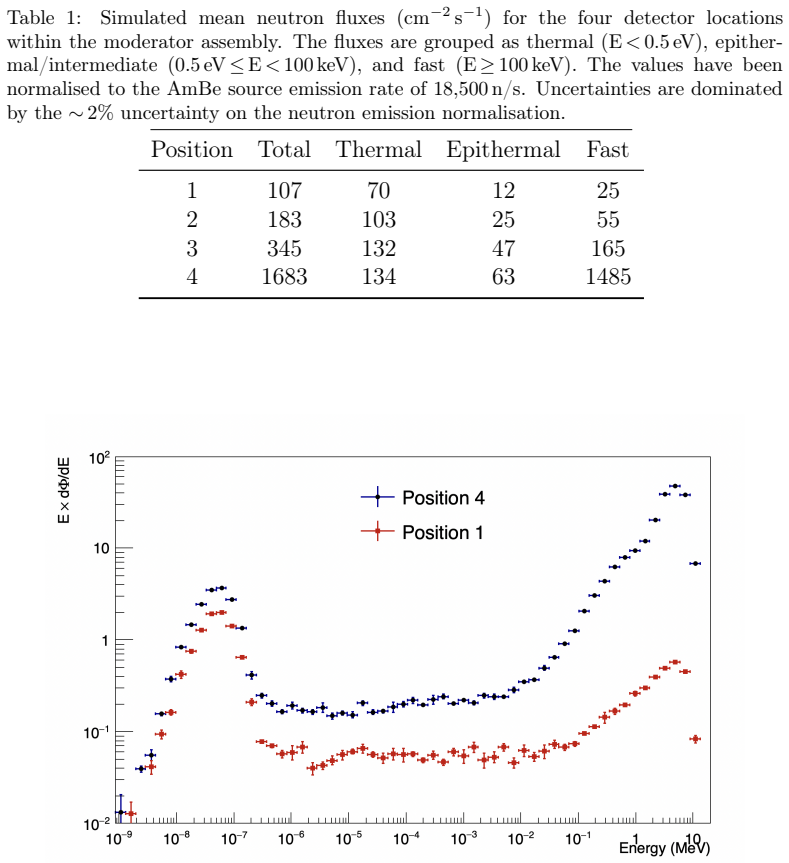
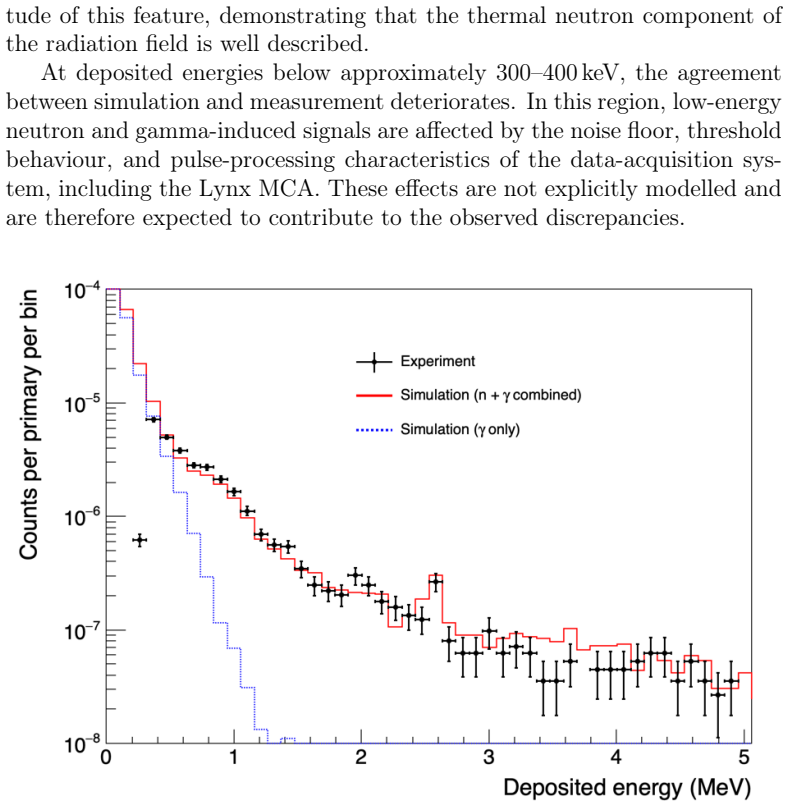
We report the design, commissioning and benchmarking of a compact AmBe-based neutron irradiation facility capable of providing both fast and thermal neutron dominated fields through multiple detector positions within a moderator assembly. Detailed radiation transport simulations using the FLUKA Monte Carlo code were performed to model the radiation environment at different detector positions. The inclusion of a single-crystal CVD diamond neutron detector in the simulations enabled direct comparison with experimental measurements, providing confidence the radiation fields are well understood. The simulations also provided a detailed breakdown of energy deposition mechanisms in the diamond sensors, including nuclear recoil, neutron capture reactions and secondary proton production from surrounding materials, highlighting the influence of detector housing materials on the local radiation environment and detector response. The facility provides a practical and accessible platform for neutron detector development and benchmarking in typical university laboratories, with dose rates outside the facility below typical natural background levels.
Editorial analysis
A structured set of objections, weighed in public.
Referee Report
Summary. The manuscript describes the design, commissioning, and benchmarking of a compact AmBe-based neutron irradiation facility capable of providing fast and thermal neutron dominated fields at multiple positions within a moderator assembly. Detailed FLUKA Monte Carlo simulations model the radiation environment, incorporating a single-crystal CVD diamond detector geometry for direct comparison with experimental measurements. The simulations also break down energy deposition mechanisms in the diamond, including nuclear recoil, neutron capture, and secondary proton production from surrounding materials. The facility is noted for its practicality in university labs with external dose rates below natural background.
Significance. Should the validation of the FLUKA model against experimental data hold with sufficient quantitative agreement, this work would provide a valuable, accessible tool for neutron detector development and benchmarking. The emphasis on the influence of detector housing materials on local radiation fields and response offers practical insights for accurate detector characterization in mixed neutron fields.
major comments (2)
- [Abstract] Abstract: The abstract states that FLUKA simulations were compared with experimental diamond-detector data and that energy-deposition mechanisms were broken down, but provides no quantitative agreement metrics, error bars, or exclusion criteria. This leaves the central validation claim only partially assessable and is load-bearing for the benchmarking assertion.
- [Abstract] Abstract and simulation/experimental sections: The validation rests on the diamond detector data alone without mention of auxiliary spectrum measurements such as Bonner spheres, activation foils, or time-of-flight to independently constrain the neutron spectra at each position. This creates a potential single-point validation loop where mismatches could be absorbed into either the field model or the detector response model, particularly regarding housing-induced secondary protons and capture reactions.
minor comments (1)
- [Abstract] Abstract: The phrase 'providing confidence the radiation fields are well understood' is somewhat vague; more precise language on the level of agreement would improve clarity.
Simulated Author's Rebuttal
We thank the referee for the constructive and detailed review. The comments highlight important aspects of how the validation is presented, and we address each point below with specific plans for revision where appropriate. Our responses focus on clarifying the manuscript's approach while strengthening the presentation of the results.
read point-by-point responses
-
Referee: [Abstract] Abstract: The abstract states that FLUKA simulations were compared with experimental diamond-detector data and that energy-deposition mechanisms were broken down, but provides no quantitative agreement metrics, error bars, or exclusion criteria. This leaves the central validation claim only partially assessable and is load-bearing for the benchmarking assertion.
Authors: We agree that the abstract would be strengthened by including quantitative metrics. In the revised manuscript we will update the abstract to report the level of agreement between FLUKA predictions and the CVD diamond measurements (e.g., count-rate agreement within stated percentages at the fast and thermal positions) together with the associated uncertainties. The detailed comparisons, including error bars on both experimental and simulated data, are already shown in the results section and figures; the abstract revision will make these key numbers visible at the outset. revision: yes
-
Referee: [Abstract] Abstract and simulation/experimental sections: The validation rests on the diamond detector data alone without mention of auxiliary spectrum measurements such as Bonner spheres, activation foils, or time-of-flight to independently constrain the neutron spectra at each position. This creates a potential single-point validation loop where mismatches could be absorbed into either the field model or the detector response model, particularly regarding housing-induced secondary protons and capture reactions.
Authors: The validation strategy deliberately couples the neutron-field model with a detailed geometric model of the diamond detector and its housing. Because the simulation predicts the full energy-deposition spectrum (nuclear recoils, capture reactions, and secondary protons generated in the surrounding materials) and this is compared directly with the measured pulse-height spectrum, agreement simultaneously tests the incident neutron field and the detector-response physics. The breakdown of energy-deposition mechanisms already isolates the contribution of housing-induced secondaries, thereby reducing the ambiguity the referee correctly identifies. We did not perform auxiliary spectrum measurements (Bonner spheres, activation foils, or time-of-flight) because the scientific focus was on practical detector characterisation rather than absolute spectrum unfolding. We will add a short paragraph in the discussion section explaining this rationale and the diagnostic power of the direct energy-deposition comparison. revision: partial
Circularity Check
No significant circularity; validation against independent experimental measurements
full rationale
The paper's central claims involve designing a neutron facility and benchmarking it via FLUKA Monte Carlo simulations that include the detector geometry for direct comparison to physical measurements with a CVD diamond detector. This constitutes an external benchmark rather than any derivation that reduces to fitted parameters or self-defined quantities by construction. No self-definitional steps, predictions that are statistically forced from subsets of the same data, or load-bearing self-citations appear in the abstract or described methodology. The separation of fast and thermal fields is supported by the moderator assembly design and experimental data, keeping the derivation chain self-contained against real-world observations.
Axiom & Free-Parameter Ledger
Reference graph
Works this paper leans on
-
[1]
ISO 8529-1:2021 Neutron reference radiations fields Part 1: Charac- teristics and methods of production,https://www.iso.org/standard/ 80060.html
2021
-
[2]
C. Ahdida, D. Bozzato, D. Calzolari, F. Cerutti, N. Charitonidis, A. Cim- mino, A. Coronetti, G. L. D’Alessandro, A. D. Servelle, L. S. Espos- ito, R. Froeschl, R. G. Alía, A. Gerbershagen, S. Gilardoni, D. Horváth, G. Hugo, A. Infantino, V. Kouskoura, A. Lechner, B. Lefebvre, G. Lerner, M. Magistris, A. Manousos, G. Moryc, F. O. Ruiz, F. Pozzi, D. Pre- l...
-
[3]
G. Battistoni, T. Boehlen, F. Cerutti, P. W. Chin, L. S. Esposito, A. Fassò, A. Ferrari, A. Lechner, A. Empl, A. Mairani, A. Mereghetti, P. G. Ortega, J. Ranft, S. Roesler, P. R. Sala, V. Vlachoudis, G. Smirnov, Overview of the fluka code, Annals of Nuclear Energy 82 (2015) 10–18. doi:10.1016/j.anucene.2014.11.007. URLhttps://doi.org/10.1016/j.anucene.201...
-
[4]
D. Rochman, A. J. Koning, F.-J. Hambsch, A. Plompen, K. Dupont, M. E. White, J. C. Sublet, R. Mills, C. D. S. Jean, O. Cabellos, G. Alib- erti, The jeff-3.3 nuclear data library: The new release of the joint eval- uated fission and fusion file, EPJ Web of Conferences 239 (2020) 02005. doi:10.1051/epjconf/202023902005
-
[5]
Cividec diamond model B6,https://www.cividec.at/
-
[6]
P. Kavrigin, P. Finocchiaro, E. Griesmayer, E. Jericha, A. Pappalardo, C. Weiss, Pulse-shape analysis for gamma background rejection in ther- mal neutron radiation using cvd diamond detectors, Nuclear Instruments and Methods in Physics Research Section A: Accelerators, Spectrom- eters, Detectors and Associated Equipment 795 (2015) 88–91.doi: 10.1016/j.nim...
-
[7]
CREMAT CR-Z-110-HV preamplifier,https://www.cremat.com/
-
[8]
T. Ito, A. Yamaguchi, T. Hayashi, K. Nakamura, T. Iwamoto, N. Shi- gyo, Analyzing the neutron andγ-ray emission properties of an ameri- cium–berylliumtaggedneutronsource, NuclearInstrumentsandMethods in Physics Research Section A 949 (2020) 162796.doi:10.1016/j.nima. 2019.162796. 22
discussion (0)
Sign in with ORCID, Apple, or X to comment. Anyone can read and Pith papers without signing in.