Recognition: unknown
mathrm{¹³⁰Te₂} spectroscopic reference for neutral Ti lines at 391 nm and 498 nm
Pith reviewed 2026-05-08 01:58 UTC · model grok-4.3
The pith
¹³⁰Te₂ absorption lines serve as frequency references to stabilize lasers at 391 nm and 498 nm for titanium experiments.
A machine-rendered reading of the paper's core claim, the machinery that carries it, and where it could break.
Core claim
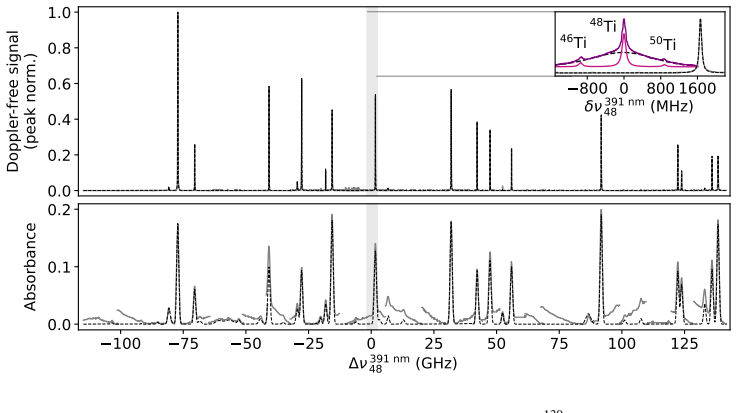
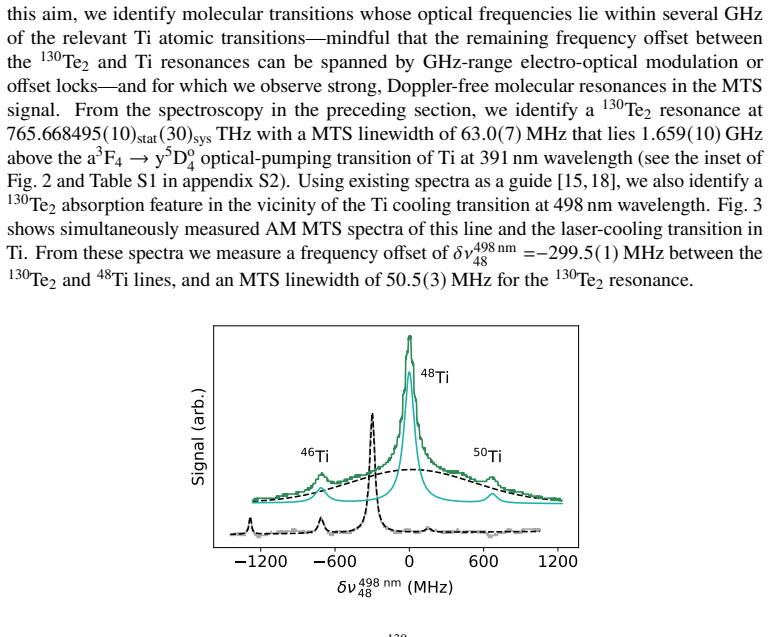
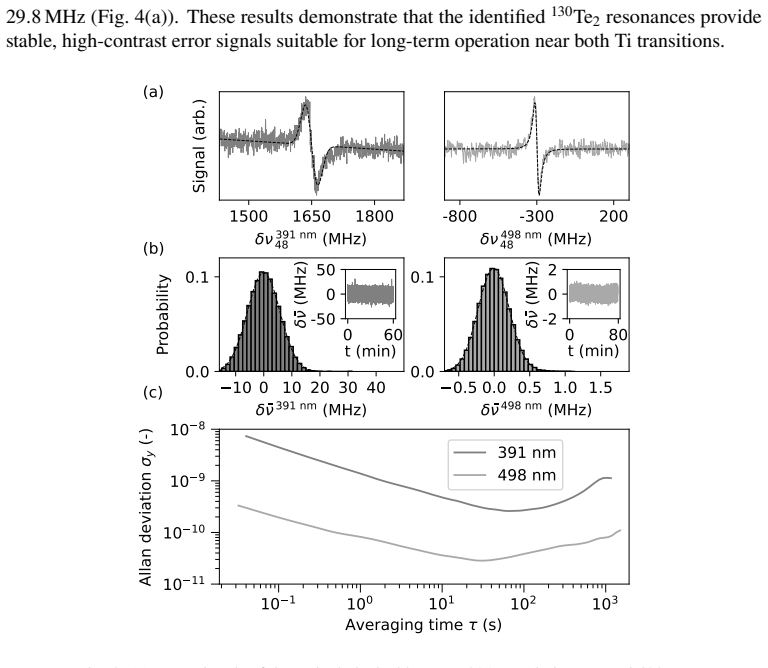
We report the observation of 36 previously unseen transitions in ¹³⁰Te₂ near 391 nm, attributed to the 0_u^+ → 0_g^+ subsystem of the ³Σ_u^- → ³Σ_g^- transition with vibrational assignments (28,27,26,25,24)→0 and (27,26)→1. Frequencies of these lines and additional lines near 498 nm were measured, enabling stabilization of lasers to ~60 MHz (~50 MHz) wide resonances close to the optical-pumping (laser-cooling) transitions in ⁴⁸Ti, with observed Allan deviations of 4.9×10^{-10} (3.6×10^{-11}) at 10 s averaging time.
What carries the argument
The 0_u^+ → 0_g^+ subsystem transitions in ¹³⁰Te₂ that act as frequency markers near the titanium wavelengths, identified by laser absorption spectroscopy and assigned via established molecular constants.
If this is right
- Lasers at 391 nm can be locked to Te₂ resonances to provide stable optical pumping for titanium.
- Lasers at 498 nm can be locked to Te₂ resonances to support laser cooling of titanium atoms.
- The achieved frequency stability supports long-term operation of titanium laser-cooling apparatus.
- The new line list expands available molecular references in the ultraviolet for atomic-physics experiments.
Where Pith is reading between the lines
- The same Te₂ cell could serve as a reference for other atomic species whose transitions fall near the reported lines.
- The measured frequencies could be used to refine the molecular constants of ¹³⁰Te₂ in the relevant vibrational range.
- Once the absolute frequency offset to titanium is calibrated, the reference could enable precision spectroscopy of titanium without an atomic source.
Load-bearing premise
The identified Te₂ resonances lie close enough in frequency to the titanium transitions to be useful for optical pumping and laser cooling, and the vibrational assignments based on the known molecular structure are correct.
What would settle it
Direct measurement of the frequency difference between a Te₂-locked laser and the actual titanium transition, or demonstration that the locked laser successfully pumps or cools a titanium atomic beam.
Figures

read the original abstract
We report on the use of ditellurium ($\mathrm{^{130}Te_2}$) as a frequency reference for laser locking at 391 nm and 498 nm optical wavelengths, which are of interest in titanium (Ti) laser-cooling experiments. In the ultraviolet region near the optical wavelength of 391 nm, 36 previously unobserved transitions were found using laser absorption spectroscopy in a 256 GHz range. Based on the established molecular structure of $\mathrm{^{130}Te_2}$, we attribute these lines to the $\mathrm{0_u^+\rightarrow 0_g^+}$ subsystem of the $\mathrm{^3\Sigma_u^-\rightarrow\ ^3\Sigma_g^-}$ transition with possible vibrational transitions of $\nu=(28,27,26,25,24)\rightarrow 0$ and $(27,26)\rightarrow 1$. We measure the frequencies of these lines, and also of lines near 498 nm wavelength, and subsequently stabilize lasers at wavelengths of 391 nm (and 498 nm) to $\sim$60 MHz ($\sim$50 MHz) wide resonances in $\mathrm{^{130}Te_2}$, near the optical-pumping (laser-cooling) transitions in $\mathrm{^{48}Ti}$. We observe robust laser frequency locks, with Allan deviations of $4.9\times 10^{-10}$ ($3.6\times 10^{-11}$) at 10 s of averaging time for the 391 nm (498 nm) wavelength lasers.
Editorial analysis
A structured set of objections, weighed in public.
Referee Report
Summary. The manuscript reports laser absorption spectroscopy of ¹³⁰Te₂ near 391 nm, identifying 36 previously unobserved transitions assigned to the 0_u⁺ → 0_g⁺ subsystem of the ³Σ_u⁻ → ³Σ_g⁻ band system with vibrational assignments (v',v'') = (28–24,0) and (27–26,1) based on established molecular constants. Frequencies of these lines and additional lines near 498 nm are measured; lasers are then locked to the ~60 MHz (391 nm) and ~50 MHz (498 nm) wide resonances, which the authors position near the ⁴⁸Ti optical-pumping and laser-cooling transitions. Robust locks are demonstrated via Allan deviations of 4.9×10^{-10} (391 nm) and 3.6×10^{-11} (498 nm) at 10 s averaging time.
Significance. If the frequency detunings to the Ti lines are shown to be small enough to be useful for capture and cooling, the work supplies accessible molecular references for Ti laser-cooling experiments. The reported locking stabilities constitute quantitative, reproducible performance metrics that strengthen the practical utility claim.
major comments (2)
- Abstract: the assertion that the observed ¹³⁰Te₂ resonances lie 'near the optical-pumping (laser-cooling) transitions in ⁴⁸Ti' is not accompanied by any tabulated or stated frequency differences between the measured Te₂ line centers and either the known ⁴⁸Ti transition frequencies or the positions predicted from the molecular constants used for assignment. Without these offsets it is impossible to determine whether the locked laser frequency lies inside the Ti capture range or hundreds of MHz away, which is load-bearing for the central claim of usability as a reference.
- The manuscript provides no explicit error budget or uncertainty analysis for the reported line centers, widths, or Allan deviations, nor does it reference a table or figure containing the raw frequency values; this omission prevents independent assessment of the measurement precision and the robustness of the vibrational assignments.
minor comments (1)
- The abstract states that 36 lines were found 'in a 256 GHz range' but does not indicate whether a corresponding spectrum or line list appears in the main text; inclusion of such a figure or table would improve reproducibility.
Simulated Author's Rebuttal
We thank the referee for their careful reading of the manuscript and for the constructive comments. We address each major comment below and will make the requested revisions to strengthen the presentation of our results.
read point-by-point responses
-
Referee: [—] Abstract: the assertion that the observed ¹³⁰Te₂ resonances lie 'near the optical-pumping (laser-cooling) transitions in ⁴⁸Ti' is not accompanied by any tabulated or stated frequency differences between the measured Te₂ line centers and either the known ⁴⁸Ti transition frequencies or the positions predicted from the molecular constants used for assignment. Without these offsets it is impossible to determine whether the locked laser frequency lies inside the Ti capture range or hundreds of MHz away, which is load-bearing for the central claim of usability as a reference.
Authors: We agree that explicit frequency offsets are necessary to substantiate the usability claim for Ti laser-cooling. The submitted manuscript describes the Te₂ lines as lying 'near' the Ti transitions but does not tabulate the detunings. In the revised manuscript we will add a table (or subsection) that lists the measured Te₂ line centers, the accepted ⁴⁸Ti transition frequencies from the literature, the detunings in MHz, and the comparison to positions predicted from the molecular constants used in the assignment. This will allow readers to verify that the locked frequencies fall inside the capture range for our MOT parameters. revision: yes
-
Referee: [—] The manuscript provides no explicit error budget or uncertainty analysis for the reported line centers, widths, or Allan deviations, nor does it reference a table or figure containing the raw frequency values; this omission prevents independent assessment of the measurement precision and the robustness of the vibrational assignments.
Authors: We acknowledge that a dedicated uncertainty analysis was omitted from the original submission. In the revision we will insert an error-budget section that quantifies the contributions from wavemeter calibration, cell pressure and temperature shifts, Doppler effects, and least-squares fitting uncertainties for both line centers and widths. We will also tabulate the measured frequencies of all identified Te₂ lines together with their estimated uncertainties and will state the conditions under which the Allan deviations were recorded (integration time, number of samples, and any statistical uncertainties). These additions will enable independent evaluation of the measurement precision and the vibrational assignments. revision: yes
Circularity Check
No circularity: direct experimental spectroscopy and locking measurements
full rationale
The paper performs laser absorption spectroscopy to discover and measure 36 new transitions in ¹³⁰Te₂ near 391 nm, assigns them to known vibrational bands of the established 0_u⁺ → 0_g⁺ subsystem using prior molecular constants (not derived in this work), measures absolute frequencies, and demonstrates laser locks with reported Allan deviations. No equations, predictions, fitted parameters, or self-citations are invoked to derive the central results; all claims rest on raw spectral data and lock performance. This is a standard experimental report with no load-bearing derivation chain.
Axiom & Free-Parameter Ledger
axioms (1)
- domain assumption The established molecular structure of ¹³⁰Te₂ allows reliable assignment of observed absorption lines to specific electronic and vibrational transitions.
Reference graph
Works this paper leans on
-
[1]
Gerstenkorn and P
S. Gerstenkorn and P. Luc. Atlas du spectre d'absorption de la molecule d'iode 14800-20000 cm ^ -1 . 1978
1978
-
[2]
Molecular frequency reference at 1.56 m using a ^ 12 C ^ 16 O overtone transition with the noise-immune cavity-enhanced optical heterodyne molecular spectroscopy method
Shailendhar Saraf, Paul Berceau, Alberto Stochino, Robert Byer, and John Lipa. Molecular frequency reference at 1.56 m using a ^ 12 C ^ 16 O overtone transition with the noise-immune cavity-enhanced optical heterodyne molecular spectroscopy method. Opt. Lett. , 41(10):2189--2192, May 2016
2016
-
[3]
Absolute frequency measurement of wavelength standard at 1542 nm: acetylene stabilized DFB laser
Petr Balling, Marc Fischer, Philipp Kubina, and Ronald Holzwarth. Absolute frequency measurement of wavelength standard at 1542 nm: acetylene stabilized DFB laser. Opt. Express , 13(23):9196--9201, Nov 2005
2005
-
[4]
Frequency locking of an InGaAsP semiconductor laser to the first overtone vibration‐rotation lines of hydrogen fluoride
Shizuo Yamaguchi and Masao Suzuki. Frequency locking of an InGaAsP semiconductor laser to the first overtone vibration‐rotation lines of hydrogen fluoride. Applied Physics Letters , 41(11):1034--1036, 12 1982
1982
-
[5]
Hall, and Jun Ye
Wang-Yau Cheng, Lisheng Chen, Tai Hyun Yoon, John L. Hall, and Jun Ye. Sub-doppler molecular-iodine transitions near the dissociation limit ( 523-498 nm ). Opt. Lett. , 27(8):571--573, Apr 2002
2002
-
[6]
R. F. Barrow and R. P. du Parcq. Rotational analysis of the A\,0_u^+ , B\,0_u^+ - X\,0_g^+ systems of gaseous Te _2 . Proceedings of the Royal Society of London. A. Mathematical and Physical Sciences , 327(1569):279--287, March 1972
1972
-
[7]
Swanson, and Steven Peil
Jennifer Taylor, Bryan Hemingway, James Hanssen, Thomas B. Swanson, and Steven Peil. Vapor-cell frequency reference for short-wavelength transitions in neutral calcium. J. Opt. Soc. Am. B , 35(7):1557--1562, Jul 2018
2018
-
[8]
T. G. Akin, Bryan Hemingway, and Steven Peil. Tellurium spectrometer for ^ 1 S_ 0 -- ^ 1 P_ 1 transitions in strontium and other alkaline-earth atoms. Review of Scientific Instruments , 93(5):053002, 05 2022
2022
-
[9]
Absolute Te _2 reference for barium ion at 455.4 nm
Tarun Dutta, Debashis De Munshi, and Manas Mukherjee. Absolute Te _2 reference for barium ion at 455.4 nm. J. Opt. Soc. Am. B , 33(6):1177--1181, Jun 2016
2016
-
[10]
D. M. Lucas, A. Ramos, J. P. Home, M. J. McDonnell, S. Nakayama, J.-P. Stacey, S. C. Webster, D. N. Stacey, and A. M. Steane. Isotope-selective photoionization for calcium ion trapping. Phys. Rev. A , 69:012711, Jan 2004
2004
-
[11]
Johanning, A
M. Johanning, A. Braun, D. Eiteneuer, Chr. Paape, Chr. Balzer, W. Neuhauser, and Chr. Wunderlich. Resonance-enhanced isotope-selective photoionization of YbI for ion trap loading. Applied Physics B , 103:327--338, 2011
2011
-
[12]
Schmidt-Kaler, S
F. Schmidt-Kaler, S. Gulde, M. Riebe, T. Deuschle, A. Kreuter, G. Lancaster, C. Becher, J. Eschner, H. Häffner, and R. Blatt. The coherence of qubits based on single Ca + ions. Journal of Physics B: Atomic, Molecular and Optical Physics , 36(3):623, January 2003
2003
-
[13]
Lis, Aruku Senoo, William F
Alec Jenkins, Joanna W. Lis, Aruku Senoo, William F. McGrew, and Adam M. Kaufman. Ytterbium nuclear-spin qubits in an optical tweezer array. Physical Review X , 12(2):021027, 2022
2022
-
[14]
Burns, J
I.S. Burns, J. Hult, and C.F. Kaminski. Use of ^ 130 Te_2 for frequency referencing and active stabilisation of a violet extended cavity diode laser. Spectrochimica Acta Part A: Molecular and Biomolecular Spectroscopy , 63(5):905--909, April 2006
2006
-
[15]
Ross and Joseph M
Amanda J. Ross and Joseph M. Cardon. Te _2 absorption spectrum from 19000 to 24000 cm ^ -1 . Journal of Molecular Spectroscopy , 384:111589, 2022
2022
-
[16]
Stamper-Kurn
Scott Eustice, Jackson Schrott, Anke St\"oltzel, Julian Wolf, Diego Novoa, Kayleigh Cassella, and Dan M. Stamper-Kurn. Magneto-optical trap of titanium atoms. Phys. Rev. Res. , 7:023025, Apr 2025
2025
-
[17]
optical telecommunications-band clock based on neutral titanium atoms
Scott Eustice, Dmytro Filin, Jackson Schrott, Sergey Porsev, Charles Cheung, Diego Novoa, Dan M. Stamper-Kurn, and Marianna S. Safronova. Supplemental material for “optical telecommunications-band clock based on neutral titanium atoms”. Physical Review A , 107(5):L051102, May 2023
2023
-
[18]
Atlas du spectre d'absorption de la molecule de tellure
P Luc and J Cariou. Atlas du spectre d'absorption de la molecule de tellure . Laboratoire Aime-Cotton CNRS II, Orsay, France, 1980
1980
-
[19]
Jon H. Shirley. Modulation transfer processes in optical heterodyne saturation spectroscopy. Opt. Lett. , 7(11):537--539, Nov 1982
1982
-
[20]
Neely, Kayleigh Cassella, Scott Eustice, A A, and Dan M
Andrew O. Neely, Kayleigh Cassella, Scott Eustice, A A, and Dan M. Stamper-Kurn. Isotope shifts in the metastable a ^ 5 F and excited y ^ 5 G ^ o terms of atomic titanium. Phys. Rev. A , 103:032818, Mar 2021
2021
-
[21]
Temperature dependence of the saturated vapor pressure of tellurium
Arnolds Ubelis. Temperature dependence of the saturated vapor pressure of tellurium. Journal of Engineering Physics , 42:309--315, 03 1982
1982
-
[22]
Effect of intersection angle between saturation and probe beams on saturated absorption spectra of the Cs - D2 line
Isao Hirano. Effect of intersection angle between saturation and probe beams on saturated absorption spectra of the Cs - D2 line. Journal of Quantitative Spectroscopy and Radiative Transfer , 40(4):531--537, 1988
1988
-
[23]
Jha, K.V
B.L. Jha, K.V. Subbaram, and D.Ramachandra Rao. Electronic spectra of ^ 130 Te_2 and ^ 128 Te_2 . Journal of Molecular Spectroscopy , 32(3):383--397, December 1969
1969
-
[24]
Magneto-optical trap of titanium atoms , author =. Phys. Rev. Res. , volume =. 2025 , month =. doi:10.1103/PhysRevResearch.7.023025 , url =
-
[25]
Optical Telecommunications-Band Clock based on Neutral Titanium Atoms
Supplemental Material for “Optical Telecommunications-Band Clock based on Neutral Titanium Atoms” , volume =. Physical Review A , author =. 2023 , pages =. doi:10.1103/PhysRevA.107.L051102 , number =
-
[26]
and Cassella, Kayleigh and Eustice, Scott and A, A and Stamper-Kurn, Dan M
Neely, Andrew O. and Cassella, Kayleigh and Eustice, Scott and A, A and Stamper-Kurn, Dan M. , journal =. Isotope shifts in the metastable. 2021 , month =. doi:10.1103/PhysRevA.103.032818 , url =
-
[27]
The Journal of Chemical Physics , author =
Dissociation Energies of Group. The Journal of Chemical Physics , author =. 1968 , pages =. doi:10.1063/1.1669545 , abstract =
-
[28]
Spectroscopy Letters , author =
Dissociation. Spectroscopy Letters , author =. 1975 , pages =. doi:10.1080/00387017508067379 , language =
-
[29]
and Luc, P
Gerstenkorn, S. and Luc, P. , title =. Journal de Physique , year =
-
[30]
Chemical Physics Letters , author =
Emission spectrum of. Chemical Physics Letters , author =. 1969 , pages =. doi:10.1016/0009-2614(69)80129-6 , language =
-
[31]
Chemical Communications (London) , author =
The internuclear distance in the. Chemical Communications (London) , author =. 1966 , pages =. doi:10.1039/c1966000270a , language =
-
[32]
Journal of the Chemical Society, Faraday Transactions 2 , author =
Observations on the absorption and fluorescence spectra of gaseous. Journal of the Chemical Society, Faraday Transactions 2 , author =. 1972 , pages =. doi:10.1039/f29726801397 , language =
-
[33]
Journal of the American Chemical Society , author =
Vapor. Journal of the American Chemical Society , author =. 1958 , pages =. doi:10.1021/ja01545a010 , language =
-
[34]
Spectrochimica Acta Part A: Molecular and Biomolecular Spectroscopy , author =
Use of. Spectrochimica Acta Part A: Molecular and Biomolecular Spectroscopy , author =. 2006 , pages =. doi:10.1016/j.saa.2005.10.053 , language =
-
[35]
The spectra and structures of simple free radicals: an introduction to molecular spectroscopy , isbn =
Herzberg, Gerhard , year =. The spectra and structures of simple free radicals: an introduction to molecular spectroscopy , isbn =
-
[36]
Proceedings of the Royal Society of London
Rotational analysis of the. Proceedings of the Royal Society of London. A. Mathematical and Physical Sciences , author =. 1972 , pages =. doi:10.1098/rspa.1972.0045 , language =
-
[37]
Journal of Molecular Spectroscopy , author =
Electronic spectra of. Journal of Molecular Spectroscopy , author =. 1969 , pages =. doi:10.1016/0022-2852(69)90004-6 , language =
-
[38]
Atlas du spectre d'absorption de la molecule de tellure , publisher =
Luc, P and Cariou, J , year =. Atlas du spectre d'absorption de la molecule de tellure , publisher =
-
[39]
Journal of the Optical Society of America B , author =
Absolute wavelength determinations in molecular tellurium: new reference lines for precision laser spectroscopy , volume =. Journal of the Optical Society of America B , author =. 1991 , pages =. doi:10.1364/JOSAB.8.002414 , language =
-
[40]
Journal of the Optical Society of America B , author =
Absolute. Journal of the Optical Society of America B , author =. 2016 , pages =. doi:10.1364/JOSAB.33.001177 , language =
-
[41]
and Luc, P
Gerstenkorn, S. and Luc, P. , title = ". 1978 , journal=
1978
-
[42]
Molecular frequency reference at 1.56 m using a
Shailendhar Saraf and Paul Berceau and Alberto Stochino and Robert Byer and John Lipa , journal =. Molecular frequency reference at 1.56 m using a. 2016 , url =
2016
-
[43]
Applied Physics Letters , volume =
Yamaguchi, Shizuo and Suzuki, Masao , title =. Applied Physics Letters , volume =. 1982 , month =. doi:10.1063/1.93384 , url =
-
[44]
Absolute frequency measurement of wavelength standard at 1542 nm: acetylene stabilized
Petr Balling and Marc Fischer and Philipp Kubina and Ronald Holzwarth , journal =. Absolute frequency measurement of wavelength standard at 1542 nm: acetylene stabilized. 2005 , url =
2005
-
[45]
Ross, Amanda J. and Cardon, Joseph M. , year =. Te _2 absorption spectrum from 19000 to 24000 cm ^. doi:https://doi.org/10.1016/j.jms.2022.111589 , journal =
-
[46]
Pure and Applied Chemistry , author =
Isotopic compositions of the elements 2013 (. Pure and Applied Chemistry , author =. 2016 , note =. doi:10.1515/pac-2015-0503 , number =
-
[47]
The Journal of Physical Chemistry , author =
Tellurium vapor pressure and optical density at. The Journal of Physical Chemistry , author =. 1968 , note =. doi:10.1021/j100849a043 , number =
-
[48]
Journal of the American Chemical Society , author =
The Vapor Pressures of Tellurium and Selenium , volume =. Journal of the American Chemical Society , author =. 1952 , note =. doi:10.1021/ja01121a059 , number =
-
[49]
Review of Scientific Instruments , author =
Tellurium Spectrometer for. Review of Scientific Instruments , author =. 2022 , note =. doi:10.1063/5.0084122 , number =
-
[50]
Journal of Physics B: Atomic and Molecular Physics , author =
Hund's coupling case (c) in diatomic molecules. Journal of Physics B: Atomic and Molecular Physics , author =. 1973 , pages =. doi:10.1088/0022-3700/6/8/025 , language =
-
[51]
WS 8-10 Wavemeter Manual , url =
-
[52]
Singh, Jaideep and Dolph, Peter A M and Tobias, William A , file =. Alkali
-
[53]
Lin, Qinning and Ma, Jie and Coker, James and Pang, Renjun and Wang, Zesen and Furneaux, J. E. and Yin, Jianping and Yang, Tao , month = apr, year =. High resolution spectroscopy of. doi:10.1016/j.saa.2024.123887 , journal =
-
[54]
Precise. Molecules , author =. 2020 , pmid =. doi:10.3390/molecules25081956 , number =
-
[55]
FM Spectroscopy - Or, How Excessive Trigonometry Solves All Problems , author =
-
[56]
Propagation of modulated optical fields through saturable-absorbing media: a general theory of modulation spectroscopy , volume =. JOSA B , author =. 1985 , note =. doi:10.1364/JOSAB.2.001444 , language =
-
[57]
Atomic physics , url =
Foot, CJ , biburl =. Atomic physics , url =
-
[58]
Nirvana Auto-Balanced Photoreceivers Manual , year =
-
[59]
Laser cooling of transition-metal atoms , author =. Phys. Rev. A , volume =. 2020 , month =. doi:10.1103/PhysRevA.102.053327 , url =
-
[60]
and Amy-Klein, A
Fraederic du Burck and Daussy, C. and Amy-Klein, A. and Goncharov, A.N. and Lopez, O. and Chardonnet, C. and Wallerand, J.-P. , journal=. Frequency measurement of an Ar/sup +/ laser stabilized on narrow lines of molecular iodine at 501.7 nm , year=
-
[61]
Absolute
Tarun Dutta and Debashis De Munshi and Manas Mukherjee , journal =. Absolute. 2016 , url =
2016
-
[62]
Swanson and Steven Peil , journal =
Jennifer Taylor and Bryan Hemingway and James Hanssen and Thomas B. Swanson and Steven Peil , journal =. Vapor-cell frequency reference for short-wavelength transitions in neutral calcium , volume =. 2018 , url =
2018
-
[63]
Akin, T. G. and Hemingway, Bryan and Peil, Steven , title =. Review of Scientific Instruments , volume =. 2022 , month =
2022
-
[64]
Isao Hirano , abstract =. Effect of intersection angle between saturation and probe beams on saturated absorption spectra of the. Journal of Quantitative Spectroscopy and Radiative Transfer , volume =. 1988 , issn =. doi:https://doi.org/10.1016/0022-4073(88)90056-8 , url =
-
[65]
Jon H. Shirley , journal =. Modulation transfer processes in optical heterodyne saturation spectroscopy , volume =. 1982 , url =. doi:10.1364/OL.7.000537 , abstract =
-
[66]
Temperature dependence of the saturated vapor pressure of tellurium , volume =
Ubelis, Arnolds , year =. Temperature dependence of the saturated vapor pressure of tellurium , volume =. Journal of Engineering Physics , doi =
-
[67]
Isotope-selective photoionization for calcium ion trapping , author =. Phys. Rev. A , volume =. 2004 , month =. doi:10.1103/PhysRevA.69.012711 , url =
-
[68]
Johanning, M. and Braun, A. and Eiteneuer, D. and Paape, Chr. and Balzer, Chr. and Neuhauser, W. and Wunderlich, Chr. , title =. Applied Physics B , year =. doi:10.1007/s00340-011-4502-7 , url =
-
[69]
Journal of Physics B: Atomic, Molecular and Optical Physics , author =
The coherence of qubits based on single. Journal of Physics B: Atomic, Molecular and Optical Physics , author =. 2003 , pages =. doi:10.1088/0953-4075/36/3/319 , abstract =
-
[70]
Hall and Jun Ye , journal =
Wang-Yau Cheng and Lisheng Chen and Tai Hyun Yoon and John L. Hall and Jun Ye , journal =. Sub-Doppler molecular-iodine transitions near the dissociation limit (. 2002 , url =
2002
-
[71]
and Senoo, Aruku and McGrew, William F
Jenkins, Alec and Lis, Joanna W. and Senoo, Aruku and McGrew, William F. and Kaufman, Adam M. , title =. Physical Review X , volume =. 2022 , doi =
2022
discussion (0)
Sign in with ORCID, Apple, or X to comment. Anyone can read and Pith papers without signing in.