Recognition: unknown
ADS: Random Sampling of Occupancy Functions using Adaptive Delaunay Scaffolding
Pith reviewed 2026-05-07 12:39 UTC · model grok-4.3
The pith
Adaptive Delaunay scaffolding samples occupancy function surfaces with random points and connecting meshes using far fewer evaluations.
A machine-rendered reading of the paper's core claim, the machinery that carries it, and where it could break.
Core claim
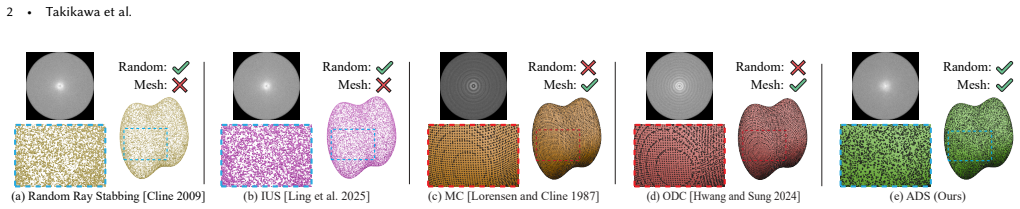
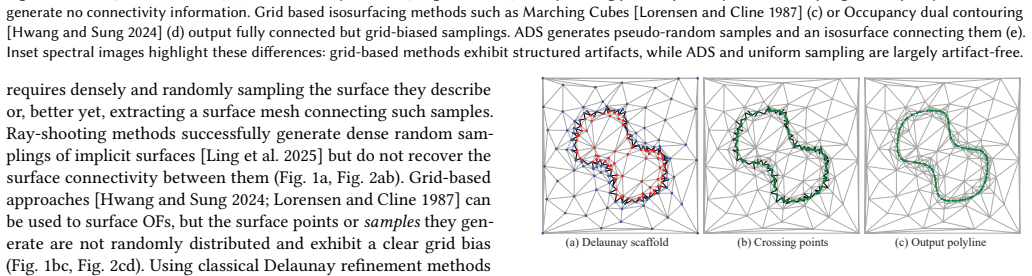
Adaptive Delaunay Sampling (ADS) uses a progressively computed Delaunay tetrahedralization as a scaffold that is refined by repeatedly identifying and subdividing crossing edges whose endpoints lie on opposite sides of the occupancy surface. The intersections of these fine crossing edges with the surface provide the pseudo-random samples, while marching tetrahedra applied to the tetrahedralization produces the isosurface mesh. Subsequent normal-based densification improves sampling near high-curvature features, all while requiring significantly fewer function evaluations than ray-shooting or grid-based alternatives.
What carries the argument
The Adaptive Delaunay Scaffolding, a Delaunay tetrahedralization that is iteratively refined at crossing edges to guide sampling toward the implicit surface and enable mesh extraction.
Load-bearing premise
Repeated refinement of crossing edges in the Delaunay tetrahedralization combined with normal-based densification produces sufficiently uniform and unbiased pseudo-random samples without systematic artifacts.
What would settle it
Measuring the area coverage and nearest-neighbor distances of ADS samples on a unit sphere and checking whether they match the statistics of true uniform random surface points within expected variance.
Figures



read the original abstract
Dense random sampling and surfacing of shapes encoded via implicit occupancy functions (OFs) are critical elements of many applications. Existing methods largely provide either one or the other of random sampling or mesh surfaces: ray shooting approaches deliver random samples with no connectivity, and grid-based methods deliver mesh surfaces but their sampling is highly biased. We propose a new method which delivers both pseudo-random OF surface samples and an isosurface mesh connecting them. Our method achieves these goals while requiring an order of magnitude fewer function evaluations than prior approaches. Key to our Adaptive Delaunay Sampling (ADS) approach is a progressively computed Delaunay tetrahedralization of points in 3D space, which we use as a sampling and surfacing scaffold. Starting from an initial coarse Delaunay scaffold, we repeatedly refine crossing edges, ones whose end vertices lie on opposite sides of the surface, augmenting the scaffold with points closer and closer to the surface. Each refinement step uses the Delaunay criterion to incorporate the newly added vertices into the scaffold, introducing new crossing edges. We use the intersections of fine crossing edges with the OF surface as the output samples, and use the marching tetrahedra method to surface these samples. We subsequently use normal estimation to densify the sampling near fine features and in areas of high surface curvature. We validate ADS by sampling 150 inputs at different resolutions, and provide extensive comparisons to existing alternatives. Our experiments demonstrate significant improvement in accuracy/function evaluation count trade-off, and showcase downstream applications.
Editorial analysis
A structured set of objections, weighed in public.
Referee Report
Summary. The manuscript introduces Adaptive Delaunay Sampling (ADS), which builds a progressively refined Delaunay tetrahedralization scaffold starting from a coarse set of points. Crossing edges (those with endpoints on opposite sides of the implicit occupancy surface) are repeatedly refined by adding points closer to the surface; intersections of the finest crossing edges with the occupancy function provide the output samples. Marching tetrahedra produces a mesh connecting the samples, and normal estimation is used to densify sampling near high-curvature features. The central claims are that ADS simultaneously delivers pseudo-random surface samples and a mesh while requiring an order of magnitude fewer occupancy evaluations than ray-shooting or grid baselines, supported by experiments on 150 inputs showing improved accuracy-versus-evaluation trade-offs and downstream applications.
Significance. If the efficiency and unbiased-sampling claims hold, ADS would constitute a meaningful advance for graphics pipelines that require both dense random sampling and explicit meshing of implicit surfaces. The scale of the empirical validation (150 inputs with direct accuracy-versus-evaluation comparisons) is a clear strength and provides a reproducible basis for assessing practical utility.
major comments (1)
- The validation experiments (described in the abstract and results) report accuracy-versus-evaluation comparisons and visual results across 150 inputs but supply no quantitative uniformity or bias metrics (e.g., star discrepancy, nearest-neighbor distance histograms, or direct comparison against ground-truth uniform samples on a sphere). This is load-bearing for the central claim because the pseudo-random guarantee and the asserted lack of systematic artifacts both rest on the untested assumption that repeated Delaunay edge refinement plus normal-based densification produces an unbiased distribution; without such a check the order-of-magnitude efficiency advantage cannot be fully separated from possible directional or curvature-induced bias.
Simulated Author's Rebuttal
We thank the referee for the constructive review and for recognizing the scale of our empirical validation. We address the single major comment below and will strengthen the manuscript accordingly.
read point-by-point responses
-
Referee: The validation experiments (described in the abstract and results) report accuracy-versus-evaluation comparisons and visual results across 150 inputs but supply no quantitative uniformity or bias metrics (e.g., star discrepancy, nearest-neighbor distance histograms, or direct comparison against ground-truth uniform samples on a sphere). This is load-bearing for the central claim because the pseudo-random guarantee and the asserted lack of systematic artifacts both rest on the untested assumption that repeated Delaunay edge refinement plus normal-based densification produces an unbiased distribution; without such a check the order-of-magnitude efficiency advantage cannot be fully separated from possible directional or curvature-induced bias.
Authors: We agree that quantitative uniformity metrics would provide stronger, more direct support for the pseudo-random sampling claim. Our current experiments emphasize practical accuracy-versus-evaluation trade-offs and visual inspection over 150 diverse inputs, which show no obvious directional or curvature-induced artifacts. Nevertheless, we acknowledge that explicit checks (star discrepancy, nearest-neighbor histograms, or comparison to ground-truth uniform samples on a sphere) are valuable to separate efficiency gains from any latent bias. In the revised version we will add these metrics on canonical shapes (including a unit sphere) and report the results alongside the existing comparisons. The Delaunay refinement criterion is intended to maintain a locally uniform scaffold, but we accept that this property requires quantitative verification rather than relying solely on design and visuals. revision: yes
Circularity Check
No circularity: algorithmic construction is self-contained
full rationale
The paper describes an algorithmic procedure (Delaunay tetrahedralization scaffold, repeated crossing-edge refinement, intersection sampling, marching tetrahedra, and normal-based densification) that is presented as a novel construction rather than a derivation from equations. No self-definitional steps, fitted parameters renamed as predictions, or load-bearing self-citations appear in the provided text. Claims of improved accuracy/evaluation trade-off rest on empirical comparisons to external baselines across 150 inputs, not on reductions to the method's own inputs by construction. The absence of any quoted equations or uniqueness theorems that collapse to tautology supports a score of 0.
Axiom & Free-Parameter Ledger
axioms (2)
- domain assumption Delaunay tetrahedralization maintains useful geometric properties when vertices are inserted along crossing edges
- standard math Marching tetrahedra produces a valid isosurface mesh from the refined samples
Reference graph
Works this paper leans on
-
[1]
InACM SIGGRAPH 2005 Papers
Varia- tional tetrahedral meshing. InACM SIGGRAPH 2005 Papers. 617–625. Nina Amenta and Marshall Bern
2005
-
[2]
Jules Bloomenthal
Fast winding numbers for soups and clouds.ACM Transactions on Graphics (TOG) 37, 4 (2018), 1–12. Jules Bloomenthal
2018
-
[3]
Jean-Daniel Boissonnat, Olivier Devillers, and Samuel Hornus
Polygonization of implicit surfaces.Computer Aided Geometric Design5, 4 (1988), 341–355. Jean-Daniel Boissonnat, Olivier Devillers, and Samuel Hornus
1988
-
[4]
Models67, 5 (2005), 405–451
Provably good sampling and meshing of surfaces.Graph. Models67, 5 (2005), 405–451. Adrian Bowyer
2005
-
[5]
Rook Bridson
Computing dirichlet tessellations.The computer journal24, 2 (1981), 162–166. Rook Bridson
1981
-
[6]
Fast Poisson disk sampling in arbitrary dimensions.SIGGRAPH sketches10, 1 (2007),
2007
-
[7]
ShapeNet: An Information-Rich 3D Model Repository
Shapenet: An information-rich 3d model repository.arXiv preprint arXiv:1512.03012(2015). Zhiqin Chen and Hao Zhang
work page internal anchor Pith review arXiv 2015
-
[8]
InProceedings of the IEEE/CVF conference on computer vision and pattern recognition
Learning implicit fields for generative shape modeling. InProceedings of the IEEE/CVF conference on computer vision and pattern recognition. 5939–5948. Erica Chiu. 2022.Uniform Sampling over Level Sets. Ph. D. Dissertation. Massachusetts Institute of Technology. David Cline, Stefan Jeschke, K White, Anshuman Razdan, and Peter Wonka
2022
-
[9]
Mark AZ Dippé and Erling Henry Wold
A survey on implicit surface polygonization.ACM Computing Surveys (CSUR)47, 4 (2015), 1–39. Mark AZ Dippé and Erling Henry Wold
2015
-
[10]
Sarah FF Gibson
An efficient method of triangulating equi-valued surfaces by using tetrahedral cells.IEICE TRANSACTIONS on Information and Systems74, 1 (1991), 214–224. Sarah FF Gibson
1991
-
[11]
Jisung Hwang and Minhyuk Sung
Sphere tracing: A geometric method for the antialiased ray tracing of implicit surfaces.The Visual Computer12, 10 (1996), 527–545. Jisung Hwang and Minhyuk Sung
1996
-
[12]
InSIG- GRAPH Asia 2024 Conference Papers
Occupancy-Based Dual Contouring. InSIG- GRAPH Asia 2024 Conference Papers. Tao Ju, Frank Losasso, Scott Schaefer, and Joe Warren
2024
-
[13]
Graph.21, 3 (July 2002), 339–346
Dual contouring of Hermite data.ACM Trans. Graph.21, 3 (July 2002), 339–346. Tao Ju and Tushar Udeshi
2002
-
[14]
InProceedings of the 2004 Eurograph- ics/ACM SIGGRAPH symposium on Geometry processing
Spectral surface reconstruction from noisy point clouds. InProceedings of the 2004 Eurograph- ics/ACM SIGGRAPH symposium on Geometry processing. 11–21. Florian Levet, Xavier Granier, and Christophe Schlick
2004
-
[15]
Selena Ling, Abhishek Madan, Nicholas Sharp, and Alec Jacobson
Marchingparticles: Fast generation of particles for the sampling of implicit surfaces.Computer graphics & geometry9, 1 (2007), 18–49. Selena Ling, Abhishek Madan, Nicholas Sharp, and Alec Jacobson
2007
-
[16]
InACM SIGGRAPH 2024 Conference Papers
Neural bounding. InACM SIGGRAPH 2024 Conference Papers. 1–10. William E Lorensen and Harvey E Cline
2024
-
[17]
Lars Mescheder, Michael Oechsle, Michael Niemeyer, Sebastian Nowozin, and Andreas Geiger
Interface area, edge length, and number of vertices in crystal aggregates with random nucleation.Philips Research Reports8 (1953), 270–290. Lars Mescheder, Michael Oechsle, Michael Niemeyer, Sebastian Nowozin, and Andreas Geiger
1953
-
[18]
Ashish Myles, Nico Pietroni, and Denis Zorin
Visualization of Implicit Surfaces Using Adaptive Tetrahedrizations.Scientific Visualization Conference (dagstuhl ’97)(1997), 243–243. Ashish Myles, Nico Pietroni, and Denis Zorin
1997
-
[19]
Graph.33, 4 (2014), 135–1
Robust field-aligned global parametrization.ACM Trans. Graph.33, 4 (2014), 135–1. Steve Oudot, Laurent Rineau, and Mariette Yvinec
2014
-
[20]
SIGGRAPH Conference Papers’26, July 19–23, 2026, Los Angeles, CA, USA
Spelunking the deep: Guaranteed queries on general neural implicit surfaces via range analysis.ACM Transactions on Graphics (TOG)41, 4 (2022), 1–16. SIGGRAPH Conference Papers’26, July 19–23, 2026, Los Angeles, CA, USA. ADS: Random Sampling of Occupancy Functions using Adaptive Delaunay Scaffolding•9 Gurprit Singh, Cengiz Öztireli, Abdalla G. M. Ahmed, Da...
2022
-
[21]
Christian Stippel, Felix Mujkanovic, Thomas Leimkühler, and Pedro Hermosilla
Analysis of Sample Correlations for Monte Carlo Rendering.Computer Graphics Forum38, 4 (2019), 101–116. Christian Stippel, Felix Mujkanovic, Thomas Leimkühler, and Pedro Hermosilla
2019
-
[22]
Towaki Takikawa, Andrew Glassner, and Morgan McGuire
Marching Neurons: Accurate Surface Extraction for Neural Implicit Shapes.ACM Transactions on Graphics (TOG)44, 6 (2025), 1–12. Towaki Takikawa, Andrew Glassner, and Morgan McGuire
2025
-
[23]
The CGAL Project
A dataset and explorer for 3D signed distance functions.Journal of Computer Graphics Techniques11, 2 (2022). The CGAL Project. 2026.CGAL User and Reference Manual(6.1.1 ed.). CGAL Editorial Board. https://doc.cgal.org/6.1.1/Manual/packages.html Anna-Karin Tornberg
2022
-
[24]
David F Watson
Multi-dimensional quadrature of singular and discontinu- ous functions.BIT Numerical Mathematics42, 3 (2002), 644–669. David F Watson
2002
-
[25]
Li-Yi Wei and Rui Wang
Computing the n-dimensional Delaunay tessellation with application to Voronoi polytopes.The computer journal24, 2 (1981), 167–172. Li-Yi Wei and Rui Wang
1981
-
[26]
ACM Transactions on Graphics (TOG)30, 4 (2011), 1–10
Differential domain analysis for non-uniform sampling. ACM Transactions on Graphics (TOG)30, 4 (2011), 1–10. Andrew P Witkin and Paul S Heckbert
2011
-
[27]
Yin Xu, Ligang Liu, Craig Gotsman, and Steven J Gortler
The blob tree.Journal of Implicit Surfaces3, 1 (1998). Yin Xu, Ligang Liu, Craig Gotsman, and Steven J Gortler
1998
-
[28]
Wang Yifan, Shihao Wu, Cengiz Oztireli, and Olga Sorkine-Hornung
Capacity-constrained Delaunay triangulation for point distributions.Computers & Graphics35, 3 (2011), 510–516. Wang Yifan, Shihao Wu, Cengiz Oztireli, and Olga Sorkine-Hornung
2011
-
[29]
42, 4, Article 92 (2023)
3DShape2VecSet: A 3D Shape Representation for Neural Fields and Generative Diffusion Models. 42, 4, Article 92 (2023). Congyi Zhang, Jinfan Yang, Eric Hedlin, Suzuran Takikawa, Nicholas Vining, Kwang Moo Yi, Wenping Wang, and Alla Sheffer
2023
-
[30]
SIGGRAPH Conference Papers’26, July 19–23, 2026, Los Angeles, CA, USA
NESI: Shape Represen- tation via Neural Explicit Surface Intersection.arXiv preprint arXiv:2409.06030 (2024). SIGGRAPH Conference Papers’26, July 19–23, 2026, Los Angeles, CA, USA. 10•Takikawa et al. Func. Evals: 5,816,403 CD: 0.919 × 10⁻³ Pts: 54,234 Time: 0.82s Func. Evals: 9,196,830 CD: 0.887 × 10⁻³ Pts: 79,366 Time: 1.90s Func. Evals: 10,866,469 CD: 0...
-
[31]
2025], marching cubes (MC) [Lorensen and Cline 1987], and occupancy dual contouring (ODC) [Hwang and Sung 2024]
Additional visual comparisons of our ADS method to uniform ray casting [Ling et al . 2025], marching cubes (MC) [Lorensen and Cline 1987], and occupancy dual contouring (ODC) [Hwang and Sung 2024]. We achieve higher accuracy and higher sample count with fewer occupancy function evaluations and less time. Contrary to [Ling et al. 2025], we generate both sa...
2025
-
[32]
Skateboard and motorcycle [Zhang et al
A gallery of our samplings and isosurface meshes using different sampling resolutions and input sources. Skateboard and motorcycle [Zhang et al. 2023], spiral, Sapphos, happy Buddha [Zhang et al. 2024], Lucy, dragon, vaselion [Barill et al. 2018]. SIGGRAPH Conference Papers’26, July 19–23, 2026, Los Angeles, CA, USA. ADS: Random Sampling of Occupancy Func...
2023
-
[33]
Box delineates the OF domain
When the input OF depicts very thin shapes, using our default method and default initial scaffold may fail to capture them even at fine mesh resolution (a,b); this can be mitigated by using a significantly higher number of refinement iterations (c) or a finer initial scaffold (d). Box delineates the OF domain. SIGGRAPH Conference Papers’26, July 19–23, 20...
2026
discussion (0)
Sign in with ORCID, Apple, or X to comment. Anyone can read and Pith papers without signing in.