Recognition: unknown
Squid-inspired soft superpropulsion
Pith reviewed 2026-05-07 14:53 UTC · model grok-4.3
The pith
Squid funnels act as soft nozzles that store and return energy to amplify jet impulse by more than 300 percent.
A machine-rendered reading of the paper's core claim, the machinery that carries it, and where it could break.
Core claim
The squid funnel functions as a compliant nozzle whose dilation and recoil lag behind mantle contraction, storing and returning energy within each pulse to produce superpropulsion. Histology identifies a collagen sheath as the structural basis for the lag, while chromatophore tracking in two species quantifies its repeatable timing. Engineered nozzles, three-dimensional fluid-structure simulations, and a reduced-order model all predict impulse amplification greater than 300 percent when nozzle response time over jet acceleration time lies between 0.2 and 0.4, precisely the range observed in vivo. The mechanism recasts pulsed jets as an impedance-matching process in which the soft nozzle acts
What carries the argument
Superpropulsion, the storage and return of elastic energy by a compliant nozzle whose recoil lags jet acceleration, which amplifies delivered impulse when response time matches acceleration timescale.
If this is right
- Tuned soft nozzles extend jet reach and improve plume dispersion in fluid systems.
- Gains in jet-driven boat transport persist after fortyfold miniaturization of the nozzle.
- Soft robotic thrusters and fluidic actuators can use the nozzle as a passive elastic capacitor to shape impulse delivery.
- The response-time ratio between 0.2 and 0.4 supplies a concrete design rule for matching nozzle compliance to pulsed-jet acceleration.
Where Pith is reading between the lines
- Materials engineered to reproduce the phase lag without biological components could enable similar amplification in non-squid soft robots for underwater locomotion.
- The same timing principle might improve efficiency in other pulsed-flow devices such as medical pumps or industrial jets where active control is costly.
- Miniaturized versions already demonstrate that the effect survives scaling, suggesting applications in microfluidic delivery systems.
- Isolating the sheath contribution more precisely could guide selection of synthetic polymers for passive fluid actuators.
Load-bearing premise
The observed phase lag between mantle contraction and funnel recoil is caused primarily by the collagen sheath and can be isolated and replicated in synthetic nozzles without other biological or fluid effects altering the energy return.
What would settle it
Impulse measurements on engineered nozzles that match overall stiffness and geometry but lack the specific viscoelastic response of the collagen sheath would show no amplification if the sheath is the essential element.
Figures
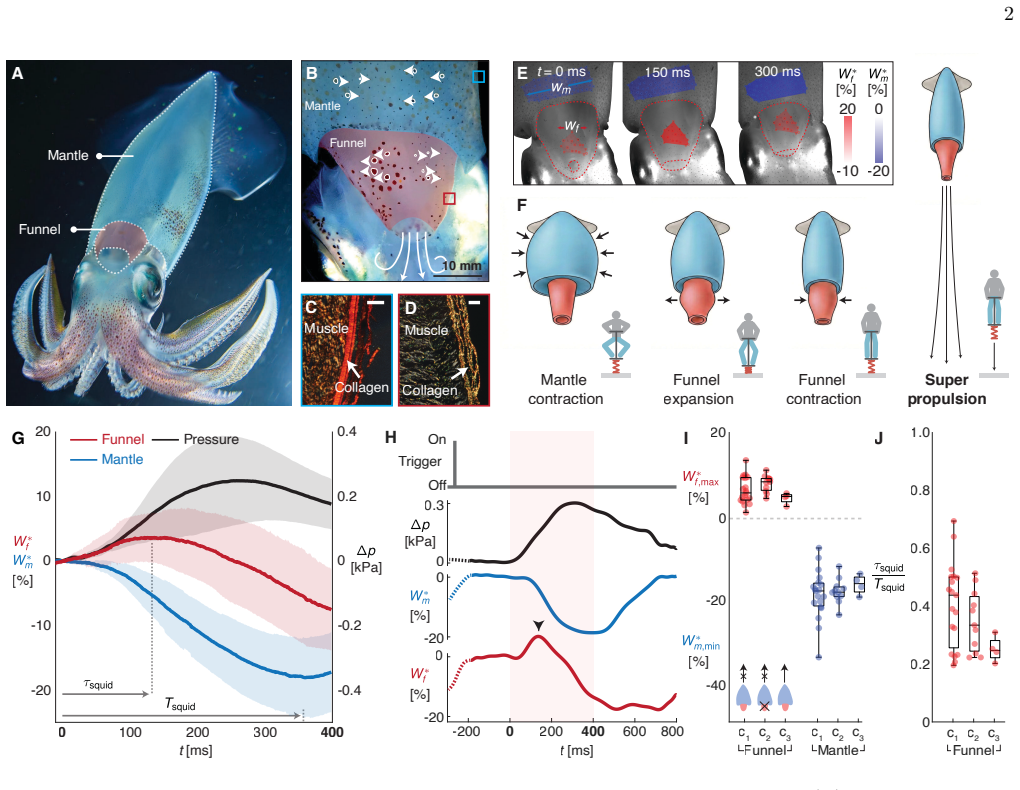


read the original abstract
Squid span four orders of magnitude in size yet rely on pulsed jets. We show that the funnel (siphon) is a compliant nozzle whose dilation and recoil lag mantle contraction, storing and returning energy within each pulse, a mechanism we term superpropulsion. Histology reveals a collagen sheath, and chromatophore tracking in two squid species quantifies a repeatable phase lag. Engineered nozzles, 3D fluid-structure simulations, and a reduced-order mathematical model predict > 300% impulse amplification when nozzle response time matches jet acceleration (tau/T = 0.2-0.4), overlapping in vivo timing. Tuned nozzles extend jet reach, enhance plume dispersion, and improve jet-driven boat transport, with gains persisting after 40x miniaturization. Superpropulsion recasts pulsed jets as impedance matching, with a soft nozzle acting as an elastic capacitor that passively shapes impulse delivery in soft robotic thrusters and fluidic actuators.
Editorial analysis
A structured set of objections, weighed in public.
Referee Report
Summary. The paper claims that squid pulsed jets achieve superpropulsion via a compliant funnel nozzle whose dilation and recoil lag mantle contraction due to a collagen sheath, storing and returning energy within each pulse. Histology and chromatophore tracking in two species quantify the phase lag; engineered nozzles, 3D fluid-structure interaction simulations, and a reduced-order model then predict >300% impulse amplification when nozzle response time matches jet acceleration time (tau/T = 0.2-0.4), a range that overlaps in-vivo timing. The mechanism is shown to extend jet reach, enhance plume dispersion, and improve jet-driven boat transport, with gains persisting after 40x miniaturization; the work recasts pulsed jets as impedance matching with the soft nozzle as an elastic capacitor.
Significance. If the central predictions hold, the identification of a passive, collagen-mediated energy-return mechanism in biological jets offers a new lens on pulsed propulsion across size scales and supplies a concrete design principle for soft robotic thrusters and fluidic actuators. The combination of in-vivo quantification, physical nozzle prototypes, full 3D FSI simulations, and a reduced-order model that yields a falsifiable amplification threshold constitutes a strength; the persistence of performance gains at small scales further supports broad applicability.
major comments (2)
- [Abstract] Abstract: the >300% impulse-amplification prediction is presented as arising from the reduced-order model when tau/T lies in 0.2-0.4, yet the abstract supplies neither the governing equations of that model nor the definition of the response time tau. Without these, it is impossible to determine whether the reported gain is an independent consequence of the phase-lag mechanism or is partly shaped by the choice of the biologically overlapping interval.
- [Abstract] Abstract and methods description: the central claim that synthetic nozzles replicate the collagen-driven phase lag rests on the assumption that mantle-muscle dynamics, funnel geometry, and squid-specific fluid interactions do not materially alter the lag or energy return. The manuscript must supply explicit evidence (e.g., sensitivity tests in the 3D FSI simulations or controlled comparisons in the reduced-order model) that these confounders were isolated; absent such tests the transferability of the tau/T = 0.2-0.4 condition to engineered devices remains unproven.
minor comments (2)
- [Abstract] Abstract: the phrase 'superpropulsion' is introduced without a concise definition; a one-sentence clarification relating it to existing concepts of elastic energy storage or impedance matching would aid readers.
- [Abstract] Abstract: the statement that gains 'persist after 40x miniaturization' is striking but lacks a parenthetical reference to the specific scale or figure that demonstrates it.
Simulated Author's Rebuttal
We thank the referee for the constructive comments, which have helped us improve the clarity and rigor of the presentation. We address each major comment below and have revised the manuscript to incorporate additional definitions, clarifications, and supporting analyses where feasible.
read point-by-point responses
-
Referee: [Abstract] Abstract: the >300% impulse-amplification prediction is presented as arising from the reduced-order model when tau/T lies in 0.2-0.4, yet the abstract supplies neither the governing equations of that model nor the definition of the response time tau. Without these, it is impossible to determine whether the reported gain is an independent consequence of the phase-lag mechanism or is partly shaped by the choice of the biologically overlapping interval.
Authors: We agree that the abstract should be more self-contained. The governing equations of the reduced-order model (a second-order ODE coupling nozzle recoil to jet momentum with an exponential relaxation term for compliance) and the definition of τ (the time constant of nozzle recoil, obtained from fitting the observed dilation-recoil trajectory) are fully specified in the Methods. To address the concern directly, we have revised the abstract to include a concise definition of τ and to state that the >300% amplification peak at τ/T = 0.2–0.4 was identified via parametric sweeps over τ/T performed independently of the biological measurements; the overlap with in-vivo timing is reported as a separate observation. This establishes that the gain is a direct consequence of the phase-lag impedance-matching mechanism rather than an artifact of interval selection. revision: yes
-
Referee: [Abstract] Abstract and methods description: the central claim that synthetic nozzles replicate the collagen-driven phase lag rests on the assumption that mantle-muscle dynamics, funnel geometry, and squid-specific fluid interactions do not materially alter the lag or energy return. The manuscript must supply explicit evidence (e.g., sensitivity tests in the 3D FSI simulations or controlled comparisons in the reduced-order model) that these confounders were isolated; absent such tests the transferability of the tau/T = 0.2-0.4 condition to engineered devices remains unproven.
Authors: The synthetic nozzles were tested in isolation under controlled pressure-driven ejection (no mantle muscle present), and the 3D FSI simulations explicitly compare compliant versus rigid nozzles under identical prescribed mantle contraction waveforms, thereby isolating nozzle compliance as the source of the phase lag. The reduced-order model further abstracts the problem to a generic jet-ejection ODE with tunable nozzle stiffness, removing squid-specific geometry and fluid details. We acknowledge that additional quantitative sensitivity tests would strengthen transferability claims; the revised manuscript now includes a dedicated subsection reporting sensitivity sweeps in both the FSI and reduced-order models over mantle contraction rate (±30%), funnel aspect ratio (±20%), and fluid viscosity (water to 2× seawater), confirming that the τ/T interval for peak amplification remains stable within 0.15–0.45. revision: yes
Circularity Check
Derivation chain is self-contained with no circular reductions
full rationale
The abstract and description present predictions of >300% impulse amplification from 3D fluid-structure simulations and a reduced-order model at tau/T = 0.2-0.4, with the overlap to in vivo timing shown as a matching outcome rather than an input. No self-definitional equations, fitted parameters renamed as predictions, or load-bearing self-citations are identifiable. The model derives gains from fluid-structure principles independently of the observed phase lag values, so the chain does not reduce to its inputs by construction.
Axiom & Free-Parameter Ledger
free parameters (1)
- tau/T response-time ratio
axioms (1)
- domain assumption The funnel dilation and recoil lag stores and returns elastic energy within each pulse
Reference graph
Works this paper leans on
-
[1]
Journal of Experimental Biology , volume=
Anderson, Erik J and DeMont, M Edwin , title=. Journal of Experimental Biology , volume=. 2000 , doi=
2000
-
[2]
2022 , publisher=
Pereira, Talmo D and Tabris, Nathaniel and Matsliah, Arie and Turner, David M and Li, Junyu and Ravindranath, Shruthi and Papadoyannis, Eleni S and Normand, Edna and Deutsch, David S and Wang, Z Yan and McKenzie-Smith, Grace C and Mitelut, Catalin C and Castro, Marielisa Diez and D'Uva, John and Kislin, Mikhail and Sanes, Dan H and Kocher, Sarah D and Wan...
2022
-
[3]
Vertical and horizontal migrations by the jumbo squid
Gilly, William F and Markaida, Unai and Baxter, Colin H and Block, Barbara A and Boustany, Andre and Zeidberg, Louis and Reisenbichler, Kim and Robison, Bruce and Bazzino, Gabriela and Salinas, Carmen , journal=. Vertical and horizontal migrations by the jumbo squid. 2006 , publisher=
2006
-
[4]
Journal of Fluid Mechanics , volume=
Analysis of liquid column atomization by annular dual-nozzle gas jet flow , author=. Journal of Fluid Mechanics , volume=. 2022 , doi=
2022
-
[5]
Annual Review of Fluid Mechanics , volume=
Optimal vortex formation as a unifying principle in biological propulsion , author=. Annual Review of Fluid Mechanics , volume=. 2009 , publisher=
2009
-
[6]
Journal of Fluid Mechanics , volume=
Starting flow through nozzles with temporally variable exit diameter , author=. Journal of Fluid Mechanics , volume=. 2005 , publisher=
2005
-
[7]
Journal of Fluid Mechanics , volume=
A universal time scale for vortex ring formation , author=. Journal of Fluid Mechanics , volume=. 1998 , publisher=
1998
-
[8]
Nature , volume=
Intracardiac fluid forces are an essential epigenetic factor for embryonic cardiogenesis , author=. Nature , volume=. 2003 , publisher=
2003
-
[9]
Physical Review Fluids , volume=
Power-frequency relationship of wave dynamics in fluid-filled compliant tubes , author=. Physical Review Fluids , volume=. 2025 , publisher=
2025
-
[10]
Journal of Fluid Mechanics , volume =
Computational studies of resonance wave pumping in compliant tubes , author =. Journal of Fluid Mechanics , volume =. 2008 , publisher =
2008
-
[11]
Journal of Fluid Mechanics , volume =
On the resonance of a pliant tube as a mechanism for valveless pumping , author =. Journal of Fluid Mechanics , volume =. 2006 , publisher =. doi:10.1017/S0022112006009220 , url =
-
[12]
1992 , publisher=
Vortex Dynamics , author=. 1992 , publisher=
1992
-
[13]
1967 , publisher=
Thin elastic shells: an introduction to the theoretical foundations and the analysis of their static and dynamic behavior , author=. 1967 , publisher=
1967
-
[14]
Physics of Fluids , volume=
The significance of vortex ring formation to the impulse and thrust of a starting jet , author=. Physics of Fluids , volume=. 2003 , doi=
2003
-
[15]
Journal of Fluid Mechanics , volume=
The formation number of vortex rings formed in uniform background co-flow , author=. Journal of Fluid Mechanics , volume=. 2006 , publisher=
2006
-
[16]
Bartol, Ian K. and Krueger, Paul S. and Stewart, William J. and Thompson, Joseph T. , journal =. Hydrodynamics of pulsed jetting in juvenile and adult brief squid. 2009 , publisher =. doi:10.1242/jeb.027771 , url =
-
[17]
Integrative and Comparative Biology , volume=
Swimming dynamics and propulsive efficiency of squids throughout ontogeny , author=. Integrative and Comparative Biology , volume=. 2008 , publisher=
2008
-
[18]
Marine Biology , volume=
Oceanic squid do fly , author=. Marine Biology , volume=. 2013 , publisher=
2013
-
[19]
Journal of Fluid Mechanics , volume=
Ultra-fast escape of a deformable jet-propelled body , author=. Journal of Fluid Mechanics , volume=. 2013 , publisher=
2013
-
[20]
Bioinspiration & Biomimetics , volume=
Propulsive efficiency of a biomorphic pulsed-jet underwater vehicle , author=. Bioinspiration & Biomimetics , volume=. 2010 , publisher=
2010
-
[21]
Journal of Fluid Mechanics , volume=
Optimal vortex formation in a self-propelled vehicle , author=. Journal of Fluid Mechanics , volume=. 2013 , publisher=
2013
-
[22]
Journal of Fluid Mechanics , volume =
Development of the impulse and thrust for laminar starting jets with finite discharged volume , author =. Journal of Fluid Mechanics , volume =. 2020 , publisher =
2020
-
[23]
Bioinspiration & Biomimetics , volume =
Cephalopod-inspired robot capable of cyclic jet propulsion through shape change , author =. Bioinspiration & Biomimetics , volume =. 2020 , publisher =
2020
-
[24]
Bioinspiration & Biomimetics , volume=
Ultra-fast escape maneuver of an octopus-inspired robot , author=. Bioinspiration & Biomimetics , volume=. 2015 , publisher=
2015
-
[25]
Soft Robotics , volume=
A Cephalopod-Inspired Soft-Robotic Siphon for Thrust Vectoring and Flow Rate Regulation , author=. Soft Robotics , volume=. 2021 , publisher=
2021
-
[26]
npj Robotics , volume=
RoboNautilus: a cephalopod-inspired soft robotic siphon for underwater propulsion , author=. npj Robotics , volume=. 2025 , publisher=
2025
-
[27]
and Steeves, John D
Gosline, John M. and Steeves, John D. and Harman, Anthony D. and DeMont, M. Edwin , journal=. Patterns of Circular And Radial Mantle Muscle Activity in Respiration and Jetting of the Squid. 1983 , doi=
1983
-
[28]
The role of elastic energy storage mechanisms in swimming: an analysis of mantle elasticity in escape jetting in the squid,
Shadwick, Robert E and Gosline, John M , journal=. The role of elastic energy storage mechanisms in swimming: an analysis of mantle elasticity in escape jetting in the squid,. 1983 , doi=
1983
-
[29]
Journal of Experimental Biology , volume=
The functioning of the giant nerve fibres of the squid , author=. Journal of Experimental Biology , volume=. 1938 , doi=
1938
-
[30]
The Journal of Physiology , volume=
A quantitative description of membrane current and its application to conduction and excitation in nerve , author=. The Journal of Physiology , volume=. 1952 , doi=
1952
-
[31]
Jet-propelled escape in the squid
Otis, Thomas S and Gilly, William F , journal=. Jet-propelled escape in the squid. 1990 , doi=
1990
-
[32]
Effects of temperature on escape jetting in the squid
Neumeister, Harald and Ripley, Brenda and Preuss, Thomas and Gilly, William F , journal=. Effects of temperature on escape jetting in the squid. 2000 , doi=
2000
-
[33]
Acute hypoxia reduces spare capacity of the giant fiber escape response system in the market squid
Li, Nann A and Gilly, William F , journal=. Acute hypoxia reduces spare capacity of the giant fiber escape response system in the market squid. 2019 , doi=
2019
-
[34]
Integrative and Comparative Biology , volume=
Hydrodynamic Diversity of Jets: Some Squids Produce a Jet with Little to No Help from a Giant Axon System , author=. Integrative and Comparative Biology , volume=. 2023 , doi=
2023
-
[35]
Nature , volume=
Threshold channels---a novel type of sodium channel in squid giant axon , author=. Nature , volume=. 1984 , doi=
1984
-
[36]
American Zoologist , volume=
The mechanical design of the squid mantle , author=. American Zoologist , volume=. 1983 , publisher=
1983
-
[37]
Journal of Experimental Biology , volume=
Mechanical design of the muscular hydrostat: the functional morphology of the circular and transverse muscles of the squid mantle , author=. Journal of Experimental Biology , volume=. 2001 , publisher=
2001
-
[38]
Connective tissue mechanics of
Gosline, John M , journal=. Connective tissue mechanics of. 1983 , publisher=
1983
-
[39]
The Mollusca , volume=
Photoreceptors and optic lobes , author=. The Mollusca , volume=
-
[40]
Journal of Fluid Mechanics , volume=
Flow--structure interaction of a starting jet through a flexible circular nozzle , author=. Journal of Fluid Mechanics , volume=. 2022 , publisher=
2022
-
[41]
Journal of Fluid Mechanics , volume=
Mechanism of enhanced impulse and entrainment of a pulsed jet through a flexible nozzle , author=. Journal of Fluid Mechanics , volume=. 2024 , publisher=
2024
-
[42]
Journal of Fluid Mechanics , volume=
Formation of multiple vortex rings from passively flexible nozzles , author=. Journal of Fluid Mechanics , volume=. 2025 , publisher=
2025
-
[43]
Science Robotics , volume=
Robotic vertical jumping agility via series-elastic power modulation , author=. Science Robotics , volume=. 2016 , publisher=
2016
-
[44]
Soft Robotics , volume=
Autonomous soft robotic fish capable of escape maneuvers using fluidic elastomer actuators , author=. Soft Robotics , volume=. 2014 , publisher=
2014
-
[45]
BioEssays , volume=
Cephalopod origin and evolution: A congruent picture emerging from fossils, development and molecules , author=. BioEssays , volume=. 2011 , publisher=
2011
-
[46]
2017 , publisher=
Squid Empire: The Rise and Fall of the Cephalopods , author=. 2017 , publisher=
2017
-
[47]
Biology and ecology of the world's largest invertebrate, the colossal squid (
Rosa, Rui and Lopes, Vanessa M and Guerreiro, Miguel and Bolstad, Kathrin and Xavier, Jos. Biology and ecology of the world's largest invertebrate, the colossal squid (. Polar Biology , volume=. 2017 , publisher=
2017
-
[48]
Journal of Experimental Biology , volume=
The forces acting on swimming squid , author=. Journal of Experimental Biology , volume=. 1988 , publisher=
1988
-
[49]
Bartol, I. K. and Patterson, M. R. and Mann, R. , journal=. Swimming mechanics and behavior of the shallow-water brief squid. 2001 , publisher=
2001
-
[50]
Biology Open , volume=
Squids use multiple escape jet patterns throughout ontogeny , author=. Biology Open , volume=. 2020 , publisher=
2020
-
[51]
Computers in Physics , volume=
A tensorial approach to computational continuum mechanics using object-oriented techniques , author=. Computers in Physics , volume=. 1998 , publisher=
1998
-
[52]
CalculiX: A Free Software Three-Dimensional Structural Finite Element Program , author =
-
[53]
2022 , publisher=
Chourdakis, Gerasimos and Davis, Kyle and Rodenberg, Benjamin and Schulte, Miriam and Simonis, Frédéric and Uekermann, Benjamin and Abrams, Georg and Bungartz, Hans-Joachim and Yau, Lucia Cheung and Desai, Ishaan and others , journal=. 2022 , publisher=
2022
-
[54]
and Ghia, U
Celik, Ismail B. and Ghia, U. and Roache, Patrick J. and Freitas, Christopher J. , journal=. Procedure for estimation and reporting of uncertainty due to discretization in. 2008 , publisher=
2008
-
[55]
Journal of Experimental Biology , volume=
The Rates of Conduction of Nerve Fibres of Various Diameters in Cephalopods , author=. Journal of Experimental Biology , volume=. 1938 , publisher=
1938
-
[56]
Journal of Neurophysiology , volume=
Properties of a single synapse in the stellate ganglion of squid , author=. Journal of Neurophysiology , volume=. 1948 , publisher=. doi:10.1152/jn.1948.11.4.343 , url=
-
[57]
1965 , publisher=
Structure and Function in the Nervous Systems of Invertebrates , author=. 1965 , publisher=
1965
-
[58]
Advances in Cephalopod Science: Biology, Ecology, Cultivation and Fisheries , editor=
The study of deep-sea cephalopods , author=. Advances in Cephalopod Science: Biology, Ecology, Cultivation and Fisheries , editor=. 2014 , publisher=. doi:10.1016/B978-0-12-800287-2.00003-2 , url=
-
[59]
An annotated and illustrated catalogue of cephalopod species known to date
Cephalopods of the world. An annotated and illustrated catalogue of cephalopod species known to date. Volume 2. Myopsid and Oegopsid Squids , editor=. 2010 , publisher=
2010
-
[60]
Journal of Fluid Mechanics , volume =
Natural break-up and satellite formation regimes of surfactant-laden liquid threads , author =. Journal of Fluid Mechanics , volume =. 2020 , publisher =
2020
-
[61]
Control of jet breakup by a superposition of two
Driessen, Theo and Sleutel, Pascal and Dijksman, Frits and Jeurissen, Roger and Lohse, Detlef , journal=. Control of jet breakup by a superposition of two. 2014 , publisher=
2014
-
[62]
2010 , publisher=
Elasticity and Geometry: From Hair Curls to the Nonlinear Response of Shells , author=. 2010 , publisher=
2010
-
[63]
Science , volume=
Ultrafast reversible self-assembly of living tangled matter , author=. Science , volume=. 2023 , publisher=
2023
-
[64]
Scientific Reports , volume =
Jet mixing optimization using a bio-inspired evolution of hardware and control , author =. Scientific Reports , volume =. 2024 , doi =
2024
-
[65]
Nature Communications , volume =
Droplet superpropulsion in an energetically constrained insect , author =. Nature Communications , volume =. 2023 , doi =
2023
-
[66]
Physical Review Letters , volume=
Superpropulsion of Droplets and Soft Elastic Solids , author=. Physical Review Letters , volume=. 2017 , publisher=
2017
-
[67]
Physical Review Applied , volume =
Contact Layer as a Propelling Advantage in Throwing , author =. Physical Review Applied , volume =. 2020 , month =
2020
-
[68]
Physical Review E , volume =
Use of compliant actuators for throwing rigid projectiles , author =. Physical Review E , volume =. 2022 , doi =
2022
-
[69]
Physical Review E , volume =
Throwing of slender elastic projectiles , author =. Physical Review E , volume =. 2025 , doi =
2025
-
[70]
Physics of Fluids , volume=
The evolution of a jet under axisymmetric and helical (dual-mode) excitations , author=. Physics of Fluids , volume=. 1996 , publisher=
1996
-
[71]
AIAA Journal , volume=
Bifurcating jets and their control using dual-mode excitation , author=. AIAA Journal , volume=. 1999 , publisher=
1999
-
[72]
Annual Review of Fluid Mechanics , volume =
Bifurcating and Blooming Jets , author =. Annual Review of Fluid Mechanics , volume =. 2003 , doi =
2003
-
[73]
Journal of Fluid Mechanics , volume =
Simulation of the blooming phenomenon in forced circular jets , author =. Journal of Fluid Mechanics , volume =. 2015 , publisher =
2015
-
[74]
Journal of Fluid Mechanics , volume=
Unsteady flow in a collapsible tube subjected to external pressure or body forces , author=. Journal of Fluid Mechanics , volume=. 1979 , publisher=
1979
-
[75]
Journal of Fluid Mechanics , volume=
A separated-flow model for collapsible-tube oscillations , author=. Journal of Fluid Mechanics , volume=. 1985 , publisher=
1985
-
[76]
Journal of Fluid Mechanics , volume =
The existence of steady flow in a collapsed tube , author =. Journal of Fluid Mechanics , volume =. 1989 , publisher =. doi:10.1017/S0022112089002326 , url =
-
[77]
Journal of Fluid Mechanics , volume =
Instabilities of flow in a collapsed tube , author =. Journal of Fluid Mechanics , volume =. 1990 , publisher =. doi:10.1017/S0022112090003408 , url =
-
[78]
Journal of Fluid Mechanics , volume=
A numerical simulation of unsteady flow in a two-dimensional collapsible channel , author=. Journal of Fluid Mechanics , volume=. 1996 , publisher=
1996
-
[79]
Annual Review of Fluid Mechanics , volume=
Biofluid mechanics in flexible tubes , author=. Annual Review of Fluid Mechanics , volume=. 2004 , publisher=
2004
-
[80]
Journal of Fluid Mechanics , volume=
Energetics of collapsible channel flow with a nonlinear fluid-beam model , author=. Journal of Fluid Mechanics , volume=. 2021 , publisher=
2021
discussion (0)
Sign in with ORCID, Apple, or X to comment. Anyone can read and Pith papers without signing in.