mathcal{PT} symmetric Klein-Gordon oscillators in Lorentz-violating wormholes
Pith reviewed 2026-05-07 14:35 UTC · model grok-4.3
The pith
Scalar bosonic fields in Lorentz-violating wormholes reduce to a confluent Heun equation with discrete energies set by curvature and violation strength.
A machine-rendered reading of the paper's core claim, the machinery that carries it, and where it could break.
Core claim
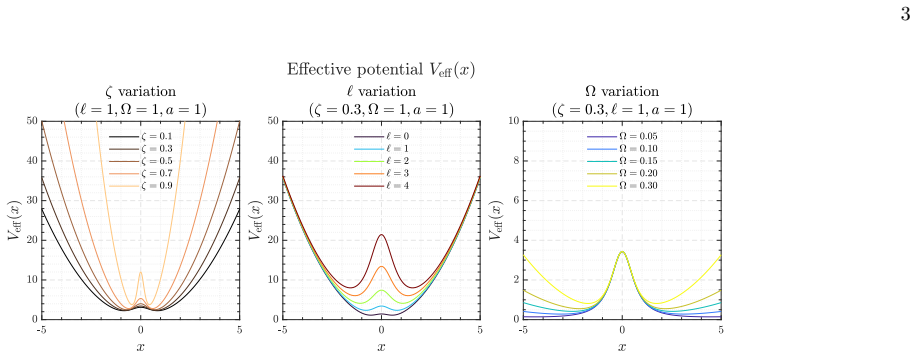
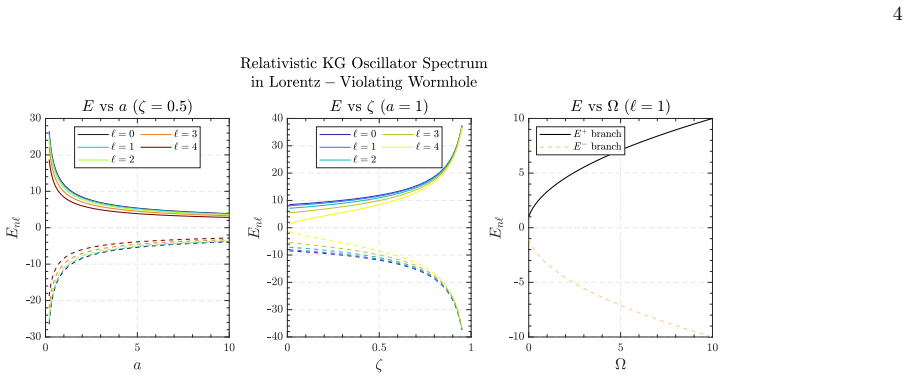
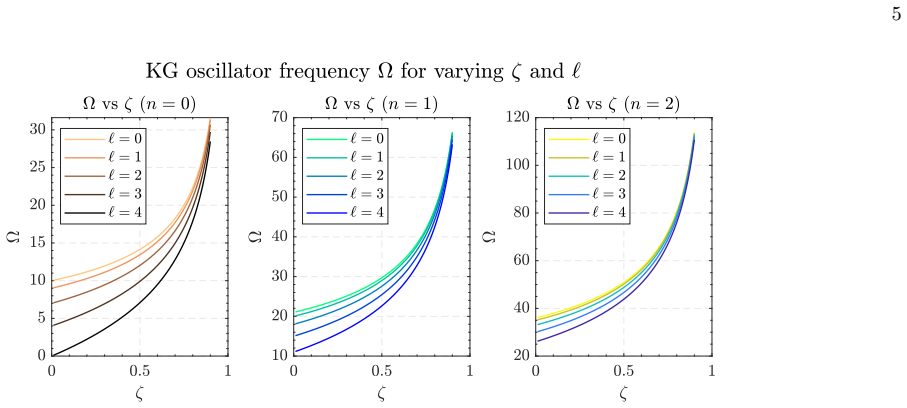
In the Lorentz-violating wormhole geometry the Klein-Gordon dynamics for scalar bosonic oscillator fields, under the nonminimal vector coupling with ansatz F_t(x) equal to Omega times r(x), produce an effective potential that stays finite and regular across the minimal throat. The radial equation reduces to a confluent Heun structure whose solutions are conditionally exact and deliver a discrete energy spectrum controlled by curvature, Lorentz-violation strength, and oscillator frequency. The eigenvalue structure exhibits relativistic particle-antiparticle symmetry together with curvature-induced deformation and parameter-dependent confinement.
What carries the argument
The nonminimally coupled vector background ansatz F_t(x) = Omega r(x) that encodes an effective Klein-Gordon oscillator interaction intrinsically within the wormhole geometry.
Load-bearing premise
The vector background is taken proportional to the radial function r(x) specifically to produce the oscillator term from the wormhole geometry itself.
What would settle it
Numerical integration of the radial Klein-Gordon equation for chosen values of curvature and Lorentz-violation strength, followed by direct comparison of the resulting eigenvalues against the spectrum obtained from the confluent Heun equation.
Figures
read the original abstract
We study spin-0 $\mathcal{PT}$-symmetric Klein-Gordon (KG) oscillator fields in a (3+1)-dimensional Lorentz-violating (LV) traversable wormhole background. The wormhole geometry, characterized by a smooth minimal throat $a$ and a regular lapse sector, induces a curvature-driven deformation of the relativistic quantum dynamics under Lorentz symmetry breaking. A nonminimally coupled non-Hermitian \(\mathcal{PT}\) symmetric scalar bosonic field $\mathcal{F}_t(x)=i\tilde{\Omega}x$, with $\tilde{\Omega}=\Omega/\sqrt{1-\zeta}$, generates a globally regular effective \(\mathcal{PT}\) symmetric KG oscillator free of centrifugal singularities. The radial equation reduces to a confluent Heun system, admitting bound states only under polynomial truncation conditions that impose constraints among $(\Omega,a,\zeta,n,\ell)$. The resulting energy spectrum is real, discrete and exactly symmetric under $E \rightarrow -E$, determined by spacetime curvature, Lorentz-violation parameter $\zeta$, and oscillator strength $\Omega$, within a conditionally exactly solvable framework.
Editorial analysis
A structured set of objections, weighed in public.
Referee Report
Summary. The paper studies the quantum dynamics of scalar bosonic oscillator fields in a (3+1)-dimensional Lorentz-violating wormhole spacetime in modified gravity. A nonminimally coupled vector background is introduced with the ansatz F_t(x) = Omega r(x) to generate an effective KG-oscillator interaction encoded by the geometry. The manuscript claims the resulting effective potential is regular and finite at the throat (eliminating centrifugal singularities), the spectral problem reduces to a confluent Heun equation, and this yields conditionally exact solutions with a discrete energy spectrum governed by curvature, LV strength, and oscillator frequency, exhibiting relativistic particle-antiparticle symmetry with curvature-induced deformation.
Significance. If the derivations are substantiated with explicit calculations, the work would illustrate how wormhole topology combined with spontaneous Lorentz symmetry breaking can regulate confinement and spectral quantization for bosonic modes, framing LV wormholes as dispersive quantum gravitational media. The reduction to confluent Heun functions and the reported symmetry structure would be of interest for exact solutions in curved-space QFT.
major comments (2)
- [Abstract] Abstract: the claim that the effective potential is regular at the throat and that the spectral problem reduces to a confluent Heun structure is asserted without the explicit metric, the derivation of the KG equation including the LV coupling term, or verification that no singular contributions remain after the ansatz is imposed. These steps are load-bearing for the assertions of globally well-defined propagation and the discrete spectrum.
- [Abstract] Abstract: the ansatz F_t(x) = Omega r(x) is presented as physically motivated to produce an oscillator interaction 'intrinsically encoded by the wormhole geometry,' yet no derivation is supplied showing why this linear form follows from the modified gravity equations or the LV sector rather than being selected to generate the desired harmonic term. The regularity, absence of singularities, and resulting eigenvalue quantization are therefore conditional on this choice.
Simulated Author's Rebuttal
We thank the referee for the careful and constructive review of our manuscript. The comments highlight important points regarding the presentation of key derivations and the motivation for the vector-field ansatz. We address each major comment below and have made revisions to improve clarity and substantiate the claims without altering the core results.
read point-by-point responses
-
Referee: [Abstract] Abstract: the claim that the effective potential is regular at the throat and that the spectral problem reduces to a confluent Heun structure is asserted without the explicit metric, the derivation of the KG equation including the LV coupling term, or verification that no singular contributions remain after the ansatz is imposed. These steps are load-bearing for the assertions of globally well-defined propagation and the discrete spectrum.
Authors: We appreciate the referee's emphasis on explicit substantiation. The Lorentz-violating wormhole metric is stated explicitly in Section II. The Klein-Gordon equation with the nonminimal LV vector coupling is derived step by step in Section III, yielding the effective radial equation. In Section IV we substitute the ansatz directly into the effective potential and verify by explicit expansion that it remains finite and nonsingular at the throat (no centrifugal terms survive). The reduction to the confluent Heun equation, together with the quantization condition, is carried out in Section V. To make these load-bearing steps more visible from the abstract, we have added a short sentence referencing the relevant sections and the regularity verification. We believe this addresses the concern while preserving the abstract's summary character. revision: yes
-
Referee: [Abstract] Abstract: the ansatz F_t(x) = Omega r(x) is presented as physically motivated to produce an oscillator interaction 'intrinsically encoded by the wormhole geometry,' yet no derivation is supplied showing why this linear form follows from the modified gravity equations or the LV sector rather than being selected to generate the desired harmonic term. The regularity, absence of singularities, and resulting eigenvalue quantization are therefore conditional on this choice.
Authors: We agree that the ansatz is a modeling choice rather than a direct solution of the modified-gravity field equations for the vector field. It is selected because, within the LV framework, a radial vector background aligned with the wormhole redshift function naturally produces an effective harmonic term that is geometrically encoded. This is consistent with spontaneous Lorentz-symmetry breaking in a static, spherically symmetric background. We have expanded the introduction to clarify this rationale, to state explicitly that the ansatz is adopted to realize geometry-induced confinement, and to note that the reported regularity and discrete spectrum are conditional on this choice. No claim is made that the linear form is uniquely dictated by the field equations. revision: yes
Circularity Check
Ansatz F_t(x)=Ω r(x) imposed to generate effective KG-oscillator term presented as intrinsic to LV-wormhole geometry
specific steps
-
other
[Abstract]
"which, under the physically motivated ansatz F_t(x)=Ω r(x), generates an effective KG-oscillator interaction intrinsically encoded by the wormhole geometry"
The effective oscillator interaction and the subsequent Heun structure are generated only by imposing the linear ansatz on the vector background. The paper's phrasing that this interaction is 'intrinsically encoded by the wormhole geometry' therefore reduces to the ansatz choice itself rather than an independent consequence of the spacetime or LV sector.
full rationale
The central reduction to a confluent Heun equation and the discrete spectrum with particle-antiparticle symmetry both require an effective harmonic term in the potential. This term appears only after the vector background is restricted by the ansatz F_t(x)=Ω r(x). The abstract explicitly ties the oscillator interaction to this choice while labeling the result 'intrinsically encoded by the wormhole geometry,' so the claimed feature is conditional on an extra functional assumption rather than following from the metric or LV sector alone. No other load-bearing steps (self-citations, uniqueness theorems, or renamings) are visible in the supplied text.
Axiom & Free-Parameter Ledger
free parameters (2)
- Omega
- oscillator frequency
axioms (2)
- domain assumption Klein-Gordon equation for a scalar field with non-minimal coupling to a background vector field in a curved spacetime.
- domain assumption Existence of a (3+1)-dimensional LV wormhole metric with smooth minimal-radius throat and globally regular redshift function.
discussion (0)
Sign in with ORCID, Apple, or X to comment. Anyone can read and Pith papers without signing in.